Skin preparing and role of antibiotics
Under the guidance of 
Dr. P.V. Buddha,(M.S) 
Dr. Venkat Reddy(M.S) 
Dr.Satyavani(M.S) 
Dr.Sailaja Rani(M.S) 
Dr.Satyanarayana(M.S)
Ignaz Semmelweis 
Puerperal fever transmission
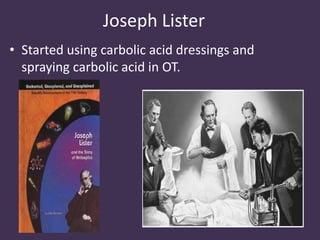
Joseph Lister 
• Started using carbolic acid dressings and 
spraying carbolic acid in OT.
In 1882 Trendelenburg constructed an apparatus 
for sterilization of surgical material and instruments 
with dry steam. In 1886 Bloodgood invented rubber 
gloves for protection of a surgeon's hands from 
infections. Since 1890 Holoted Y. and Isege (since 
1897) became to use gloves for protection of a wound 
from a surgeon's hands. 
Bergman E. and Shimelbus K. constructed a 
sterilizing machine for boiling the instruments; they 
created metallic drums for sterilization of clothes and 
dressing, perfected an autoclave.
Introduction to Sterile Technique 
• Proper aseptic techniques is one of the most fundamental 
and essential principles of infection control in the clinical and 
surgical setting 
• Aseptic Techniques are those which: 
– Remove/reduce or kill microorganisms from hands and objects 
– Employ sterile instruments 
– Reduce patient risk of exposure to microorganisms that cannot be 
removed
The measures to prevent an infection from entering a 
wound are referred to as asepsis, while those to cause the 
exclusion or destruction of harmful microbes are generally 
called antisepsis. 
The two principles represent the united whole in the 
prophylaxis of surgical infections. They have to be 
considered in terms of the interrelationship between the 
source of infection and its mode of transmission and the 
susceptibility of the body.
The major sources of endogenous infections 
incorporate chronic infections outside the area of the 
operation (e.g. skin diseases, dental or tonsillar 
conditions) or of the organs operated on as is (e.g. 
appendicitis, cholecystitis, osteomyelitis), as well as the 
oral, intestinal and respiratory saprophytes. 
Among the modes of transmission of endogenous 
infections are direct contact, lympho- and 
haematogenous spread.
Aseptic Technique 
• Immediately before and during surgical procedures 
to reduce post-operative infection: 
– Surgical Attire 
– Surgical scrub, sterile gowning & gloving 
– Patients surgical skin prep 
– Using surgical barriers (surgical drapes and PPE) 
– Using safe operative technique
Asepsis 
• Absence of microorganism that cause disease 
• Freedom from infection 
• Aspetic Technique = methods by which 
contamination with microorganisms is prevented
Principles of Aseptic Technique 
• Only sterile items are used within the sterile field 
• Sterile persons are gowned and gloved 
– Gowns are only sterile from waist to shoulder 
– Gloved hand must be kept in sight at all times 
• Only the top of a draped table is considered sterile 
• Sterile persons touch only sterile items or areas
• Unsterile persons avoid reaching over the sterile field 
• The edges of anything that encloses sterile contents 
are considered unsterile 
• Sterile field is created as close as possible to the time 
of use 
• Sterile areas are continuously kept in view
• Sterile persons keep well within the sterile area 
• Sterile persons keep contact with sterile areas to a 
minimum 
• Unsterile persons avoid sterile areas 
• Destruction of the integrity of microbial barriers 
results in contamination
The Surgical Hand Antisepsis 
• Process of removing as many microorganisms as 
possible from the hands and arms by mechanical 
washing and chemical antisepsis before participating 
in a surgical procedure 
– Despite the mechanical action and the chemical 
antimicrobial component of the scrub process, skin is 
never sterile
Surgical Hand Antisepsis 
• 4 factors affecting the effectiveness of surgical hand 
antisepsis: 
– The preparation before cleansing 
– The choice of antiseptic solution 
– The cleansing method 
– The duration for hand cleansing
Choice of Antiseptic Solution 
• Antimicrobial soaps, aqueous scrubs (ex. biguanides), 
alcohol rubs used as antiseptic solutions+ 
• Alcoholic chlorhexidine was found to have greater 
residual antimicrobial activity 
– Review by Tanner et al, reported that biguanides (ex 
Chlorohexidine gluconate are more effective in removing 
microorganism on hands than Iodophors (ex. Providone iodine)
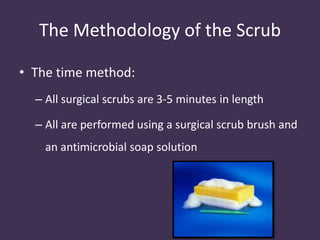
The Methodology of the Scrub 
• The time method: 
– All surgical scrubs are 3-5 minutes in length 
– All are performed using a surgical scrub brush and 
an antimicrobial soap solution
Preparation Before Surgical Scrub 
• Removal of finger rings/jewelry, nail polish and artificial 
nails 
– Finger rings and jewelry can harbor microorganism and 
dead skin 
– Dark nail polish obscures the subungual space and 
likelihood of careful cleansing is reduced 
– Artifical nail ↑ the microbial load on hands
Preparation Before Surgical Scrub 
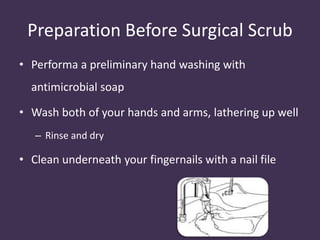
• Performa a preliminary hand washing with 
antimicrobial soap 
• Wash both of your hands and arms, lathering up well 
– Rinse and dry 
• Clean underneath your fingernails with a nail file
Surgical Scrub Procedure 
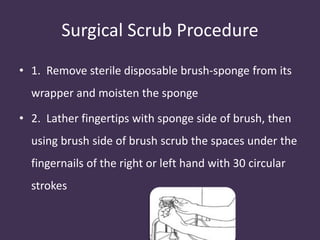
• 1. Remove sterile disposable brush-sponge from its 
wrapper and moisten the sponge 
• 2. Lather fingertips with sponge side of brush, then 
using brush side of brush scrub the spaces under the 
fingernails of the right or left hand with 30 circular 
strokes
Surgical Scrub Procedure 
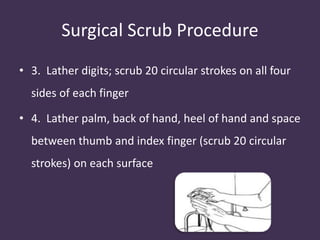
• 3. Lather digits; scrub 20 circular strokes on all four 
sides of each finger 
• 4. Lather palm, back of hand, heel of hand and space 
between thumb and index finger (scrub 20 circular 
strokes) on each surface
Surgical Scrub Procedure 
• 5. Forearm scrub – divide the forearm into 3 
inch increments (the brush is 3 inches 
lengthwise) 
– Use the sponge side of the brush lengthwise to 
apply soap around the wrist 
– Scrub 20 circular strokes on all four sides of wrist 
– Then move up the forearm – lather, then scrub 
ending 2 inches above the elbow
Surgical Scrub Procedure 
• 6. Repeat the previous steps for the other 
arm 
• 7. Discard the brush 
• 8. Rinse hands and arms without retracing or 
contaminating; allow the water to drip from 
the elbows
Surgical Scrub Procedure 
• 8. After final rinse, turn water off and keep scrubbed 
hands and arms in view to avoid contamination and 
back into operating room 
• 9. In the operating room, dry hands and arms with a 
sterile towel before donning a sterile surgical gown 
and gloves
Drying the Hands 
• Step 1: Reach down to the opened sterile 
package containing the gown, and pick up the 
towel 
– Be careful not to drip water onto the pack 
• Step 2: Open the towel full-length, holding one 
end away from the non-sterile scrub attire 
– Bend slightly forward
Drying the Hands 
• Step 3: Dry both hands thoroughly but independently 
– To dry one arm, hold the towel in the opposite hand and, 
using the oscillating motion of the arm, draw the towel up 
to the elbow 
• Step 4: Carefully reverse the towel, still holding it away 
from the body 
– Dry the opposite arm on the unused end of the towel
Gowning Technique 
– The gown is pulled on, leaving the cuffs of the sleeves 
extended over the hands 
– The back of the gown is securely tied or fastened at 
the neck and waist, touch the outside of the gown at 
the line of ties or fasteners in the back only
Gowning Technique 
• Summary Principles: 
– Touch only the inside of the gown while donning it 
– If touch the outside, the gown is considered contaminated 
– Scrubbed hands and arms are considered contaminated if they 
fall below the waist level or touch the body 
– After donning the gown, the only parts of the gown that are 
considered sterile are the sleeves and front from waist level to a 
few inches below neck opening
Gloving by the Closed Glove Technique 
• Preferred method over open-gloving technique 
• Provides a bacterial barrier between patient and 
surgeon 
• Step1: Using the right hand and keeping it within the 
cuff of the sleeve, pick up the left glove from the 
inner wrap of the glove package by grasping the 
folded cuff
Gloving by the Closed Glove Technique 
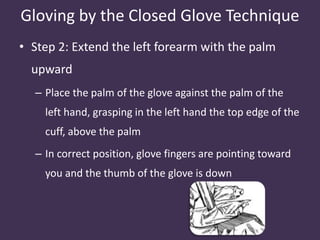
• Step 2: Extend the left forearm with the palm 
upward 
– Place the palm of the glove against the palm of the 
left hand, grasping in the left hand the top edge of the 
cuff, above the palm 
– In correct position, glove fingers are pointing toward 
you and the thumb of the glove is down
Gloving by the Closed Glove Technique 
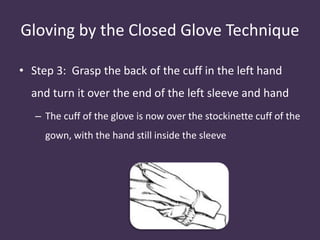
• Step 3: Grasp the back of the cuff in the left hand 
and turn it over the end of the left sleeve and hand 
– The cuff of the glove is now over the stockinette cuff of the 
gown, with the hand still inside the sleeve
Gloving by the Closed Glove Technique 
• Step 4: Grasp the top of the left glove and underlying 
gown sleeve with the covered right hand 
– Pull the glove on over the extended right fingers until it 
completely covers the stockinette cuff 
• Step 5: Glove the right hand in the same manner 
– Use the gloved left hand to pull on the right glove
• Proper aseptic technique is one of the most 
fundamental and essential principles of 
infection control 
• This stepwise process of proper aspetic 
technique should be performed every single 
time in the OR
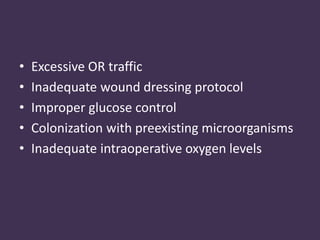
Modifiable Risk Factors 
• Skin or site preparation ineffective 
– Removal of hair with clipper than razors 
• Colorectal procedures 
– Inadequate bowel prep/antibiotics 
– Improper intraoperative temperature regulation 
• Antimicrobial prophylaxis 
– Inappropriate choice (procedure specific) 
– Improper timing (pre-incision dose) 
– Inadequate dose based on body mass index, procedures 
>3h, or increased blood loss
• Excessive OR traffic 
• Inadequate wound dressing protocol 
• Improper glucose control 
• Colonization with preexisting microorganisms 
• Inadequate intraoperative oxygen levels
Prevention Strategies 
Administer antimicrobial prophylaxis in accordance 
with evidence based standards and guidelines 
– Administer within 1 hour prior to incision* 
• 2hr for vancomycin and fluoroquinolones 
– Select appropriate agents on basis of 
• Surgical procedure 
• Most common SSI pathogens for the procedure 
• Published recommendations
• Remote infections-whenever possible: 
– Identify and treat before elective operation 
– Postpone operation until infection has resolved 
• Do not remove hair at the operative site unless it 
will interfere with the operation; do not use razors 
– If necessary, remove by clipping or by use of a 
depilatory agent 
• Operating Room (OR) Traffic 
– Keep OR doors closed during surgery except as 
needed for passage of equipment, personnel, and 
the patient
• Redose antibiotic at the 3 hr interval in procedures with 
duration >3hrs (* See exceptions to this recommendation in*Engelman 
R, et al. The Society of Thoracic Surgeons Practice Guideline 
Series:Antibiotic Prophylaxis in Cardica Surgery, Part II:Antibiotic Choice. 
Ann Thor Surg 2007;83:1569-76) 
• Adjust antimicrobial prophylaxis dose for obese patients (body mass 
index >30)*Anderson DJ, Kaye KS, Classen D, et al. Strategies to prevent 
surgical site infections in acute care hospitals. Infect Control Hosp 
Epidemiol 2008;29 (Suppl 1):S51-S61 
• Use atleast 50% of inspired oxygen intraoperatively and immediately 
postoperatively in select procedure()*Maragakis LL, Cosgrove SE, 
Martinez EA, et al. Intraoperative fraction of inspired oxygen is a 
modifiable risk factor for surgical site infection after spinal surgery. 
Anesthesiology 2009;110:556-562.
• Aqueous-based iodophors, such as povidone-iodine, contain 
iodine complexed with a solubilizing agent, allowing for the 
release of free iodine when in a solution. Iodine acts in an 
antiseptic manner by destroying microbial proteins and DNA. 
Iodophor-containing products enjoy widespread use because 
of their broad-spectrum antimicrobial properties, efficacy, and 
safety on nearly all skin surfaces regardless of the patient’s 
age. 
• Alcohol-based solutions are quick, sustained, and durable, 
with broader spectrum antimicrobial activity. These agents 
seem ideal for longer open surgeries with the potential for 
irrigation or surgical spillage.
• Ethyl and isopropyl alcohol are 2 of the most effective 
antiseptic agents available. When used alone, alcohol is fast 
and short acting, has broad-spectrum antimicrobial activity, 
and is relatively inexpensive. Flammability can be avoided by 
allowing skin to completely dry and by avoiding preparation of 
areas with excessive body hair that can delay alcohol 
vaporization. 
• Recent studies suggest that alcohol-based solutions may have 
greater efficacy, easier application, improved durability, and a 
superior cost profile when compared with traditional 
aqueous-based solutions.
• DuraPrep solution, an antiseptic skin solution that contains 
iodine povacrylex in isopropyl alcohol, shows durability in the 
surgical/procedural environment and enhances adhesion 
between surgical drapes and the prepared skin surface, 
theoretically limiting the spread of organisms onto the 
surgical field.
• Effects of Preoperative Skin Preparation on 
Postoperative Wound Infection Rates: A 
Prospective Study of 3 Skin Preparation 
Protocols. 
• Authors swenson etal 
• In 2009 
• OBJECTIVE 
To compare the effects of different skin 
preparation solutions on surgical-site infection 
rates.
DESIGN 
Three skin preparations were compared by means of a sequential 
implementation design. 
Period 1 used a povidone-iodine scrub-paint combination (Betadine) 
with an isopropyl alcohol application between these steps. 
Period 2 used 2% chlorhexidine and 70% isopropyl alcohol 
(ChloraPrep). 
Period 3 used iodine povacrylex in isopropyl alcohol (DuraPrep). 
Surgical-site infections were tracked for 30 days .
CONCLUSIONS 
• Skin preparation solution is an important 
factor in the prevention of surgical-site 
infections. Iodophor-based compounds may 
be superior to chlorhexidine for this purpose 
in general surgery patients.
• Perioperative antibiotic prophylaxis: improved 
compliance and impact on infection rates 
• By E. PROSPERO, P. BARBADORO, A. 
MARIGLIANO, E. MARTINI and M. M. D'ERRICO 
• In Cambridge journals in 2010
• Aim- of this study were to determine 
adherence to the perioperative antibiotic 
prophylaxis (PAP) protocol used at a large 
Italian teaching hospital during a 6-year 
period, to assess the variables associated with 
inappropriate administration, and to measure 
the impact on surgical site infection (SSI) rates 
• Results - 28 621 patients surveyed of which 
74·6% received PAP. An improvement in 
adherence to the PAP protocol was registered 
for 58·8% of patients. 
• During the study period, a significant 
reduction in SSIs rates was detected
• Conclusion - global reduction of inadequate 
PAP administration signifies the efficacy of a 
multidisciplinary quality improvement 
initiative on antimicrobial utilization, and this 
is supported by the observed reduction of the 
SSI rate.
• Timing of Surgical Antibiotic Prophylaxis and 
the Risk of Surgical Site Infection 
• By Mary T. Hawn, MD, MPH etal 
• In JAMA Surg. 2013 
• Objective - To determine whether 
prophylactic antibiotic timing is associated 
with SSI occurrence 
• Design - Retrospective cohort study
• Results 
• Of the 32 459 operations, prophylactic 
antibiotics were administered at a median of 
28 minutes (interquartile range, 17-39 
minutes) prior to surgical incision, and 1497 
cases (4.6%) developed an SSI 
• Compared with procedures with antibiotic 
administration within 60 minutes prior to 
incision, higher SSI rates were observed for 
timing more than 60 minutes prior to incision
• Conclusions and Relevance - The SSI risk 
varies by patient and procedure factors as well 
as antibiotic properties but is not significantly 
associated with prophylactic antibiotic timing. 
While adherence to the timely prophylactic 
antibiotic measure is not bad care, there is 
little evidence to suggest that it is better care.
• A systematic review of the ASEPSIS scoring 
system used in non-cardiac-related surgery 
• By C J Shia et al 
• In Journal of wound care in Aug 2013
• Objective: To assess the validity, reliability and 
sensitivity of the ASEPSIS scoring system, used to 
assess non-cardiac related surgery for surgical 
wound infection. 
• Method: Five studies were included in this 
review. One study discussed the development of 
the ASEPSIS scoring system; two studies were on 
its reliability, one study on the sensitivity and the 
final compared the ASEPSIS scoring system 
against other surgical wound infection criteria 
and definitions. Due to variation in study designs, 
the findings were summarised and presented in a 
narrative format.
• Results: Validity and reliability were not 
established in assessing non-cardiac surgical 
sites. Sensitivity level was reported for non-cardiac 
surgical sites, but its reliability level 
declined as the severity of infection worsened. 
• Conclusion: This review revealed that there 
are limited choices of scoring systems to 
assess different surgical sites for surgical 
wound infection. Currently, only the ASEPSIS 
scoring system is available, but it is not 
validated for use with sternal wounds. 
Therefore, it should be used cautiously when 
assessing non-cardiac surgical wound 
infection.
Asepsis and antisepsis

Asepsis and antisepsis

  • 1.
    Skin preparing androle of antibiotics
  • 2.
    Under the guidanceof Dr. P.V. Buddha,(M.S) Dr. Venkat Reddy(M.S) Dr.Satyavani(M.S) Dr.Sailaja Rani(M.S) Dr.Satyanarayana(M.S)
  • 3.
    Ignaz Semmelweis Puerperalfever transmission
  • 4.
    Joseph Lister •Started using carbolic acid dressings and spraying carbolic acid in OT.
  • 5.
    In 1882 Trendelenburgconstructed an apparatus for sterilization of surgical material and instruments with dry steam. In 1886 Bloodgood invented rubber gloves for protection of a surgeon's hands from infections. Since 1890 Holoted Y. and Isege (since 1897) became to use gloves for protection of a wound from a surgeon's hands. Bergman E. and Shimelbus K. constructed a sterilizing machine for boiling the instruments; they created metallic drums for sterilization of clothes and dressing, perfected an autoclave.
  • 6.
    Introduction to SterileTechnique • Proper aseptic techniques is one of the most fundamental and essential principles of infection control in the clinical and surgical setting • Aseptic Techniques are those which: – Remove/reduce or kill microorganisms from hands and objects – Employ sterile instruments – Reduce patient risk of exposure to microorganisms that cannot be removed
  • 7.
    The measures toprevent an infection from entering a wound are referred to as asepsis, while those to cause the exclusion or destruction of harmful microbes are generally called antisepsis. The two principles represent the united whole in the prophylaxis of surgical infections. They have to be considered in terms of the interrelationship between the source of infection and its mode of transmission and the susceptibility of the body.
  • 8.
    The major sourcesof endogenous infections incorporate chronic infections outside the area of the operation (e.g. skin diseases, dental or tonsillar conditions) or of the organs operated on as is (e.g. appendicitis, cholecystitis, osteomyelitis), as well as the oral, intestinal and respiratory saprophytes. Among the modes of transmission of endogenous infections are direct contact, lympho- and haematogenous spread.
  • 9.
    Aseptic Technique •Immediately before and during surgical procedures to reduce post-operative infection: – Surgical Attire – Surgical scrub, sterile gowning & gloving – Patients surgical skin prep – Using surgical barriers (surgical drapes and PPE) – Using safe operative technique
  • 10.
    Asepsis • Absenceof microorganism that cause disease • Freedom from infection • Aspetic Technique = methods by which contamination with microorganisms is prevented
  • 11.
    Principles of AsepticTechnique • Only sterile items are used within the sterile field • Sterile persons are gowned and gloved – Gowns are only sterile from waist to shoulder – Gloved hand must be kept in sight at all times • Only the top of a draped table is considered sterile • Sterile persons touch only sterile items or areas
  • 12.
    • Unsterile personsavoid reaching over the sterile field • The edges of anything that encloses sterile contents are considered unsterile • Sterile field is created as close as possible to the time of use • Sterile areas are continuously kept in view
  • 13.
    • Sterile personskeep well within the sterile area • Sterile persons keep contact with sterile areas to a minimum • Unsterile persons avoid sterile areas • Destruction of the integrity of microbial barriers results in contamination
  • 14.
    The Surgical HandAntisepsis • Process of removing as many microorganisms as possible from the hands and arms by mechanical washing and chemical antisepsis before participating in a surgical procedure – Despite the mechanical action and the chemical antimicrobial component of the scrub process, skin is never sterile
  • 15.
    Surgical Hand Antisepsis • 4 factors affecting the effectiveness of surgical hand antisepsis: – The preparation before cleansing – The choice of antiseptic solution – The cleansing method – The duration for hand cleansing
  • 16.
    Choice of AntisepticSolution • Antimicrobial soaps, aqueous scrubs (ex. biguanides), alcohol rubs used as antiseptic solutions+ • Alcoholic chlorhexidine was found to have greater residual antimicrobial activity – Review by Tanner et al, reported that biguanides (ex Chlorohexidine gluconate are more effective in removing microorganism on hands than Iodophors (ex. Providone iodine)
  • 17.
    The Methodology ofthe Scrub • The time method: – All surgical scrubs are 3-5 minutes in length – All are performed using a surgical scrub brush and an antimicrobial soap solution
  • 18.
    Preparation Before SurgicalScrub • Removal of finger rings/jewelry, nail polish and artificial nails – Finger rings and jewelry can harbor microorganism and dead skin – Dark nail polish obscures the subungual space and likelihood of careful cleansing is reduced – Artifical nail ↑ the microbial load on hands
  • 19.
    Preparation Before SurgicalScrub • Performa a preliminary hand washing with antimicrobial soap • Wash both of your hands and arms, lathering up well – Rinse and dry • Clean underneath your fingernails with a nail file
  • 20.
    Surgical Scrub Procedure • 1. Remove sterile disposable brush-sponge from its wrapper and moisten the sponge • 2. Lather fingertips with sponge side of brush, then using brush side of brush scrub the spaces under the fingernails of the right or left hand with 30 circular strokes
  • 21.
    Surgical Scrub Procedure • 3. Lather digits; scrub 20 circular strokes on all four sides of each finger • 4. Lather palm, back of hand, heel of hand and space between thumb and index finger (scrub 20 circular strokes) on each surface
  • 22.
    Surgical Scrub Procedure • 5. Forearm scrub – divide the forearm into 3 inch increments (the brush is 3 inches lengthwise) – Use the sponge side of the brush lengthwise to apply soap around the wrist – Scrub 20 circular strokes on all four sides of wrist – Then move up the forearm – lather, then scrub ending 2 inches above the elbow
  • 23.
    Surgical Scrub Procedure • 6. Repeat the previous steps for the other arm • 7. Discard the brush • 8. Rinse hands and arms without retracing or contaminating; allow the water to drip from the elbows
  • 24.
    Surgical Scrub Procedure • 8. After final rinse, turn water off and keep scrubbed hands and arms in view to avoid contamination and back into operating room • 9. In the operating room, dry hands and arms with a sterile towel before donning a sterile surgical gown and gloves
  • 25.
    Drying the Hands • Step 1: Reach down to the opened sterile package containing the gown, and pick up the towel – Be careful not to drip water onto the pack • Step 2: Open the towel full-length, holding one end away from the non-sterile scrub attire – Bend slightly forward
  • 26.
    Drying the Hands • Step 3: Dry both hands thoroughly but independently – To dry one arm, hold the towel in the opposite hand and, using the oscillating motion of the arm, draw the towel up to the elbow • Step 4: Carefully reverse the towel, still holding it away from the body – Dry the opposite arm on the unused end of the towel
  • 27.
    Gowning Technique –The gown is pulled on, leaving the cuffs of the sleeves extended over the hands – The back of the gown is securely tied or fastened at the neck and waist, touch the outside of the gown at the line of ties or fasteners in the back only
  • 28.
    Gowning Technique •Summary Principles: – Touch only the inside of the gown while donning it – If touch the outside, the gown is considered contaminated – Scrubbed hands and arms are considered contaminated if they fall below the waist level or touch the body – After donning the gown, the only parts of the gown that are considered sterile are the sleeves and front from waist level to a few inches below neck opening
  • 29.
    Gloving by theClosed Glove Technique • Preferred method over open-gloving technique • Provides a bacterial barrier between patient and surgeon • Step1: Using the right hand and keeping it within the cuff of the sleeve, pick up the left glove from the inner wrap of the glove package by grasping the folded cuff
  • 30.
    Gloving by theClosed Glove Technique • Step 2: Extend the left forearm with the palm upward – Place the palm of the glove against the palm of the left hand, grasping in the left hand the top edge of the cuff, above the palm – In correct position, glove fingers are pointing toward you and the thumb of the glove is down
  • 31.
    Gloving by theClosed Glove Technique • Step 3: Grasp the back of the cuff in the left hand and turn it over the end of the left sleeve and hand – The cuff of the glove is now over the stockinette cuff of the gown, with the hand still inside the sleeve
  • 32.
    Gloving by theClosed Glove Technique • Step 4: Grasp the top of the left glove and underlying gown sleeve with the covered right hand – Pull the glove on over the extended right fingers until it completely covers the stockinette cuff • Step 5: Glove the right hand in the same manner – Use the gloved left hand to pull on the right glove
  • 34.
    • Proper aseptictechnique is one of the most fundamental and essential principles of infection control • This stepwise process of proper aspetic technique should be performed every single time in the OR
  • 35.
    Modifiable Risk Factors • Skin or site preparation ineffective – Removal of hair with clipper than razors • Colorectal procedures – Inadequate bowel prep/antibiotics – Improper intraoperative temperature regulation • Antimicrobial prophylaxis – Inappropriate choice (procedure specific) – Improper timing (pre-incision dose) – Inadequate dose based on body mass index, procedures >3h, or increased blood loss
  • 36.
    • Excessive ORtraffic • Inadequate wound dressing protocol • Improper glucose control • Colonization with preexisting microorganisms • Inadequate intraoperative oxygen levels
  • 37.
    Prevention Strategies Administerantimicrobial prophylaxis in accordance with evidence based standards and guidelines – Administer within 1 hour prior to incision* • 2hr for vancomycin and fluoroquinolones – Select appropriate agents on basis of • Surgical procedure • Most common SSI pathogens for the procedure • Published recommendations
  • 38.
    • Remote infections-wheneverpossible: – Identify and treat before elective operation – Postpone operation until infection has resolved • Do not remove hair at the operative site unless it will interfere with the operation; do not use razors – If necessary, remove by clipping or by use of a depilatory agent • Operating Room (OR) Traffic – Keep OR doors closed during surgery except as needed for passage of equipment, personnel, and the patient
  • 39.
    • Redose antibioticat the 3 hr interval in procedures with duration >3hrs (* See exceptions to this recommendation in*Engelman R, et al. The Society of Thoracic Surgeons Practice Guideline Series:Antibiotic Prophylaxis in Cardica Surgery, Part II:Antibiotic Choice. Ann Thor Surg 2007;83:1569-76) • Adjust antimicrobial prophylaxis dose for obese patients (body mass index >30)*Anderson DJ, Kaye KS, Classen D, et al. Strategies to prevent surgical site infections in acute care hospitals. Infect Control Hosp Epidemiol 2008;29 (Suppl 1):S51-S61 • Use atleast 50% of inspired oxygen intraoperatively and immediately postoperatively in select procedure()*Maragakis LL, Cosgrove SE, Martinez EA, et al. Intraoperative fraction of inspired oxygen is a modifiable risk factor for surgical site infection after spinal surgery. Anesthesiology 2009;110:556-562.
  • 40.
    • Aqueous-based iodophors,such as povidone-iodine, contain iodine complexed with a solubilizing agent, allowing for the release of free iodine when in a solution. Iodine acts in an antiseptic manner by destroying microbial proteins and DNA. Iodophor-containing products enjoy widespread use because of their broad-spectrum antimicrobial properties, efficacy, and safety on nearly all skin surfaces regardless of the patient’s age. • Alcohol-based solutions are quick, sustained, and durable, with broader spectrum antimicrobial activity. These agents seem ideal for longer open surgeries with the potential for irrigation or surgical spillage.
  • 41.
    • Ethyl andisopropyl alcohol are 2 of the most effective antiseptic agents available. When used alone, alcohol is fast and short acting, has broad-spectrum antimicrobial activity, and is relatively inexpensive. Flammability can be avoided by allowing skin to completely dry and by avoiding preparation of areas with excessive body hair that can delay alcohol vaporization. • Recent studies suggest that alcohol-based solutions may have greater efficacy, easier application, improved durability, and a superior cost profile when compared with traditional aqueous-based solutions.
  • 42.
    • DuraPrep solution,an antiseptic skin solution that contains iodine povacrylex in isopropyl alcohol, shows durability in the surgical/procedural environment and enhances adhesion between surgical drapes and the prepared skin surface, theoretically limiting the spread of organisms onto the surgical field.
  • 44.
    • Effects ofPreoperative Skin Preparation on Postoperative Wound Infection Rates: A Prospective Study of 3 Skin Preparation Protocols. • Authors swenson etal • In 2009 • OBJECTIVE To compare the effects of different skin preparation solutions on surgical-site infection rates.
  • 45.
    DESIGN Three skinpreparations were compared by means of a sequential implementation design. Period 1 used a povidone-iodine scrub-paint combination (Betadine) with an isopropyl alcohol application between these steps. Period 2 used 2% chlorhexidine and 70% isopropyl alcohol (ChloraPrep). Period 3 used iodine povacrylex in isopropyl alcohol (DuraPrep). Surgical-site infections were tracked for 30 days .
  • 46.
    CONCLUSIONS • Skinpreparation solution is an important factor in the prevention of surgical-site infections. Iodophor-based compounds may be superior to chlorhexidine for this purpose in general surgery patients.
  • 47.
    • Perioperative antibioticprophylaxis: improved compliance and impact on infection rates • By E. PROSPERO, P. BARBADORO, A. MARIGLIANO, E. MARTINI and M. M. D'ERRICO • In Cambridge journals in 2010
  • 48.
    • Aim- ofthis study were to determine adherence to the perioperative antibiotic prophylaxis (PAP) protocol used at a large Italian teaching hospital during a 6-year period, to assess the variables associated with inappropriate administration, and to measure the impact on surgical site infection (SSI) rates • Results - 28 621 patients surveyed of which 74·6% received PAP. An improvement in adherence to the PAP protocol was registered for 58·8% of patients. • During the study period, a significant reduction in SSIs rates was detected
  • 49.
    • Conclusion -global reduction of inadequate PAP administration signifies the efficacy of a multidisciplinary quality improvement initiative on antimicrobial utilization, and this is supported by the observed reduction of the SSI rate.
  • 50.
    • Timing ofSurgical Antibiotic Prophylaxis and the Risk of Surgical Site Infection • By Mary T. Hawn, MD, MPH etal • In JAMA Surg. 2013 • Objective - To determine whether prophylactic antibiotic timing is associated with SSI occurrence • Design - Retrospective cohort study
  • 51.
    • Results •Of the 32 459 operations, prophylactic antibiotics were administered at a median of 28 minutes (interquartile range, 17-39 minutes) prior to surgical incision, and 1497 cases (4.6%) developed an SSI • Compared with procedures with antibiotic administration within 60 minutes prior to incision, higher SSI rates were observed for timing more than 60 minutes prior to incision
  • 52.
    • Conclusions andRelevance - The SSI risk varies by patient and procedure factors as well as antibiotic properties but is not significantly associated with prophylactic antibiotic timing. While adherence to the timely prophylactic antibiotic measure is not bad care, there is little evidence to suggest that it is better care.
  • 53.
    • A systematicreview of the ASEPSIS scoring system used in non-cardiac-related surgery • By C J Shia et al • In Journal of wound care in Aug 2013
  • 54.
    • Objective: Toassess the validity, reliability and sensitivity of the ASEPSIS scoring system, used to assess non-cardiac related surgery for surgical wound infection. • Method: Five studies were included in this review. One study discussed the development of the ASEPSIS scoring system; two studies were on its reliability, one study on the sensitivity and the final compared the ASEPSIS scoring system against other surgical wound infection criteria and definitions. Due to variation in study designs, the findings were summarised and presented in a narrative format.
  • 55.
    • Results: Validityand reliability were not established in assessing non-cardiac surgical sites. Sensitivity level was reported for non-cardiac surgical sites, but its reliability level declined as the severity of infection worsened. • Conclusion: This review revealed that there are limited choices of scoring systems to assess different surgical sites for surgical wound infection. Currently, only the ASEPSIS scoring system is available, but it is not validated for use with sternal wounds. Therefore, it should be used cautiously when assessing non-cardiac surgical wound infection.

Editor's Notes

  • #11 Transient organisms: Micro-organisms that are introduced onto the skin surface by contact; mechanical scrubbing and surgical cleansing agents will remove most of these bacteria Resident organisms: Micro-organisms whose natural habitat is the skin; comprised mostly of gram + and gram negative bacteria. These exist in large numbers under the fingernails and in the deeper layers of the skin such as the hair follicles, the sweat glands, the sebaceous glands Scrubbing removes the resident bacteria from the surface and just beneath the surface of the skin; after a time the resident organisms in the deeper layers of the skin are brought to the surface by perspiration and the oil secretion of the sebaceous glands and the bacterial count is again increased Sterile gloves are worn to prevent contamination from this source
  • #12 Discard any contaminated items: If a sterile package is found in a contaminated area. If uncertain about the actual timing or operation of the sterilizer. If an unsterile person comes into close contact with a sterile table. If a sterile table or unwrapped sterile items are not under constant supervision. If the integrity of the packaging material is not intact. If a sterile package wrapped in a material other than plastic or another moisture-resistant barrier becomes damp or wet. If a sterile package wrapped in a pervious woven material drops on the floor or other areas of questionable cleanliness. Self-gowning and gloving should be done from a separate sterile surface to avoid dripping water onto sterile supplies or a sterile table. The stockinette cuffs of the gown are enclosed beneath sterile gloves. The stockinette is absorbent and retains moisture, and doesn’t provide a microbial border. Sterile persons keep their hands in sight at all times and at or above waist level or the level of the sterile field. Hands are kept away from the face, and the elbows are kept close to the sides. The back of the gown is considered contaminated. The gown is considered sterile only to the highest level of the sterile tables Only the top of a sterile, draped table is considered sterile. The edges and sides of the drape extending below table level are considered unsterile. Anything falling or extending over the table edge, such as a piece of suture, is unsterile. When unfolding a sterile drape, the part that drops below the table surface is not brought back up to table level Sterile team members maintain contact with the sterile field by means of sterile gowns and gloves. The unsterile circulator does not directly contact the sterile field. Supplies are brought to sterile team members by the circulator, who opens the wrappers on sterile packages
  • #13 5. The unsterile circulator never reaches over a sterile field to transfer sterile items.The circulator holds only the lip of the bottle over the basin when pouring solution into a sterile basin in order to avoid reaching over the sterile area. The scrub person sets basins or glasses to be filled at the edge of the sterile table. 6. The inside of a wrapper is considered sterile to within 1 inch of the edges. The circulator opens top flap away from self. Then turns the sides under. The ends of the flaps are secured in the hand so they do not dangle loosely. The last flap is pulled toward the person opening the package, thereby exposing the package contents away from the unsterile hand. Sterile persons lift contents from packages by reaching down and lifting them straight up, holding their elbows high. The flaps on peel-open packages should be pulled back, not torn, to expose the sterile contents. The contents should not be permitted to slide over the edges. 7. Sterile tables are set up just prior to the surgical procedure. 8. Sterile persons face sterile areas. Someone must remain in the room to maintain vigilance when sterile packs are opened in a room or a sterile field is set up. Sterility cannot by ensured without direct observation. An unguarded sterile field should be considered contaminated.
  • #14 9. Sterile persons stand back at a safe distance from operating bed when draping the patient. Sterile persons pass each other back to back at a 360-degree turn. Sterile persons turn their backs to an unsterile person or area when passing. Sterile persons face a sterile area to pass it. Sterile persons ask an unsterile individual to step aside rather than risk contamination.Sterile persons stay within the sterile field. They do not walk around or go outside the room. Movement within and around a sterile area is kept to a minimum to avoid contamination of sterile items or persons. 10. Sterile persons do not lean on sterile tables or on the draped patient. Sitting or leaning against an unsterile surface is a break in technique. 11. Unsterile persons maintain a distance of at least 1 foot from any area of the sterile field. Unsterile persons face and observe a sterile area when passing to be sure they do not touch it. Unsterile persons never walk between two sterile areas. The circulator restricts to a minimum all activity near the sterile field. 12. Sterile packages are laid on dry surfaces only. If a sterile package wrapped in absorbent material becomes damp or wet, it is discarded. The package is considered unsterile if any part of it comes in contact with moisture. Drapes are placed on a dry field.
  • #18 If hands are visibly soiled: wash hands with plain soap before performing surgical hand preparation. Debris from underneath fingernails should also be removed. When using surgical antimicrobial soap, scrub hands and froearms for 2-5 minutes as recommended by the manufacturers