COLONIC NEOPLASTIC
POLYPS
Definition
A GI polyp is a discrete mass of tissue that protrudes into the
lumen of the bowel.
characterized by its gross
appearance and overall size,
whether or not it has a stalk,
whether it is 1 of multiple similar masses occurring elsewhere in
the GI tract.
Classifications
Pathology
Histological features
Pedunculated-attached by a stalk
Sessile –attached by broad base with little or no
stalk
By definition, all colorectal adenomas are
dysplastic.
World Health Organization,
adenomas are classified
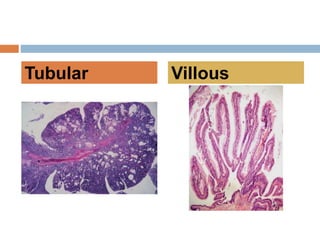
Tubular- if at least 80% of the glands are of the
branching tubule type
Villous -if at least 80% of the glands are villiform.
Of all adenomatous polyps,
tubular adenomas account for 80% to 86%,tubulovillous
for 8% to 16%, and villous adenomas for 3% to16%.
Tubular Villous
Dysplasia
Mild Dysplasia
Mod Dysplasia
Severe
Dysplasia
Low grade
Dysplasia
High grade
Dysplasia
Mild Dysplasia
Mod Dysplasia
Severe Dysplasia
Histologic Types of Adenomas
and Their Features
Malignant Potential of Polyp
Larger adenoma size >1cm
Villous Adenoma on histology
Higher degrees of dysplasia
Adenoma with advanced pathology(AAP)
Flat Polyps
Macroscopically, a flat adenoma is either
completely flat or slightly raised, and can
contain a central depression.
Diameter of this polyp is more than twice its
thickness.
Typically less than 1 cm in diameter, these
lesions can be easily missed at endoscopy.
Relation of Adenoma, Histology, and Degree of
Dysplasia to the Incidence of Invasive
Carcinoma by Adenoma Size
Pathogenesis
 Adenomatous polyps are thought to arise from
a failure in a step, or steps, of the normal
process of cell proliferation and cell death
(apoptosis).
Pathogenesis
Adenoma-carcinoma hypothesis
Epidemiologic Evidence
Clinicopathologic Evidence
Molecular Genetic Evidence
Pathway Of Colon
Carcinogenesis
Evolution of adenoma &
colon ca
Pravalence
Anatomic Distribution of Colorectal
Adenomas Based on Autopsy and
Colonoscopy Studies
Risk Factors for Susceptibility to
Adenomas
Inherited Susceptibility
Dietary and lifestyle risk factors
Conditions Associated With
Adenomatous Polyps
Inherited Susceptibility
Hereditary Polyposis Syndrome
Lynch Syndrome
Probands with first degree relatives
with colon cancer or adenoma
Adenomas in pts with family history
of colon cancer have faster growth
rates
10-30% are familial
Dietary and Lifestyle Risk
Factors
excess dietary fat
excess alcohol intake
Obesity(central)
cigarette smoking
dietary fiber,
plant foods
Carbohydrate
Chemoprotective-
NSAIDS,Calcium,
HRT,Selenium
Increased risk Protective
Dietary and Lifestyle Risk
Factors
Dietary and Lifestyle Risk
Factors
Conditions Associated with
Adenomatous Polyps
Ureterosigmoidostomy -29%,20-26yrs later
Acromegaly – Increased IGF,5-25% CRC,14-35%
adenoma
Streptococcus bovis and JC virus
Cholecystectomy-increased bile in colon,
increases proliferation
Clinical Features
Usually no symptoms
Occult or Overt bleeding
Constipation,diarrhea and flatulance.
• Intermittant intususception
Cramping abdominal Pain
• Villous,3-4cm,sigmoid or rectal
Secretary Diarrhea
Obstruction
Detection
Fecal occult blood testing –
<40% pts adenoma have Positive testing
Asymptomatic >40yrs-1-3% positive
50% will have adenoma colonoscopy
3:1Adenoma Vs CRC
PPV-Adenoma(30-35%),CRC(8-12%)
Sigmoidoscopy
Rigid sigmoidoscopy would detect polyps
(of all histologic types) in about 7% of
asymptomatic persons older than 40 years,
flexible sigmoidoscope would find polyps in
10% to 15%,principally because a greater
length of bowel could be examined.
Screening sigmoidoscopy now show
reductions in CRC mortality from 21% to
38%.
Colonoscopy
Preferred colon cancer screening
test
Gold standard
• 10% failure caecal intubation
• higher cost, can miss CRC
• Miss rate-0-6%(1cm),
• 12-13%(6to9mm),15-27%(<6mm)
Limitations -
• Adequacy of preparation,caecal intubation rate,withdrawl time and
adenoma detection rate
Miss Rate
Current Guidelines-
Caecal intubation rate >90% all,95% for
screening
Adenoma detection rate –At least 15%
Withdrawl time->=6 minutes
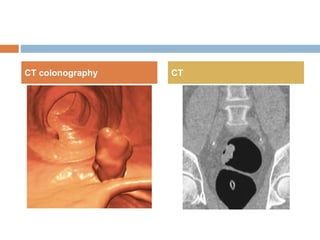
CT Colonography (virtual
colonoscopy)
2 and 3dimensional CT
Bowel preparation,colon
distended with CO2
Images taken in supine and
prone position
Sensitivity-
86%(5to9mm),92%(>10mm)
Low sensitivity for <5mm
polpyps
Radiation exposure(0.14%)
Incidental findings 70%,11%
Surveilliance interval
Concerns
CT colonography CT
Newer methods
 Altered human DNA in stool analysis
 3-4 times more sensitive for adenoma
detection
Treatment
Untreated adenoma-5-10yrs for CRC
cumulative risk of cancer at the polyp site is 2.5% at 5 years,
8% at 10 years, and 24% at 20 years after diagnosis.
Diminutive polyp <5mm size reaches 1cm at 3yrs
Age distributions-mean age of people with a single adenoma
is about 4 to 5 years younger than those with a colon cancer.
A similar analysis in FAP patients has shown that patients with
adenomas are about 12 years younger than colon cancer.
Multiple Adenomas-2 or more
Synchronus adenoma– same time
(30%),50-85% 2 cancers
Metachronus lesion-6 months later
Initial treatment
Full colonoscopy
Remove Polyp
Histological examination
Search synchronous lesion
Complete endoscopic resection
A few general
recommendations
contain carcinoma in situ, pedunculated
adenomas that harbour well differentiated or
moderately differentiated invasive carcinoma,
and polypoid carcinomas.
Endoscopic polypectomy alone is adequate
therapy for adenomas that
malignant polyps in which the invasive carcinoma is
poorly differentiated,
involves endothelium-lined channels
(lymphatics,blood vessels),
extends to or within 2 mm of the polypectomy
margin,
or involves the submucosa of the colonic wall
(includes all sessile adenomas).
Resection surgery is indicated for
Polyp Recurrence Rates.
Surveillance Recommendations
after
Polypectomy
Serrated Polyps
Most common nonadenomatous polyps.
CpG island methylation pathway (CIMP) results in decreased
expression of genes,including DNA mismatch repair genes,
which can lead to microsatellite instability (MSI).
SSP/As are much less common than HPs, accounting for less
than 1% of all polyps and between1% and 11% of adenomas
SSP/As are typically flat, located in the right colon, and
covered with a mucus cap.
Features of Serrated Polyps
Treatment
It is recommended that all serrated polyps
be removed when detected.
This is because it may not be possible to
distinguish SSP/A or TSA from an HP, and
SSP/As and TSAs have a significant risk
of progression to invasive carcinoma.
Thank
you

Colonic neoplastic polyps

  • 1.
  • 2.
    Definition A GI polypis a discrete mass of tissue that protrudes into the lumen of the bowel. characterized by its gross appearance and overall size, whether or not it has a stalk, whether it is 1 of multiple similar masses occurring elsewhere in the GI tract.
  • 3.
  • 5.
    Pathology Histological features Pedunculated-attached bya stalk Sessile –attached by broad base with little or no stalk By definition, all colorectal adenomas are dysplastic.
  • 6.
    World Health Organization, adenomasare classified Tubular- if at least 80% of the glands are of the branching tubule type Villous -if at least 80% of the glands are villiform. Of all adenomatous polyps, tubular adenomas account for 80% to 86%,tubulovillous for 8% to 16%, and villous adenomas for 3% to16%.
  • 7.
  • 8.
  • 9.
  • 12.
    Histologic Types ofAdenomas and Their Features
  • 13.
    Malignant Potential ofPolyp Larger adenoma size >1cm Villous Adenoma on histology Higher degrees of dysplasia Adenoma with advanced pathology(AAP)
  • 14.
    Flat Polyps Macroscopically, aflat adenoma is either completely flat or slightly raised, and can contain a central depression. Diameter of this polyp is more than twice its thickness. Typically less than 1 cm in diameter, these lesions can be easily missed at endoscopy.
  • 16.
    Relation of Adenoma,Histology, and Degree of Dysplasia to the Incidence of Invasive Carcinoma by Adenoma Size
  • 17.
    Pathogenesis  Adenomatous polypsare thought to arise from a failure in a step, or steps, of the normal process of cell proliferation and cell death (apoptosis).
  • 18.
  • 19.
  • 20.
  • 21.
  • 22.
    Anatomic Distribution ofColorectal Adenomas Based on Autopsy and Colonoscopy Studies
  • 23.
    Risk Factors forSusceptibility to Adenomas Inherited Susceptibility Dietary and lifestyle risk factors Conditions Associated With Adenomatous Polyps
  • 24.
    Inherited Susceptibility Hereditary PolyposisSyndrome Lynch Syndrome Probands with first degree relatives with colon cancer or adenoma Adenomas in pts with family history of colon cancer have faster growth rates 10-30% are familial
  • 25.
    Dietary and LifestyleRisk Factors excess dietary fat excess alcohol intake Obesity(central) cigarette smoking dietary fiber, plant foods Carbohydrate Chemoprotective- NSAIDS,Calcium, HRT,Selenium Increased risk Protective
  • 26.
  • 27.
  • 28.
    Conditions Associated with AdenomatousPolyps Ureterosigmoidostomy -29%,20-26yrs later Acromegaly – Increased IGF,5-25% CRC,14-35% adenoma Streptococcus bovis and JC virus Cholecystectomy-increased bile in colon, increases proliferation
  • 29.
    Clinical Features Usually nosymptoms Occult or Overt bleeding Constipation,diarrhea and flatulance. • Intermittant intususception Cramping abdominal Pain • Villous,3-4cm,sigmoid or rectal Secretary Diarrhea Obstruction
  • 30.
    Detection Fecal occult bloodtesting – <40% pts adenoma have Positive testing Asymptomatic >40yrs-1-3% positive 50% will have adenoma colonoscopy 3:1Adenoma Vs CRC PPV-Adenoma(30-35%),CRC(8-12%)
  • 31.
    Sigmoidoscopy Rigid sigmoidoscopy woulddetect polyps (of all histologic types) in about 7% of asymptomatic persons older than 40 years, flexible sigmoidoscope would find polyps in 10% to 15%,principally because a greater length of bowel could be examined. Screening sigmoidoscopy now show reductions in CRC mortality from 21% to 38%.
  • 32.
    Colonoscopy Preferred colon cancerscreening test Gold standard • 10% failure caecal intubation • higher cost, can miss CRC • Miss rate-0-6%(1cm), • 12-13%(6to9mm),15-27%(<6mm) Limitations - • Adequacy of preparation,caecal intubation rate,withdrawl time and adenoma detection rate Miss Rate
  • 33.
    Current Guidelines- Caecal intubationrate >90% all,95% for screening Adenoma detection rate –At least 15% Withdrawl time->=6 minutes
  • 34.
    CT Colonography (virtual colonoscopy) 2and 3dimensional CT Bowel preparation,colon distended with CO2 Images taken in supine and prone position Sensitivity- 86%(5to9mm),92%(>10mm) Low sensitivity for <5mm polpyps Radiation exposure(0.14%) Incidental findings 70%,11% Surveilliance interval Concerns
  • 35.
  • 36.
    Newer methods  Alteredhuman DNA in stool analysis  3-4 times more sensitive for adenoma detection
  • 37.
    Treatment Untreated adenoma-5-10yrs forCRC cumulative risk of cancer at the polyp site is 2.5% at 5 years, 8% at 10 years, and 24% at 20 years after diagnosis. Diminutive polyp <5mm size reaches 1cm at 3yrs Age distributions-mean age of people with a single adenoma is about 4 to 5 years younger than those with a colon cancer. A similar analysis in FAP patients has shown that patients with adenomas are about 12 years younger than colon cancer.
  • 38.
    Multiple Adenomas-2 ormore Synchronus adenoma– same time (30%),50-85% 2 cancers Metachronus lesion-6 months later
  • 39.
    Initial treatment Full colonoscopy RemovePolyp Histological examination Search synchronous lesion Complete endoscopic resection
  • 40.
    A few general recommendations containcarcinoma in situ, pedunculated adenomas that harbour well differentiated or moderately differentiated invasive carcinoma, and polypoid carcinomas. Endoscopic polypectomy alone is adequate therapy for adenomas that
  • 41.
    malignant polyps inwhich the invasive carcinoma is poorly differentiated, involves endothelium-lined channels (lymphatics,blood vessels), extends to or within 2 mm of the polypectomy margin, or involves the submucosa of the colonic wall (includes all sessile adenomas). Resection surgery is indicated for
  • 43.
  • 44.
  • 45.
    Serrated Polyps Most commonnonadenomatous polyps. CpG island methylation pathway (CIMP) results in decreased expression of genes,including DNA mismatch repair genes, which can lead to microsatellite instability (MSI). SSP/As are much less common than HPs, accounting for less than 1% of all polyps and between1% and 11% of adenomas SSP/As are typically flat, located in the right colon, and covered with a mucus cap.
  • 46.
  • 47.
    Treatment It is recommendedthat all serrated polyps be removed when detected. This is because it may not be possible to distinguish SSP/A or TSA from an HP, and SSP/As and TSAs have a significant risk of progression to invasive carcinoma.
  • 48.