Shock 
& 
Haemorrhagic shock
Shock 
• Shock is the clinical syndrome that results from 
inadequate tissue perfusion which leads to hypoxia 
and ultimately cellular dysfunction. 
• The cellular dysfunction is manifested as aerobic to 
anaerobic leading to lactic acidosis.
Principle mechanisms 
• Not enough blood volume 
• Pump failure 
• Abnormalities of peripheral circulation (when all 
small blood vessels dilate) 
• Mechanical blockage of outflow from the heart
• Most common type of shock 
– Insufficient circulating volume 
• Primary cause = loss of blood or body fluids from an 
internal or external source 
• Hemorrhage, severe burns, severe dehydration 
4 
Hypovolemic shock 
Scalp laceration 3rd degree/full thickness burn
• Failure of the heart to pump effectively 
1. Due to damage to the heart muscle 
2. Large myocardial infarction 
3. Arrhythmias (too fast or too slow) 
4. Cardiomyopathy 
5. Congestive heart failure (CHF) 
6. Cardiac valve problems 
5 
Cardiogenic Shock
• Similar to hypovolemic shock - insufficient 
intravascular volume of blood or “relative" 
hypovolemia 
– result of dilation of all blood vessels so the “tank” 
is much larger 
6 
Distributive shock 
Urticaria/anaphylaxis Meningococcic sepsis
• Septic shock 
– Overwhelming infection leading to profound 
systemic vasodilation 
• Anaphylactic shock 
– Severe reaction to an allergen, antigen, drug or 
foreign protein, releasing histamine causing 
widespread vasodilation, hypotension and 
increased capillary permeability 
• Neurogenic shock 
– Rarest form of shock. 
– Trauma to spinal cord resulting in loss of 
autonomic and motor reflexes below injury level. 
Vessel walls relax uncontrolled, decreasing 
peripheral vascular resistance, result = 
vasodilation and hypotension 
7 
Distributive shock examples
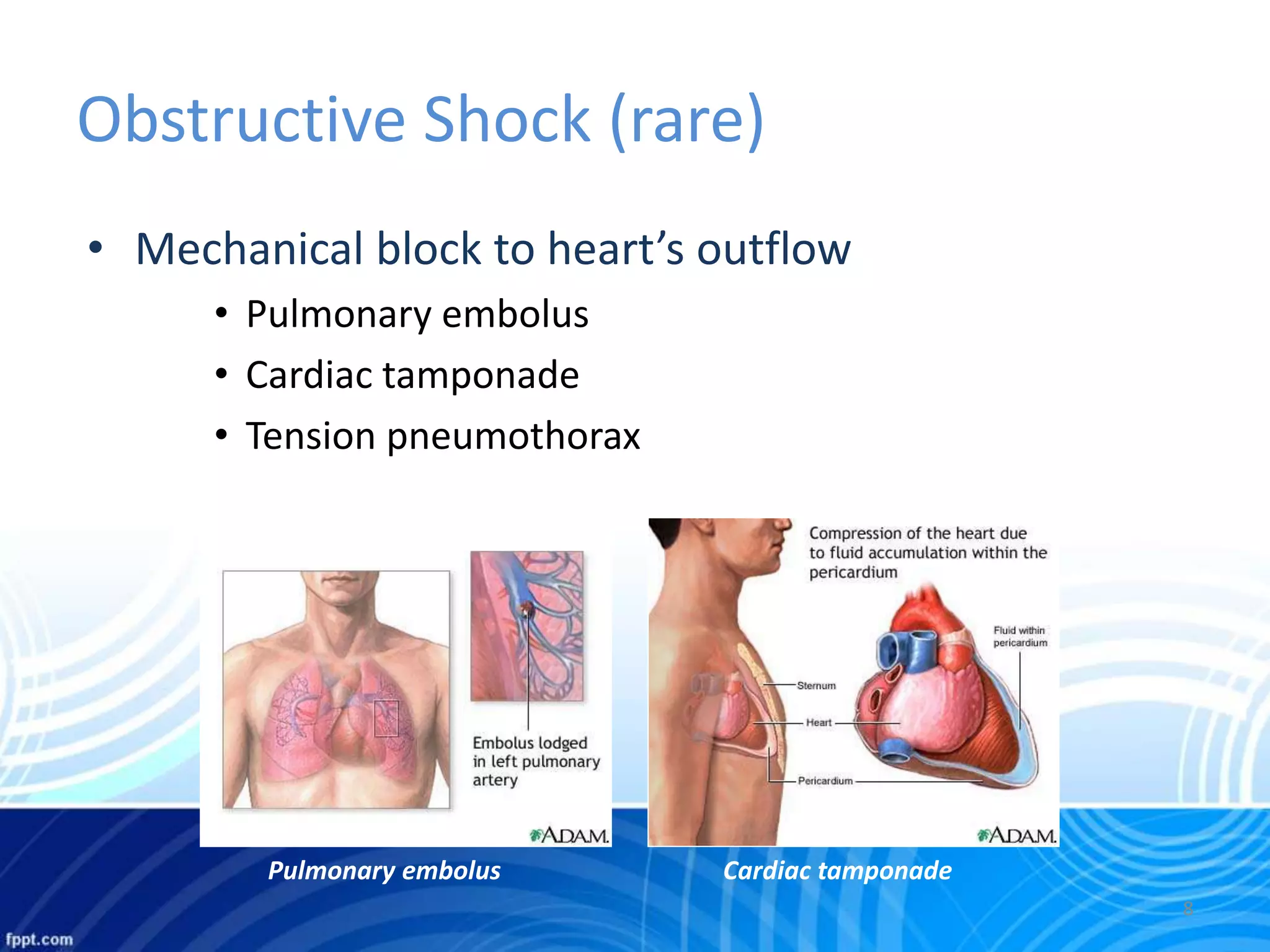
• Mechanical block to heart’s outflow 
• Pulmonary embolus 
• Cardiac tamponade 
• Tension pneumothorax 
8 
Obstructive Shock (rare) 
Pulmonary embolus Cardiac tamponade
Psychogenic shock 
• Immediately follows sudden fright 
• Eg bad news, severe pain( blow to 
the testes)
Haemorrhagic shock 
• It is one of the commonest form of hypovolemic shock 
• Hypovolemia leads to decreased preload which leads to 
increased sympathetic activity and vasoconstriction 
• Vasoconstriction leads to decreased mean arterial 
pressure and ischemia which ultimately leads to 
multiorgan failure-ARDS,HEPATIC FAILURE,STRESS,GI 
BLEEDING.RENAL FAILURE . 
• Ischemia leads to myocardial insufficiency and severe 
decrease in Systemic Vascular Resistance and finally 
death
Hemorrhage Classification
External Hemorrhage 
• Results from soft tissue injury. 
• Most soft tissue trauma is accompanied by mild hemorrhage 
and is not life threatening. 
– Can carry significant risks of patient morbidity and disfigurement 
• The seriousness of the injury is dependent on: 
– Anatomical source of the hemorrhage (arterial, venous, 
capillary) 
– Degree of vascular disruption 
– Amount of blood loss that can be tolerated by the patient
Internal Hemorrhage 
• Can result from: 
– Blunt or penetrating trauma 
– Acute or chronic medical illnesses 
• Internal bleeding that can cause hemodynamic 
instability usually occurs in one of four body cavities: 
– Chest 
– Abdomen 
– Pelvis 
– Retroperitoneum
Internal Hemorrhage 
• Signs and symptoms that may suggest significant 
internal hemorrhage include: 
– Bright red blood from mouth, rectum, or other 
orifice 
– Coffee-ground appearance of vomit 
– Melena (black, tarry stools) 
– Dizziness or syncope on sitting or standing 
– Orthostatic hypotension 
• Internal hemorrhage is associated with higher 
morbidity and mortality than external hemorrhage
Compensated shock 
– 0-20% of blood loss 
– Blood pressure is maintained via increased 
vascular tone and increased blood flow to vital 
organs
The body’s response: 
Compensated shock Baroreceptor mediated 
vasoconstriction! 
• Increased epinephrine, vasopressin, angiotensin 
• Results in: 
– Tachycardia 
– Tachypnoea 
– Lowered pulse pressure 
– Slightly lowered urine output
The Organs which well perfused : 
• Brain 
• Heart 
• Kidneys 
• Liver 
The Organs which are less perfused: 
• Skin 
• GI tract 
• Skeletal Muscle
But why 
• The body will make whatever adjustments it can to 
maintain…. 
Adequate 
Cardiac 
Output 
• Brain and heart perfusions remain near normal while other 
less critical organ systems are, in proportion to the blood 
volume deficit, stressed by ischemia.
Uncompensated shock 
• 20-40% loss of blood volume 
• Decrease in BP 
• Tachycardia
The body’s response 
Uncompensated shock 
• The intravascular volume deficit exceeds the capacity 
of vasoconstrictive mechanisms to maintain systemic 
perfusion pressure. 
• Increased cardiac output 
• Increased respiration 
• Sodium retention
Classification 
Class I 
A. Loss of up to 15% of total blood volume (0 to 750 
ml in 70 kg person). 
B. Characterized by normal blood pressure, urine 
output, slight tachycardia, tachypnea, slight anxiety.
Class II 
A. Loss of 15 % to 30% of total blood volume 
(750 to 1,500 ml ) 
B. Characterized by normal blood pressure, 
tachycardia, mild tachypnea, decrease urine 
output and mild anxiety.
Class III 
A. Loss of 30% to 40% of total blood volume 
(1,500 to 2,ooo) 
B. Characterized by hypotension, tachycardia, 
tachypnea, decreased urine output , anxiety and 
confusion.
Class IV 
A. Loss of > 40% of total blood volume (>2,ooo) 
B. Characterized by severe hypotension and 
tachycardia, tachypnea, negligible urine output 
and lethargy
Class 1 Class 2 Class 3 Class 4 
Blood loss (in <750 ml 750-1500 1500-2000 >2000 
ml) 
Blood volume <15 15-30 30-40 >40 
(in%) 
Heart rate <100 >100 >120 >140 
Decreased decreased 
mean arterial 
pressure<60 
Normal or Normal (+tilt ) 
increased 
Blood pressure 
Pulse Normal Decreased Decrease d e creased 
pressure 
Usually Always delayed 
delayed 
May be 
delayed 
Capillary refill Normal 
Usually Always delayed 
delayed 
Respirations normal Mildly delayed 
Essentially 
anuric 
Urinary output >30 20-30 5-15 
(ml/hr) 
Lethargic,obtu 
nded 
Normal or Anxious confused 
anxious 
Mental status
Concomitant Factors 
• Pre-existing condition 
– eg Anaemia, HTN etc 
• Rate of blood loss 
• Patient Types 
– Pregnant 
• >50% greater blood volume than normal 
• Fetal circulation impaired when mother compensating 
– Athletes 
• Greater fluid and cardiac capacity 
– Obese 
• CBV is based on IDEAL weight (less CBV)
• Children 
– CBV 8–9% of body weight 
– Poor compensatory mechanisms 
– TREAT AGGRESSIVELY! 
• Elderly 
– Decreased CBV 
– Medications 
• BP 
• Anticoagulants
Hemorrhage Assessment 
• Blood loss at the scene 
• Mechanism of Injury/Nature of Illness 
• Should only be used in conjunction with vital signs and 
other clinical signs of injury to determine the 
probability of injury 
• Need for Additional Resources
• Initial Assessment 
– General Impression 
• Obvious bleeding 
– Mental Status 
– Interventions 
• Manage as you go 
– O2 
– Bleeding control 
– Shock 
– BLS before ALS!
• Focused History & Physical examination 
– Rapid Trauma Assessment 
• Full head to toe 
• Consider air medical if stage 2+ blood loss 
– Focused Physical Exam 
• Guided by c/c 
– Vitals, SAMPLE, and OPQRST 
– Additional Assessment 
• Orthostatic hypotension 
• Tilt test: 20 
– BP or P from supine to sitting
Fractures and Blood Loss 
• Pelvic fracture: 
• Femur fracture: 
• Tibia/fibula fracture: 
• Hematomas and contusions: 
2,000 mL 
1,500 mL 
500–750 mL 
500 mL
• Ongoing Assessment 
– Reassess vitals and mental status: 
• Q 5 min: UNSTABLE patients 
• Q 15 min: STABLE patients 
– Reassess interventions: 
• Oxygen 
• ET 
• IV 
• Medication actions 
– Trending: improvement vs. deterioration 
• Pulse oximetry 
• End-tidal CO2 levels
Management 
• C-ABCs of trauma 
• Control hemorrhage (splint the limb!!) 
• Obtain IV access and resuscitate with fluids and 
blood 
– 2 liters crystalloid for adults 
– 20 cc/kg crystalloid x 2 for kids 
• Blood vs. Crystalloid?? 
• Long term critical care management
Management goals AFTER securing the ABCs: 
• stop the bleeding! 
• restore volume! 
• correct any electrolyte/acid-base disturbances!
Apply direct pressure: 
• with gloved hand, 
• sterile dressing(s). 
No Bleeding stopped? Yes 
Elevate extremity: 
• above victim’s heart, 
continue direct pressure 
Locate pressure point, 
apply pressure: 
• maintain direct pressure 
over wound 
Treat for shock: 
• care for wound, 
• seek definitive care 
Bleeding stopped? 
Bleeding stopped? 
No 
No 
Bleeding from 
extremity? 
Yes 
Apply tourniquet 
(last resort) 
No 
Definitive therapy
• Apply pressure directly to wound 
site: 
– Gloved hand, dressing 
– If dressing soaks thru, add 
more gauze on top and press 
harder 
37 
Direct pressure 
Apply direct pressure: 
• with gloved hand, 
• sterile dressing(s). 
No Bleeding stopped? Yes 
Elevate extremity: 
• above victim’s heart, 
continue direct pressure 
Locate pressure point, 
apply pressure: 
• maintain direct pressure 
over wound 
Treat for shock: 
• care for wound, 
• seek definitive care 
Bleeding stopped? 
Bleeding stopped? 
No 
No 
Bleeding from 
extremity? 
Yes 
Apply tourniquet 
(last resort) 
No 
Definitive therapy
• If possible, raise wound site 
above level of victim’s heart 
38 
Elevate wound site 
Apply direct pressure: 
• with gloved hand, 
• sterile dressing(s). 
No Bleeding stopped? Yes 
Elevate extremity: 
• above victim’s heart, 
continue direct pressure 
Locate pressure point, 
apply pressure: 
• maintain direct pressure 
over wound 
Treat for shock: 
• care for wound, 
• seek definitive care 
Bleeding stopped? 
Bleeding stopped? 
No 
No 
Bleeding from 
extremity? 
Yes 
Apply tourniquet 
(last resort) 
No 
Definitive therapy
• Find proximal “pressure point” 
and press on it 
(radial, ulnar, brachial, axillary, femoral 
arteries—not carotid) 
• Apply direct pressure to site 
39 
Pressure points 
Apply direct pressure: 
• with gloved hand, 
• sterile dressing(s). 
No Bleeding stopped? Yes 
Elevate extremity: 
• above victim’s heart, 
continue direct pressure 
Locate pressure point, 
apply pressure: 
• maintain direct pressure 
over wound 
Treat for shock: 
• care for wound, 
• seek definitive care 
Bleeding stopped? 
Bleeding stopped? 
No 
No 
Bleeding from 
extremity? 
Yes 
Apply tourniquet 
(last resort) 
No 
Definitive therapy
• Apply band above injury site, 
tighten to stop bleeding: 
– Last resort—risky 
– Note time of application 
– Reassess frequently 
40 
Tourniquet 
Apply direct pressure: 
• with gloved hand, 
• sterile dressing(s). 
No Bleeding stopped? Yes 
Elevate extremity: 
• above victim’s heart, 
continue direct pressure 
Locate pressure point, 
apply pressure: 
• maintain direct pressure 
over wound 
Treat for shock: 
• care for wound, 
• seek definitive care 
Bleeding stopped? 
Bleeding stopped? 
No 
No 
Bleeding from 
extremity? 
Yes 
Apply tourniquet 
(last resort) 
No 
Definitive therapy
Volume Resuscitation 
• Rapid Responder 
– Give 500cc-1 Liter crystalloid  rapid 
improvement of BP/HR/Urine output 
– < 20% blood loss 
• Transient Responder 
– Give 500cc-1 Liter crystalloid  improves briefly 
then deteriorates 
– 20-40% blood loss 
– Continue crystalloid infusion +/- Blood
• Non Responder 
– Give 2 Liters crystalloid/ 2 units Blood  no 
response 
– > 40% blood loss
volume resuscitation adequate/inadequate? 
• Urine output 
• Vital signs 
• Skin perfusion 
• Pulse Oximetry 
• Acidemia??
Correction of any electrolyte/acid-base 
disturbances 
• Normalization of acidosis and oxygen consumption 
are the best current indicators of adequate 
resuscitation 
• Base deficit and lactate level are good indications of 
tissue perfusion
• Bicarbonate 
• HCO3 combined with hydrogen ion to form water and 
carbon dioxide 
• CO2 diffuses into cells and worsens intracellular 
acidosis 
• It is not indicated for lactic acidosis from HS 
• Best treatment of acidosis from HS is restoring 
perfusion to ischemic tissue.
Complications 
• Multi organ dysfunction 
• Coagulopathy
Multiple organ failure 
• pt who survive HS but die in the hospital later usually 
die of MOF or sepsis 
• MOF results from systemic inflammatory response 
• Duration and severity of HS correlate with incidence 
of MOF 
• Patients who get > 6 units of packed RBCs in the first 
12 hours of HS resusitation have higher risk of MOF
Coagulopathy 
• Hypothermia 
– Most common cause of coagulopathy in HS 
– Significant coagulopathy begins at 34o c 
– Undetectable on lab tests of coagulation ,blood 
warmed to 37 c before testing 
Note that 
Treat with warmed fluids and external rewarming
• Platelet dysfunction and deficiency 
– Second most common cause 
– Hypothermia cause plt dysfunction 
– Thrombocytopenia is common is massive HS 
– Degree of thrombocytopenia not correlated 
directly with volume of blood loss 
– Platelets transfusion
haemorrhagic shock

haemorrhagic shock

  • 1.
  • 2.
    Shock • Shockis the clinical syndrome that results from inadequate tissue perfusion which leads to hypoxia and ultimately cellular dysfunction. • The cellular dysfunction is manifested as aerobic to anaerobic leading to lactic acidosis.
  • 3.
    Principle mechanisms •Not enough blood volume • Pump failure • Abnormalities of peripheral circulation (when all small blood vessels dilate) • Mechanical blockage of outflow from the heart
  • 4.
    • Most commontype of shock – Insufficient circulating volume • Primary cause = loss of blood or body fluids from an internal or external source • Hemorrhage, severe burns, severe dehydration 4 Hypovolemic shock Scalp laceration 3rd degree/full thickness burn
  • 5.
    • Failure ofthe heart to pump effectively 1. Due to damage to the heart muscle 2. Large myocardial infarction 3. Arrhythmias (too fast or too slow) 4. Cardiomyopathy 5. Congestive heart failure (CHF) 6. Cardiac valve problems 5 Cardiogenic Shock
  • 6.
    • Similar tohypovolemic shock - insufficient intravascular volume of blood or “relative" hypovolemia – result of dilation of all blood vessels so the “tank” is much larger 6 Distributive shock Urticaria/anaphylaxis Meningococcic sepsis
  • 7.
    • Septic shock – Overwhelming infection leading to profound systemic vasodilation • Anaphylactic shock – Severe reaction to an allergen, antigen, drug or foreign protein, releasing histamine causing widespread vasodilation, hypotension and increased capillary permeability • Neurogenic shock – Rarest form of shock. – Trauma to spinal cord resulting in loss of autonomic and motor reflexes below injury level. Vessel walls relax uncontrolled, decreasing peripheral vascular resistance, result = vasodilation and hypotension 7 Distributive shock examples
  • 8.
    • Mechanical blockto heart’s outflow • Pulmonary embolus • Cardiac tamponade • Tension pneumothorax 8 Obstructive Shock (rare) Pulmonary embolus Cardiac tamponade
  • 9.
    Psychogenic shock •Immediately follows sudden fright • Eg bad news, severe pain( blow to the testes)
  • 11.
    Haemorrhagic shock •It is one of the commonest form of hypovolemic shock • Hypovolemia leads to decreased preload which leads to increased sympathetic activity and vasoconstriction • Vasoconstriction leads to decreased mean arterial pressure and ischemia which ultimately leads to multiorgan failure-ARDS,HEPATIC FAILURE,STRESS,GI BLEEDING.RENAL FAILURE . • Ischemia leads to myocardial insufficiency and severe decrease in Systemic Vascular Resistance and finally death
  • 12.
  • 13.
    External Hemorrhage •Results from soft tissue injury. • Most soft tissue trauma is accompanied by mild hemorrhage and is not life threatening. – Can carry significant risks of patient morbidity and disfigurement • The seriousness of the injury is dependent on: – Anatomical source of the hemorrhage (arterial, venous, capillary) – Degree of vascular disruption – Amount of blood loss that can be tolerated by the patient
  • 14.
    Internal Hemorrhage •Can result from: – Blunt or penetrating trauma – Acute or chronic medical illnesses • Internal bleeding that can cause hemodynamic instability usually occurs in one of four body cavities: – Chest – Abdomen – Pelvis – Retroperitoneum
  • 15.
    Internal Hemorrhage •Signs and symptoms that may suggest significant internal hemorrhage include: – Bright red blood from mouth, rectum, or other orifice – Coffee-ground appearance of vomit – Melena (black, tarry stools) – Dizziness or syncope on sitting or standing – Orthostatic hypotension • Internal hemorrhage is associated with higher morbidity and mortality than external hemorrhage
  • 16.
    Compensated shock –0-20% of blood loss – Blood pressure is maintained via increased vascular tone and increased blood flow to vital organs
  • 17.
    The body’s response: Compensated shock Baroreceptor mediated vasoconstriction! • Increased epinephrine, vasopressin, angiotensin • Results in: – Tachycardia – Tachypnoea – Lowered pulse pressure – Slightly lowered urine output
  • 18.
    The Organs whichwell perfused : • Brain • Heart • Kidneys • Liver The Organs which are less perfused: • Skin • GI tract • Skeletal Muscle
  • 19.
    But why •The body will make whatever adjustments it can to maintain…. Adequate Cardiac Output • Brain and heart perfusions remain near normal while other less critical organ systems are, in proportion to the blood volume deficit, stressed by ischemia.
  • 20.
    Uncompensated shock •20-40% loss of blood volume • Decrease in BP • Tachycardia
  • 21.
    The body’s response Uncompensated shock • The intravascular volume deficit exceeds the capacity of vasoconstrictive mechanisms to maintain systemic perfusion pressure. • Increased cardiac output • Increased respiration • Sodium retention
  • 22.
    Classification Class I A. Loss of up to 15% of total blood volume (0 to 750 ml in 70 kg person). B. Characterized by normal blood pressure, urine output, slight tachycardia, tachypnea, slight anxiety.
  • 23.
    Class II A.Loss of 15 % to 30% of total blood volume (750 to 1,500 ml ) B. Characterized by normal blood pressure, tachycardia, mild tachypnea, decrease urine output and mild anxiety.
  • 24.
    Class III A.Loss of 30% to 40% of total blood volume (1,500 to 2,ooo) B. Characterized by hypotension, tachycardia, tachypnea, decreased urine output , anxiety and confusion.
  • 25.
    Class IV A.Loss of > 40% of total blood volume (>2,ooo) B. Characterized by severe hypotension and tachycardia, tachypnea, negligible urine output and lethargy
  • 26.
    Class 1 Class2 Class 3 Class 4 Blood loss (in <750 ml 750-1500 1500-2000 >2000 ml) Blood volume <15 15-30 30-40 >40 (in%) Heart rate <100 >100 >120 >140 Decreased decreased mean arterial pressure<60 Normal or Normal (+tilt ) increased Blood pressure Pulse Normal Decreased Decrease d e creased pressure Usually Always delayed delayed May be delayed Capillary refill Normal Usually Always delayed delayed Respirations normal Mildly delayed Essentially anuric Urinary output >30 20-30 5-15 (ml/hr) Lethargic,obtu nded Normal or Anxious confused anxious Mental status
  • 27.
    Concomitant Factors •Pre-existing condition – eg Anaemia, HTN etc • Rate of blood loss • Patient Types – Pregnant • >50% greater blood volume than normal • Fetal circulation impaired when mother compensating – Athletes • Greater fluid and cardiac capacity – Obese • CBV is based on IDEAL weight (less CBV)
  • 28.
    • Children –CBV 8–9% of body weight – Poor compensatory mechanisms – TREAT AGGRESSIVELY! • Elderly – Decreased CBV – Medications • BP • Anticoagulants
  • 29.
    Hemorrhage Assessment •Blood loss at the scene • Mechanism of Injury/Nature of Illness • Should only be used in conjunction with vital signs and other clinical signs of injury to determine the probability of injury • Need for Additional Resources
  • 30.
    • Initial Assessment – General Impression • Obvious bleeding – Mental Status – Interventions • Manage as you go – O2 – Bleeding control – Shock – BLS before ALS!
  • 31.
    • Focused History& Physical examination – Rapid Trauma Assessment • Full head to toe • Consider air medical if stage 2+ blood loss – Focused Physical Exam • Guided by c/c – Vitals, SAMPLE, and OPQRST – Additional Assessment • Orthostatic hypotension • Tilt test: 20 – BP or P from supine to sitting
  • 32.
    Fractures and BloodLoss • Pelvic fracture: • Femur fracture: • Tibia/fibula fracture: • Hematomas and contusions: 2,000 mL 1,500 mL 500–750 mL 500 mL
  • 33.
    • Ongoing Assessment – Reassess vitals and mental status: • Q 5 min: UNSTABLE patients • Q 15 min: STABLE patients – Reassess interventions: • Oxygen • ET • IV • Medication actions – Trending: improvement vs. deterioration • Pulse oximetry • End-tidal CO2 levels
  • 34.
    Management • C-ABCsof trauma • Control hemorrhage (splint the limb!!) • Obtain IV access and resuscitate with fluids and blood – 2 liters crystalloid for adults – 20 cc/kg crystalloid x 2 for kids • Blood vs. Crystalloid?? • Long term critical care management
  • 35.
    Management goals AFTERsecuring the ABCs: • stop the bleeding! • restore volume! • correct any electrolyte/acid-base disturbances!
  • 36.
    Apply direct pressure: • with gloved hand, • sterile dressing(s). No Bleeding stopped? Yes Elevate extremity: • above victim’s heart, continue direct pressure Locate pressure point, apply pressure: • maintain direct pressure over wound Treat for shock: • care for wound, • seek definitive care Bleeding stopped? Bleeding stopped? No No Bleeding from extremity? Yes Apply tourniquet (last resort) No Definitive therapy
  • 37.
    • Apply pressuredirectly to wound site: – Gloved hand, dressing – If dressing soaks thru, add more gauze on top and press harder 37 Direct pressure Apply direct pressure: • with gloved hand, • sterile dressing(s). No Bleeding stopped? Yes Elevate extremity: • above victim’s heart, continue direct pressure Locate pressure point, apply pressure: • maintain direct pressure over wound Treat for shock: • care for wound, • seek definitive care Bleeding stopped? Bleeding stopped? No No Bleeding from extremity? Yes Apply tourniquet (last resort) No Definitive therapy
  • 38.
    • If possible,raise wound site above level of victim’s heart 38 Elevate wound site Apply direct pressure: • with gloved hand, • sterile dressing(s). No Bleeding stopped? Yes Elevate extremity: • above victim’s heart, continue direct pressure Locate pressure point, apply pressure: • maintain direct pressure over wound Treat for shock: • care for wound, • seek definitive care Bleeding stopped? Bleeding stopped? No No Bleeding from extremity? Yes Apply tourniquet (last resort) No Definitive therapy
  • 39.
    • Find proximal“pressure point” and press on it (radial, ulnar, brachial, axillary, femoral arteries—not carotid) • Apply direct pressure to site 39 Pressure points Apply direct pressure: • with gloved hand, • sterile dressing(s). No Bleeding stopped? Yes Elevate extremity: • above victim’s heart, continue direct pressure Locate pressure point, apply pressure: • maintain direct pressure over wound Treat for shock: • care for wound, • seek definitive care Bleeding stopped? Bleeding stopped? No No Bleeding from extremity? Yes Apply tourniquet (last resort) No Definitive therapy
  • 40.
    • Apply bandabove injury site, tighten to stop bleeding: – Last resort—risky – Note time of application – Reassess frequently 40 Tourniquet Apply direct pressure: • with gloved hand, • sterile dressing(s). No Bleeding stopped? Yes Elevate extremity: • above victim’s heart, continue direct pressure Locate pressure point, apply pressure: • maintain direct pressure over wound Treat for shock: • care for wound, • seek definitive care Bleeding stopped? Bleeding stopped? No No Bleeding from extremity? Yes Apply tourniquet (last resort) No Definitive therapy
  • 41.
    Volume Resuscitation •Rapid Responder – Give 500cc-1 Liter crystalloid  rapid improvement of BP/HR/Urine output – < 20% blood loss • Transient Responder – Give 500cc-1 Liter crystalloid  improves briefly then deteriorates – 20-40% blood loss – Continue crystalloid infusion +/- Blood
  • 42.
    • Non Responder – Give 2 Liters crystalloid/ 2 units Blood  no response – > 40% blood loss
  • 43.
    volume resuscitation adequate/inadequate? • Urine output • Vital signs • Skin perfusion • Pulse Oximetry • Acidemia??
  • 44.
    Correction of anyelectrolyte/acid-base disturbances • Normalization of acidosis and oxygen consumption are the best current indicators of adequate resuscitation • Base deficit and lactate level are good indications of tissue perfusion
  • 45.
    • Bicarbonate •HCO3 combined with hydrogen ion to form water and carbon dioxide • CO2 diffuses into cells and worsens intracellular acidosis • It is not indicated for lactic acidosis from HS • Best treatment of acidosis from HS is restoring perfusion to ischemic tissue.
  • 46.
    Complications • Multiorgan dysfunction • Coagulopathy
  • 47.
    Multiple organ failure • pt who survive HS but die in the hospital later usually die of MOF or sepsis • MOF results from systemic inflammatory response • Duration and severity of HS correlate with incidence of MOF • Patients who get > 6 units of packed RBCs in the first 12 hours of HS resusitation have higher risk of MOF
  • 48.
    Coagulopathy • Hypothermia – Most common cause of coagulopathy in HS – Significant coagulopathy begins at 34o c – Undetectable on lab tests of coagulation ,blood warmed to 37 c before testing Note that Treat with warmed fluids and external rewarming
  • 49.
    • Platelet dysfunctionand deficiency – Second most common cause – Hypothermia cause plt dysfunction – Thrombocytopenia is common is massive HS – Degree of thrombocytopenia not correlated directly with volume of blood loss – Platelets transfusion