ABDOMINAL AORTIC ANEURYSMS
Abdominal Aortic Aneurysm
ABDOMINAL AORTIC ANEURYSMSABDOMINAL AORTIC ANEURYSMS
Did you know one of
the greatest minds
in history
succumbed to AAA?
JK WICKS
ABDOMINAL AORTIC ANEURYSMS
Abdominal Aortic Aneurysm
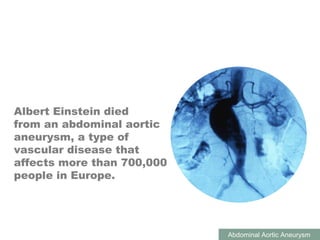
Albert Einstein died
from an abdominal aortic
aneurysm, a type of
vascular disease that
affects more than 700,000
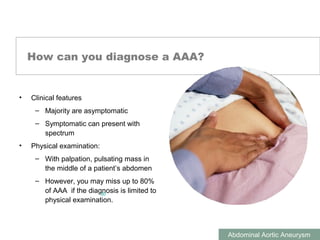
people in Europe.
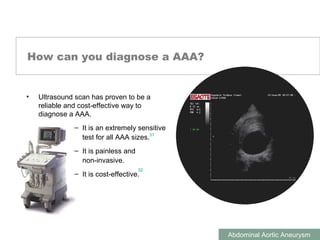
ABDOMINAL AORTIC ANEURYSMS
Abdominal Aortic Aneurysm
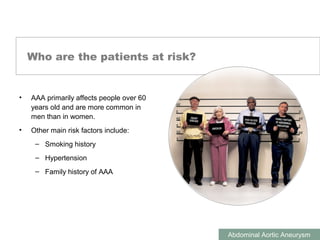
Abdominal Aortic Aneurysms:
An expanding problem?
Mr JK Wicks, FRACS (vasc)
ABDOMINAL AORTIC ANEURYSMS
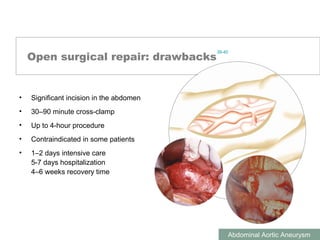
Abdominal Aortic Aneurysm
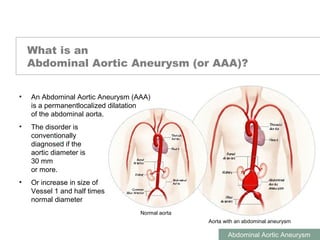
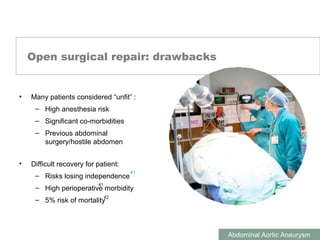
What is an
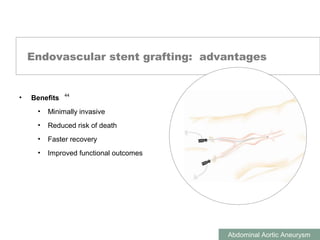
Abdominal Aortic Aneurysm (or AAA)?
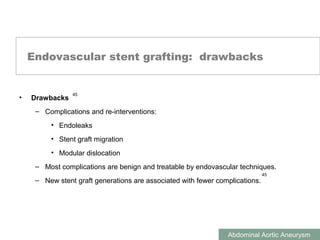
Normal aorta
Aorta with an abdominal aneurysm
• An Abdominal Aortic Aneurysm (AAA)
is a permanentlocalized dilatation
of the abdominal aorta.
• The disorder is
conventionally
diagnosed if the
aortic diameter is
30 mm
or more.
• Or increase in size of
Vessel 1 and half times
normal diameter
1
ABDOMINAL AORTIC ANEURYSMS
Abdominal Aortic Aneurysm
Why are AAAs a serious healthcare issue?
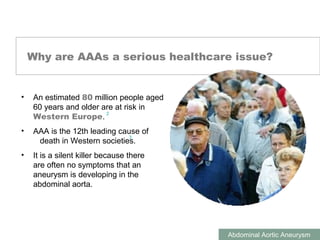
• An estimated 80 million people aged
60 years and older are at risk in
Western Europe.
• AAA is the 12th leading cause of
death in Western societies.
• It is a silent killer because there
are often no symptoms that an
aneurysm is developing in the
abdominal aorta.
2
3
ABDOMINAL AORTIC ANEURYSMS
Abdominal Aortic Aneurysm
Epidemiology
• Incidence of AAA is estimated
between 4% and 8% of the male
population aged 65 years or older.
• Comparatively, it is between 0.5%
and 1% in females of the same age.
• Incidence of AAA has been
estimated as a result of large screening
programs.
• Incidence is growing as the population
is aging.
13-19
ABDOMINAL AORTIC ANEURYSMS
Abdominal Aortic Aneurysm
Pathophysiology of a AAA
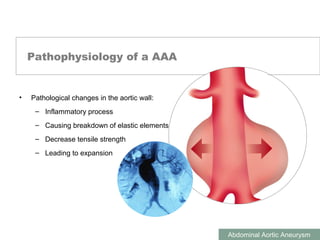
• Pathological changes in the aortic wall:
– Inflammatory process
– Causing breakdown of elastic elements in media
– Decrease tensile strength
– Leading to expansion
ABDOMINAL AORTIC ANEURYSMS
Abdominal Aortic Aneurysm
Pathophysiology of a AAA – risk factors
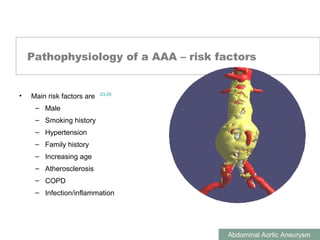
• Main risk factors are
– Male
– Smoking history
– Hypertension
– Family history
– Increasing age
– Atherosclerosis
– COPD
– Infection/inflammation
23-25
ABDOMINAL AORTIC ANEURYSMS
Abdominal Aortic Aneurysm
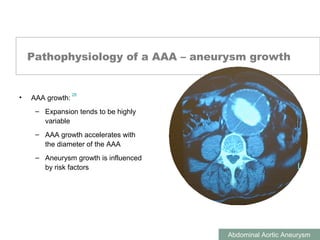
Pathophysiology of a AAA – aneurysm growth
• AAA growth:
– Expansion tends to be highly
variable
– AAA growth accelerates with
the diameter of the AAA
– Aneurysm growth is influenced
by risk factors
26
ABDOMINAL AORTIC ANEURYSMS
Abdominal Aortic Aneurysm
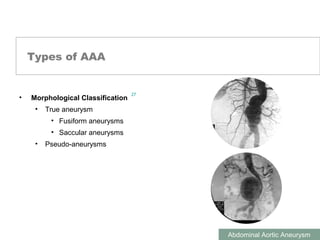
Types of AAA
• Morphological Classification
• True aneurysm
• Fusiform aneurysms
• Saccular aneurysms
• Pseudo-aneurysms
27
ABDOMINAL AORTIC ANEURYSMS
Abdominal Aortic Aneurysm
Why is early diagnosis of AAA so important?
• The operative mortality of treating a ruptured aneurysm is 80%
• For elective AAA cases, the operative mortality rate is drastically reduced,
approximately only 2-7% of cases result in death.
• AAA ruptures can be avoided by identifying the population at risk and conducting
simple and inexpensive ultrasound examinations.
4-10
11-12
ABDOMINAL AORTIC ANEURYSMS
Abdominal Aortic Aneurysm
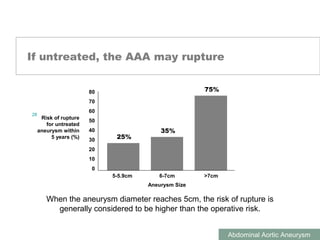
If untreated, the AAA may rupture
When the aneurysm diameter reaches 5cm, the risk of rupture is
generally considered to be higher than the operative risk.
0
Risk of rupture
for untreated
aneurysm within
5 years (%)
10
70
60
40
50
30
20
80
25%
35%
75%
Aneurysm Size
5-5.9cm 6-7cm >7cm
28
ABDOMINAL AORTIC ANEURYSMS
Abdominal Aortic Aneurysm
Why do you have a decisive
role in preventing AAA ruptures?
• You are the first to see the patient.
• No national or international AAA
screening program is in place today,
except in the U.S.A.
• A simple ultrasound examination
easily detects aneurysms.
Click here to see
the press release
22
ABDOMINAL AORTIC ANEURYSMS
Abdominal Aortic Aneurysm
How can you diagnose a AAA?
• Clinical features
– Majority are asymptomatic
– Symptomatic can present with
spectrum
• Physical examination:
– With palpation, pulsating mass in
the middle of a patient’s abdomen
– However, you may miss up to 80%
of AAA if the diagnosis is limited to
physical examination.
30
ABDOMINAL AORTIC ANEURYSMS
Abdominal Aortic Aneurysm
How can you diagnose a AAA?
• Ultrasound scan has proven to be a
reliable and cost-effective way to
diagnose a AAA.
– It is an extremely sensitive
test for all AAA sizes.
– It is painless and
non-invasive.
– It is cost-effective.
31
32
ABDOMINAL AORTIC ANEURYSMS
Abdominal Aortic Aneurysm
How can you
diagnose a AAA?
• An additional benefit of ultrasound
examination is that you may help
diagnose other vascular diseases:
– Carotid artery disease (CAD)
– Renal artery disease
– Peripheral artery disease (PAD)
ABDOMINAL AORTIC ANEURYSMS
Abdominal Aortic Aneurysm
Who are the patients at risk?
• AAA primarily affects people over 60
years old and are more common in
men than in women.
• Other main risk factors include:
– Smoking history
– Hypertension
– Family history of AAA
ABDOMINAL AORTIC ANEURYSMS
Abdominal Aortic Aneurysm
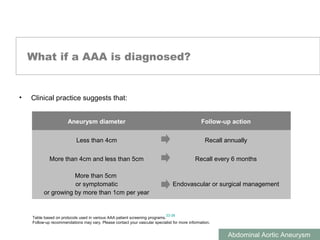
What if a AAA is diagnosed?
• Clinical practice suggests that:
Table based on protocols used in various AAA patient screening programs.
Follow-up recommendations may vary. Please contact your vascular specialist for more information.
33-38
Aneurysm diameter Follow-up action
Less than 4cm Recall annually
More than 4cm and less than 5cm Recall every 6 months
More than 5cm
or symptomatic
or growing by more than 1cm per year
Endovascular or surgical management
ABDOMINAL AORTIC ANEURYSMS
Abdominal Aortic Aneurysm
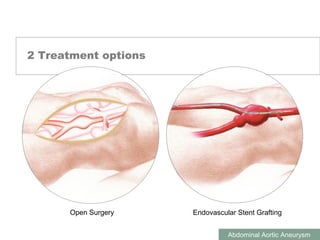
2 Treatment options
Endovascular Stent GraftingOpen Surgery
ABDOMINAL AORTIC ANEURYSMS
Abdominal Aortic Aneurysm
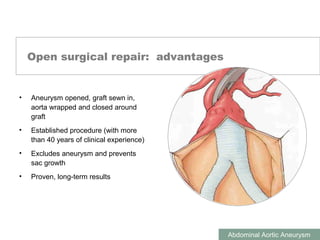
Open surgical repair: advantages
• Aneurysm opened, graft sewn in,
aorta wrapped and closed around
graft
• Established procedure (with more
than 40 years of clinical experience)
• Excludes aneurysm and prevents
sac growth
• Proven, long-term results
ABDOMINAL AORTIC ANEURYSMS
Abdominal Aortic Aneurysm
Open surgical repair: drawbacks
• Significant incision in the abdomen
• 30–90 minute cross-clamp
• Up to 4-hour procedure
• Contraindicated in some patients
• 1–2 days intensive care
5-7 days hospitalization
4–6 weeks recovery time
39-40
ABDOMINAL AORTIC ANEURYSMS
Abdominal Aortic Aneurysm
Open surgical repair: drawbacks
• Many patients considered “unfit” :
– High anesthesia risk
– Significant co-morbidities
– Previous abdominal
surgery/hostile abdomen
• Difficult recovery for patient:
– Risks losing independence
– High perioperative morbidity
– 5% risk of mortality
41
41
42
ABDOMINAL AORTIC ANEURYSMS
Abdominal Aortic Aneurysm
Endovascular stent grafting: advantages
• Benefits
• Minimally invasive
• Reduced risk of death
• Faster recovery
• Improved functional outcomes
44
ABDOMINAL AORTIC ANEURYSMS
Abdominal Aortic Aneurysm
Endovascular stent grafting: drawbacks
• Drawbacks
– Complications and re-interventions:
• Endoleaks
• Stent graft migration
• Modular dislocation
– Most complications are benign and treatable by endovascular techniques.
– New stent graft generations are associated with fewer complications.
45
45
ABDOMINAL AORTIC ANEURYSMS
Abdominal Aortic Aneurysm
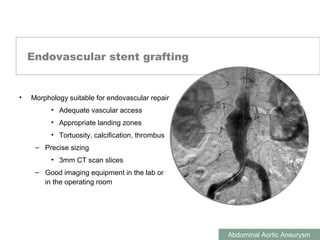
Endovascular stent grafting
• Morphology suitable for endovascular repair
• Adequate vascular access
• Appropriate landing zones
• Tortuosity, calcification, thrombus
– Precise sizing
• 3mm CT scan slices
– Good imaging equipment in the lab or
in the operating room
ABDOMINAL AORTIC ANEURYSMS
Abdominal Aortic Aneurysm
Typical patient follow-up
• Following open surgery:
– Ultrasound every year for patients
treated via open surgery
• Following endovascular stent grafting:
– Plain X-ray and CT scan at 6 months
and then annually for patients treated
with an endovascular stent graft
his is only indicative information.
Follow up protocols and procedures may
differ according to physician’s practice.
ABDOMINAL AORTIC ANEURYSMS
Abdominal Aortic Aneurysm
Which treatment for which patients?
• Case by case basis
• Endovascular stent grafting should be proposed to all AAA patients who:
• Are 70 yrs or older,
• And have an anatomy compatible with stent graft repair.
• Open surgery should be proposed to all patients fit for open repair or those who
refuse EVAR and are fit for open repair.
• In patients with comorbidities who are unsuitable for open surgery, endovascular
stent graft repair may be but balanced against life expectancy.
46-51
ABDOMINAL AORTIC ANEURYSMS
Abdominal Aortic Aneurysm
Learning points
Who are the patients at risk of AAA?
• Predominantly males
• 60 years old or older
• Smoking history
• Hypertension
• Family history of AAA
ABDOMINAL AORTIC ANEURYSMS
Abdominal Aortic Aneurysm
Learning points
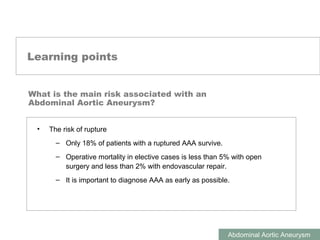
• The risk of rupture
– Only 18% of patients with a ruptured AAA survive.
– Operative mortality in elective cases is less than 5% with open
surgery and less than 2% with endovascular repair.
– It is important to diagnose AAA as early as possible.
What is the main risk associated with an
Abdominal Aortic Aneurysm?
ABDOMINAL AORTIC ANEURYSMS
Abdominal Aortic Aneurysm
Learning points
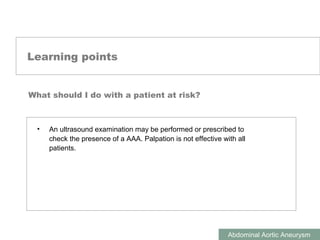
What should I do with a patient at risk?
• An ultrasound examination may be performed or prescribed to
check the presence of a AAA. Palpation is not effective with all
patients.
ABDOMINAL AORTIC ANEURYSMS
Abdominal Aortic Aneurysm
Learning points
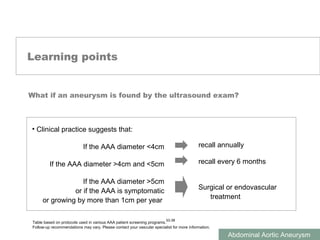
What if an aneurysm is found by the ultrasound exam?
• Clinical practice suggests that:
If the AAA diameter <4cm
If the AAA diameter >4cm and <5cm
If the AAA diameter >5cm
or if the AAA is symptomatic
or growing by more than 1cm per year
recall annually
recall every 6 months
Surgical or endovascular
treatment
Table based on protocols used in various AAA patient screening programs.
Follow-up recommendations may vary. Please contact your vascular specialist for more information.
33-38

Abdominal Aortic Aneurysm

  • 1.
  • 2.
    ABDOMINAL AORTIC ANEURYSMSABDOMINALAORTIC ANEURYSMS Did you know one of the greatest minds in history succumbed to AAA? JK WICKS
  • 3.
    ABDOMINAL AORTIC ANEURYSMS AbdominalAortic Aneurysm Albert Einstein died from an abdominal aortic aneurysm, a type of vascular disease that affects more than 700,000 people in Europe.
  • 4.
    ABDOMINAL AORTIC ANEURYSMS AbdominalAortic Aneurysm Abdominal Aortic Aneurysms: An expanding problem? Mr JK Wicks, FRACS (vasc)
  • 5.
    ABDOMINAL AORTIC ANEURYSMS AbdominalAortic Aneurysm What is an Abdominal Aortic Aneurysm (or AAA)? Normal aorta Aorta with an abdominal aneurysm • An Abdominal Aortic Aneurysm (AAA) is a permanentlocalized dilatation of the abdominal aorta. • The disorder is conventionally diagnosed if the aortic diameter is 30 mm or more. • Or increase in size of Vessel 1 and half times normal diameter 1
  • 6.
    ABDOMINAL AORTIC ANEURYSMS AbdominalAortic Aneurysm Why are AAAs a serious healthcare issue? • An estimated 80 million people aged 60 years and older are at risk in Western Europe. • AAA is the 12th leading cause of death in Western societies. • It is a silent killer because there are often no symptoms that an aneurysm is developing in the abdominal aorta. 2 3
  • 7.
    ABDOMINAL AORTIC ANEURYSMS AbdominalAortic Aneurysm Epidemiology • Incidence of AAA is estimated between 4% and 8% of the male population aged 65 years or older. • Comparatively, it is between 0.5% and 1% in females of the same age. • Incidence of AAA has been estimated as a result of large screening programs. • Incidence is growing as the population is aging. 13-19
  • 8.
    ABDOMINAL AORTIC ANEURYSMS AbdominalAortic Aneurysm Pathophysiology of a AAA • Pathological changes in the aortic wall: – Inflammatory process – Causing breakdown of elastic elements in media – Decrease tensile strength – Leading to expansion
  • 9.
    ABDOMINAL AORTIC ANEURYSMS AbdominalAortic Aneurysm Pathophysiology of a AAA – risk factors • Main risk factors are – Male – Smoking history – Hypertension – Family history – Increasing age – Atherosclerosis – COPD – Infection/inflammation 23-25
  • 10.
    ABDOMINAL AORTIC ANEURYSMS AbdominalAortic Aneurysm Pathophysiology of a AAA – aneurysm growth • AAA growth: – Expansion tends to be highly variable – AAA growth accelerates with the diameter of the AAA – Aneurysm growth is influenced by risk factors 26
  • 11.
    ABDOMINAL AORTIC ANEURYSMS AbdominalAortic Aneurysm Types of AAA • Morphological Classification • True aneurysm • Fusiform aneurysms • Saccular aneurysms • Pseudo-aneurysms 27
  • 12.
    ABDOMINAL AORTIC ANEURYSMS AbdominalAortic Aneurysm Why is early diagnosis of AAA so important? • The operative mortality of treating a ruptured aneurysm is 80% • For elective AAA cases, the operative mortality rate is drastically reduced, approximately only 2-7% of cases result in death. • AAA ruptures can be avoided by identifying the population at risk and conducting simple and inexpensive ultrasound examinations. 4-10 11-12
  • 13.
    ABDOMINAL AORTIC ANEURYSMS AbdominalAortic Aneurysm If untreated, the AAA may rupture When the aneurysm diameter reaches 5cm, the risk of rupture is generally considered to be higher than the operative risk. 0 Risk of rupture for untreated aneurysm within 5 years (%) 10 70 60 40 50 30 20 80 25% 35% 75% Aneurysm Size 5-5.9cm 6-7cm >7cm 28
  • 14.
    ABDOMINAL AORTIC ANEURYSMS AbdominalAortic Aneurysm Why do you have a decisive role in preventing AAA ruptures? • You are the first to see the patient. • No national or international AAA screening program is in place today, except in the U.S.A. • A simple ultrasound examination easily detects aneurysms. Click here to see the press release 22
  • 15.
    ABDOMINAL AORTIC ANEURYSMS AbdominalAortic Aneurysm How can you diagnose a AAA? • Clinical features – Majority are asymptomatic – Symptomatic can present with spectrum • Physical examination: – With palpation, pulsating mass in the middle of a patient’s abdomen – However, you may miss up to 80% of AAA if the diagnosis is limited to physical examination. 30
  • 16.
    ABDOMINAL AORTIC ANEURYSMS AbdominalAortic Aneurysm How can you diagnose a AAA? • Ultrasound scan has proven to be a reliable and cost-effective way to diagnose a AAA. – It is an extremely sensitive test for all AAA sizes. – It is painless and non-invasive. – It is cost-effective. 31 32
  • 17.
    ABDOMINAL AORTIC ANEURYSMS AbdominalAortic Aneurysm How can you diagnose a AAA? • An additional benefit of ultrasound examination is that you may help diagnose other vascular diseases: – Carotid artery disease (CAD) – Renal artery disease – Peripheral artery disease (PAD) ABDOMINAL AORTIC ANEURYSMS
  • 18.
    ABDOMINAL AORTIC ANEURYSMS AbdominalAortic Aneurysm Who are the patients at risk? • AAA primarily affects people over 60 years old and are more common in men than in women. • Other main risk factors include: – Smoking history – Hypertension – Family history of AAA
  • 19.
    ABDOMINAL AORTIC ANEURYSMS AbdominalAortic Aneurysm What if a AAA is diagnosed? • Clinical practice suggests that: Table based on protocols used in various AAA patient screening programs. Follow-up recommendations may vary. Please contact your vascular specialist for more information. 33-38 Aneurysm diameter Follow-up action Less than 4cm Recall annually More than 4cm and less than 5cm Recall every 6 months More than 5cm or symptomatic or growing by more than 1cm per year Endovascular or surgical management
  • 20.
    ABDOMINAL AORTIC ANEURYSMS AbdominalAortic Aneurysm 2 Treatment options Endovascular Stent GraftingOpen Surgery
  • 21.
    ABDOMINAL AORTIC ANEURYSMS AbdominalAortic Aneurysm Open surgical repair: advantages • Aneurysm opened, graft sewn in, aorta wrapped and closed around graft • Established procedure (with more than 40 years of clinical experience) • Excludes aneurysm and prevents sac growth • Proven, long-term results
  • 22.
    ABDOMINAL AORTIC ANEURYSMS AbdominalAortic Aneurysm Open surgical repair: drawbacks • Significant incision in the abdomen • 30–90 minute cross-clamp • Up to 4-hour procedure • Contraindicated in some patients • 1–2 days intensive care 5-7 days hospitalization 4–6 weeks recovery time 39-40
  • 23.
    ABDOMINAL AORTIC ANEURYSMS AbdominalAortic Aneurysm Open surgical repair: drawbacks • Many patients considered “unfit” : – High anesthesia risk – Significant co-morbidities – Previous abdominal surgery/hostile abdomen • Difficult recovery for patient: – Risks losing independence – High perioperative morbidity – 5% risk of mortality 41 41 42
  • 24.
    ABDOMINAL AORTIC ANEURYSMS AbdominalAortic Aneurysm Endovascular stent grafting: advantages • Benefits • Minimally invasive • Reduced risk of death • Faster recovery • Improved functional outcomes 44
  • 25.
    ABDOMINAL AORTIC ANEURYSMS AbdominalAortic Aneurysm Endovascular stent grafting: drawbacks • Drawbacks – Complications and re-interventions: • Endoleaks • Stent graft migration • Modular dislocation – Most complications are benign and treatable by endovascular techniques. – New stent graft generations are associated with fewer complications. 45 45
  • 26.
    ABDOMINAL AORTIC ANEURYSMS AbdominalAortic Aneurysm Endovascular stent grafting • Morphology suitable for endovascular repair • Adequate vascular access • Appropriate landing zones • Tortuosity, calcification, thrombus – Precise sizing • 3mm CT scan slices – Good imaging equipment in the lab or in the operating room
  • 27.
    ABDOMINAL AORTIC ANEURYSMS AbdominalAortic Aneurysm Typical patient follow-up • Following open surgery: – Ultrasound every year for patients treated via open surgery • Following endovascular stent grafting: – Plain X-ray and CT scan at 6 months and then annually for patients treated with an endovascular stent graft his is only indicative information. Follow up protocols and procedures may differ according to physician’s practice. ABDOMINAL AORTIC ANEURYSMS
  • 28.
    ABDOMINAL AORTIC ANEURYSMS AbdominalAortic Aneurysm Which treatment for which patients? • Case by case basis • Endovascular stent grafting should be proposed to all AAA patients who: • Are 70 yrs or older, • And have an anatomy compatible with stent graft repair. • Open surgery should be proposed to all patients fit for open repair or those who refuse EVAR and are fit for open repair. • In patients with comorbidities who are unsuitable for open surgery, endovascular stent graft repair may be but balanced against life expectancy. 46-51
  • 29.
    ABDOMINAL AORTIC ANEURYSMS AbdominalAortic Aneurysm Learning points Who are the patients at risk of AAA? • Predominantly males • 60 years old or older • Smoking history • Hypertension • Family history of AAA
  • 30.
    ABDOMINAL AORTIC ANEURYSMS AbdominalAortic Aneurysm Learning points • The risk of rupture – Only 18% of patients with a ruptured AAA survive. – Operative mortality in elective cases is less than 5% with open surgery and less than 2% with endovascular repair. – It is important to diagnose AAA as early as possible. What is the main risk associated with an Abdominal Aortic Aneurysm?
  • 31.
    ABDOMINAL AORTIC ANEURYSMS AbdominalAortic Aneurysm Learning points What should I do with a patient at risk? • An ultrasound examination may be performed or prescribed to check the presence of a AAA. Palpation is not effective with all patients.
  • 32.
    ABDOMINAL AORTIC ANEURYSMS AbdominalAortic Aneurysm Learning points What if an aneurysm is found by the ultrasound exam? • Clinical practice suggests that: If the AAA diameter <4cm If the AAA diameter >4cm and <5cm If the AAA diameter >5cm or if the AAA is symptomatic or growing by more than 1cm per year recall annually recall every 6 months Surgical or endovascular treatment Table based on protocols used in various AAA patient screening programs. Follow-up recommendations may vary. Please contact your vascular specialist for more information. 33-38

Editor's Notes

  • #11 Average AAA size increases by: {3 - 4cm} = 0.23cm / year ~ 4 year Life Span {4 - 5cm} = 0.31cm / year ~ 3.5 year Life Span {&amp;gt; 5cm} = 0.5cm / year ~ 3 year Life Span (considering AAA expand at around 0.5cm / yr and risk of rupture is between 30% - 50% for AAA &amp;gt;6cm)
  • #12 Aneurysm Classification Fusiform aneurysm is a cylindrical and symmetrical dilatation that involves the entire circumference of the aortic wall.And is more common than saccular. Saccular aneurysm is more a localized outpouching of only a portion of the aortic wall. Dissecting aneurysm is a hemorrhagic separation of the medial layer of the vessel wall which creates a false lumen. Pseudo or false aneurysm is a well defined collection of blood and connective tissues outside the vessel wall. This may be a consequence of a contained aortic wall rupture from trauma or anastomotic disruption. Aortic aneurysms can also be classified according to the segment involved, thoracic, thoracoabdominal and abdominal (may occur in the branches of the aorta as well. The clinical presentation and treatment depend greatly on their location
  • #14 A review of six case-series including 703 cases of ruptured aneurysm estimated that only 18% of all patients with ruptured AAA reached a hospital and survived surgery. (See Ref 25)
  • #15 Without the existence of a mass screening program at national level, first line physicians such as General Practitioners remain the only way to fight this disease, by prescribing simple and painless ultrasound exams to their patients at risk. A National screening program is being initiated in the United States. The bill has been passed by U.S. Congress and Senate and was signed by President G w Bush on February 8, 2006.
  • #16 22% reported sensitivity by palpation in the literature, 94% specificity, and positive predictive value of 17% in a population with a 5% prevalence of aneurysms. (See Ref 26)
  • #17 Ultrasound is an extremely sensitive and specific test for AAA of all sizes, at least in cases where the diagnosis and size of the aneurysm can be confirmed at surgery. Reported sensitivities range from 82% to 99%, with sensitivity approaching 100% in some series of patients with a pulsatile mass. In a small proportion of patients, visualization of the aorta will be inadequate due to obesity, bowel gas, or periaortic disease. (See Ref 27) Ultrasound screening of AAA have proven to be cost-effective in many studies. In the MASS trial, the largest study ever conducted in Europe on AAA screening, the average cost of an ultrasound exam was £19.08 (= 28 EUR). (See Ref 28)
  • #20 AAA SCREENING REVIEW Various AAA screening programs have been published. Different protocols have been adopted. The following list provides the targeted population and the follow up protocol adopted in recent screening programs. Western Australia (2001) Inclusion criteria: - All males between 65 and 83 years AAA Measure and Follow-up: Aorta diameterAction &amp;lt; 3cmDischarge Between 3cm and 4.5cmOffer monitoring &amp;gt; 4.5cmRefer to vascular surgical service Viborg, Denmark (2001) Inclusion criteria: - All males from 65 to 73 years AAA Measure and Follow-up: Aorta diameterAction &amp;lt; 3cmDischarge Between 3cm to 4.9cmRecall annually &amp;gt; 5cmReferred to a Vascular Surgeon Expansion &amp;gt;=1cm per year or symptomsSurgical/Endovascular options offered MASS, United Kingdom (2002) Inclusion criteria: - All males from 65 to 74 years AAA Measure and Follow-up: Aorta diameterAction &amp;lt; 3cmDischarge Between 3cm to 5.4.cmRecall annually &amp;gt; 5.4cmSurgical/Endovascular options offered Expansion &amp;gt;=1cm per year or symptomsSurgical/Endovascular options offered Gloucester, United Kingdom (2005) Inclusion criteria: - All males of 65 years and older AAA Measure and Follow-up: Aorta diameterAction &amp;lt; 2.6cmDischarge Between 2.6cm to 3.9cmRecall annually Between 4cm to 5.4cmReferred to a Vascular Surgeon + ultrasound scan every 6 months &amp;gt; 5.4cmSurgical/Endovascular options offered US Preventive Task force, United States (2005), Inclusion criteria: - Screening should be suggested to all men aged 65 to 75 years, who have ever smoked - Screening should not be denied to all men aged 65 years or older - Screening should be suggested to any person with abnormal findings on medical examination or with symptoms that might be due to AAA. AAA Measure and Follow-up: Aorta diameterAction &amp;lt; 3cmDischarge Between 3cm to 3.9cmRecall annually Between 4cm to 5.4cmRecall in 6 months &amp;gt; 5.4cmSurgical/Endovascular options offered Sources: See Ref 29-34
  • #23 Open Surgical Repair of AAA Contraindicated in many patients, usually due to advanced age and associated medical problems. The surgery requires a significant incision in the patient’s abdomen. Full-length (xiphoid to pubis) midline incision provides access to the entire abdominal cavity, including the supraceliac aorta and iliac arteries. The aorta is cross clamped for a period of 30-90 minutes. The aneurysm is opened and cleaned of any thrombus and debris. A prosthetic graft of polyester or PTFE is then selected based on the size of the aneurysm and sewn to the aorta, below the renal arteries and above the distal aortoiliac arteries. The wall of the aorta is wrapped and sewn around the graft to protect it. The incision site is then closed with sutures and staples. Surgical repair can take up to four hours to perform. The patient is typically admitted to the intensive care unit for one to two days post-operatively, in addition to seven to 14 days of routine hospitalization. Total recovery time is four to six weeks. Open surgical repair has a reported mortality rate of 2 to 5 %. Complications which include bleeding, bowel ischemia, infection, cardiopulmonary morbidity, and wound problems have been reported as high as 20 %. Emergent surgical treatment for ruptured aneurysm is much more costly, and mortality rates have been reported to vary from 20-90 %, with an average mortality rate of approximately 50 %. See Ref 35-36