LOSS BUDGET
CALCULATION OF FIBER
CABLE LINK
SECTION 1: DEFINITION OF TERMS
SECTION 2: LOSS BUDGET
CALCULATION STEPS (SAMPLE)
SECTION 3: CALCULATION CASE STUDY
SECTION 1
Definition of terms
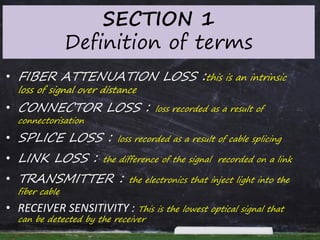
• FIBER ATTENUATION LOSS :this is an intrinsic
loss of signal over distance
• CONNECTOR LOSS : loss recorded as a result of
connectorisation
• SPLICE LOSS : loss recorded as a result of cable splicing
• LINK LOSS : the difference of the signal recorded on a link
• TRANSMITTER : the electronics that inject light into the
fiber cable
• RECEIVER SENSITIVITY : This is the lowest optical signal that
can be detected by the receiver
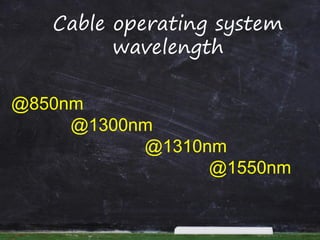
Cable operating system
wavelength
@850nm
@1300nm
@1310nm
@1550nm
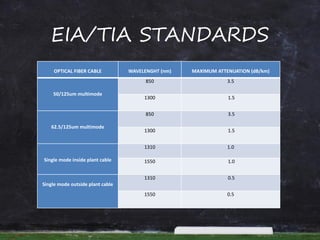
EIA/TIA STANDARDS
OPTICAL FIBER CABLE WAVELENGHT (nm) MAXIMUM ATTENUATION (dB/km)
50/125um multimode
850 3.5
1300 1.5
62.5/125um multimode
850 3.5
1300 1.5
Single mode inside plant cable
1310 1.0
1550 1.0
Single mode outside plant cable
1310 0.5
1550 0.5
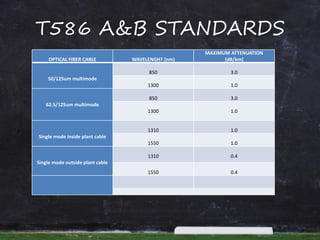
T586 A&B STANDARDS
OPTICAL FIBER CABLE WAVELENGHT (nm)
MAXIMUM ATTENUATION
(dB/km)
50/125um multimode
850 3.0
1300 1.0
62.5/125um multimode
850 3.0
1300 1.0
Single mode inside plant cable
1310 1.0
1550 1.0
Single mode outside plant cable
1310 0.4
1550 0.4
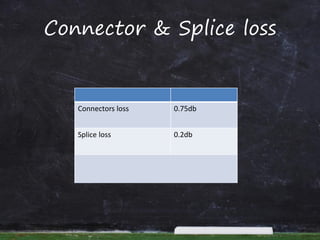
Connector & Splice loss
Connectors loss 0.75db
Splice loss 0.2db
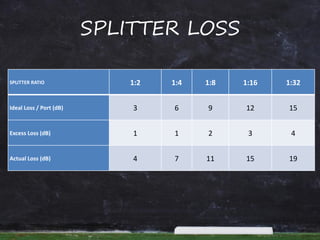
SPLITTER LOSS
SPLITTER RATIO 1:2 1:4 1:8 1:16 1:32
Ideal Loss / Port (dB) 3 6 9 12 15
Excess Loss (dB) 1 1 2 3 4
Actual Loss (dB) 4 7 11 15 19
SECTION 2: LOSS BUDGET
CALCULATION STEPS
(SAMPLE)
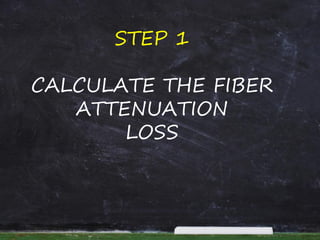
STEP 1
CALCULATE THE FIBER
ATTENUATION
LOSS
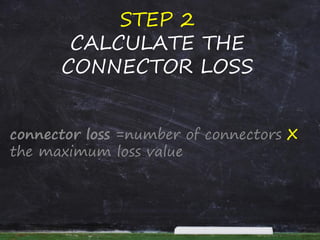
STEP 2
CALCULATE THE
CONNECTOR LOSS
connector loss =number of connectors X
the maximum loss value
STEP 3
CALCULATE THE
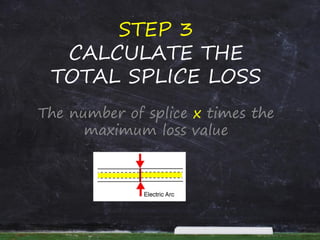
TOTAL SPLICE LOSS
The number of splice x times the
maximum loss value
STEP 4
CALCULATE OTHER
COMPONENT LOSS
if ANY
OTHER COMPONENT SUCH
AS SPLITER,ATTENUATOR,
STEP 5
CALCULATE THE PASIVE
SYSTEM ATTENUATION
This is the addition of
fiber loss + connector loss + splice loss +
other components loss + safety buffer
STEP 6
CALCULATE THE LINK
LOSS BUDGET
Receiver sensitivity - transmitter’s
average output power, (in dBm.)
STEP 7
VERIFY THE SYSTEM
PERFORMANCE MARGIN
Link loss budget - passive system
attenuation
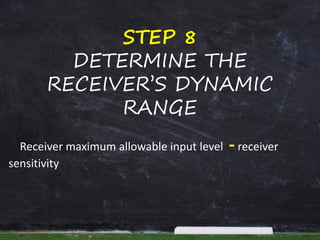
STEP 8
DETERMINE THE
RECEIVER’S DYNAMIC
RANGE
Receiver maximum allowable input level -receiver
sensitivity
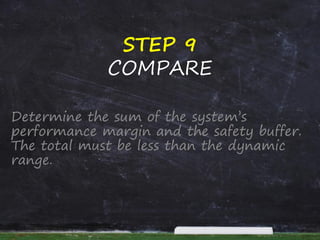
STEP 9
COMPARE
Determine the sum of the system’s
performance margin and the safety buffer.
The total must be less than the dynamic
range.
SECTION 3: CASE STUDY
,
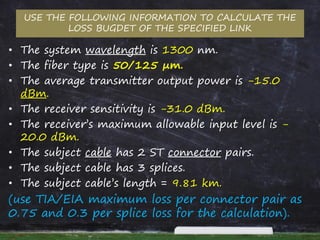
USE THE FOLLOWING INFORMATION TO CALCULATE THE
LOSS BUGDET OF THE SPECIFIED LINK
• The system wavelength is 1300 nm.
• The fiber type is 50/125 µm.
• The average transmitter output power is -15.0
dBm.
• The receiver sensitivity is -31.0 dBm.
• The receiver’s maximum allowable input level is -
20.0 dBm.
• The subject cable has 2 ST connector pairs.
• The subject cable has 3 splices.
• The subject cable’s length = 9.81 km.
(use TIA/EIA maximum loss per connector pair as
0.75 and 0.3 per splice loss for the calculation).
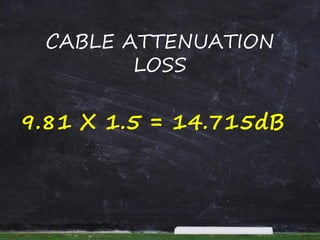
CABLE ATTENUATION
LOSS
9.81 X 1.5 = 14.715dB
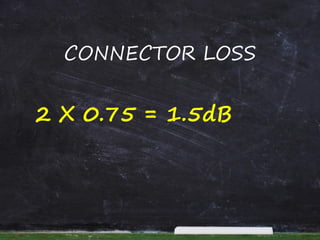
CONNECTOR LOSS
2 X 0.75 = 1.5dB
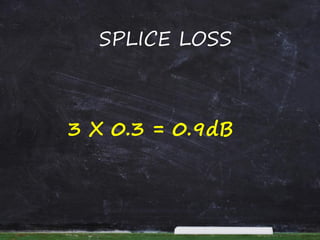
SPLICE LOSS
3 X 0.3 = 0.9dB
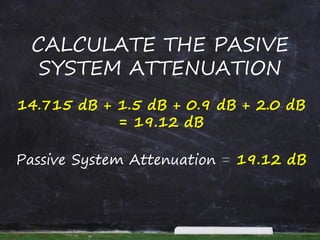
CALCULATE THE PASIVE
SYSTEM ATTENUATION
14.715 dB + 1.5 dB + 0.9 dB + 2.0 dB
= 19.12 dB
Passive System Attenuation = 19.12 dB
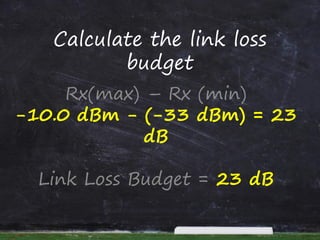
Calculate the link loss
budget
Rx(max) – Rx (min)
-10.0 dBm - (-33 dBm) = 23
dB
Link Loss Budget = 23 dB
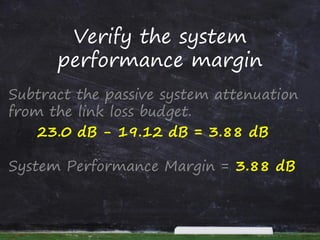
Verify the system
performance margin
Subtract the passive system attenuation
from the link loss budget.
23.0 dB - 19.12 dB = 3.88 dB
System Performance Margin = 3.88 dB
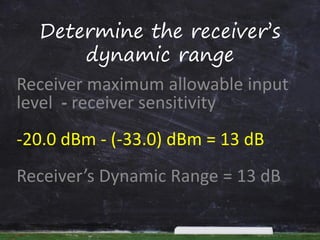
Determine the receiver’s
dynamic range
Receiver maximum allowable input
level - receiver sensitivity
-20.0 dBm - (-33.0) dBm = 13 dB
Receiver’s Dynamic Range = 13 dB
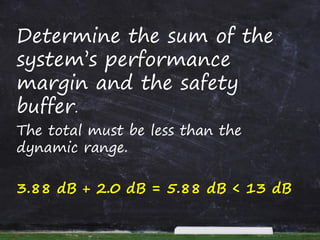
Determine the sum of the
system’s performance
margin and the safety
buffer.
The total must be less than the
dynamic range.
3.88 dB + 2.0 dB = 5.88 dB < 13 dB
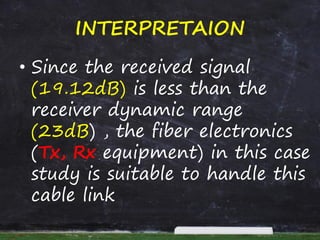
INTERPRETAION
• Since the received signal
(19.12dB) is less than the
receiver dynamic range
(23dB) , the fiber electronics
(Tx, Rx equipment) in this case
study is suitable to handle this
cable link
For all your
fiber Optics
certification
training
in
Nigeria
visit
www.imtfiber.com
and
ww.imtcomputer.net

loss budget calculation in fiber optic link

  • 2.
  • 3.
    SECTION 1: DEFINITIONOF TERMS SECTION 2: LOSS BUDGET CALCULATION STEPS (SAMPLE) SECTION 3: CALCULATION CASE STUDY
  • 4.
    SECTION 1 Definition ofterms • FIBER ATTENUATION LOSS :this is an intrinsic loss of signal over distance • CONNECTOR LOSS : loss recorded as a result of connectorisation • SPLICE LOSS : loss recorded as a result of cable splicing • LINK LOSS : the difference of the signal recorded on a link • TRANSMITTER : the electronics that inject light into the fiber cable • RECEIVER SENSITIVITY : This is the lowest optical signal that can be detected by the receiver
  • 5.
  • 6.
    EIA/TIA STANDARDS OPTICAL FIBERCABLE WAVELENGHT (nm) MAXIMUM ATTENUATION (dB/km) 50/125um multimode 850 3.5 1300 1.5 62.5/125um multimode 850 3.5 1300 1.5 Single mode inside plant cable 1310 1.0 1550 1.0 Single mode outside plant cable 1310 0.5 1550 0.5
  • 7.
    T586 A&B STANDARDS OPTICALFIBER CABLE WAVELENGHT (nm) MAXIMUM ATTENUATION (dB/km) 50/125um multimode 850 3.0 1300 1.0 62.5/125um multimode 850 3.0 1300 1.0 Single mode inside plant cable 1310 1.0 1550 1.0 Single mode outside plant cable 1310 0.4 1550 0.4
  • 8.
    Connector & Spliceloss Connectors loss 0.75db Splice loss 0.2db
  • 9.
    SPLITTER LOSS SPLITTER RATIO1:2 1:4 1:8 1:16 1:32 Ideal Loss / Port (dB) 3 6 9 12 15 Excess Loss (dB) 1 1 2 3 4 Actual Loss (dB) 4 7 11 15 19
  • 10.
    SECTION 2: LOSSBUDGET CALCULATION STEPS (SAMPLE)
  • 11.
    STEP 1 CALCULATE THEFIBER ATTENUATION LOSS
  • 12.
    STEP 2 CALCULATE THE CONNECTORLOSS connector loss =number of connectors X the maximum loss value
  • 13.
    STEP 3 CALCULATE THE TOTALSPLICE LOSS The number of splice x times the maximum loss value
  • 14.
    STEP 4 CALCULATE OTHER COMPONENTLOSS if ANY OTHER COMPONENT SUCH AS SPLITER,ATTENUATOR,
  • 15.
    STEP 5 CALCULATE THEPASIVE SYSTEM ATTENUATION This is the addition of fiber loss + connector loss + splice loss + other components loss + safety buffer
  • 16.
    STEP 6 CALCULATE THELINK LOSS BUDGET Receiver sensitivity - transmitter’s average output power, (in dBm.)
  • 17.
    STEP 7 VERIFY THESYSTEM PERFORMANCE MARGIN Link loss budget - passive system attenuation
  • 18.
    STEP 8 DETERMINE THE RECEIVER’SDYNAMIC RANGE Receiver maximum allowable input level -receiver sensitivity
  • 19.
    STEP 9 COMPARE Determine thesum of the system’s performance margin and the safety buffer. The total must be less than the dynamic range.
  • 20.
  • 21.
    USE THE FOLLOWINGINFORMATION TO CALCULATE THE LOSS BUGDET OF THE SPECIFIED LINK • The system wavelength is 1300 nm. • The fiber type is 50/125 µm. • The average transmitter output power is -15.0 dBm. • The receiver sensitivity is -31.0 dBm. • The receiver’s maximum allowable input level is - 20.0 dBm. • The subject cable has 2 ST connector pairs. • The subject cable has 3 splices. • The subject cable’s length = 9.81 km. (use TIA/EIA maximum loss per connector pair as 0.75 and 0.3 per splice loss for the calculation).
  • 22.
  • 23.
    CONNECTOR LOSS 2 X0.75 = 1.5dB
  • 24.
    SPLICE LOSS 3 X0.3 = 0.9dB
  • 25.
    CALCULATE THE PASIVE SYSTEMATTENUATION 14.715 dB + 1.5 dB + 0.9 dB + 2.0 dB = 19.12 dB Passive System Attenuation = 19.12 dB
  • 26.
    Calculate the linkloss budget Rx(max) – Rx (min) -10.0 dBm - (-33 dBm) = 23 dB Link Loss Budget = 23 dB
  • 27.
    Verify the system performancemargin Subtract the passive system attenuation from the link loss budget. 23.0 dB - 19.12 dB = 3.88 dB System Performance Margin = 3.88 dB
  • 28.
    Determine the receiver’s dynamicrange Receiver maximum allowable input level - receiver sensitivity -20.0 dBm - (-33.0) dBm = 13 dB Receiver’s Dynamic Range = 13 dB
  • 29.
    Determine the sumof the system’s performance margin and the safety buffer. The total must be less than the dynamic range. 3.88 dB + 2.0 dB = 5.88 dB < 13 dB
  • 30.
    INTERPRETAION • Since thereceived signal (19.12dB) is less than the receiver dynamic range (23dB) , the fiber electronics (Tx, Rx equipment) in this case study is suitable to handle this cable link
  • 31.
    For all your fiberOptics certification training in Nigeria visit www.imtfiber.com and ww.imtcomputer.net