1
Min power issue
 While doing min power measurement, B27 can reach
the power level less than -30 dBm, but B28 can NOT[1].
Transceiver
PA
ASM
B27/B28
 As shown below, in terms of hardware, B27/B28 share
the same RF path. In other words, this should NOT be
hardware issue because B27 is normal.
2
Min power issue
 While doing calibration, under the same RGI(RF Gain
Index), there is 10 dB gap for the output power between
B27 and B28[1].
 Nevertheless, under the same RGI, there is no gap for
the output power between B27 and B28 in transceiver
output port. Thus, there should be
something wrong with PA[1].
3
Min power issue
 As shown below, B27 and B28 should be configured LB
and VLB respectively[1]. Thus, if B27/B28 are both
configured LB or VLB, the issue occurs.
4
HSUPA EVM Phase Error Peak fail
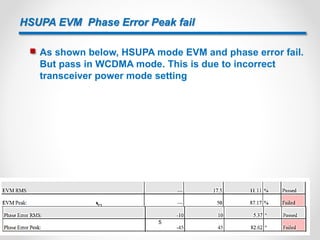
 As shown below, HSUPA mode EVM and phase error fail.
But pass in WCDMA mode. This is due to incorrect
transceiver power mode setting
5
HSUPA EVM Phase Error Peak fail
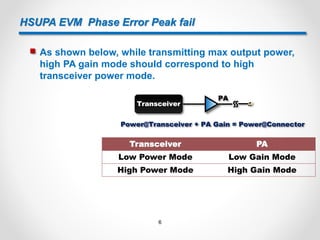
 As shown below, while transmitting max output power,
high PA gain mode should correspond to high
transceiver power mode.
Transceiver
PA
Power@Transceiver + PA Gain = Power@Connector
Transceiver PA
Low Power Mode Low Gain Mode
High Power Mode High Gain Mode
6
HSUPA EVM Phase Error Peak fail
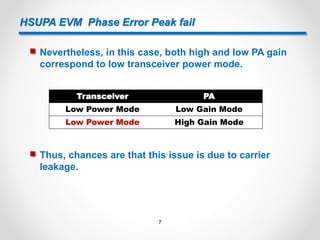
 Nevertheless, in this case, both high and low PA gain
correspond to low transceiver power mode.
Transceiver PA
Low Power Mode Low Gain Mode
Low Power Mode High Gain Mode
 Thus, chances are that this issue is due to carrier
leakage.
7
HSUPA EVM Phase Error Peak fail
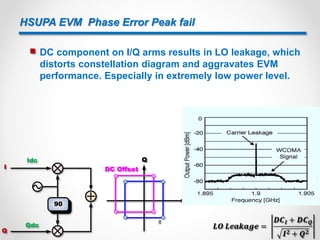
 DC component on I/Q arms results in LO leakage, which
distorts constellation diagram and aggravates EVM
performance. Especially in extremely low power level.
Q
I
DC Offset
8
Transceiver PA
Low Power Mode High Gain Mode
HSUPA EVM Phase Error Peak fail
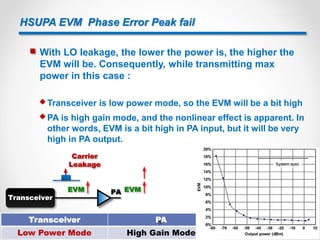
 With LO leakage, the lower the power is, the higher the
EVM will be. Consequently, while transmitting max
power in this case :
 Transceiver is low power mode, so the EVM will be a bit high
 PA is high gain mode, and the nonlinear effect is apparent. In
other words, EVM is a bit high in PA input, but it will be very
high in PA output.
Transceiver
PAEVM EVM
Carrier
Leakage
9
HSUPA EVM Phase Error Peak fail
 According to [3], HSUPA has more strict EVM
specification than WCDMA, that is why WCDMA passes,
but HSUPA fails in this case. WCDMA 17.5%
HSUPA 14%
 The only solution is to modify transceiver power mode
setting while transmitting max power.
10
Max power issue under online mode
 While transmitting max power, B7 can merely reach 22
dBm in online mode, but it can reach 27 dBm in
FTM(Factory Test Mode).
 Take the MMPA, SKY77645-11, for example, PA
output is larger than 27.5 dBm[2]. To Subtract
post-loss from PA output is about 27 dBm.
Online 22 dBm
FTM 27 dBm
PA
ASM
Duplexer
Post-loss
≧ 27.5 dBm
11
Max power issue under online mode
 Thus, as analyzed above, in terms of hardware, the B7
transmitter path is okay.
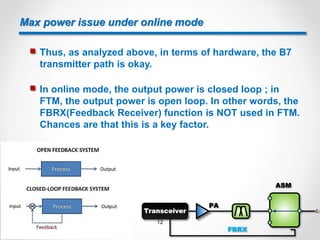
 In online mode, the output power is closed loop ; in
FTM, the output power is open loop. In other words, the
FBRX(Feedback Receiver) function is NOT used in FTM.
Chances are that this is a key factor.
PA
ASM
Transceiver
FBRX
12
Max power issue under online mode
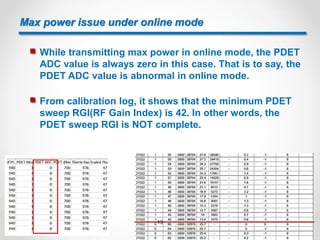
 While transmitting max power in online mode, the PDET
ADC value is always zero in this case. That is to say, the
PDET ADC value is abnormal in online mode.
 From calibration log, it shows that the minimum PDET
sweep RGI(RF Gain Index) is 42. In other words, the
PDET sweep RGI is NOT complete.
13
Max power issue under online mode
 As mentioned earlier, the FBRX function is NOT used in
FTM. Thus, even though PDET sweep RGI is NOT
complete, the output power in FTM is still normal.
 Nevertheless, because FBRX function is used in online
mode, incomplete PDET RGI sweep leads to abnormal
output power in online mode.
 The only solution is to make minimum PDET sweep
RGI(RF Gain Index) be 32, and the corresponding power
is less than 6.8 dBm. By doing this, the PDET sweep
RGI is complete, and the output power is normal in
online mode.
14
Reference
[1] Min power issue based on RF54** design, Qualcomm
[2] SKY77645-11 SkyLiTE™ Multimode Multiband Power Amplifier Module, SKYWORKS
[3] 3GPP TS 25.101
15

Some issue due to incorrect PA and transceiver configuration

  • 1.
  • 2.
    Min power issue While doing min power measurement, B27 can reach the power level less than -30 dBm, but B28 can NOT[1]. Transceiver PA ASM B27/B28  As shown below, in terms of hardware, B27/B28 share the same RF path. In other words, this should NOT be hardware issue because B27 is normal. 2
  • 3.
    Min power issue While doing calibration, under the same RGI(RF Gain Index), there is 10 dB gap for the output power between B27 and B28[1].  Nevertheless, under the same RGI, there is no gap for the output power between B27 and B28 in transceiver output port. Thus, there should be something wrong with PA[1]. 3
  • 4.
    Min power issue As shown below, B27 and B28 should be configured LB and VLB respectively[1]. Thus, if B27/B28 are both configured LB or VLB, the issue occurs. 4
  • 5.
    HSUPA EVM PhaseError Peak fail  As shown below, HSUPA mode EVM and phase error fail. But pass in WCDMA mode. This is due to incorrect transceiver power mode setting 5
  • 6.
    HSUPA EVM PhaseError Peak fail  As shown below, while transmitting max output power, high PA gain mode should correspond to high transceiver power mode. Transceiver PA Power@Transceiver + PA Gain = Power@Connector Transceiver PA Low Power Mode Low Gain Mode High Power Mode High Gain Mode 6
  • 7.
    HSUPA EVM PhaseError Peak fail  Nevertheless, in this case, both high and low PA gain correspond to low transceiver power mode. Transceiver PA Low Power Mode Low Gain Mode Low Power Mode High Gain Mode  Thus, chances are that this issue is due to carrier leakage. 7
  • 8.
    HSUPA EVM PhaseError Peak fail  DC component on I/Q arms results in LO leakage, which distorts constellation diagram and aggravates EVM performance. Especially in extremely low power level. Q I DC Offset 8
  • 9.
    Transceiver PA Low PowerMode High Gain Mode HSUPA EVM Phase Error Peak fail  With LO leakage, the lower the power is, the higher the EVM will be. Consequently, while transmitting max power in this case :  Transceiver is low power mode, so the EVM will be a bit high  PA is high gain mode, and the nonlinear effect is apparent. In other words, EVM is a bit high in PA input, but it will be very high in PA output. Transceiver PAEVM EVM Carrier Leakage 9
  • 10.
    HSUPA EVM PhaseError Peak fail  According to [3], HSUPA has more strict EVM specification than WCDMA, that is why WCDMA passes, but HSUPA fails in this case. WCDMA 17.5% HSUPA 14%  The only solution is to modify transceiver power mode setting while transmitting max power. 10
  • 11.
    Max power issueunder online mode  While transmitting max power, B7 can merely reach 22 dBm in online mode, but it can reach 27 dBm in FTM(Factory Test Mode).  Take the MMPA, SKY77645-11, for example, PA output is larger than 27.5 dBm[2]. To Subtract post-loss from PA output is about 27 dBm. Online 22 dBm FTM 27 dBm PA ASM Duplexer Post-loss ≧ 27.5 dBm 11
  • 12.
    Max power issueunder online mode  Thus, as analyzed above, in terms of hardware, the B7 transmitter path is okay.  In online mode, the output power is closed loop ; in FTM, the output power is open loop. In other words, the FBRX(Feedback Receiver) function is NOT used in FTM. Chances are that this is a key factor. PA ASM Transceiver FBRX 12
  • 13.
    Max power issueunder online mode  While transmitting max power in online mode, the PDET ADC value is always zero in this case. That is to say, the PDET ADC value is abnormal in online mode.  From calibration log, it shows that the minimum PDET sweep RGI(RF Gain Index) is 42. In other words, the PDET sweep RGI is NOT complete. 13
  • 14.
    Max power issueunder online mode  As mentioned earlier, the FBRX function is NOT used in FTM. Thus, even though PDET sweep RGI is NOT complete, the output power in FTM is still normal.  Nevertheless, because FBRX function is used in online mode, incomplete PDET RGI sweep leads to abnormal output power in online mode.  The only solution is to make minimum PDET sweep RGI(RF Gain Index) be 32, and the corresponding power is less than 6.8 dBm. By doing this, the PDET sweep RGI is complete, and the output power is normal in online mode. 14
  • 15.
    Reference [1] Min powerissue based on RF54** design, Qualcomm [2] SKY77645-11 SkyLiTE™ Multimode Multiband Power Amplifier Module, SKYWORKS [3] 3GPP TS 25.101 15