LOSS BUDGET
CALCULATION OF FIBER
CABLE LINK
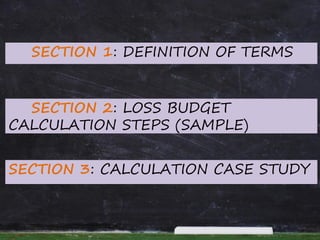
SECTION 1: DEFINITION OF TERMS
SECTION 2: LOSS BUDGET
CALCULATION STEPS (SAMPLE)
SECTION 3: CALCULATION CASE STUDY
SECTION 1
Definition of terms
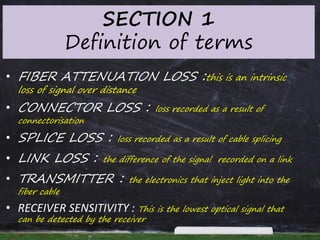
• FIBER ATTENUATION LOSS :this is an intrinsic
loss of signal over distance
• CONNECTOR LOSS : loss recorded as a result of
connectorisation
• SPLICE LOSS : loss recorded as a result of cable splicing
• LINK LOSS : the difference of the signal recorded on a link
• TRANSMITTER : the electronics that inject light into the
fiber cable
• RECEIVER SENSITIVITY : This is the lowest optical signal that
can be detected by the receiver
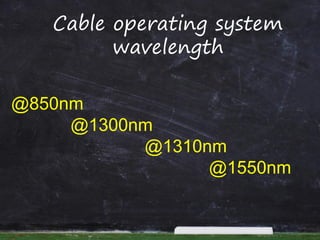
Cable operating system
wavelength
@850nm
@1300nm
@1310nm
@1550nm
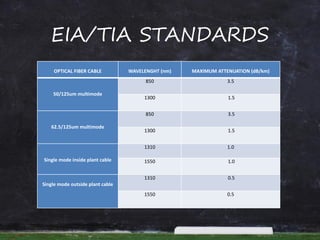
EIA/TIA STANDARDS
OPTICAL FIBER CABLE WAVELENGHT (nm) MAXIMUM ATTENUATION (dB/km)
50/125um multimode
850 3.5
1300 1.5
62.5/125um multimode
850 3.5
1300 1.5
Single mode inside plant cable
1310 1.0
1550 1.0
Single mode outside plant cable
1310 0.5
1550 0.5
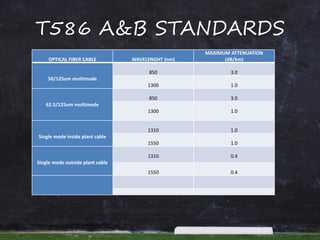
T586 A&B STANDARDS
OPTICAL FIBER CABLE WAVELENGHT (nm)
MAXIMUM ATTENUATION
(dB/km)
50/125um multimode
850 3.0
1300 1.0
62.5/125um multimode
850 3.0
1300 1.0
Single mode inside plant cable
1310 1.0
1550 1.0
Single mode outside plant cable
1310 0.4
1550 0.4
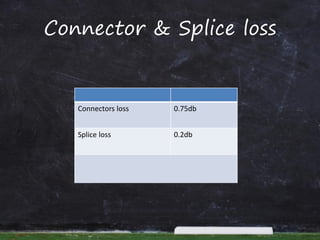
Connector & Splice loss
Connectors loss 0.75db
Splice loss 0.2db
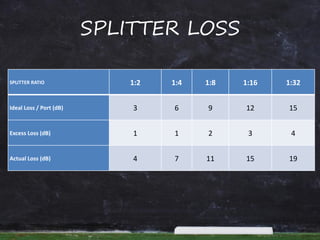
SPLITTER LOSS
SPLITTER RATIO 1:2 1:4 1:8 1:16 1:32
Ideal Loss / Port (dB) 3 6 9 12 15
Excess Loss (dB) 1 1 2 3 4
Actual Loss (dB) 4 7 11 15 19
SECTION 2: LOSS BUDGET
CALCULATION STEPS
(SAMPLE)
STEP 1
CALCULATE THE FIBER
ATTENUATION
LOSS
STEP 2
CALCULATE THE
CONNECTOR LOSS
connector loss =number of connectors X
the maximum loss value
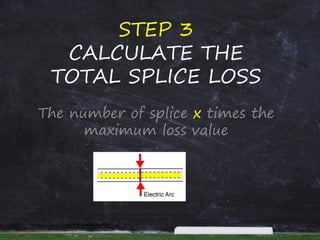
STEP 3
CALCULATE THE
TOTAL SPLICE LOSS
The number of splice x times the
maximum loss value
STEP 4
CALCULATE OTHER
COMPONENT LOSS
if ANY
OTHER COMPONENT SUCH
AS SPLITER,ATTENUATOR,
STEP 5
CALCULATE THE PASIVE
SYSTEM ATTENUATION
This is the addition of
fiber loss + connector loss + splice loss +
other components loss + safety buffer
STEP 6
CALCULATE THE LINK
LOSS BUDGET
Receiver sensitivity - transmitter’s
average output power, (in dBm.)
STEP 7
VERIFY THE SYSTEM
PERFORMANCE MARGIN
Link loss budget - passive system
attenuation
STEP 8
DETERMINE THE
RECEIVER’S DYNAMIC
RANGE
Receiver maximum allowable input level -receiver
sensitivity
STEP 9
COMPARE
Determine the sum of the system’s
performance margin and the safety buffer.
The total must be less than the dynamic
range.
SECTION 3: CASE STUDY
,
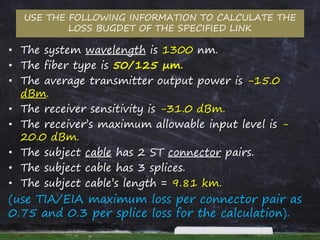
USE THE FOLLOWING INFORMATION TO CALCULATE THE
LOSS BUGDET OF THE SPECIFIED LINK
• The system wavelength is 1300 nm.
• The fiber type is 50/125 µm.
• The average transmitter output power is -15.0
dBm.
• The receiver sensitivity is -31.0 dBm.
• The receiver’s maximum allowable input level is -
20.0 dBm.
• The subject cable has 2 ST connector pairs.
• The subject cable has 3 splices.
• The subject cable’s length = 9.81 km.
(use TIA/EIA maximum loss per connector pair as
0.75 and 0.3 per splice loss for the calculation).
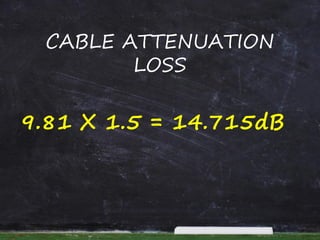
CABLE ATTENUATION
LOSS
9.81 X 1.5 = 14.715dB
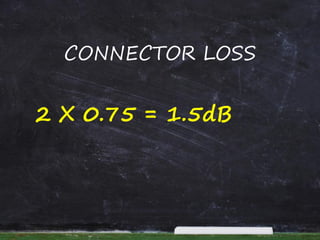
CONNECTOR LOSS
2 X 0.75 = 1.5dB
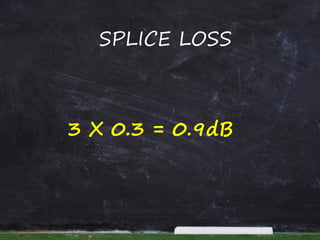
SPLICE LOSS
3 X 0.3 = 0.9dB
CALCULATE THE PASIVE
SYSTEM ATTENUATION
14.715 dB + 1.5 dB + 0.9 dB + 2.0 dB
= 19.12 dB
Passive System Attenuation = 19.12 dB
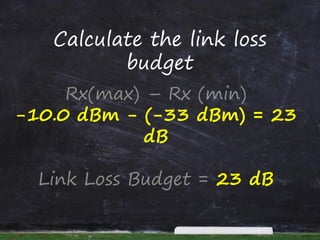
Calculate the link loss
budget
Rx(max) – Rx (min)
-10.0 dBm - (-33 dBm) = 23
dB
Link Loss Budget = 23 dB
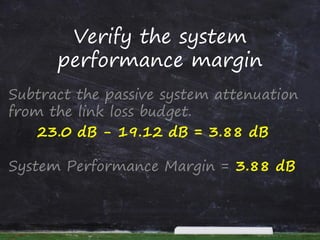
Verify the system
performance margin
Subtract the passive system attenuation
from the link loss budget.
23.0 dB - 19.12 dB = 3.88 dB
System Performance Margin = 3.88 dB
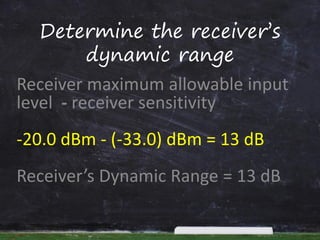
Determine the receiver’s
dynamic range
Receiver maximum allowable input
level - receiver sensitivity
-20.0 dBm - (-33.0) dBm = 13 dB
Receiver’s Dynamic Range = 13 dB
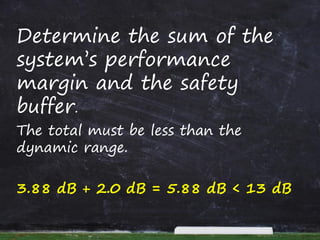
Determine the sum of the
system’s performance
margin and the safety
buffer.
The total must be less than the
dynamic range.
3.88 dB + 2.0 dB = 5.88 dB < 13 dB
INTERPRETAION
• Since the received signal
(19.12dB) is less than the
receiver dynamic range
(23dB) , the fiber electronics
(Tx, Rx equipment) in this case
study is suitable to handle this
cable link
For all your
fiber Optics
certification
training
in
Nigeria
visit
www.imtfiber.com
and
ww.imtcomputer.net

9 steps to calculate loss budget

  • 2.
  • 3.
    SECTION 1: DEFINITIONOF TERMS SECTION 2: LOSS BUDGET CALCULATION STEPS (SAMPLE) SECTION 3: CALCULATION CASE STUDY
  • 4.
    SECTION 1 Definition ofterms • FIBER ATTENUATION LOSS :this is an intrinsic loss of signal over distance • CONNECTOR LOSS : loss recorded as a result of connectorisation • SPLICE LOSS : loss recorded as a result of cable splicing • LINK LOSS : the difference of the signal recorded on a link • TRANSMITTER : the electronics that inject light into the fiber cable • RECEIVER SENSITIVITY : This is the lowest optical signal that can be detected by the receiver
  • 5.
  • 6.
    EIA/TIA STANDARDS OPTICAL FIBERCABLE WAVELENGHT (nm) MAXIMUM ATTENUATION (dB/km) 50/125um multimode 850 3.5 1300 1.5 62.5/125um multimode 850 3.5 1300 1.5 Single mode inside plant cable 1310 1.0 1550 1.0 Single mode outside plant cable 1310 0.5 1550 0.5
  • 7.
    T586 A&B STANDARDS OPTICALFIBER CABLE WAVELENGHT (nm) MAXIMUM ATTENUATION (dB/km) 50/125um multimode 850 3.0 1300 1.0 62.5/125um multimode 850 3.0 1300 1.0 Single mode inside plant cable 1310 1.0 1550 1.0 Single mode outside plant cable 1310 0.4 1550 0.4
  • 8.
    Connector & Spliceloss Connectors loss 0.75db Splice loss 0.2db
  • 9.
    SPLITTER LOSS SPLITTER RATIO1:2 1:4 1:8 1:16 1:32 Ideal Loss / Port (dB) 3 6 9 12 15 Excess Loss (dB) 1 1 2 3 4 Actual Loss (dB) 4 7 11 15 19
  • 10.
    SECTION 2: LOSSBUDGET CALCULATION STEPS (SAMPLE)
  • 11.
    STEP 1 CALCULATE THEFIBER ATTENUATION LOSS
  • 12.
    STEP 2 CALCULATE THE CONNECTORLOSS connector loss =number of connectors X the maximum loss value
  • 13.
    STEP 3 CALCULATE THE TOTALSPLICE LOSS The number of splice x times the maximum loss value
  • 14.
    STEP 4 CALCULATE OTHER COMPONENTLOSS if ANY OTHER COMPONENT SUCH AS SPLITER,ATTENUATOR,
  • 15.
    STEP 5 CALCULATE THEPASIVE SYSTEM ATTENUATION This is the addition of fiber loss + connector loss + splice loss + other components loss + safety buffer
  • 16.
    STEP 6 CALCULATE THELINK LOSS BUDGET Receiver sensitivity - transmitter’s average output power, (in dBm.)
  • 17.
    STEP 7 VERIFY THESYSTEM PERFORMANCE MARGIN Link loss budget - passive system attenuation
  • 18.
    STEP 8 DETERMINE THE RECEIVER’SDYNAMIC RANGE Receiver maximum allowable input level -receiver sensitivity
  • 19.
    STEP 9 COMPARE Determine thesum of the system’s performance margin and the safety buffer. The total must be less than the dynamic range.
  • 20.
  • 21.
    USE THE FOLLOWINGINFORMATION TO CALCULATE THE LOSS BUGDET OF THE SPECIFIED LINK • The system wavelength is 1300 nm. • The fiber type is 50/125 µm. • The average transmitter output power is -15.0 dBm. • The receiver sensitivity is -31.0 dBm. • The receiver’s maximum allowable input level is - 20.0 dBm. • The subject cable has 2 ST connector pairs. • The subject cable has 3 splices. • The subject cable’s length = 9.81 km. (use TIA/EIA maximum loss per connector pair as 0.75 and 0.3 per splice loss for the calculation).
  • 22.
  • 23.
    CONNECTOR LOSS 2 X0.75 = 1.5dB
  • 24.
    SPLICE LOSS 3 X0.3 = 0.9dB
  • 25.
    CALCULATE THE PASIVE SYSTEMATTENUATION 14.715 dB + 1.5 dB + 0.9 dB + 2.0 dB = 19.12 dB Passive System Attenuation = 19.12 dB
  • 26.
    Calculate the linkloss budget Rx(max) – Rx (min) -10.0 dBm - (-33 dBm) = 23 dB Link Loss Budget = 23 dB
  • 27.
    Verify the system performancemargin Subtract the passive system attenuation from the link loss budget. 23.0 dB - 19.12 dB = 3.88 dB System Performance Margin = 3.88 dB
  • 28.
    Determine the receiver’s dynamicrange Receiver maximum allowable input level - receiver sensitivity -20.0 dBm - (-33.0) dBm = 13 dB Receiver’s Dynamic Range = 13 dB
  • 29.
    Determine the sumof the system’s performance margin and the safety buffer. The total must be less than the dynamic range. 3.88 dB + 2.0 dB = 5.88 dB < 13 dB
  • 30.
    INTERPRETAION • Since thereceived signal (19.12dB) is less than the receiver dynamic range (23dB) , the fiber electronics (Tx, Rx equipment) in this case study is suitable to handle this cable link
  • 31.
    For all your fiberOptics certification training in Nigeria visit www.imtfiber.com and ww.imtcomputer.net