GSM LINK BUDGET
Naveen Jakhar, ITS
Content
 What is a link budget?
 Objectives
 Commonly used terms
 Calculations
Link Budget
 It is a way of quantifying the link performance
 It includes analysis of all losses and gains in a
transmission system ( from the transmitter
through the medium to the receiver)
why link budget ?
 Link budget is calculated in design of mobile
communication system for the proper call
establishment.
 Quality of call establishment is based on received
signal strength. The received signal strength
depends on the path loss and the parameters of the
transmitter and receiver. Signal strength also varies
based on the environment and the intermediate
losses
OBJECTIVES
 to estimate the maximum allowable path loss
 to compute the required EIRP for a balanced
path
 to estimate the coverage design threshold
 to evaluate technology performance
Parameters
The link budget includes the following key parameters.
 Transmitted power
 Antenna gains (both transmitter antenna gain and
receiver antenna gain)
 Antenna feeder losses
 Path loss
 Receiver sensitivity
ERP vs EiRP
ERP (Effective Radiated Power)
the Radiated power (transmit power times antenna
gain) with respect to a dipole antenna
EiRP (Effective isotropic Radiated Power)
the radiated power from an isotropic antenna
EiRP = ERP + 2.15 (dB)
Antenna Gain
 A relative measure of an antenna's ability to direct or
concentrate radio frequency energy in a particular direction or
pattern.
 describes how much power is transmitted in the direction
of peak radiation to that of an isotropic source
 A transmitting antenna with a gain of 3 dB means that the
power received far from the antenna will be 3 dB higher
(twice as much) than what would be received from a
lossless isotropic antenna with the same input power.
Units for Antenna Gain
 dB - decibels, ratio of power levels. 10 dB means 10 times the energy
relative to an isotropic antenna in the peak direction of radiation
 dBi - "decibels relative to an isotropic antenna". This is the same as dB . 3
dBi means twice (2x) the power relative to an isotropic antenna in the peak
direction
 dBd - "decibels relative to a dipole antenna.
A half-wavelength dipole antenna has a gain of 2.15 dBi. Hence, 7.85 dBd
means the peak gain is 7.85 dB higher than a dipole antenna; this is 10 dB
higher than an isotropic antenna.
gain in dBd = gain in dBi − 2.15 d
Diversity Gain
 Diversity gain is the increase in signal-to-interference
ratio due to some diversity scheme
 A diversity scheme refers to a method for improving
the reliability of a message signal by using two or
more communication channels with different
characteristics. Diversity is mainly used in radio
communication and is a common technique for
combating fading and co-channel interference and
avoiding error bursts. It is based on the fact that
individual channels experience different levels of
fading and interference
Rx Sensitivity
 Receiver sensitivity is a measure of how well the
receiver performs and is defined as the power of
the weakest signal the receiver can detect
Path Loss
 The path loss is the unwanted reduction in the signal strength
during the propagation of the transmitted signal from the
transmitter to the receiver.
 It may be due to many effects, such as free-space
loss, refraction, diffraction, reflection,aperture-
medium coupling loss, and absorption.
 It is also influenced by terrain contours, environment (urban or
rural, vegetation and foliage), propagation medium (dry or
moist air), the distance between the transmitter and the
receiver, and the height and location of antennas
 HATA model is the most widely used radio frequency
propagation model for predicting the behaviour of cellular
transmission.
Feeder loss
 ALL feeders have loss
 the longer the feeder the greater the loss
Body Loss
 Body loss indicates the loss generated due to signal
blocking and absorption when a terminal antenna is
close to the body. This affects handsets in particular.
 An Node B antenna is mounted at a height of tens of
meters, in which case body loss can be ignored as the
body loss value is 0 dB. For mobile terminals, body
loss must be considered and in this instance, the body
loss is about 3 dB.
Penetration loss
 an extra signal attenuation associated to building
penetration
Fade margin
 Fade Margin is an expression for how much margin - in
dB - there is between the received signal strength level
and the receiver sensitivity of the radio.
 A design allowance that provides for sufficient system
gain or sensitivity to accommodate expected fading, for
the purpose of ensuring that the required quality of
service is maintained.
 The amount by which a received signal level may be
reduced without causing system performance to fall
below a specified threshold value.
Link Budget Element of a GSM Network
BTS Antenna Gain
Max. Path Loss
(PLmax)
Fade Margin
LNA
(optional)
Feeder Loss
Diversity
Gain
BTS Receiver
Sensitivity
ACE
Loss
BTS Transmit
Power
Penetration Loss
MS Antenna Gain,
Body and Cable
Loss
Mobile
Transmit Power
Mobile Receiver
Sensitivity
Link Budget Equation
In order to formulate a link budget equation, it is required to look into all the
areas where gains and losses may occur between the transmitter and the
receiver.
PRX = PTX + GTX + GRX - LTX - LFS - LFM – LRX
PRX= received power (dBm)
PTX= transmitter output power (dBm)
GTX = transmitter antenna gain (dBi)
GRX= receiver antenna gain (dBi)
LTX = transmitter feeder and connector losses (dB)
LFS = free space loss or path loss (dB)
LFM = many-sided signal propagation losses (dB)
LRX = receiver feeder connector losses (dB)
Link Budget calculation
 Link budget calculation involves both uplink and
downlink calculation.
 In uplink, the signal transmission is from MS to the
BTS. Here MS acts as a transmitter and the BTS acts
as receiver.
 In downlink, the signal transmission is from the BTS
to the MS. Here BTS acts as a transmitter and the
MS acts as a receiver.
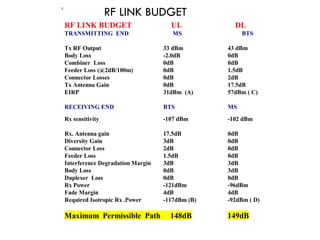
z
RF LINK BUDGET UL DL
TRANSMITTING END MS BTS
Tx RF Output 33 dBm 43 dBm
Body Loss -2.0dB 0dB
Combiner Loss 0dB 0dB
Feeder Loss (@2dB/100m) 0dB 1.5dB
Connector Losses 0dB 2dB
Tx Antenna Gain 0dB 17.5dB
EIRP 31dBm (A) 57dBm ( C)
RECEIVING END BTS MS
Rx sensitivity -107 dBm -102 dBm
Rx. Antenna gain 17.5dB 0dB
Diversity Gain 3dB 0dB
Connector Loss 2dB 0dB
Feeder Loss 1.5dB 0dB
Interference Degradation Margin 3dB 3dB
Body Loss 0dB 3dB
Duplexer Loss 0dB 0dB
Rx Power -121dBm -96dBm
Fade Margin 4dB 4dB
Required Isotropic Rx .Power -117dBm (B) -92dBm ( D)
Maximum Permissible Path 148dB 149dB
RF LINK BUDGET
21
Types of Coverage
Indoor Coverage : RSS ≥ -65 dBm
In-Car Coverage : RSS ≥ -75 dBm
Outdoor Coverage: RSS ≥ -85 dBm
Radio coverage requirements
 Indoor Coverage: Signal level measured at street level shall be better than
–65dBm.
 In car coverage: Signal level measured at street level shall be better than
–75 dBm.
 Outdoor Coverage: At least 95% of the remaining coverage area. Signal
level measured at street level shall be better than –85 dBm.
 The indoor coverage shall be provided in all the commercial areas, Multi-
storied housing complexes, star hotels, industrial areas, software/Hardware
technology parks, airports, railway stations etc.
 The coverage shall be provided in all the residential areas, tourist spots,
roads, lanes, high ways, bypasses and rail routes.
 The remaining areas shall be provided with out-door coverage.
THANK YOU

GSM Link Budget

  • 1.
  • 2.
    Content  What isa link budget?  Objectives  Commonly used terms  Calculations
  • 3.
    Link Budget  Itis a way of quantifying the link performance  It includes analysis of all losses and gains in a transmission system ( from the transmitter through the medium to the receiver)
  • 4.
    why link budget?  Link budget is calculated in design of mobile communication system for the proper call establishment.  Quality of call establishment is based on received signal strength. The received signal strength depends on the path loss and the parameters of the transmitter and receiver. Signal strength also varies based on the environment and the intermediate losses
  • 5.
    OBJECTIVES  to estimatethe maximum allowable path loss  to compute the required EIRP for a balanced path  to estimate the coverage design threshold  to evaluate technology performance
  • 6.
    Parameters The link budgetincludes the following key parameters.  Transmitted power  Antenna gains (both transmitter antenna gain and receiver antenna gain)  Antenna feeder losses  Path loss  Receiver sensitivity
  • 7.
    ERP vs EiRP ERP(Effective Radiated Power) the Radiated power (transmit power times antenna gain) with respect to a dipole antenna EiRP (Effective isotropic Radiated Power) the radiated power from an isotropic antenna EiRP = ERP + 2.15 (dB)
  • 8.
    Antenna Gain  Arelative measure of an antenna's ability to direct or concentrate radio frequency energy in a particular direction or pattern.  describes how much power is transmitted in the direction of peak radiation to that of an isotropic source  A transmitting antenna with a gain of 3 dB means that the power received far from the antenna will be 3 dB higher (twice as much) than what would be received from a lossless isotropic antenna with the same input power.
  • 9.
    Units for AntennaGain  dB - decibels, ratio of power levels. 10 dB means 10 times the energy relative to an isotropic antenna in the peak direction of radiation  dBi - "decibels relative to an isotropic antenna". This is the same as dB . 3 dBi means twice (2x) the power relative to an isotropic antenna in the peak direction  dBd - "decibels relative to a dipole antenna. A half-wavelength dipole antenna has a gain of 2.15 dBi. Hence, 7.85 dBd means the peak gain is 7.85 dB higher than a dipole antenna; this is 10 dB higher than an isotropic antenna. gain in dBd = gain in dBi − 2.15 d
  • 10.
    Diversity Gain  Diversitygain is the increase in signal-to-interference ratio due to some diversity scheme  A diversity scheme refers to a method for improving the reliability of a message signal by using two or more communication channels with different characteristics. Diversity is mainly used in radio communication and is a common technique for combating fading and co-channel interference and avoiding error bursts. It is based on the fact that individual channels experience different levels of fading and interference
  • 11.
    Rx Sensitivity  Receiversensitivity is a measure of how well the receiver performs and is defined as the power of the weakest signal the receiver can detect
  • 12.
    Path Loss  Thepath loss is the unwanted reduction in the signal strength during the propagation of the transmitted signal from the transmitter to the receiver.  It may be due to many effects, such as free-space loss, refraction, diffraction, reflection,aperture- medium coupling loss, and absorption.  It is also influenced by terrain contours, environment (urban or rural, vegetation and foliage), propagation medium (dry or moist air), the distance between the transmitter and the receiver, and the height and location of antennas  HATA model is the most widely used radio frequency propagation model for predicting the behaviour of cellular transmission.
  • 13.
    Feeder loss  ALLfeeders have loss  the longer the feeder the greater the loss
  • 14.
    Body Loss  Bodyloss indicates the loss generated due to signal blocking and absorption when a terminal antenna is close to the body. This affects handsets in particular.  An Node B antenna is mounted at a height of tens of meters, in which case body loss can be ignored as the body loss value is 0 dB. For mobile terminals, body loss must be considered and in this instance, the body loss is about 3 dB.
  • 15.
    Penetration loss  anextra signal attenuation associated to building penetration
  • 16.
    Fade margin  FadeMargin is an expression for how much margin - in dB - there is between the received signal strength level and the receiver sensitivity of the radio.  A design allowance that provides for sufficient system gain or sensitivity to accommodate expected fading, for the purpose of ensuring that the required quality of service is maintained.  The amount by which a received signal level may be reduced without causing system performance to fall below a specified threshold value.
  • 17.
    Link Budget Elementof a GSM Network BTS Antenna Gain Max. Path Loss (PLmax) Fade Margin LNA (optional) Feeder Loss Diversity Gain BTS Receiver Sensitivity ACE Loss BTS Transmit Power Penetration Loss MS Antenna Gain, Body and Cable Loss Mobile Transmit Power Mobile Receiver Sensitivity
  • 18.
    Link Budget Equation Inorder to formulate a link budget equation, it is required to look into all the areas where gains and losses may occur between the transmitter and the receiver. PRX = PTX + GTX + GRX - LTX - LFS - LFM – LRX PRX= received power (dBm) PTX= transmitter output power (dBm) GTX = transmitter antenna gain (dBi) GRX= receiver antenna gain (dBi) LTX = transmitter feeder and connector losses (dB) LFS = free space loss or path loss (dB) LFM = many-sided signal propagation losses (dB) LRX = receiver feeder connector losses (dB)
  • 19.
    Link Budget calculation Link budget calculation involves both uplink and downlink calculation.  In uplink, the signal transmission is from MS to the BTS. Here MS acts as a transmitter and the BTS acts as receiver.  In downlink, the signal transmission is from the BTS to the MS. Here BTS acts as a transmitter and the MS acts as a receiver.
  • 20.
    z RF LINK BUDGETUL DL TRANSMITTING END MS BTS Tx RF Output 33 dBm 43 dBm Body Loss -2.0dB 0dB Combiner Loss 0dB 0dB Feeder Loss (@2dB/100m) 0dB 1.5dB Connector Losses 0dB 2dB Tx Antenna Gain 0dB 17.5dB EIRP 31dBm (A) 57dBm ( C) RECEIVING END BTS MS Rx sensitivity -107 dBm -102 dBm Rx. Antenna gain 17.5dB 0dB Diversity Gain 3dB 0dB Connector Loss 2dB 0dB Feeder Loss 1.5dB 0dB Interference Degradation Margin 3dB 3dB Body Loss 0dB 3dB Duplexer Loss 0dB 0dB Rx Power -121dBm -96dBm Fade Margin 4dB 4dB Required Isotropic Rx .Power -117dBm (B) -92dBm ( D) Maximum Permissible Path 148dB 149dB RF LINK BUDGET
  • 21.
    21 Types of Coverage IndoorCoverage : RSS ≥ -65 dBm In-Car Coverage : RSS ≥ -75 dBm Outdoor Coverage: RSS ≥ -85 dBm
  • 22.
    Radio coverage requirements Indoor Coverage: Signal level measured at street level shall be better than –65dBm.  In car coverage: Signal level measured at street level shall be better than –75 dBm.  Outdoor Coverage: At least 95% of the remaining coverage area. Signal level measured at street level shall be better than –85 dBm.  The indoor coverage shall be provided in all the commercial areas, Multi- storied housing complexes, star hotels, industrial areas, software/Hardware technology parks, airports, railway stations etc.  The coverage shall be provided in all the residential areas, tourist spots, roads, lanes, high ways, bypasses and rail routes.  The remaining areas shall be provided with out-door coverage.
  • 23.