DWDM Principles
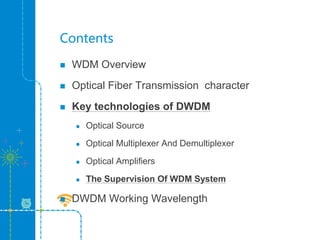
Contents
 WDM Overview
 Optical Fiber Transmission character
 Key technologies of DWDM
 DWDM Working Wavelength
© ZTE Corporation. All rights reserved
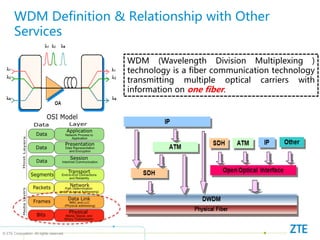
WDM Definition & Relationship with Other
Services
WDM (Wavelength Division Multiplexing )
technology is a fiber communication technology
transmitting multiple optical carriers with
information on one fiber.
© ZTE Corporation. All rights reserved
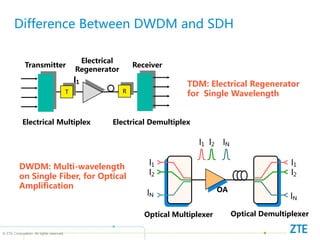
T R
l1
Electrical Multiplex Electrical Demultiplex
Transmitter Receiver
Electrical
Regenerator
lN
l2
l1
lN
l2
l1
lN
l2
l1
Optical Multiplexer Optical Demultiplexer
OA
TDM: Electrical Regenerator
for Single Wavelength
DWDM: Multi-wavelength
on Single Fiber, for Optical
Amplification
Difference Between DWDM and SDH
© ZTE Corporation. All rights reserved
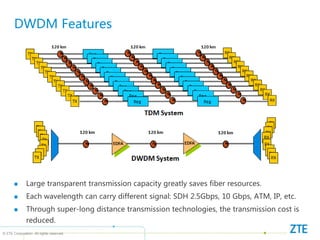
DWDM Features
 Large transparent transmission capacity greatly saves fiber resources.
 Each wavelength can carry different signal: SDH 2.5Gbps, 10 Gbps, ATM, IP, etc.
 Through super-long distance transmission technologies, the transmission cost is
reduced.
© ZTE Corporation. All rights reserved
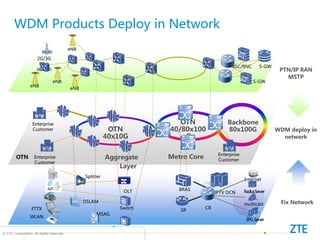
WDM Products Deploy in Network
Metro Core
Aggregate
Layer
CR
SR
BRAS
Switch
DSLAM
Splitter
OLT
MSAG
Enterprise
Customer
2G/3G
Base
station
eNB
S-GW
S-GW
BSC/RNC
Enterprise
Customer
Enterprise
Customer
FTTX
WLAN
IPTV DCN
Internet
RadiusServer
multicast
EPGServer
WDM deploy in
network
PTN/IP RAN
MSTP
Fix Network
Backbone
80x100G
OTN
40/80x100
G
OTN
40x10G
OTN
eNB
eNB
eNB
© ZTE Corporation. All rights reserved
WDM Classification
 CWDM: Coarse Wavelength Division
Multiplexing
 DWDM : Dense Wavelength Division
Multiplexing
© ZTE Corporation. All rights reserved
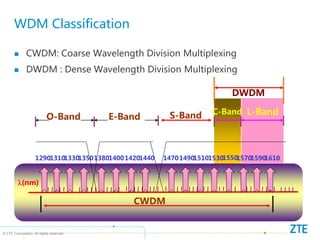
WDM Classification
 CWDM: Coarse Wavelength Division Multiplexing
 DWDM : Dense Wavelength Division Multiplexing
12901310133013501380140014201440 14701490
DWDM
E-Band
L-Band
(nm)
151015301550
1570 1610
1590
O-Band
CWDM
C-Band
S-Band
© ZTE Corporation. All rights reserved
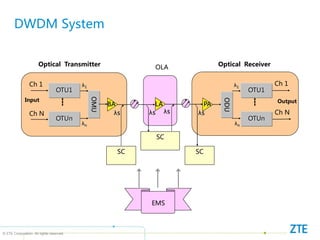
OTU1
┇
Input
Ch 1
Ch N
Ch 1
Ch N
λ1
λn
OTUn
OMU
BA LA PA
ODU
λ1
λn
OTU1
┇
OTUn
λs λs λs λs
SC
SC SC
Output
EMS
Optical Transmitter OLA Optical Receiver
DWDM System
© ZTE Corporation. All rights reserved
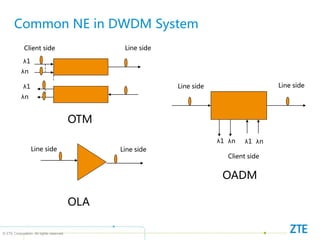
Common NE in DWDM System
Client side Line side
λ1
λn
λ1
λn
OTM
Line side Line side
OLA
Client side
Line side Line side
λ1 λn λ1 λn
OADM
© ZTE Corporation. All rights reserved
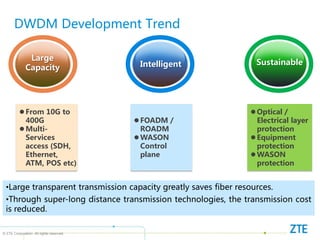
DWDM Development Trend
Sustainable
Intelligent
Large
Capacity
From 10G to
400G
Multi-
Services
access (SDH,
Ethernet,
ATM, POS etc)
FOADM /
ROADM
WASON
Control
plane
Optical /
Electrical layer
protection
Equipment
protection
WASON
protection
•Large transparent transmission capacity greatly saves fiber resources.
•Through super-long distance transmission technologies, the transmission cost
is reduced.
Contents
 WDM Overview
 Optical Fiber Transmission Character
 Key technologies of DWDM
 DWDM Working Wavelength
© ZTE Corporation. All rights reserved
Optical Fiber & Type
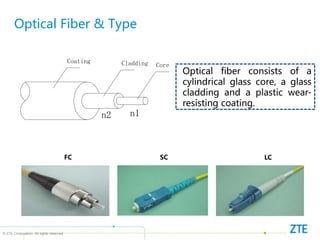
Coating Cladding Core
n2 n1
Optical fiber consists of a
cylindrical glass core, a glass
cladding and a plastic wear-
resisting coating.
FC LC
SC
© ZTE Corporation. All rights reserved
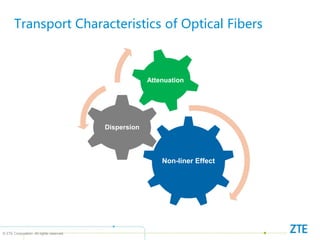
Transport Characteristics of Optical Fibers
Non-liner Effect
Dispersion
Attenuation
© ZTE Corporation. All rights reserved
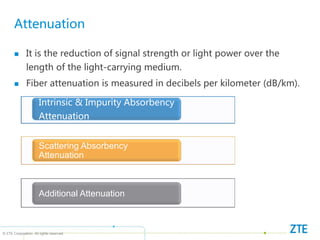
Attenuation
 It is the reduction of signal strength or light power over the
length of the light-carrying medium.
 Fiber attenuation is measured in decibels per kilometer (dB/km).
Intrinsic & Impurity Absorbency
Attenuation
Scattering Absorbency
Attenuation
Additional Attenuation
© ZTE Corporation. All rights reserved
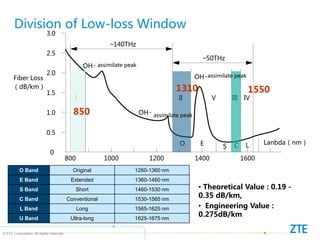
• Theoretical Value : 0.19-
0.35 dB/km,
• Engineering Value :
0.275dB/km
0
0.5
1.0
1.5
2.0
2.5
3.0
800 1000 1200 1400 1600
Lanbda(nm)
Fiber Loss
(dB/km)
~140THz
~50THz
OH- assimilate peak
OH-
OH-
O E S C L
II
I III IV
V
850
1310 1550
assimilate peak
O Band Original 1260-1360 nm
E Band Extended 1360-1460 nm
S Band Short 1460-1530 nm
C Band Conventional 1530-1565 nm
L Band Long 1565-1625 nm
U Band Ultra-long 1625-1675 nm
assimilate peak
Division of Low-loss Window
© ZTE Corporation. All rights reserved
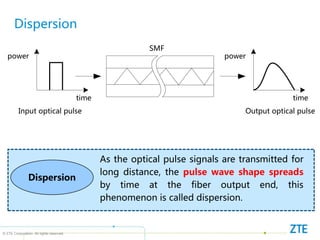
Dispersion
time
power
Input optical pulse
SMF
time
power
Output optical pulse
As the optical pulse signals are transmitted for
long distance, the pulse wave shape spreads
by time at the fiber output end, this
phenomenon is called dispersion.
Dispersion
© ZTE Corporation. All rights reserved
Kind of Dispersion
CD ---- Chromatic Dispersion
PMD ---- Polarization Mode Dispersion
© ZTE Corporation. All rights reserved
T
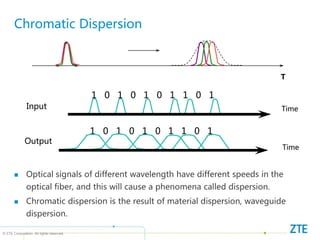
Chromatic Dispersion
 Optical signals of different wavelength have different speeds in the
optical fiber, and this will cause a phenomena called dispersion.
 Chromatic dispersion is the result of material dispersion, waveguide
dispersion.
1 0 1 0 1 0 1 1 0 1
1 0 1 0 1 0 1 1 0 1
Input
Output
Time
Time
© ZTE Corporation. All rights reserved
Influences of Chromatic Dispersion
 Pulse spreading
 A major influence of chromatic dispersion to system performance.
When transmission distance is longer than fiber dispersion
length, pulse spreading is too large. At this time, the system will
have serious inter-symbol interference and bit errors.
© ZTE Corporation. All rights reserved
Dispersion Tolerance
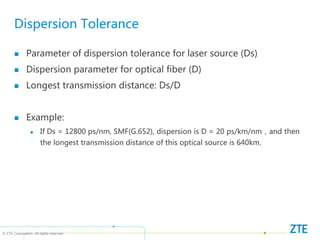
 Parameter of dispersion tolerance for laser source (Ds)
 Dispersion parameter for optical fiber (D)
 Longest transmission distance: Ds/D
 Example:
 If Ds = 12800 ps/nm, SMF(G.652), dispersion is D = 20 ps/km/nm,and then
the longest transmission distance of this optical source is 640km.
© ZTE Corporation. All rights reserved
Polarization Mode Dispersion
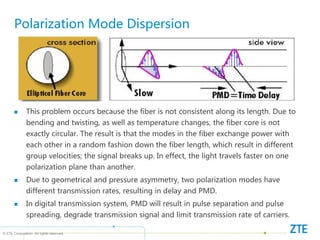
 This problem occurs because the fiber is not consistent along its length. Due to
bending and twisting, as well as temperature changes, the fiber core is not
exactly circular. The result is that the modes in the fiber exchange power with
each other in a random fashion down the fiber length, which result in different
group velocities; the signal breaks up. In effect, the light travels faster on one
polarization plane than another.
 Due to geometrical and pressure asymmetry, two polarization modes have
different transmission rates, resulting in delay and PMD.
 In digital transmission system, PMD will result in pulse separation and pulse
spreading, degrade transmission signal and limit transmission rate of carriers.
© ZTE Corporation. All rights reserved
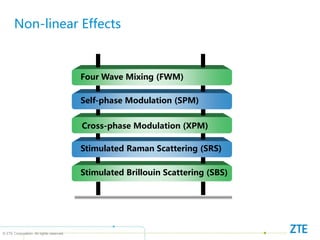
Four Wave Mixing (FWM)
Self-phase Modulation (SPM)
Cross-phase Modulation (XPM)
Stimulated Raman Scattering (SRS)
Stimulated Brillouin Scattering (SBS)
Non-linear Effects
© ZTE Corporation. All rights reserved
Four Wave Mixing (FWM)
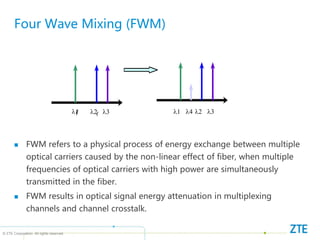
 FWM refers to a physical process of energy exchange between multiple
optical carriers caused by the non-linear effect of fiber, when multiple
frequencies of optical carriers with high power are simultaneously
transmitted in the fiber.
 FWM results in optical signal energy attenuation in multiplexing
channels and channel crosstalk.
f
1 f
f
3
f f f
f f
f
1 2 3
4
1 2 3
© ZTE Corporation. All rights reserved
Single Phase Modulation (SPM)
Intensity
Pulse width before
transmission
Pulse width after
transmission
Optical spectrum
before transmission
Optical spectrum after
transmission
Intensity
Light Intensity
refractive index
Optical Signal Phase
Modulation
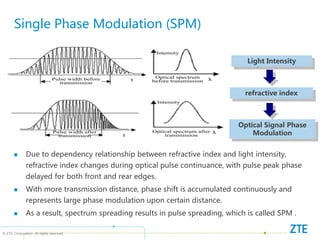
 Due to dependency relationship between refractive index and light intensity,
refractive index changes during optical pulse continuance, with pulse peak phase
delayed for both front and rear edges.
 With more transmission distance, phase shift is accumulated continuously and
represents large phase modulation upon certain distance.
 As a result, spectrum spreading results in pulse spreading, which is called SPM .
© ZTE Corporation. All rights reserved
Cross Phase Modulation (XPM)
Refractive of channel
A change.
The Signal Phase
Modulation of
channel B.
Refractive of channel
B change.
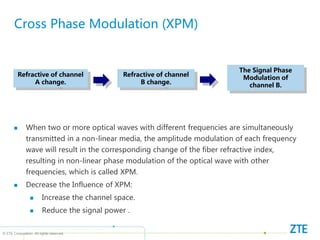
 When two or more optical waves with different frequencies are simultaneously
transmitted in a non-linear media, the amplitude modulation of each frequency
wave will result in the corresponding change of the fiber refractive index,
resulting in non-linear phase modulation of the optical wave with other
frequencies, which is called XPM.
 Decrease the Influence of XPM:
 Increase the channel space.
 Reduce the signal power .
© ZTE Corporation. All rights reserved
Stimulated Raman Scattering (SRS)
Input Output

P

P
1 2 3 4 1 2 3 4
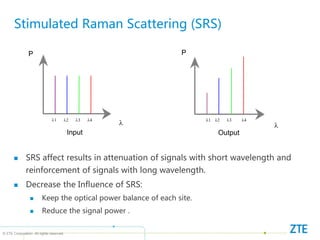
 SRS affect results in attenuation of signals with short wavelength and
reinforcement of signals with long wavelength.
 Decrease the Influence of SRS:
 Keep the optical power balance of each site.
 Reduce the signal power .
© ZTE Corporation. All rights reserved
Stimulated Brillouin Scattering (SBS)
Input Power
Output
Power
Scattering
Power
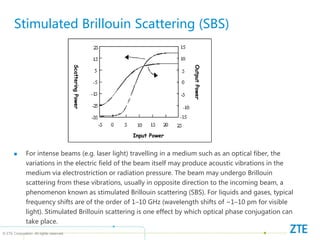
 For intense beams (e.g. laser light) travelling in a medium such as an optical fiber, the
variations in the electric field of the beam itself may produce acoustic vibrations in the
medium via electrostriction or radiation pressure. The beam may undergo Brillouin
scattering from these vibrations, usually in opposite direction to the incoming beam, a
phenomenon known as stimulated Brillouin scattering (SBS). For liquids and gases, typical
frequency shifts are of the order of 1–10 GHz (wavelength shifts of ~1–10 pm for visible
light). Stimulated Brillouin scattering is one effect by which optical phase conjugation can
take place.
© ZTE Corporation. All rights reserved
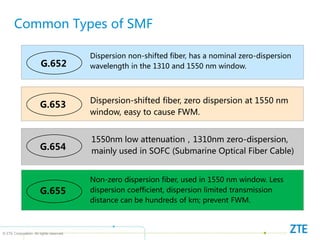
G.652
Dispersion non-shifted fiber, has a nominal zero-dispersion
wavelength in the 1310 and 1550 nm window.
G.653 Dispersion-shifted fiber, zero dispersion at 1550 nm
window, easy to cause FWM.
G.654
G.655
Non-zero dispersion fiber, used in 1550 nm window. Less
dispersion coefficient, dispersion limited transmission
distance can be hundreds of km; prevent FWM.
1550nm low attenuation,1310nm zero-dispersion,
mainly used in SOFC (Submarine Optical Fiber Cable)
Common Types of SMF
Contents
 WDM Overview
 Optical Fiber Transmission character
 Key technologies of DWDM
 Optical Source
 Optical Multiplexer And Demultiplexer
 Optical Amplifiers
 The Supervision Of WDM System
 DWDM Working Wavelength
© ZTE Corporation. All rights reserved
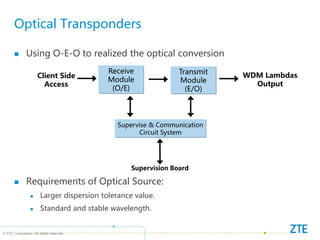
Optical Transponders
 Using O-E-O to realized the optical conversion
 Requirements of Optical Source:
 Larger dispersion tolerance value.
 Standard and stable wavelength.
Client Side
Access
WDM Lambdas
Output
Receive
Module
(O/E)
Supervise & Communication
Circuit System
Supervision Board
Transmit
Module
(E/O)
Contents
 WDM Overview
 Optical Fiber Transmission character
 Key technologies of DWDM
 Optical Source
 Optical Multiplexer And Demultiplexer
 Optical Amplifiers
 The Supervision Of WDM System
 DWDM Working Wavelength
© ZTE Corporation. All rights reserved
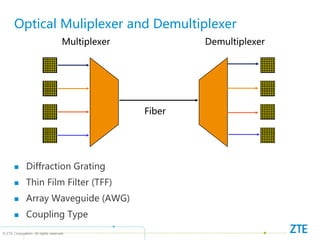
Optical Muliplexer and Demultiplexer
 Diffraction Grating
 Thin Film Filter (TFF)
 Array Waveguide (AWG)
 Coupling Type
Multiplexer
Fiber
Demultiplexer
© ZTE Corporation. All rights reserved
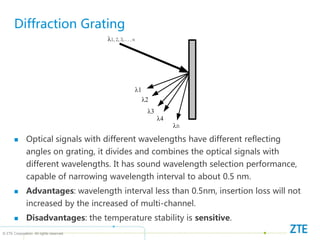
Diffraction Grating
 Optical signals with different wavelengths have different reflecting
angles on grating, it divides and combines the optical signals with
different wavelengths. It has sound wavelength selection performance,
capable of narrowing wavelength interval to about 0.5 nm.
 Advantages: wavelength interval less than 0.5nm, insertion loss will not
increased by the increased of multi-channel.
 Disadvantages: the temperature stability is sensitive.
1,2,3,...n
1
3
2
4
n
© ZTE Corporation. All rights reserved
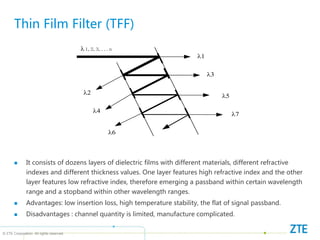
Thin Film Filter (TFF)
 It consists of dozens layers of dielectric films with different materials, different refractive
indexes and different thickness values. One layer features high refractive index and the other
layer features low refractive index, therefore emerging a passband within certain wavelength
range and a stopband within other wavelength ranges.
 Advantages: low insertion loss, high temperature stability, the flat of signal passband.
 Disadvantages : channel quantity is limited, manufacture complicated.

1
1,2,3,...n
3
5
7
2
4
6
© ZTE Corporation. All rights reserved
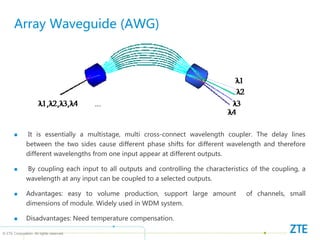
Array Waveguide (AWG)
 It is essentially a multistage, multi cross-connect wavelength coupler. The delay lines
between the two sides cause different phase shifts for different wavelength and therefore
different wavelengths from one input appear at different outputs.
 By coupling each input to all outputs and controlling the characteristics of the coupling, a
wavelength at any input can be coupled to a selected outputs.
 Advantages: easy to volume production, support large amount of channels, small
dimensions of module. Widely used in WDM system.
 Disadvantages: Need temperature compensation.
© ZTE Corporation. All rights reserved
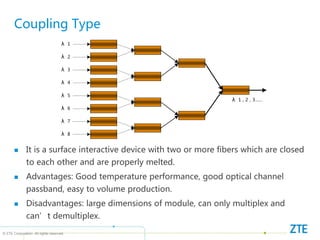
Coupling Type
 It is a surface interactive device with two or more fibers which are closed
to each other and are properly melted.
 Advantages: Good temperature performance, good optical channel
passband, easy to volume production.
 Disadvantages: large dimensions of module, can only multiplex and
can’t demultiplex.
λ 1
λ 2
λ 3
λ 4
λ 5
λ 6
λ 7
λ 8
λ 1,2,3……
© ZTE Corporation. All rights reserved
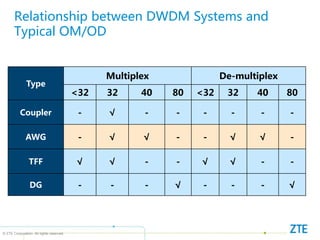
Relationship between DWDM Systems and
Typical OM/OD
Type
Multiplex De-multiplex
<32 32 40 80 <32 32 40 80
Coupler - √ - - - - - -
AWG - √ √ - - √ √ -
TFF √ √ - - √ √ - -
DG - - - √ - - - √
© ZTE Corporation. All rights reserved
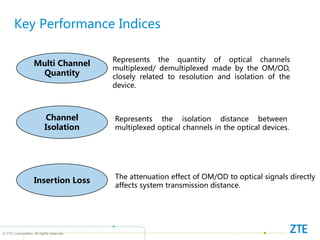
Key Performance Indices
Channel
Isolation
Insertion Loss
Multi Channel
Quantity
Represents the quantity of optical channels
multiplexed/ demultiplexed made by the OM/OD,
closely related to resolution and isolation of the
device.
Represents the isolation distance between
multiplexed optical channels in the optical devices.
The attenuation effect of OM/OD to optical signals directly
affects system transmission distance.
© ZTE Corporation. All rights reserved
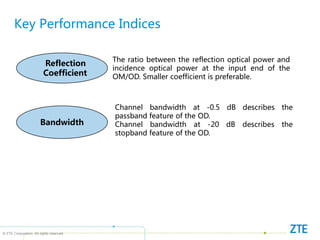
Key Performance Indices
Bandwidth
Reflection
Coefficient
The ratio between the reflection optical power and
incidence optical power at the input end of the
OM/OD. Smaller coefficient is preferable.
Channel bandwidth at -0.5 dB describes the
passband feature of the OD.
Channel bandwidth at -20 dB describes the
stopband feature of the OD.
Contents
 WDM Overview
 Optical Fiber Transmission character
 Key technologies of DWDM
 Optical Source
 Optical Multiplexer And Demultiplexer
 Optical Amplifiers
 The Supervision Of WDM System
 DWDM Working Wavelength
© ZTE Corporation. All rights reserved
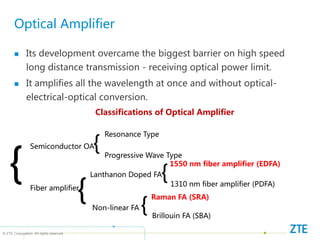
Optical Amplifier
 Its development overcame the biggest barrier on high speed
long distance transmission - receiving optical power limit.
 It amplifies all the wavelength at once and without optical-
electrical-optical conversion.
Semiconductor OA{
Resonance Type
Progressive Wave Type
Fiber amplifier
Lanthanon Doped FA
Non-linear FA
1550 nm fiber amplifier (EDFA)
1310 nm fiber amplifier (PDFA)
Raman FA (SRA)
Brillouin FA (SBA)
{
{
{
{
Classifications of Optical Amplifier
© ZTE Corporation. All rights reserved
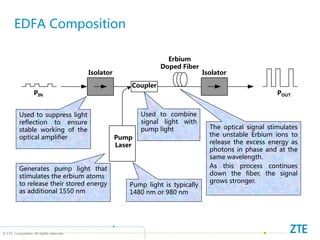
EDFA Composition
Used to suppress light
reflection to ensure
stable working of the
optical amplifier
The optical signal stimulates
the unstable Erbium ions to
release the excess energy as
photons in phase and at the
same wavelength.
As this process continues
down the fiber, the signal
grows stronger.
Generates pump light that
stimulates the erbium atoms
to release their stored energy
as additional 1550 nm
Used to combine
signal light with
pump light
Isolator
Coupler
Isolator
Erbium
Doped Fiber
PIN POUT
Pump
Laser
Pump light is typically
1480 nm or 980 nm
© ZTE Corporation. All rights reserved
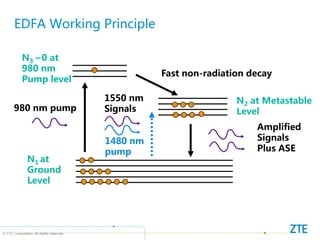
EDFA Working Principle
980 nm pump
1480 nm
pump
Fast non-radiation decay
N1 at
Ground
Level
N3 ~0 at
980 nm
Pump level
N2 at Metastable
Level
Amplified
Signals
Plus ASE
1550 nm
Signals
© ZTE Corporation. All rights reserved
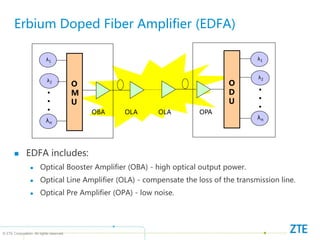
Erbium Doped Fiber Amplifier (EDFA)
 EDFA includes:
 Optical Booster Amplifier (OBA) - high optical output power.
 Optical Line Amplifier (OLA) - compensate the loss of the transmission line.
 Optical Pre Amplifier (OPA) - low noise.
λ1
λ2
λn
•
•
• OBA
λ1
λ2
λn
•
•
•
OLA OPA
OLA
O
M
U
O
D
U
© ZTE Corporation. All rights reserved
Key Performance Indices
 1.Gain (G)
 The ratio between output optical signal power and input optical signal power.
 2.Noise Figure (NF)
 The ratio between SNR at EDFA input end and SNR at output end.
 3.Bandwidth
 The working wavelength range of DWDM system covers C and L bands. The
optical amplifier needs to amplify all the multiplexing channel signals of the
system, so its bandwidth should be wide enough.
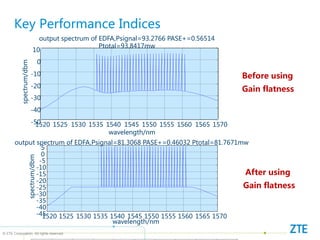
 4.Gain flatness
 The allowed fluctuation of EDFA gain within the specified working band
range. For the sake of sound flatness, aluminum doped technology is usually
used in the EDF.
© ZTE Corporation. All rights reserved
Key Performance Indices
1520 1525 1530 1535 1540 1545 1550 1555 1560 1565 1570
-50
-40
-30
-20
-10
0
10
wavelength/nm
spectrum/dbm
output spectrum of EDFA,Psignal=93.2766 PASE+=0.56514
Ptotal=93.8417mw
1520 1525 1530 1535 1540 1545 1550 1555 1560 1565 1570
-45
-40
-35
-30
-25
-20
-15
-10
-5
0
5
wavelength/nm
spectrum/dbm
output spectrum of EDFA,Psignal=81.3068 PASE+=0.46032 Ptotal=81.7671mw
Before using
Gain flatness
After using
Gain flatness
© ZTE Corporation. All rights reserved
Problems of EDFA
 Optical Surge
 Non-liner Effect
 Bandwidth
 Dispersion
© ZTE Corporation. All rights reserved
Problems of EDFA
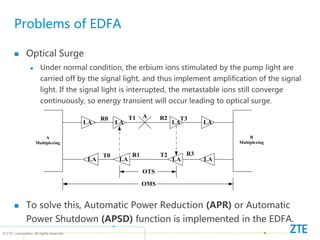
 Optical Surge
 Under normal condition, the erbium ions stimulated by the pump light are
carried off by the signal light, and thus implement amplification of the signal
light. If the signal light is interrupted, the metastable ions still converge
continuously, so energy transient will occur leading to optical surge.
 To solve this, Automatic Power Reduction (APR) or Automatic
Power Shutdown (APSD) function is implemented in the EDFA.
A
Multiplexing
LA LA LA LA
LA
LA
LA
LA
T1 R2
T2
R1
OTS
OMS
A
R0
T0
T3
R3
B
Multiplexing
© ZTE Corporation. All rights reserved
Problems of EDFA
 Non-linear effect
 When the optical power is increased to a certain degree, fiber non-linear
effect will occur. Therefore, in the use of fiber amplifier, it is required to
control the value of the in-fiber optical power in a single channel.
 Bandwidth
 Bandwidth refers to the range of the optical wavelength which can be
amplified flatly. The working wavelength range of the EDFA in C band is 1530
nm ~ 1561 nm, and in L band is 1565 nm ~ 1625 nm.
 Dispersion
 As transmission distance increase, the total dispersion increases
correspondingly. Therefore, the current-free relay segment in WDM system
cannot be prolonged limitlessly. We can prolong the current-free relay
distance of the multiplexing section through dispersion compensation
measures.
Contents
 WDM Overview
 Optical Fiber Transmission character
 Key technologies of DWDM
 Optical Source
 Optical Multiplexer And Demultiplexer
 Optical Amplifiers
 The Supervision Of WDM System
 DWDM Working Wavelength
© ZTE Corporation. All rights reserved
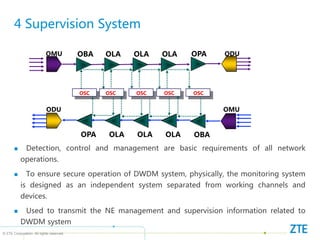
 Detection, control and management are basic requirements of all network
operations.
 To ensure secure operation of DWDM system, physically, the monitoring system
is designed as an independent system separated from working channels and
devices.
 Used to transmit the NE management and supervision information related to
DWDM system
4 Supervision System
OMU ODU
OBA
OPA
OPA
OBA
ODU OMU
OLA
OLA
OLA
OLA
OLA
OLA
OSC OSC OSC OSC
OSC
© ZTE Corporation. All rights reserved
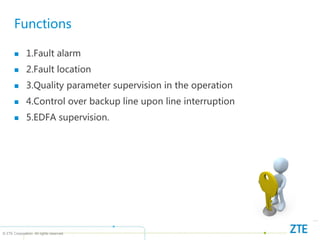
Functions
 1.Fault alarm
 2.Fault location
 3.Quality parameter supervision in the operation
 4.Control over backup line upon line interruption
 5.EDFA supervision.
© ZTE Corporation. All rights reserved
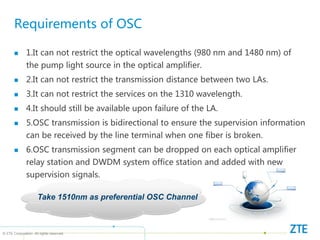
Requirements of OSC
 1.It can not restrict the optical wavelengths (980 nm and 1480 nm) of
the pump light source in the optical amplifier.
 2.It can not restrict the transmission distance between two LAs.
 3.It can not restrict the services on the 1310 wavelength.
 4.It should still be available upon failure of the LA.
 5.OSC transmission is bidirectional to ensure the supervision information
can be received by the line terminal when one fiber is broken.
 6.OSC transmission segment can be dropped on each optical amplifier
relay station and DWDM system office station and added with new
supervision signals.
Take 1510nm as preferential OSC Channel
Contents
 WDM Overview
 Optical Fiber Transmission character
 Key Technologies of DWDM
 DWDM Working Wavelength
© ZTE Corporation. All rights reserved
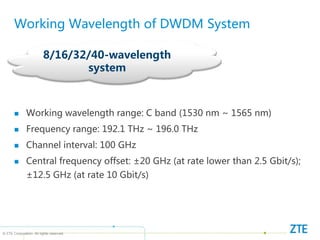
8/16/32/40-wavelength
system
Working Wavelength of DWDM System
 Working wavelength range: C band (1530 nm ~ 1565 nm)
 Frequency range: 192.1 THz ~ 196.0 THz
 Channel interval: 100 GHz
 Central frequency offset: ±20 GHz (at rate lower than 2.5 Gbit/s);
±12.5 GHz (at rate 10 Gbit/s)
© ZTE Corporation. All rights reserved
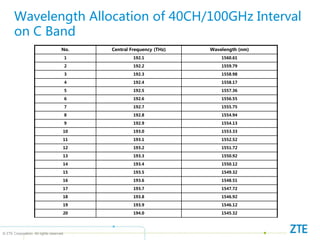
Wavelength Allocation of 40CH/100GHz Interval
on C Band
No. Central Frequency (THz) Wavelength (nm)
1 192.1 1560.61
2 192.2 1559.79
3 192.3 1558.98
4 192.4 1558.17
5 192.5 1557.36
6 192.6 1556.55
7 192.7 1555.75
8 192.8 1554.94
9 192.9 1554.13
10 193.0 1553.33
11 193.1 1552.52
12 193.2 1551.72
13 193.3 1550.92
14 193.4 1550.12
15 193.5 1549.32
16 193.6 1548.51
17 193.7 1547.72
18 193.8 1546.92
19 193.9 1546.12
20 194.0 1545.32
© ZTE Corporation. All rights reserved
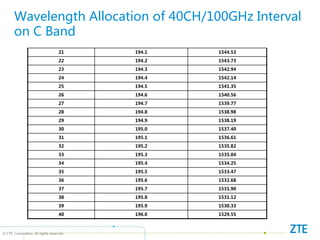
Wavelength Allocation of 40CH/100GHz Interval
on C Band
21 194.1 1544.53
22 194.2 1543.73
23 194.3 1542.94
24 194.4 1542.14
25 194.5 1541.35
26 194.6 1540.56
27 194.7 1539.77
28 194.8 1538.98
29 194.9 1538.19
30 195.0 1537.40
31 195.1 1536.61
32 195.2 1535.82
33 195.3 1535.04
34 195.4 1534.25
35 195.5 1533.47
36 195.6 1532.68
37 195.7 1531.90
38 195.8 1531.12
39 195.9 1530.33
40 196.0 1529.55
© ZTE Corporation. All rights reserved
80 -wavelength system
Working Wavelength of DWDM System
 Working wavelength range: C band (1530 nm ~ 1565 nm)
 Frequency range: C band (192.1 THz ~ 196.0 THz)
 Channel interval: 50 GHz
 Central frequency offset: ±5 GHz
© ZTE Corporation. All rights reserved
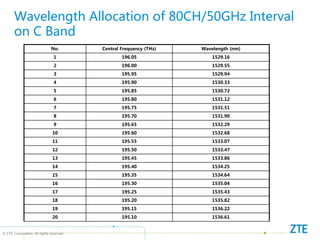
Wavelength Allocation of 80CH/50GHz Interval
on C Band
No. Central Frequency (THz) Wavelength (nm)
1 196.05 1529.16
2 196.00 1529.55
3 195.95 1529.94
4 195.90 1530.33
5 195.85 1530.72
6 195.80 1531.12
7 195.75 1531.51
8 195.70 1531.90
9 195.65 1532.29
10 195.60 1532.68
11 195.55 1533.07
12 195.50 1533.47
13 195.45 1533.86
14 195.40 1534.25
15 195.35 1534.64
16 195.30 1535.04
17 195.25 1535.43
18 195.20 1535.82
19 195.15 1536.22
20 195.10 1536.61
© ZTE Corporation. All rights reserved
160 - wavelength system
Working Wavelength of DWDM System
 Working wavelength range: C band (1530 nm ~ 1565 nm) + L
band (1565 nm ~ 1625 nm)
 Frequency range: C band (192.1 THz ~ 196.0 THz) + L band
(190.90 THz ~ 186.95 THz)
 Channel interval: 50 GHz
 Central frequency offset: ±5 GHz
 DWDM Principle

DWDM Principle

  • 1.
  • 2.
    Contents  WDM Overview Optical Fiber Transmission character  Key technologies of DWDM  DWDM Working Wavelength
  • 3.
    © ZTE Corporation.All rights reserved WDM Definition & Relationship with Other Services WDM (Wavelength Division Multiplexing ) technology is a fiber communication technology transmitting multiple optical carriers with information on one fiber.
  • 4.
    © ZTE Corporation.All rights reserved T R l1 Electrical Multiplex Electrical Demultiplex Transmitter Receiver Electrical Regenerator lN l2 l1 lN l2 l1 lN l2 l1 Optical Multiplexer Optical Demultiplexer OA TDM: Electrical Regenerator for Single Wavelength DWDM: Multi-wavelength on Single Fiber, for Optical Amplification Difference Between DWDM and SDH
  • 5.
    © ZTE Corporation.All rights reserved DWDM Features  Large transparent transmission capacity greatly saves fiber resources.  Each wavelength can carry different signal: SDH 2.5Gbps, 10 Gbps, ATM, IP, etc.  Through super-long distance transmission technologies, the transmission cost is reduced.
  • 6.
    © ZTE Corporation.All rights reserved WDM Products Deploy in Network Metro Core Aggregate Layer CR SR BRAS Switch DSLAM Splitter OLT MSAG Enterprise Customer 2G/3G Base station eNB S-GW S-GW BSC/RNC Enterprise Customer Enterprise Customer FTTX WLAN IPTV DCN Internet RadiusServer multicast EPGServer WDM deploy in network PTN/IP RAN MSTP Fix Network Backbone 80x100G OTN 40/80x100 G OTN 40x10G OTN eNB eNB eNB
  • 7.
    © ZTE Corporation.All rights reserved WDM Classification  CWDM: Coarse Wavelength Division Multiplexing  DWDM : Dense Wavelength Division Multiplexing
  • 8.
    © ZTE Corporation.All rights reserved WDM Classification  CWDM: Coarse Wavelength Division Multiplexing  DWDM : Dense Wavelength Division Multiplexing 12901310133013501380140014201440 14701490 DWDM E-Band L-Band (nm) 151015301550 1570 1610 1590 O-Band CWDM C-Band S-Band
  • 9.
    © ZTE Corporation.All rights reserved OTU1 ┇ Input Ch 1 Ch N Ch 1 Ch N λ1 λn OTUn OMU BA LA PA ODU λ1 λn OTU1 ┇ OTUn λs λs λs λs SC SC SC Output EMS Optical Transmitter OLA Optical Receiver DWDM System
  • 10.
    © ZTE Corporation.All rights reserved Common NE in DWDM System Client side Line side λ1 λn λ1 λn OTM Line side Line side OLA Client side Line side Line side λ1 λn λ1 λn OADM
  • 11.
    © ZTE Corporation.All rights reserved DWDM Development Trend Sustainable Intelligent Large Capacity From 10G to 400G Multi- Services access (SDH, Ethernet, ATM, POS etc) FOADM / ROADM WASON Control plane Optical / Electrical layer protection Equipment protection WASON protection •Large transparent transmission capacity greatly saves fiber resources. •Through super-long distance transmission technologies, the transmission cost is reduced.
  • 12.
    Contents  WDM Overview Optical Fiber Transmission Character  Key technologies of DWDM  DWDM Working Wavelength
  • 13.
    © ZTE Corporation.All rights reserved Optical Fiber & Type Coating Cladding Core n2 n1 Optical fiber consists of a cylindrical glass core, a glass cladding and a plastic wear- resisting coating. FC LC SC
  • 14.
    © ZTE Corporation.All rights reserved Transport Characteristics of Optical Fibers Non-liner Effect Dispersion Attenuation
  • 15.
    © ZTE Corporation.All rights reserved Attenuation  It is the reduction of signal strength or light power over the length of the light-carrying medium.  Fiber attenuation is measured in decibels per kilometer (dB/km). Intrinsic & Impurity Absorbency Attenuation Scattering Absorbency Attenuation Additional Attenuation
  • 16.
    © ZTE Corporation.All rights reserved • Theoretical Value : 0.19- 0.35 dB/km, • Engineering Value : 0.275dB/km 0 0.5 1.0 1.5 2.0 2.5 3.0 800 1000 1200 1400 1600 Lanbda(nm) Fiber Loss (dB/km) ~140THz ~50THz OH- assimilate peak OH- OH- O E S C L II I III IV V 850 1310 1550 assimilate peak O Band Original 1260-1360 nm E Band Extended 1360-1460 nm S Band Short 1460-1530 nm C Band Conventional 1530-1565 nm L Band Long 1565-1625 nm U Band Ultra-long 1625-1675 nm assimilate peak Division of Low-loss Window
  • 17.
    © ZTE Corporation.All rights reserved Dispersion time power Input optical pulse SMF time power Output optical pulse As the optical pulse signals are transmitted for long distance, the pulse wave shape spreads by time at the fiber output end, this phenomenon is called dispersion. Dispersion
  • 18.
    © ZTE Corporation.All rights reserved Kind of Dispersion CD ---- Chromatic Dispersion PMD ---- Polarization Mode Dispersion
  • 19.
    © ZTE Corporation.All rights reserved T Chromatic Dispersion  Optical signals of different wavelength have different speeds in the optical fiber, and this will cause a phenomena called dispersion.  Chromatic dispersion is the result of material dispersion, waveguide dispersion. 1 0 1 0 1 0 1 1 0 1 1 0 1 0 1 0 1 1 0 1 Input Output Time Time
  • 20.
    © ZTE Corporation.All rights reserved Influences of Chromatic Dispersion  Pulse spreading  A major influence of chromatic dispersion to system performance. When transmission distance is longer than fiber dispersion length, pulse spreading is too large. At this time, the system will have serious inter-symbol interference and bit errors.
  • 21.
    © ZTE Corporation.All rights reserved Dispersion Tolerance  Parameter of dispersion tolerance for laser source (Ds)  Dispersion parameter for optical fiber (D)  Longest transmission distance: Ds/D  Example:  If Ds = 12800 ps/nm, SMF(G.652), dispersion is D = 20 ps/km/nm,and then the longest transmission distance of this optical source is 640km.
  • 22.
    © ZTE Corporation.All rights reserved Polarization Mode Dispersion  This problem occurs because the fiber is not consistent along its length. Due to bending and twisting, as well as temperature changes, the fiber core is not exactly circular. The result is that the modes in the fiber exchange power with each other in a random fashion down the fiber length, which result in different group velocities; the signal breaks up. In effect, the light travels faster on one polarization plane than another.  Due to geometrical and pressure asymmetry, two polarization modes have different transmission rates, resulting in delay and PMD.  In digital transmission system, PMD will result in pulse separation and pulse spreading, degrade transmission signal and limit transmission rate of carriers.
  • 23.
    © ZTE Corporation.All rights reserved Four Wave Mixing (FWM) Self-phase Modulation (SPM) Cross-phase Modulation (XPM) Stimulated Raman Scattering (SRS) Stimulated Brillouin Scattering (SBS) Non-linear Effects
  • 24.
    © ZTE Corporation.All rights reserved Four Wave Mixing (FWM)  FWM refers to a physical process of energy exchange between multiple optical carriers caused by the non-linear effect of fiber, when multiple frequencies of optical carriers with high power are simultaneously transmitted in the fiber.  FWM results in optical signal energy attenuation in multiplexing channels and channel crosstalk. f 1 f f 3 f f f f f f 1 2 3 4 1 2 3
  • 25.
    © ZTE Corporation.All rights reserved Single Phase Modulation (SPM) Intensity Pulse width before transmission Pulse width after transmission Optical spectrum before transmission Optical spectrum after transmission Intensity Light Intensity refractive index Optical Signal Phase Modulation  Due to dependency relationship between refractive index and light intensity, refractive index changes during optical pulse continuance, with pulse peak phase delayed for both front and rear edges.  With more transmission distance, phase shift is accumulated continuously and represents large phase modulation upon certain distance.  As a result, spectrum spreading results in pulse spreading, which is called SPM .
  • 26.
    © ZTE Corporation.All rights reserved Cross Phase Modulation (XPM) Refractive of channel A change. The Signal Phase Modulation of channel B. Refractive of channel B change.  When two or more optical waves with different frequencies are simultaneously transmitted in a non-linear media, the amplitude modulation of each frequency wave will result in the corresponding change of the fiber refractive index, resulting in non-linear phase modulation of the optical wave with other frequencies, which is called XPM.  Decrease the Influence of XPM:  Increase the channel space.  Reduce the signal power .
  • 27.
    © ZTE Corporation.All rights reserved Stimulated Raman Scattering (SRS) Input Output  P  P 1 2 3 4 1 2 3 4  SRS affect results in attenuation of signals with short wavelength and reinforcement of signals with long wavelength.  Decrease the Influence of SRS:  Keep the optical power balance of each site.  Reduce the signal power .
  • 28.
    © ZTE Corporation.All rights reserved Stimulated Brillouin Scattering (SBS) Input Power Output Power Scattering Power  For intense beams (e.g. laser light) travelling in a medium such as an optical fiber, the variations in the electric field of the beam itself may produce acoustic vibrations in the medium via electrostriction or radiation pressure. The beam may undergo Brillouin scattering from these vibrations, usually in opposite direction to the incoming beam, a phenomenon known as stimulated Brillouin scattering (SBS). For liquids and gases, typical frequency shifts are of the order of 1–10 GHz (wavelength shifts of ~1–10 pm for visible light). Stimulated Brillouin scattering is one effect by which optical phase conjugation can take place.
  • 29.
    © ZTE Corporation.All rights reserved G.652 Dispersion non-shifted fiber, has a nominal zero-dispersion wavelength in the 1310 and 1550 nm window. G.653 Dispersion-shifted fiber, zero dispersion at 1550 nm window, easy to cause FWM. G.654 G.655 Non-zero dispersion fiber, used in 1550 nm window. Less dispersion coefficient, dispersion limited transmission distance can be hundreds of km; prevent FWM. 1550nm low attenuation,1310nm zero-dispersion, mainly used in SOFC (Submarine Optical Fiber Cable) Common Types of SMF
  • 30.
    Contents  WDM Overview Optical Fiber Transmission character  Key technologies of DWDM  Optical Source  Optical Multiplexer And Demultiplexer  Optical Amplifiers  The Supervision Of WDM System  DWDM Working Wavelength
  • 31.
    © ZTE Corporation.All rights reserved Optical Transponders  Using O-E-O to realized the optical conversion  Requirements of Optical Source:  Larger dispersion tolerance value.  Standard and stable wavelength. Client Side Access WDM Lambdas Output Receive Module (O/E) Supervise & Communication Circuit System Supervision Board Transmit Module (E/O)
  • 32.
    Contents  WDM Overview Optical Fiber Transmission character  Key technologies of DWDM  Optical Source  Optical Multiplexer And Demultiplexer  Optical Amplifiers  The Supervision Of WDM System  DWDM Working Wavelength
  • 33.
    © ZTE Corporation.All rights reserved Optical Muliplexer and Demultiplexer  Diffraction Grating  Thin Film Filter (TFF)  Array Waveguide (AWG)  Coupling Type Multiplexer Fiber Demultiplexer
  • 34.
    © ZTE Corporation.All rights reserved Diffraction Grating  Optical signals with different wavelengths have different reflecting angles on grating, it divides and combines the optical signals with different wavelengths. It has sound wavelength selection performance, capable of narrowing wavelength interval to about 0.5 nm.  Advantages: wavelength interval less than 0.5nm, insertion loss will not increased by the increased of multi-channel.  Disadvantages: the temperature stability is sensitive. 1,2,3,...n 1 3 2 4 n
  • 35.
    © ZTE Corporation.All rights reserved Thin Film Filter (TFF)  It consists of dozens layers of dielectric films with different materials, different refractive indexes and different thickness values. One layer features high refractive index and the other layer features low refractive index, therefore emerging a passband within certain wavelength range and a stopband within other wavelength ranges.  Advantages: low insertion loss, high temperature stability, the flat of signal passband.  Disadvantages : channel quantity is limited, manufacture complicated.  1 1,2,3,...n 3 5 7 2 4 6
  • 36.
    © ZTE Corporation.All rights reserved Array Waveguide (AWG)  It is essentially a multistage, multi cross-connect wavelength coupler. The delay lines between the two sides cause different phase shifts for different wavelength and therefore different wavelengths from one input appear at different outputs.  By coupling each input to all outputs and controlling the characteristics of the coupling, a wavelength at any input can be coupled to a selected outputs.  Advantages: easy to volume production, support large amount of channels, small dimensions of module. Widely used in WDM system.  Disadvantages: Need temperature compensation.
  • 37.
    © ZTE Corporation.All rights reserved Coupling Type  It is a surface interactive device with two or more fibers which are closed to each other and are properly melted.  Advantages: Good temperature performance, good optical channel passband, easy to volume production.  Disadvantages: large dimensions of module, can only multiplex and can’t demultiplex. λ 1 λ 2 λ 3 λ 4 λ 5 λ 6 λ 7 λ 8 λ 1,2,3……
  • 38.
    © ZTE Corporation.All rights reserved Relationship between DWDM Systems and Typical OM/OD Type Multiplex De-multiplex <32 32 40 80 <32 32 40 80 Coupler - √ - - - - - - AWG - √ √ - - √ √ - TFF √ √ - - √ √ - - DG - - - √ - - - √
  • 39.
    © ZTE Corporation.All rights reserved Key Performance Indices Channel Isolation Insertion Loss Multi Channel Quantity Represents the quantity of optical channels multiplexed/ demultiplexed made by the OM/OD, closely related to resolution and isolation of the device. Represents the isolation distance between multiplexed optical channels in the optical devices. The attenuation effect of OM/OD to optical signals directly affects system transmission distance.
  • 40.
    © ZTE Corporation.All rights reserved Key Performance Indices Bandwidth Reflection Coefficient The ratio between the reflection optical power and incidence optical power at the input end of the OM/OD. Smaller coefficient is preferable. Channel bandwidth at -0.5 dB describes the passband feature of the OD. Channel bandwidth at -20 dB describes the stopband feature of the OD.
  • 41.
    Contents  WDM Overview Optical Fiber Transmission character  Key technologies of DWDM  Optical Source  Optical Multiplexer And Demultiplexer  Optical Amplifiers  The Supervision Of WDM System  DWDM Working Wavelength
  • 42.
    © ZTE Corporation.All rights reserved Optical Amplifier  Its development overcame the biggest barrier on high speed long distance transmission - receiving optical power limit.  It amplifies all the wavelength at once and without optical- electrical-optical conversion. Semiconductor OA{ Resonance Type Progressive Wave Type Fiber amplifier Lanthanon Doped FA Non-linear FA 1550 nm fiber amplifier (EDFA) 1310 nm fiber amplifier (PDFA) Raman FA (SRA) Brillouin FA (SBA) { { { { Classifications of Optical Amplifier
  • 43.
    © ZTE Corporation.All rights reserved EDFA Composition Used to suppress light reflection to ensure stable working of the optical amplifier The optical signal stimulates the unstable Erbium ions to release the excess energy as photons in phase and at the same wavelength. As this process continues down the fiber, the signal grows stronger. Generates pump light that stimulates the erbium atoms to release their stored energy as additional 1550 nm Used to combine signal light with pump light Isolator Coupler Isolator Erbium Doped Fiber PIN POUT Pump Laser Pump light is typically 1480 nm or 980 nm
  • 44.
    © ZTE Corporation.All rights reserved EDFA Working Principle 980 nm pump 1480 nm pump Fast non-radiation decay N1 at Ground Level N3 ~0 at 980 nm Pump level N2 at Metastable Level Amplified Signals Plus ASE 1550 nm Signals
  • 45.
    © ZTE Corporation.All rights reserved Erbium Doped Fiber Amplifier (EDFA)  EDFA includes:  Optical Booster Amplifier (OBA) - high optical output power.  Optical Line Amplifier (OLA) - compensate the loss of the transmission line.  Optical Pre Amplifier (OPA) - low noise. λ1 λ2 λn • • • OBA λ1 λ2 λn • • • OLA OPA OLA O M U O D U
  • 46.
    © ZTE Corporation.All rights reserved Key Performance Indices  1.Gain (G)  The ratio between output optical signal power and input optical signal power.  2.Noise Figure (NF)  The ratio between SNR at EDFA input end and SNR at output end.  3.Bandwidth  The working wavelength range of DWDM system covers C and L bands. The optical amplifier needs to amplify all the multiplexing channel signals of the system, so its bandwidth should be wide enough.  4.Gain flatness  The allowed fluctuation of EDFA gain within the specified working band range. For the sake of sound flatness, aluminum doped technology is usually used in the EDF.
  • 47.
    © ZTE Corporation.All rights reserved Key Performance Indices 1520 1525 1530 1535 1540 1545 1550 1555 1560 1565 1570 -50 -40 -30 -20 -10 0 10 wavelength/nm spectrum/dbm output spectrum of EDFA,Psignal=93.2766 PASE+=0.56514 Ptotal=93.8417mw 1520 1525 1530 1535 1540 1545 1550 1555 1560 1565 1570 -45 -40 -35 -30 -25 -20 -15 -10 -5 0 5 wavelength/nm spectrum/dbm output spectrum of EDFA,Psignal=81.3068 PASE+=0.46032 Ptotal=81.7671mw Before using Gain flatness After using Gain flatness
  • 48.
    © ZTE Corporation.All rights reserved Problems of EDFA  Optical Surge  Non-liner Effect  Bandwidth  Dispersion
  • 49.
    © ZTE Corporation.All rights reserved Problems of EDFA  Optical Surge  Under normal condition, the erbium ions stimulated by the pump light are carried off by the signal light, and thus implement amplification of the signal light. If the signal light is interrupted, the metastable ions still converge continuously, so energy transient will occur leading to optical surge.  To solve this, Automatic Power Reduction (APR) or Automatic Power Shutdown (APSD) function is implemented in the EDFA. A Multiplexing LA LA LA LA LA LA LA LA T1 R2 T2 R1 OTS OMS A R0 T0 T3 R3 B Multiplexing
  • 50.
    © ZTE Corporation.All rights reserved Problems of EDFA  Non-linear effect  When the optical power is increased to a certain degree, fiber non-linear effect will occur. Therefore, in the use of fiber amplifier, it is required to control the value of the in-fiber optical power in a single channel.  Bandwidth  Bandwidth refers to the range of the optical wavelength which can be amplified flatly. The working wavelength range of the EDFA in C band is 1530 nm ~ 1561 nm, and in L band is 1565 nm ~ 1625 nm.  Dispersion  As transmission distance increase, the total dispersion increases correspondingly. Therefore, the current-free relay segment in WDM system cannot be prolonged limitlessly. We can prolong the current-free relay distance of the multiplexing section through dispersion compensation measures.
  • 51.
    Contents  WDM Overview Optical Fiber Transmission character  Key technologies of DWDM  Optical Source  Optical Multiplexer And Demultiplexer  Optical Amplifiers  The Supervision Of WDM System  DWDM Working Wavelength
  • 52.
    © ZTE Corporation.All rights reserved  Detection, control and management are basic requirements of all network operations.  To ensure secure operation of DWDM system, physically, the monitoring system is designed as an independent system separated from working channels and devices.  Used to transmit the NE management and supervision information related to DWDM system 4 Supervision System OMU ODU OBA OPA OPA OBA ODU OMU OLA OLA OLA OLA OLA OLA OSC OSC OSC OSC OSC
  • 53.
    © ZTE Corporation.All rights reserved Functions  1.Fault alarm  2.Fault location  3.Quality parameter supervision in the operation  4.Control over backup line upon line interruption  5.EDFA supervision.
  • 54.
    © ZTE Corporation.All rights reserved Requirements of OSC  1.It can not restrict the optical wavelengths (980 nm and 1480 nm) of the pump light source in the optical amplifier.  2.It can not restrict the transmission distance between two LAs.  3.It can not restrict the services on the 1310 wavelength.  4.It should still be available upon failure of the LA.  5.OSC transmission is bidirectional to ensure the supervision information can be received by the line terminal when one fiber is broken.  6.OSC transmission segment can be dropped on each optical amplifier relay station and DWDM system office station and added with new supervision signals. Take 1510nm as preferential OSC Channel
  • 55.
    Contents  WDM Overview Optical Fiber Transmission character  Key Technologies of DWDM  DWDM Working Wavelength
  • 56.
    © ZTE Corporation.All rights reserved 8/16/32/40-wavelength system Working Wavelength of DWDM System  Working wavelength range: C band (1530 nm ~ 1565 nm)  Frequency range: 192.1 THz ~ 196.0 THz  Channel interval: 100 GHz  Central frequency offset: ±20 GHz (at rate lower than 2.5 Gbit/s); ±12.5 GHz (at rate 10 Gbit/s)
  • 57.
    © ZTE Corporation.All rights reserved Wavelength Allocation of 40CH/100GHz Interval on C Band No. Central Frequency (THz) Wavelength (nm) 1 192.1 1560.61 2 192.2 1559.79 3 192.3 1558.98 4 192.4 1558.17 5 192.5 1557.36 6 192.6 1556.55 7 192.7 1555.75 8 192.8 1554.94 9 192.9 1554.13 10 193.0 1553.33 11 193.1 1552.52 12 193.2 1551.72 13 193.3 1550.92 14 193.4 1550.12 15 193.5 1549.32 16 193.6 1548.51 17 193.7 1547.72 18 193.8 1546.92 19 193.9 1546.12 20 194.0 1545.32
  • 58.
    © ZTE Corporation.All rights reserved Wavelength Allocation of 40CH/100GHz Interval on C Band 21 194.1 1544.53 22 194.2 1543.73 23 194.3 1542.94 24 194.4 1542.14 25 194.5 1541.35 26 194.6 1540.56 27 194.7 1539.77 28 194.8 1538.98 29 194.9 1538.19 30 195.0 1537.40 31 195.1 1536.61 32 195.2 1535.82 33 195.3 1535.04 34 195.4 1534.25 35 195.5 1533.47 36 195.6 1532.68 37 195.7 1531.90 38 195.8 1531.12 39 195.9 1530.33 40 196.0 1529.55
  • 59.
    © ZTE Corporation.All rights reserved 80 -wavelength system Working Wavelength of DWDM System  Working wavelength range: C band (1530 nm ~ 1565 nm)  Frequency range: C band (192.1 THz ~ 196.0 THz)  Channel interval: 50 GHz  Central frequency offset: ±5 GHz
  • 60.
    © ZTE Corporation.All rights reserved Wavelength Allocation of 80CH/50GHz Interval on C Band No. Central Frequency (THz) Wavelength (nm) 1 196.05 1529.16 2 196.00 1529.55 3 195.95 1529.94 4 195.90 1530.33 5 195.85 1530.72 6 195.80 1531.12 7 195.75 1531.51 8 195.70 1531.90 9 195.65 1532.29 10 195.60 1532.68 11 195.55 1533.07 12 195.50 1533.47 13 195.45 1533.86 14 195.40 1534.25 15 195.35 1534.64 16 195.30 1535.04 17 195.25 1535.43 18 195.20 1535.82 19 195.15 1536.22 20 195.10 1536.61
  • 61.
    © ZTE Corporation.All rights reserved 160 - wavelength system Working Wavelength of DWDM System  Working wavelength range: C band (1530 nm ~ 1565 nm) + L band (1565 nm ~ 1625 nm)  Frequency range: C band (192.1 THz ~ 196.0 THz) + L band (190.90 THz ~ 186.95 THz)  Channel interval: 50 GHz  Central frequency offset: ±5 GHz