Technology Training that WorksTechnology Training that Workswww.idc-online.com/slideshare
Testing &
Troubleshooting of
Fibre Optic
Cables
Technology Training that WorksTechnology Training that Workswww.idc-online.com/slideshare
If you are interested in further training or information,
please visit:
http://www.idc-online.com/slideshare
Technology Training that WorksTechnology Training that Workswww.idc-online.com/slideshare
• To be discussed
– Fundamental concepts of optical measurement
– Standard fibre optic cable tests
– Standard fibre optic equipment tests
– Data transmission tests
– Laboratory measurements
Technology Training that WorksTechnology Training that Workswww.idc-online.com/slideshare
Fundamental concepts of optical
measurement
• Optical power
– Measured in watts
– Optical measurements relate directly to electrical
measurements
– Optical energy measured as average of incoming
optical pulsed signal
Technology Training that WorksTechnology Training that Workswww.idc-online.com/slideshare
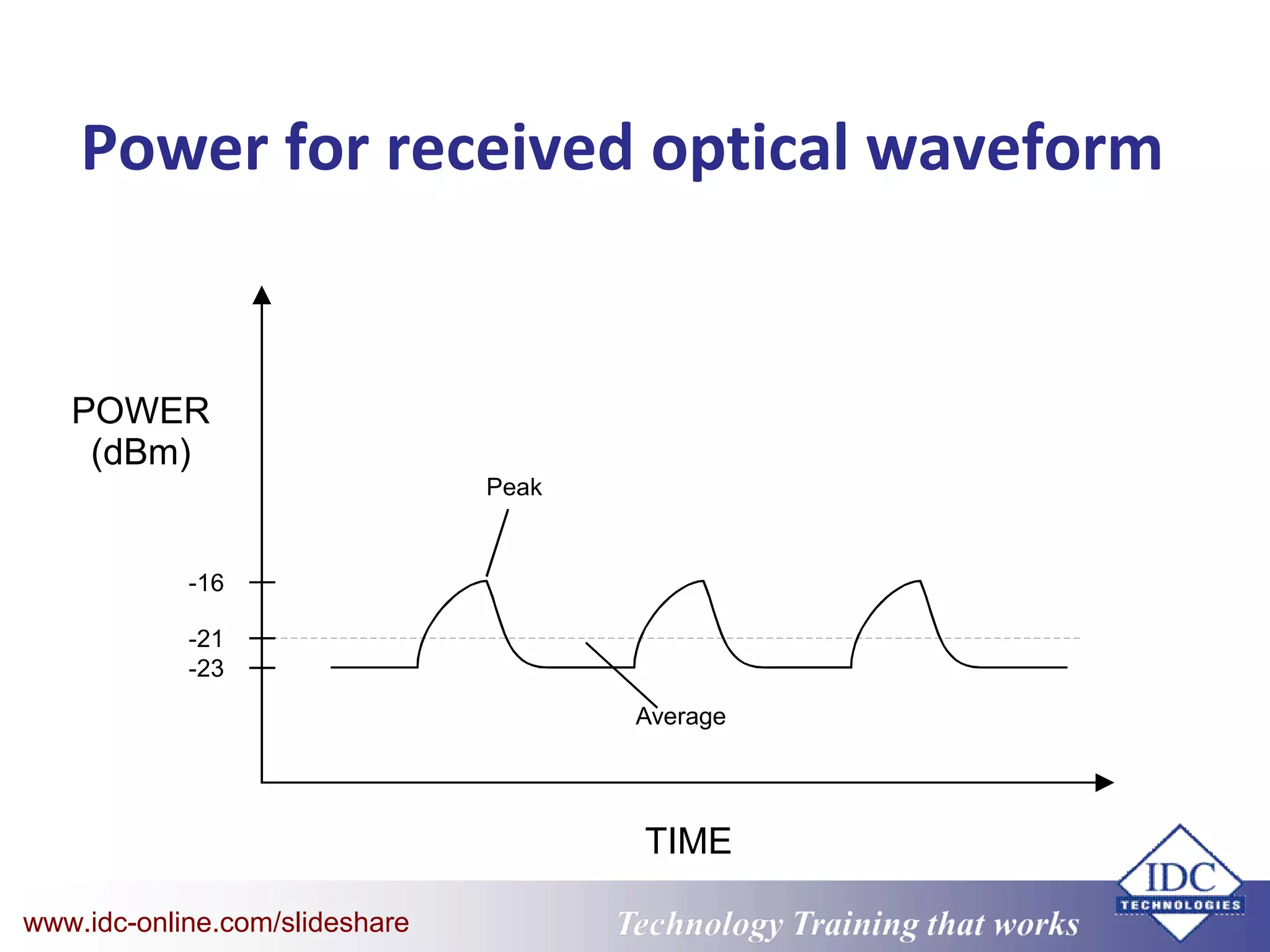
Power for received optical waveform
POWER
(dBm)
TIME
Peak
Average
-16
-21
-23
Technology Training that WorksTechnology Training that Workswww.idc-online.com/slideshare
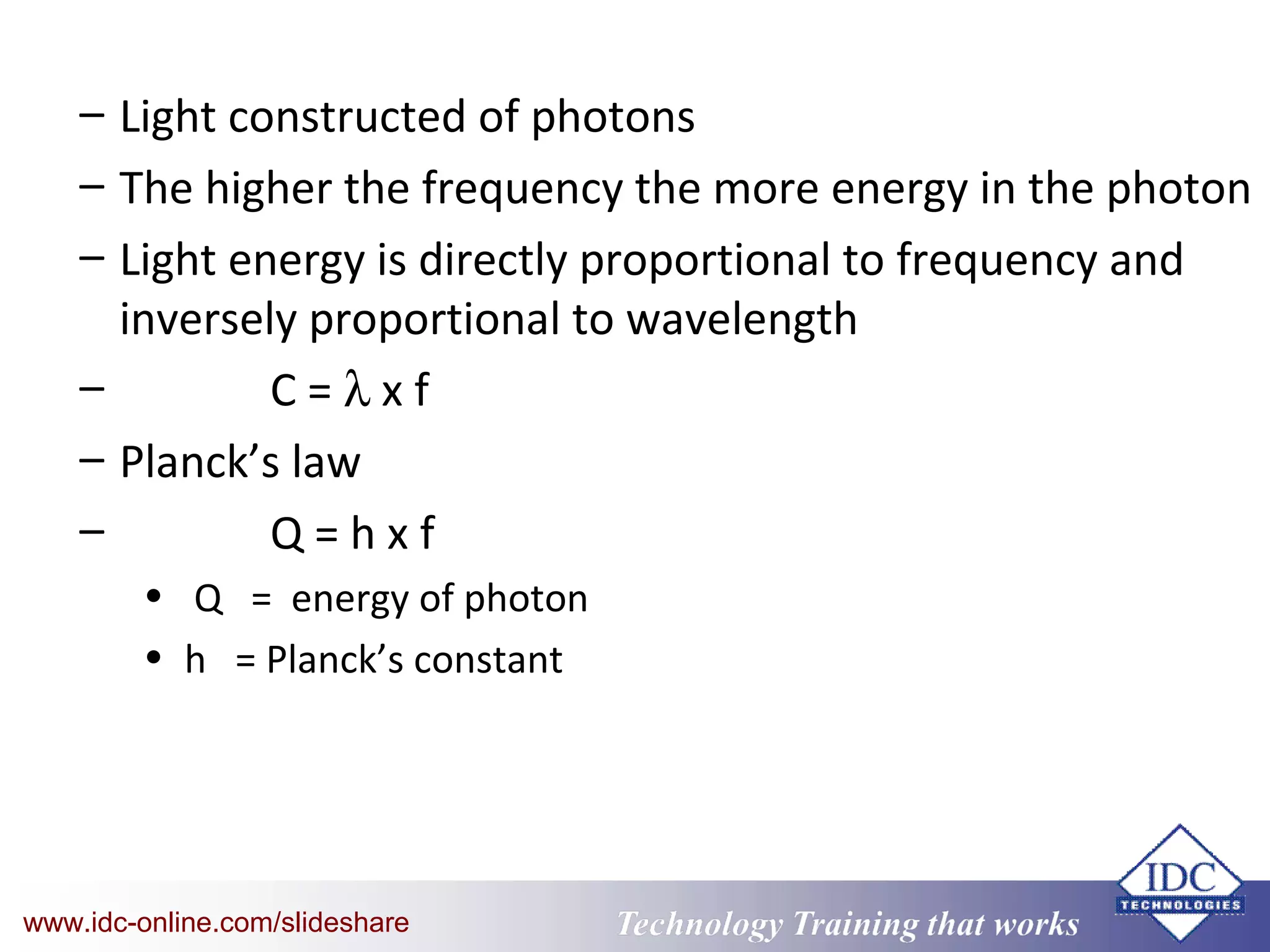
– Light constructed of photons
– The higher the frequency the more energy in the photon
– Light energy is directly proportional to frequency and
inversely proportional to wavelength
– C = λ x f
– Planck’s law
– Q = h x f
• Q = energy of photon
• h = Planck’s constant
Technology Training that WorksTechnology Training that Workswww.idc-online.com/slideshare
• Electrical power
– P = dQ / dt
Q = electron energy in joules
• Light power
– P = d (nQp) / dt
Qp = energy of a single photon
n = number of photons
Technology Training that WorksTechnology Training that Workswww.idc-online.com/slideshare
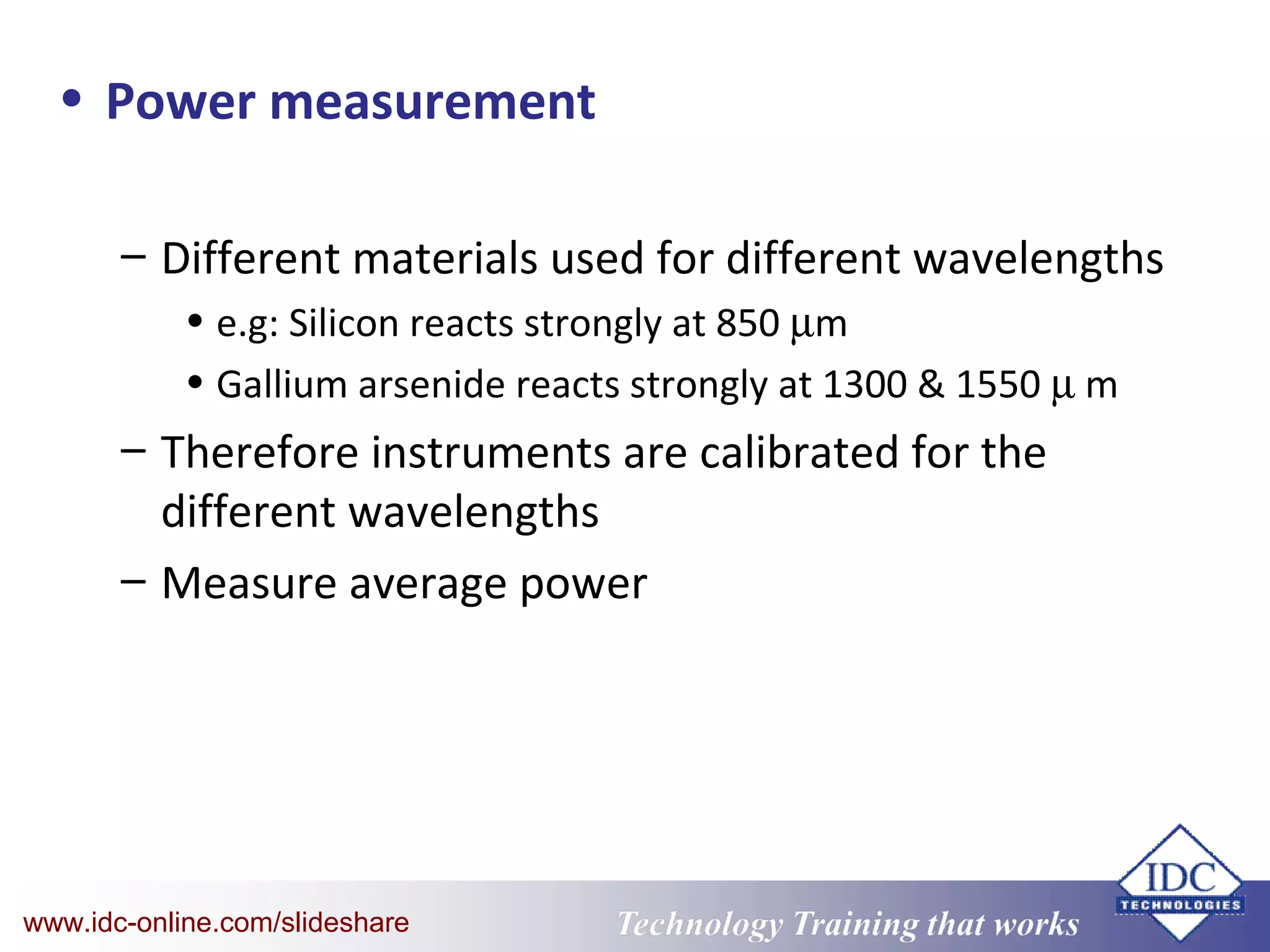
• Power measurement
– Different materials used for different wavelengths
• e.g: Silicon reacts strongly at 850 µm
• Gallium arsenide reacts strongly at 1300 & 1550 µ m
– Therefore instruments are calibrated for the
different wavelengths
– Measure average power
Technology Training that WorksTechnology Training that Workswww.idc-online.com/slideshare
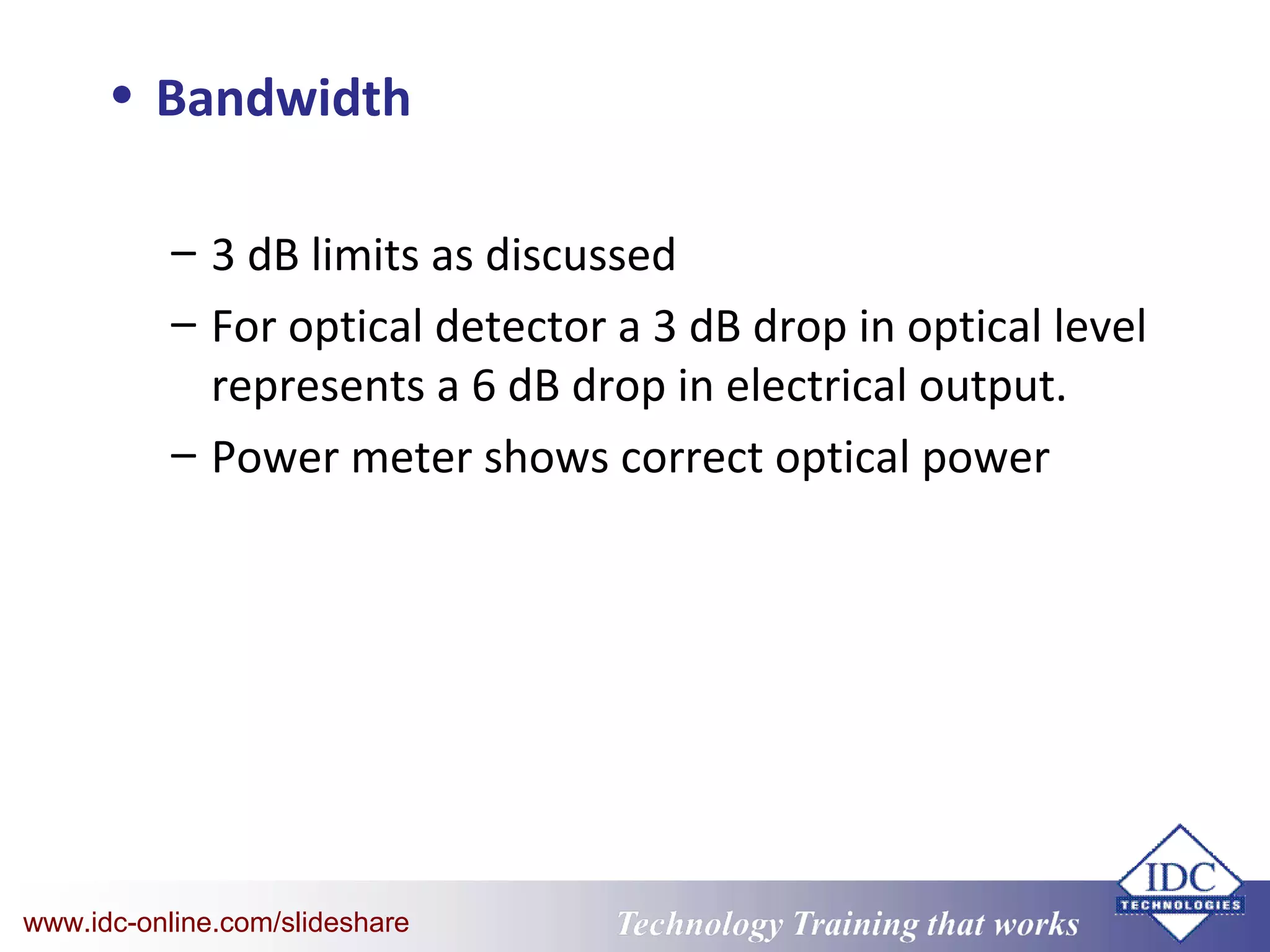
• Bandwidth
– 3 dB limits as discussed
– For optical detector a 3 dB drop in optical level
represents a 6 dB drop in electrical output.
– Power meter shows correct optical power
Technology Training that WorksTechnology Training that Workswww.idc-online.com/slideshare
Fibre optic tests
• Generally tests carried out before and after
installation
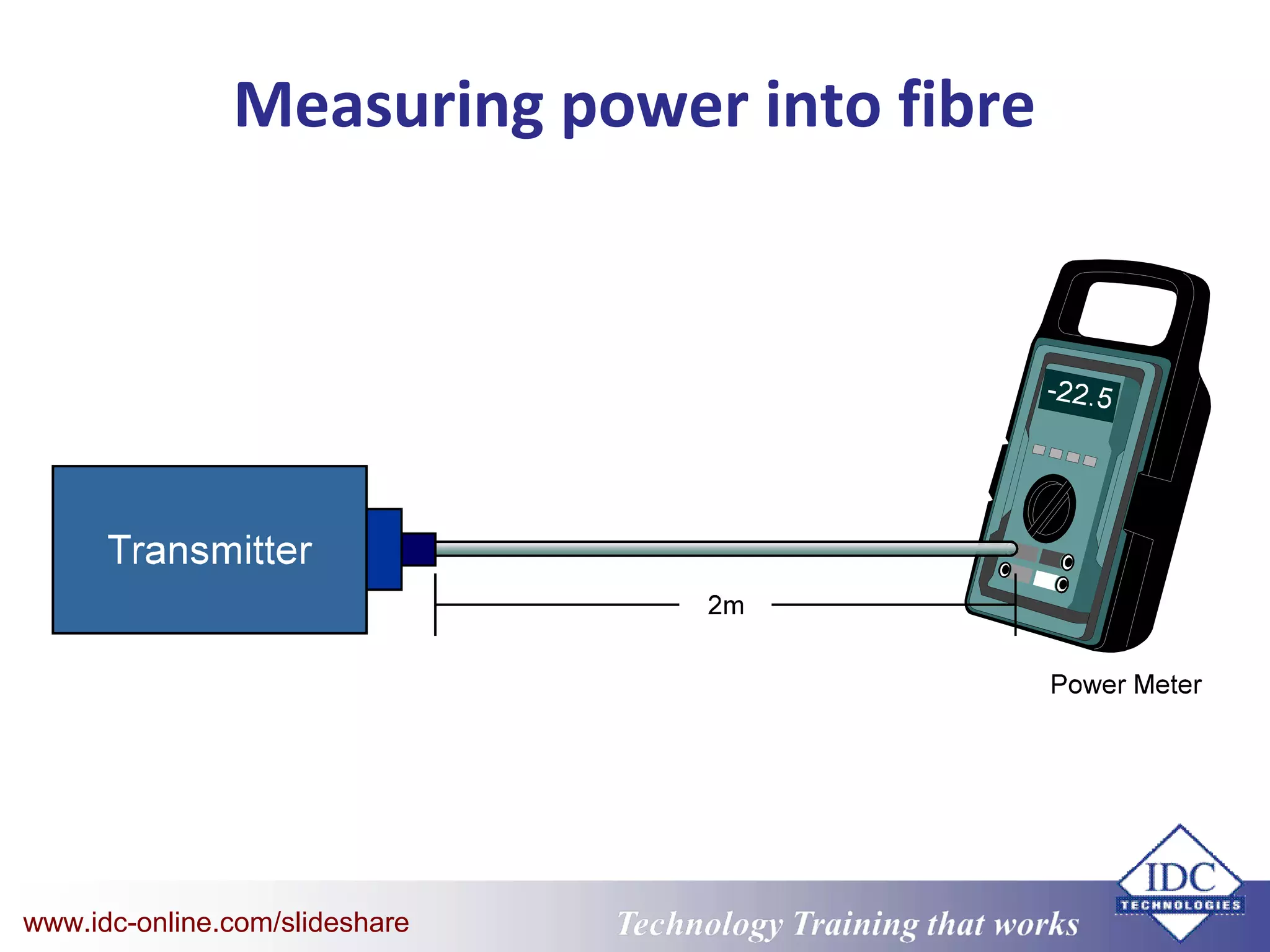
• Transmitter power test
• Connect Tx device via 2 m fibre to power meter
• Should be +/- 5% of specified figure
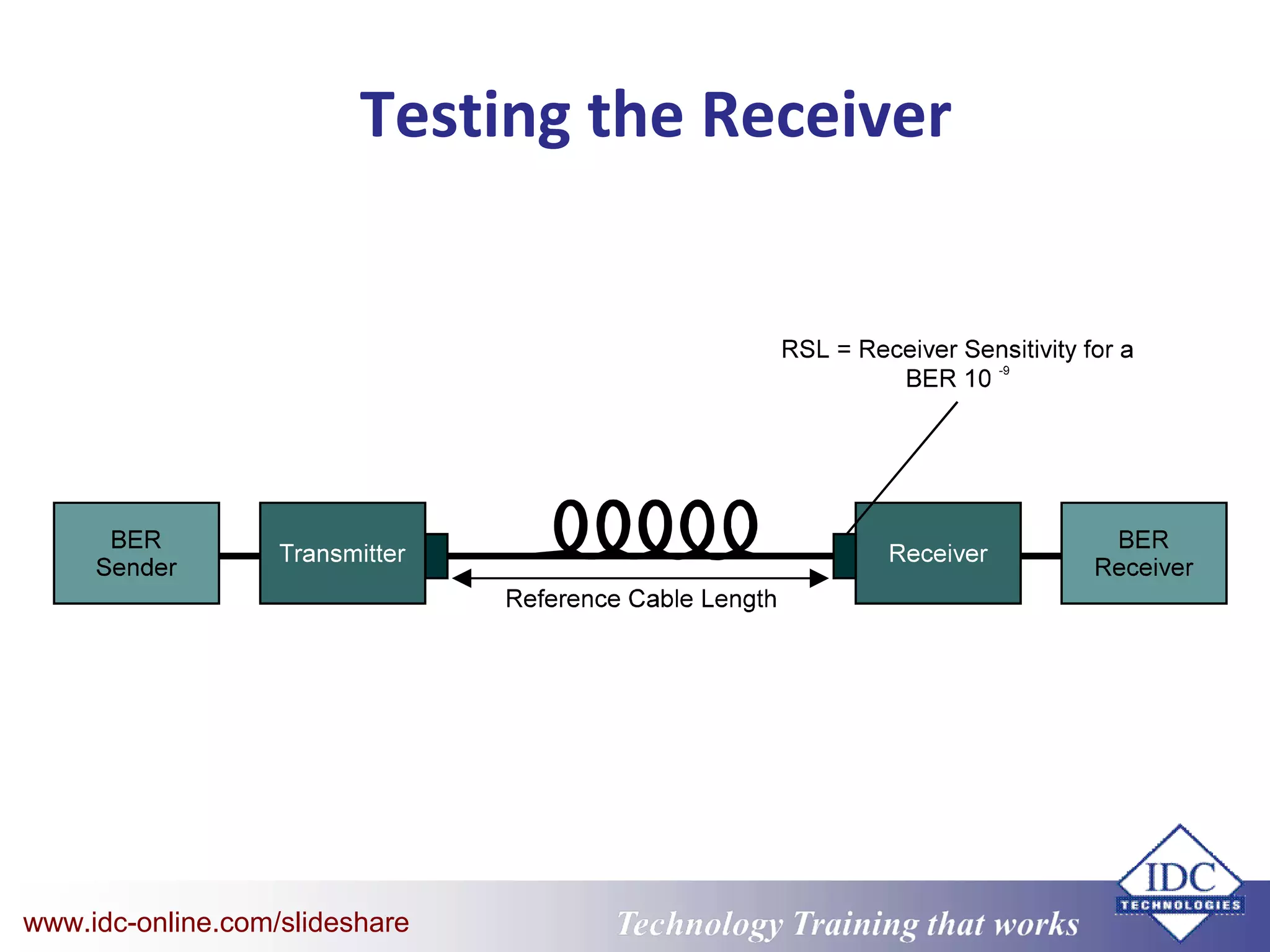
• Receiver performance test
• Connect Tx to Rx through optical fibre & attenuators.
Drop Rx level down to specified receiver sensitivity
• Check BER is < 10
-9
Technology Training that WorksTechnology Training that Workswww.idc-online.com/slideshare
Measuring power into fibre
Technology Training that WorksTechnology Training that Workswww.idc-online.com/slideshare
Testing the Receiver
Technology Training that WorksTechnology Training that Workswww.idc-online.com/slideshare
• Continuity testing
– Very basic test of fibre continuity
– A continuity tester works at a 650µm
wavelength (red).
– Use physical observation
– Used for
• Tracing cores
• Finding fractures or bad splices with leaking
light
• Locating cores at intermediate points by
bending the fibres
Technology Training that WorksTechnology Training that Workswww.idc-online.com/slideshare
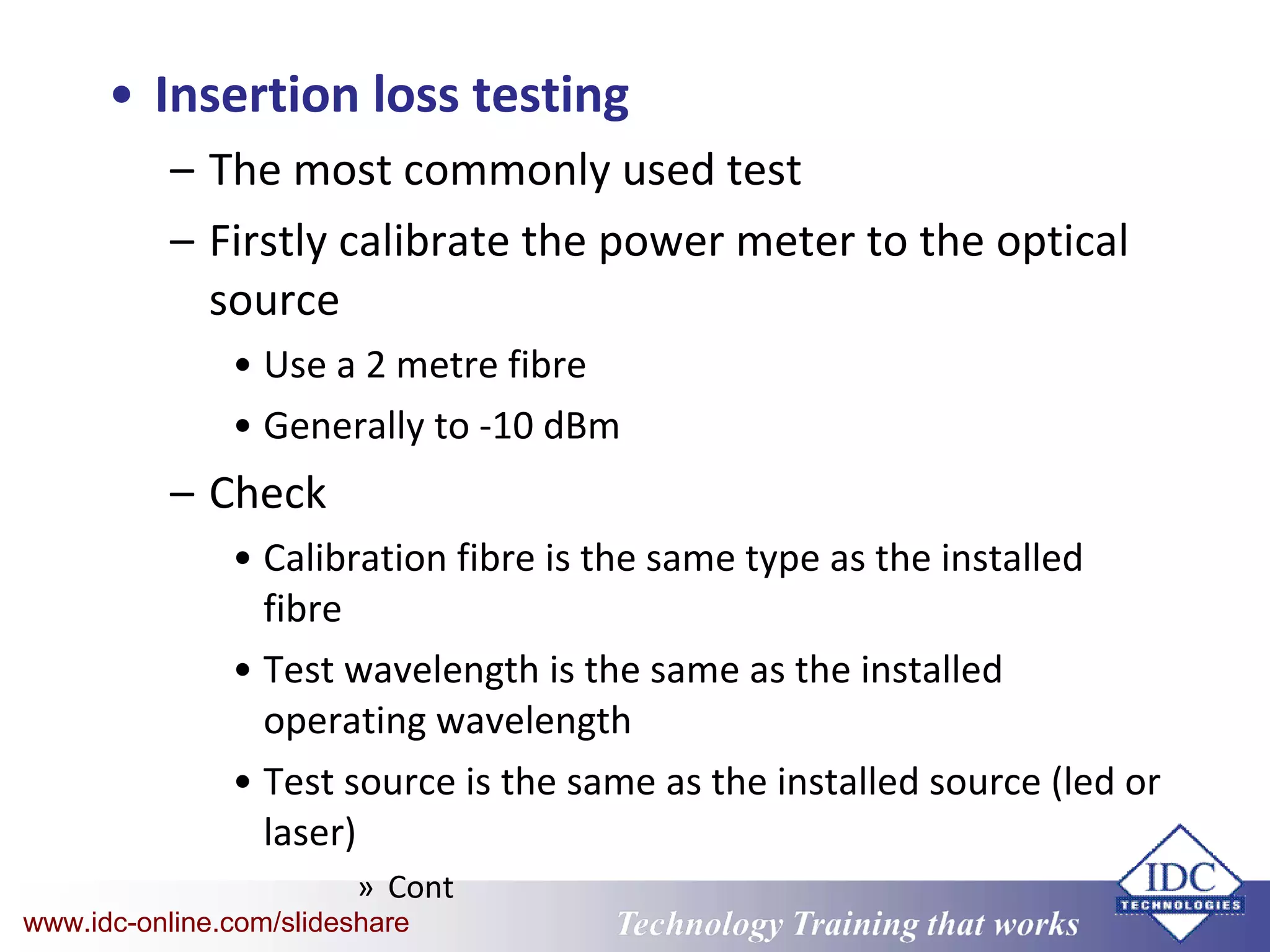
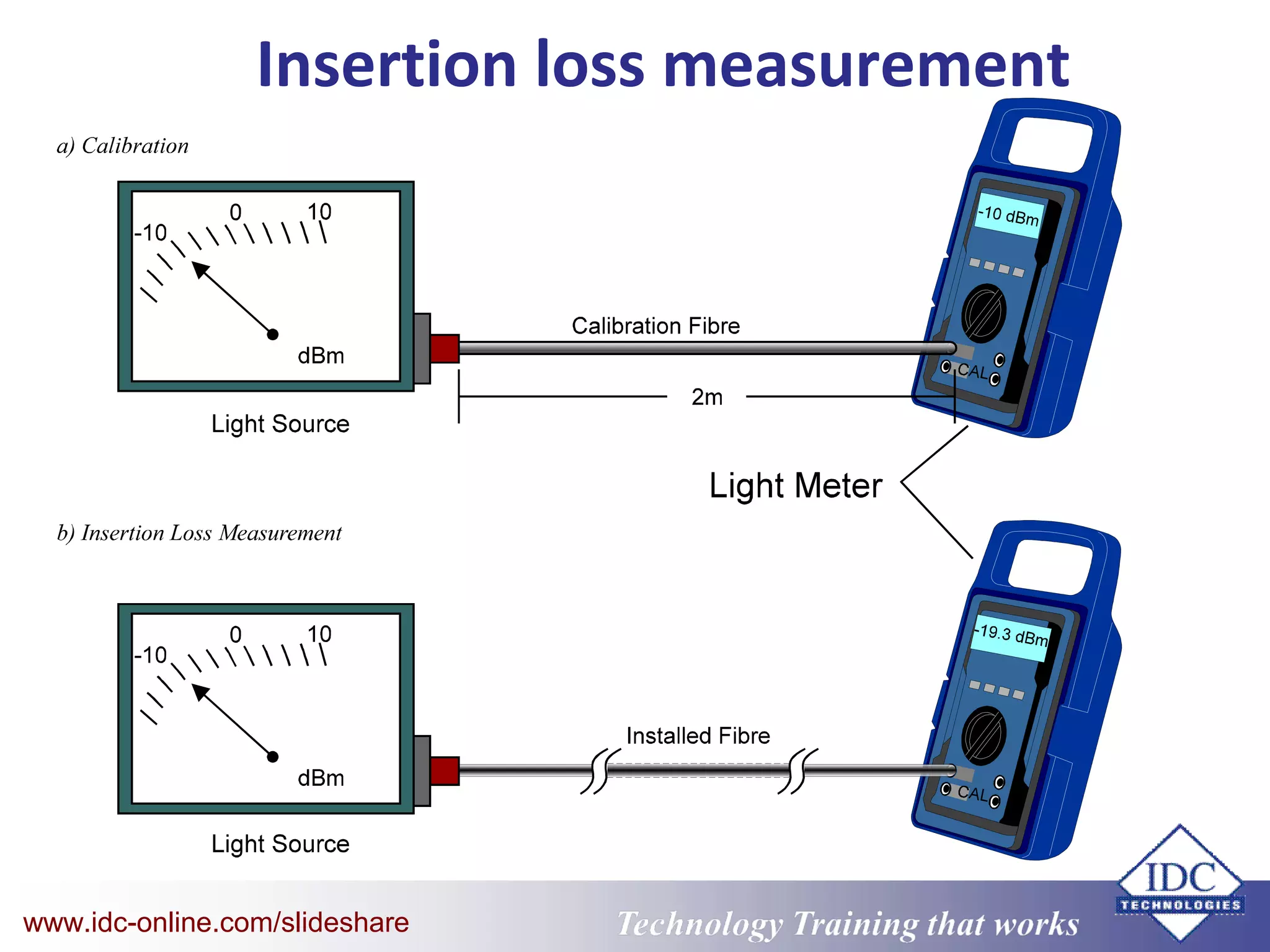
• Insertion loss testing
– The most commonly used test
– Firstly calibrate the power meter to the optical
source
• Use a 2 metre fibre
• Generally to -10 dBm
– Check
• Calibration fibre is the same type as the installed
fibre
• Test wavelength is the same as the installed
operating wavelength
• Test source is the same as the installed source (led or
laser)
» Cont
Technology Training that WorksTechnology Training that Workswww.idc-online.com/slideshare
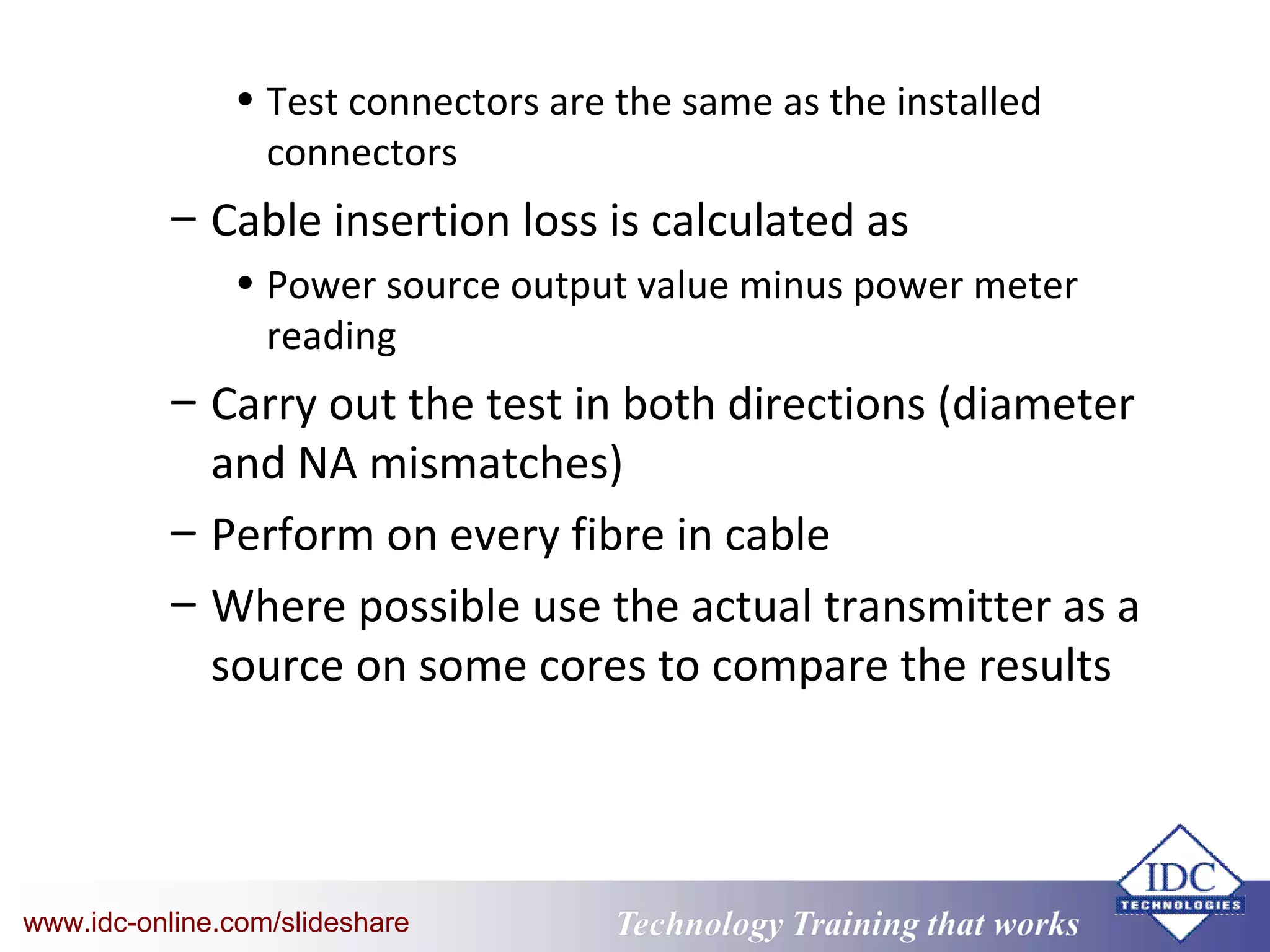
• Test connectors are the same as the installed
connectors
– Cable insertion loss is calculated as
• Power source output value minus power meter
reading
– Carry out the test in both directions (diameter
and NA mismatches)
– Perform on every fibre in cable
– Where possible use the actual transmitter as a
source on some cores to compare the results
Technology Training that WorksTechnology Training that Workswww.idc-online.com/slideshare
Insertion loss measurement
Technology Training that WorksTechnology Training that Workswww.idc-online.com/slideshare
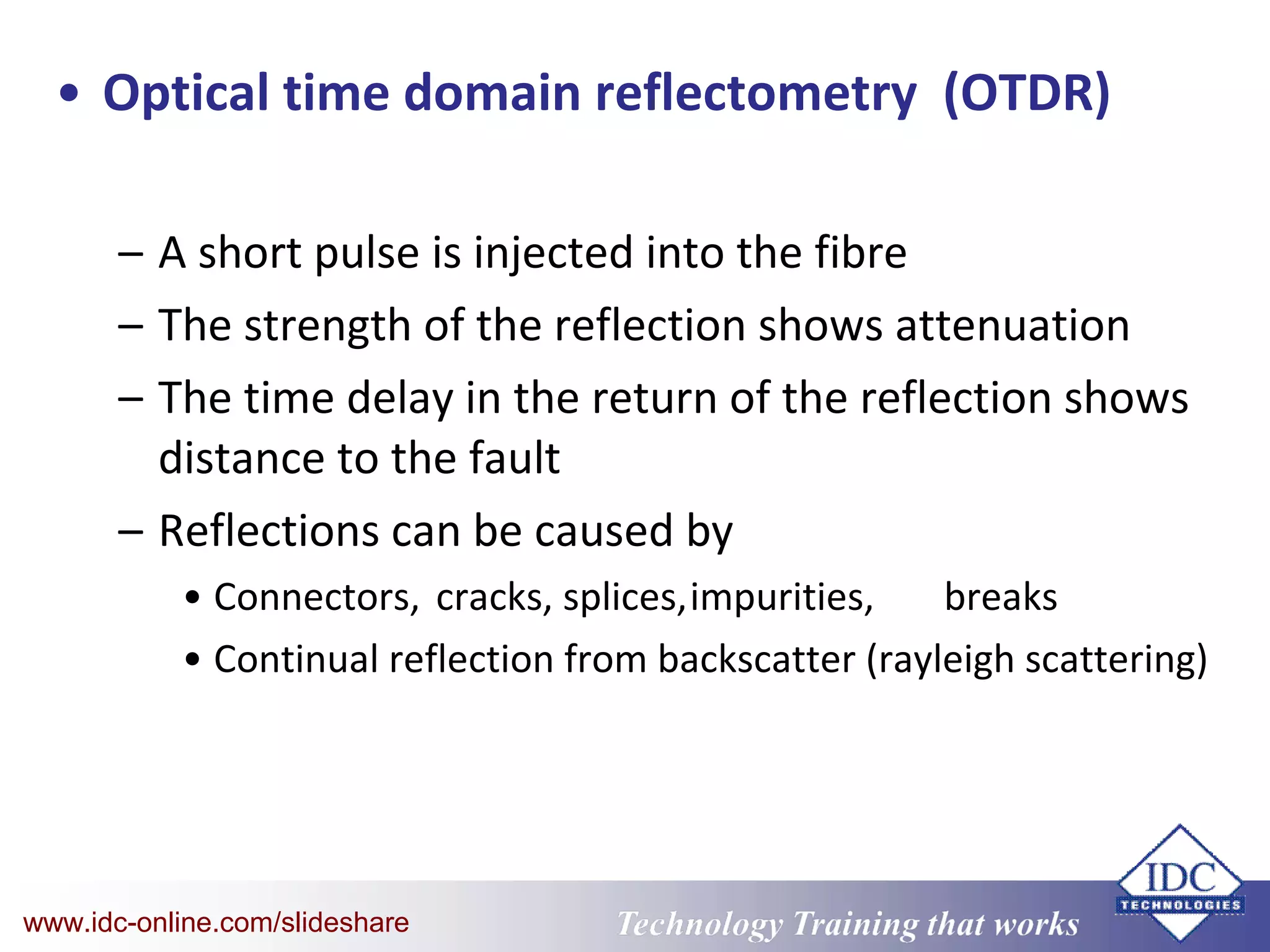
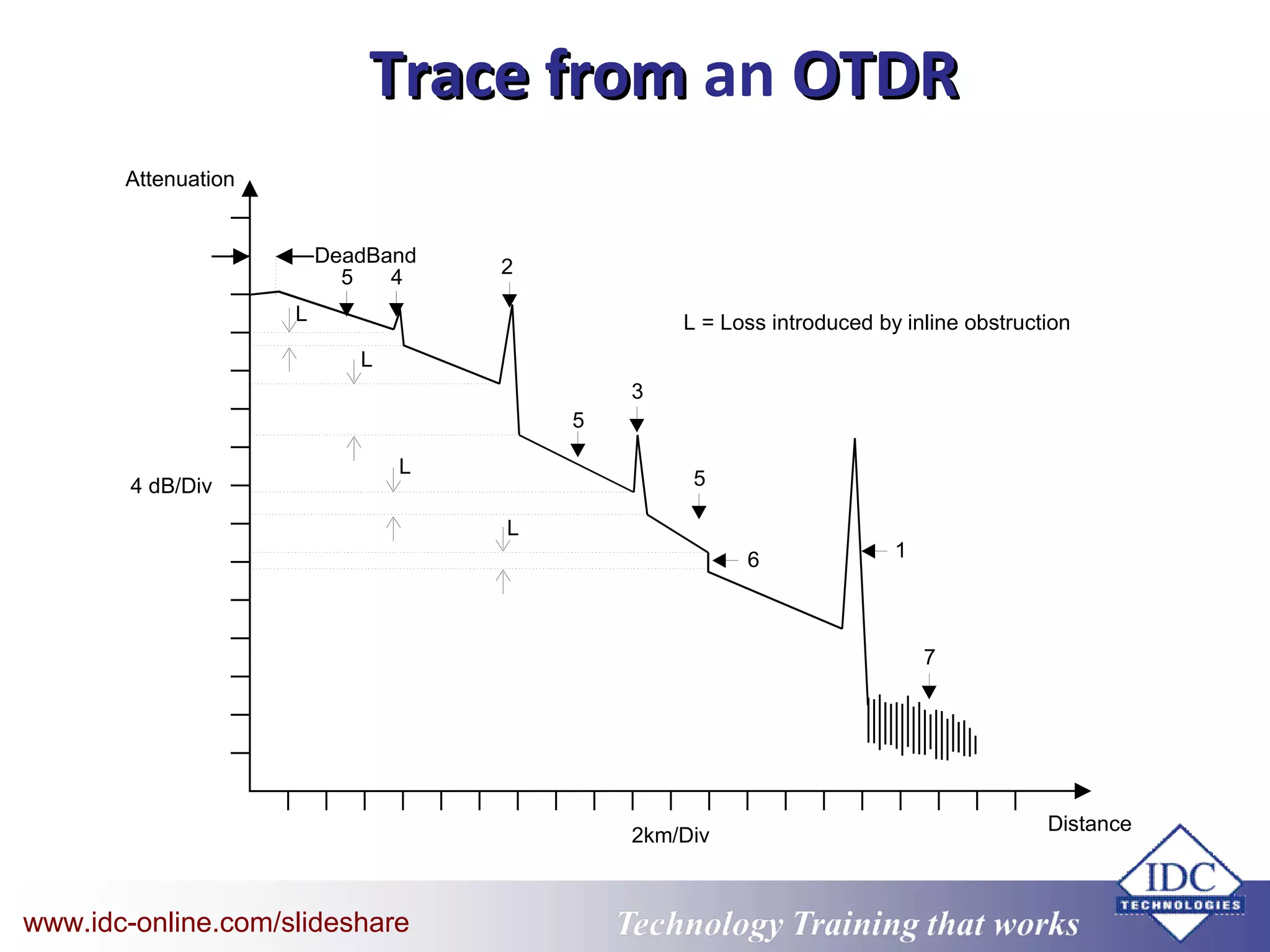
• Optical time domain reflectometry (OTDR)
– A short pulse is injected into the fibre
– The strength of the reflection shows attenuation
– The time delay in the return of the reflection shows
distance to the fault
– Reflections can be caused by
• Connectors, cracks, splices,impurities, breaks
• Continual reflection from backscatter (rayleigh scattering)
Technology Training that WorksTechnology Training that Workswww.idc-online.com/slideshare
Trace fromTrace from an OTDROTDR
4 dB/Div
2km/Div
DeadBand
L
L
L
L
5 4 2
5
5
6 1
7
3
L = Loss introduced by inline obstruction
Distance
Attenuation
Technology Training that WorksTechnology Training that Workswww.idc-online.com/slideshare
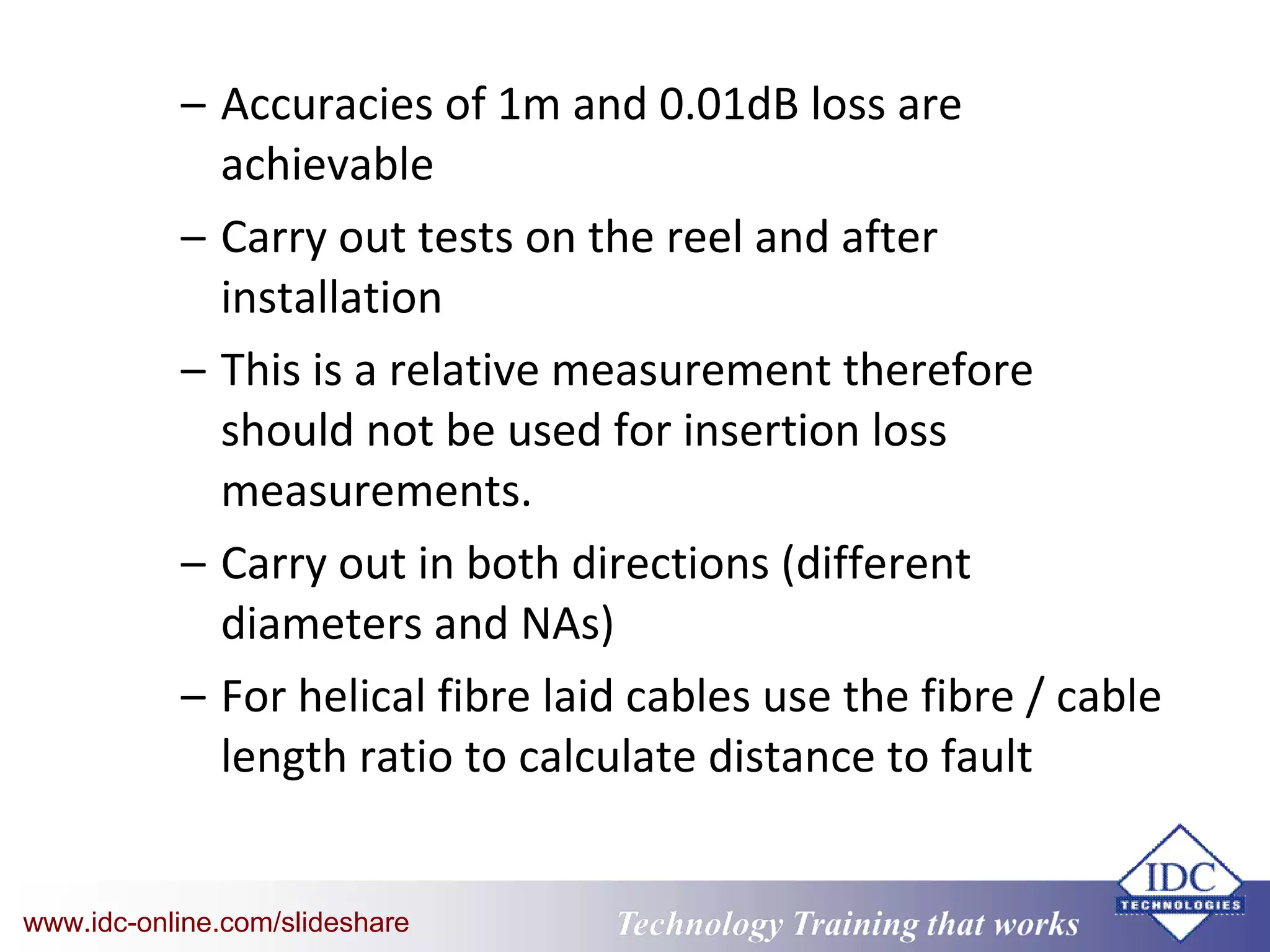
– Accuracies of 1m and 0.01dB loss are
achievable
– Carry out tests on the reel and after
installation
– This is a relative measurement therefore
should not be used for insertion loss
measurements.
– Carry out in both directions (different
diameters and NAs)
– For helical fibre laid cables use the fibre / cable
length ratio to calculate distance to fault
Technology Training that WorksTechnology Training that Workswww.idc-online.com/slideshare
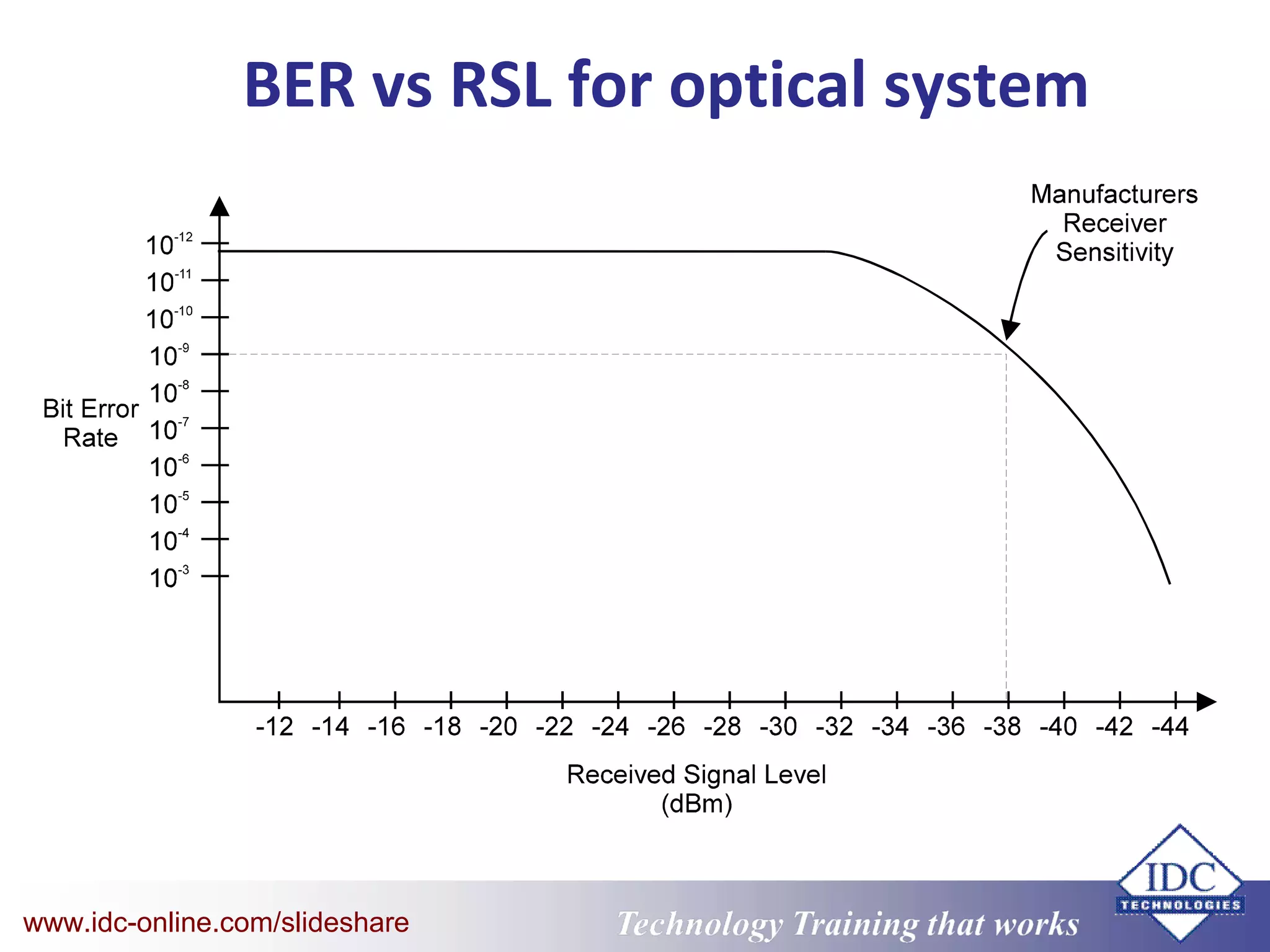
• Bit Error Rate testing
– BER = error bits received
total bits sent for a given period of time
– Normally 30 mins to 1 hr
– Expect residual BERof 10
-9
– Availability
• Time that link is available for uninterrupted use
over a 12 month period at a BER of 10
-12
• Expect 99.9999% or better
Technology Training that WorksTechnology Training that Workswww.idc-online.com/slideshare
BER vs RSL for optical system
Technology Training that WorksTechnology Training that Workswww.idc-online.com/slideshare
• Eye diagrams
– Provides analysis of the communications
system in real time
– Formed by continually overlapping the
signal at the Rx input on a scope (with a
pseudo random signal from the Tx)
– Measures
• Noise, jitter, period, duty cycle, settling time,
pulse width, rise time, fall time, overshoot,
undershoot, preshoot, settling time, pulse
quality and extinction ratio.
Technology Training that WorksTechnology Training that Workswww.idc-online.com/slideshare
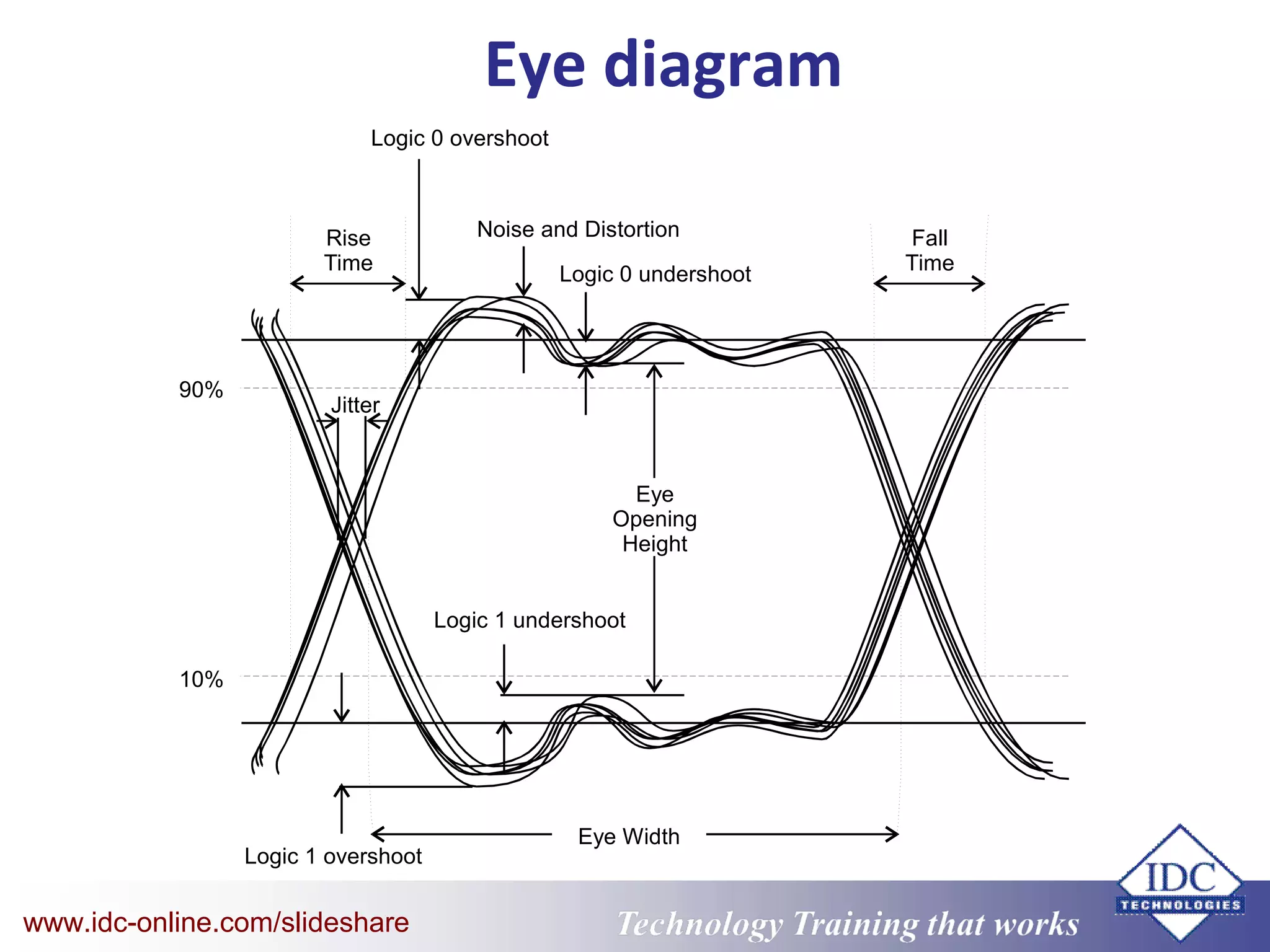
Eye diagram
Logic 1 overshoot
Logic 0 overshoot
Logic 1 undershoot
Logic 0 undershoot
Eye Width
10%
90%
Eye
Opening
Height
Rise
Time
Fall
Time
Noise and Distortion
Jitter
Technology Training that WorksTechnology Training that Workswww.idc-online.com/slideshare
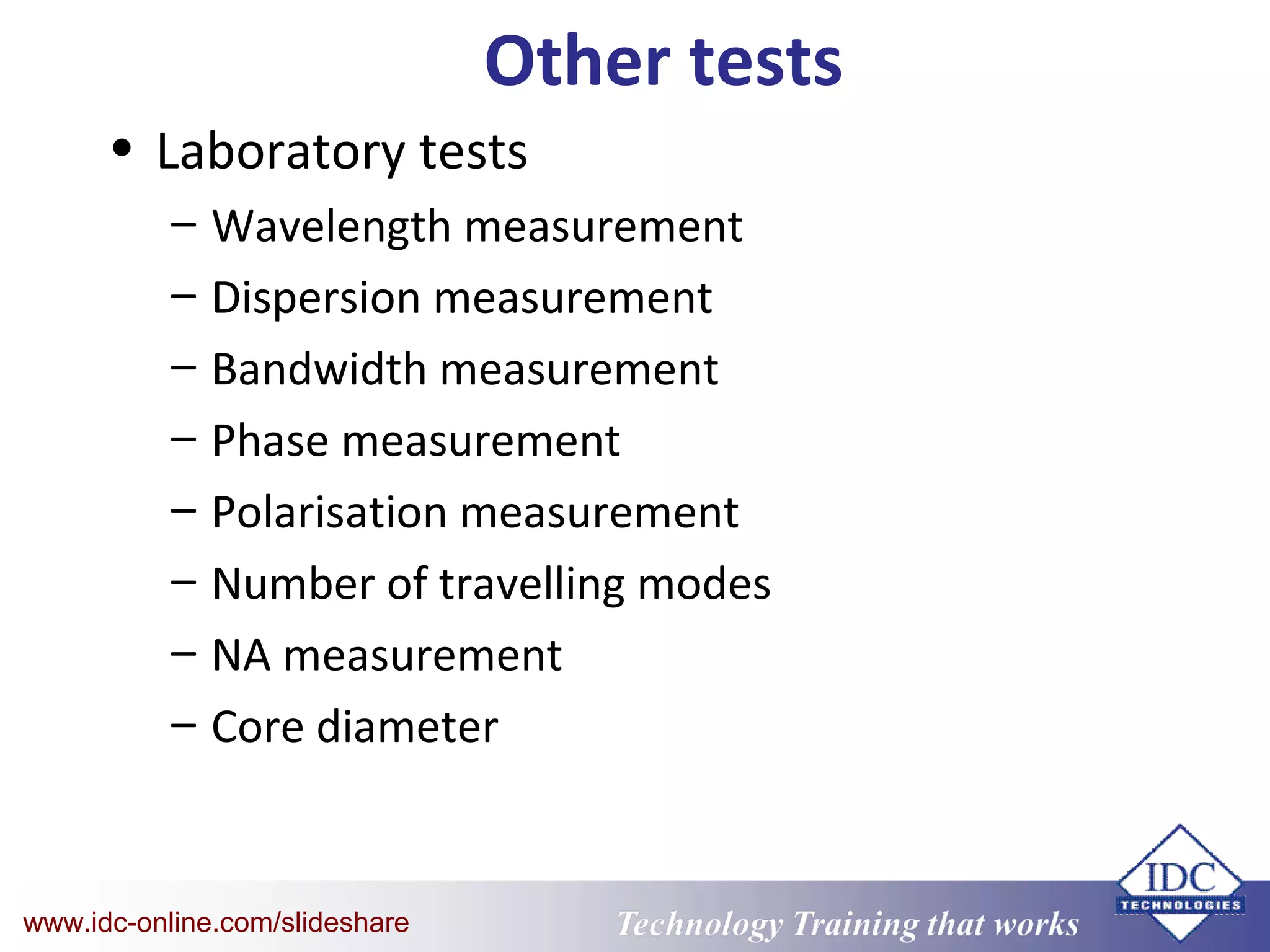
Other tests
• Laboratory tests
– Wavelength measurement
– Dispersion measurement
– Bandwidth measurement
– Phase measurement
– Polarisation measurement
– Number of travelling modes
– NA measurement
– Core diameter
Technology Training that WorksTechnology Training that Workswww.idc-online.com/slideshare
Thank You For Your Interest
If you are interested in further training, please visit:
http://www.idc-online.com/slideshare

Testing and Troubleshooting Fiber Optic Cables

  • 1.
    Technology Training thatWorksTechnology Training that Workswww.idc-online.com/slideshare Testing & Troubleshooting of Fibre Optic Cables
  • 2.
    Technology Training thatWorksTechnology Training that Workswww.idc-online.com/slideshare If you are interested in further training or information, please visit: http://www.idc-online.com/slideshare
  • 3.
    Technology Training thatWorksTechnology Training that Workswww.idc-online.com/slideshare • To be discussed – Fundamental concepts of optical measurement – Standard fibre optic cable tests – Standard fibre optic equipment tests – Data transmission tests – Laboratory measurements
  • 4.
    Technology Training thatWorksTechnology Training that Workswww.idc-online.com/slideshare Fundamental concepts of optical measurement • Optical power – Measured in watts – Optical measurements relate directly to electrical measurements – Optical energy measured as average of incoming optical pulsed signal
  • 5.
    Technology Training thatWorksTechnology Training that Workswww.idc-online.com/slideshare Power for received optical waveform POWER (dBm) TIME Peak Average -16 -21 -23
  • 6.
    Technology Training thatWorksTechnology Training that Workswww.idc-online.com/slideshare – Light constructed of photons – The higher the frequency the more energy in the photon – Light energy is directly proportional to frequency and inversely proportional to wavelength – C = λ x f – Planck’s law – Q = h x f • Q = energy of photon • h = Planck’s constant
  • 7.
    Technology Training thatWorksTechnology Training that Workswww.idc-online.com/slideshare • Electrical power – P = dQ / dt Q = electron energy in joules • Light power – P = d (nQp) / dt Qp = energy of a single photon n = number of photons
  • 8.
    Technology Training thatWorksTechnology Training that Workswww.idc-online.com/slideshare • Power measurement – Different materials used for different wavelengths • e.g: Silicon reacts strongly at 850 µm • Gallium arsenide reacts strongly at 1300 & 1550 µ m – Therefore instruments are calibrated for the different wavelengths – Measure average power
  • 9.
    Technology Training thatWorksTechnology Training that Workswww.idc-online.com/slideshare • Bandwidth – 3 dB limits as discussed – For optical detector a 3 dB drop in optical level represents a 6 dB drop in electrical output. – Power meter shows correct optical power
  • 10.
    Technology Training thatWorksTechnology Training that Workswww.idc-online.com/slideshare Fibre optic tests • Generally tests carried out before and after installation • Transmitter power test • Connect Tx device via 2 m fibre to power meter • Should be +/- 5% of specified figure • Receiver performance test • Connect Tx to Rx through optical fibre & attenuators. Drop Rx level down to specified receiver sensitivity • Check BER is < 10 -9
  • 11.
    Technology Training thatWorksTechnology Training that Workswww.idc-online.com/slideshare Measuring power into fibre
  • 12.
    Technology Training thatWorksTechnology Training that Workswww.idc-online.com/slideshare Testing the Receiver
  • 13.
    Technology Training thatWorksTechnology Training that Workswww.idc-online.com/slideshare • Continuity testing – Very basic test of fibre continuity – A continuity tester works at a 650µm wavelength (red). – Use physical observation – Used for • Tracing cores • Finding fractures or bad splices with leaking light • Locating cores at intermediate points by bending the fibres
  • 14.
    Technology Training thatWorksTechnology Training that Workswww.idc-online.com/slideshare • Insertion loss testing – The most commonly used test – Firstly calibrate the power meter to the optical source • Use a 2 metre fibre • Generally to -10 dBm – Check • Calibration fibre is the same type as the installed fibre • Test wavelength is the same as the installed operating wavelength • Test source is the same as the installed source (led or laser) » Cont
  • 15.
    Technology Training thatWorksTechnology Training that Workswww.idc-online.com/slideshare • Test connectors are the same as the installed connectors – Cable insertion loss is calculated as • Power source output value minus power meter reading – Carry out the test in both directions (diameter and NA mismatches) – Perform on every fibre in cable – Where possible use the actual transmitter as a source on some cores to compare the results
  • 16.
    Technology Training thatWorksTechnology Training that Workswww.idc-online.com/slideshare Insertion loss measurement
  • 17.
    Technology Training thatWorksTechnology Training that Workswww.idc-online.com/slideshare • Optical time domain reflectometry (OTDR) – A short pulse is injected into the fibre – The strength of the reflection shows attenuation – The time delay in the return of the reflection shows distance to the fault – Reflections can be caused by • Connectors, cracks, splices,impurities, breaks • Continual reflection from backscatter (rayleigh scattering)
  • 18.
    Technology Training thatWorksTechnology Training that Workswww.idc-online.com/slideshare Trace fromTrace from an OTDROTDR 4 dB/Div 2km/Div DeadBand L L L L 5 4 2 5 5 6 1 7 3 L = Loss introduced by inline obstruction Distance Attenuation
  • 19.
    Technology Training thatWorksTechnology Training that Workswww.idc-online.com/slideshare – Accuracies of 1m and 0.01dB loss are achievable – Carry out tests on the reel and after installation – This is a relative measurement therefore should not be used for insertion loss measurements. – Carry out in both directions (different diameters and NAs) – For helical fibre laid cables use the fibre / cable length ratio to calculate distance to fault
  • 20.
    Technology Training thatWorksTechnology Training that Workswww.idc-online.com/slideshare • Bit Error Rate testing – BER = error bits received total bits sent for a given period of time – Normally 30 mins to 1 hr – Expect residual BERof 10 -9 – Availability • Time that link is available for uninterrupted use over a 12 month period at a BER of 10 -12 • Expect 99.9999% or better
  • 21.
    Technology Training thatWorksTechnology Training that Workswww.idc-online.com/slideshare BER vs RSL for optical system
  • 22.
    Technology Training thatWorksTechnology Training that Workswww.idc-online.com/slideshare • Eye diagrams – Provides analysis of the communications system in real time – Formed by continually overlapping the signal at the Rx input on a scope (with a pseudo random signal from the Tx) – Measures • Noise, jitter, period, duty cycle, settling time, pulse width, rise time, fall time, overshoot, undershoot, preshoot, settling time, pulse quality and extinction ratio.
  • 23.
    Technology Training thatWorksTechnology Training that Workswww.idc-online.com/slideshare Eye diagram Logic 1 overshoot Logic 0 overshoot Logic 1 undershoot Logic 0 undershoot Eye Width 10% 90% Eye Opening Height Rise Time Fall Time Noise and Distortion Jitter
  • 24.
    Technology Training thatWorksTechnology Training that Workswww.idc-online.com/slideshare Other tests • Laboratory tests – Wavelength measurement – Dispersion measurement – Bandwidth measurement – Phase measurement – Polarisation measurement – Number of travelling modes – NA measurement – Core diameter
  • 25.
    Technology Training thatWorksTechnology Training that Workswww.idc-online.com/slideshare Thank You For Your Interest If you are interested in further training, please visit: http://www.idc-online.com/slideshare