Why use logistic regression?
• There are many important research topics for which the dependent
variable is "limited."
• For example: voting, morbidity or mortality, and participation data
is not continuous or distributed normally.
• Binary logistic regression is a type of regression analysis where the
dependent variable is a dummy variable: coded 0 (did not vote) or
1(did vote)
Introduction
• Logistic regression estimates the probability of a certain event
occurring.
• It is used in a situation where a researcher is interested to predict the
occurrence of any happenings.
Objective of Logistic Regression
• The objective of logistic regression is to find the best fitting model
to describe the relationship between the dichotomous (binary)
characteristics of interest and a set of independent variables.
Examples of Binary Outcomes
• Should a bank give a person loan or not.
• What determines admittance into a school.
• Which consumers are more likely to buy a new product.
Uses of Logistic Regression
• Prediction of group membership
• It is also provides knowledge of the relationship and strength among
the variables.
• Casual relationship between one or more independent variables and
one binary dependent variables.
• Used to forecast the outcome event.
• Used to predict changes in probabilities.
Assumptions
• The relationship between the dependent and independent variable
may be linear or non-linear.
• The outcome variable must be coded as 0 and 1.
• The independent variable do not need to be metric.
• Independent variable linearly related to the log odds.
• It requires quit large sample size.
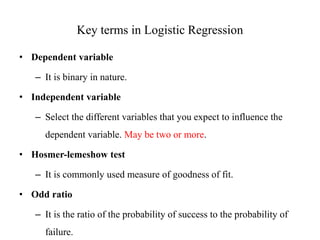
Key terms in Logistic Regression
• Dependent variable
– It is binary in nature.
• Independent variable
– Select the different variables that you expect to influence the
dependent variable. May be two or more.
• Hosmer-lemeshow test
– It is commonly used measure of goodness of fit.
• Odd ratio
– It is the ratio of the probability of success to the probability of
failure.
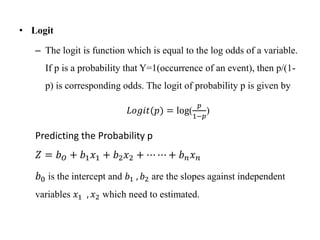
• Logit
– The logit is function which is equal to the log odds of a variable.
If p is a probability that Y=1(occurrence of an event), then p/(1-
p) is corresponding odds. The logit of probability p is given by
𝐿𝑜𝑔𝑖𝑡(𝑝) = log(
𝑝
1−𝑝
)
Predicting the Probability p
𝑍 = 𝑏𝑂 + 𝑏1𝑥1 + 𝑏2𝑥2 + ⋯ ⋯ + 𝑏𝑛𝑥𝑛
𝑏0 is the intercept and 𝑏1 , 𝑏2 are the slopes against independent
variables 𝑥1 , 𝑥2 which need to estimated.
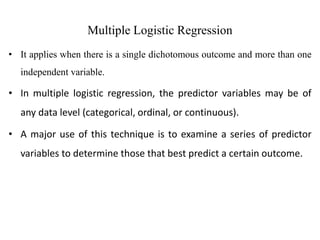
Multiple Logistic Regression
• It applies when there is a single dichotomous outcome and more than one
independent variable.
• In multiple logistic regression, the predictor variables may be of
any data level (categorical, ordinal, or continuous).
• A major use of this technique is to examine a series of predictor
variables to determine those that best predict a certain outcome.
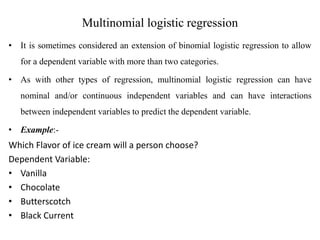
Multinomial logistic regression
• It is sometimes considered an extension of binomial logistic regression to allow
for a dependent variable with more than two categories.
• As with other types of regression, multinomial logistic regression can have
nominal and/or continuous independent variables and can have interactions
between independent variables to predict the dependent variable.
• Example:-
Which Flavor of ice cream will a person choose?
Dependent Variable:
• Vanilla
• Chocolate
• Butterscotch
• Black Current
Independent Variables:
• Gender
• Age
• Occasion
• Happiness
• Etc.

PPT_logistic regression.pptx

  • 1.
    Why use logisticregression? • There are many important research topics for which the dependent variable is "limited." • For example: voting, morbidity or mortality, and participation data is not continuous or distributed normally. • Binary logistic regression is a type of regression analysis where the dependent variable is a dummy variable: coded 0 (did not vote) or 1(did vote)
  • 2.
    Introduction • Logistic regressionestimates the probability of a certain event occurring. • It is used in a situation where a researcher is interested to predict the occurrence of any happenings. Objective of Logistic Regression • The objective of logistic regression is to find the best fitting model to describe the relationship between the dichotomous (binary) characteristics of interest and a set of independent variables. Examples of Binary Outcomes • Should a bank give a person loan or not. • What determines admittance into a school. • Which consumers are more likely to buy a new product.
  • 3.
    Uses of LogisticRegression • Prediction of group membership • It is also provides knowledge of the relationship and strength among the variables. • Casual relationship between one or more independent variables and one binary dependent variables. • Used to forecast the outcome event. • Used to predict changes in probabilities.
  • 4.
    Assumptions • The relationshipbetween the dependent and independent variable may be linear or non-linear. • The outcome variable must be coded as 0 and 1. • The independent variable do not need to be metric. • Independent variable linearly related to the log odds. • It requires quit large sample size.
  • 5.
    Key terms inLogistic Regression • Dependent variable – It is binary in nature. • Independent variable – Select the different variables that you expect to influence the dependent variable. May be two or more. • Hosmer-lemeshow test – It is commonly used measure of goodness of fit. • Odd ratio – It is the ratio of the probability of success to the probability of failure.
  • 6.
    • Logit – Thelogit is function which is equal to the log odds of a variable. If p is a probability that Y=1(occurrence of an event), then p/(1- p) is corresponding odds. The logit of probability p is given by 𝐿𝑜𝑔𝑖𝑡(𝑝) = log( 𝑝 1−𝑝 ) Predicting the Probability p 𝑍 = 𝑏𝑂 + 𝑏1𝑥1 + 𝑏2𝑥2 + ⋯ ⋯ + 𝑏𝑛𝑥𝑛 𝑏0 is the intercept and 𝑏1 , 𝑏2 are the slopes against independent variables 𝑥1 , 𝑥2 which need to estimated.
  • 7.
    Multiple Logistic Regression •It applies when there is a single dichotomous outcome and more than one independent variable. • In multiple logistic regression, the predictor variables may be of any data level (categorical, ordinal, or continuous). • A major use of this technique is to examine a series of predictor variables to determine those that best predict a certain outcome.
  • 8.
    Multinomial logistic regression •It is sometimes considered an extension of binomial logistic regression to allow for a dependent variable with more than two categories. • As with other types of regression, multinomial logistic regression can have nominal and/or continuous independent variables and can have interactions between independent variables to predict the dependent variable. • Example:- Which Flavor of ice cream will a person choose? Dependent Variable: • Vanilla • Chocolate • Butterscotch • Black Current
  • 9.
    Independent Variables: • Gender •Age • Occasion • Happiness • Etc.