Machine	
  learning	
  workshop	
  
guodong@hulu.com	
  

Machine	
  learning	
  introduc7on	
  

Logis&c	
  regression	
  
Feature	
  selec7on	
  
Boos7ng,	
  tree	
  boos7ng	


See	
  more	
  machine	
  learning	
  post:	
  h>p://dongguo.me	
  	
  
Overview	
  of	
  machine	
  learning	


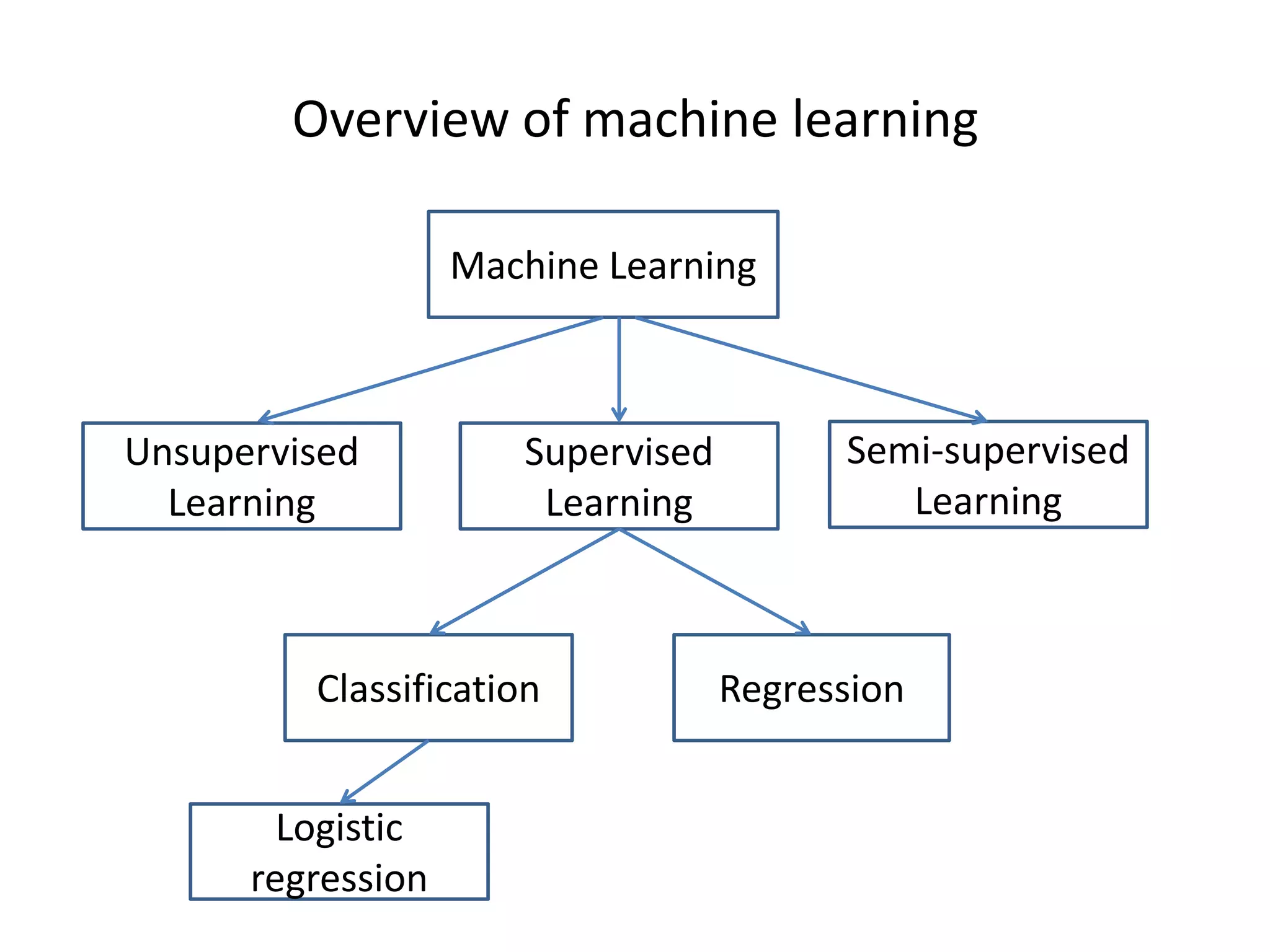
Machine	
  Learning	
  

Unsupervised	
  
Learning	
  

Supervised	
  
Learning	
  

Classifica7on	
  
Logis7c	
  
regression	
  

Semi-­‐supervised	
  
Learning	
  

Regression	
  
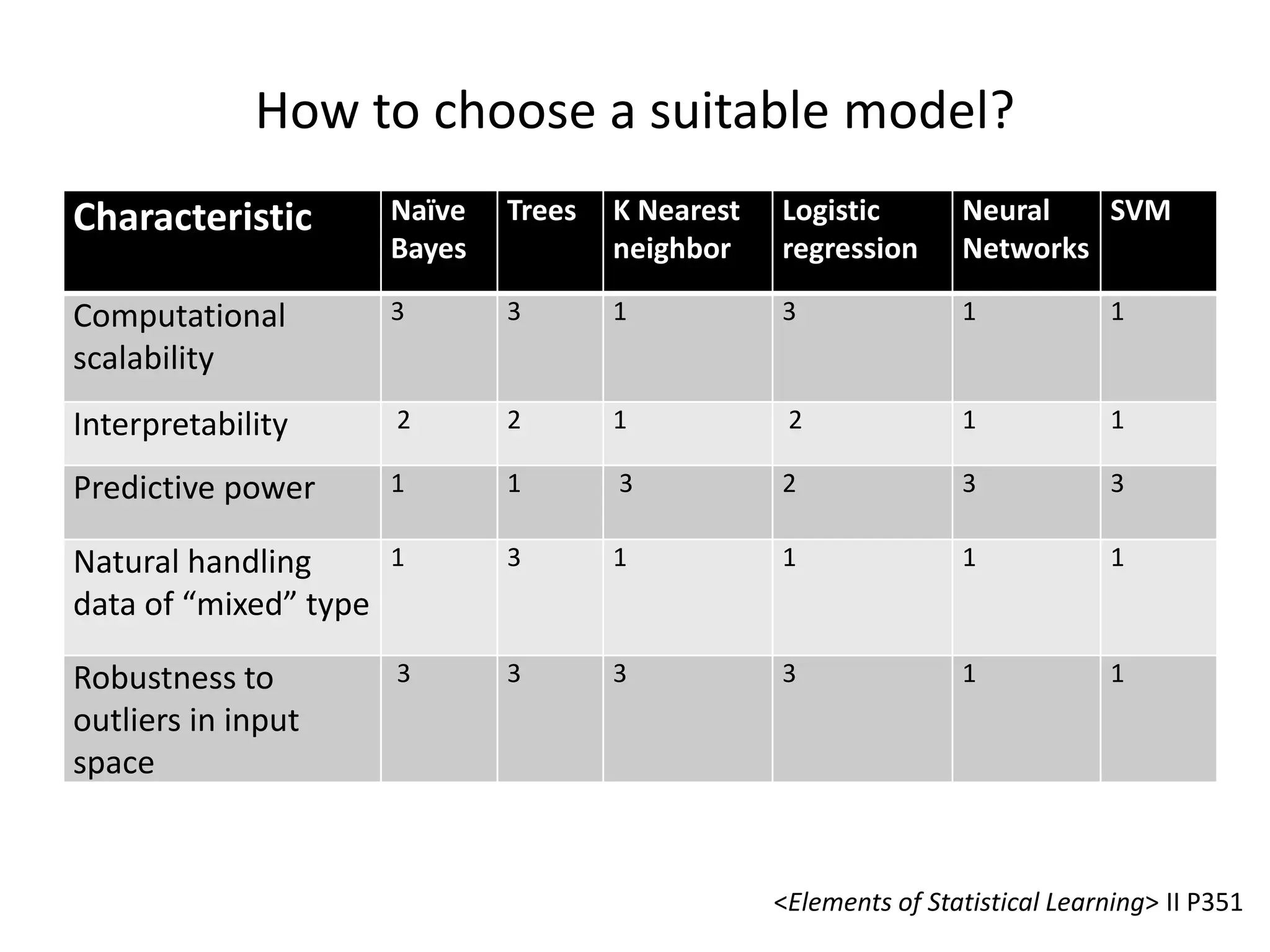
How	
  to	
  choose	
  a	
  suitable	
  model?	
  
Characteris&c	
  

Naïve	
  
Bayes	
  

Trees	
   K	
  Nearest	
  
neighbor	
  

Logis&c	
  
regression	
  

Neural	
  
SVM	
  
Networks	
  

Computa7onal	
  
scalability	
  

3	
  

3	
  

1	
  

3	
  

1	
  

1	
  

Interpretability	


  2	
  

2	


1	


  2	
  

1	
  

1	
  

Predic7ve	
  power	
  

1	
  

1	


  3	
  

2	
  

3	
  

3	
  

Natural	
  handling	
  
data	
  of	
  “mixed”	
  type	
  

1	
  

3	
  

1	
  

1	
  

1	
  

1	
  

Robustness	
  to	
  
outliers	
  in	
  input	
  
space	


  3	
  

3	
  

3	
  

3	


1	
  

1	
  

<Elements	
  of	
  Sta-s-cal	
  Learning>	
  II	
  P351	


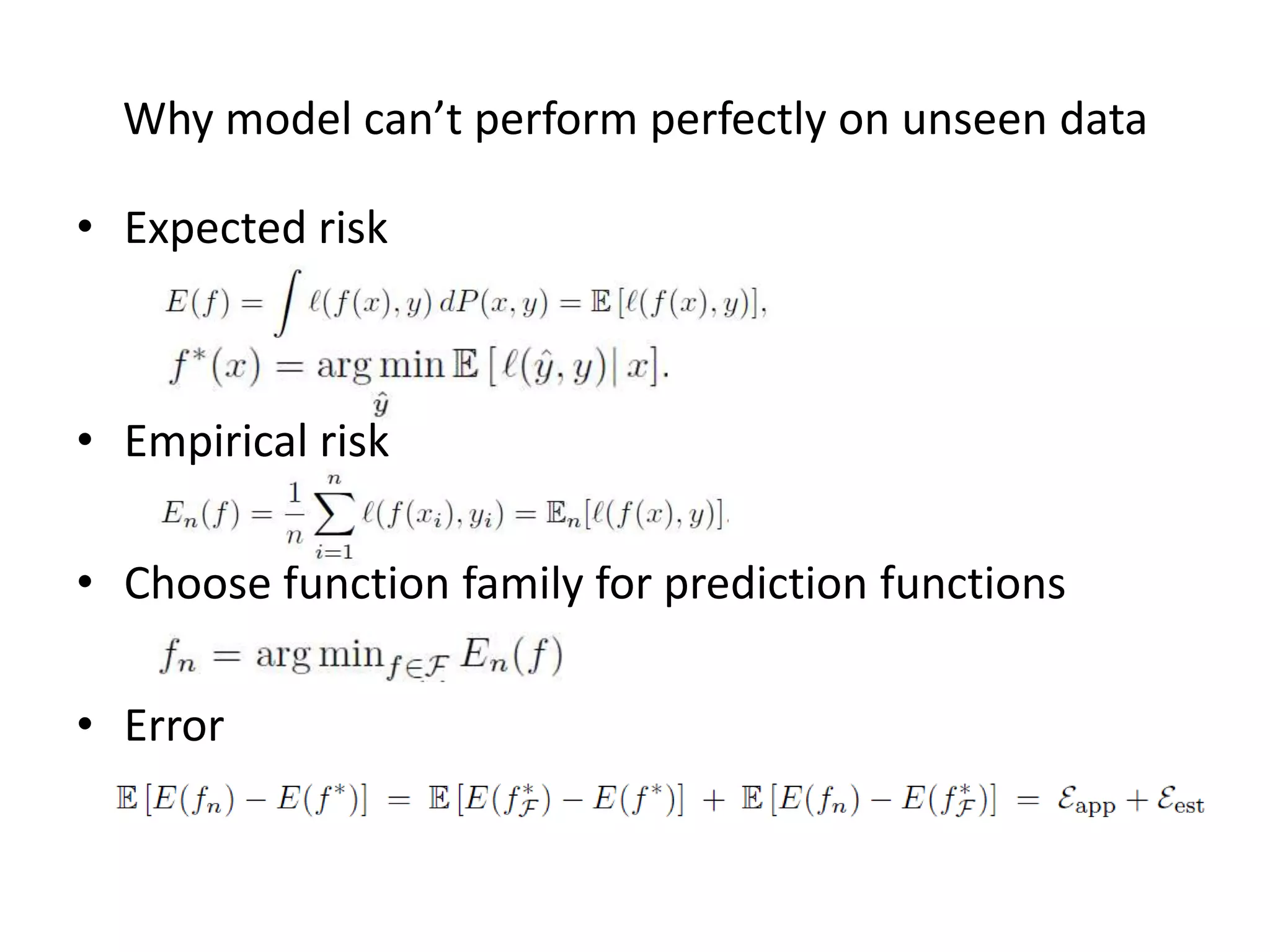
Why	
  model	
  can’t	
  perform	
  perfectly	
  on	
  unseen	
  data	
  
•  Expected	
  risk	
  

•  Empirical	
  risk	
  
•  Choose	
  func7on	
  family	
  for	
  predic7on	
  func7ons	
  	
  
•  Error	
  
Logis7c	
  regression	
  
Outline	
  
• 
• 
• 
• 
• 

Introduc7on	
  
Inference	
  
Regulariza7on	
  
Experiments	
  
More	
  
–  Mul7-­‐nominal	
  LR	
  
–  Generalized	
  linear	
  model	
  

•  Applica7on	
  
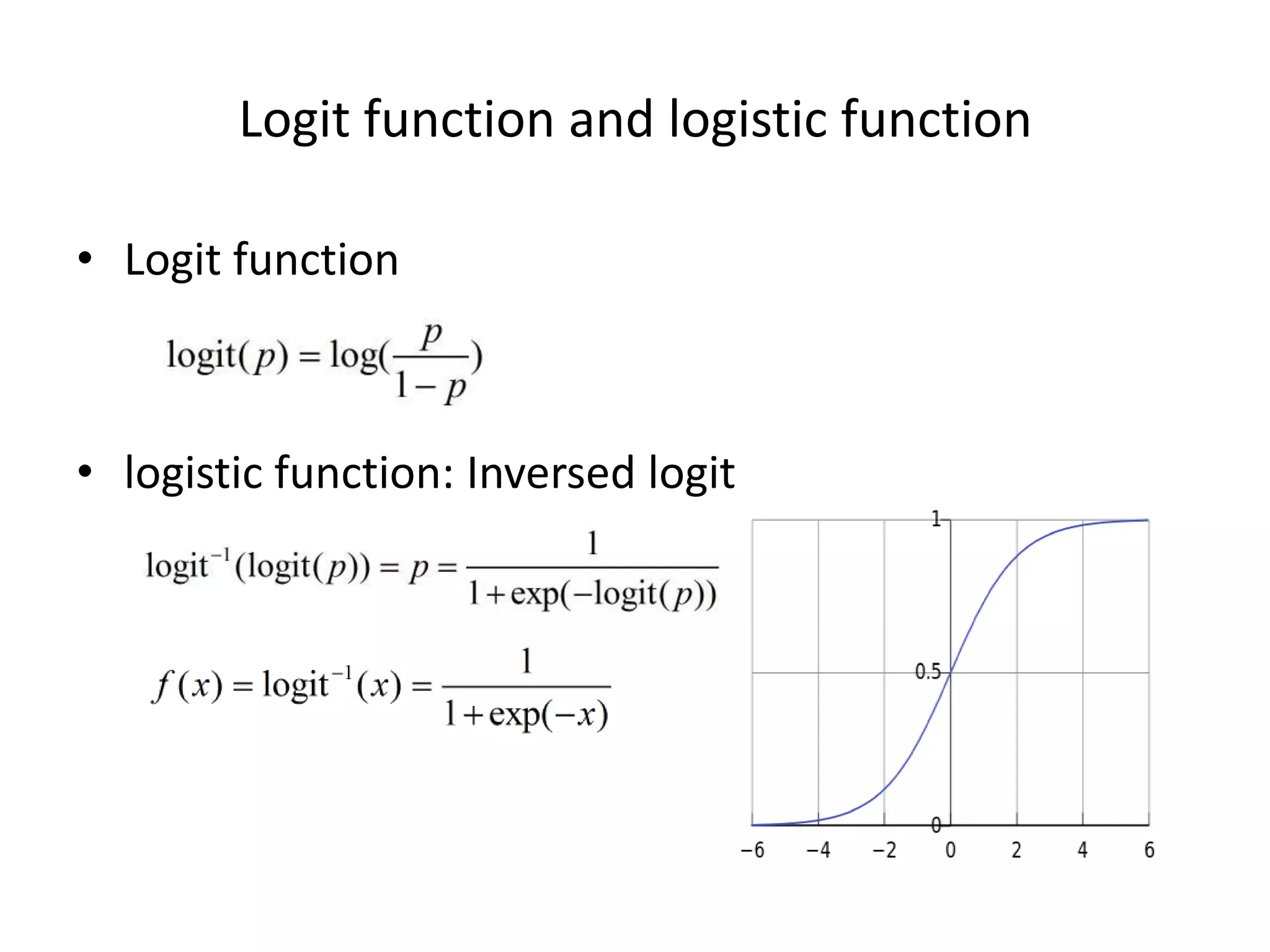
Logit	
  func7on	
  and	
  logis7c	
  func7on	
  
•  Logit	
  func7on	


•  logis7c	
  func7on:	
  Inversed	
  logit	
  
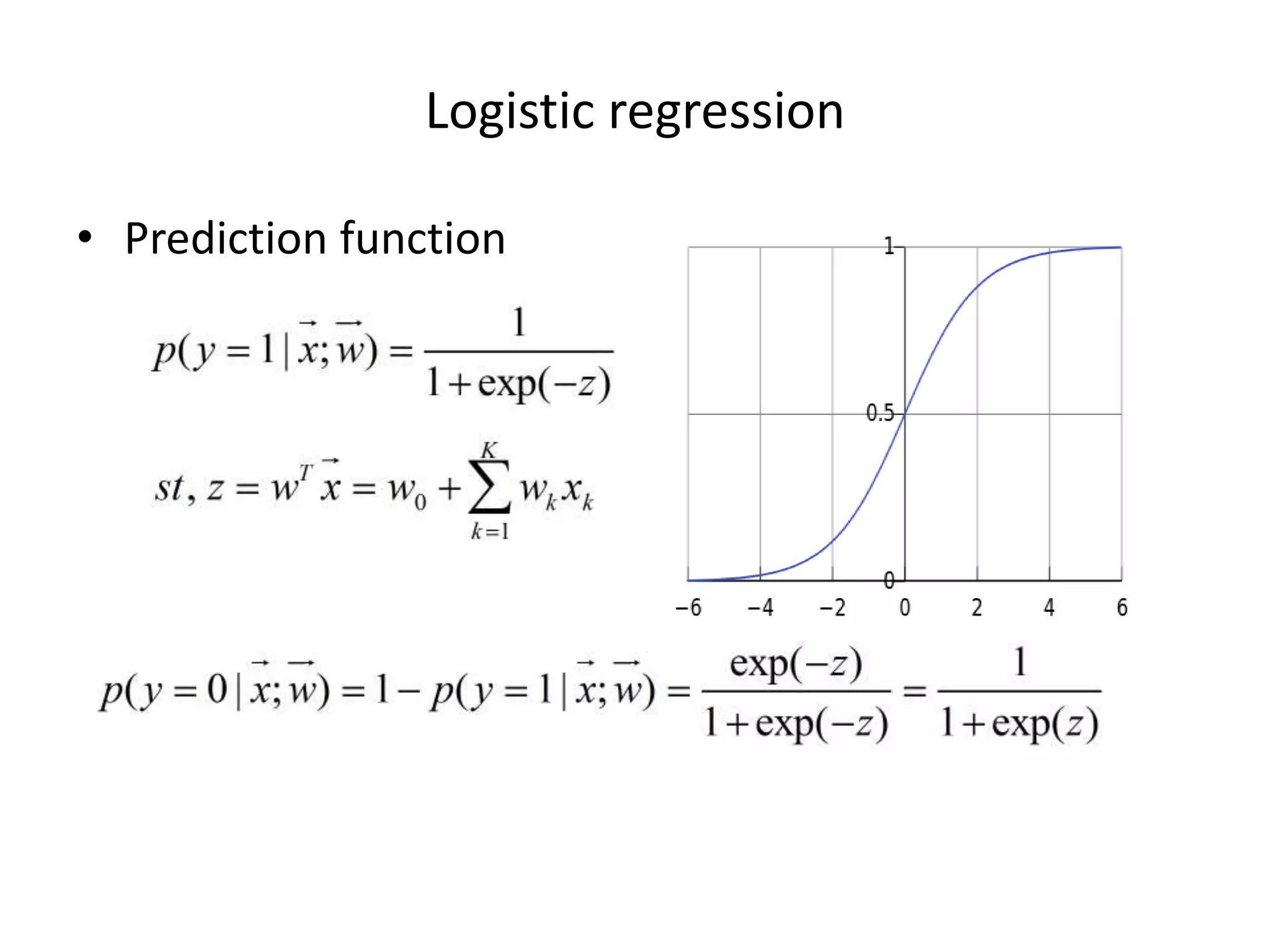
Logis7c	
  regression	
  
•  Predic7on	
  func7on	
  
Inference	
  with	
  maximize	
  likelihood	
  (1)	
  
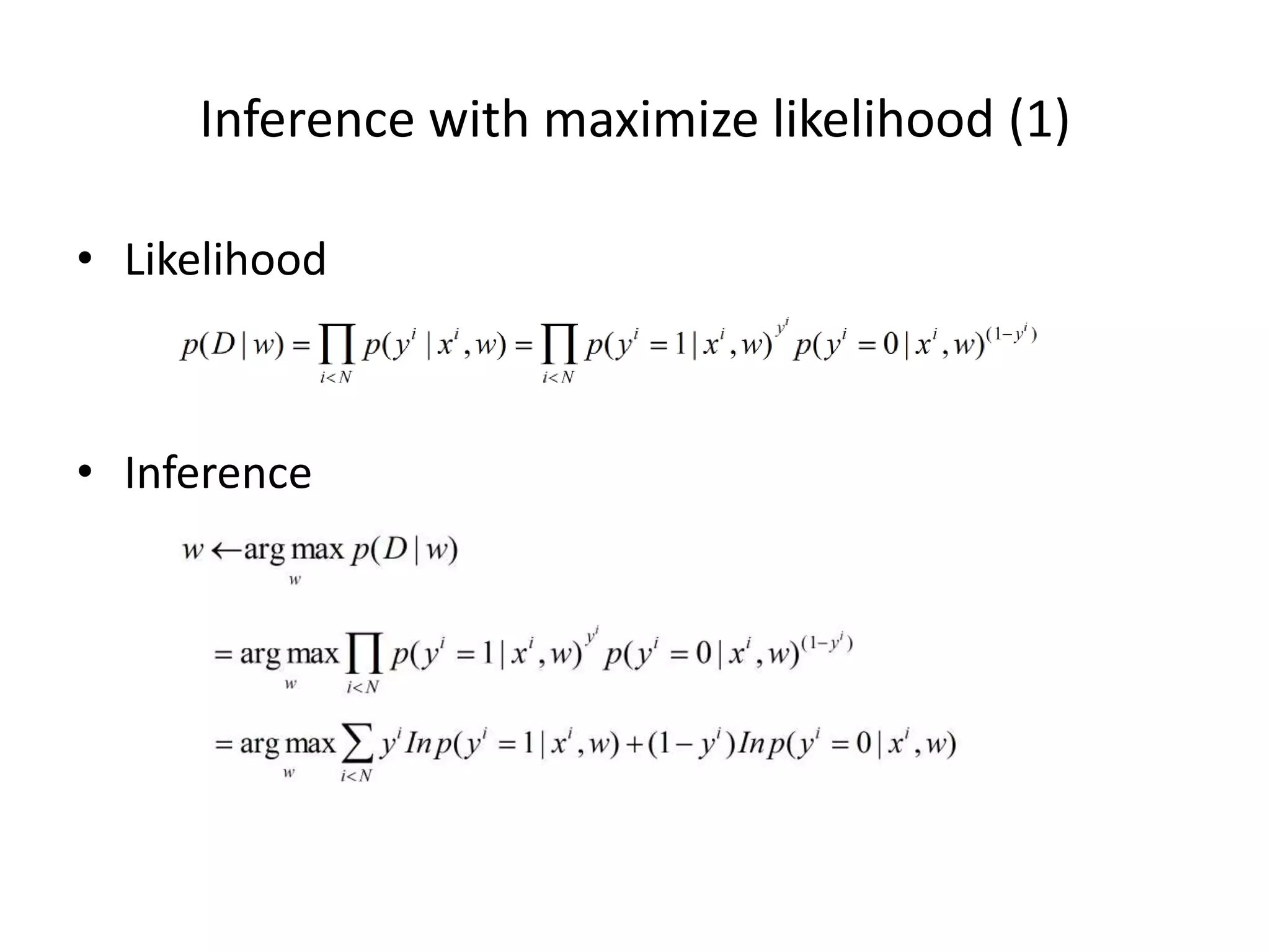
•  Likelihood	
  

•  Inference	
  
Inference	
  with	
  maximize	
  likelihood	
  (2)	
  
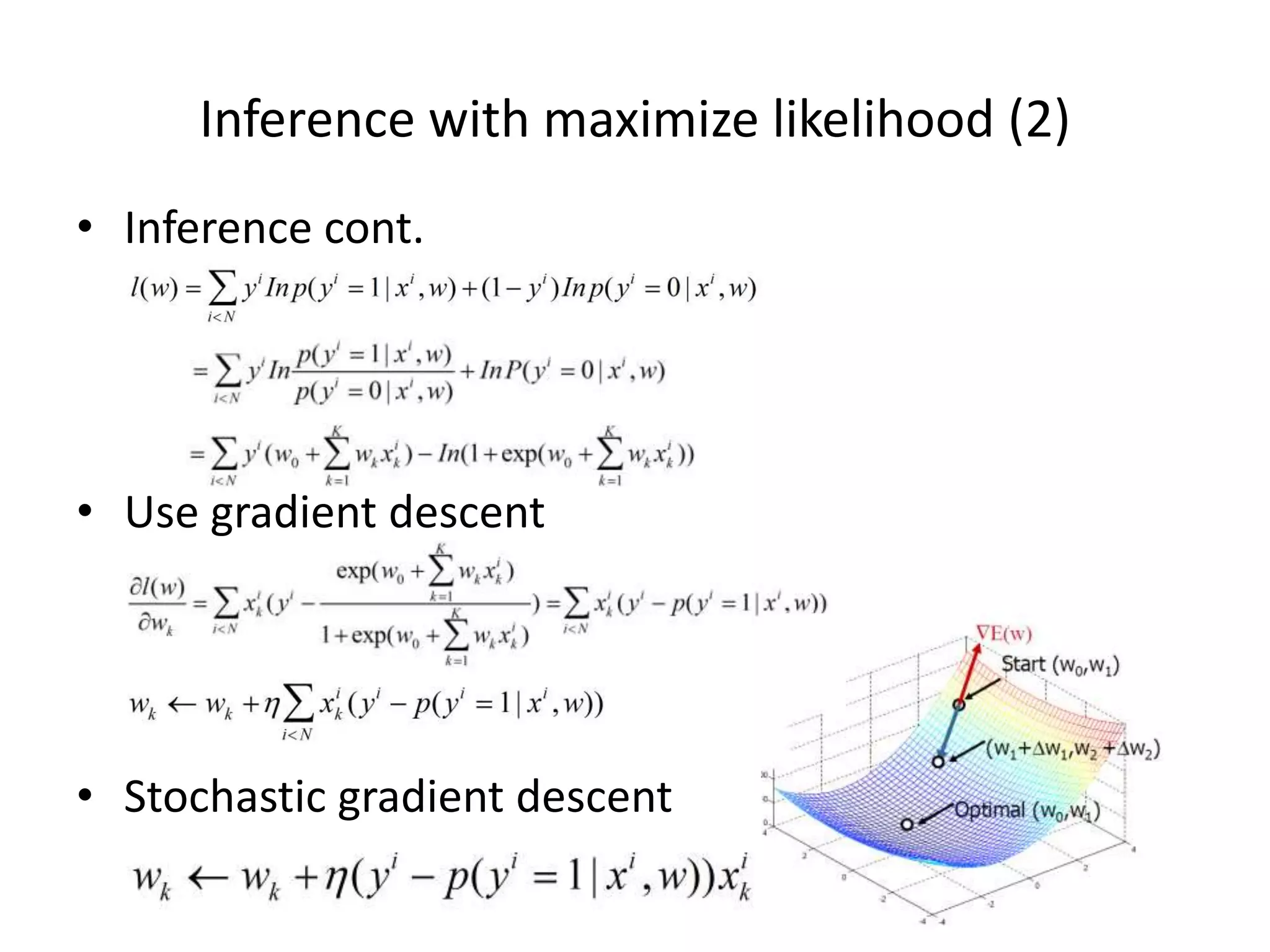
•  Inference	
  cont.	
  

•  Use	
  gradient	
  descent	


•  Stochas7c	
  gradient	
  descent	
  
Regulariza7on	
  
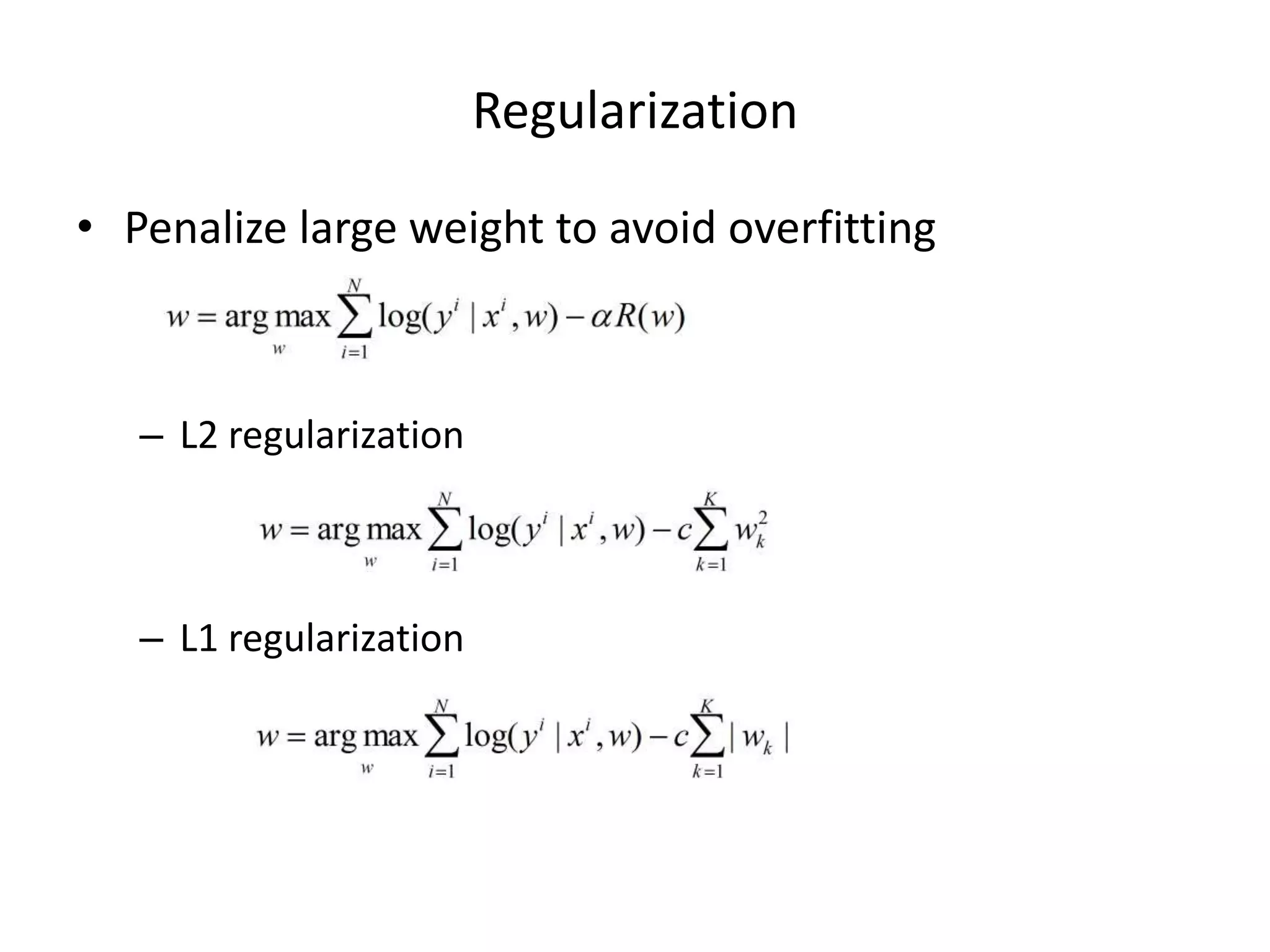
•  Penalize	
  large	
  weight	
  to	
  avoid	
  overfi`ng	


–  L2	
  regulariza7on	


–  L1	
  regulariza7on	
  
Regulariza7on:	
  Maximum	
  a	
  posteriori	
  
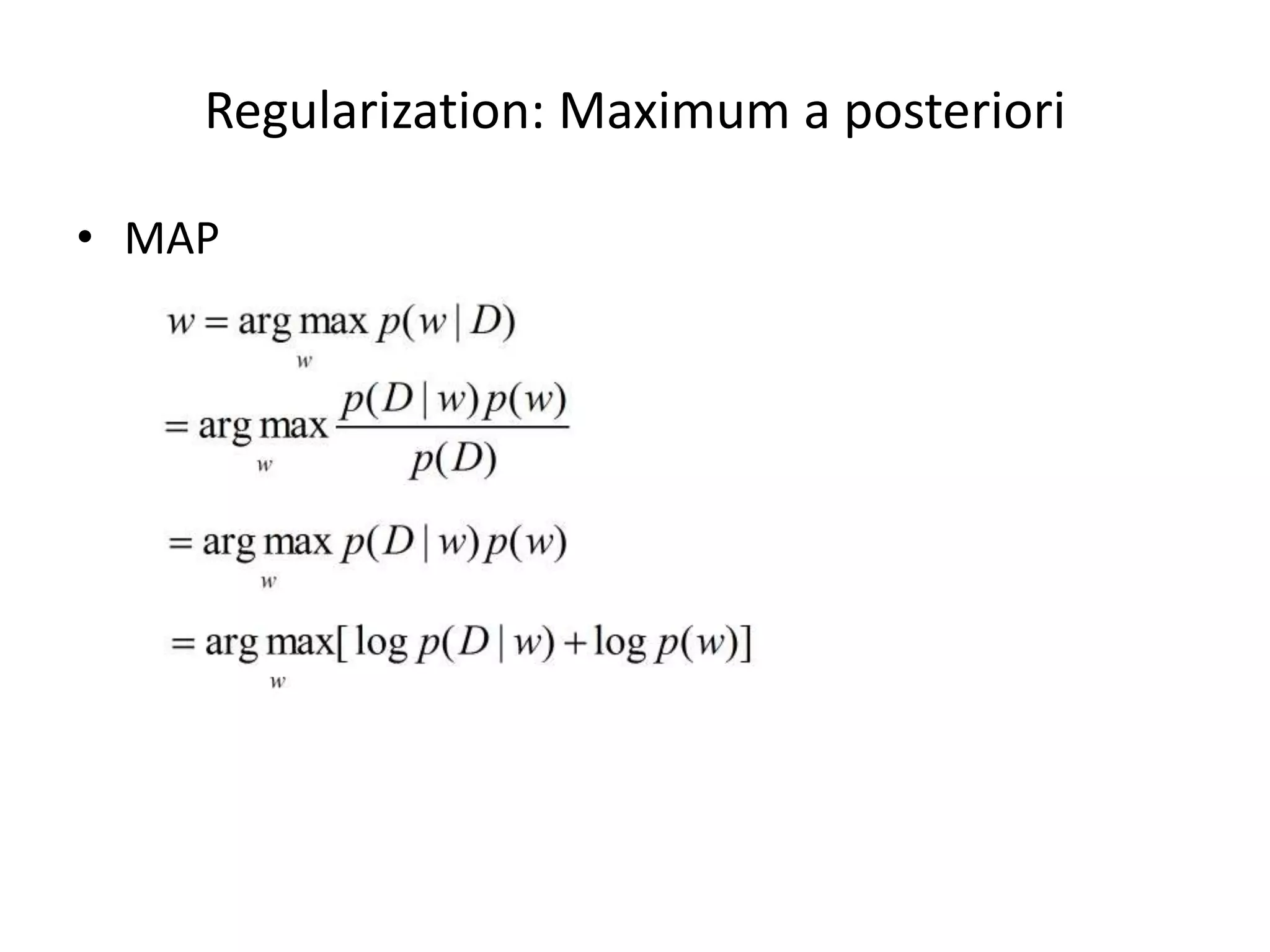
•  MAP	
  
L2	
  regulariza7on	
  :	
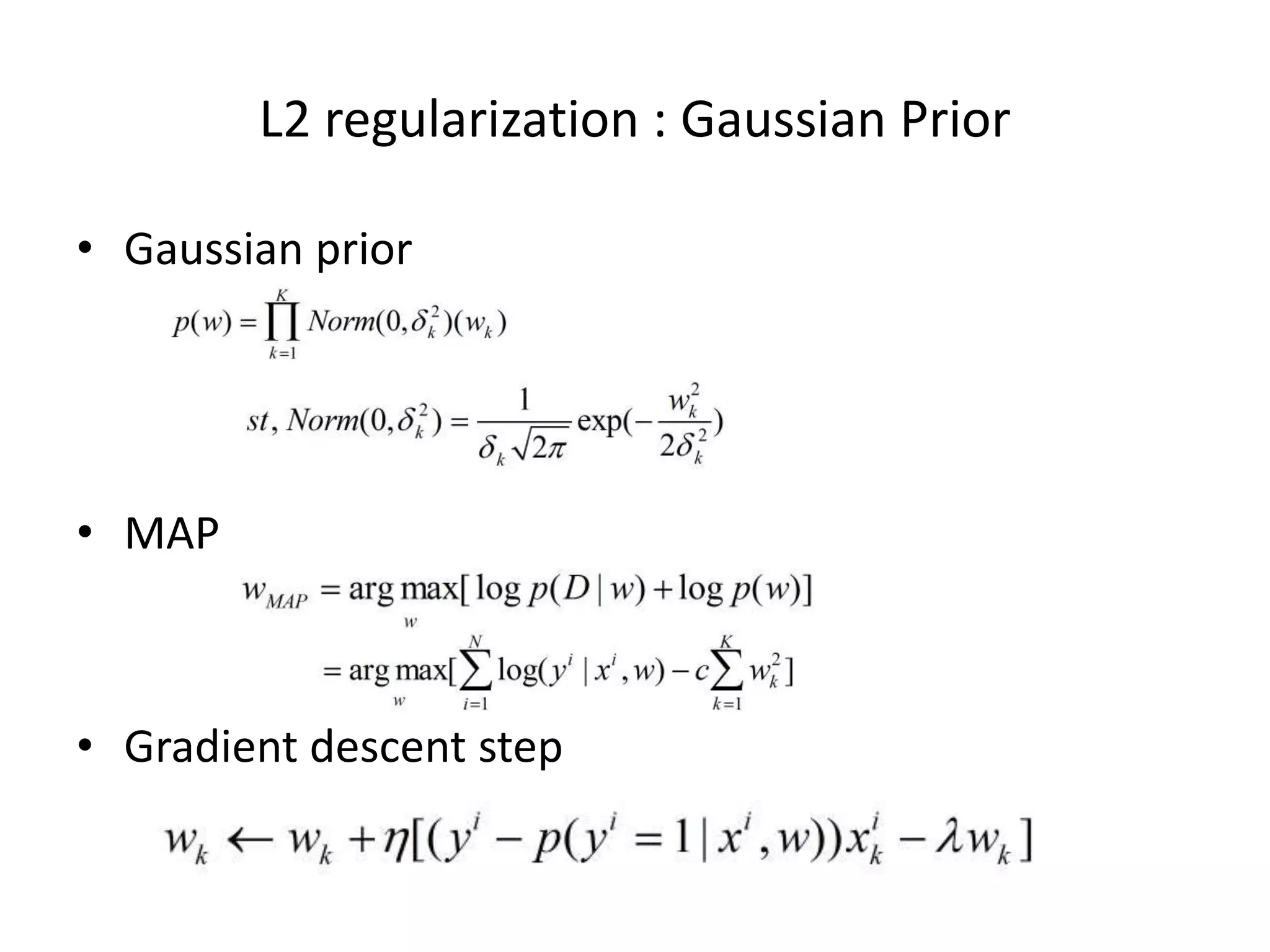
  Gaussian	
  Prior	
  	
  
•  Gaussian	
  prior	


•  MAP	


•  Gradient	
  descent	
  step	
  
L1	
  regulariza7on	
  :	
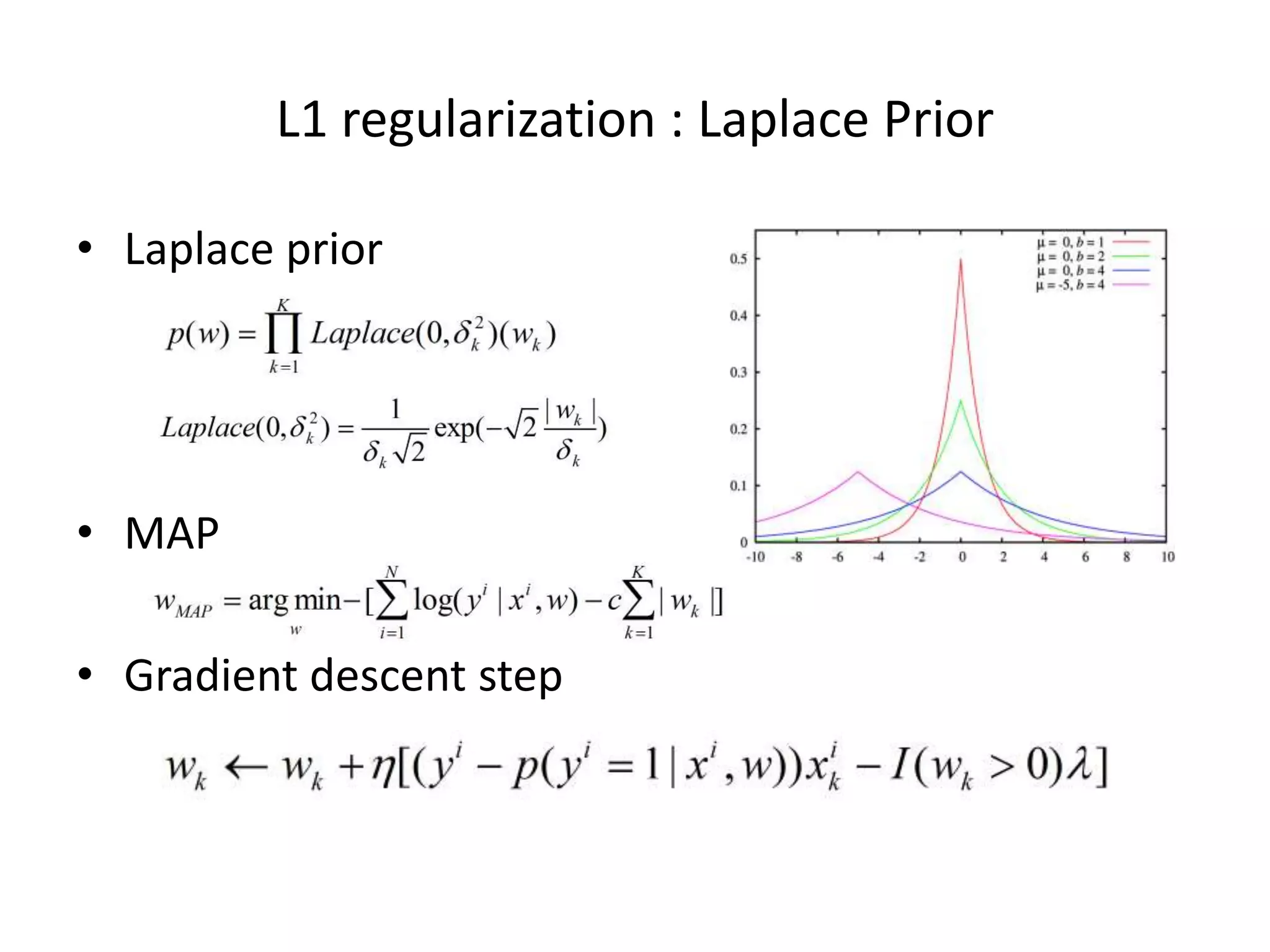
  Laplace	
  Prior	
  	
  
•  Laplace	
  prior	
  

•  MAP	


•  Gradient	
  descent	
  step	
  
Implementa7on	
  
•  L2	
  LR	
  
_weightOfFeatures[fea] += step * (feaValue * error - reguParam * _weightOfFeatures[fea]);
	
  
•  L1	
  LR	
  
if (_weightOfFeatures[fea] > 0)
{
_weightOfFeatures[fea] += step * (feaValue * error) - step * reguParam;
if (_weightOfFeatures[fea] < 0)
_weightOfFeatures[fea] = 0;
}else if (_weightOfFeatures[fea] < 0)
{
_weightOfFeatures[fea] += step * (feaValue * error) + step * reguParam;
if (_weightOfFeatures[fea] > 0)
_weightOfFeatures[fea] = 0;
}else{
_weightOfFeatures[fea] += step * (feaValue * error);
}
L2	
  VS.	
  L1	
  
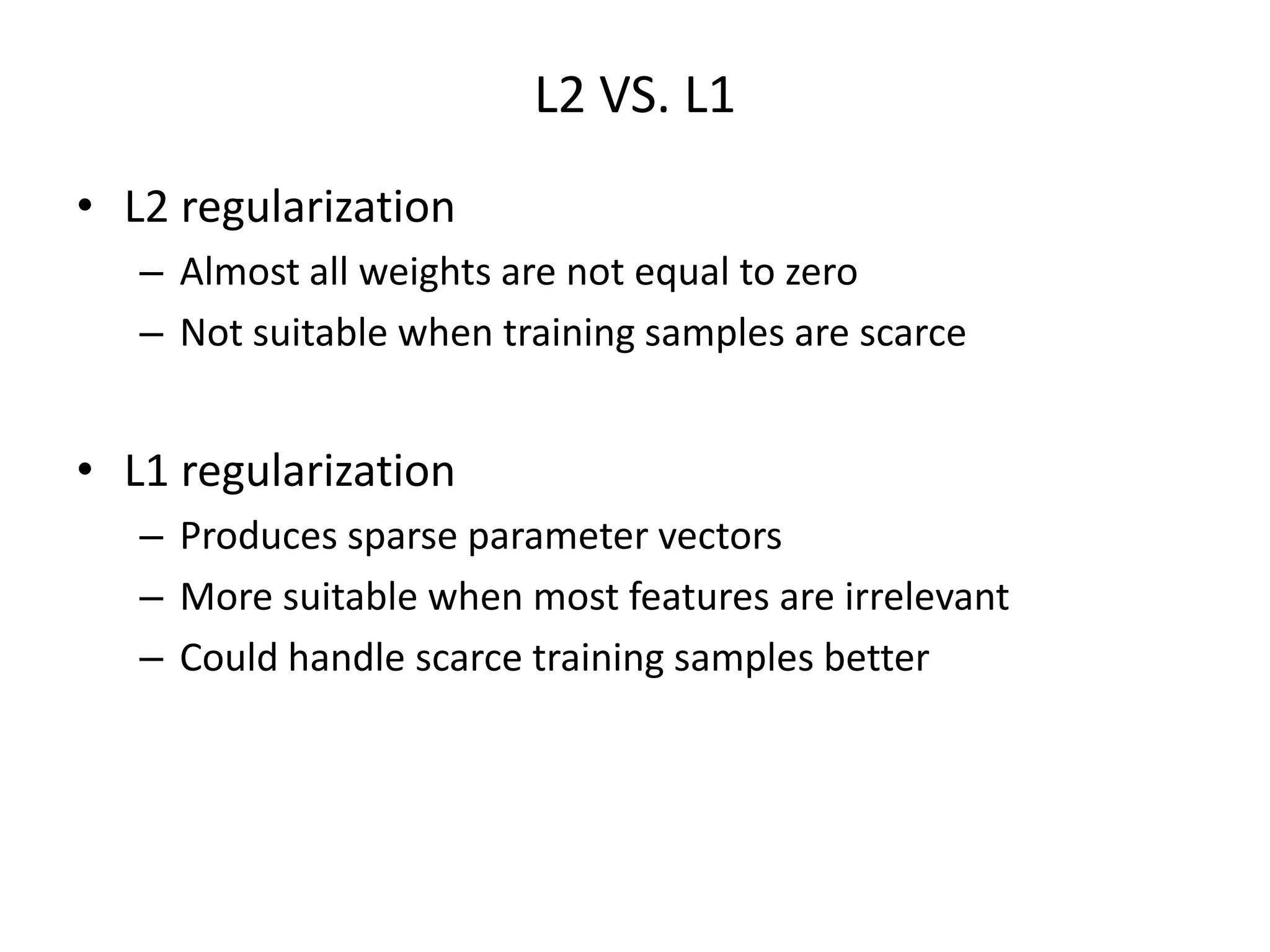
•  L2	
  regulariza7on	
  
–  Almost	
  all	
  weights	
  are	
  not	
  equal	
  to	
  zero	
  
–  Not	
  suitable	
  when	
  training	
  samples	
  are	
  scarce	
  

•  L1	
  regulariza7on	
  
–  Produces	
  sparse	
  parameter	
  vectors	
  
–  More	
  suitable	
  when	
  most	
  features	
  are	
  irrelevant	
  
–  Could	
  handle	
  scarce	
  training	
  samples	
  be>er	
  
Experiments	
  
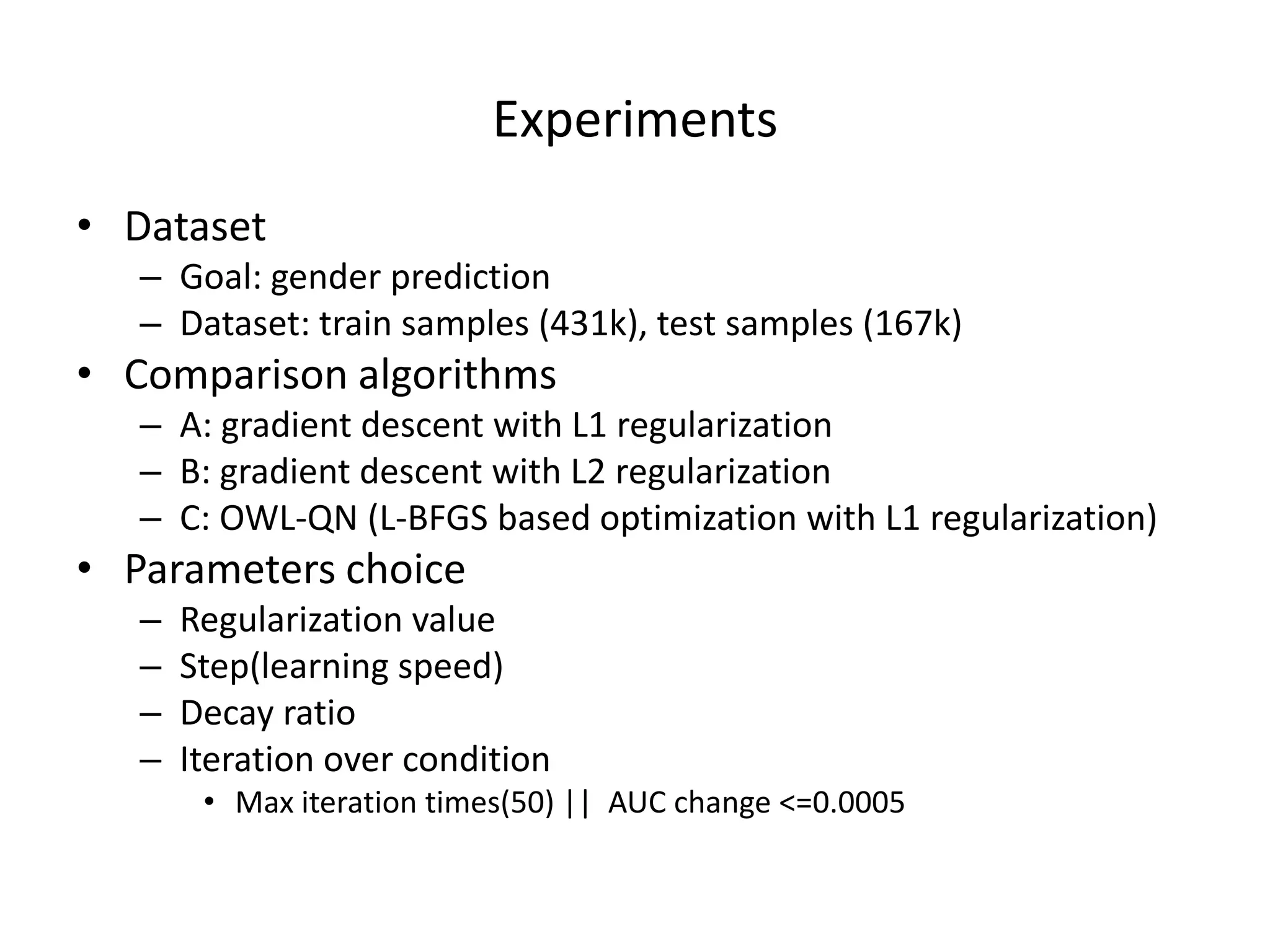
•  Dataset	
  

–  Goal:	
  gender	
  predic7on	
  
–  Dataset:	
  train	
  samples	
  (431k),	
  test	
  samples	
  (167k)	
  

•  Comparison	
  algorithms	
  

–  A:	
  gradient	
  descent	
  with	
  L1	
  regulariza7on	
  
–  B:	
  gradient	
  descent	
  with	
  L2	
  regulariza7on	
  
–  C:	
  OWL-­‐QN	
  (L-­‐BFGS	
  based	
  op7miza7on	
  with	
  L1	
  regulariza7on)	
  

•  Parameters	
  choice	
  
– 
– 
– 
– 

Regulariza7on	
  value	
  
Step(learning	
  speed)	
  
Decay	
  ra7o	
  
Itera7on	
  over	
  condi7on	
  

•  Max	
  itera7on	
  7mes(50)	
  ||	
  	
  AUC	
  change	
  <=0.0005	
  
Experiments	
  (cont.)	
  
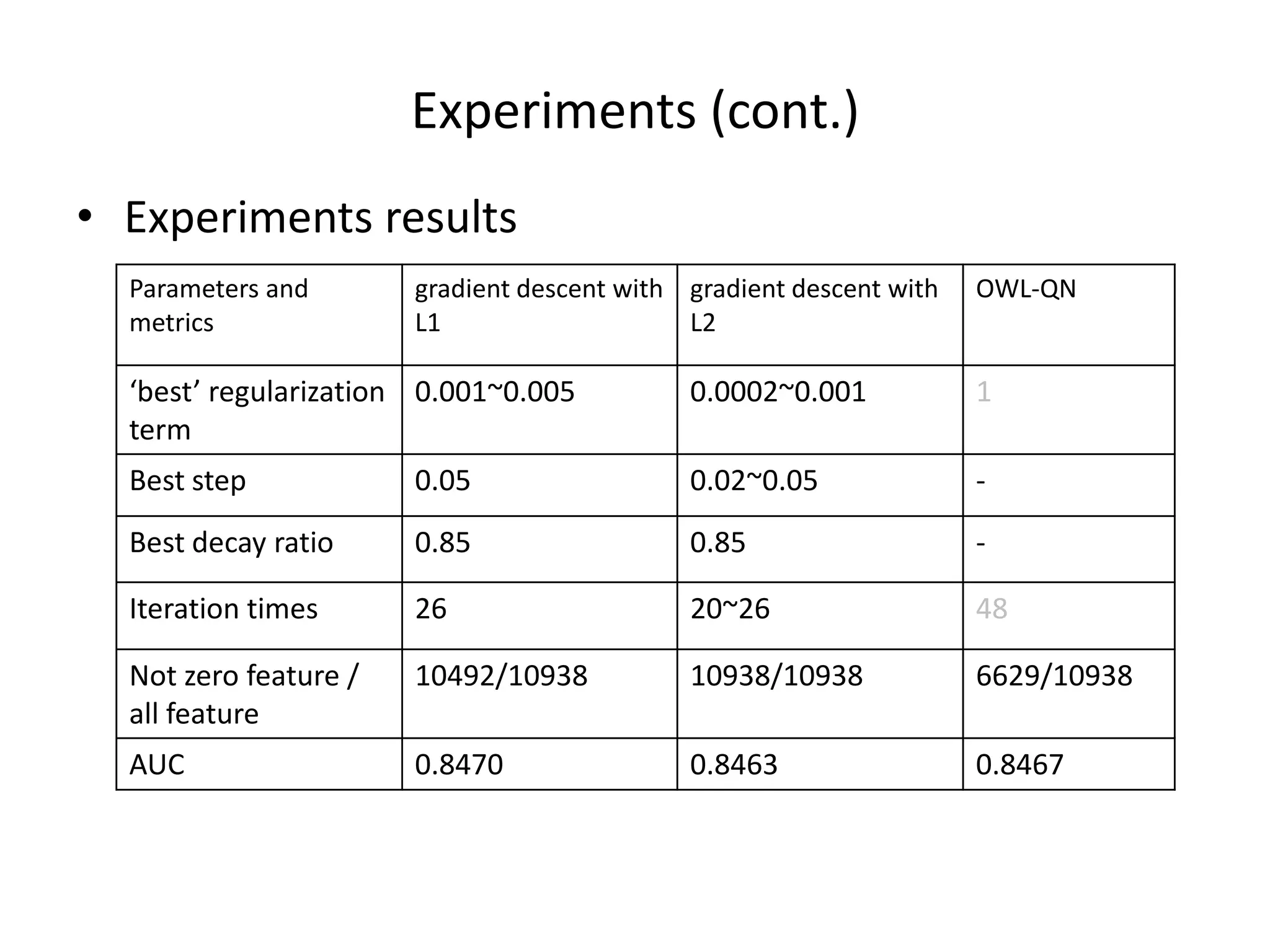
•  Experiments	
  results	
  
Parameters	
  and	
  
metrics	
  

gradient	
  descent	
  with	
   gradient	
  descent	
  with	
  
L1	
  
L2	
  

OWL-­‐QN	
  

‘best’	
  regulariza7on	
   0.001~0.005	
  
term	
  

0.0002~0.001	
  

1	
  

Best	
  step	
  

0.05	
  

0.02~0.05	
  

-­‐	
  

Best	
  decay	
  ra7o	
  

0.85	
  

0.85	
  

-­‐	
  

Itera7on	
  7mes	
  

26	
  

20~26	
  

48	
  

Not	
  zero	
  feature	
  /	
  
all	
  feature	
  

10492/10938	
  

10938/10938	
  

6629/10938	
  

AUC	
  

0.8470	
  

0.8463	
  

0.8467	
  
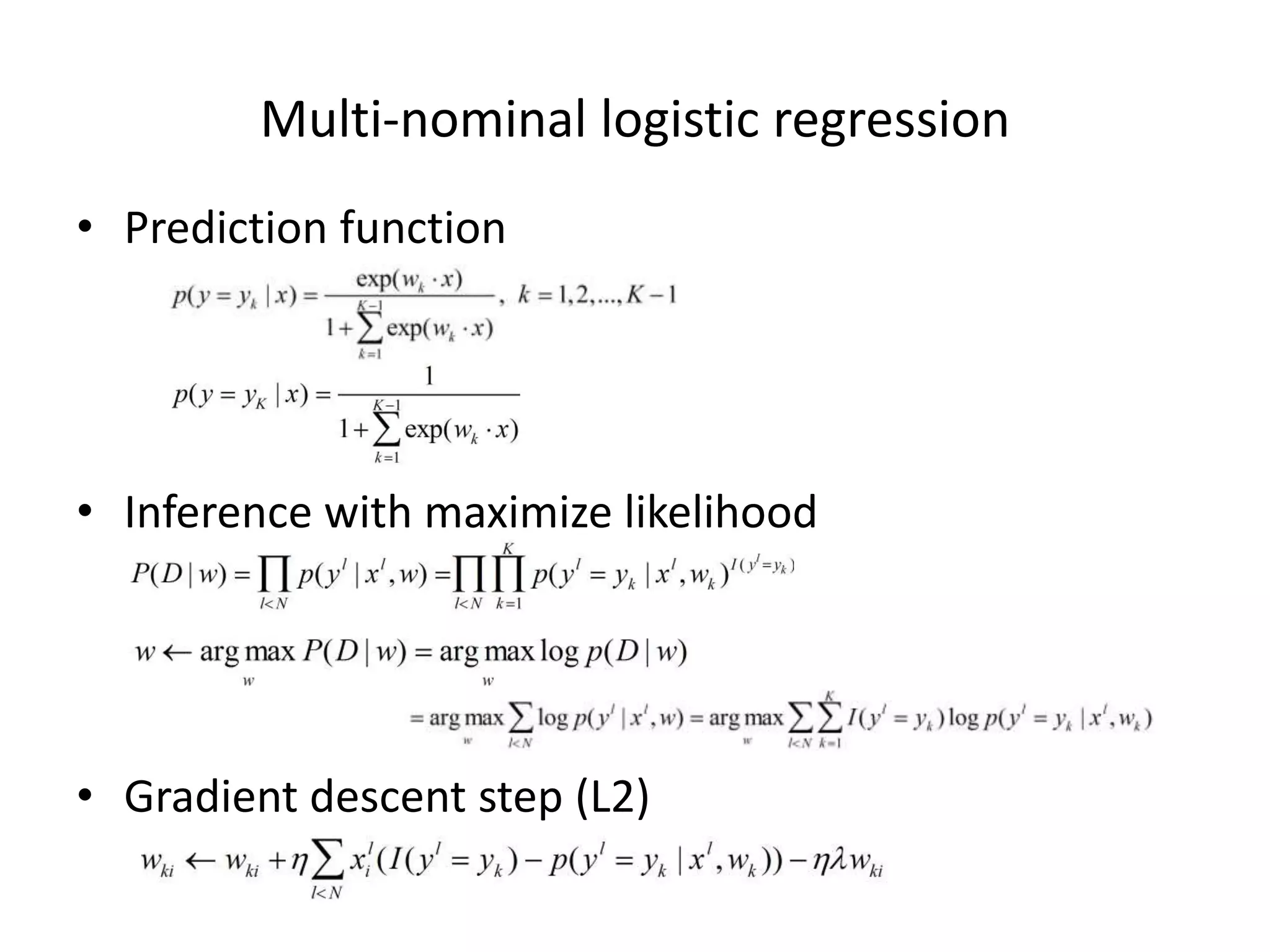
Mul7-­‐nominal	
  logis7c	
  regression	
  
•  Predic7on	
  func7on	


•  Inference	
  with	
  maximize	
  likelihood	
  

•  Gradient	
  descent	
  step	
  (L2)	
  
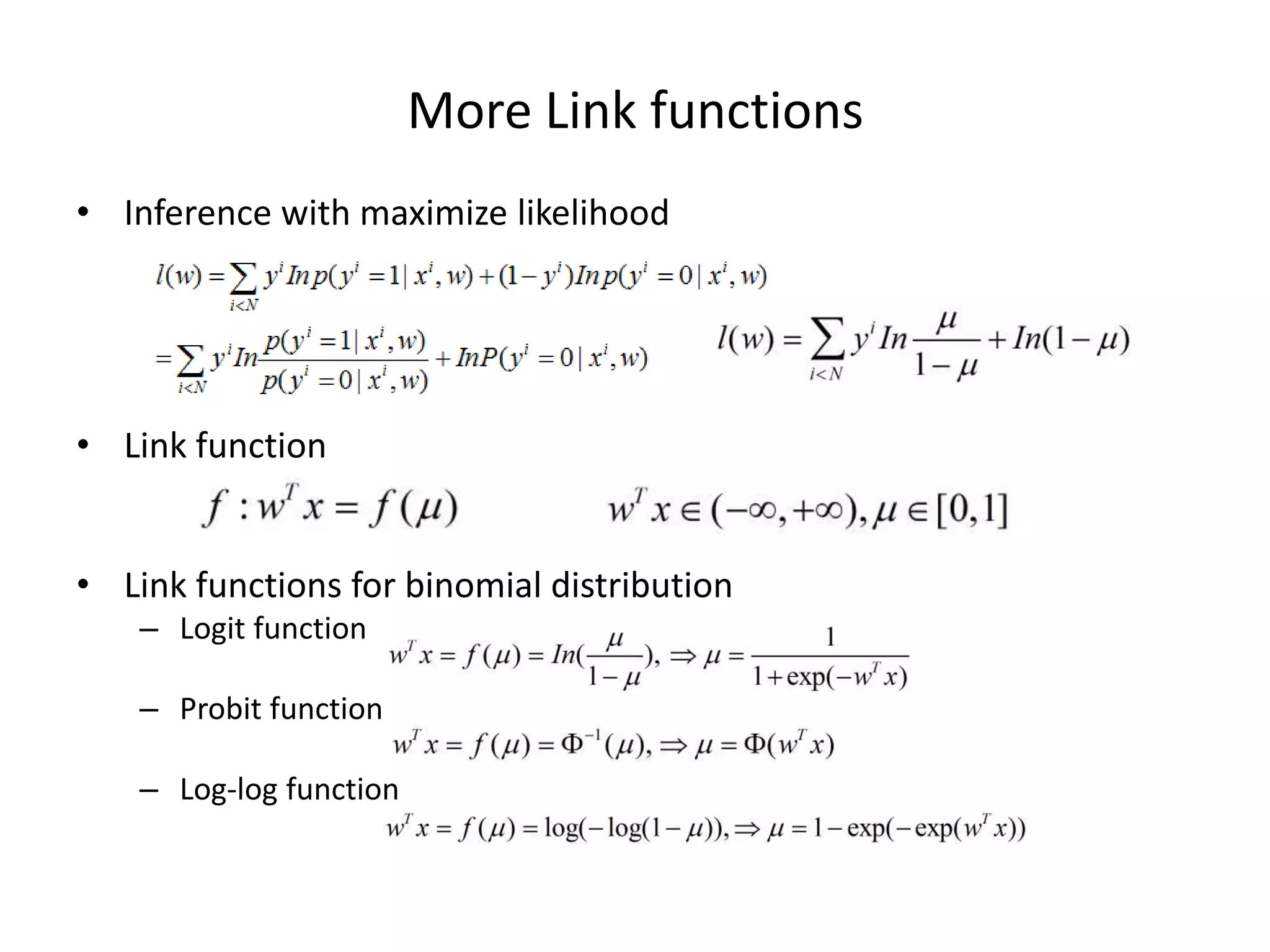
More	
  Link	
  func7ons	
  
•  Inference	
  with	
  maximize	
  likelihood	


•  Link	
  func7on	
  
•  Link	
  func7ons	
  for	
  binomial	
  distribu7on	
  
–  Logit	
  func7on	
  

–  Probit	
  func7on	
  
–  Log-­‐log	
  func7on	
  
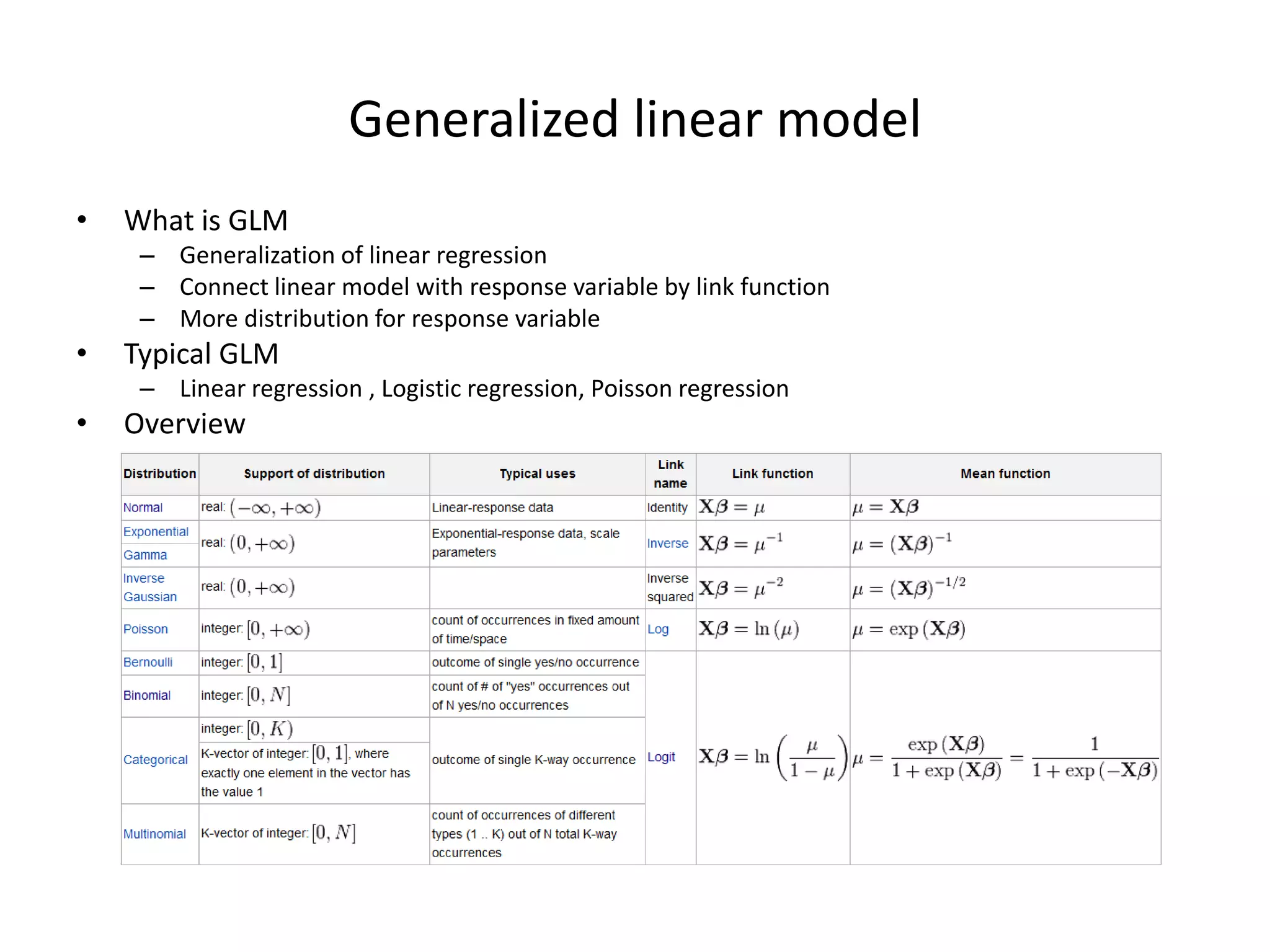
Generalized	
  linear	
  model	
  
• 

What	
  is	
  GLM	
  

–  Generaliza7on	
  of	
  linear	
  regression	
  
–  Connect	
  linear	
  model	
  with	
  response	
  variable	
  by	
  link	
  func7on	
  
–  More	
  distribu7on	
  for	
  response	
  variable	
  

• 

Typical	
  GLM	
  

• 

Overview	


–  Linear	
  regression	
  ,	
  Logis7c	
  regression,	
  Poisson	
  regression	
  
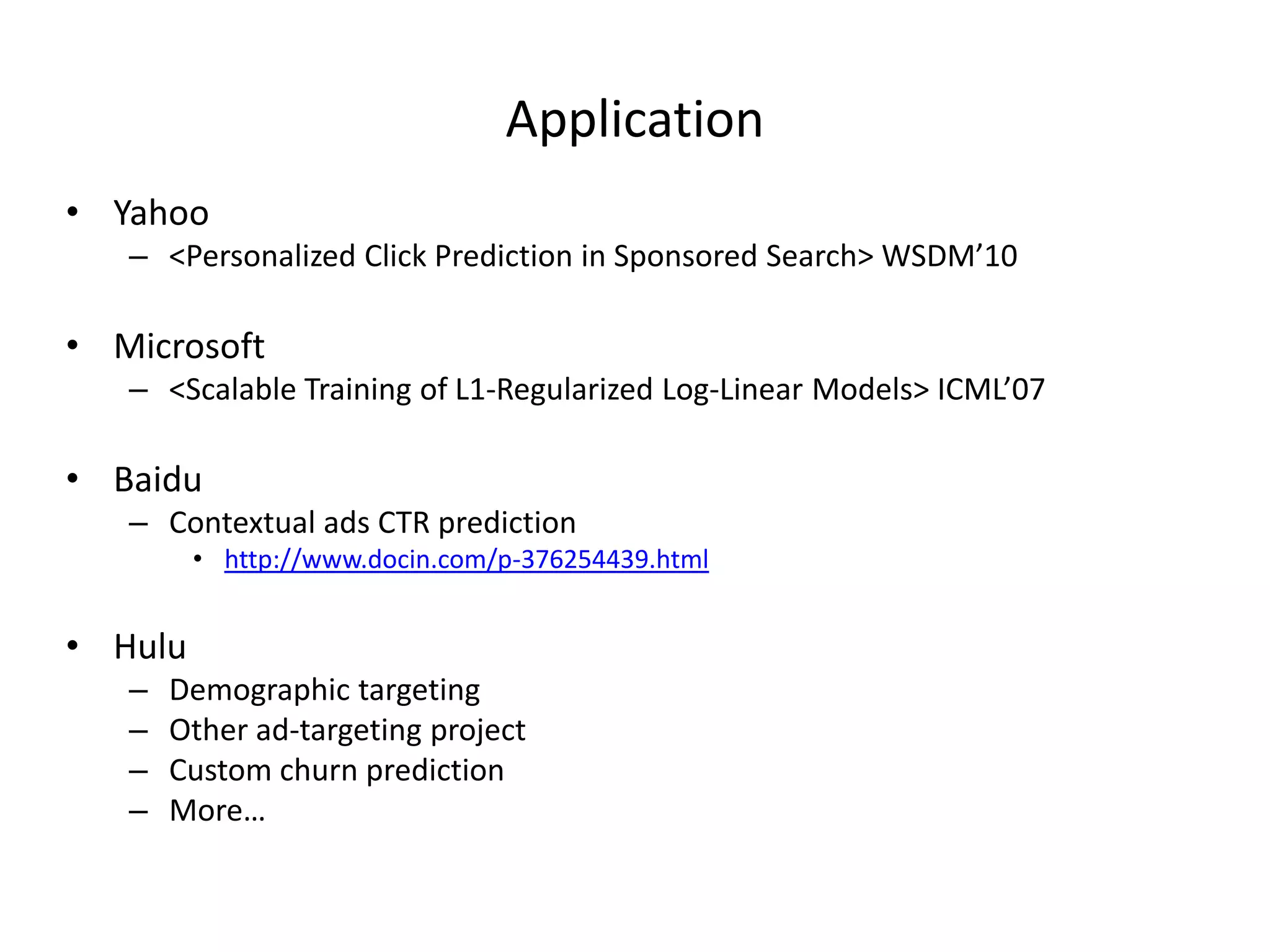
Applica7on	
  
•  Yahoo	
  

–  <Personalized	
  Click	
  Predic7on	
  in	
  Sponsored	
  Search>	
  WSDM’10	
  

•  Microsoq	
  

–  <Scalable	
  Training	
  of	
  L1-­‐Regularized	
  Log-­‐Linear	
  Models>	
  ICML’07	
  

•  Baidu	
  

–  Contextual	
  ads	
  CTR	
  predic7on	
  

•  h>p://www.docin.com/p-­‐376254439.html	
  

•  Hulu	
  
– 
– 
– 
– 

Demographic	
  targe7ng	
  
Other	
  ad-­‐targe7ng	
  project	
  
Custom	
  churn	
  predic7on	
  
More…	
  
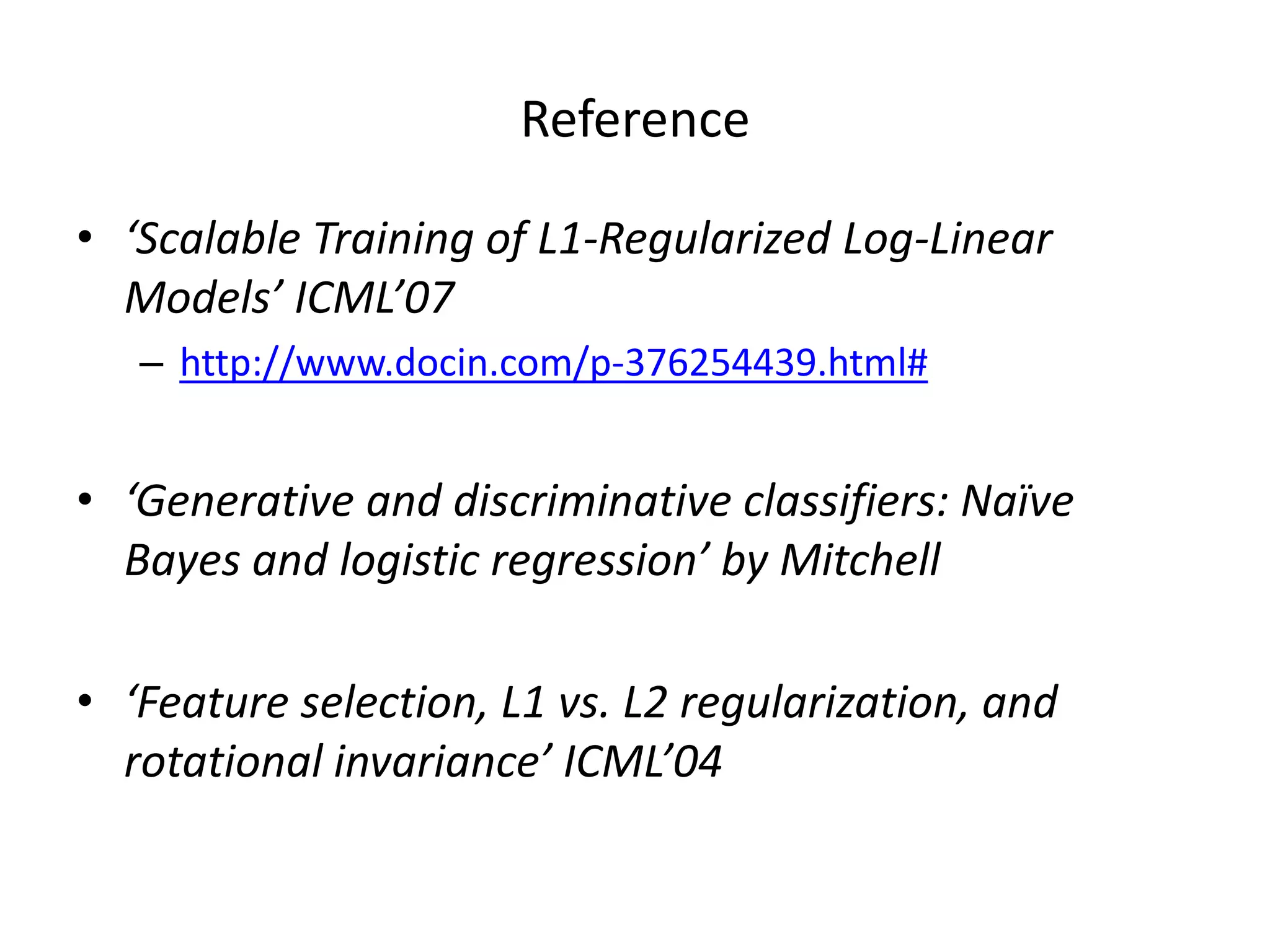
Reference	
  
•  ‘Scalable	
  Training	
  of	
  L1-­‐Regularized	
  Log-­‐Linear	
  
Models’	
  ICML’07	
  
–  h>p://www.docin.com/p-­‐376254439.html#	
  

•  ‘Genera-ve	
  and	
  discrimina-ve	
  classifiers:	
  Naïve	
  
Bayes	
  and	
  logis-c	
  regression’	
  by	
  Mitchell	
  
•  ‘Feature	
  selec-on,	
  L1	
  vs.	
  L2	
  regulariza-on,	
  and	
  
rota-onal	
  invariance’	
  ICML’04	
  
Recommended	
  resources	
  
•  Machine	
  Learning	
  open	
  class	
  –	
  by	
  Andrew	
  Ng	
  
–  //10.20.0.130/TempShare/Machine-­‐Learning	
  Open	
  Class	
  

•  h>p://www.cnblogs.com/vivounicorn/archive/
2012/02/24/2365328.html	
  
•  logis7c	
  regression	
  Implementa7on[link]	
  
–  //10.20.0.130/TempShare/guodong/Logis7c	
  regression	
  Implementa7on/	
  

–  Support	
  binomial	
  and	
  mul7nominal	
  LR	
  with	
  L1	
  and	
  L2	
  regulariza7on	
  

•  OWL-­‐QN	
  
–  //10.20.0.130/TempShare/guodong/OWL-­‐QN/	
  
Thanks