Multinomial logistic
regression
Presented
by:
Amira Badr
Aya Essam
Merit Adel
Eman Abbas
Hajer Bilal
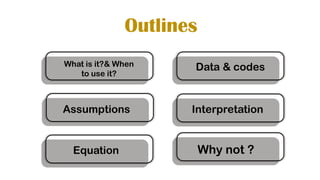
Outlines
What is it?& When
to use it?
Assumptions
Data & codes
Interpretation
Why not ?
Equation
What is it?
when to use?
?
?
It is an extension to binary logistic
regression for multinomial responses,
where the outcome categories are
more than two and unordered.
Like binary logistic regression,
multinomial logistic regression uses
maximum likelihood estimation to
evaluate the probability of categorical
membership.
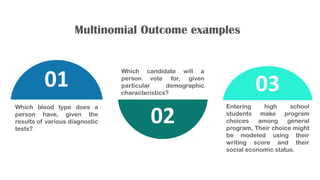
Multinomial Outcome examples
01
02
03
Which blood type does a
person have, given the
results of various diagnostic
tests?
Which candidate will a
person vote for, given
particular demographic
characteristics?
Entering high school
students make program
choices among general
program, Their choice might
be modeled using their
writing score and their
social economic status.
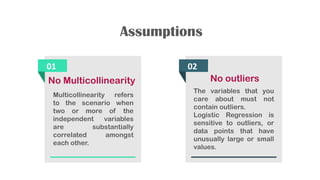
Assumptions
01
No Multicollinearity
Multicollinearity refers
to the scenario when
two or more of the
independent variables
are substantially
correlated amongst
each other.
02
No outliers
The variables that you
care about must not
contain outliers.
Logistic Regression is
sensitive to outliers, or
data points that have
unusually large or small
values.
Assumptions
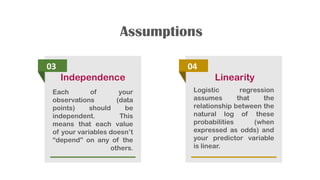
03
Independence
Each of your
observations (data
points) should be
independent. This
means that each value
of your variables doesn’t
“depend” on any of the
others.
04
Linearity
Logistic regression
assumes that the
relationship between the
natural log of these
probabilities (when
expressed as odds) and
your predictor variable
is linear.
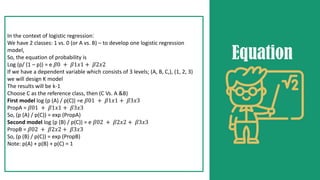
In the context of logistic regression:
We have 2 classes: 1 vs. 0 (or A vs. B) – to develop one logistic regression
model,
So, the equation of probability is
Log (p/ (1 – p)) = e 𝛽0 + 𝛽1𝑥1 + 𝛽2𝑥2
If we have a dependent variable which consists of 3 levels; (A, B, C,), (1, 2, 3)
we will design K model
The results will be k-1
Choose C as the reference class, then (C Vs. A &B)
First model log (p (A) / p(C)) =e 𝛽01 + 𝛽1𝑥1 + 𝛽3𝑥3
PropA = 𝛽01 + 𝛽1𝑥1 + 𝛽3𝑥3
So, (p (A) / p(C)) = exp (PropA)
Second model log (p (B) / p(C)) = e 𝛽02 + 𝛽2𝑥2 + 𝛽3𝑥3
PropB = 𝛽02 + 𝛽2𝑥2 + 𝛽3𝑥3
So, (p (B) / p(C)) = exp (PropB)
Note: p(A) + p(B) + p(C) = 1
Equation
our data
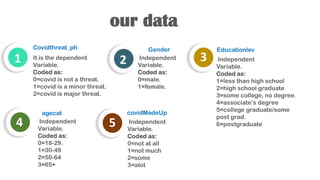
Covidthreat_ph
1
4
2
5
It is the dependent
Variable.
Coded as:
0=covid is not a threat.
1=covid is a minor threat.
2=covid is major threat.
Gender
agecat covidMadeUp
3
Educationlev
Independent
Variable.
Coded as:
0=male.
1=female.
Independent
Variable.
Coded as:
0=18-29.
1=30-49
2=50-64
3=65+
Independent
Variable.
Coded as:
1=less than high school
2=high school graduate
3=some college, no degree.
4=associate’s degree
5=college graduate/some
post grad.
6=postgraduate
Independent
Variable.
Coded as:
0=not at all
1=not much
2=some
3=alot
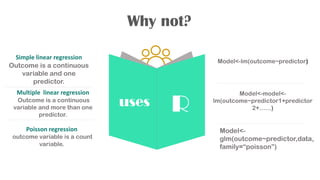
Simple linear regression
Outcome is a continuous
variable and one
predictor.
Multiple linear regression
Outcome is a continuous
variable and more than one
predictor.
Poisson regression
outcome variable is a count
variable.
Why not?
Model<-lm(outcome~predictor)
Model<-
glm(outcome~predictor,data,
family=“poisson”)
uses R
Model<-model<-
lm(outcome~predictor1+predictor
2+……)
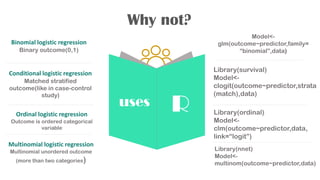
Binomial logistic regression
Binary outcome(0,1)
Conditional logistic regression
Matched stratified
outcome(like in case-control
study)
Ordinal logistic regression
Outcome is ordered categorical
variable
Multinomial logistic regression
Multinomial unordered outcome
(more than two categories)
Why not?
Model<-
glm(outcome~predictor,family=
“binomial”,data)
Library(survival)
Model<-
clogit(outcome~predictor,strata
(match),data)
Library(nnet)
Model<-
multinom(outcome~predictor,data)
Library(ordinal)
Model<-
clm(outcome~predictor,data,
link=“logit”)
uses R
INTERPRETATION
pseudo R square
P values
Odds ratio
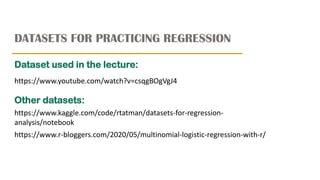
DATASETS FOR PRACTICING REGRESSION
https://www.kaggle.com/code/rtatman/datasets-for-regression-
analysis/notebook
https://www.r-bloggers.com/2020/05/multinomial-logistic-regression-with-r/
https://www.youtube.com/watch?v=csqgBOgVgJ4
Other datasets:
Dataset used in the lecture:
Thank you

multinomial-pdf.pdf

  • 1.
    Multinomial logistic regression Presented by: Amira Badr AyaEssam Merit Adel Eman Abbas Hajer Bilal
  • 2.
    Outlines What is it?&When to use it? Assumptions Data & codes Interpretation Why not ? Equation
  • 3.
    What is it? whento use? ? ? It is an extension to binary logistic regression for multinomial responses, where the outcome categories are more than two and unordered. Like binary logistic regression, multinomial logistic regression uses maximum likelihood estimation to evaluate the probability of categorical membership.
  • 4.
    Multinomial Outcome examples 01 02 03 Whichblood type does a person have, given the results of various diagnostic tests? Which candidate will a person vote for, given particular demographic characteristics? Entering high school students make program choices among general program, Their choice might be modeled using their writing score and their social economic status.
  • 5.
    Assumptions 01 No Multicollinearity Multicollinearity refers tothe scenario when two or more of the independent variables are substantially correlated amongst each other. 02 No outliers The variables that you care about must not contain outliers. Logistic Regression is sensitive to outliers, or data points that have unusually large or small values.
  • 6.
    Assumptions 03 Independence Each of your observations(data points) should be independent. This means that each value of your variables doesn’t “depend” on any of the others. 04 Linearity Logistic regression assumes that the relationship between the natural log of these probabilities (when expressed as odds) and your predictor variable is linear.
  • 7.
    In the contextof logistic regression: We have 2 classes: 1 vs. 0 (or A vs. B) – to develop one logistic regression model, So, the equation of probability is Log (p/ (1 – p)) = e 𝛽0 + 𝛽1𝑥1 + 𝛽2𝑥2 If we have a dependent variable which consists of 3 levels; (A, B, C,), (1, 2, 3) we will design K model The results will be k-1 Choose C as the reference class, then (C Vs. A &B) First model log (p (A) / p(C)) =e 𝛽01 + 𝛽1𝑥1 + 𝛽3𝑥3 PropA = 𝛽01 + 𝛽1𝑥1 + 𝛽3𝑥3 So, (p (A) / p(C)) = exp (PropA) Second model log (p (B) / p(C)) = e 𝛽02 + 𝛽2𝑥2 + 𝛽3𝑥3 PropB = 𝛽02 + 𝛽2𝑥2 + 𝛽3𝑥3 So, (p (B) / p(C)) = exp (PropB) Note: p(A) + p(B) + p(C) = 1 Equation
  • 8.
    our data Covidthreat_ph 1 4 2 5 It isthe dependent Variable. Coded as: 0=covid is not a threat. 1=covid is a minor threat. 2=covid is major threat. Gender agecat covidMadeUp 3 Educationlev Independent Variable. Coded as: 0=male. 1=female. Independent Variable. Coded as: 0=18-29. 1=30-49 2=50-64 3=65+ Independent Variable. Coded as: 1=less than high school 2=high school graduate 3=some college, no degree. 4=associate’s degree 5=college graduate/some post grad. 6=postgraduate Independent Variable. Coded as: 0=not at all 1=not much 2=some 3=alot
  • 9.
    Simple linear regression Outcomeis a continuous variable and one predictor. Multiple linear regression Outcome is a continuous variable and more than one predictor. Poisson regression outcome variable is a count variable. Why not? Model<-lm(outcome~predictor) Model<- glm(outcome~predictor,data, family=“poisson”) uses R Model<-model<- lm(outcome~predictor1+predictor 2+……)
  • 10.
    Binomial logistic regression Binaryoutcome(0,1) Conditional logistic regression Matched stratified outcome(like in case-control study) Ordinal logistic regression Outcome is ordered categorical variable Multinomial logistic regression Multinomial unordered outcome (more than two categories) Why not? Model<- glm(outcome~predictor,family= “binomial”,data) Library(survival) Model<- clogit(outcome~predictor,strata (match),data) Library(nnet) Model<- multinom(outcome~predictor,data) Library(ordinal) Model<- clm(outcome~predictor,data, link=“logit”) uses R
  • 11.
  • 12.
    DATASETS FOR PRACTICINGREGRESSION https://www.kaggle.com/code/rtatman/datasets-for-regression- analysis/notebook https://www.r-bloggers.com/2020/05/multinomial-logistic-regression-with-r/ https://www.youtube.com/watch?v=csqgBOgVgJ4 Other datasets: Dataset used in the lecture:
  • 13.