



Dilum Bandara
Dilum.Bandara@uom.lk
Some slides extracted from Dr. Hans Gray
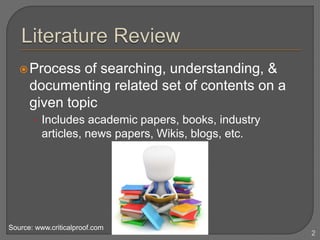
Process of searching, understanding, &
documenting related set of contents on a
given topic
• Includes academic papers, books, industry
articles, news papers, Wikis, blogs, etc.
2
Source: www.criticalproof.com
3
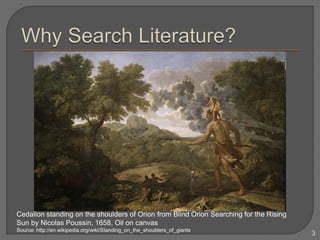
Cedalion standing on the shoulders of Orion from Blind Orion Searching for the Rising
Sun by Nicolas Poussin, 1658, Oil on canvas
Source: http://en.wikipedia.org/wiki/Standing_on_the_shoulders_of_giants
“Dwarfs standing on the shoulders of
giants”
• Metaphor meaning “One who develops future
intellectual pursuits by understanding the research
& works created by notable thinkers of the past”
“If I have seen further it is only by standing
on the shoulders of giants.” ― Isaac
Newton
“Those who don't know history are doomed
to repeat it.” ― Edmund Burke
4
To find a solution to a problem
Knowledge accumulates
• We learn from & build on what others have done
• Today’s studies build on those of yesterday!
To make sure work you are trying to do
hasn’t already been done
5
 Distinguish what has been done from what needs to be
done
 Discover important variables relevant to topic
 Synthesize & gain a new perspective
 Identify relationships between ideas & practice
 Establish context of topic or problem
 Rationalize significance of problem
 Enhance & acquiring subject vocabulary
 Identify methodologies & techniques that have been used
 Place research in a historical context to show familiarity
with state-of-the-art developments
6
Problem identification
Analysis of problem in relation to existing
literature
• Depth of the problem
• How my solution can be unique?
During project work
• Design parameters
• Experiment/simulation setup
While writing thesis
7
Peer reviewed journals
Academic books
Articles in encyclopedias, hand books
Periodicals
News papers, news letters, magazines
Patents
Documents, project reports
Experts & consultants
On-line sources of information
• Wiki, Blogs, Forum, Twitter
8
 Google Scholar
 Other research indexes & online databases
 University libraries
 Government document collections
• National Archives
 Government departments & institutions
• NERD, NSF, ITI
 Resources centers run by foreign missions
• British Council, Russian Cultural Center, American
Center, Practical Action
9
Suppose your are interested in “online
payments using virtual currencies”
1. Go to Google Scholar & search for “virtual
currency”
• Note title, date, source, no of citations
• Are results are all over the place?
• Let’s be more specific in selecting search terms
2. Search for “virtual currency payments”
• Better not miss fundamental papers
10
3. Search for more recent papers
• Papers within last 2-3 years
• Select ones to read should be based on title,
citations, then later by abstract
• Look for recurrent terms/words
• See the word “BitCoin”?
4. Search for “BitCoin”
• Lot more related results
11
5. Expand search
• Looks at citations of a paper – these are related
work
• Look for related work from same authors, others,
& supporting & opposing arguments
12
 Google Scholar has a “Save” link
 Use a tool
• Zotero
 Browser-based research tool
 Help you collect, organize, search, cite, & share your
research sources
• Mendeley & Qiqqa
 Web & desktop based
 Partly free
• EndNote
 Commercial
 Most university libraries have access
13
After a while
• You don’t remember where your ideas came from
 You better not miss key/all citations
• All your sources are mixed up
Styles are complicated
• Hundreds of styles of references
• Conferences & journals have their own styles &
reviewers are strict on style
14
15
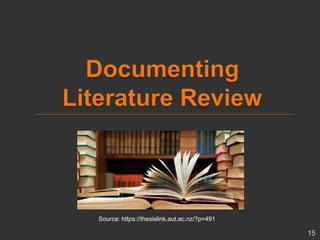
Source: https://thesislink.aut.ac.nz/?p=491
 As you read widely, but selectively in your topic
area, consider what themes or issues connect your
sources together
 Do they present one or different solutions?
 Is there an aspect that is missing?
 How well do they present material & portray it
according to an appropriate theory?
 Do they reveal a trend in the field?
 Is there a raging debate?
 Pick one of these themes to focus the organization
of your review
16
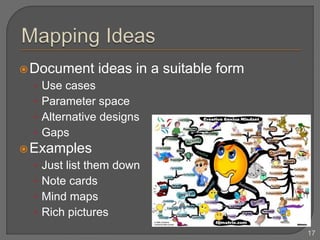
Document ideas in a suitable form
• Use cases
• Parameter space
• Alternative designs
• Gaps
Examples
• Just list them down
• Note cards
• Mind maps
• Rich pictures
17
You got a focus, & narrowed it down to a
problem statement
What is the most effective way of
presenting information?
What are the most important topics,
subtopics, etc.?
What order should you present them?
18
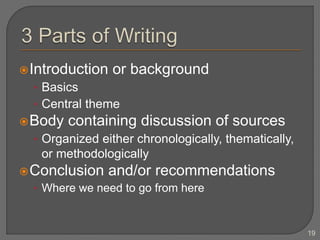
Introduction or background
• Basics
• Central theme
Body containing discussion of sources
• Organized either chronologically, thematically,
or methodologically
Conclusion and/or recommendations
• Where we need to go from here
19
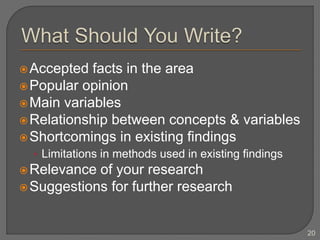
Accepted facts in the area
Popular opinion
Main variables
Relationship between concepts & variables
Shortcomings in existing findings
• Limitations in methods used in existing findings
Relevance of your research
Suggestions for further research
20
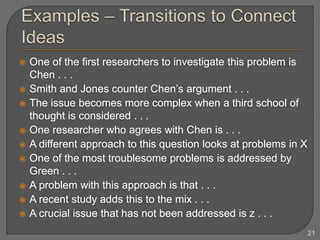
 One of the first researchers to investigate this problem is
Chen . . .
 Smith and Jones counter Chen’s argument . . .
 The issue becomes more complex when a third school of
thought is considered . . .
 One researcher who agrees with Chen is . . .
 A different approach to this question looks at problems in X
 One of the most troublesome problems is addressed by
Green . . .
 A problem with this approach is that . . .
 A recent study adds this to the mix . . .
 A crucial issue that has not been addressed is z . . .
21
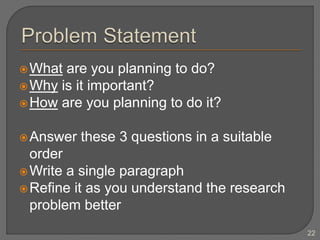
What are you planning to do?
Why is it important?
How are you planning to do it?
Answer these 3 questions in a suitable
order
Write a single paragraph
Refine it as you understand the research
problem better
22
Get stuck while writing it?
• It means you are still not clear about the research
problem
• If so, think, read, & analyze more, talk to others
• Then give it another try
23
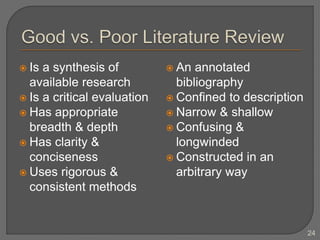
 Is a synthesis of
available research
 Is a critical evaluation
 Has appropriate
breadth & depth
 Has clarity &
conciseness
 Uses rigorous &
consistent methods
 An annotated
bibliography
 Confined to description
 Narrow & shallow
 Confusing &
longwinded
 Constructed in an
arbitrary way
24
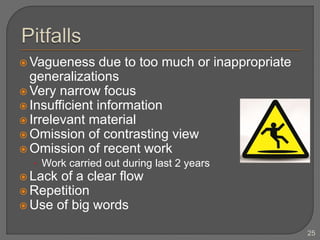
 Vagueness due to too much or inappropriate
generalizations
 Very narrow focus
 Insufficient information
 Irrelevant material
 Omission of contrasting view
 Omission of recent work
• Work carried out during last 2 years
 Lack of a clear flow
 Repetition
 Use of big words
25
All the Best!
26

Literature review

  • 1.
  • 2.
    Process of searching,understanding, & documenting related set of contents on a given topic • Includes academic papers, books, industry articles, news papers, Wikis, blogs, etc. 2 Source: www.criticalproof.com
  • 3.
    3 Cedalion standing onthe shoulders of Orion from Blind Orion Searching for the Rising Sun by Nicolas Poussin, 1658, Oil on canvas Source: http://en.wikipedia.org/wiki/Standing_on_the_shoulders_of_giants
  • 4.
    “Dwarfs standing onthe shoulders of giants” • Metaphor meaning “One who develops future intellectual pursuits by understanding the research & works created by notable thinkers of the past” “If I have seen further it is only by standing on the shoulders of giants.” ― Isaac Newton “Those who don't know history are doomed to repeat it.” ― Edmund Burke 4
  • 5.
    To find asolution to a problem Knowledge accumulates • We learn from & build on what others have done • Today’s studies build on those of yesterday! To make sure work you are trying to do hasn’t already been done 5
  • 6.
     Distinguish whathas been done from what needs to be done  Discover important variables relevant to topic  Synthesize & gain a new perspective  Identify relationships between ideas & practice  Establish context of topic or problem  Rationalize significance of problem  Enhance & acquiring subject vocabulary  Identify methodologies & techniques that have been used  Place research in a historical context to show familiarity with state-of-the-art developments 6
  • 7.
    Problem identification Analysis ofproblem in relation to existing literature • Depth of the problem • How my solution can be unique? During project work • Design parameters • Experiment/simulation setup While writing thesis 7
  • 8.
    Peer reviewed journals Academicbooks Articles in encyclopedias, hand books Periodicals News papers, news letters, magazines Patents Documents, project reports Experts & consultants On-line sources of information • Wiki, Blogs, Forum, Twitter 8
  • 9.
     Google Scholar Other research indexes & online databases  University libraries  Government document collections • National Archives  Government departments & institutions • NERD, NSF, ITI  Resources centers run by foreign missions • British Council, Russian Cultural Center, American Center, Practical Action 9
  • 10.
    Suppose your areinterested in “online payments using virtual currencies” 1. Go to Google Scholar & search for “virtual currency” • Note title, date, source, no of citations • Are results are all over the place? • Let’s be more specific in selecting search terms 2. Search for “virtual currency payments” • Better not miss fundamental papers 10
  • 11.
    3. Search formore recent papers • Papers within last 2-3 years • Select ones to read should be based on title, citations, then later by abstract • Look for recurrent terms/words • See the word “BitCoin”? 4. Search for “BitCoin” • Lot more related results 11
  • 12.
    5. Expand search •Looks at citations of a paper – these are related work • Look for related work from same authors, others, & supporting & opposing arguments 12
  • 13.
     Google Scholarhas a “Save” link  Use a tool • Zotero  Browser-based research tool  Help you collect, organize, search, cite, & share your research sources • Mendeley & Qiqqa  Web & desktop based  Partly free • EndNote  Commercial  Most university libraries have access 13
  • 14.
    After a while •You don’t remember where your ideas came from  You better not miss key/all citations • All your sources are mixed up Styles are complicated • Hundreds of styles of references • Conferences & journals have their own styles & reviewers are strict on style 14
  • 15.
  • 16.
     As youread widely, but selectively in your topic area, consider what themes or issues connect your sources together  Do they present one or different solutions?  Is there an aspect that is missing?  How well do they present material & portray it according to an appropriate theory?  Do they reveal a trend in the field?  Is there a raging debate?  Pick one of these themes to focus the organization of your review 16
  • 17.
    Document ideas ina suitable form • Use cases • Parameter space • Alternative designs • Gaps Examples • Just list them down • Note cards • Mind maps • Rich pictures 17
  • 18.
    You got afocus, & narrowed it down to a problem statement What is the most effective way of presenting information? What are the most important topics, subtopics, etc.? What order should you present them? 18
  • 19.
    Introduction or background •Basics • Central theme Body containing discussion of sources • Organized either chronologically, thematically, or methodologically Conclusion and/or recommendations • Where we need to go from here 19
  • 20.
    Accepted facts inthe area Popular opinion Main variables Relationship between concepts & variables Shortcomings in existing findings • Limitations in methods used in existing findings Relevance of your research Suggestions for further research 20
  • 21.
     One ofthe first researchers to investigate this problem is Chen . . .  Smith and Jones counter Chen’s argument . . .  The issue becomes more complex when a third school of thought is considered . . .  One researcher who agrees with Chen is . . .  A different approach to this question looks at problems in X  One of the most troublesome problems is addressed by Green . . .  A problem with this approach is that . . .  A recent study adds this to the mix . . .  A crucial issue that has not been addressed is z . . . 21
  • 22.
    What are youplanning to do? Why is it important? How are you planning to do it? Answer these 3 questions in a suitable order Write a single paragraph Refine it as you understand the research problem better 22
  • 23.
    Get stuck whilewriting it? • It means you are still not clear about the research problem • If so, think, read, & analyze more, talk to others • Then give it another try 23
  • 24.
     Is asynthesis of available research  Is a critical evaluation  Has appropriate breadth & depth  Has clarity & conciseness  Uses rigorous & consistent methods  An annotated bibliography  Confined to description  Narrow & shallow  Confusing & longwinded  Constructed in an arbitrary way 24
  • 25.
     Vagueness dueto too much or inappropriate generalizations  Very narrow focus  Insufficient information  Irrelevant material  Omission of contrasting view  Omission of recent work • Work carried out during last 2 years  Lack of a clear flow  Repetition  Use of big words 25
  • 26.

Editor's Notes

  • #11 Step 1 – Students will realize there are too much content & most of the top ones are very old
  • #20 Thematically – based on theme