Borromeo B. Motin, Ph.D.
Romblon State University
 To understand concepts, phenomenon,
concepts, etc.
 To appreciate significance and the existence
of things around us.
 To develop answer, solution or suggestions
to problem at hand.
 To discover, learn and explore the nature of
earth. Environment, etc., e.g. blue hole
 To solve problem or apply solution to
problem.
 Re – (Latin word) again, again and again,
to indicate repetition
 Search - Try to find something by looking
or seeking carefully and thoroughly.
- To make a thorough examination of;
look over carefully in order to find
something; explore.
- To make a careful examination or
investigation of; probe.
 Diligent and systematic inquiry into a subject
in order to discover or revise facts theories
etc.
 A systematic and extensively careful
investigation into.
 Diligent inquiry or examination in seeking
facts or principles laborious or continued
search after truth as researches of human
wisdom
 Critical and exhaustive investigation or
experimentation, having for its aim the
discovery of new facts and their correct
interpretation, the revision of accepted
conclusions, theories, or laws in the light
of newly discovered facts, or the practical
application of such new or revised
conclusions, theories, or laws.
(Webster, 3rd ed.)
 Anything which gives a person a feeling of
discomfort. If a person worries about how
things are, he/she has a problem.
 A problem could be a state of affairs that
needs to be changed or anything that is not
working as expected.
 An issue that should be settled or question
about unknown characteristics of a
population or about factors that explain the
presence or occurrence of a phenomenon.
 Conditions they want to improve
 Difficulties they want to eliminate
 Questions for which they want answers or
 Information gaps they wish to fill
 Theories they wish to validate.
Not all research statements is
researchable…
1. Does the problem really exist? What are the
evidences of the problem’s existence?
2. Is the problem serious? Who and how many
are affected by it?
3. What places are affected? How widespread is
it?
4. How often does the problem occur?
 Examines a significant issue
 Addresses a knowledgeable reader and brings
that reader to a higher plain
 Has a serious purpose requiring analysis of
relevant issues, argument from a viewpoint
and explanation of important details
From: Lester, James D. 1999. Writing Research Papers. A
Complete Guide. Ninth Edition. New York: Longman.
 Enables you to meet a requirement
 Is interesting enough for you to read more
and contribute additional knowledge
 Provides you with more knowledge and
expands your horizon
 Is manageable in scope
 Has enough available information
 Is suitable and interesting to a target
audience
QuaLitative
L for literature, descriptive
Number not the primary focus
Interpretative, ethnographic, naturalistic
QuaNtitative
 N for numbers
 Statistical
 Quantifiable
 Content analysis
 Discourse analysis
 Focus group discussion
 Interviews
 Observation (obtrusive & non-obtrusive);
participant observation
 Think loud protocol
 Usability testing
1. Review relevant literature and previous
studies on the problem
2. Examine current available data/statistics
3. Seek educated opinions from persons
concerned with the problem
4. Determine the probable reason for the
existence of the problem from social,
economic, or other theories that may
explain the existence of the problem and
the possible connection between the problem
and other factors.
A research problem should posses four
essential characteristics:
1. Relevant:
a. Will answers to the research questions
help advance knowledge?
b. Can answer to the research question help
improving practices/behavior performance?
c. Will answers to the research problem
improve human conditions?
2. Feasible? –Availability of resources: funds,
human resources, appropriate tools/devices
needed in the conduct of the study.
3. Clear? Clearly state the problem being
investigated. Major variable/s of the study
should be measurable and should be
specified in the problem statement.
4. Ethical.
Study should not pose any danger,
embarrassment, hurt, or any risk to the
research respondents or subject or any one.
Information collected without violating the
rights of sources of information, privacy must
therefore protected.
 Has a single source that provides all the
information you need
 Was already written about by you (and
submitted for publication)
 Is not interesting to you
 Is very broad and vague
 Has an irrelevant result
 Has been written about many times
 Is highly controversial
 Is unsuitable to a target audience
Source: Roth, Audrey J. 1999. The Research Paper. Process,
Form, and Content. Eighth Edition. California: Wadsworth.
1. Read, read and read.
2. Consult knowledgeable people on your
chosen topic.
3. Ask your self the ff. Questions:
a. Is this topic interesting me?
b. Why I have to do this?
c. Who will benefit from it?
d. I am capable to do it?
e. Do we have enough time?
f. Do we have resources to carry out this topic?
4. Start gathering data/references.
5. Classify your references into the ff.
Categories:
a. Primary sources
b. Secondary sources
c. Tertiary sources
6. Start writing Review of Related Literature
(RRL)
 Topic 1. Purpose
To review or analyze existing or
available materials related to topic of
present study
 Process
SKIM: General references
Primary sources (professional
journals, reports)
Secondary sources
The review of related literature is a must in
research. It serves as follows:
 Helps identify and define a research problem
 Helps justify the need for studying a problem
 Can be a source of theoretical basis for
the study
 Helps eliminate duplication of what has been
done provide useful hypotheses and useful
suggestions for significant investigation.
 Helps conceptualize a research problem and
identify and operationally defines study
variables
 Basis for identifying and using appropriate
research design
 Provides lessons for data analysis and
interpretation
 Provides background for the research project
 Makes the reader aware of the status of the
issue
***mere listing of annotated studies
relating to the problem is ineffective and
inappropriate…Only those studies that are
plainly relevant, competently executed, and
clearly reported should be included.
 Classify your references into: Primary,
secondary or tertiary
 Evaluate the text by understanding the
context of the work and assess author’s.
credibility, publisher, and date of publication.
 Jot down only important ideas, words or texts
 keep in mind taking a compressed and
accurate record of information, other
people’s opinions, and possibly your own
observations on the subject in question.
 For every notecard, write the Author, title,
publisher, publication date, and edition of
book/journal.
 Write clearly and leave a space between
each note. Don’t try to cram onto one page
 Use some system of tabulation.
 Notes should be abbreviated and
compressed. Use abbreviations, initials, and
shortened forms of commonly used terms.
 Don’t string the points together continuously,
make it one after the other on the page.
 Devise a logical and a memorable layout. Use
lettering, numbering, and indentation for
sections and for sub-sections.
 Use a new page for each set of notes.
 Write on one side of the page only. Leave the
blank sides free for possible future additions
or details which may be needed later.
 Select only those few words of the source
material which will be of use. Avoid being
descriptive. Think more, and write less. Be
rigorously selective.
 Keep the research topic or the essay question
more clearly in mind. Take notes only on
those issues which are directly relevant to the
subject in question.
 Having a well-developed Review of Related
Literature means 50% of your thesis is done.
 With the use of inverted pyramid or deductive
logic, naturally it helps you to focus on your
problem statement.
 Filling in or answering the identified gap
gives you the objective of the study or
statement of the problem
 Significance of the study. Answering the

question, “why is it important to generate
data or information that fill in the gap?,” gives
you details on the significance of the study.
 Scope and Limitation. It is self assessment on
your capability (resources, facility, time, etc.)
to carry out your study.
 Methodology – procedure on how to produce
data or process to be carried out in able to
meet the objective/statement of the problem
 A criminal act
 Presentation of another
person’s work/material as if it
were your own by failing to
acknowledge the other person’s
authorship
 Done intentionally or
unintentionally
 The Modern Language
Association (MLA) says:
 Scholarly authors generously
acknowledge their debts to
predecessors by carefully
giving credit to each source.
 Whenever you use another person’s
ideas or terminology, specify what
you borrowed whether facts,
opinions, or quotations and where
you borrowed it from.
.
Derived from the Latin plagiarius
(“kidnapper”), plagiarism refers to a
form of intellectual theft.
Plagiarism is a violation of
professional ethics.
Joseph Gibaldi. MLA Style Manual and Guide to
Scholarly Publishing. 2nd ed. New York:
MLA, 1998:151.
 DOCUMENT or acknowledge
indebtedness for an idea or fact which
can be - - -
 Quoted materials
 Borrowed ideas, including
paraphrases, summaries, translations
 Visual materials as maps, charts,
diagrams, pictures, film clips, etc.
 INTEGRATE Documented information
into the text
At the beginning
Example: Audrey J. Roth (1999) suggests
acknowledging or indicating at the beginning
of a paragraph the author of the ideas in the
succeeding paragraph. In this way,
misunderstanding or confusion is prevented
Within the sentence or paragraph
Example: Oftentimes, readers discover too late
that the ideas were just summarized that AJ
Roth (1999) suggests that acknowledgment be
given earlier.
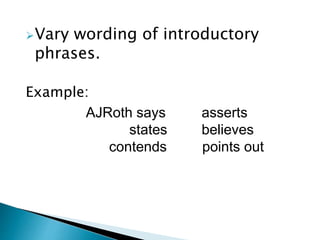
Vary wording of introductory
phrases.
Example:
AJRoth says asserts
states believes
contends points out
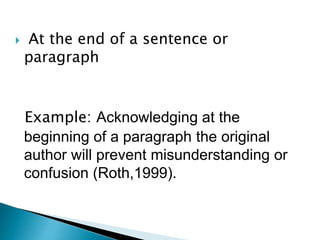
 At the end of a sentence or
paragraph
Example: Acknowledging at the
beginning of a paragraph the original
author will prevent misunderstanding or
confusion (Roth,1999).
Proper documentation . . .
 Establishes your integrity as
scholar
 Allows readers to identify and
verify materials
 Encourages intellectual honesty
among readers/listeners
Fraenkel, Jack R and Norman E. Wallen. 2006.
How To Design and Evaluate Research in
Education. Sixth Edition. Boston:
McGraw-Hill.
Lester, James D. 1999. Writing Research Papers. A
Complete Guide. Ninth Edition. New York:
Longman.
Roth, Audrey J. 1999. The Research Paper.
Process, Form, and Content. Eighth
Edition. California: Wadsworth.
 faculty.ksu.edu.sa/.../The%20Feasibility%20
Study/.. Retrieved 27 Nov 2012
 www.indiastudychannel.com/.../19587-
What-Are-The-Main-Ty... - India Retrieved
27 Nov 2012
 www.mbakku.com/STD/.../Feasibility%20St
udy%20Framework.pdf Retrieved 12 Nov
2012.
Thank you
Let us make research more fun and
enjoyable!!!

Research-making-MPA.MEM.pptx

  • 1.
    Borromeo B. Motin,Ph.D. Romblon State University
  • 2.
     To understandconcepts, phenomenon, concepts, etc.  To appreciate significance and the existence of things around us.  To develop answer, solution or suggestions to problem at hand.  To discover, learn and explore the nature of earth. Environment, etc., e.g. blue hole  To solve problem or apply solution to problem.
  • 3.
     Re –(Latin word) again, again and again, to indicate repetition  Search - Try to find something by looking or seeking carefully and thoroughly. - To make a thorough examination of; look over carefully in order to find something; explore. - To make a careful examination or investigation of; probe.
  • 4.
     Diligent andsystematic inquiry into a subject in order to discover or revise facts theories etc.  A systematic and extensively careful investigation into.  Diligent inquiry or examination in seeking facts or principles laborious or continued search after truth as researches of human wisdom
  • 5.
     Critical andexhaustive investigation or experimentation, having for its aim the discovery of new facts and their correct interpretation, the revision of accepted conclusions, theories, or laws in the light of newly discovered facts, or the practical application of such new or revised conclusions, theories, or laws. (Webster, 3rd ed.)
  • 6.
     Anything whichgives a person a feeling of discomfort. If a person worries about how things are, he/she has a problem.  A problem could be a state of affairs that needs to be changed or anything that is not working as expected.
  • 7.
     An issuethat should be settled or question about unknown characteristics of a population or about factors that explain the presence or occurrence of a phenomenon.
  • 8.
     Conditions theywant to improve  Difficulties they want to eliminate  Questions for which they want answers or  Information gaps they wish to fill  Theories they wish to validate. Not all research statements is researchable…
  • 9.
    1. Does theproblem really exist? What are the evidences of the problem’s existence? 2. Is the problem serious? Who and how many are affected by it? 3. What places are affected? How widespread is it? 4. How often does the problem occur?
  • 10.
     Examines asignificant issue  Addresses a knowledgeable reader and brings that reader to a higher plain  Has a serious purpose requiring analysis of relevant issues, argument from a viewpoint and explanation of important details From: Lester, James D. 1999. Writing Research Papers. A Complete Guide. Ninth Edition. New York: Longman.
  • 11.
     Enables youto meet a requirement  Is interesting enough for you to read more and contribute additional knowledge  Provides you with more knowledge and expands your horizon  Is manageable in scope  Has enough available information  Is suitable and interesting to a target audience
  • 12.
    QuaLitative L for literature,descriptive Number not the primary focus Interpretative, ethnographic, naturalistic QuaNtitative  N for numbers  Statistical  Quantifiable
  • 13.
     Content analysis Discourse analysis  Focus group discussion  Interviews  Observation (obtrusive & non-obtrusive); participant observation  Think loud protocol  Usability testing
  • 14.
    1. Review relevantliterature and previous studies on the problem 2. Examine current available data/statistics 3. Seek educated opinions from persons concerned with the problem 4. Determine the probable reason for the existence of the problem from social, economic, or other theories that may explain the existence of the problem and the possible connection between the problem and other factors.
  • 15.
    A research problemshould posses four essential characteristics: 1. Relevant: a. Will answers to the research questions help advance knowledge? b. Can answer to the research question help improving practices/behavior performance? c. Will answers to the research problem improve human conditions?
  • 16.
    2. Feasible? –Availabilityof resources: funds, human resources, appropriate tools/devices needed in the conduct of the study. 3. Clear? Clearly state the problem being investigated. Major variable/s of the study should be measurable and should be specified in the problem statement.
  • 17.
    4. Ethical. Study shouldnot pose any danger, embarrassment, hurt, or any risk to the research respondents or subject or any one. Information collected without violating the rights of sources of information, privacy must therefore protected.
  • 18.
     Has asingle source that provides all the information you need  Was already written about by you (and submitted for publication)  Is not interesting to you  Is very broad and vague  Has an irrelevant result  Has been written about many times  Is highly controversial  Is unsuitable to a target audience Source: Roth, Audrey J. 1999. The Research Paper. Process, Form, and Content. Eighth Edition. California: Wadsworth.
  • 19.
    1. Read, readand read. 2. Consult knowledgeable people on your chosen topic. 3. Ask your self the ff. Questions: a. Is this topic interesting me? b. Why I have to do this? c. Who will benefit from it? d. I am capable to do it? e. Do we have enough time? f. Do we have resources to carry out this topic?
  • 20.
    4. Start gatheringdata/references. 5. Classify your references into the ff. Categories: a. Primary sources b. Secondary sources c. Tertiary sources 6. Start writing Review of Related Literature (RRL)
  • 21.
     Topic 1.Purpose To review or analyze existing or available materials related to topic of present study  Process SKIM: General references Primary sources (professional journals, reports) Secondary sources
  • 22.
    The review ofrelated literature is a must in research. It serves as follows:  Helps identify and define a research problem  Helps justify the need for studying a problem  Can be a source of theoretical basis for the study  Helps eliminate duplication of what has been done provide useful hypotheses and useful suggestions for significant investigation.
  • 23.
     Helps conceptualizea research problem and identify and operationally defines study variables  Basis for identifying and using appropriate research design  Provides lessons for data analysis and interpretation
  • 24.
     Provides backgroundfor the research project  Makes the reader aware of the status of the issue ***mere listing of annotated studies relating to the problem is ineffective and inappropriate…Only those studies that are plainly relevant, competently executed, and clearly reported should be included.
  • 25.
     Classify yourreferences into: Primary, secondary or tertiary  Evaluate the text by understanding the context of the work and assess author’s. credibility, publisher, and date of publication.  Jot down only important ideas, words or texts  keep in mind taking a compressed and accurate record of information, other people’s opinions, and possibly your own observations on the subject in question.
  • 26.
     For everynotecard, write the Author, title, publisher, publication date, and edition of book/journal.  Write clearly and leave a space between each note. Don’t try to cram onto one page  Use some system of tabulation.  Notes should be abbreviated and compressed. Use abbreviations, initials, and shortened forms of commonly used terms.
  • 27.
     Don’t stringthe points together continuously, make it one after the other on the page.  Devise a logical and a memorable layout. Use lettering, numbering, and indentation for sections and for sub-sections.  Use a new page for each set of notes.  Write on one side of the page only. Leave the blank sides free for possible future additions or details which may be needed later.
  • 28.
     Select onlythose few words of the source material which will be of use. Avoid being descriptive. Think more, and write less. Be rigorously selective.  Keep the research topic or the essay question more clearly in mind. Take notes only on those issues which are directly relevant to the subject in question.
  • 29.
     Having awell-developed Review of Related Literature means 50% of your thesis is done.  With the use of inverted pyramid or deductive logic, naturally it helps you to focus on your problem statement.  Filling in or answering the identified gap gives you the objective of the study or statement of the problem
  • 30.
     Significance ofthe study. Answering the question, “why is it important to generate data or information that fill in the gap?,” gives you details on the significance of the study.  Scope and Limitation. It is self assessment on your capability (resources, facility, time, etc.) to carry out your study.  Methodology – procedure on how to produce data or process to be carried out in able to meet the objective/statement of the problem
  • 31.
     A criminalact  Presentation of another person’s work/material as if it were your own by failing to acknowledge the other person’s authorship  Done intentionally or unintentionally
  • 32.
     The ModernLanguage Association (MLA) says:  Scholarly authors generously acknowledge their debts to predecessors by carefully giving credit to each source.
  • 33.
     Whenever youuse another person’s ideas or terminology, specify what you borrowed whether facts, opinions, or quotations and where you borrowed it from. .
  • 34.
    Derived from theLatin plagiarius (“kidnapper”), plagiarism refers to a form of intellectual theft. Plagiarism is a violation of professional ethics. Joseph Gibaldi. MLA Style Manual and Guide to Scholarly Publishing. 2nd ed. New York: MLA, 1998:151.
  • 35.
     DOCUMENT oracknowledge indebtedness for an idea or fact which can be - - -  Quoted materials  Borrowed ideas, including paraphrases, summaries, translations  Visual materials as maps, charts, diagrams, pictures, film clips, etc.
  • 36.
     INTEGRATE Documentedinformation into the text At the beginning Example: Audrey J. Roth (1999) suggests acknowledging or indicating at the beginning of a paragraph the author of the ideas in the succeeding paragraph. In this way, misunderstanding or confusion is prevented
  • 37.
    Within the sentenceor paragraph Example: Oftentimes, readers discover too late that the ideas were just summarized that AJ Roth (1999) suggests that acknowledgment be given earlier.
  • 38.
    Vary wording ofintroductory phrases. Example: AJRoth says asserts states believes contends points out
  • 39.
     At theend of a sentence or paragraph Example: Acknowledging at the beginning of a paragraph the original author will prevent misunderstanding or confusion (Roth,1999).
  • 40.
    Proper documentation .. .  Establishes your integrity as scholar  Allows readers to identify and verify materials  Encourages intellectual honesty among readers/listeners
  • 43.
    Fraenkel, Jack Rand Norman E. Wallen. 2006. How To Design and Evaluate Research in Education. Sixth Edition. Boston: McGraw-Hill. Lester, James D. 1999. Writing Research Papers. A Complete Guide. Ninth Edition. New York: Longman. Roth, Audrey J. 1999. The Research Paper. Process, Form, and Content. Eighth Edition. California: Wadsworth.
  • 44.
     faculty.ksu.edu.sa/.../The%20Feasibility%20 Study/.. Retrieved27 Nov 2012  www.indiastudychannel.com/.../19587- What-Are-The-Main-Ty... - India Retrieved 27 Nov 2012  www.mbakku.com/STD/.../Feasibility%20St udy%20Framework.pdf Retrieved 12 Nov 2012.
  • 45.
    Thank you Let usmake research more fun and enjoyable!!!