LITERATURE REVIEW: EVALUATING
INFORMATION SOURCES
B Y
O Y I N T O L A I S I A K A A M U S A
N I M B E A D E D I P E L I B R A R Y,
F E D E R A L U N I V E R S I T Y O F A G R I C U L T U R E ,
A B E O K U T A .
A P R E S E N T AT I O N AT T H E F U N A A B P O S T - G R A D U A T E
S C H O O L O R G A N I S E D
I N F O R M A T I O N L I T E R A C Y W O R K S H O P.
1 7 T H – 1 8 T H J U N E , 2 0 1 5 .
1
INTRODUCTION
What is research?
It is exploration, quest, scrutiny, examination, study, or investigation
into an identified problem or issue to find solution, to discover ne idea
or knowledge.
Research is a systematic investigation into and study of material and
sources in order to establish facts and research new conclusion.
Research is formal, systematic, and intensive.
Research can be basic research and applied research. Basic research is
inquiry aimed at increasing scientific knowledge, and applied research
is effort aimed at using basic research for solving problems or developing new
processes, products or techniques
2
BASIC COMPONENTS OF SCIENTIFIC RESEARCH
Introduction/ Background of the study Objectives of the study
Statement of the problem
Objectives of the study
Research questions/ hypotheses
Scope of the study
Significance of the study
Operational definition of terms
Literature Review
Theoretical background
Conceptual model
Methodology
Data Analysis/ Discussion
Summary, Limitation of the study, Suggestion for further studies etc.
This discourse focused on literature review aspect of research and how to
evaluate the information and information resources to be included in
literature review.
3
LITERATURE REVIEW
• It is an account of what have been published on a topic by accredited
scholars and researchers.
• It creates the context from the past for the new study to be conducted
with new subject and newly gathered data.
• It provides some insight regarding strong points and limitations of the
previous studies. This enables the researcher to avoid repetition of
what has been done and to improve his own investigation.
• It is highly creative and tedious because researcher has to synthesis
the available knowledge of the field in a unique way to provide the
rationale for his study.
4
REASONS FOR REVIEW OF LITERATURE
• Indication of direction
• To be up-to-date and current
• To establish the gap in the literature that the researcher desires to fill
• To provide justification for the study and to established the existing
literature upon wish the current study relates to.
5
RESOURCES FOR LITERATURE REVIEW
• Printed Information Sources: Textbooks, Journals, Pamphlets, Periodicals,
Theses,
• Reference source, Bibliographies, Published abstracts, Handbooks,
Encyclopedia,
• Specialized document, Year books, etc.
• Electronic/Online source
• Databases: TEEAL, AGORA, TROPAG, HINARI,EBSCO HOST
• Electronic Journals
• Electronic Books
• Other electronic documents.
These resources and several others are available for your use in the university
library, Nimbe Adedipe library.
6
NIMBE ADEDIPE LIBRARY
• The main university library is named after the pioneer Vice-chancellor,
Professor Nurudeen Olorunnimbe Adedipe. It is centrally located and it
has facilities for 24-hour services.
• It has capacity for 700 users at a time and 250,000 volumes of books.
• Its collections of books is over 85,000 and it subscribes to about 185
local and foreign journal.
• It also subscribes to a series of databases and electronic information
resources.
• To effectively serve all the staff and students of the university, the
library has branches in all the colleges of the university except
COLERM.
7
NIMBE ADEEDIPE LIBRARY OPENING HOURS
- Monday – Friday : 8.00am – 8.00pm
- Saturday : 10.00am - 6.00pm
- During examination, the library provides 24hours services
- The library does not open during public holidays
- During long vacation: Monday – Friday: 8.00am - 6.00pm
8
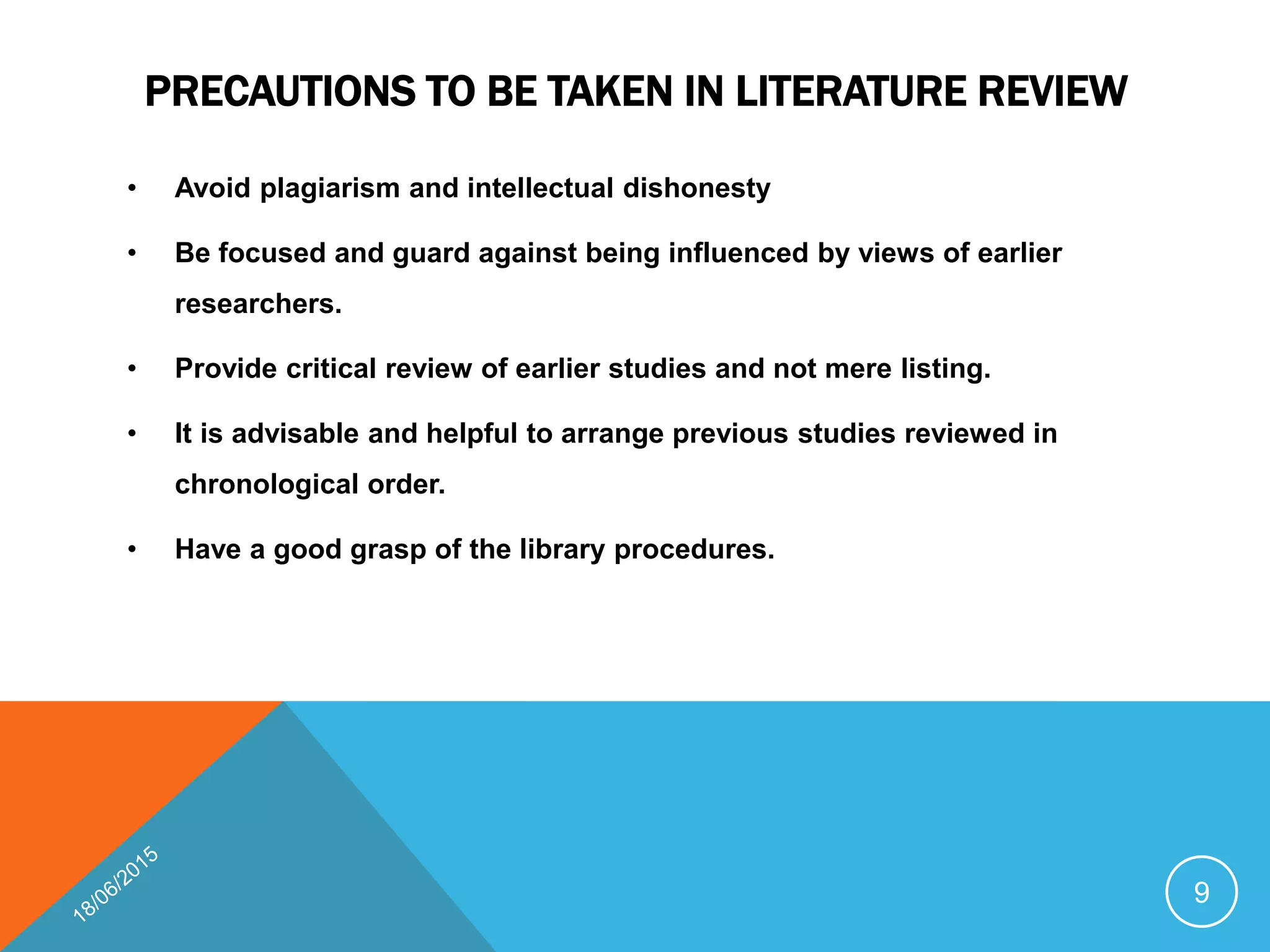
PRECAUTIONS TO BE TAKEN IN LITERATURE REVIEW
• Avoid plagiarism and intellectual dishonesty
• Be focused and guard against being influenced by views of earlier
researchers.
• Provide critical review of earlier studies and not mere listing.
• It is advisable and helpful to arrange previous studies reviewed in
chronological order.
• Have a good grasp of the library procedures.
9
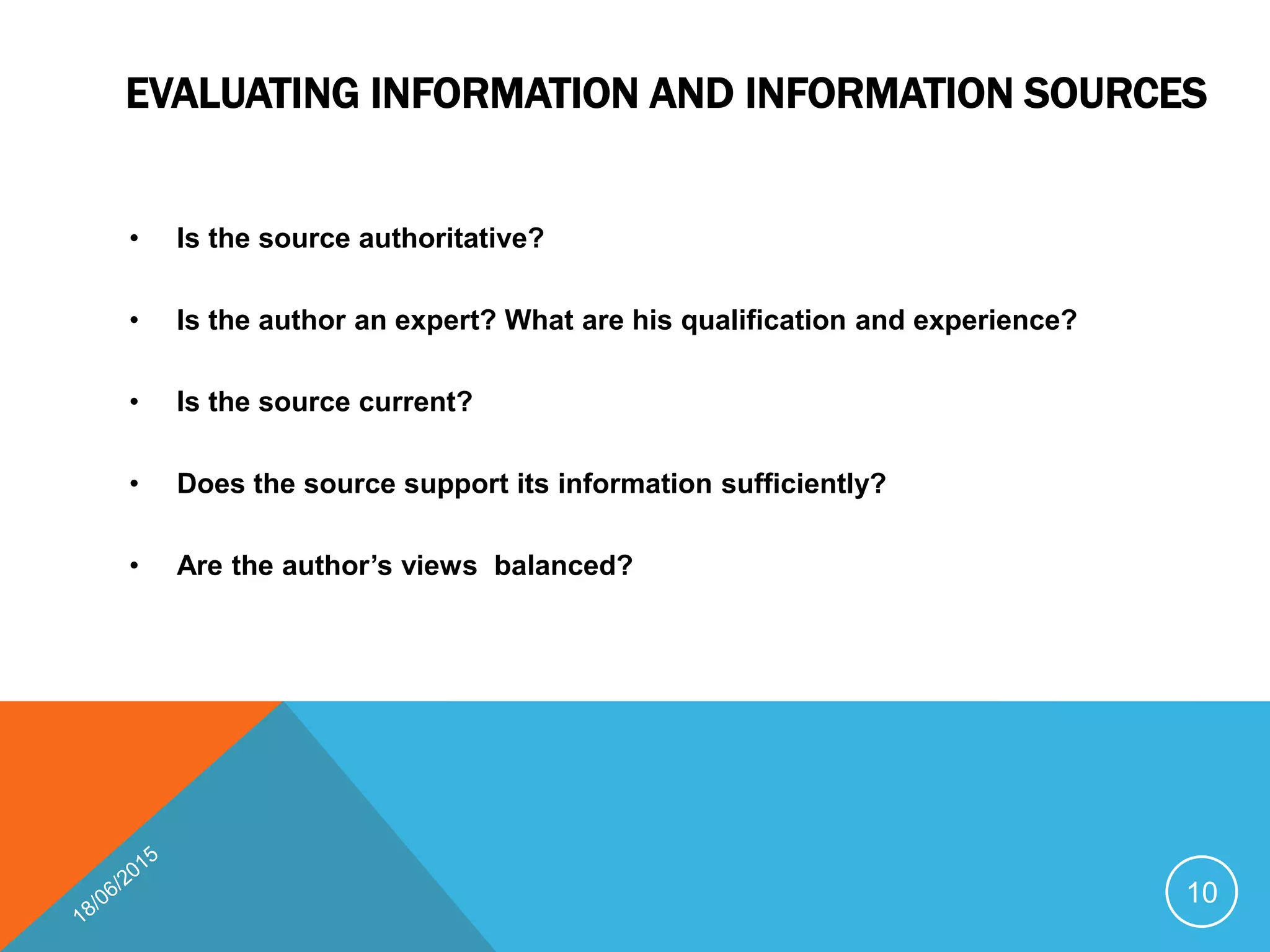
EVALUATING INFORMATION AND INFORMATION SOURCES
• Is the source authoritative?
• Is the author an expert? What are his qualification and experience?
• Is the source current?
• Does the source support its information sufficiently?
• Are the author’s views balanced?
10
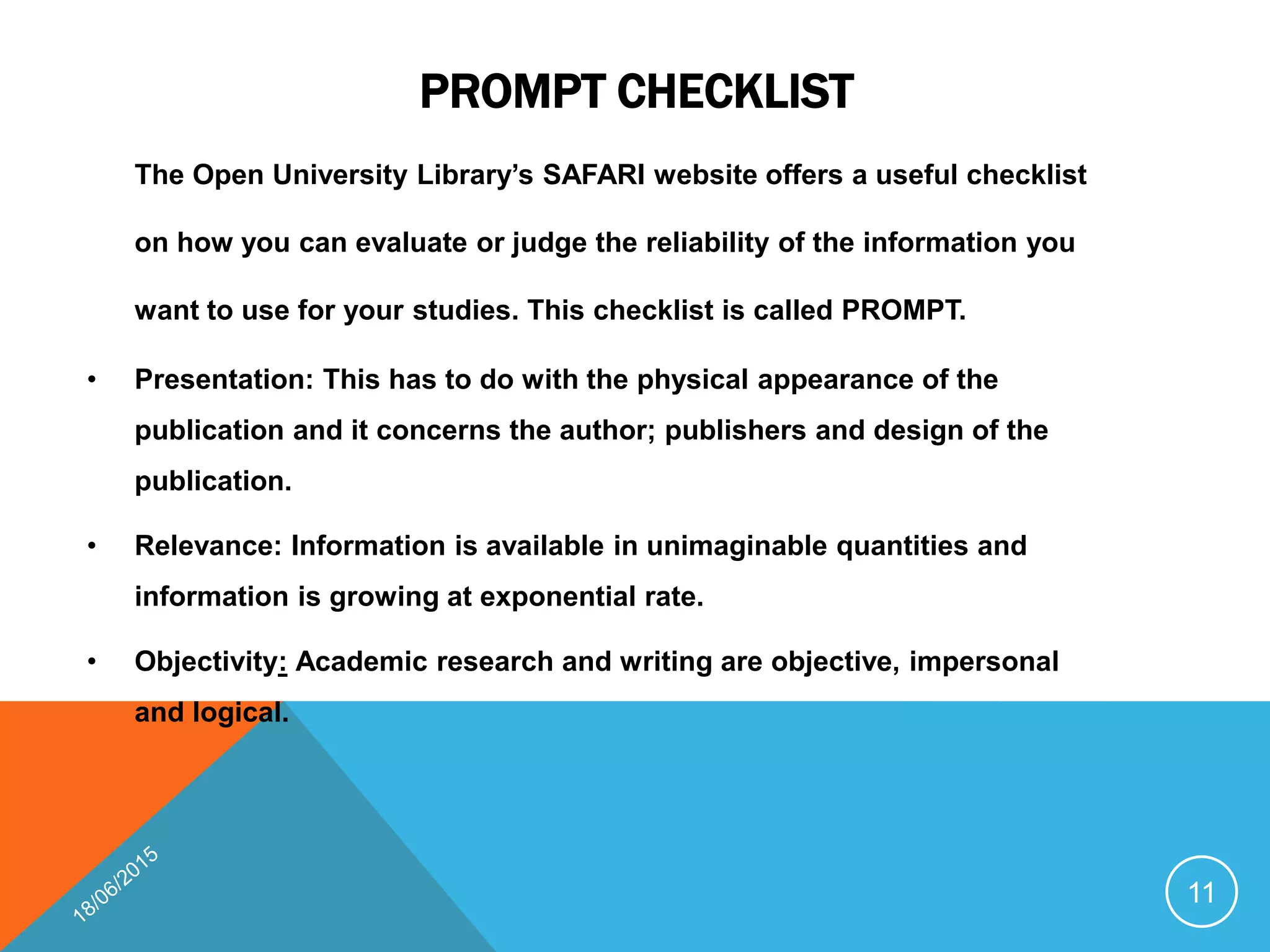
PROMPT CHECKLIST
The Open University Library’s SAFARI website offers a useful checklist
on how you can evaluate or judge the reliability of the information you
want to use for your studies. This checklist is called PROMPT.
• Presentation: This has to do with the physical appearance of the
publication and it concerns the author; publishers and design of the
publication.
• Relevance: Information is available in unimaginable quantities and
information is growing at exponential rate.
• Objectivity: Academic research and writing are objective, impersonal
and logical.
11
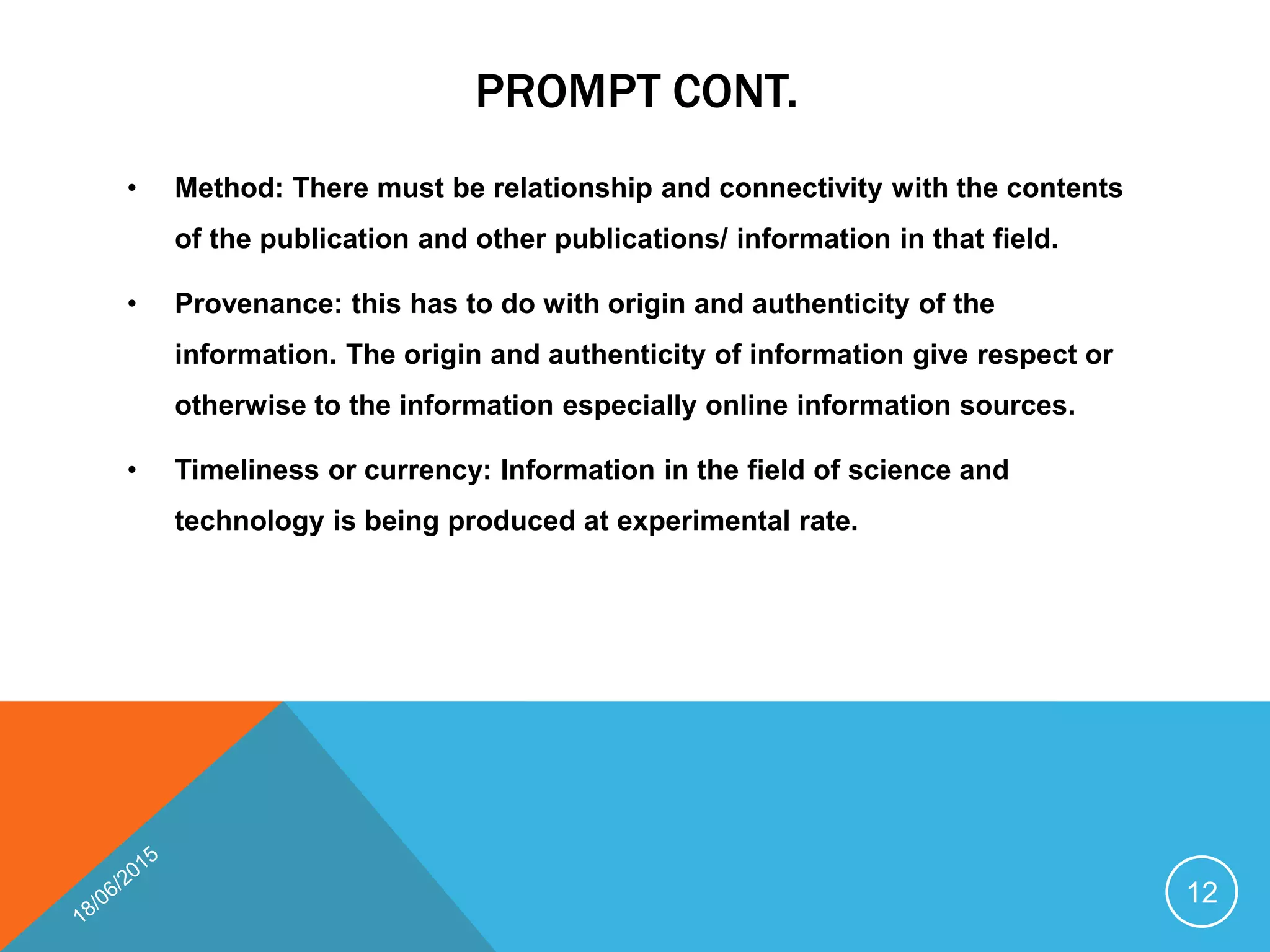
PROMPT CONT.
• Method: There must be relationship and connectivity with the contents
of the publication and other publications/ information in that field.
• Provenance: this has to do with origin and authenticity of the
information. The origin and authenticity of information give respect or
otherwise to the information especially online information sources.
• Timeliness or currency: Information in the field of science and
technology is being produced at experimental rate.
12
HACKER (2008)TIPS ON EVALUATION OF
INFORMATION SOURCES
To determine if a source is scholarly. Look for the following:
• Formal language and presentation.
• Authors who are academics or scientists, not journalist or a bibliography
documenting the works cited by the author in the source.
• Original research and interpretation (rather than a survey of other people’s
work).
• Quotations from analysis of primary sources (in humanities such literature,
history, and philosophy).
• A description of research method or a review of related research (in the science
and social sciences)
13
EVALUATING WEB SOURCES
• Authorship: Does the web site or document has an author? If there is an
author, how knowledgeable is he/she and what is he/she qualification.
• Sponsorship: Who is responsible for the site. This is often named and
described on the home page. The URL ending should indicate the type
of hosting. i.e. educational, commercial, governmental, network etc. and
the country of origin e.g. U.k, jp. Ng.
• Purpose and Audience: Why was the site created (to sell product, to
argue a position, to influence readers, academic publishing (Who are
the intend audience. Determine if you fit into the audience.
• Currency: how current is the site? Check for the date of publication or
the latest update. Also, find out how current the site’s link are. If many
of the links no longer work, the site may be too old for your need.
14
CONCLUSION
Literature review makes research effective because it provides link to
the past knowledge, eliminate repetition of efforts, provide useful basis
for the formulation of hypothesis and, methodology of the study.
However, information and information sources to be included in
literature review must be evaluated and found worthy of inclusion. This
can be achieved through PROMPT check and other measures identified
in this discourse.
15
REFERENCES
Hacker, Diana (2008). A Writer’s Reference with Exercise, 6th edition, Boton:
Bedford/St. Martin’s, Pp. 359-394.
Northedge, Andrew (2005). The Good Study Guide. Walton Hall, U.K: The Open
University, Pp.237-240.
Olayinka, A. I and Oriaku, R. O (2006). Writing a PhD Thesis In Olayinka, A. I, Taiwo,
V. O, Raji-Oyedele,A and Farai, I. P. (eds.) Methodology of Basic and Applied
Research, 2nd edition. Ibadan: The postgraduate School, Pp.243-266.
Singh, Y. K. and Bajpai, R. B. (2007). Research Methodology: Techniques and
Trends, Vol. 1. New Delhi: APH Publishing Corporation, Pp. 59-67.
Troyka, Lym Q. (2005). Simon & Schuster Handbook for Writers, 7th edition. New
Jersey: Pearson Education, Inc. Pp.533-537.
16

LITERATURE REVIEW: EVALUATING INFORMATION SOURCES

  • 1.
    LITERATURE REVIEW: EVALUATING INFORMATIONSOURCES B Y O Y I N T O L A I S I A K A A M U S A N I M B E A D E D I P E L I B R A R Y, F E D E R A L U N I V E R S I T Y O F A G R I C U L T U R E , A B E O K U T A . A P R E S E N T AT I O N AT T H E F U N A A B P O S T - G R A D U A T E S C H O O L O R G A N I S E D I N F O R M A T I O N L I T E R A C Y W O R K S H O P. 1 7 T H – 1 8 T H J U N E , 2 0 1 5 . 1
  • 2.
    INTRODUCTION What is research? Itis exploration, quest, scrutiny, examination, study, or investigation into an identified problem or issue to find solution, to discover ne idea or knowledge. Research is a systematic investigation into and study of material and sources in order to establish facts and research new conclusion. Research is formal, systematic, and intensive. Research can be basic research and applied research. Basic research is inquiry aimed at increasing scientific knowledge, and applied research is effort aimed at using basic research for solving problems or developing new processes, products or techniques 2
  • 3.
    BASIC COMPONENTS OFSCIENTIFIC RESEARCH Introduction/ Background of the study Objectives of the study Statement of the problem Objectives of the study Research questions/ hypotheses Scope of the study Significance of the study Operational definition of terms Literature Review Theoretical background Conceptual model Methodology Data Analysis/ Discussion Summary, Limitation of the study, Suggestion for further studies etc. This discourse focused on literature review aspect of research and how to evaluate the information and information resources to be included in literature review. 3
  • 4.
    LITERATURE REVIEW • Itis an account of what have been published on a topic by accredited scholars and researchers. • It creates the context from the past for the new study to be conducted with new subject and newly gathered data. • It provides some insight regarding strong points and limitations of the previous studies. This enables the researcher to avoid repetition of what has been done and to improve his own investigation. • It is highly creative and tedious because researcher has to synthesis the available knowledge of the field in a unique way to provide the rationale for his study. 4
  • 5.
    REASONS FOR REVIEWOF LITERATURE • Indication of direction • To be up-to-date and current • To establish the gap in the literature that the researcher desires to fill • To provide justification for the study and to established the existing literature upon wish the current study relates to. 5
  • 6.
    RESOURCES FOR LITERATUREREVIEW • Printed Information Sources: Textbooks, Journals, Pamphlets, Periodicals, Theses, • Reference source, Bibliographies, Published abstracts, Handbooks, Encyclopedia, • Specialized document, Year books, etc. • Electronic/Online source • Databases: TEEAL, AGORA, TROPAG, HINARI,EBSCO HOST • Electronic Journals • Electronic Books • Other electronic documents. These resources and several others are available for your use in the university library, Nimbe Adedipe library. 6
  • 7.
    NIMBE ADEDIPE LIBRARY •The main university library is named after the pioneer Vice-chancellor, Professor Nurudeen Olorunnimbe Adedipe. It is centrally located and it has facilities for 24-hour services. • It has capacity for 700 users at a time and 250,000 volumes of books. • Its collections of books is over 85,000 and it subscribes to about 185 local and foreign journal. • It also subscribes to a series of databases and electronic information resources. • To effectively serve all the staff and students of the university, the library has branches in all the colleges of the university except COLERM. 7
  • 8.
    NIMBE ADEEDIPE LIBRARYOPENING HOURS - Monday – Friday : 8.00am – 8.00pm - Saturday : 10.00am - 6.00pm - During examination, the library provides 24hours services - The library does not open during public holidays - During long vacation: Monday – Friday: 8.00am - 6.00pm 8
  • 9.
    PRECAUTIONS TO BETAKEN IN LITERATURE REVIEW • Avoid plagiarism and intellectual dishonesty • Be focused and guard against being influenced by views of earlier researchers. • Provide critical review of earlier studies and not mere listing. • It is advisable and helpful to arrange previous studies reviewed in chronological order. • Have a good grasp of the library procedures. 9
  • 10.
    EVALUATING INFORMATION ANDINFORMATION SOURCES • Is the source authoritative? • Is the author an expert? What are his qualification and experience? • Is the source current? • Does the source support its information sufficiently? • Are the author’s views balanced? 10
  • 11.
    PROMPT CHECKLIST The OpenUniversity Library’s SAFARI website offers a useful checklist on how you can evaluate or judge the reliability of the information you want to use for your studies. This checklist is called PROMPT. • Presentation: This has to do with the physical appearance of the publication and it concerns the author; publishers and design of the publication. • Relevance: Information is available in unimaginable quantities and information is growing at exponential rate. • Objectivity: Academic research and writing are objective, impersonal and logical. 11
  • 12.
    PROMPT CONT. • Method:There must be relationship and connectivity with the contents of the publication and other publications/ information in that field. • Provenance: this has to do with origin and authenticity of the information. The origin and authenticity of information give respect or otherwise to the information especially online information sources. • Timeliness or currency: Information in the field of science and technology is being produced at experimental rate. 12
  • 13.
    HACKER (2008)TIPS ONEVALUATION OF INFORMATION SOURCES To determine if a source is scholarly. Look for the following: • Formal language and presentation. • Authors who are academics or scientists, not journalist or a bibliography documenting the works cited by the author in the source. • Original research and interpretation (rather than a survey of other people’s work). • Quotations from analysis of primary sources (in humanities such literature, history, and philosophy). • A description of research method or a review of related research (in the science and social sciences) 13
  • 14.
    EVALUATING WEB SOURCES •Authorship: Does the web site or document has an author? If there is an author, how knowledgeable is he/she and what is he/she qualification. • Sponsorship: Who is responsible for the site. This is often named and described on the home page. The URL ending should indicate the type of hosting. i.e. educational, commercial, governmental, network etc. and the country of origin e.g. U.k, jp. Ng. • Purpose and Audience: Why was the site created (to sell product, to argue a position, to influence readers, academic publishing (Who are the intend audience. Determine if you fit into the audience. • Currency: how current is the site? Check for the date of publication or the latest update. Also, find out how current the site’s link are. If many of the links no longer work, the site may be too old for your need. 14
  • 15.
    CONCLUSION Literature review makesresearch effective because it provides link to the past knowledge, eliminate repetition of efforts, provide useful basis for the formulation of hypothesis and, methodology of the study. However, information and information sources to be included in literature review must be evaluated and found worthy of inclusion. This can be achieved through PROMPT check and other measures identified in this discourse. 15
  • 16.
    REFERENCES Hacker, Diana (2008).A Writer’s Reference with Exercise, 6th edition, Boton: Bedford/St. Martin’s, Pp. 359-394. Northedge, Andrew (2005). The Good Study Guide. Walton Hall, U.K: The Open University, Pp.237-240. Olayinka, A. I and Oriaku, R. O (2006). Writing a PhD Thesis In Olayinka, A. I, Taiwo, V. O, Raji-Oyedele,A and Farai, I. P. (eds.) Methodology of Basic and Applied Research, 2nd edition. Ibadan: The postgraduate School, Pp.243-266. Singh, Y. K. and Bajpai, R. B. (2007). Research Methodology: Techniques and Trends, Vol. 1. New Delhi: APH Publishing Corporation, Pp. 59-67. Troyka, Lym Q. (2005). Simon & Schuster Handbook for Writers, 7th edition. New Jersey: Pearson Education, Inc. Pp.533-537. 16