Assignment Planning
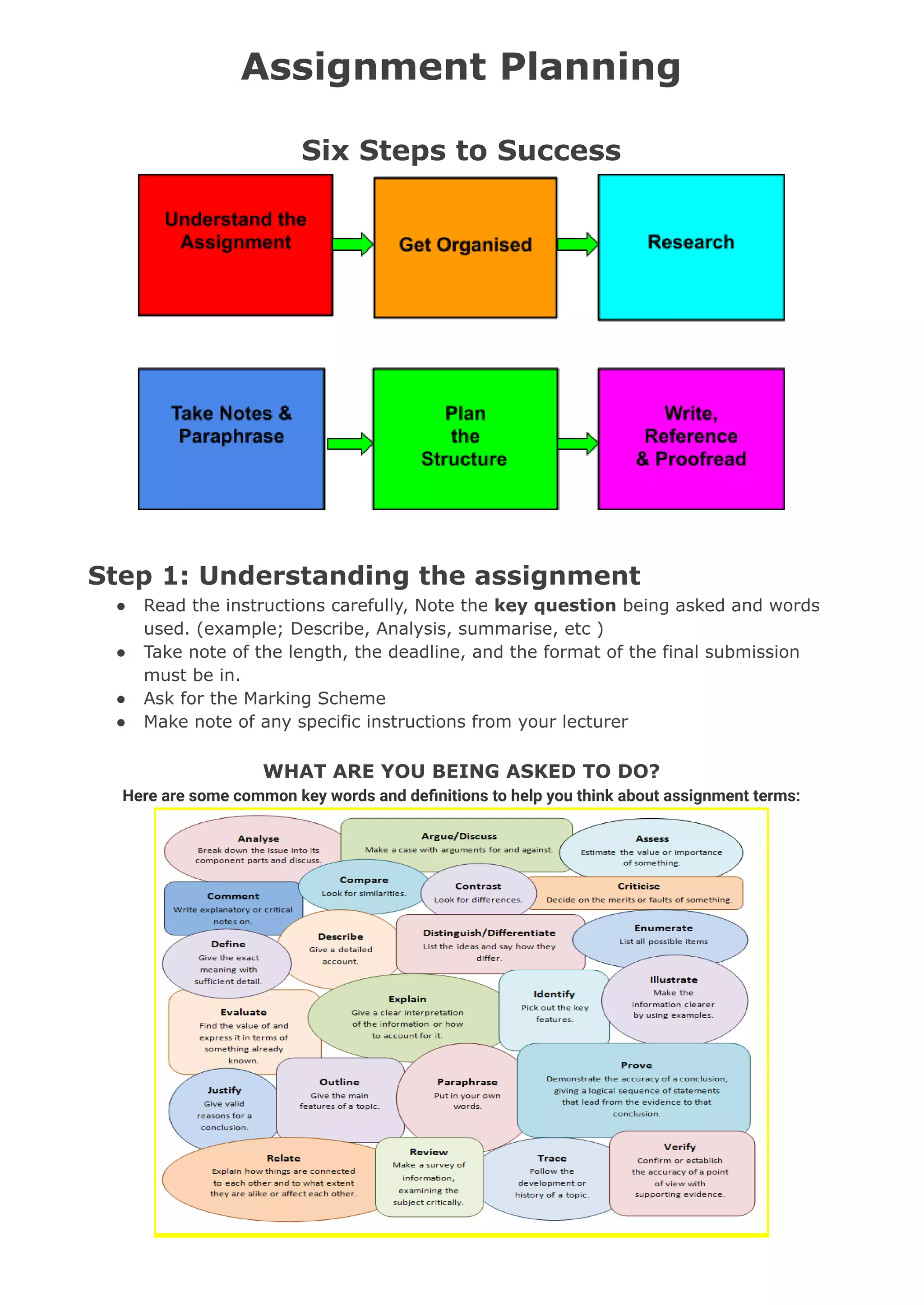
Six Steps to Success
Step 1: Understanding the assignment
● Read the instructions carefully, Note the key question being asked and words
used. (example; Describe, Analysis, summarise, etc )
● Take note of the length, the deadline, and the format of the final submission
must be in.
● Ask for the Marking Scheme
● Make note of any specific instructions from your lecturer
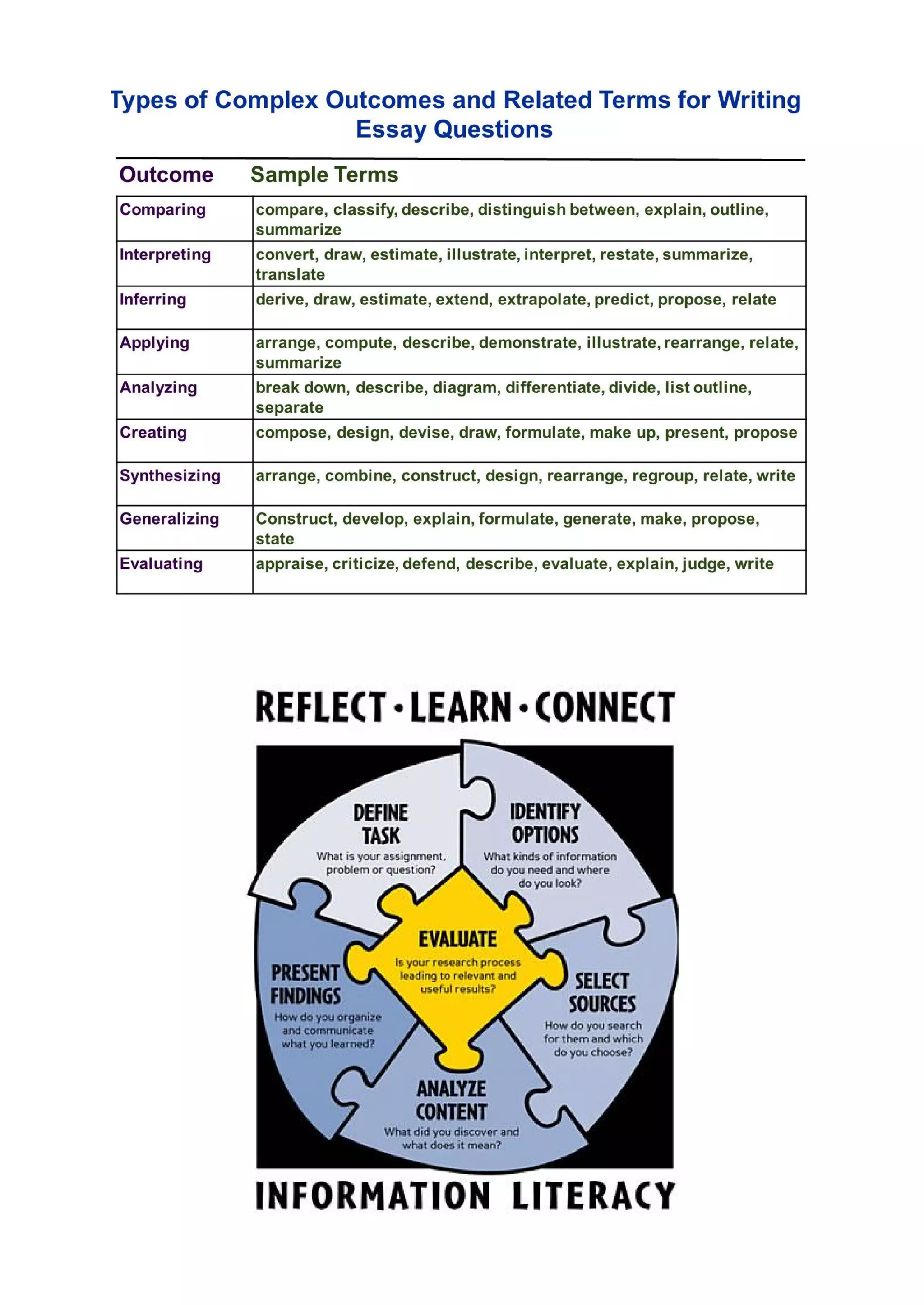
WHAT ARE YOU BEING ASKED TO DO?
Here are some common key words and definitions to help you think about assignment terms:
Step 2 Get Organised
● Assess the Reading list
● Timeframe: 2 hours a week on each assignment
● Reserve books / look at databases
● Reread the assignment: What is the tutor looking for? If unsure email
the tutor to clarify.
● Folders: Online and notes etc
Step 3 Research
● Read the assignment text - ---- Get an Overview ----Reread and
underline keywords and summarise the central question in your own
words
● Create Mind Maps using keywords on the topic and expand
● These keywords will become your search terms when using the
databases and catalogue in the library
● Keywords are the main ideas central to the question that you are trying
to answer. They give direction for your search & provide boundaries. The
example below demonstrates the selection of keywords from a question.
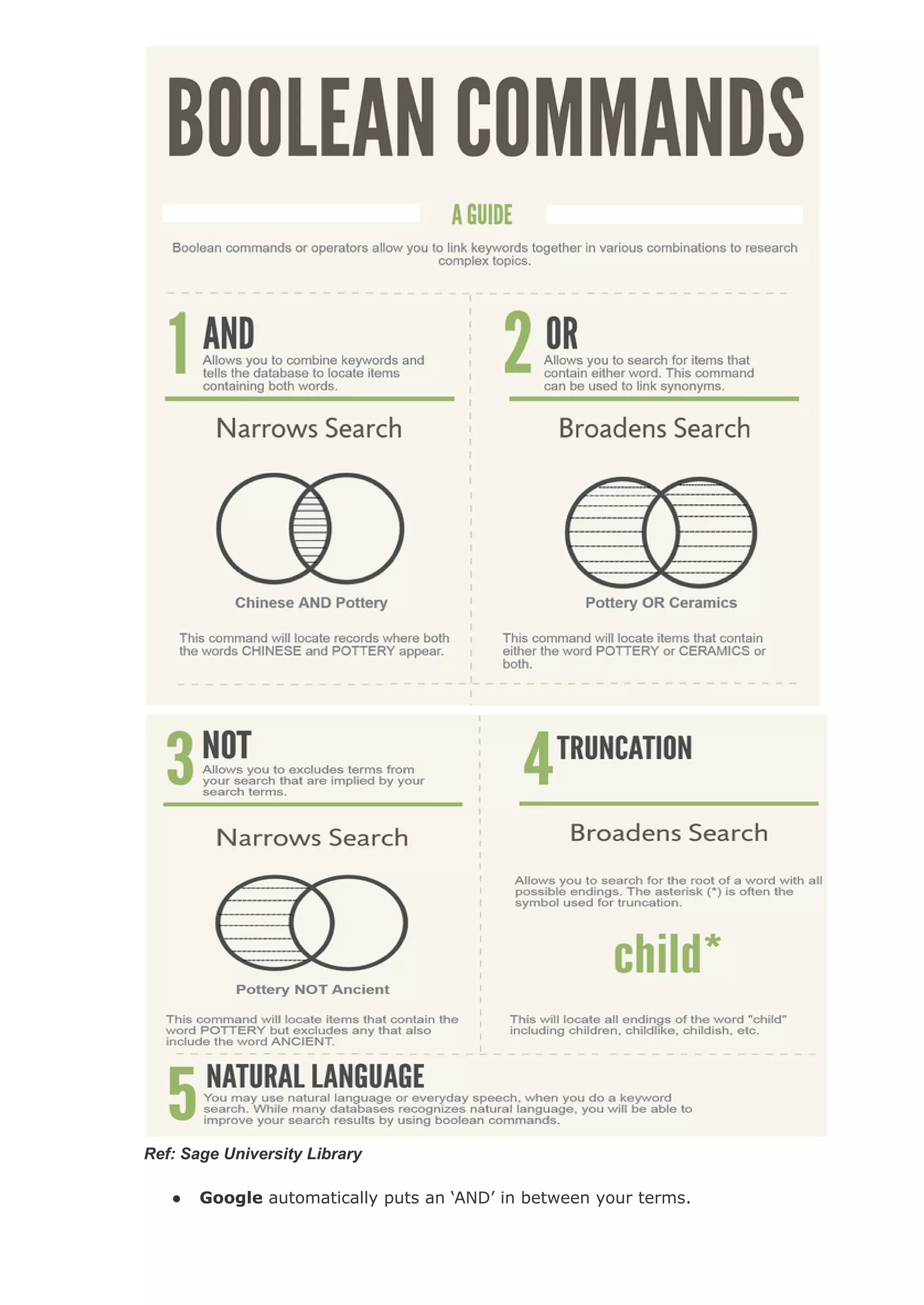
Search Strategies: Boolean Commands for Keywords
- What words MUST be included in the search? What words MIGHT be included in
the search? What words SHOULD NOT be included in the search?
AND - OR - NOT
Example
Question: What are the key concepts explored in Nan Goldin’s photography from a
feminist perspective?
Keywords: Nan Goldin AND Photography AND Feminism OR Feminist
Ref: Sage University Library
● Google automatically puts an ‘AND’ in between your terms.
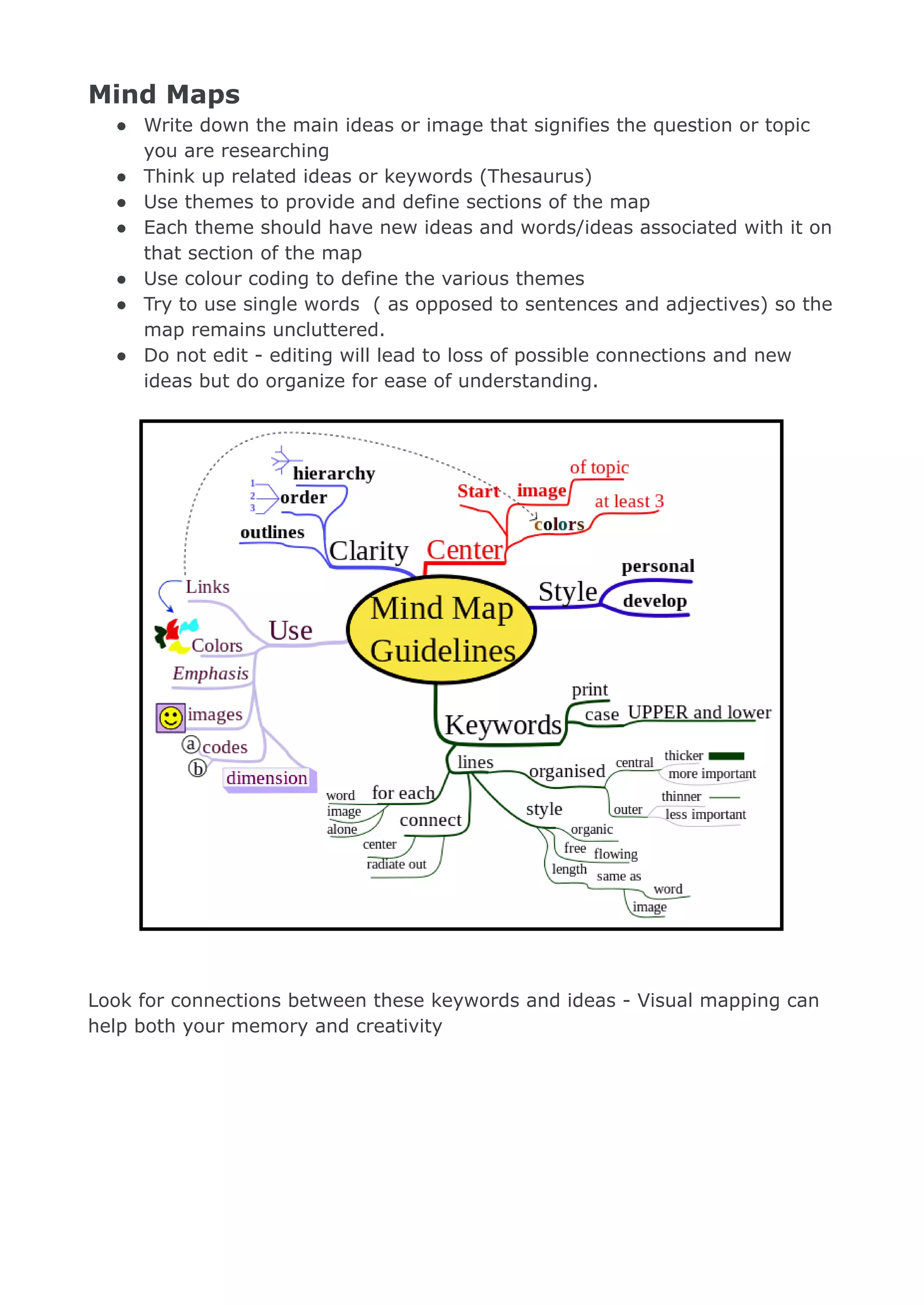
Mind Maps
● Write down the main ideas or image that signifies the question or topic
you are researching
● Think up related ideas or keywords (Thesaurus)
● Use themes to provide and define sections of the map
● Each theme should have new ideas and words/ideas associated with it on
that section of the map
● Use colour coding to define the various themes
● Try to use single words ( as opposed to sentences and adjectives) so the
map remains uncluttered.
● Do not edit - editing will lead to loss of possible connections and new
ideas but do organize for ease of understanding.
Look for connections between these keywords and ideas - Visual mapping can
help both your memory and creativity
Step 4. Find Resources
● Begin with the library sources on hand: Books, Journals, etc (Search the
Library Catalogue)
● Then use the ‘Subject guides’ option on the Library website and search
the Library databases for content relevant to your topic.
● It’s important to use information that is accurate and reliable – it’s not
just about Google!
● Not expected to read everything - be selective, by knowing what you are
being asked (Time-saving)
● Collect citations and references
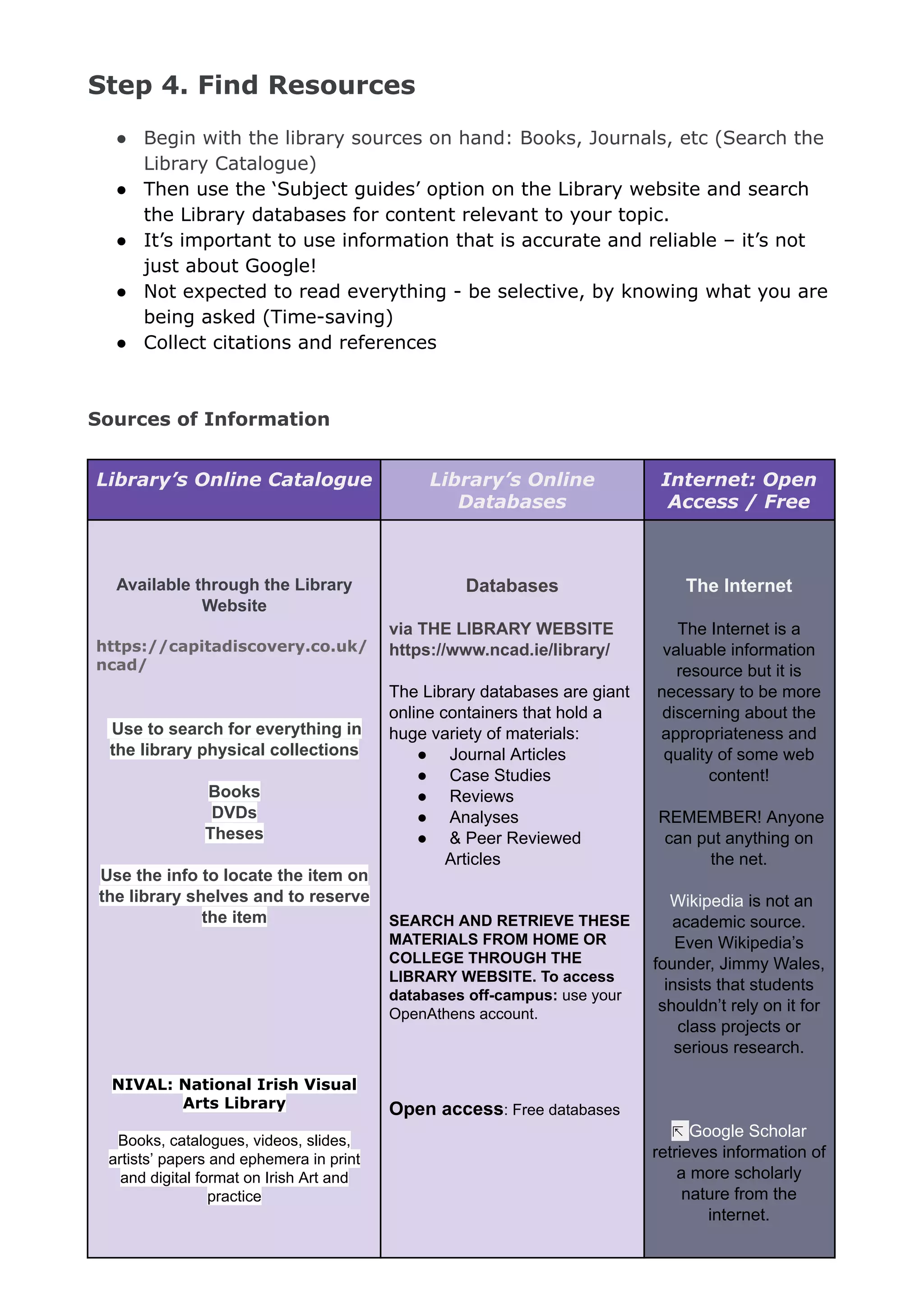
Sources of Information
Library’s Online Catalogue Library’s Online
Databases
Internet: Open
Access / Free
Available through the Library
Website
https://capitadiscovery.co.uk/
ncad/
Use to search for everything in
the library physical collections
Books
DVDs
Theses
Use the info to locate the item on
the library shelves and to reserve
the item
NIVAL: National Irish Visual
Arts Library
Books, catalogues, videos, slides,
artists’ papers and ephemera in print
and digital format on Irish Art and
practice
Databases
via THE LIBRARY WEBSITE
https://www.ncad.ie/library/
The Library databases are giant
online containers that hold a
huge variety of materials:
● Journal Articles
● Case Studies
● Reviews
● Analyses
● & Peer Reviewed
Articles
SEARCH AND RETRIEVE THESE
MATERIALS FROM HOME OR
COLLEGE THROUGH THE
LIBRARY WEBSITE. To access
databases off-campus: use your
OpenAthens account.
Open access: Free databases
The Internet
The Internet is a
valuable information
resource but it is
necessary to be more
discerning about the
appropriateness and
quality of some web
content!
REMEMBER! Anyone
can put anything on
the net.
Wikipedia is not an
academic source.
Even Wikipedia’s
founder, Jimmy Wales,
insists that students
shouldn’t rely on it for
class projects or
serious research.
⇱ Google Scholar
retrieves information of
a more scholarly
nature from the
internet.
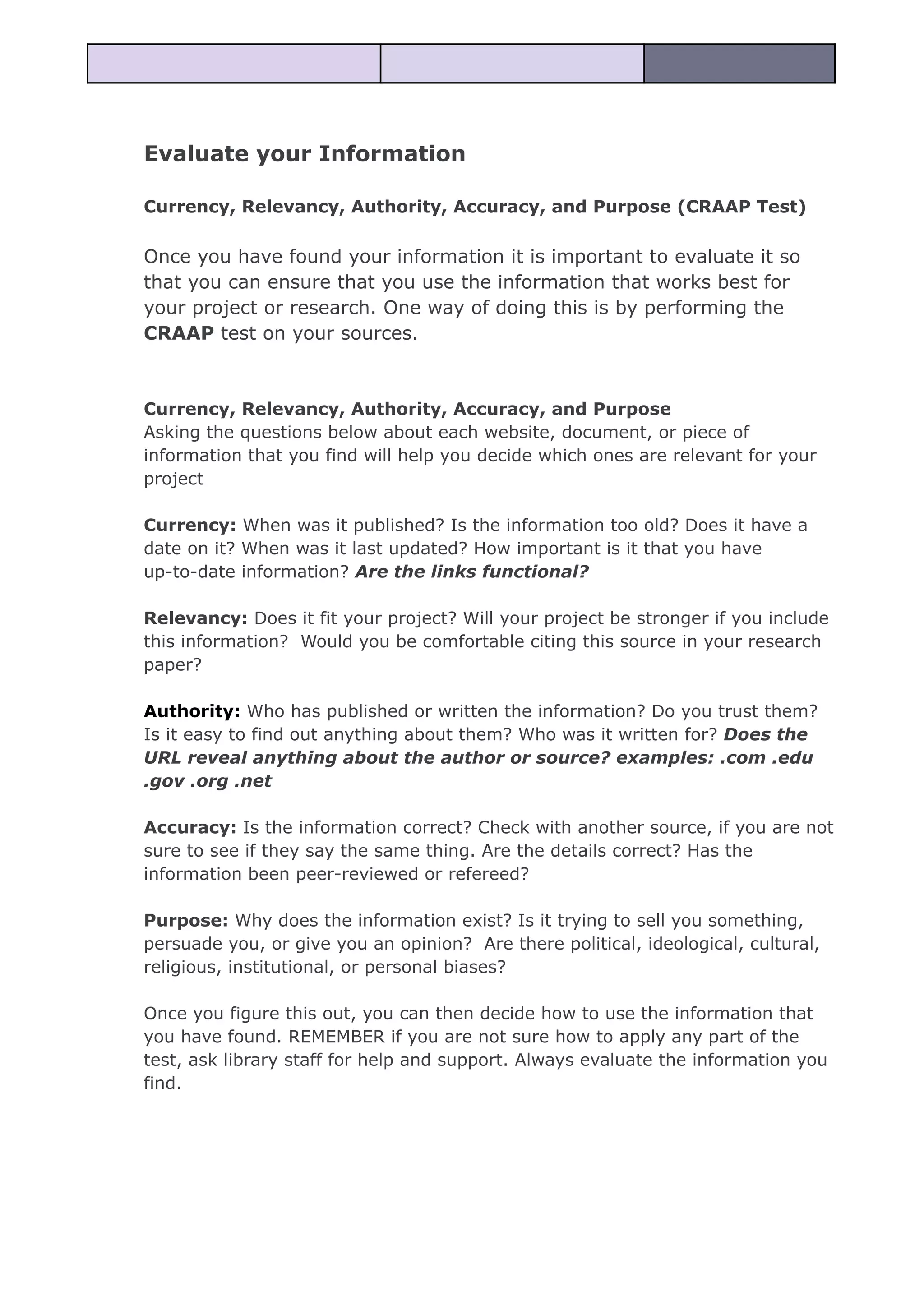
Evaluate your Information
Currency, Relevancy, Authority, Accuracy, and Purpose (CRAAP Test)
Once you have found your information it is important to evaluate it so
that you can ensure that you use the information that works best for
your project or research. One way of doing this is by performing the
CRAAP test on your sources.
Currency, Relevancy, Authority, Accuracy, and Purpose
Asking the questions below about each website, document, or piece of
information that you find will help you decide which ones are relevant for your
project
Currency: When was it published? Is the information too old? Does it have a
date on it? When was it last updated? How important is it that you have
up-to-date information? Are the links functional?
Relevancy: Does it fit your project? Will your project be stronger if you include
this information? Would you be comfortable citing this source in your research
paper?
Authority: Who has published or written the information? Do you trust them?
Is it easy to find out anything about them? Who was it written for? Does the
URL reveal anything about the author or source? examples: .com .edu
.gov .org .net
Accuracy: Is the information correct? Check with another source, if you are not
sure to see if they say the same thing. Are the details correct? Has the
information been peer-reviewed or refereed?
Purpose: Why does the information exist? Is it trying to sell you something,
persuade you, or give you an opinion? Are there political, ideological, cultural,
religious, institutional, or personal biases?
Once you figure this out, you can then decide how to use the information that
you have found. REMEMBER if you are not sure how to apply any part of the
test, ask library staff for help and support. Always evaluate the information you
find.
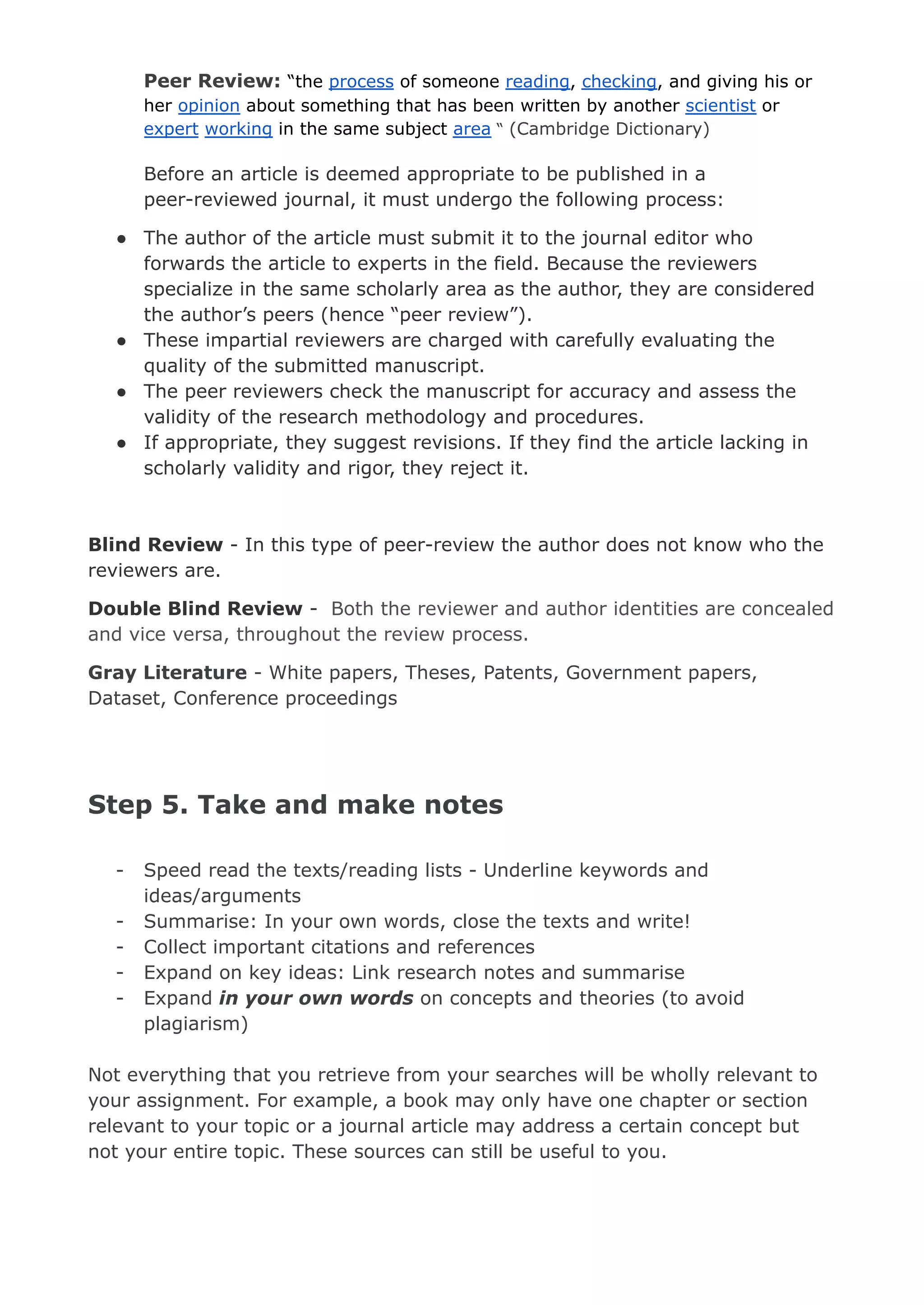
Peer Review: “the process of someone reading, checking, and giving his or
her opinion about something that has been written by another scientist or
expert working in the same subject area “ (Cambridge Dictionary)
Before an article is deemed appropriate to be published in a
peer-reviewed journal, it must undergo the following process:
● The author of the article must submit it to the journal editor who
forwards the article to experts in the field. Because the reviewers
specialize in the same scholarly area as the author, they are considered
the author’s peers (hence “peer review”).
● These impartial reviewers are charged with carefully evaluating the
quality of the submitted manuscript.
● The peer reviewers check the manuscript for accuracy and assess the
validity of the research methodology and procedures.
● If appropriate, they suggest revisions. If they find the article lacking in
scholarly validity and rigor, they reject it.
Blind Review - In this type of peer-review the author does not know who the
reviewers are.
Double Blind Review - Both the reviewer and author identities are concealed
and vice versa, throughout the review process.
Gray Literature - White papers, Theses, Patents, Government papers,
Dataset, Conference proceedings
Step 5. Take and make notes
- Speed read the texts/reading lists - Underline keywords and
ideas/arguments
- Summarise: In your own words, close the texts and write!
- Collect important citations and references
- Expand on key ideas: Link research notes and summarise
- Expand in your own words on concepts and theories (to avoid
plagiarism)
Not everything that you retrieve from your searches will be wholly relevant to
your assignment. For example, a book may only have one chapter or section
relevant to your topic or a journal article may address a certain concept but
not your entire topic. These sources can still be useful to you.
ACTIVE READING
When reading the text you should take notes from it that relate to your
assignment.
This is called Active Reading:
1. If the text is very difficult to understand read it through once to get a
general idea of the content.
2. Then, on a second reading underline key phrases (NOT if it’s a Library
book!) and/or write down notes on your notepad.
3. Take notes from it in the form of keywords. These keywords are the
building blocks for your paraphrased version of the original text.
4. Make sure you write down the bibliographic details (e.g. author and page
no.) as you will need this for your reference.
5. The key is to extract information or evidence from the source which will help
you to fulfil the assignment brief.
Step 6. Write Assignment
Before a builder begins to build a house before he even digs the foundation, he
creates a blueprint or plan. This blueprint allows him to know exactly how he
should proceed in order to build a strong and steady house. You should
approach your essay in the same way. Before you begin writing, plan the
structure of your essay - from your introduction to the description and
analysis of the topic, right through to the conclusion.
Rough outline of essay
All essays should conform to the basic structure of 1. Introduction 2. The main
body of essay 3. Conclusion
INTRODUCTION
•Plan a stylish opening.
•Basic Opening: 'This essay examines excessive alcohol consumption in
Ireland today.'
•Stylish Opening: 'A recent EU survey highlights Ireland as the number one
binge drinking nation in Europe, with 34% of Irish respondents admitting to
drinking five or more drinks in every session.' (European Commission, 2009)
•HOOK THE READER!
• Essay Outline - introduce each of the concepts which you discuss in the
main body.
• Brief Summary - how you are going to answer the question - introduce it at
this point, do not address it.
MAIN BODY OF ESSAY
•Define the concept - quote or paraphrase accepted definitions,
e.g. If you are writing an essay on 'Services Marketing', what does the
phrase mean?
•Put it in context with other research - for example, describe
the progression of the topic - from initial research to the most recent
studies.
•Analyse - answer the essay question.
• Use Research to back up your argument.
CONCLUSION
•Sum up the information and research supplied in the essay.
•Provide a concrete answer to the question posed in the essay.
•Conclude with a stylish sentence or two. Your lecturer is about to mark your
essay! Don’t leave it hanging in midair.
Planning the ‘Main Body’ of your Essay
● Divide it into paragraphs – one main idea per paragraph. For the
purpose of planning, invent temporary headings for your paragraphs,
just to show at this stage how your argument will progress.
● Try out different arrangements of your argument.
● All the major points in your argument must be supported by evidence.
● At this point you should plan where each of your notes & quotes would
be best used.
● Note the referencing details of each one.
Step 6 – Write, reference & proofread
AVOIDING PLAGIARISM
When you use the words or ideas from another person’s work, reference it!
● Be consistent in your referencing.
● Be aware of which referencing style you should use & follow the format
set out: Harvard.
● When paraphrasing, make sure you completely re-write the original text
in your own words.
● Take notes or keywords from the original.
● Put the original text away and re-write in your own words using your
notes. Always reference the original.
EXAMPLE OF GOOD & BAD PARAPHRASING
Original text: Global warming affects most people in the world, especially those
living in low-lying areas near the sea. It has been predicted that the melting of
polar ice may cause the sea to rise by as much as twelve metres by 2050.
Bad Paraphrasing - PLAGIARISM Global warming affects a lot of people
across the world, in particular people living near the sea. Experts predict that
the melting ice of the poles will result in the sea rising by as much as twelve
metres by 2050 (Murphy, 2010).
Good Paraphrasing - NOT PLAGIARISM The increasing temperature of the
earth’s climate, known as global warming, is causing the polar ice caps to melt.
The effects of this are felt worldwide but people who live at sea level are at
particular risk due to rising sea levels, which have been calculated to rise by at
least twelve metres in the next forty years (Murphy, 2010, p. 26).
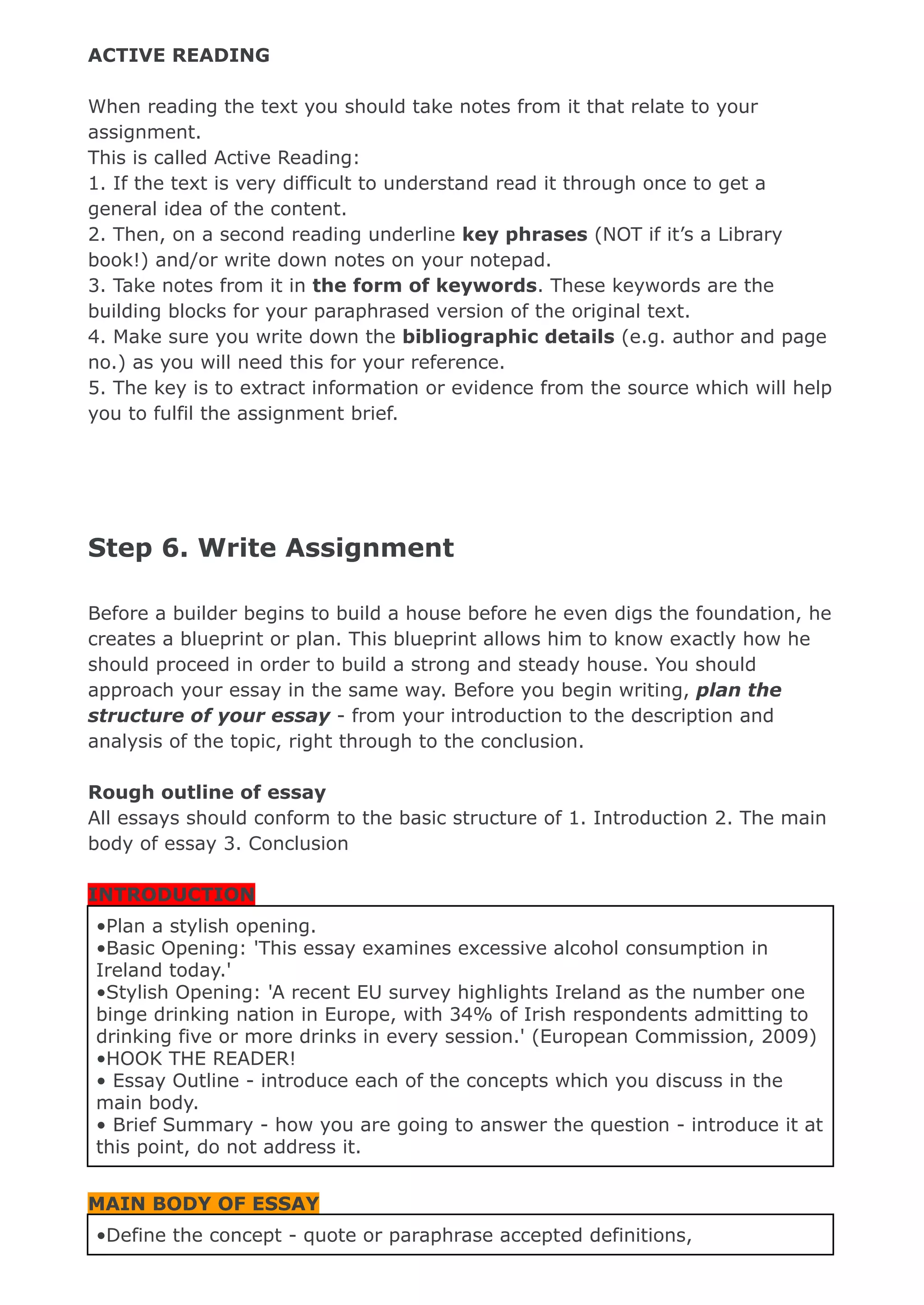
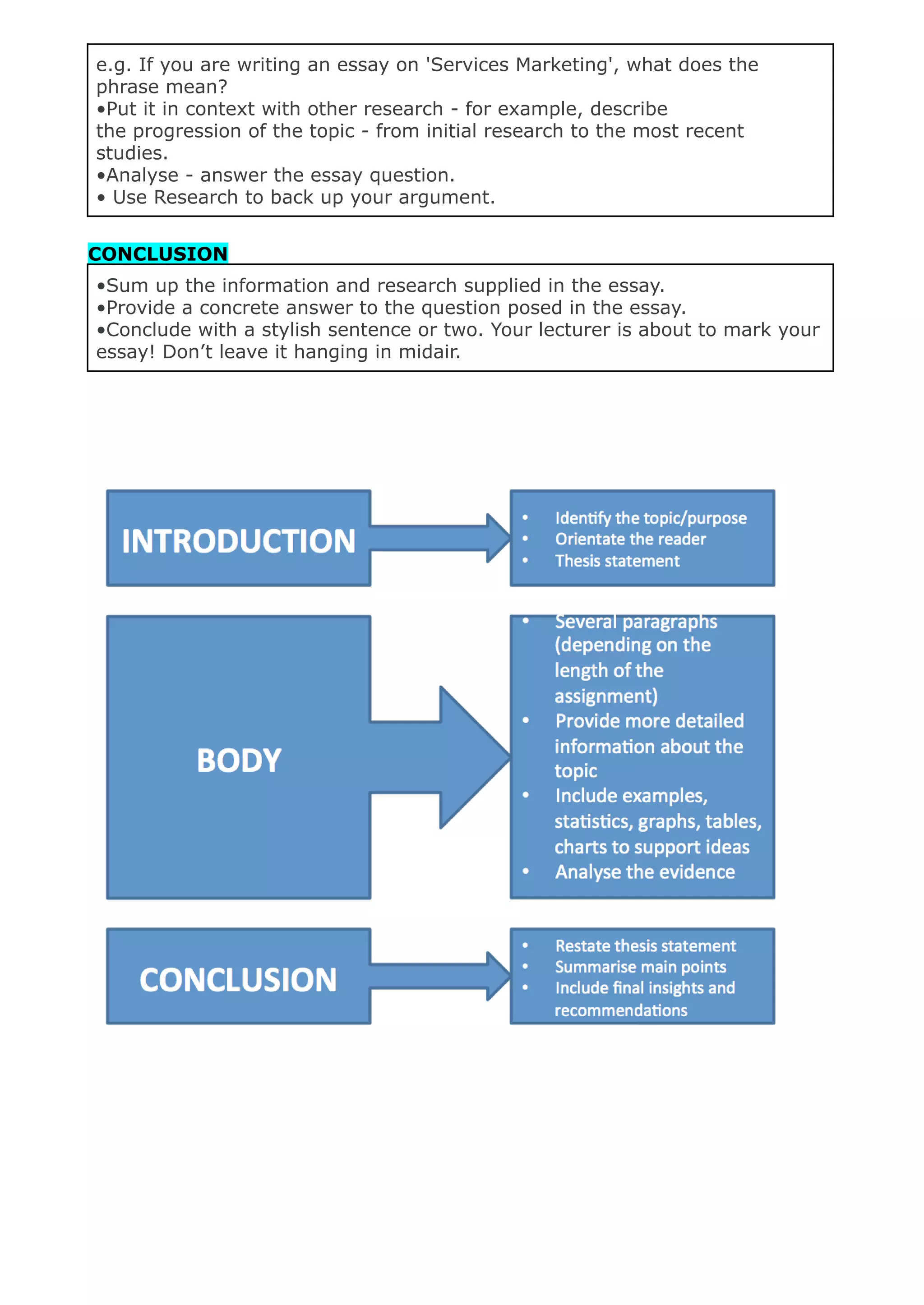
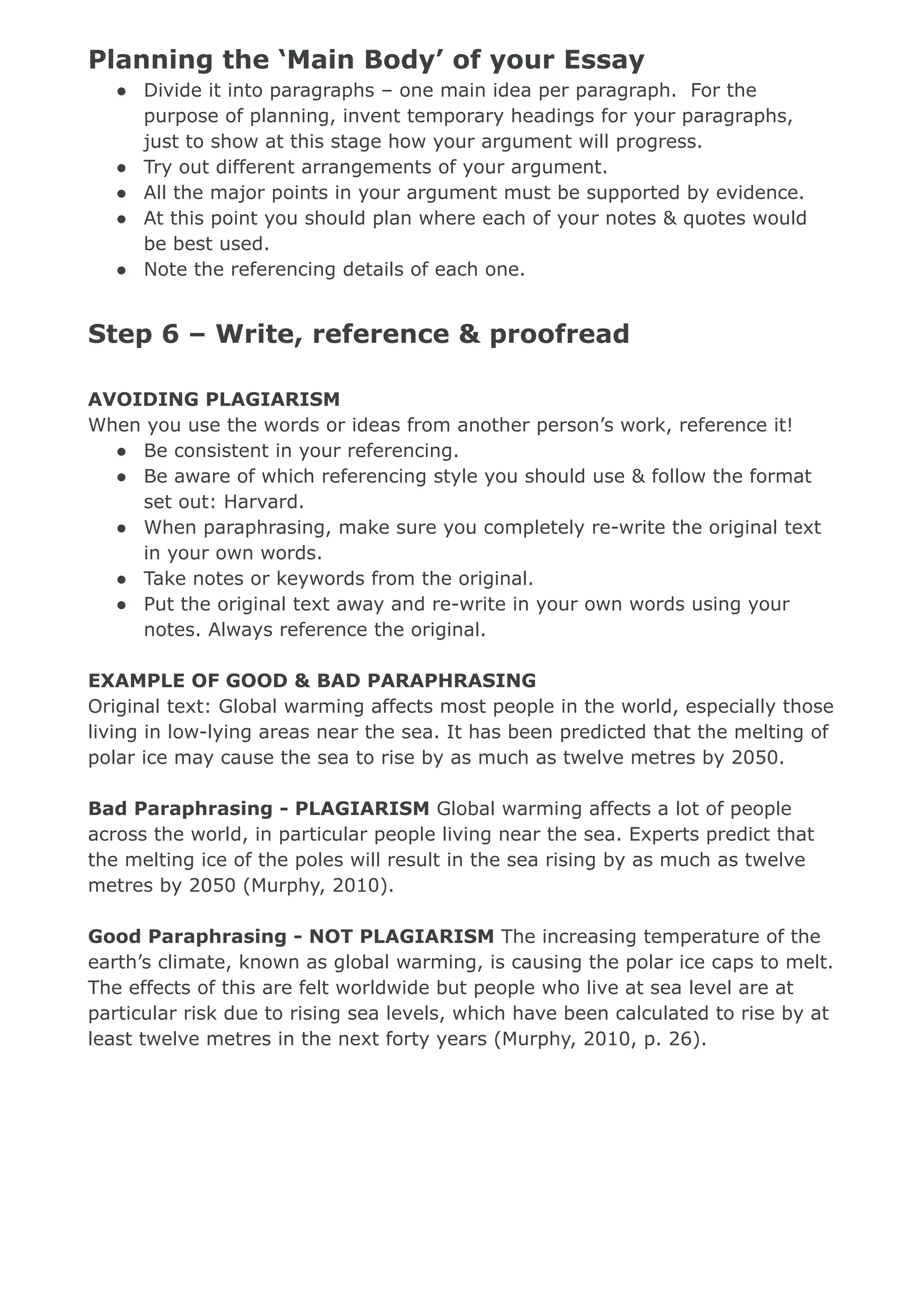
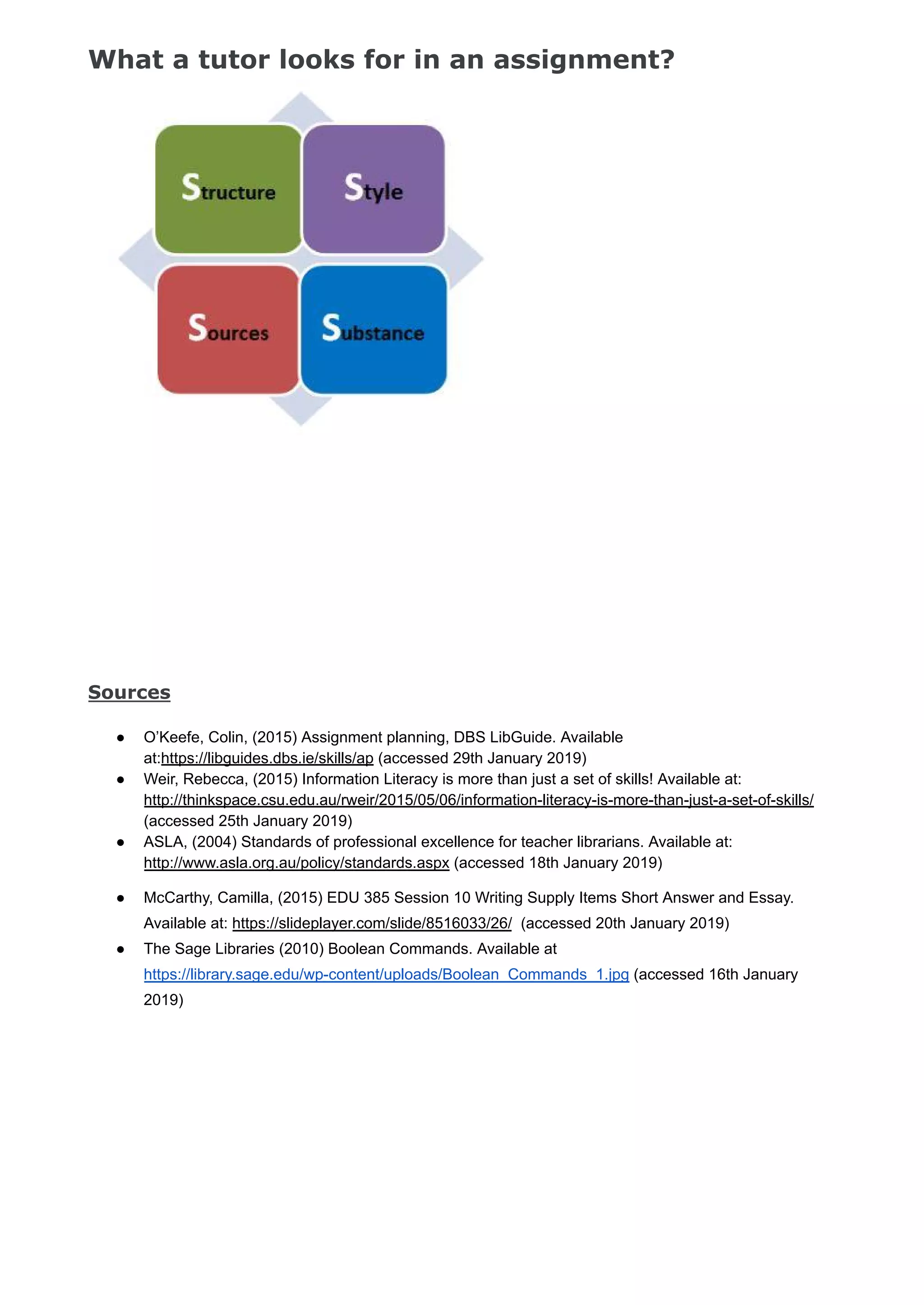
What a tutor looks for in an assignment?
Sources
● O’Keefe, Colin, (2015) Assignment planning, DBS LibGuide. Available
at:https://libguides.dbs.ie/skills/ap (accessed 29th January 2019)
● Weir, Rebecca, (2015) Information Literacy is more than just a set of skills! Available at:
http://thinkspace.csu.edu.au/rweir/2015/05/06/information-literacy-is-more-than-just-a-set-of-skills/
(accessed 25th January 2019)
● ASLA, (2004) Standards of professional excellence for teacher librarians. Available at:
http://www.asla.org.au/policy/standards.aspx (accessed 18th January 2019)
● McCarthy, Camilla, (2015) EDU 385 Session 10 Writing Supply Items Short Answer and Essay.
Available at: https://slideplayer.com/slide/8516033/26/ (accessed 20th January 2019)
● The Sage Libraries (2010) Boolean Commands. Available at
https://library.sage.edu/wp-content/uploads/Boolean_Commands_1.jpg (accessed 16th January
2019)

Assignment Planning for Undergraduates .pdf

  • 1.
    Assignment Planning Six Stepsto Success Step 1: Understanding the assignment ● Read the instructions carefully, Note the key question being asked and words used. (example; Describe, Analysis, summarise, etc ) ● Take note of the length, the deadline, and the format of the final submission must be in. ● Ask for the Marking Scheme ● Make note of any specific instructions from your lecturer WHAT ARE YOU BEING ASKED TO DO? Here are some common key words and definitions to help you think about assignment terms:
  • 3.
    Step 2 GetOrganised ● Assess the Reading list ● Timeframe: 2 hours a week on each assignment ● Reserve books / look at databases ● Reread the assignment: What is the tutor looking for? If unsure email the tutor to clarify. ● Folders: Online and notes etc Step 3 Research ● Read the assignment text - ---- Get an Overview ----Reread and underline keywords and summarise the central question in your own words ● Create Mind Maps using keywords on the topic and expand ● These keywords will become your search terms when using the databases and catalogue in the library ● Keywords are the main ideas central to the question that you are trying to answer. They give direction for your search & provide boundaries. The example below demonstrates the selection of keywords from a question. Search Strategies: Boolean Commands for Keywords - What words MUST be included in the search? What words MIGHT be included in the search? What words SHOULD NOT be included in the search? AND - OR - NOT Example Question: What are the key concepts explored in Nan Goldin’s photography from a feminist perspective? Keywords: Nan Goldin AND Photography AND Feminism OR Feminist
  • 4.
    Ref: Sage UniversityLibrary ● Google automatically puts an ‘AND’ in between your terms.
  • 5.
    Mind Maps ● Writedown the main ideas or image that signifies the question or topic you are researching ● Think up related ideas or keywords (Thesaurus) ● Use themes to provide and define sections of the map ● Each theme should have new ideas and words/ideas associated with it on that section of the map ● Use colour coding to define the various themes ● Try to use single words ( as opposed to sentences and adjectives) so the map remains uncluttered. ● Do not edit - editing will lead to loss of possible connections and new ideas but do organize for ease of understanding. Look for connections between these keywords and ideas - Visual mapping can help both your memory and creativity
  • 6.
    Step 4. FindResources ● Begin with the library sources on hand: Books, Journals, etc (Search the Library Catalogue) ● Then use the ‘Subject guides’ option on the Library website and search the Library databases for content relevant to your topic. ● It’s important to use information that is accurate and reliable – it’s not just about Google! ● Not expected to read everything - be selective, by knowing what you are being asked (Time-saving) ● Collect citations and references Sources of Information Library’s Online Catalogue Library’s Online Databases Internet: Open Access / Free Available through the Library Website https://capitadiscovery.co.uk/ ncad/ Use to search for everything in the library physical collections Books DVDs Theses Use the info to locate the item on the library shelves and to reserve the item NIVAL: National Irish Visual Arts Library Books, catalogues, videos, slides, artists’ papers and ephemera in print and digital format on Irish Art and practice Databases via THE LIBRARY WEBSITE https://www.ncad.ie/library/ The Library databases are giant online containers that hold a huge variety of materials: ● Journal Articles ● Case Studies ● Reviews ● Analyses ● & Peer Reviewed Articles SEARCH AND RETRIEVE THESE MATERIALS FROM HOME OR COLLEGE THROUGH THE LIBRARY WEBSITE. To access databases off-campus: use your OpenAthens account. Open access: Free databases The Internet The Internet is a valuable information resource but it is necessary to be more discerning about the appropriateness and quality of some web content! REMEMBER! Anyone can put anything on the net. Wikipedia is not an academic source. Even Wikipedia’s founder, Jimmy Wales, insists that students shouldn’t rely on it for class projects or serious research. ⇱ Google Scholar retrieves information of a more scholarly nature from the internet.
  • 7.
    Evaluate your Information Currency,Relevancy, Authority, Accuracy, and Purpose (CRAAP Test) Once you have found your information it is important to evaluate it so that you can ensure that you use the information that works best for your project or research. One way of doing this is by performing the CRAAP test on your sources. Currency, Relevancy, Authority, Accuracy, and Purpose Asking the questions below about each website, document, or piece of information that you find will help you decide which ones are relevant for your project Currency: When was it published? Is the information too old? Does it have a date on it? When was it last updated? How important is it that you have up-to-date information? Are the links functional? Relevancy: Does it fit your project? Will your project be stronger if you include this information? Would you be comfortable citing this source in your research paper? Authority: Who has published or written the information? Do you trust them? Is it easy to find out anything about them? Who was it written for? Does the URL reveal anything about the author or source? examples: .com .edu .gov .org .net Accuracy: Is the information correct? Check with another source, if you are not sure to see if they say the same thing. Are the details correct? Has the information been peer-reviewed or refereed? Purpose: Why does the information exist? Is it trying to sell you something, persuade you, or give you an opinion? Are there political, ideological, cultural, religious, institutional, or personal biases? Once you figure this out, you can then decide how to use the information that you have found. REMEMBER if you are not sure how to apply any part of the test, ask library staff for help and support. Always evaluate the information you find.
  • 8.
    Peer Review: “theprocess of someone reading, checking, and giving his or her opinion about something that has been written by another scientist or expert working in the same subject area “ (Cambridge Dictionary) Before an article is deemed appropriate to be published in a peer-reviewed journal, it must undergo the following process: ● The author of the article must submit it to the journal editor who forwards the article to experts in the field. Because the reviewers specialize in the same scholarly area as the author, they are considered the author’s peers (hence “peer review”). ● These impartial reviewers are charged with carefully evaluating the quality of the submitted manuscript. ● The peer reviewers check the manuscript for accuracy and assess the validity of the research methodology and procedures. ● If appropriate, they suggest revisions. If they find the article lacking in scholarly validity and rigor, they reject it. Blind Review - In this type of peer-review the author does not know who the reviewers are. Double Blind Review - Both the reviewer and author identities are concealed and vice versa, throughout the review process. Gray Literature - White papers, Theses, Patents, Government papers, Dataset, Conference proceedings Step 5. Take and make notes - Speed read the texts/reading lists - Underline keywords and ideas/arguments - Summarise: In your own words, close the texts and write! - Collect important citations and references - Expand on key ideas: Link research notes and summarise - Expand in your own words on concepts and theories (to avoid plagiarism) Not everything that you retrieve from your searches will be wholly relevant to your assignment. For example, a book may only have one chapter or section relevant to your topic or a journal article may address a certain concept but not your entire topic. These sources can still be useful to you.
  • 9.
    ACTIVE READING When readingthe text you should take notes from it that relate to your assignment. This is called Active Reading: 1. If the text is very difficult to understand read it through once to get a general idea of the content. 2. Then, on a second reading underline key phrases (NOT if it’s a Library book!) and/or write down notes on your notepad. 3. Take notes from it in the form of keywords. These keywords are the building blocks for your paraphrased version of the original text. 4. Make sure you write down the bibliographic details (e.g. author and page no.) as you will need this for your reference. 5. The key is to extract information or evidence from the source which will help you to fulfil the assignment brief. Step 6. Write Assignment Before a builder begins to build a house before he even digs the foundation, he creates a blueprint or plan. This blueprint allows him to know exactly how he should proceed in order to build a strong and steady house. You should approach your essay in the same way. Before you begin writing, plan the structure of your essay - from your introduction to the description and analysis of the topic, right through to the conclusion. Rough outline of essay All essays should conform to the basic structure of 1. Introduction 2. The main body of essay 3. Conclusion INTRODUCTION •Plan a stylish opening. •Basic Opening: 'This essay examines excessive alcohol consumption in Ireland today.' •Stylish Opening: 'A recent EU survey highlights Ireland as the number one binge drinking nation in Europe, with 34% of Irish respondents admitting to drinking five or more drinks in every session.' (European Commission, 2009) •HOOK THE READER! • Essay Outline - introduce each of the concepts which you discuss in the main body. • Brief Summary - how you are going to answer the question - introduce it at this point, do not address it. MAIN BODY OF ESSAY •Define the concept - quote or paraphrase accepted definitions,
  • 10.
    e.g. If youare writing an essay on 'Services Marketing', what does the phrase mean? •Put it in context with other research - for example, describe the progression of the topic - from initial research to the most recent studies. •Analyse - answer the essay question. • Use Research to back up your argument. CONCLUSION •Sum up the information and research supplied in the essay. •Provide a concrete answer to the question posed in the essay. •Conclude with a stylish sentence or two. Your lecturer is about to mark your essay! Don’t leave it hanging in midair.
  • 11.
    Planning the ‘MainBody’ of your Essay ● Divide it into paragraphs – one main idea per paragraph. For the purpose of planning, invent temporary headings for your paragraphs, just to show at this stage how your argument will progress. ● Try out different arrangements of your argument. ● All the major points in your argument must be supported by evidence. ● At this point you should plan where each of your notes & quotes would be best used. ● Note the referencing details of each one. Step 6 – Write, reference & proofread AVOIDING PLAGIARISM When you use the words or ideas from another person’s work, reference it! ● Be consistent in your referencing. ● Be aware of which referencing style you should use & follow the format set out: Harvard. ● When paraphrasing, make sure you completely re-write the original text in your own words. ● Take notes or keywords from the original. ● Put the original text away and re-write in your own words using your notes. Always reference the original. EXAMPLE OF GOOD & BAD PARAPHRASING Original text: Global warming affects most people in the world, especially those living in low-lying areas near the sea. It has been predicted that the melting of polar ice may cause the sea to rise by as much as twelve metres by 2050. Bad Paraphrasing - PLAGIARISM Global warming affects a lot of people across the world, in particular people living near the sea. Experts predict that the melting ice of the poles will result in the sea rising by as much as twelve metres by 2050 (Murphy, 2010). Good Paraphrasing - NOT PLAGIARISM The increasing temperature of the earth’s climate, known as global warming, is causing the polar ice caps to melt. The effects of this are felt worldwide but people who live at sea level are at particular risk due to rising sea levels, which have been calculated to rise by at least twelve metres in the next forty years (Murphy, 2010, p. 26).
  • 12.
    What a tutorlooks for in an assignment? Sources ● O’Keefe, Colin, (2015) Assignment planning, DBS LibGuide. Available at:https://libguides.dbs.ie/skills/ap (accessed 29th January 2019) ● Weir, Rebecca, (2015) Information Literacy is more than just a set of skills! Available at: http://thinkspace.csu.edu.au/rweir/2015/05/06/information-literacy-is-more-than-just-a-set-of-skills/ (accessed 25th January 2019) ● ASLA, (2004) Standards of professional excellence for teacher librarians. Available at: http://www.asla.org.au/policy/standards.aspx (accessed 18th January 2019) ● McCarthy, Camilla, (2015) EDU 385 Session 10 Writing Supply Items Short Answer and Essay. Available at: https://slideplayer.com/slide/8516033/26/ (accessed 20th January 2019) ● The Sage Libraries (2010) Boolean Commands. Available at https://library.sage.edu/wp-content/uploads/Boolean_Commands_1.jpg (accessed 16th January 2019)