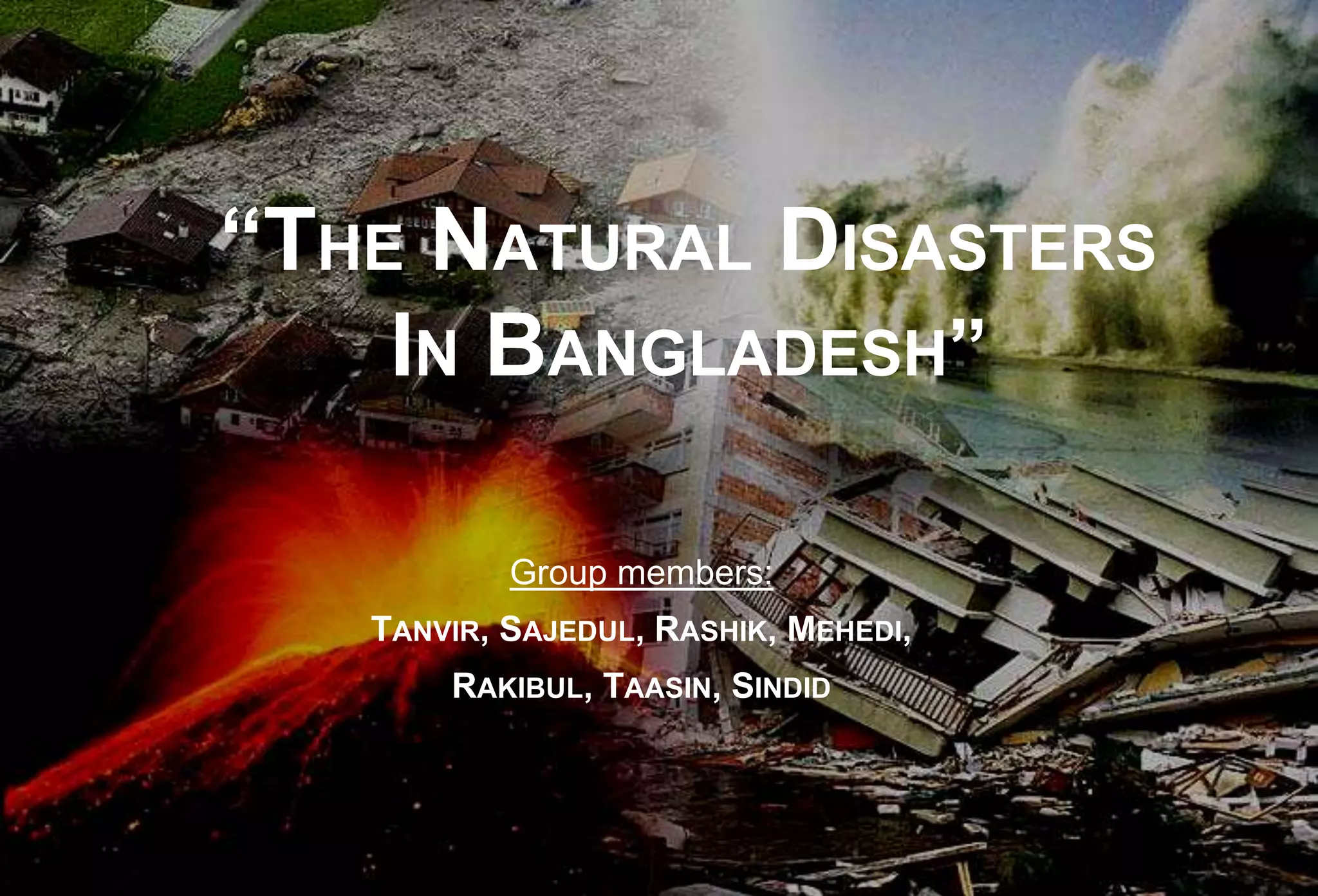

“THE NATURAL DISASTERS
IN BANGLADESH”
Group members:
TANVIR, SAJEDUL, RASHIK, MEHEDI,
RAKIBUL, TAASIN, SINDID
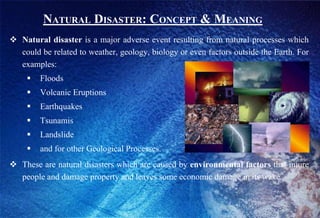
 Natural disaster is a major adverse event resulting from natural processes which
could be related to weather, geology, biology or even factors outside the Earth. For
examples:
 Floods
 Volcanic Eruptions
 Earthquakes
 Tsunamis
 Landslide
 and for other Geological Processes.
 These are natural disasters which are caused by environmental factors that injure
people and damage property and leaves some economic damage in its wake.
NATURAL DISASTER: CONCEPT & MEANING
NATURAL DISASTERS IN BANGLADESH
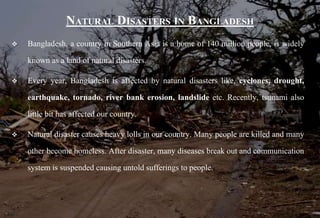
 Bangladesh, a country in Southern Asia is a home of 140 million people, is widely
known as a land of natural disasters.
 Every year, Bangladesh is affected by natural disasters like, cyclones, drought,
earthquake, tornado, river bank erosion, landslide etc. Recently, tsunami also
little bit has affected our country.
 Natural disaster causes heavy lolls in our country. Many people are killed and many
other become homeless. After disaster, many diseases break out and communication
system is suspended causing untold sufferings to people.
FLOOD
 The flood is an overflow of a large amount of water beyond its normal limits,
especially over what is normally dry land. Floods are the most significant natural
hazard in Bangladesh causing extensive damage to human life and property.
 The major floods that occurred in 1954, 1955, 1974, 1984, 1987, 1988, 1993, 1998,
1999, 2000 and 2007 have been very destructive and caused serious threat to lives and
economy. Floods hit our country during the rainy season when there is excessive
rainfall. The country lies on the downstream part of three major river
basins: Brahmaputra, Ganges and Meghna and thus is frequently flooded.
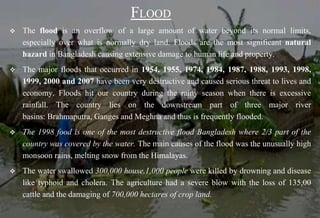
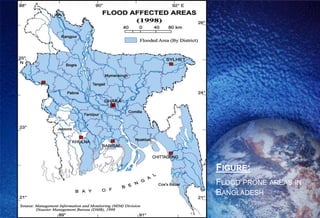
 The 1998 food is one of the most destructive flood Bangladesh where 2/3 part of the
country was covered by the water. The main causes of the flood was the unusually high
monsoon rains, melting snow from the Himalayas.
 The water swallowed 300,000 house,1,000 people were killed by drowning and disease
like typhoid and cholera. The agriculture had a severe blow with the loss of 135,00
cattle and the damaging of 700,000 hectares of crop land.
FIGURE:
FLOOD PRONE AREAS IN
BANGLADESH
CYCLONE
 Cyclone is the system of winds rotating inwards to an area of low barometric
pressure, with an anticlockwise (northern hemisphere) or clockwise (southern
hemisphere) circulation.
 Cyclones, sometimes associated with storm surge have been a cause of concern
for Bangladesh.
 In 1991, Bangladesh cyclone was among the deadliest tropical cyclones on record.
On the night of April 29th a powerful cyclone struck the Chittagong district of
southeastern Bangladesh with winds of around 250 km/h. The storm forced 20ft.
Storm surge inland over a wide area, killing at least 138,000 people and leaving as
many as 10 million homeless.
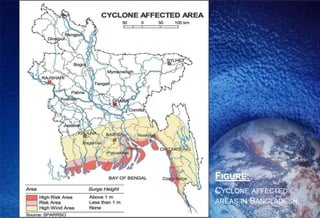
 In Bangladesh nearly 4,641,060 people are exposed in areas under the threat of
cyclones; ranking it 6th among the 89 countries analysed.
FIGURE:
CYCLONE AFFECTED
AREAS IN BANGLADESH
LANDSLIDE
❖ Landslide is the collapse of a mass of earth or rock from a mountain or cliff. Recently
landslide has emerged as a major hazard, particularly after the Chittagong Landslide
2007.
❖ Due to heavy rainfall during 10 -11 June 2007, landslides and collapsed walls caused
widespread damages in six areas of Chittagong city and in different Upazilas of the
District. 50mm of rainfall was recorded from 12:00 AM on 10 June 2007 to 6:00 AM
on 11 June 2007, and 315mm of rainfall was recorded from 6:00am to 2:00 PM on 11
June 2007.
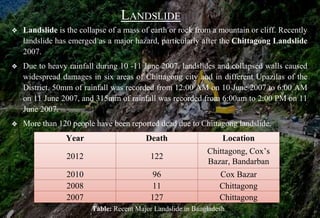
❖ More than 120 people have been reported dead due to Chittagong landslide.
Table: Recent Major Landslide in Bangladesh
Year Death Location
2012 122
Chittagong, Cox’s
Bazar, Bandarban
2010 96 Cox Bazar
2008 11 Chittagong
2007 127 Chittagong
EARTHQUAKE
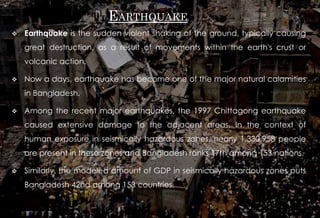
 Earthquake is the sudden violent shaking of the ground, typically causing
great destruction, as a result of movements within the earth's crust or
volcanic action.
 Now a days, earthquake has become one of the major natural calamities
in Bangladesh.
 Among the recent major earthquakes, the 1997 Chittagong earthquake
caused extensive damage to the adjacent areas. In the context of
human exposure in seismically hazardous zones, nearly 1,330,958 people
are present in these zones and Bangladesh ranks 17th among 153 nations.
 Similarly, the modeled amount of GDP in seismically hazardous zones puts
Bangladesh 42nd among 153 countries.
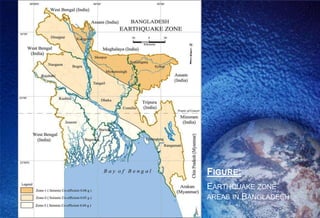
FIGURE:
EARTHQUAKE ZONE
AREAS IN BANGLADESH
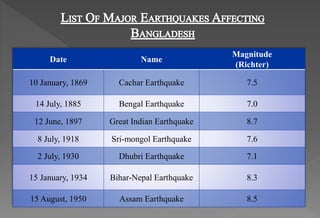
Date Name
Magnitude
(Richter)
10 January, 1869 Cachar Earthquake 7.5
14 July, 1885 Bengal Earthquake 7.0
12 June, 1897 Great Indian Earthquake 8.7
8 July, 1918 Sri-mongol Earthquake 7.6
2 July, 1930 Dhubri Earthquake 7.1
15 January, 1934 Bihar-Nepal Earthquake 8.3
15 August, 1950 Assam Earthquake 8.5
DROUGHT
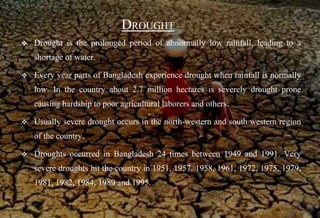
 Drought is the prolonged period of abnormally low rainfall, leading to a
shortage of water.
 Every year parts of Bangladesh experience drought when rainfall is normally
low. In the country about 2.7 million hectares is severely drought prone
causing hardship to poor agricultural laborers and others.
 Usually severe drought occurs in the north-western and south western region
of the country.
 Droughts occurred in Bangladesh 24 times between 1949 and 1991. Very
severe droughts hit the country in 1951, 1957, 1958, 1961, 1972, 1975, 1979,
1981, 1982, 1984, 1989 and 1995.
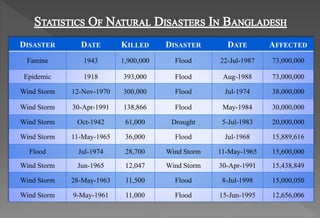
DISASTER DATE KILLED DISASTER DATE AFFECTED
Famine 1943 1,900,000 Flood 22-Jul-1987 73,000,000
Epidemic 1918 393,000 Flood Aug-1988 73,000,000
Wind Storm 12-Nov-1970 300,000 Flood Jul-1974 38,000,000
Wind Storm 30-Apr-1991 138,866 Flood May-1984 30,000,000
Wind Storm Oct-1942 61,000 Drought 5-Jul-1983 20,000,000
Wind Storm 11-May-1965 36,000 Flood Jul-1968 15,889,616
Flood Jul-1974 28,700 Wind Storm 11-May-1965 15,600,000
Wind Storm Jun-1965 12,047 Wind Storm 30-Apr-1991 15,438,849
Wind Storm 28-May-1963 11,500 Flood 8-Jul-1998 15,000,050
Wind Storm 9-May-1961 11,000 Flood 15-Jun-1995 12,656,006
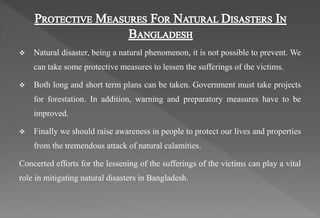
 Natural disaster, being a natural phenomenon, it is not possible to prevent. We
can take some protective measures to lessen the sufferings of the victims.
 Both long and short term plans can be taken. Government must take projects
for forestation. In addition, warning and preparatory measures have to be
improved.
 Finally we should raise awareness in people to protect our lives and properties
from the tremendous attack of natural calamities.
Concerted efforts for the lessening of the sufferings of the victims can play a vital
role in mitigating natural disasters in Bangladesh.
Natural disaster presentation

Natural disaster presentation

  • 1.
    “THE NATURAL DISASTERS INBANGLADESH” Group members: TANVIR, SAJEDUL, RASHIK, MEHEDI, RAKIBUL, TAASIN, SINDID
  • 2.
     Natural disasteris a major adverse event resulting from natural processes which could be related to weather, geology, biology or even factors outside the Earth. For examples:  Floods  Volcanic Eruptions  Earthquakes  Tsunamis  Landslide  and for other Geological Processes.  These are natural disasters which are caused by environmental factors that injure people and damage property and leaves some economic damage in its wake. NATURAL DISASTER: CONCEPT & MEANING
  • 3.
    NATURAL DISASTERS INBANGLADESH  Bangladesh, a country in Southern Asia is a home of 140 million people, is widely known as a land of natural disasters.  Every year, Bangladesh is affected by natural disasters like, cyclones, drought, earthquake, tornado, river bank erosion, landslide etc. Recently, tsunami also little bit has affected our country.  Natural disaster causes heavy lolls in our country. Many people are killed and many other become homeless. After disaster, many diseases break out and communication system is suspended causing untold sufferings to people.
  • 4.
    FLOOD  The floodis an overflow of a large amount of water beyond its normal limits, especially over what is normally dry land. Floods are the most significant natural hazard in Bangladesh causing extensive damage to human life and property.  The major floods that occurred in 1954, 1955, 1974, 1984, 1987, 1988, 1993, 1998, 1999, 2000 and 2007 have been very destructive and caused serious threat to lives and economy. Floods hit our country during the rainy season when there is excessive rainfall. The country lies on the downstream part of three major river basins: Brahmaputra, Ganges and Meghna and thus is frequently flooded.  The 1998 food is one of the most destructive flood Bangladesh where 2/3 part of the country was covered by the water. The main causes of the flood was the unusually high monsoon rains, melting snow from the Himalayas.  The water swallowed 300,000 house,1,000 people were killed by drowning and disease like typhoid and cholera. The agriculture had a severe blow with the loss of 135,00 cattle and the damaging of 700,000 hectares of crop land.
  • 5.
  • 6.
    CYCLONE  Cyclone isthe system of winds rotating inwards to an area of low barometric pressure, with an anticlockwise (northern hemisphere) or clockwise (southern hemisphere) circulation.  Cyclones, sometimes associated with storm surge have been a cause of concern for Bangladesh.  In 1991, Bangladesh cyclone was among the deadliest tropical cyclones on record. On the night of April 29th a powerful cyclone struck the Chittagong district of southeastern Bangladesh with winds of around 250 km/h. The storm forced 20ft. Storm surge inland over a wide area, killing at least 138,000 people and leaving as many as 10 million homeless.  In Bangladesh nearly 4,641,060 people are exposed in areas under the threat of cyclones; ranking it 6th among the 89 countries analysed.
  • 7.
  • 8.
    LANDSLIDE ❖ Landslide isthe collapse of a mass of earth or rock from a mountain or cliff. Recently landslide has emerged as a major hazard, particularly after the Chittagong Landslide 2007. ❖ Due to heavy rainfall during 10 -11 June 2007, landslides and collapsed walls caused widespread damages in six areas of Chittagong city and in different Upazilas of the District. 50mm of rainfall was recorded from 12:00 AM on 10 June 2007 to 6:00 AM on 11 June 2007, and 315mm of rainfall was recorded from 6:00am to 2:00 PM on 11 June 2007. ❖ More than 120 people have been reported dead due to Chittagong landslide. Table: Recent Major Landslide in Bangladesh Year Death Location 2012 122 Chittagong, Cox’s Bazar, Bandarban 2010 96 Cox Bazar 2008 11 Chittagong 2007 127 Chittagong
  • 9.
    EARTHQUAKE  Earthquake isthe sudden violent shaking of the ground, typically causing great destruction, as a result of movements within the earth's crust or volcanic action.  Now a days, earthquake has become one of the major natural calamities in Bangladesh.  Among the recent major earthquakes, the 1997 Chittagong earthquake caused extensive damage to the adjacent areas. In the context of human exposure in seismically hazardous zones, nearly 1,330,958 people are present in these zones and Bangladesh ranks 17th among 153 nations.  Similarly, the modeled amount of GDP in seismically hazardous zones puts Bangladesh 42nd among 153 countries.
  • 10.
  • 11.
    Date Name Magnitude (Richter) 10 January,1869 Cachar Earthquake 7.5 14 July, 1885 Bengal Earthquake 7.0 12 June, 1897 Great Indian Earthquake 8.7 8 July, 1918 Sri-mongol Earthquake 7.6 2 July, 1930 Dhubri Earthquake 7.1 15 January, 1934 Bihar-Nepal Earthquake 8.3 15 August, 1950 Assam Earthquake 8.5
  • 12.
    DROUGHT  Drought isthe prolonged period of abnormally low rainfall, leading to a shortage of water.  Every year parts of Bangladesh experience drought when rainfall is normally low. In the country about 2.7 million hectares is severely drought prone causing hardship to poor agricultural laborers and others.  Usually severe drought occurs in the north-western and south western region of the country.  Droughts occurred in Bangladesh 24 times between 1949 and 1991. Very severe droughts hit the country in 1951, 1957, 1958, 1961, 1972, 1975, 1979, 1981, 1982, 1984, 1989 and 1995.
  • 13.
    DISASTER DATE KILLEDDISASTER DATE AFFECTED Famine 1943 1,900,000 Flood 22-Jul-1987 73,000,000 Epidemic 1918 393,000 Flood Aug-1988 73,000,000 Wind Storm 12-Nov-1970 300,000 Flood Jul-1974 38,000,000 Wind Storm 30-Apr-1991 138,866 Flood May-1984 30,000,000 Wind Storm Oct-1942 61,000 Drought 5-Jul-1983 20,000,000 Wind Storm 11-May-1965 36,000 Flood Jul-1968 15,889,616 Flood Jul-1974 28,700 Wind Storm 11-May-1965 15,600,000 Wind Storm Jun-1965 12,047 Wind Storm 30-Apr-1991 15,438,849 Wind Storm 28-May-1963 11,500 Flood 8-Jul-1998 15,000,050 Wind Storm 9-May-1961 11,000 Flood 15-Jun-1995 12,656,006
  • 14.
     Natural disaster,being a natural phenomenon, it is not possible to prevent. We can take some protective measures to lessen the sufferings of the victims.  Both long and short term plans can be taken. Government must take projects for forestation. In addition, warning and preparatory measures have to be improved.  Finally we should raise awareness in people to protect our lives and properties from the tremendous attack of natural calamities. Concerted efforts for the lessening of the sufferings of the victims can play a vital role in mitigating natural disasters in Bangladesh.