





Programming for Evolutionary Biology
        March 17th - April 1st 2012
            Leipzig, Germany


Introduction to Unix systems
    Extra: awk and gawk
        Giovanni Marco Dall'Olio
        Universitat Pompeu Fabra
            Barcelona (Spain)
awk
   “awk” is a “swiss army” command line tool to 
      manipulate tabular files
   Things you can do with awk:
          Extract all the lines of a file that match a pattern, and 
            print only some of the columns (instead of “grep | 
            cut”)
          Add a prefix/suffix to all the element of a column 
            (instead of “cut | paste”)
          Sum values of different columsn
awk and gawk
   In these slides we will be talking about awk
   In reality, the original awk is not available 
      anymore. We will use gawk, a free version of 
      gawk developed by the GNU project
Basic awk usage
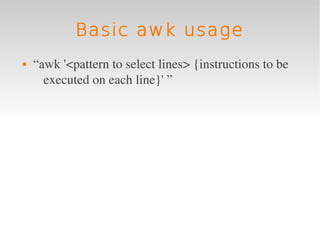
   “awk '<pattern to select lines> {instructions to be 
      executed on each line}' ” 
Example awk usage
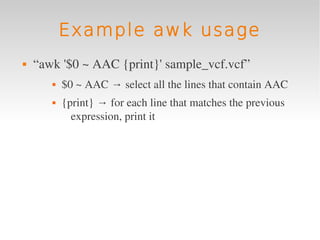
   “awk '$0 ~ AAC {print}' sample_vcf.vcf”
          $0 ~ AAC → select all the lines that contain AAC
          {print} → for each line that matches the previous 
             expression, print it
Column names in awk
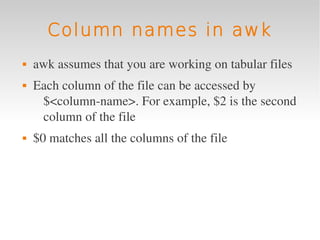
   awk assumes that you are working on tabular files
   Each column of the file can be accessed by 
     $<column­name>. For example, $2 is the second 
     column of the file
   $0 matches all the columns of the file
Accessing columns in awk
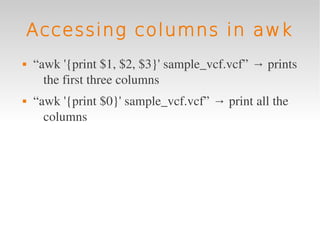
   “awk '{print $1, $2, $3}' sample_vcf.vcf” → prints 
      the first three columns
   “awk '{print $0}' sample_vcf.vcf” → print all the 
      columns
Adding a prefix to a column
         with awk
   A common awk usage is to add a prefix or suffix to 
     all the entries of a column
   Example: 
          awk '{print $2 “my_prefix”$2}' myfile.txt
Summing columns in awk
   If two columns contain numeric values, we can use 
       awk to sum them
   Usage:
          “awk '{print $1 + $2}' myfile.txt
Selecting columns with awk
   Awk can be used to select columns, 
   It is like grep, but more powerful, because it let you 
       specify on which columns the match must be
   This example will print all the lines that have a 
     AAC in their first colum:
          “awk '$1 ~ AAC {print}' myfile.txt 
More on awk
   awk is a complete programming language
   It is the equivalent of a spreadsheet for the 
       command line
   If you want to know more, check the book “Gawk 
       effective AWK Programming” at 
       http://www.gnu.org/software/gawk/manual

Linux intro 5 extra: awk

  • 1.
    Programming for EvolutionaryBiology March 17th - April 1st 2012 Leipzig, Germany Introduction to Unix systems Extra: awk and gawk Giovanni Marco Dall'Olio Universitat Pompeu Fabra Barcelona (Spain)
  • 2.
    awk  “awk” is a “swiss army” command line tool to  manipulate tabular files  Things you can do with awk:  Extract all the lines of a file that match a pattern, and  print only some of the columns (instead of “grep |  cut”)  Add a prefix/suffix to all the element of a column  (instead of “cut | paste”)  Sum values of different columsn
  • 3.
    awk and gawk  In these slides we will be talking about awk  In reality, the original awk is not available  anymore. We will use gawk, a free version of  gawk developed by the GNU project
  • 4.
    Basic awk usage  “awk '<pattern to select lines> {instructions to be  executed on each line}' ” 
  • 5.
    Example awk usage  “awk '$0 ~ AAC {print}' sample_vcf.vcf”  $0 ~ AAC → select all the lines that contain AAC  {print} → for each line that matches the previous  expression, print it
  • 6.
    Column names inawk  awk assumes that you are working on tabular files  Each column of the file can be accessed by  $<column­name>. For example, $2 is the second  column of the file  $0 matches all the columns of the file
  • 7.
    Accessing columns inawk  “awk '{print $1, $2, $3}' sample_vcf.vcf” → prints  the first three columns  “awk '{print $0}' sample_vcf.vcf” → print all the  columns
  • 8.
    Adding a prefixto a column with awk  A common awk usage is to add a prefix or suffix to  all the entries of a column  Example:   awk '{print $2 “my_prefix”$2}' myfile.txt
  • 9.
    Summing columns inawk  If two columns contain numeric values, we can use  awk to sum them  Usage:  “awk '{print $1 + $2}' myfile.txt
  • 10.
    Selecting columns withawk  Awk can be used to select columns,   It is like grep, but more powerful, because it let you  specify on which columns the match must be  This example will print all the lines that have a  AAC in their first colum:  “awk '$1 ~ AAC {print}' myfile.txt 
  • 11.
    More on awk  awk is a complete programming language  It is the equivalent of a spreadsheet for the  command line  If you want to know more, check the book “Gawk  effective AWK Programming” at  http://www.gnu.org/software/gawk/manual