Applications of network theory to human
population genetics:
from pathways to genotype networks

Giovanni Marco Dall'Olio
Pompeu Fabra University, Barcelona
Advisors: Jaume Bertranpetit
and Hafid Laayouni
Acknowledgments
●

I would like to thank:
–

My PhD supervisors, Jaume Bertranpetit and Hafid
Laayouni

–

My committee: Dr. Mauro Santos, Dr. Ricard Solé,
Prof. Guido Barbujani, Dr. Ferran Casals, Dra.
Yolanda Espinosa

–

The Evolutionary Systems Biology group at UPF

–

The Institut of Biologia Evolutiva

2
Topics
●

Context and motivations

●

My research:
–
–

Pathway approach on the N-Glycosylation pathway

–

The Genotype Network Approach

–
●

Annotating the N-Glycosylation pathway

The Human Selection Browser and Biostar

Conclusions

3
Context of the thesis
●

●

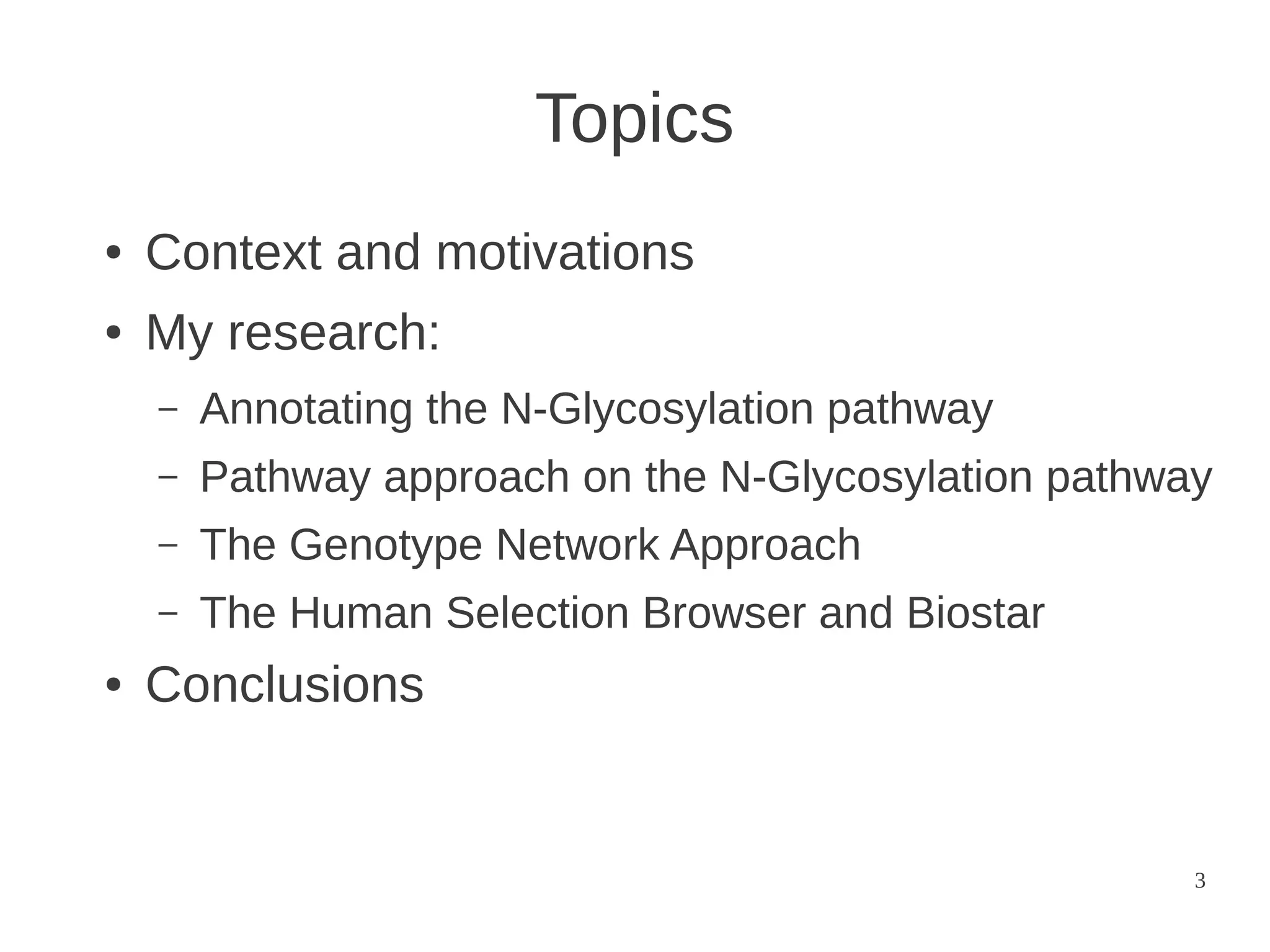
The first anatomically modern humans
appeared about 200,000 years ago
How can we understand the signals of genetic
adaptation in our genome, since then?

4
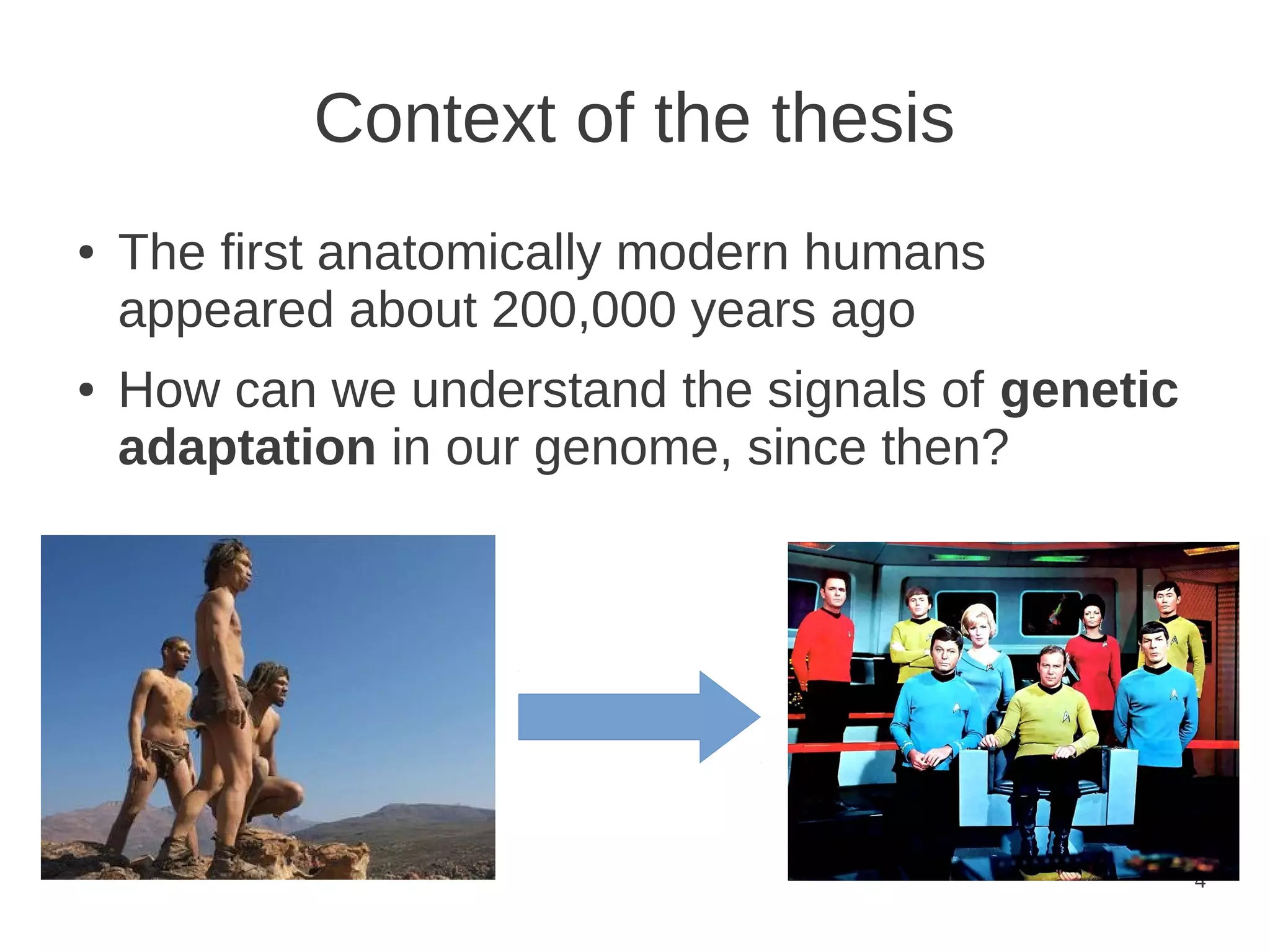
Factors that influenced recent
human evolution

New climates

Diseases

Agriculture

5
The opportunity
●

●

We have access to large datasets of human
sequences
Better annotations on gene function and role

6
Contributions
●

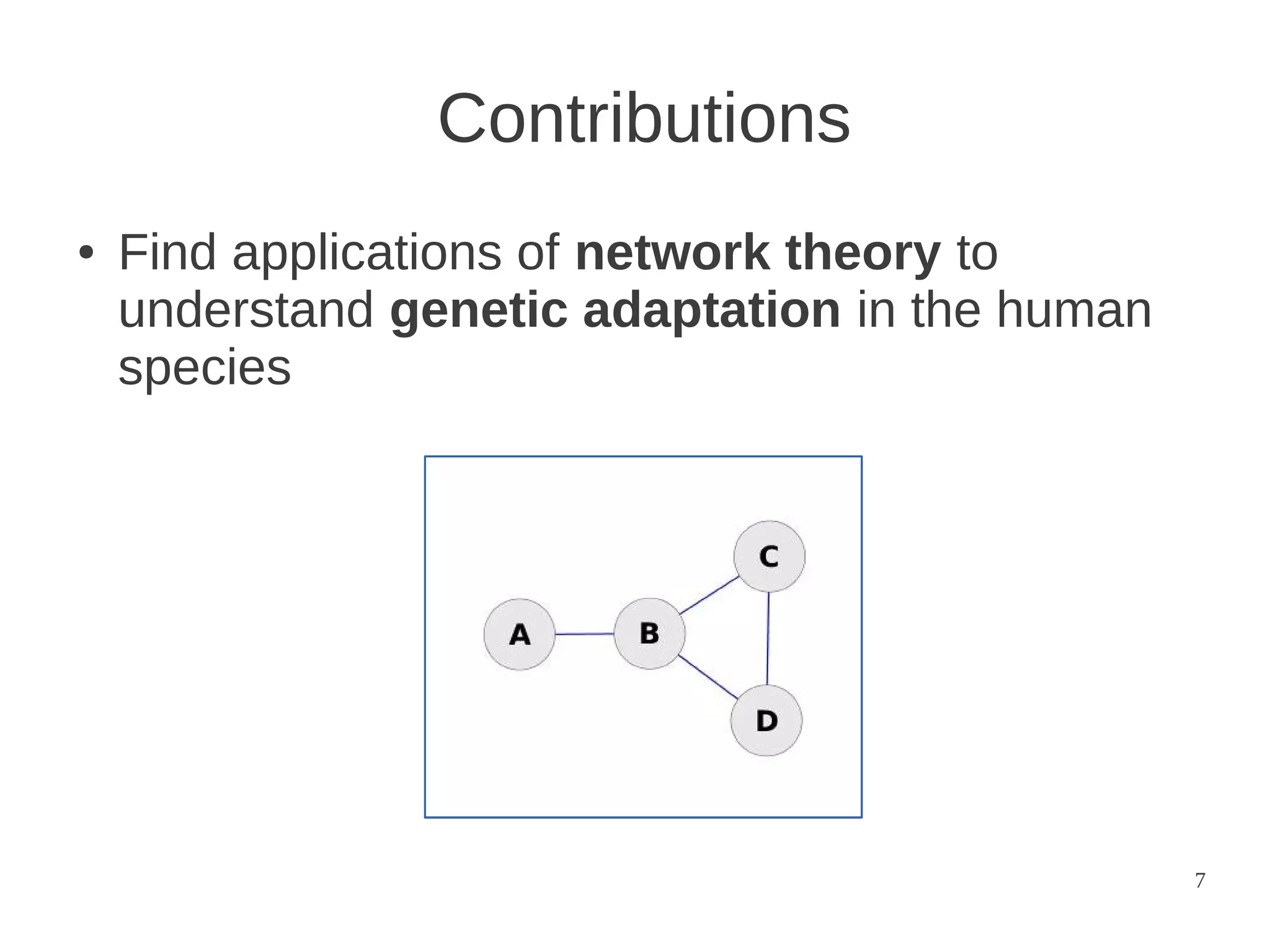
Find applications of network theory to
understand genetic adaptation in the human
species

7
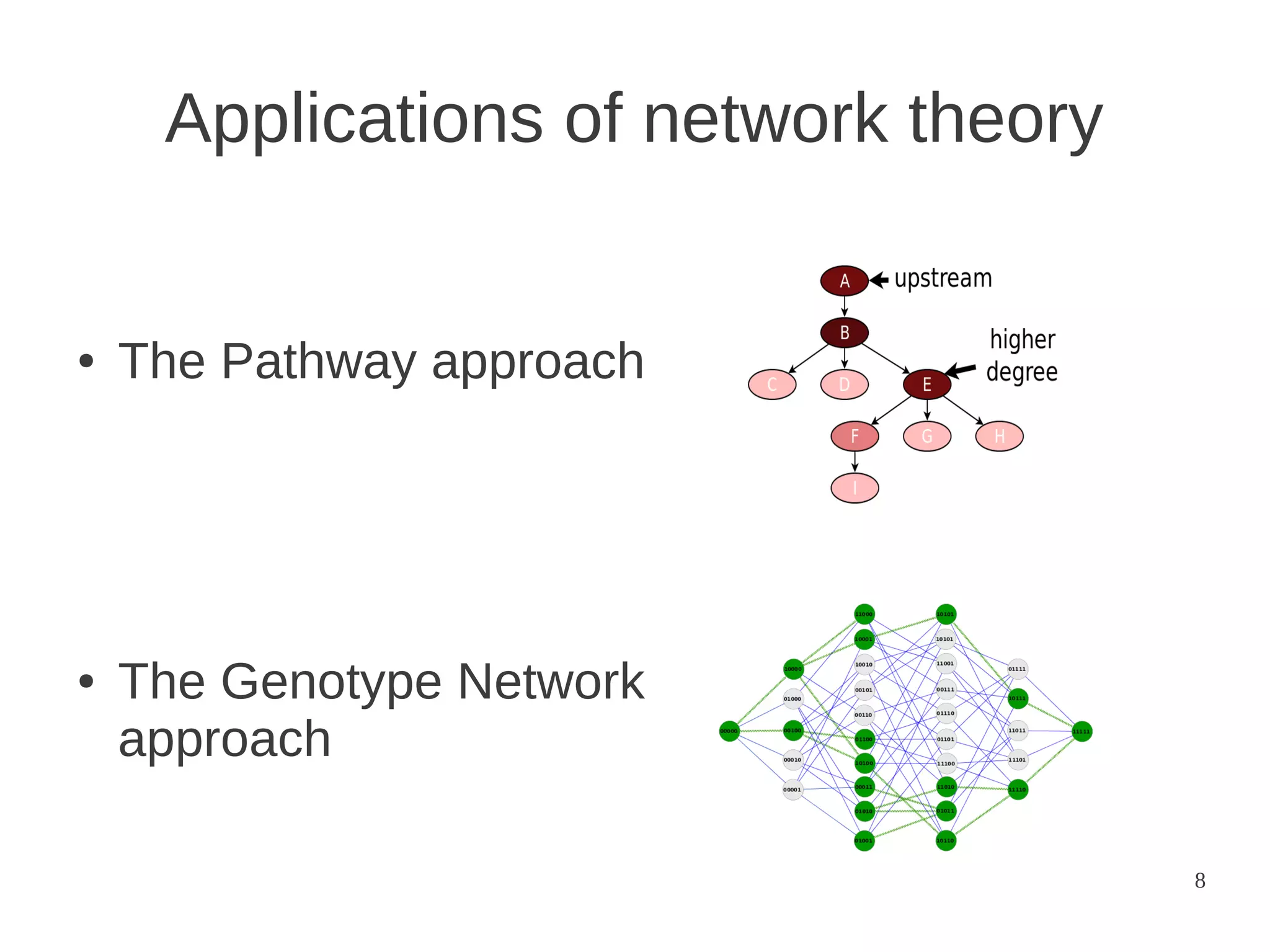
Applications of network theory

●

●

The Pathway approach

The Genotype Network
approach
8
Topics
●

Context and motivations

●

My research:
–
–

Pathway approach on the N-Glycosylation pathway

–

The Genotype Network Approach

–
●

Annotating the N-Glycosylation pathway

The Human Selection Browser and Biostar

Conclusions

9
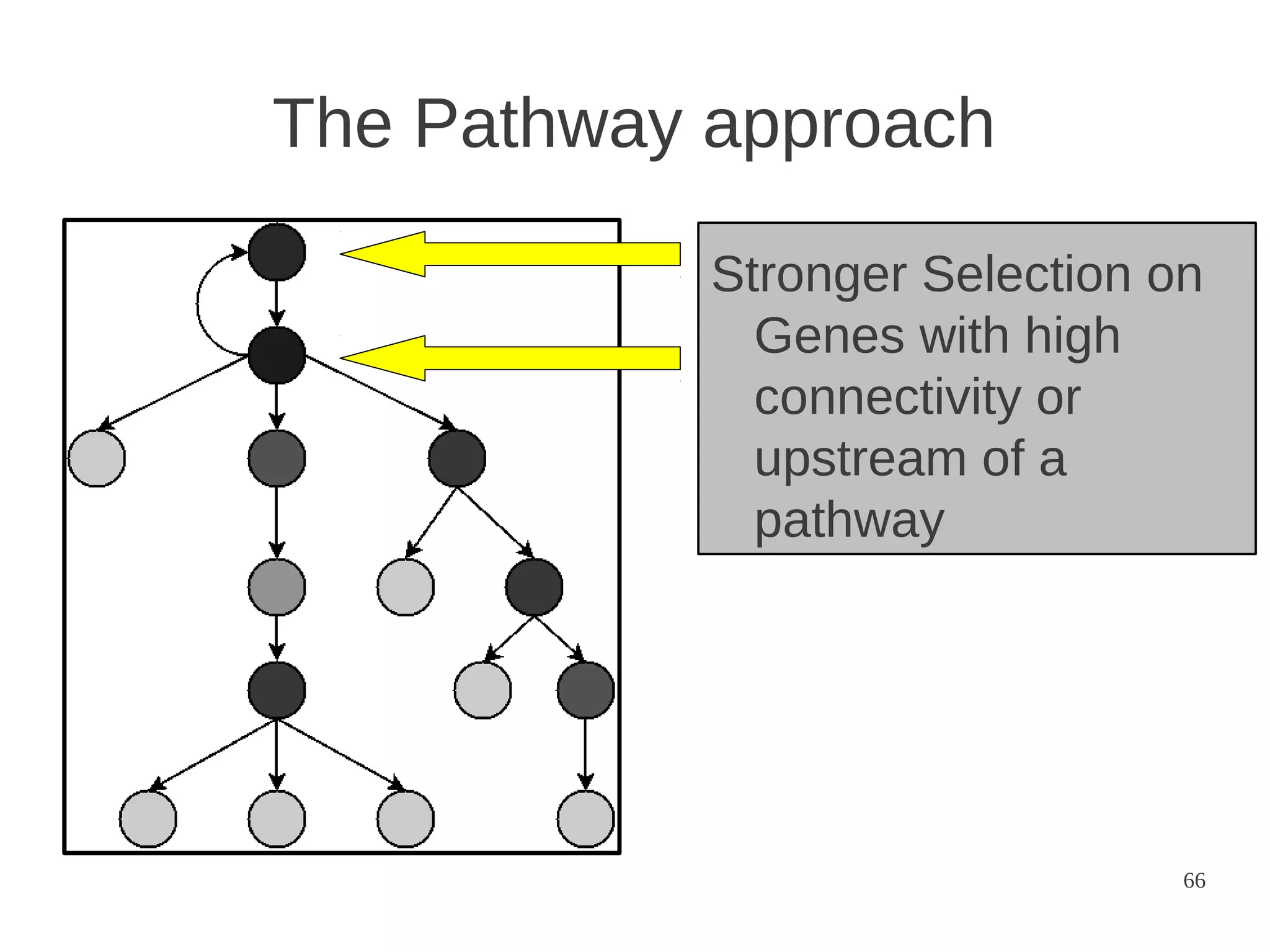
The Pathway approach
●

●

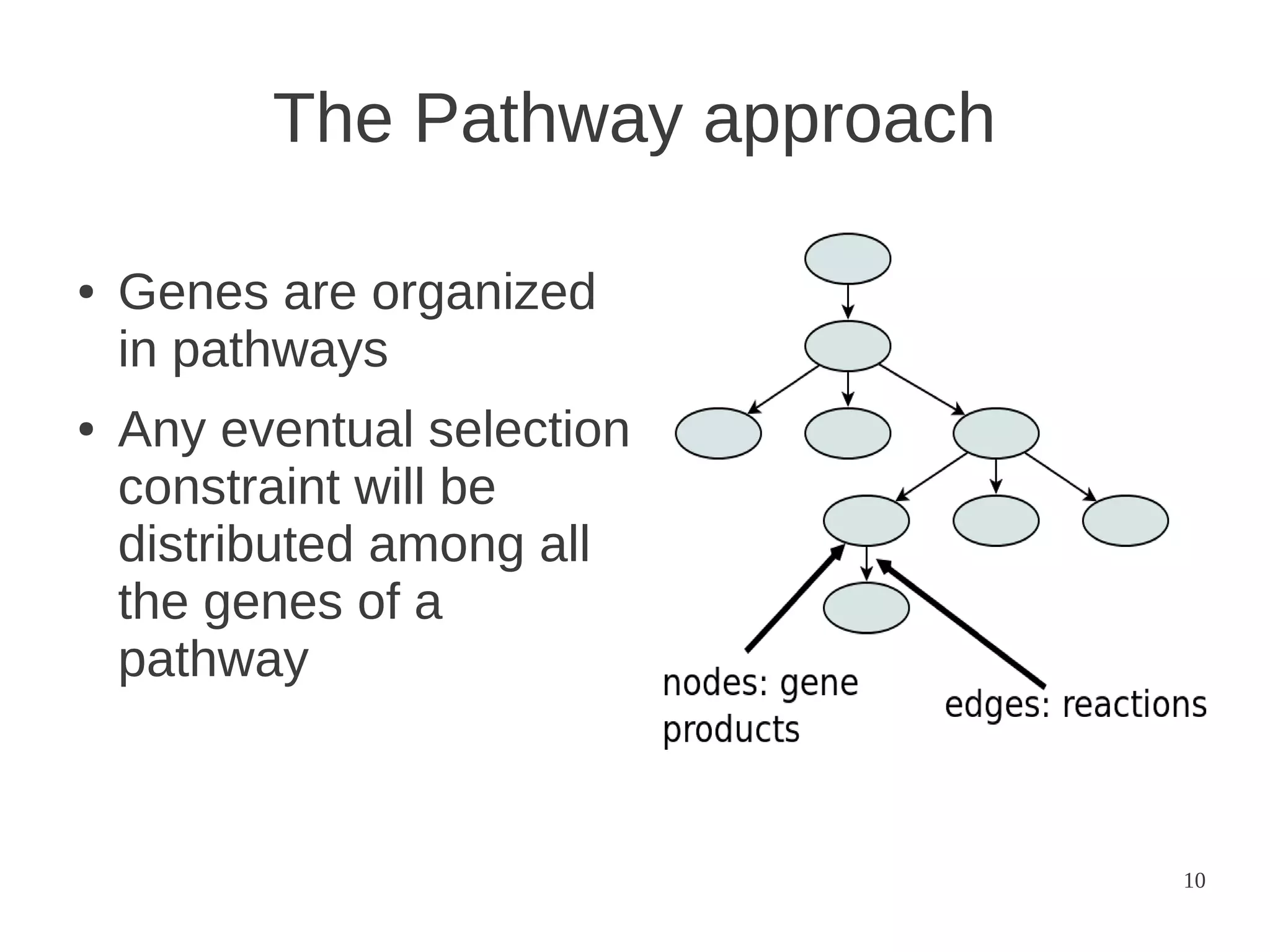
Genes are organized
in pathways
Any eventual selection
constraint will be
distributed among all
the genes of a
pathway

10
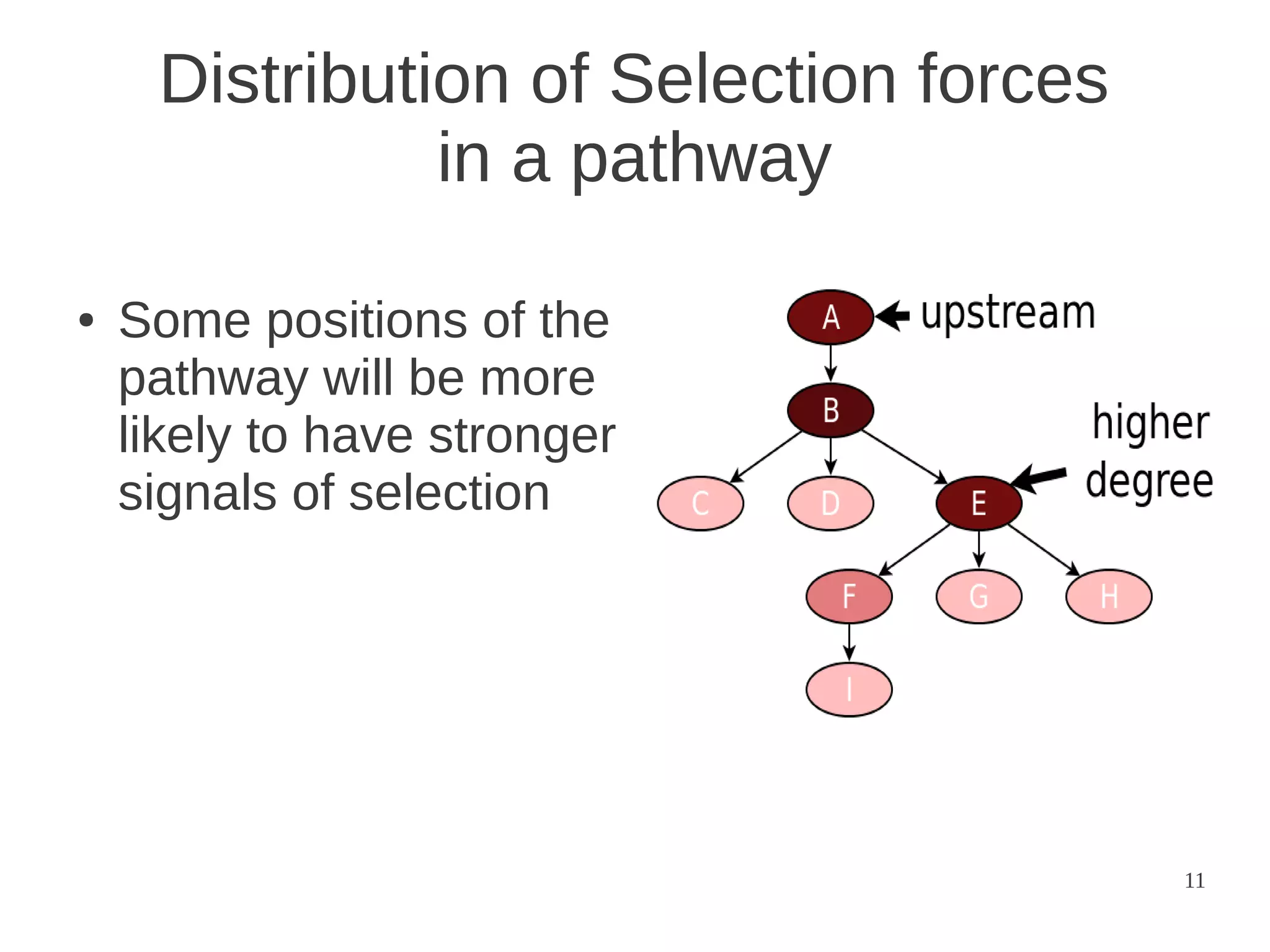
Distribution of Selection forces
in a pathway
●

Some positions of the
pathway will be more
likely to have stronger
signals of selection

11
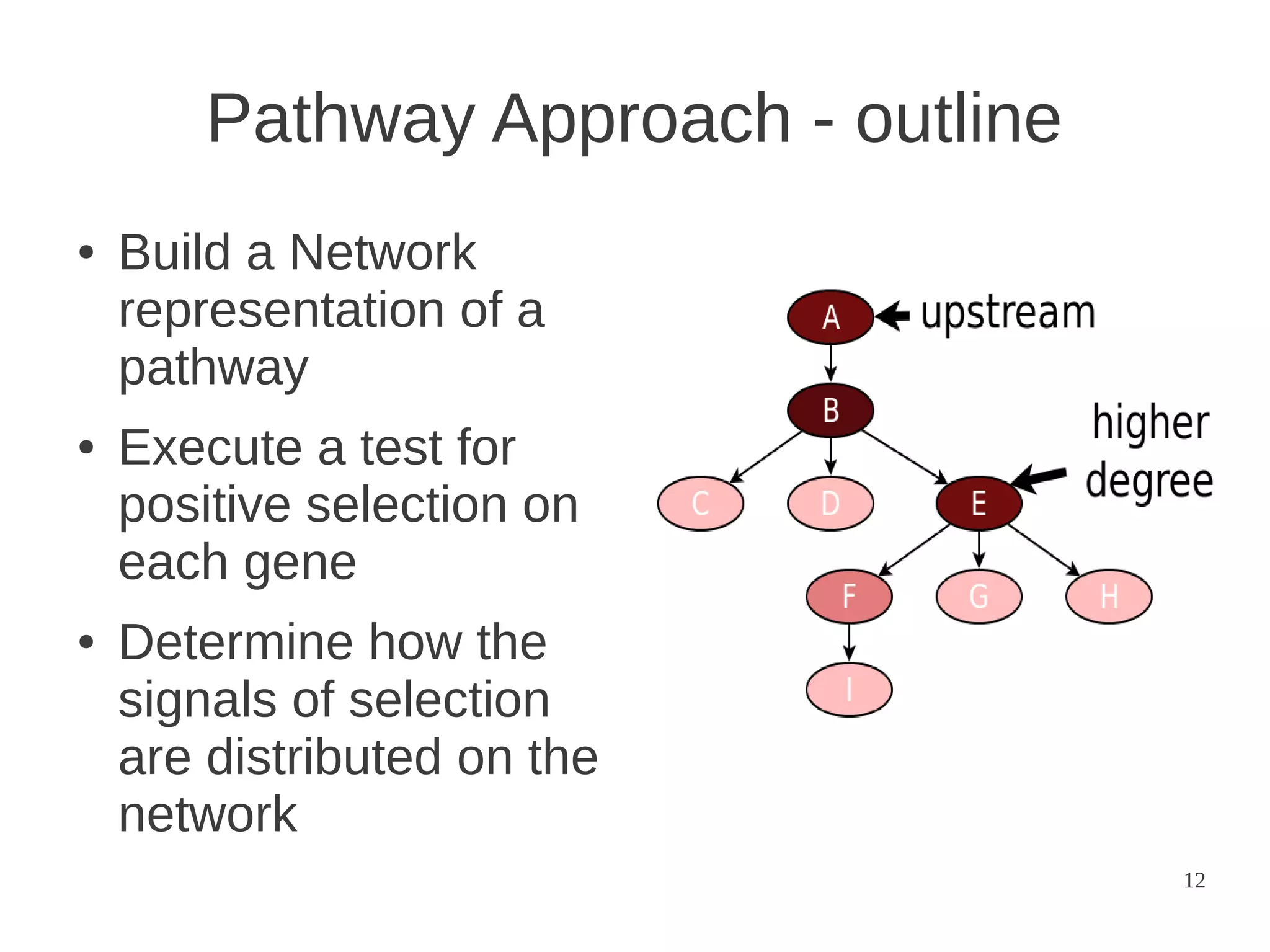
Pathway Approach - outline
●

●

●

Build a Network
representation of a
pathway
Execute a test for
positive selection on
each gene
Determine how the
signals of selection
are distributed on the
network
12
Pathway approach on the
N-Glycosylation pathway
●

●

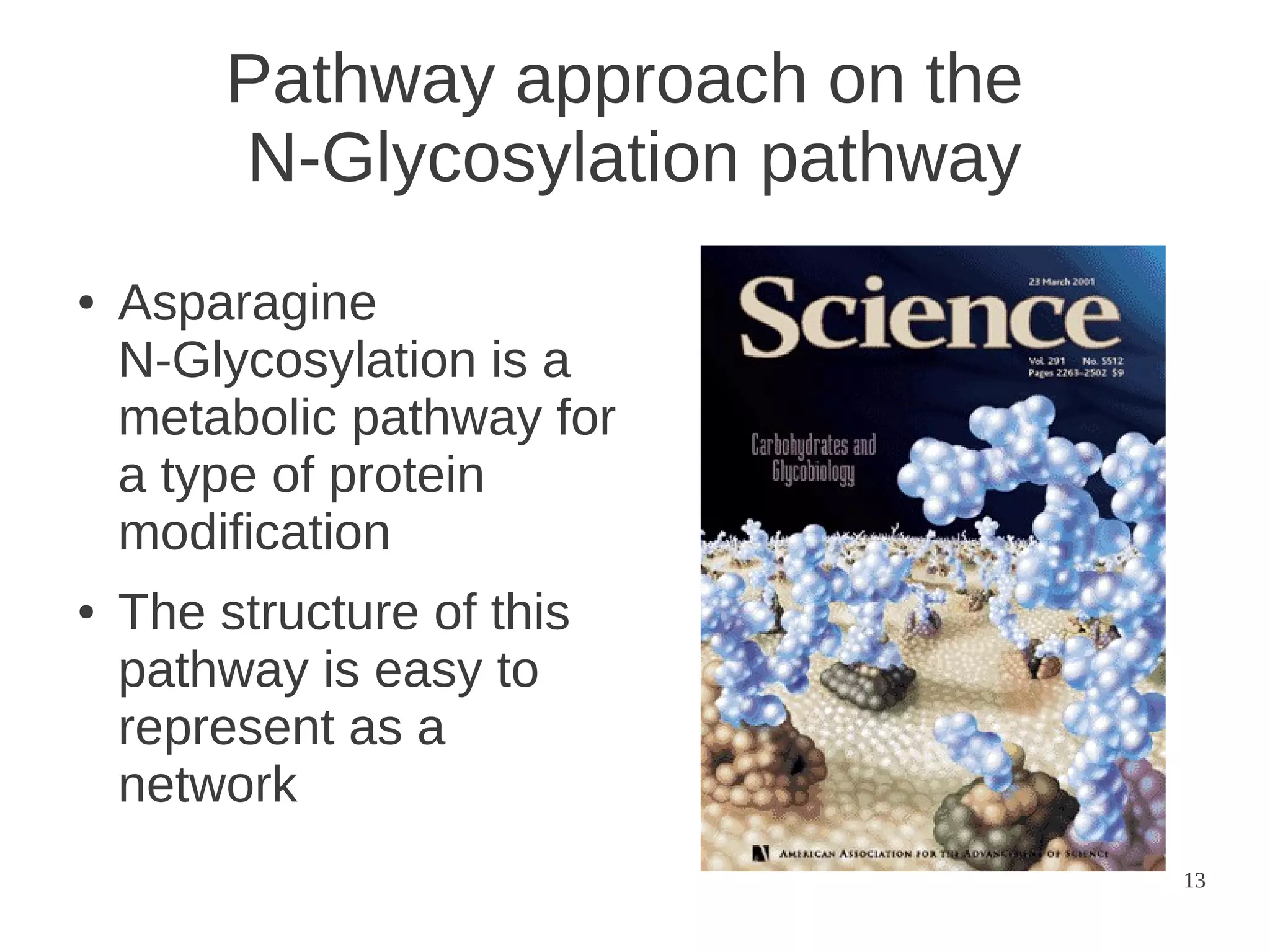
Asparagine
N-Glycosylation is a
metabolic pathway for
a type of protein
modification
The structure of this
pathway is easy to
represent as a
network
13
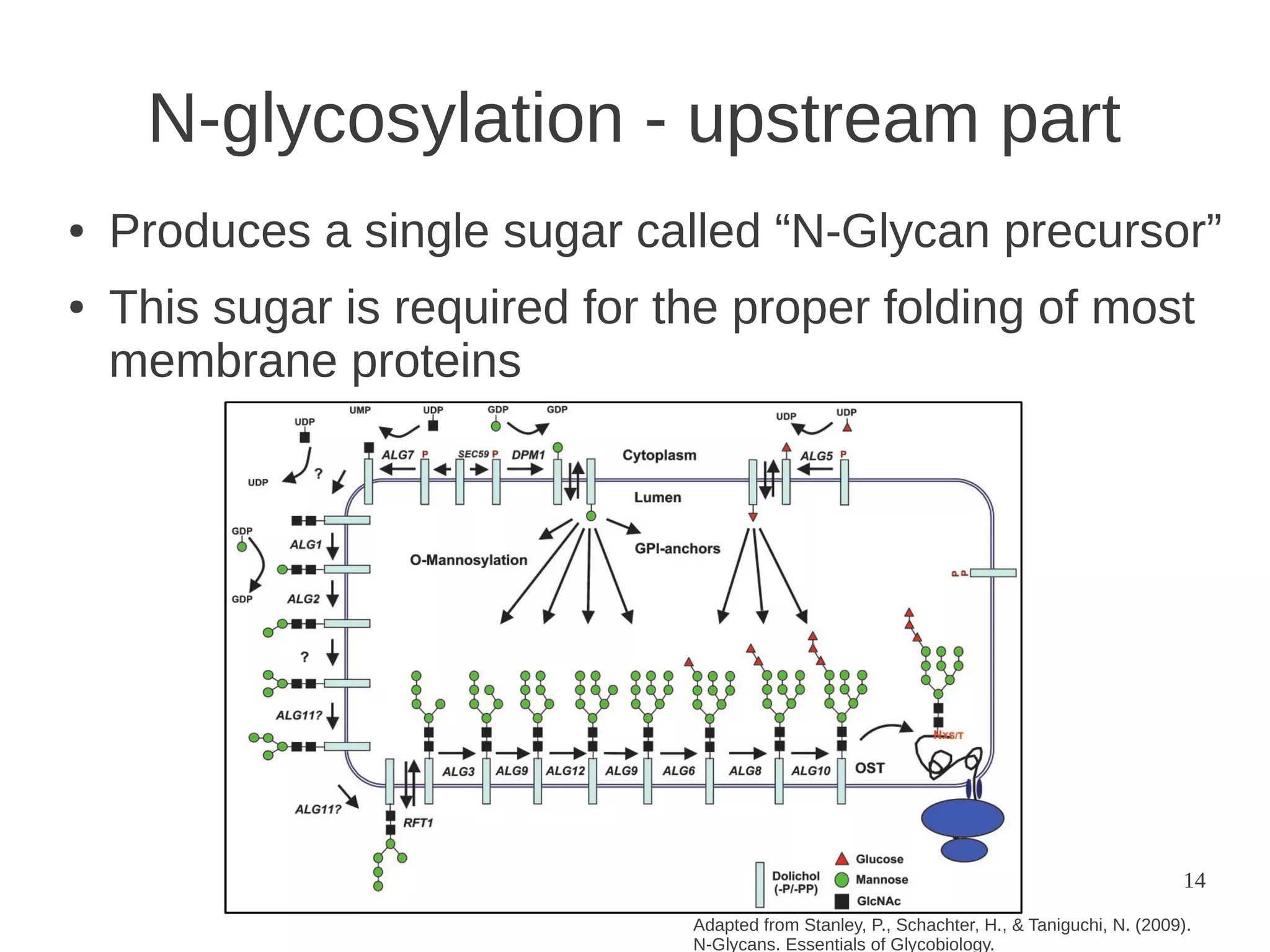
N-glycosylation - upstream part
●

●

Produces a single sugar called “N-Glycan precursor”
This sugar is required for the proper folding of most
membrane proteins

14
Adapted from Stanley, P., Schachter, H., & Taniguchi, N. (2009).
N-Glycans. Essentials of Glycobiology.
N-Glycosylation and protein folding
●

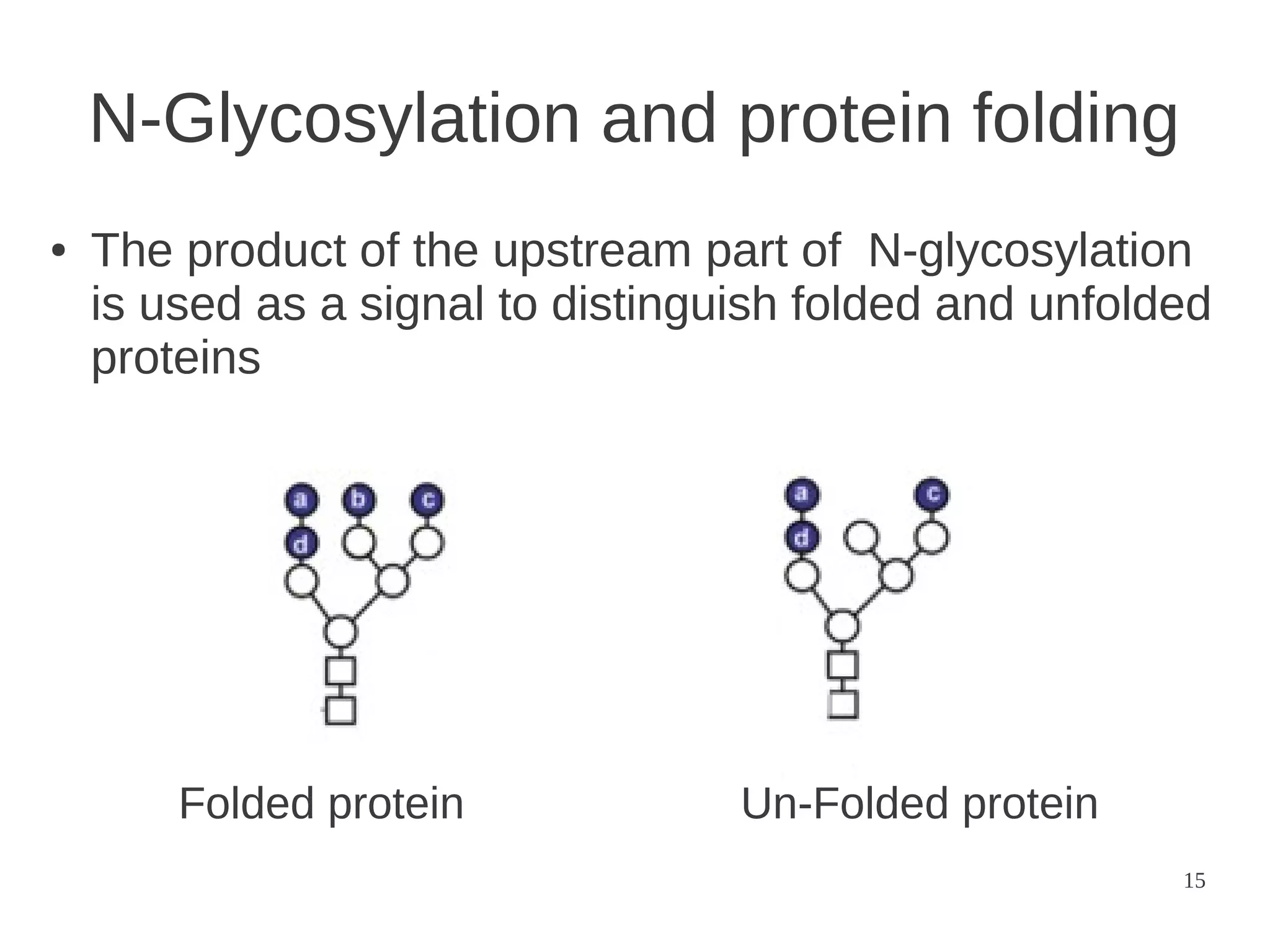
The product of the upstream part of N-glycosylation
is used as a signal to distinguish folded and unfolded
proteins

Folded protein

Un-Folded protein
15
N-glycosylation - downstream part
●

●

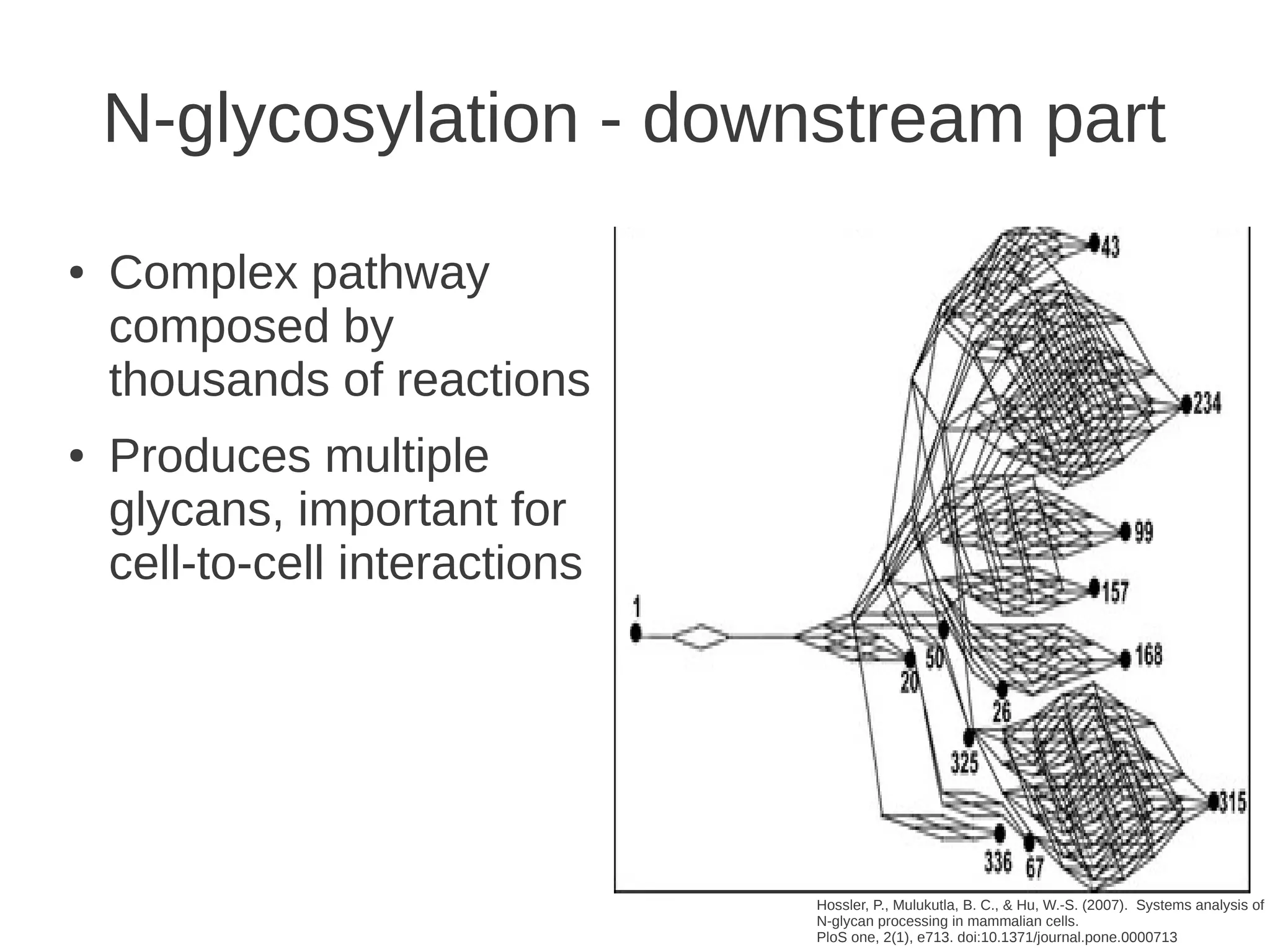
Complex pathway
composed by
thousands of reactions
Produces multiple
glycans, important for
cell-to-cell interactions

16
Hossler, P., Mulukutla, B. C., & Hu, W.-S. (2007). Systems analysis of
N-glycan processing in mammalian cells.
PloS one, 2(1), e713. doi:10.1371/journal.pone.0000713
Glycans on the cell surface
●

●

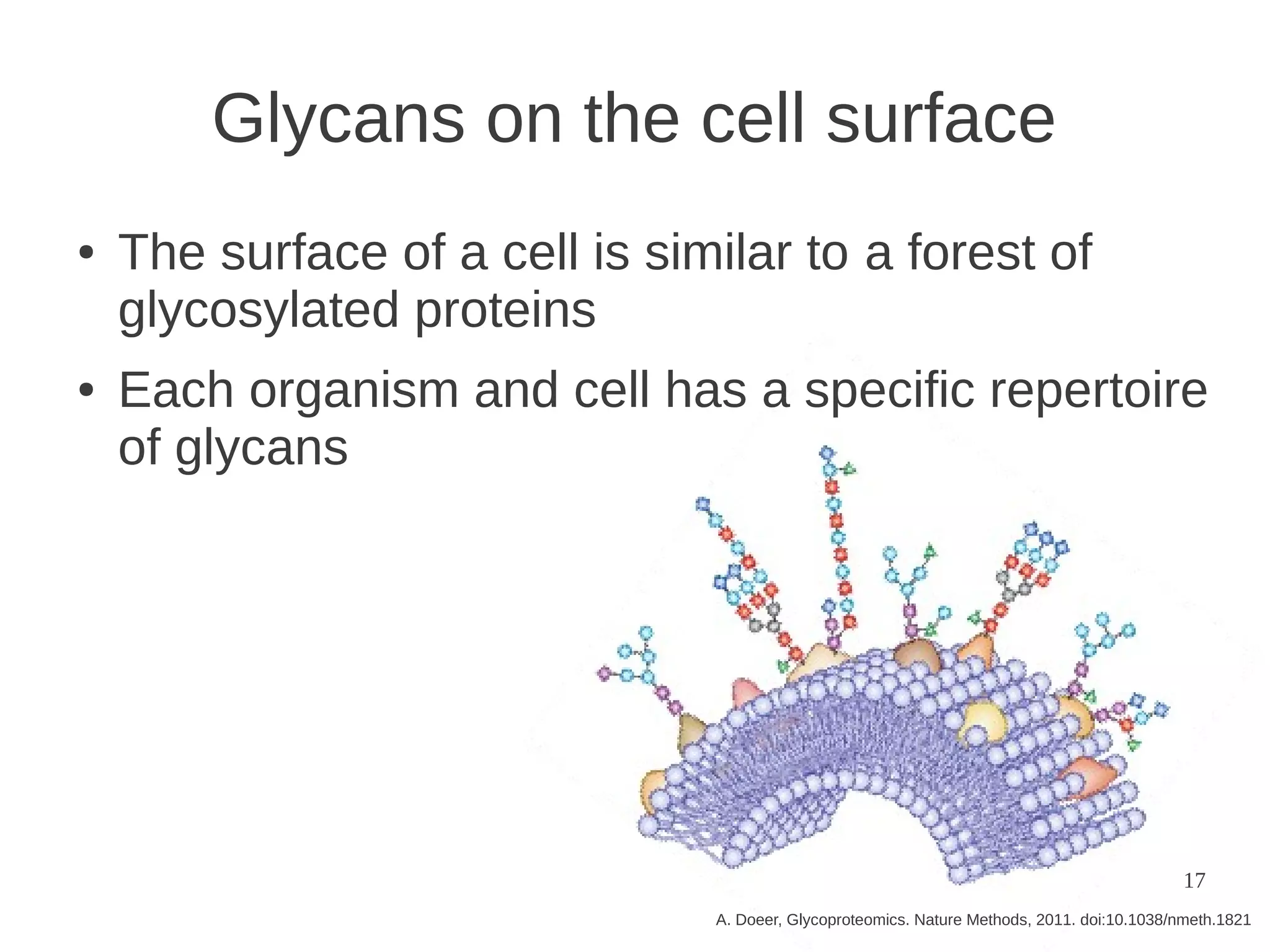
The surface of a cell is similar to a forest of
glycosylated proteins
Each organism and cell has a specific repertoire
of glycans

17
A. Doeer, Glycoproteomics. Nature Methods, 2011. doi:10.1038/nmeth.1821
Annotating the
N-Glycosylation pathway
●

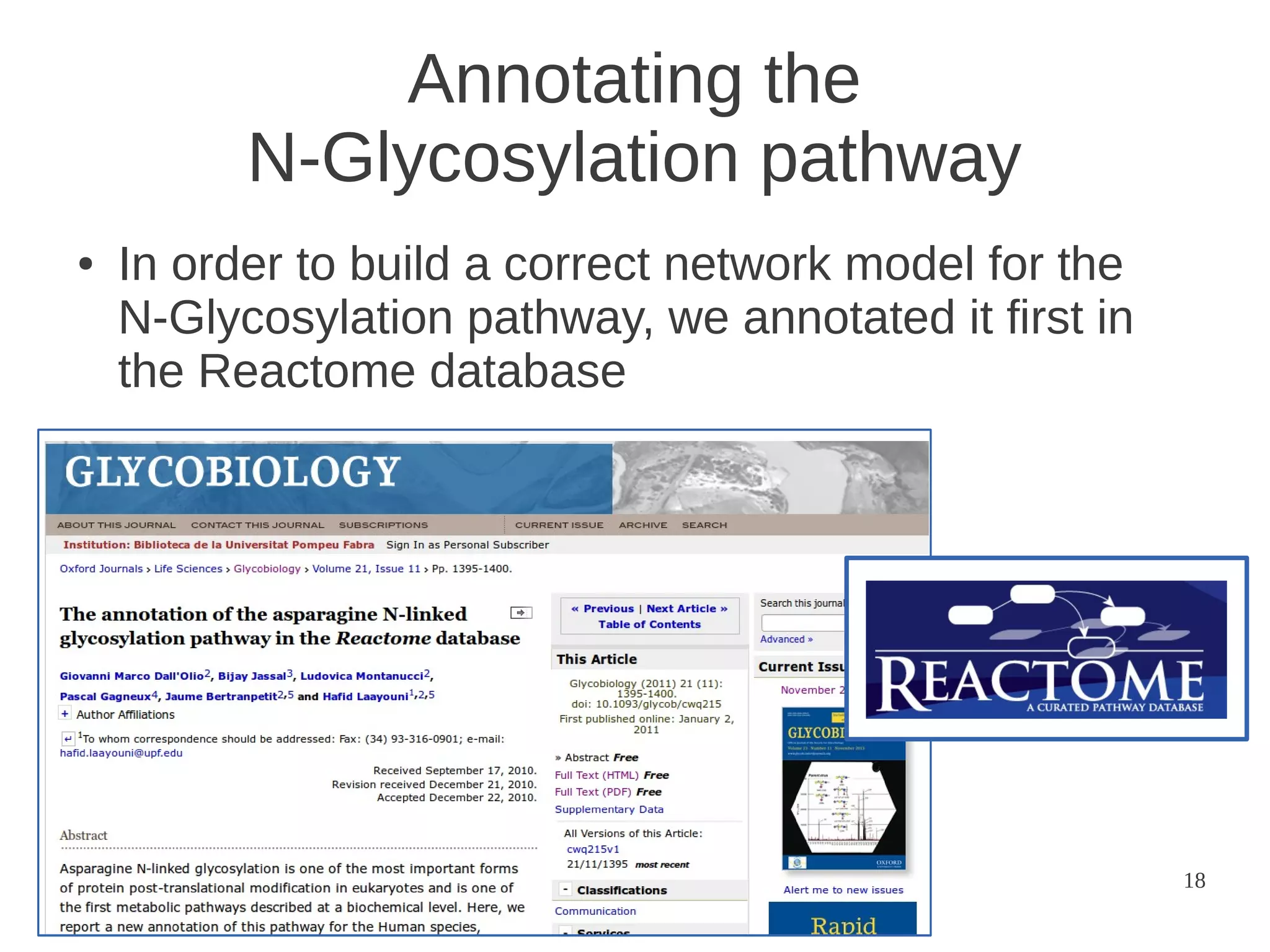
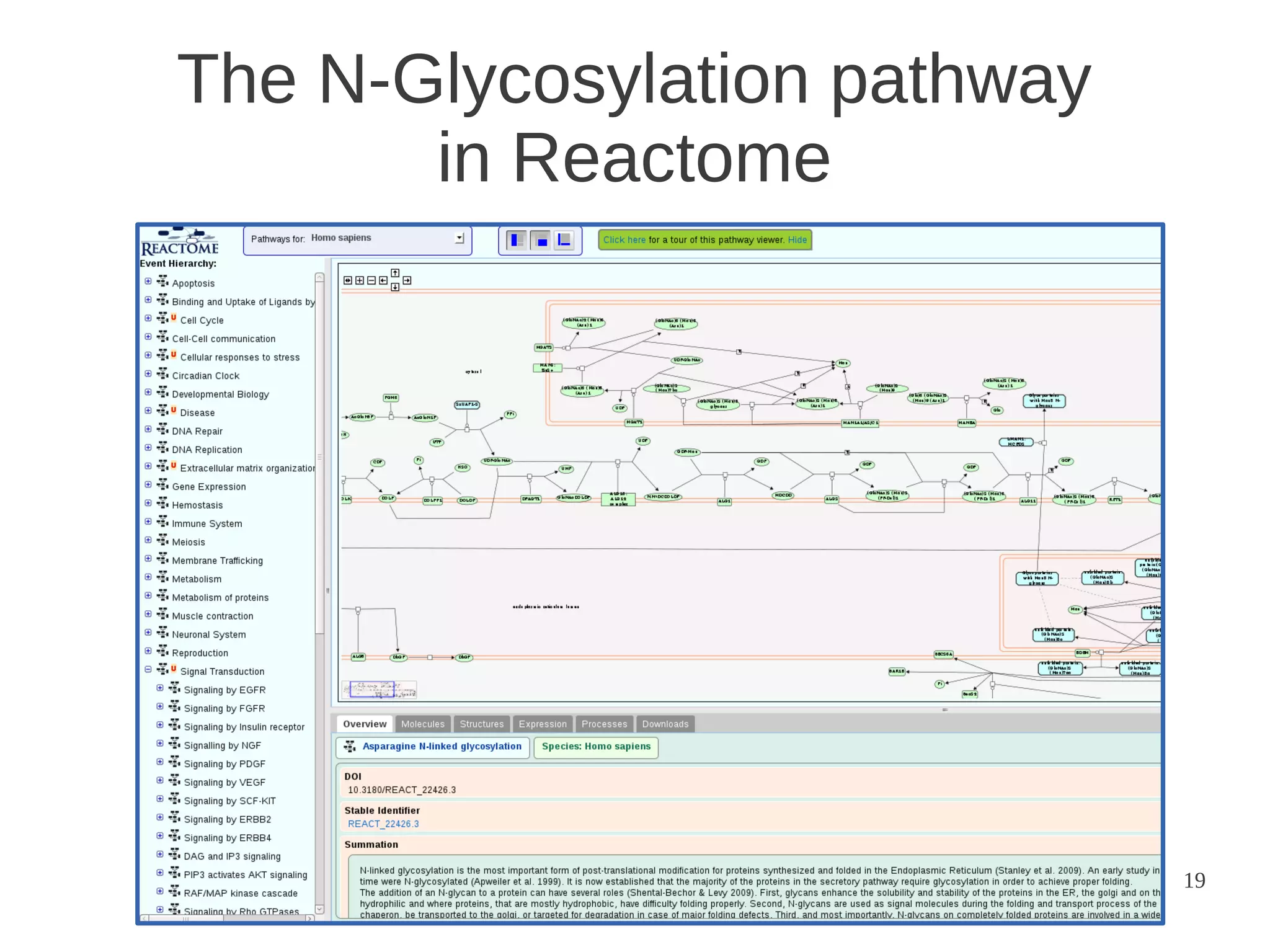
In order to build a correct network model for the
N-Glycosylation pathway, we annotated it first in
the Reactome database

18
The N-Glycosylation pathway
in Reactome

19
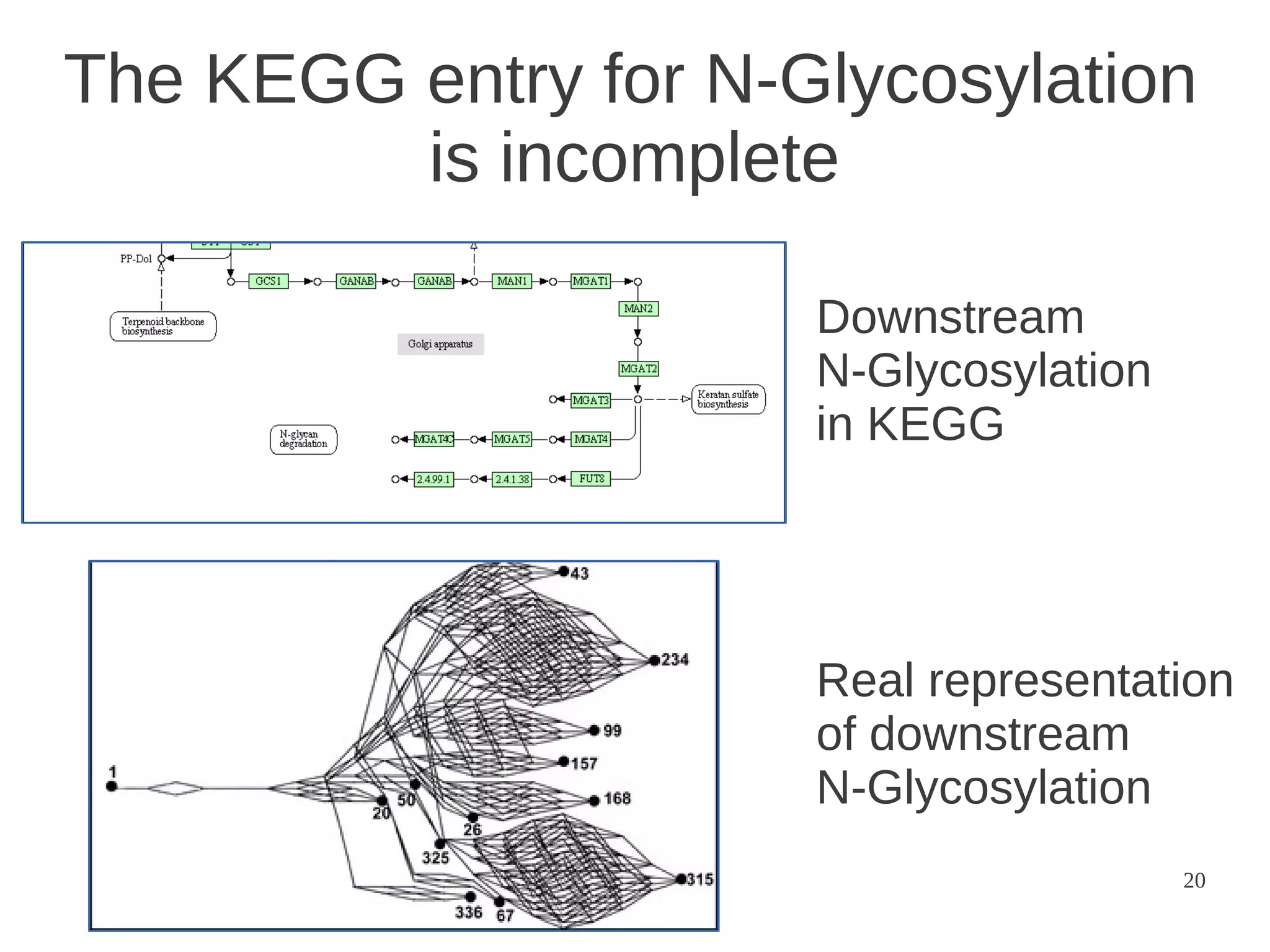
The KEGG entry for N-Glycosylation
is incomplete
Downstream
N-Glycosylation
in KEGG

Real representation
of downstream
N-Glycosylation
20
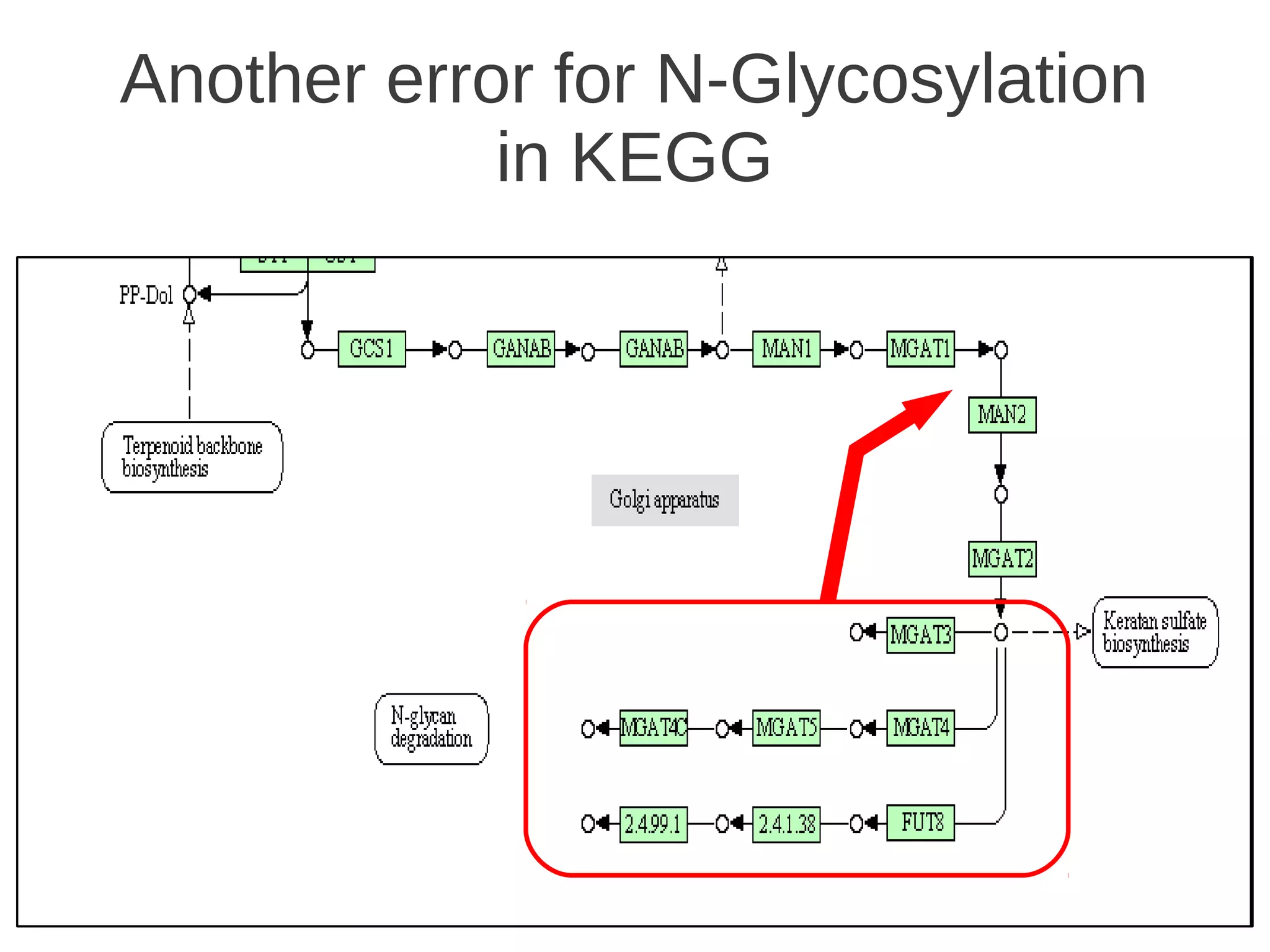
Another error for N-Glycosylation
in KEGG

21
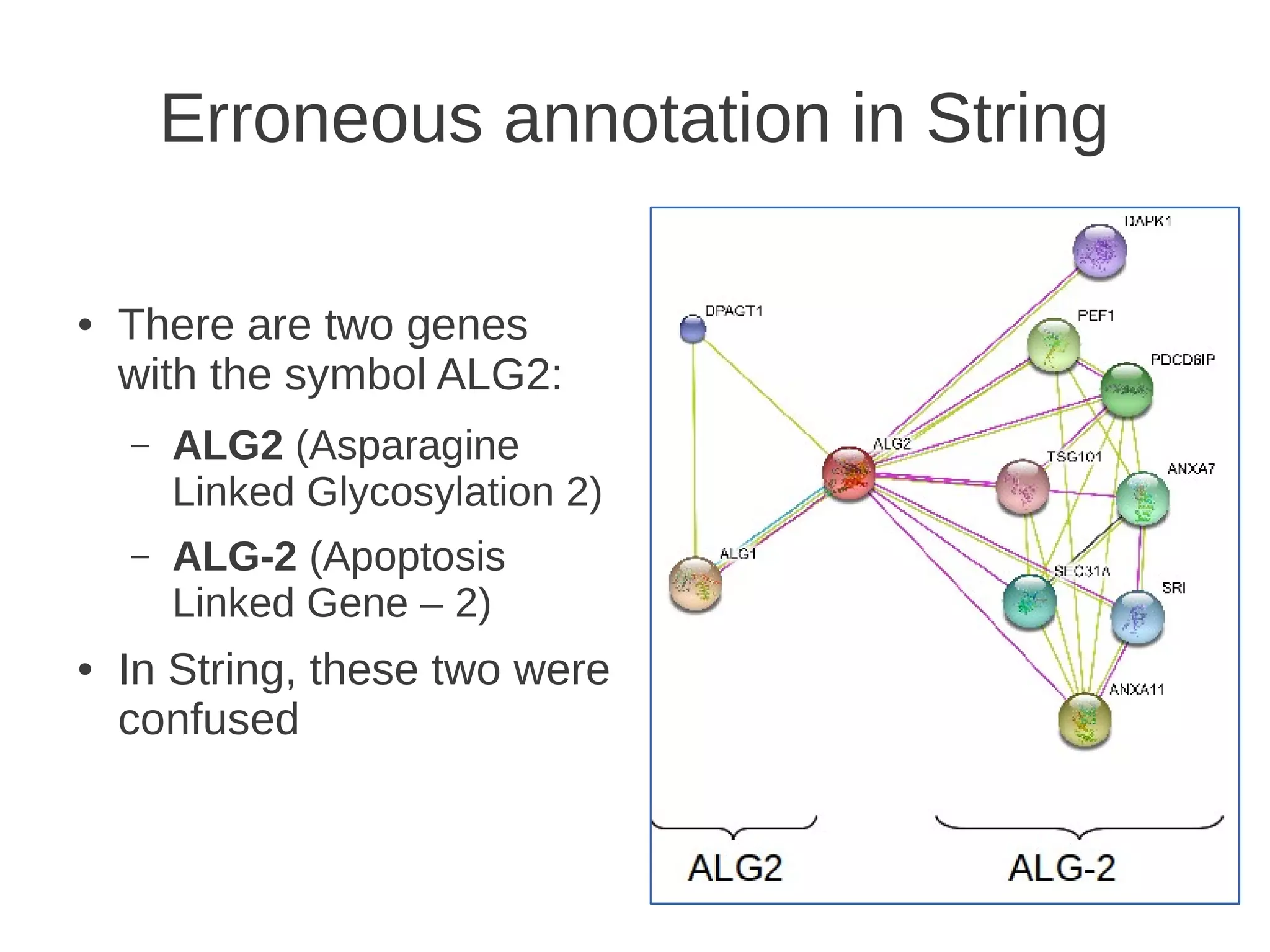
Erroneous annotation in String
●

There are two genes
with the symbol ALG2:
–

–

●

ALG2 (Asparagine
Linked Glycosylation 2)
ALG-2 (Apoptosis
Linked Gene – 2)

In String, these two were
confused

22
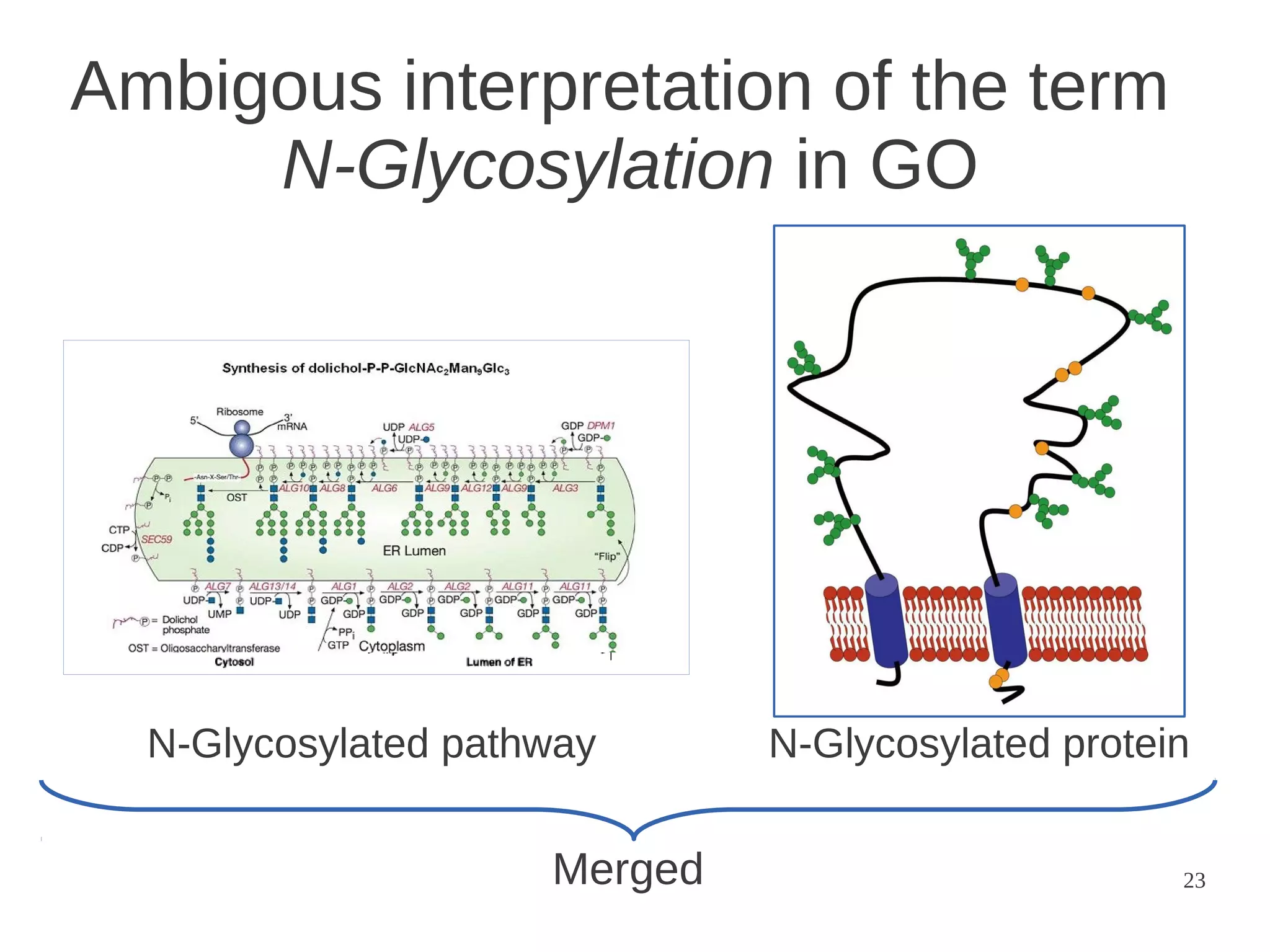
Ambigous interpretation of the term
N-Glycosylation in GO

N-Glycosylated pathway

Merged

N-Glycosylated protein
23
Annotating the
N-Glycosylation pathway
●

Annotated ~100 reactions in Reactome

●

Fixed ~50 Gene Ontology terms

●

Fixed key errors in String and KEGG

24
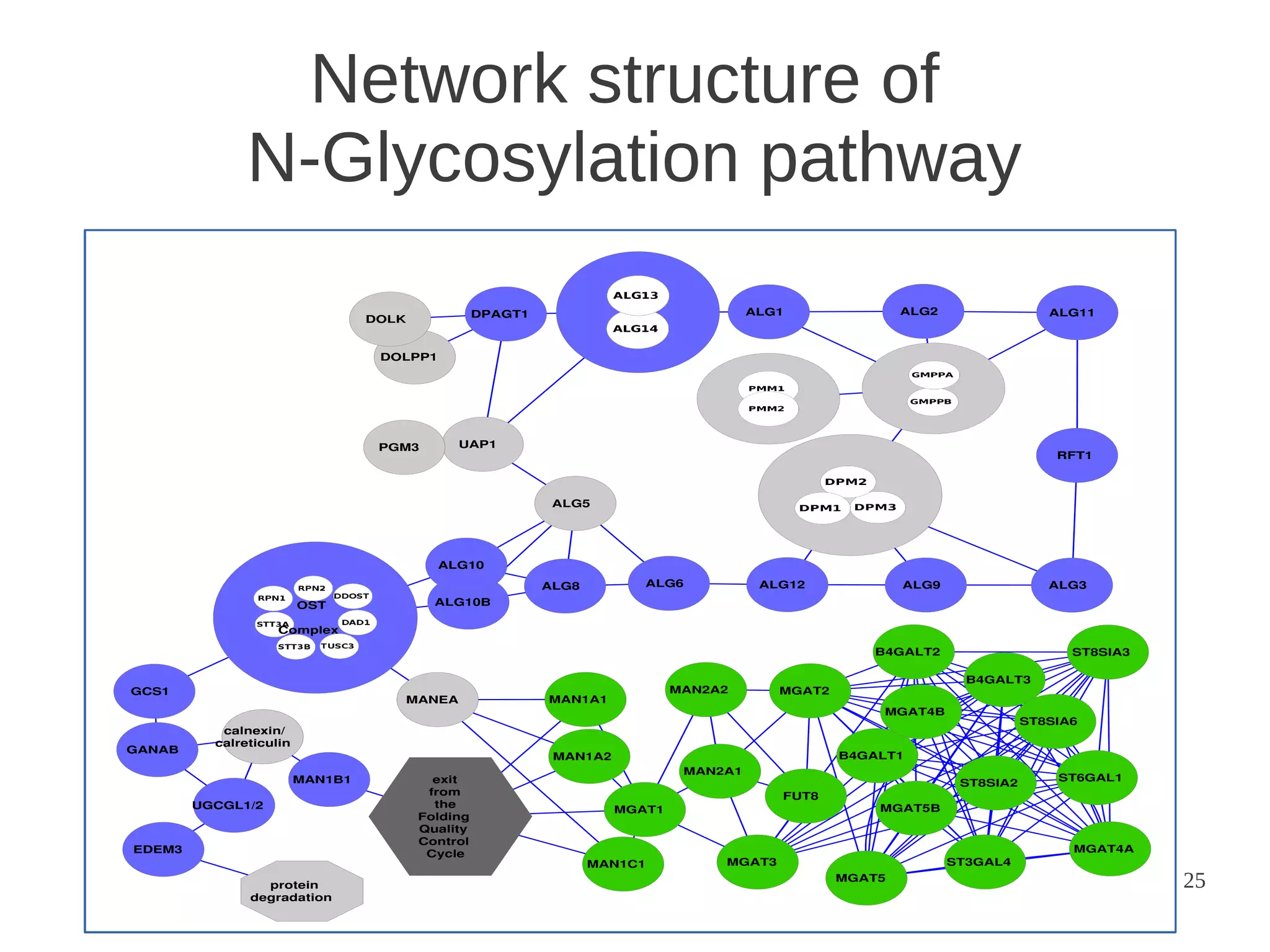
Network structure of
N-Glycosylation pathway

25
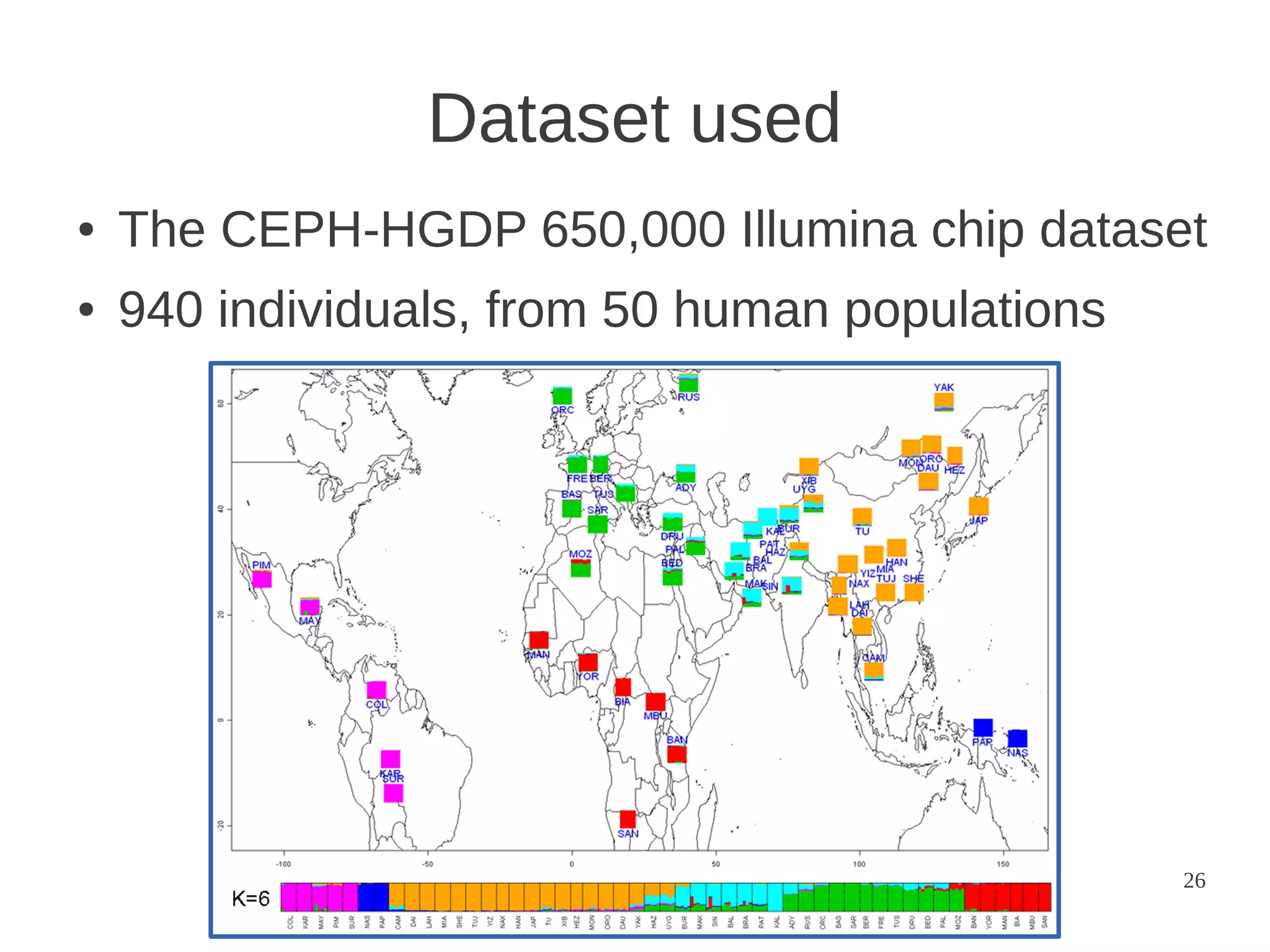
Dataset used
●

The CEPH-HGDP 650,000 Illumina chip dataset

●

940 individuals, from 50 human populations

26
Methods used
●

●

The FST index → measure of population
differentiation
The iHS test → identification of signals of
recent positive selection

27
FST – Population differentiation
●

●

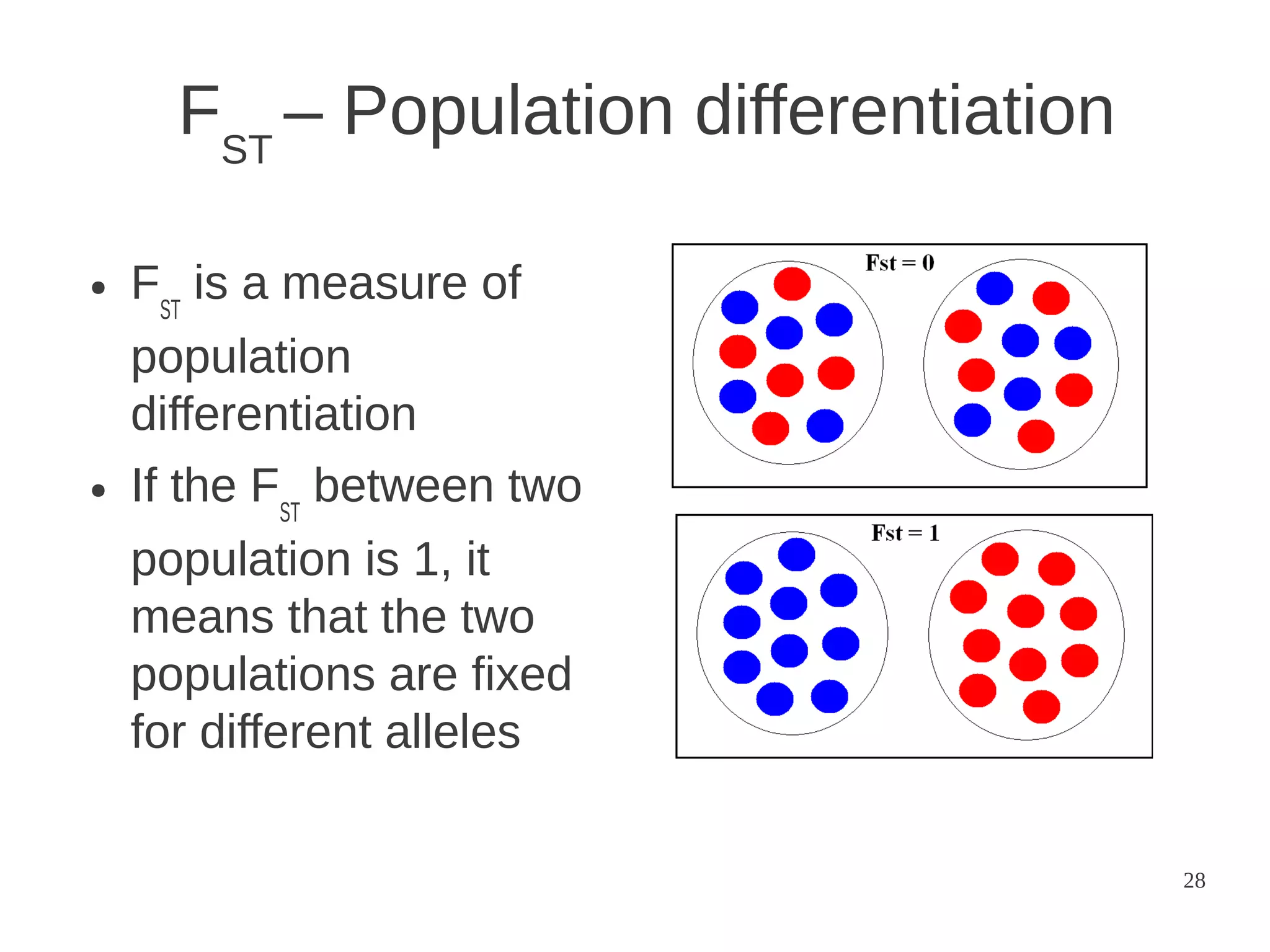
FST is a measure of
population
differentiation
If the FST between two
population is 1, it
means that the two
populations are fixed
for different alleles
28
Signatures of population differentiation
in the N-Glycosylation pathway

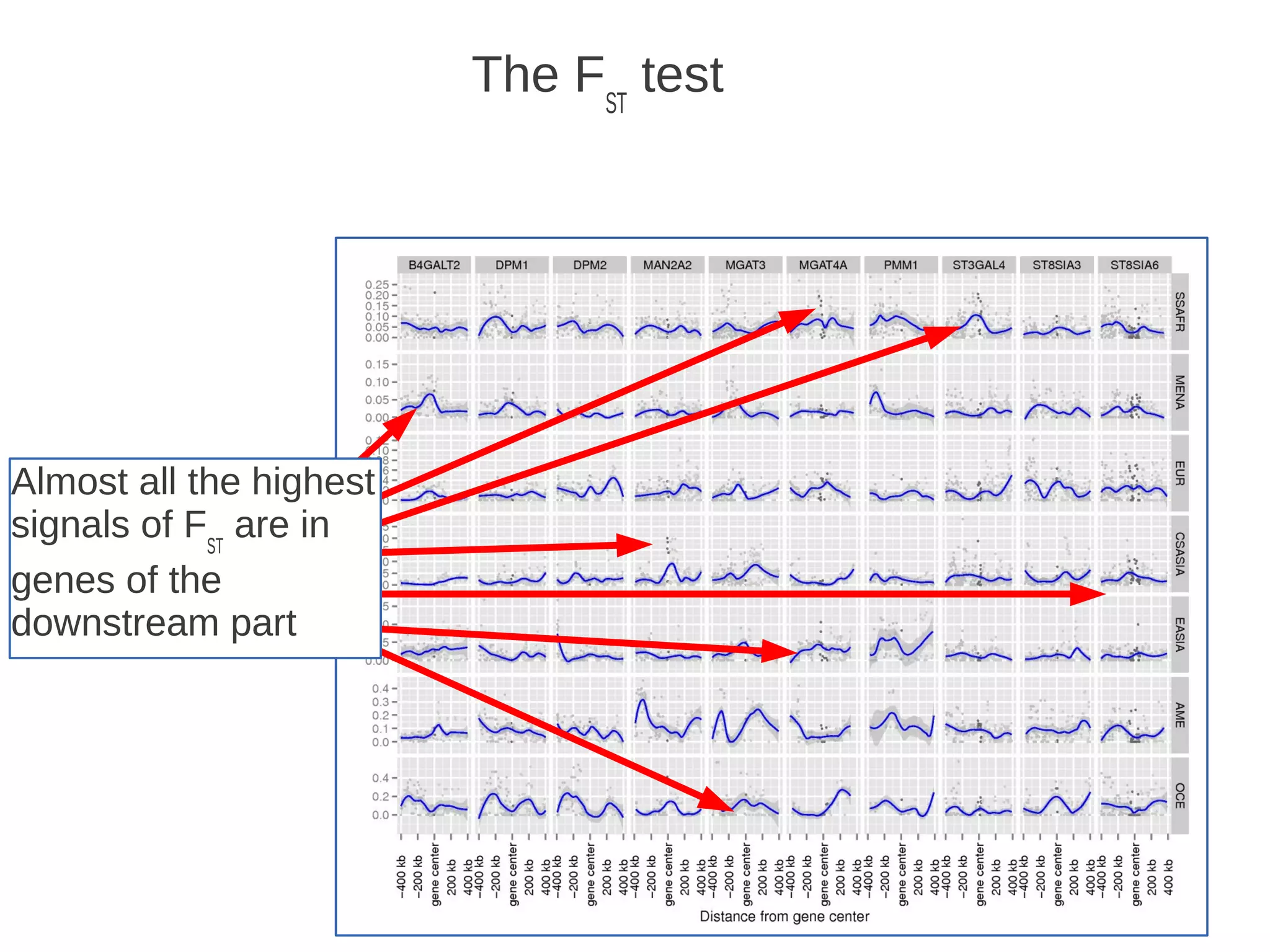
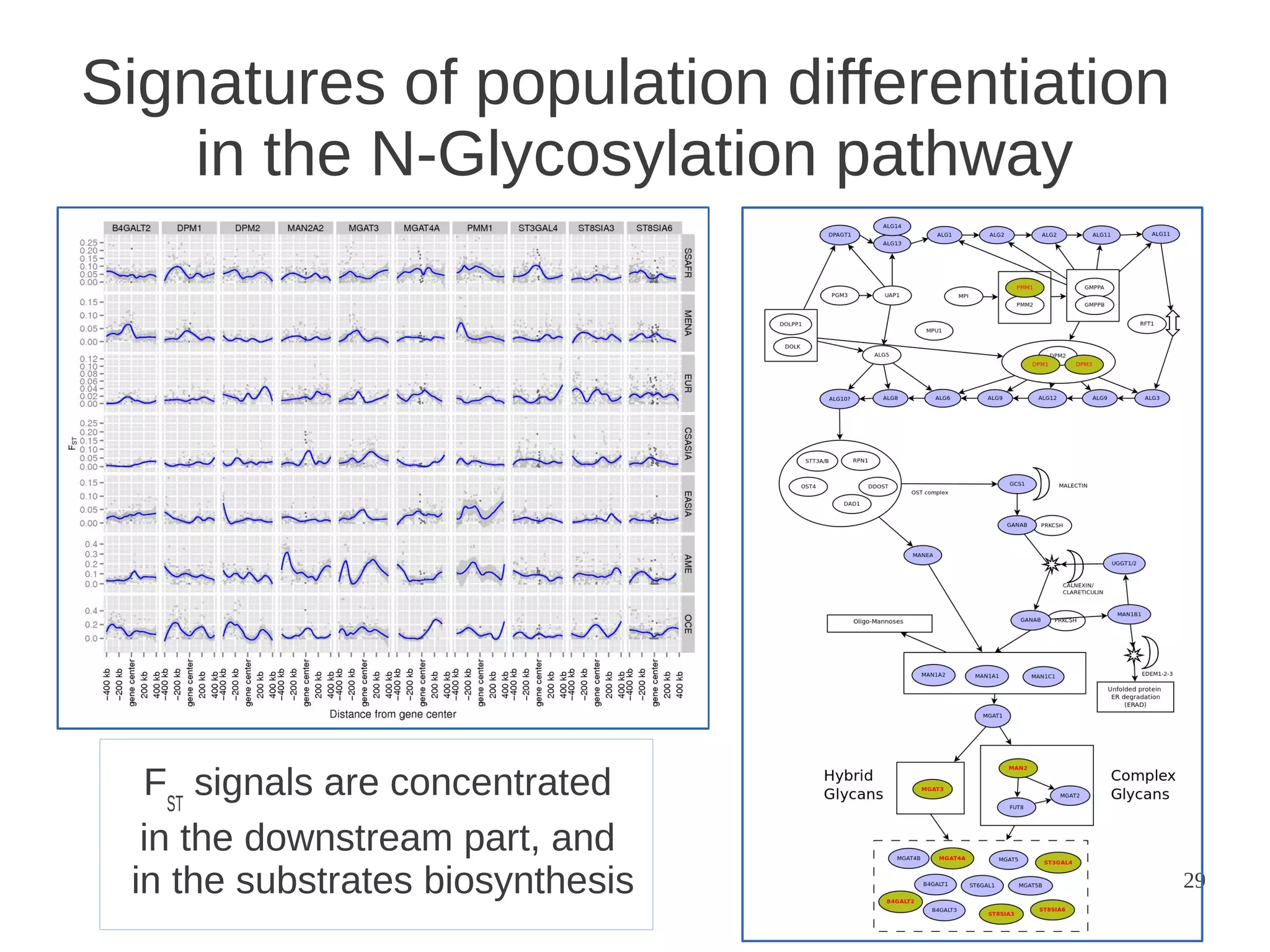
FST signals are concentrated
in the downstream part, and
in the substrates biosynthesis

29
Population Differentiation
and network position
●

●

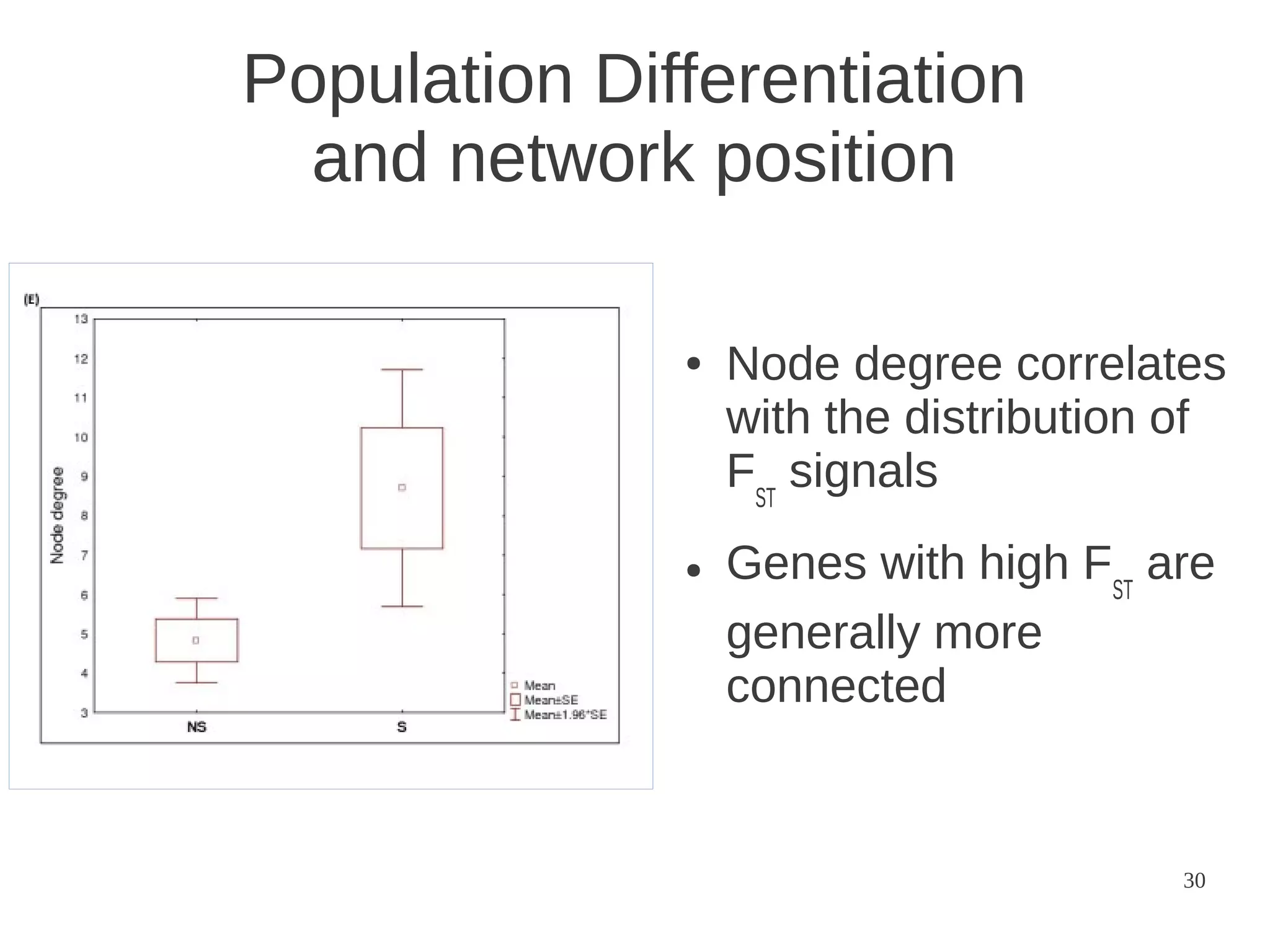
Node degree correlates
with the distribution of
FST signals
Genes with high FST are
generally more
connected

30
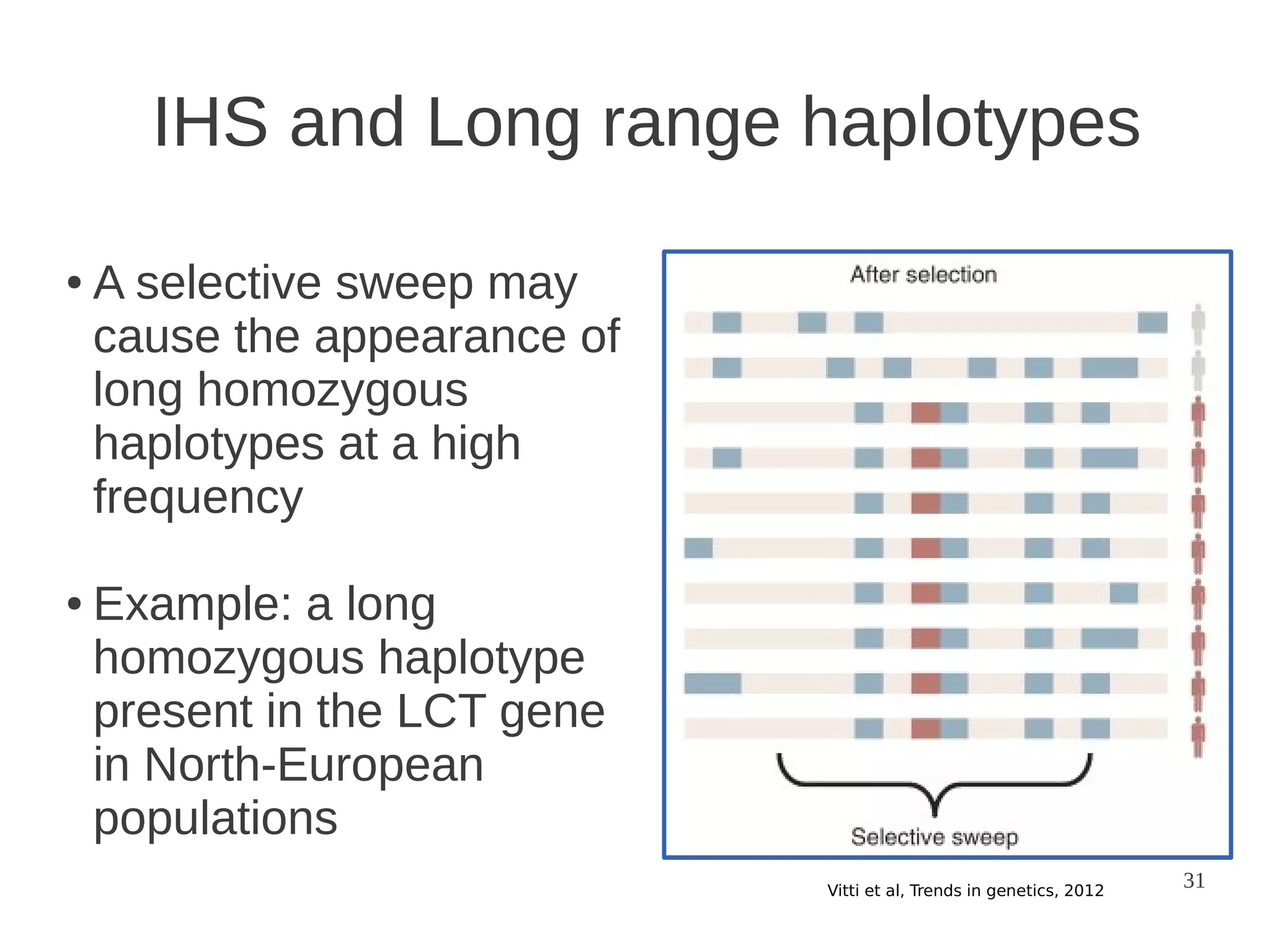
IHS and Long range haplotypes
●

●

A selective sweep may
cause the appearance of
long homozygous
haplotypes at a high
frequency
Example: a long
homozygous haplotype
present in the LCT gene
in North-European
populations
Vitti et al, Trends in genetics, 2012

31
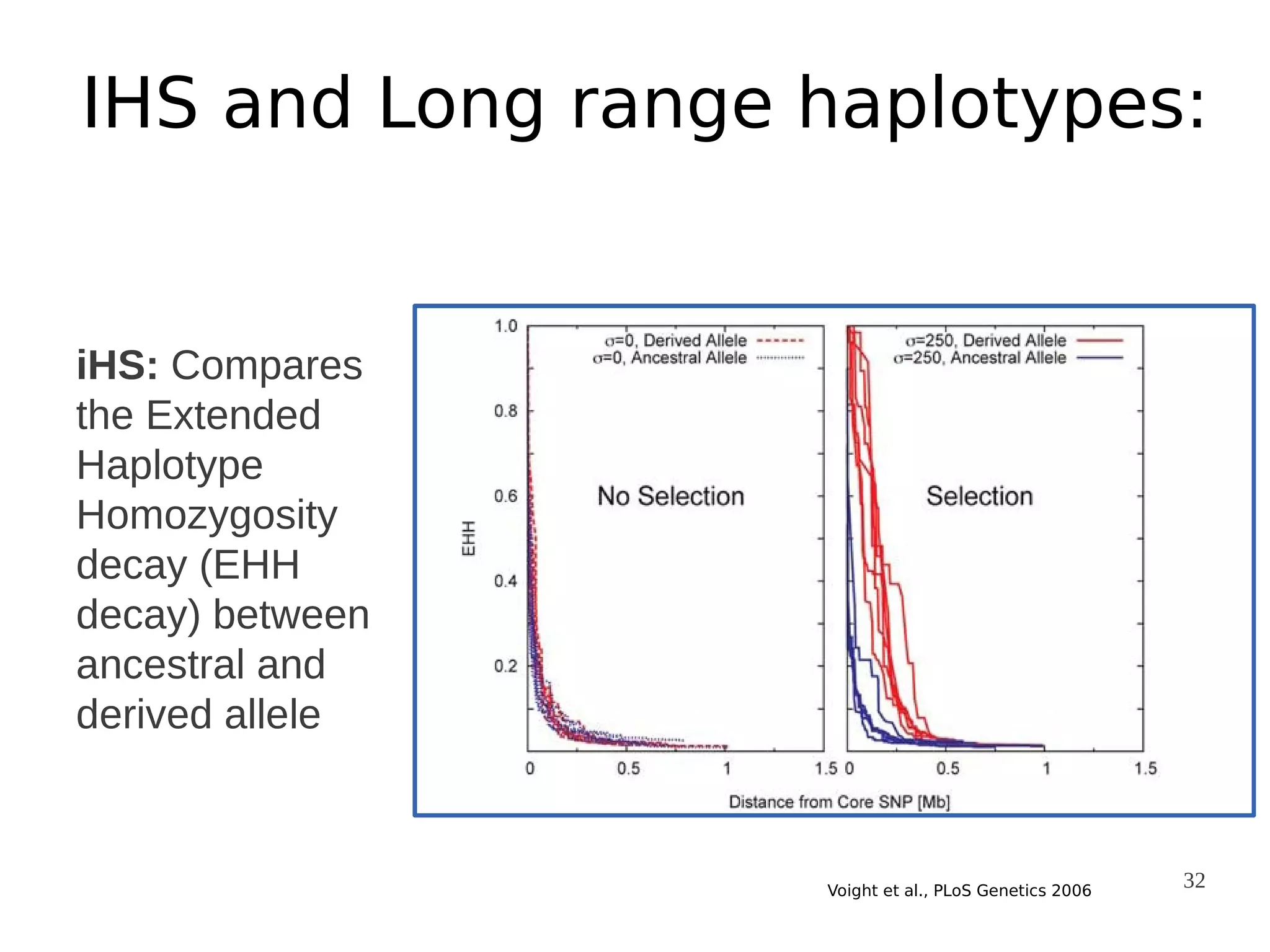
IHS and Long range haplotypes:

iHS: Compares
the Extended
Haplotype
Homozygosity
decay (EHH
decay) between
ancestral and
derived allele

Voight et al., PLoS Genetics 2006

32
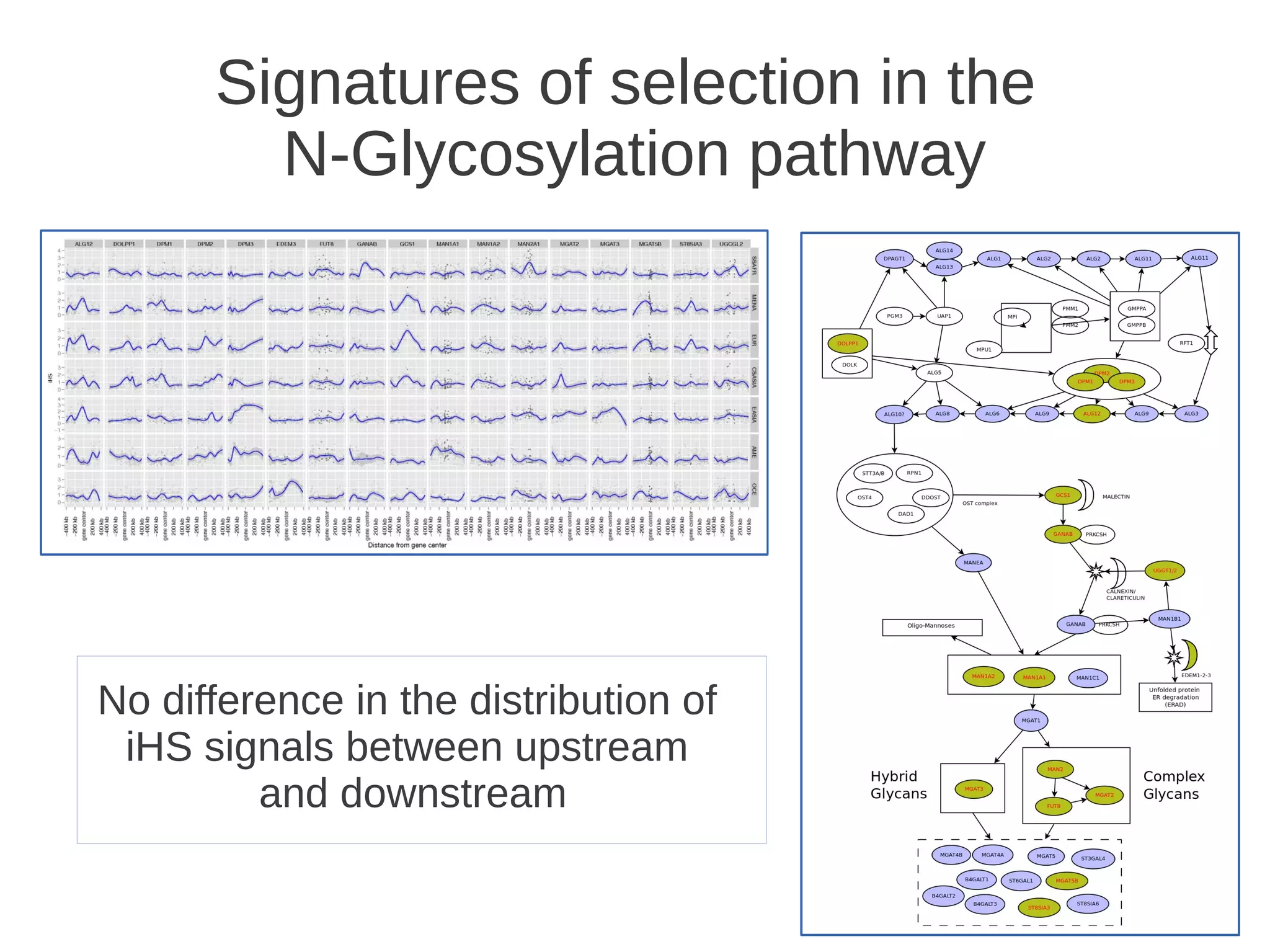
Signatures of selection in the
N-Glycosylation pathway

No difference in the distribution of
iHS signals between upstream
and downstream
33
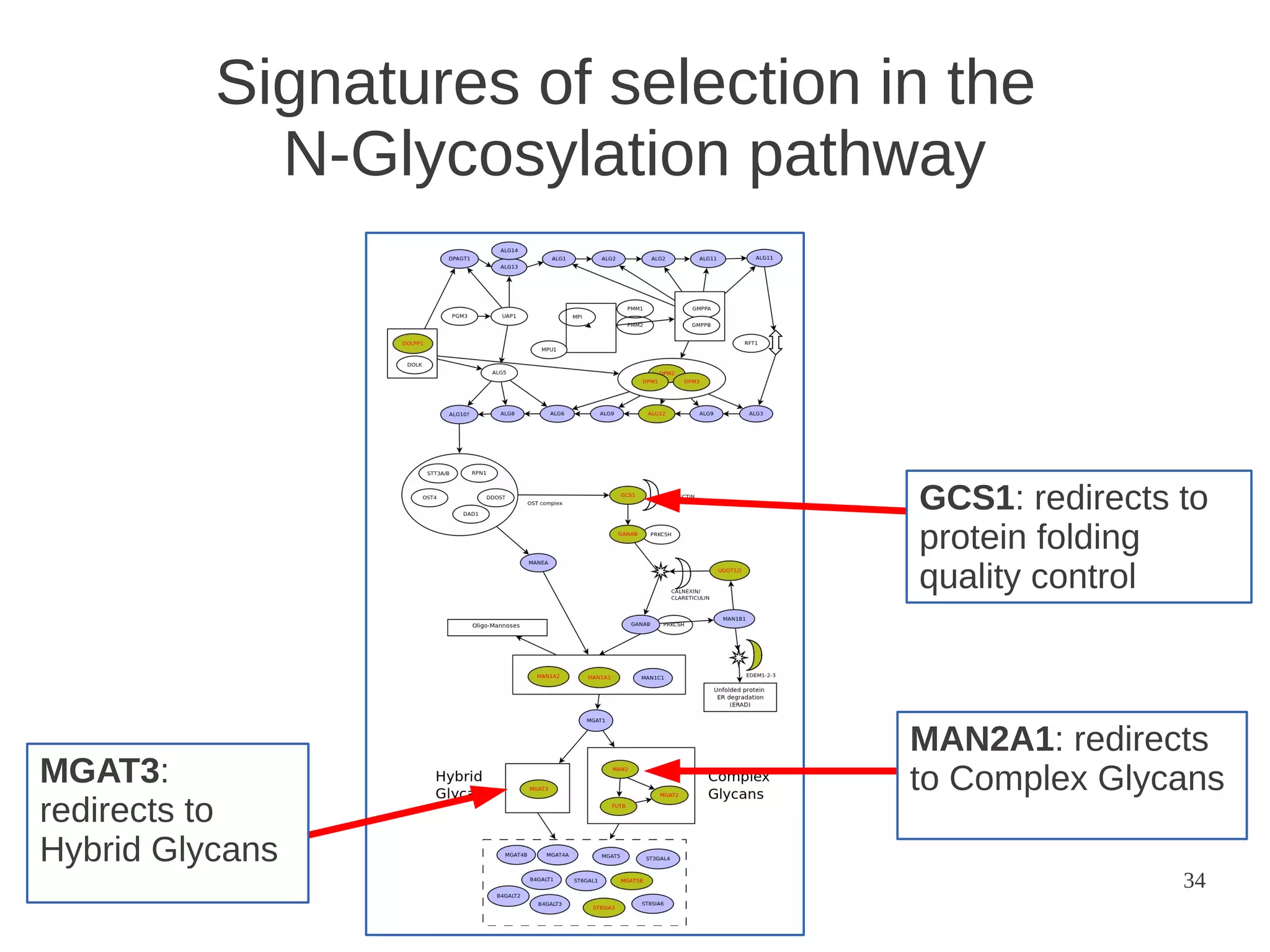
Signatures of selection in the
N-Glycosylation pathway

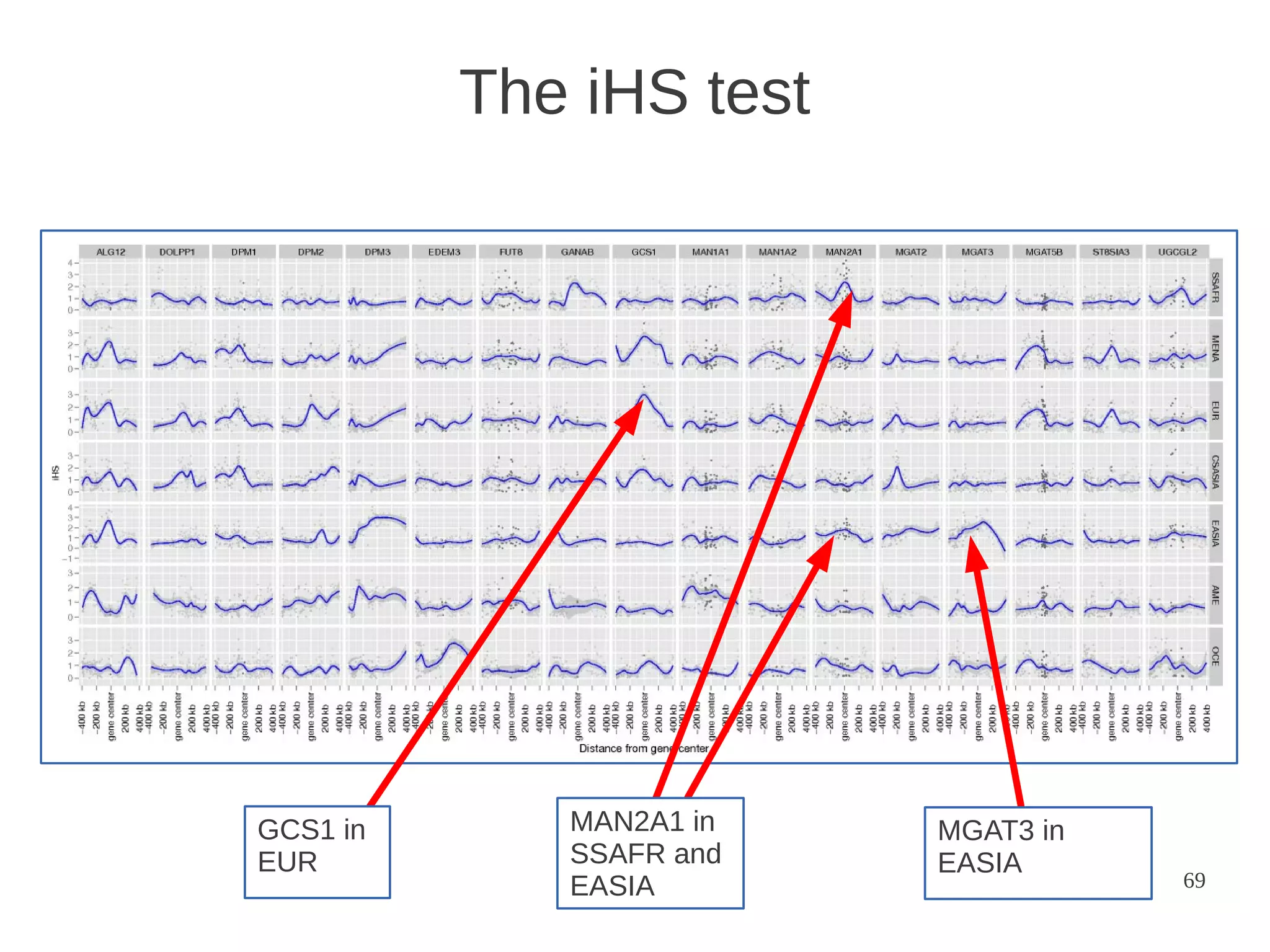
GCS1: redirects to
protein folding
quality control

MGAT3:
redirects to
Hybrid Glycans

MAN2A1: redirects
to Complex Glycans
34
Pathway approach on N-Glycosylation
●

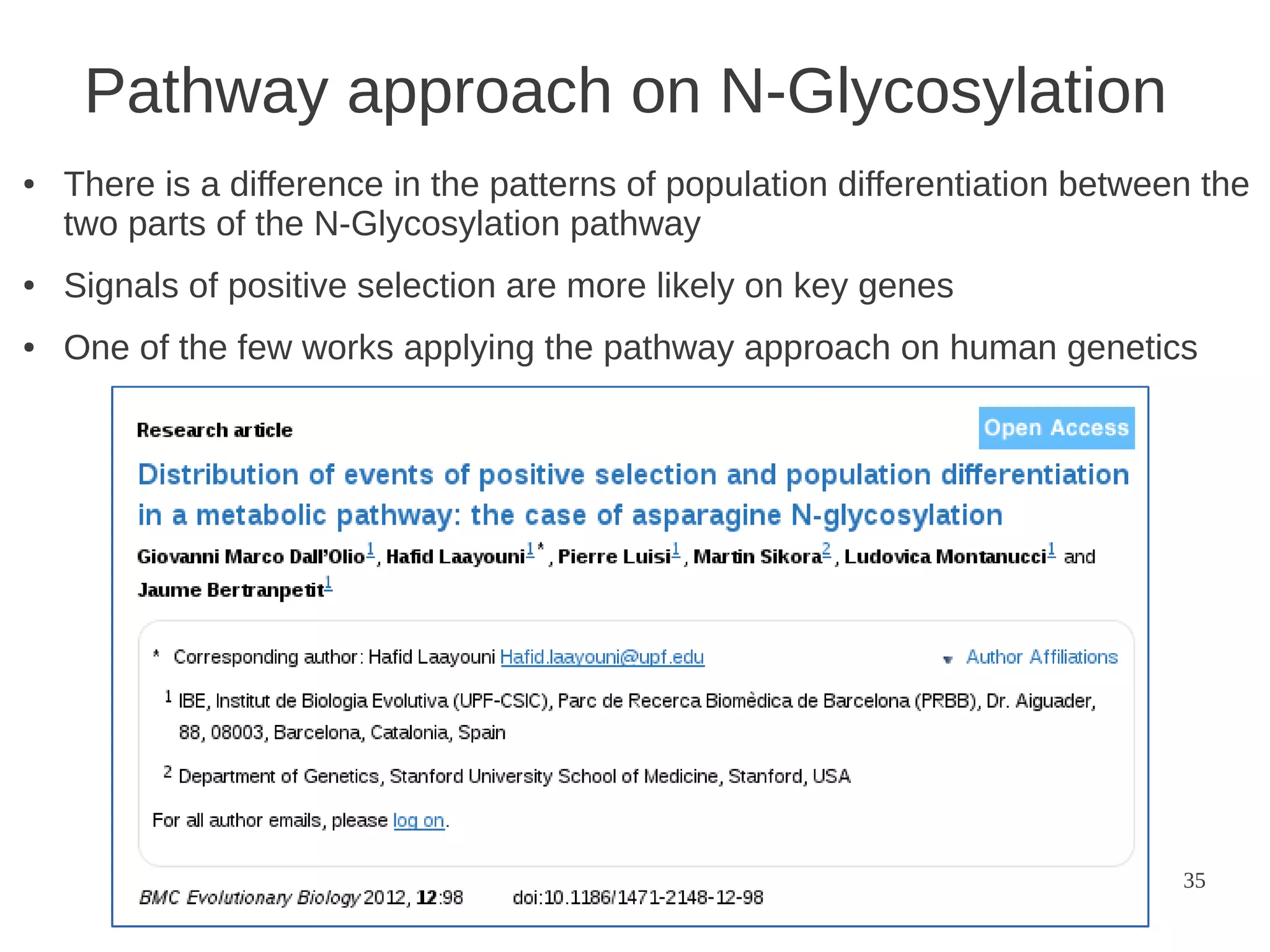
There is a difference in the patterns of population differentiation between the
two parts of the N-Glycosylation pathway

●

Signals of positive selection are more likely on key genes

●

One of the few works applying the pathway approach on human genetics

35
Topics
●

Context and motivations

●

My research:
–
–

Pathway approach on the N-Glycosylation pathway

–

The Genotype Network Approach

–
●

Annotating the N-Glycosylation pathway

The Human Selection Browser and Biostar

Conclusions

36
The Genotype Network approach
●

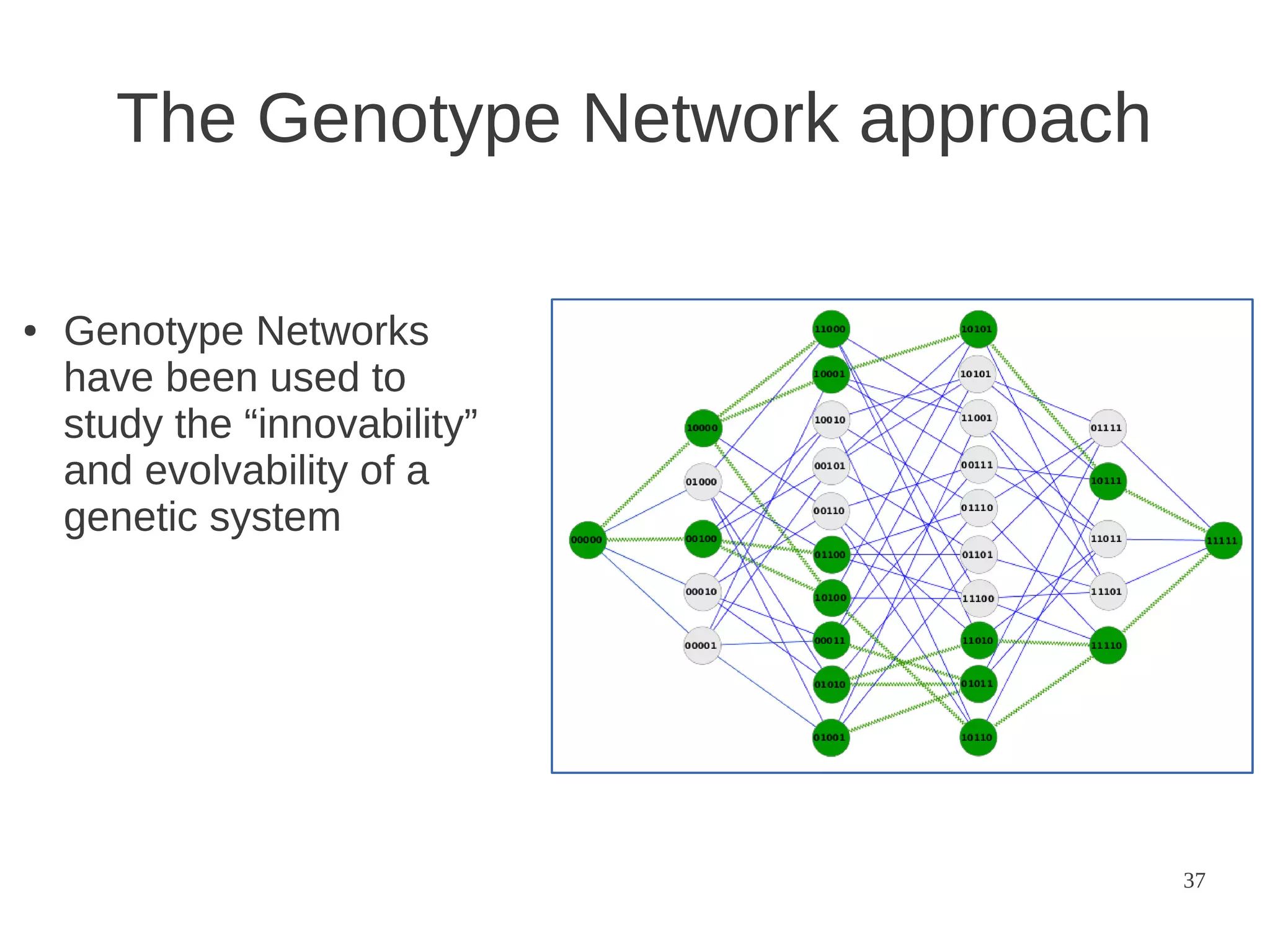
Genotype Networks
have been used to
study the “innovability”
and evolvability of a
genetic system

37
The Genotype Network approach
●

●

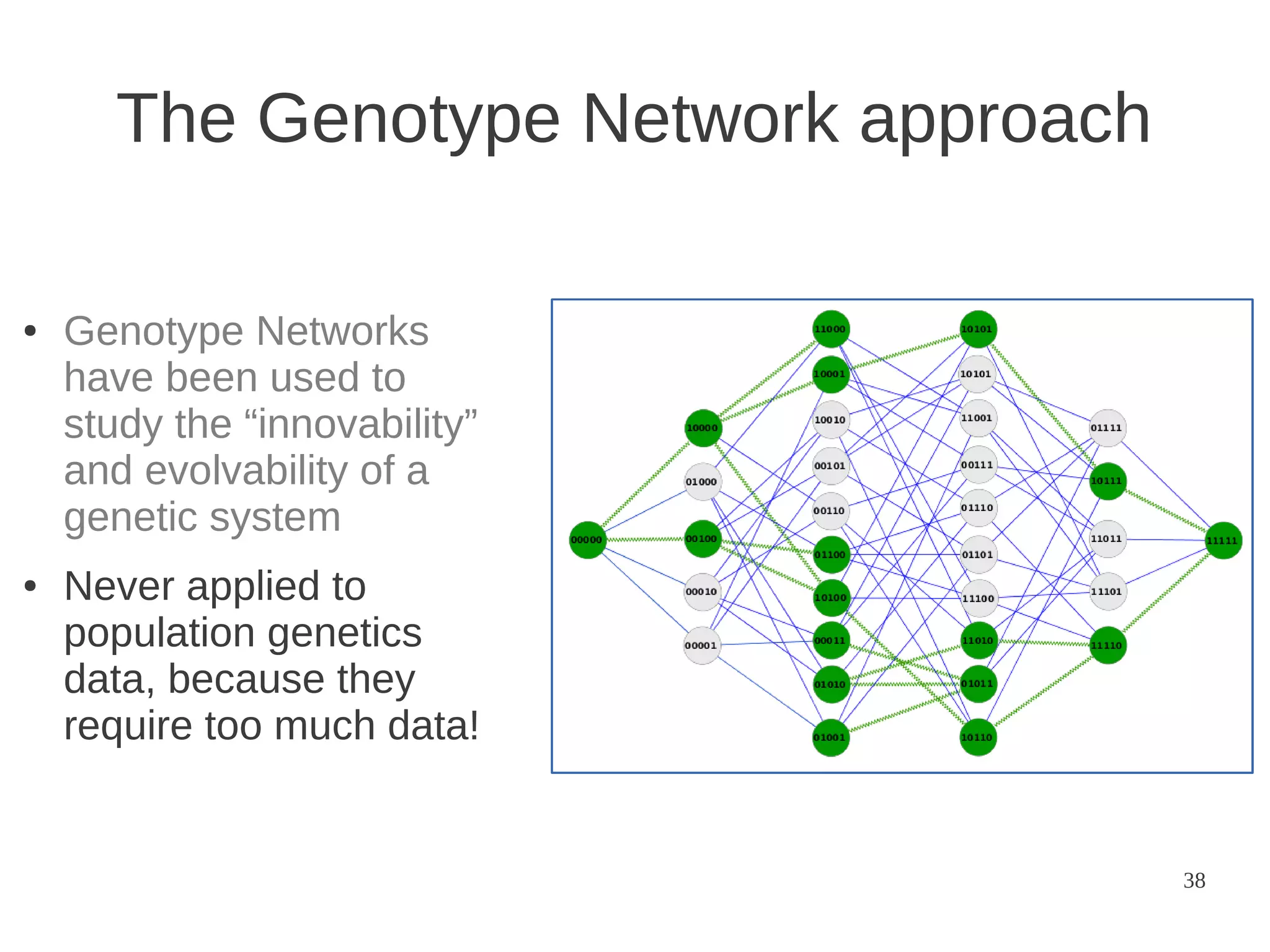
Genotype Networks
have been used to
study the “innovability”
and evolvability of a
genetic system
Never applied to
population genetics
data, because they
require too much data!

38
Genotype Networks - theory
●

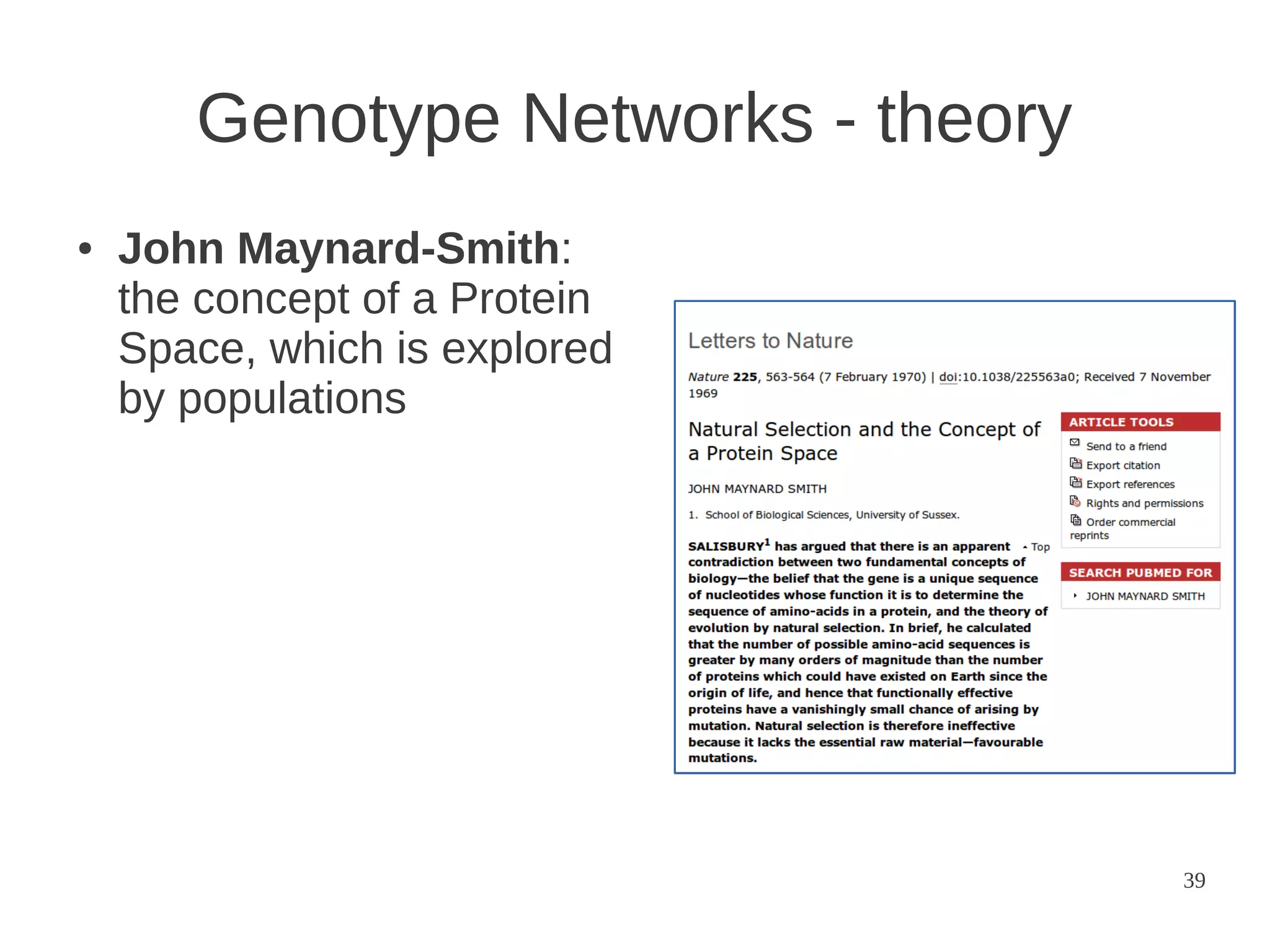
John Maynard-Smith:
the concept of a Protein
Space, which is explored
by populations

39
Genotype Networks - theory
●

John Maynard-Smith:
the concept of a Protein
Space, which is explored
by populations

“if evolution by natural selection is
to occur, functional proteins [or
DNA sequences] must form a
continuous network which can be
traversed by unit mutational steps
without passing through nonfunctional intermediates”
40
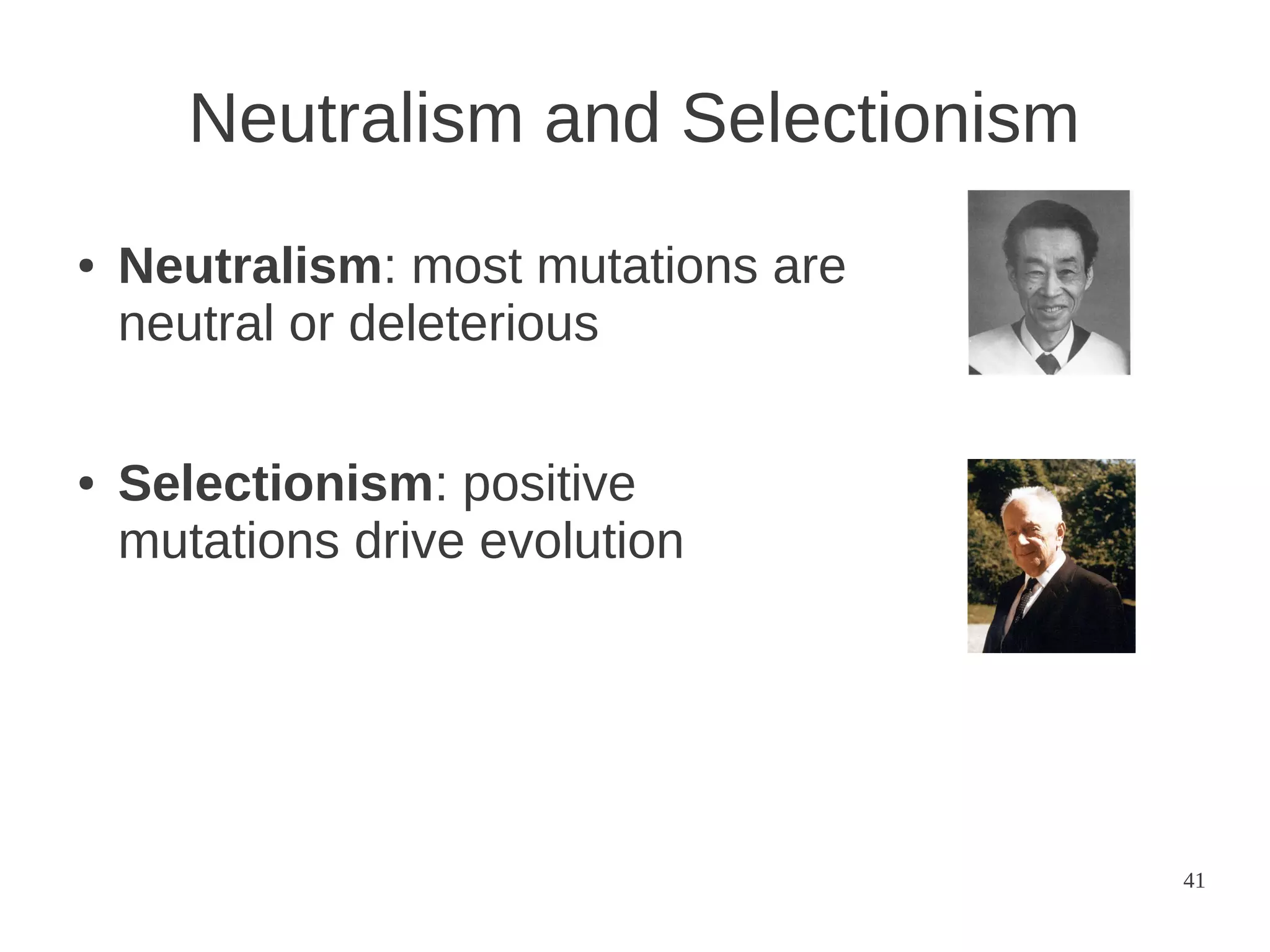
Neutralism and Selectionism
●

●

Neutralism: most mutations are
neutral or deleterious
Selectionism: positive
mutations drive evolution

41
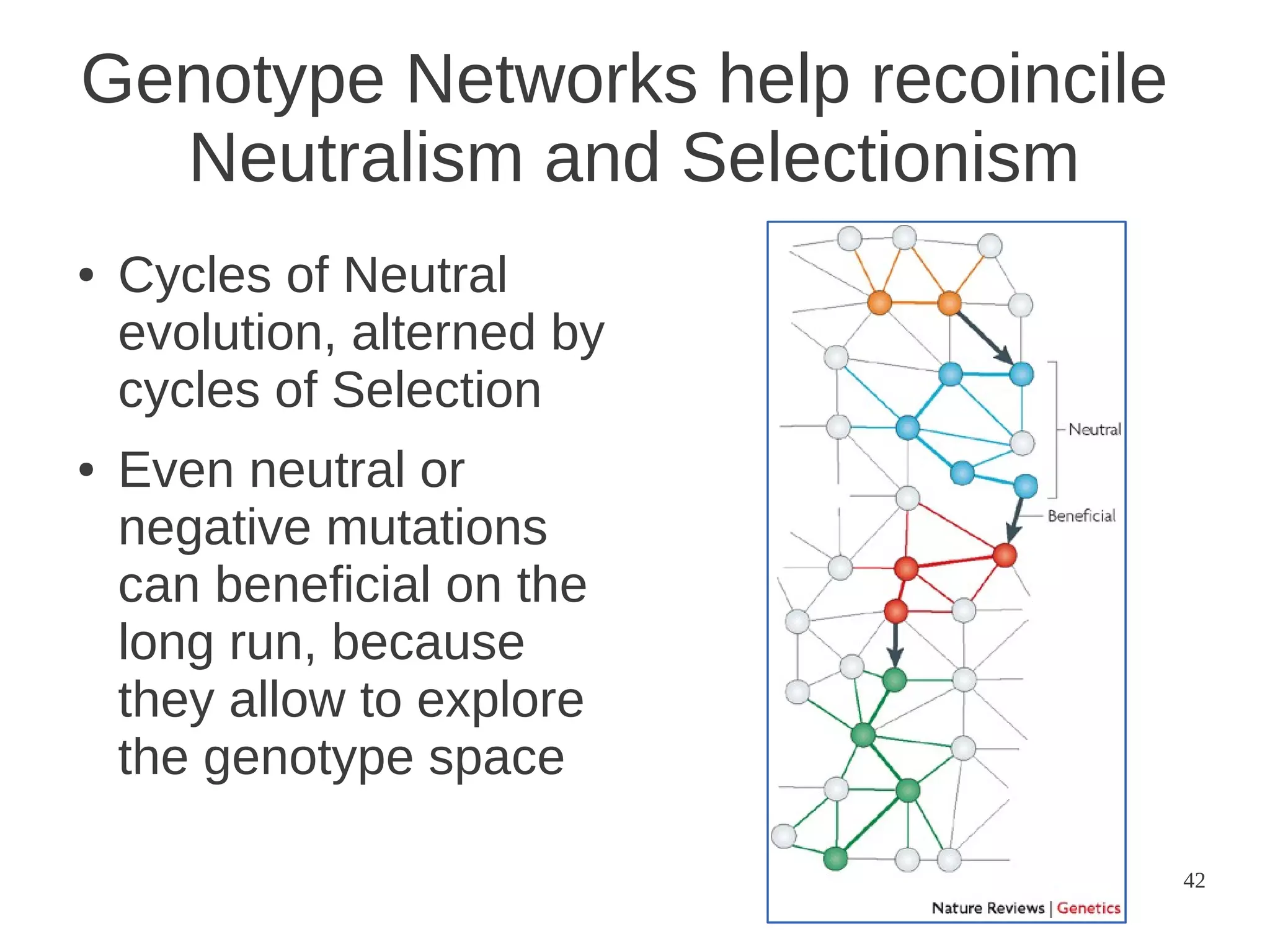
Genotype Networks help recoincile
Neutralism and Selectionism
●

●

Cycles of Neutral
evolution, alterned by
cycles of Selection
Even neutral or
negative mutations
can beneficial on the
long run, because
they allow to explore
the genotype space
42
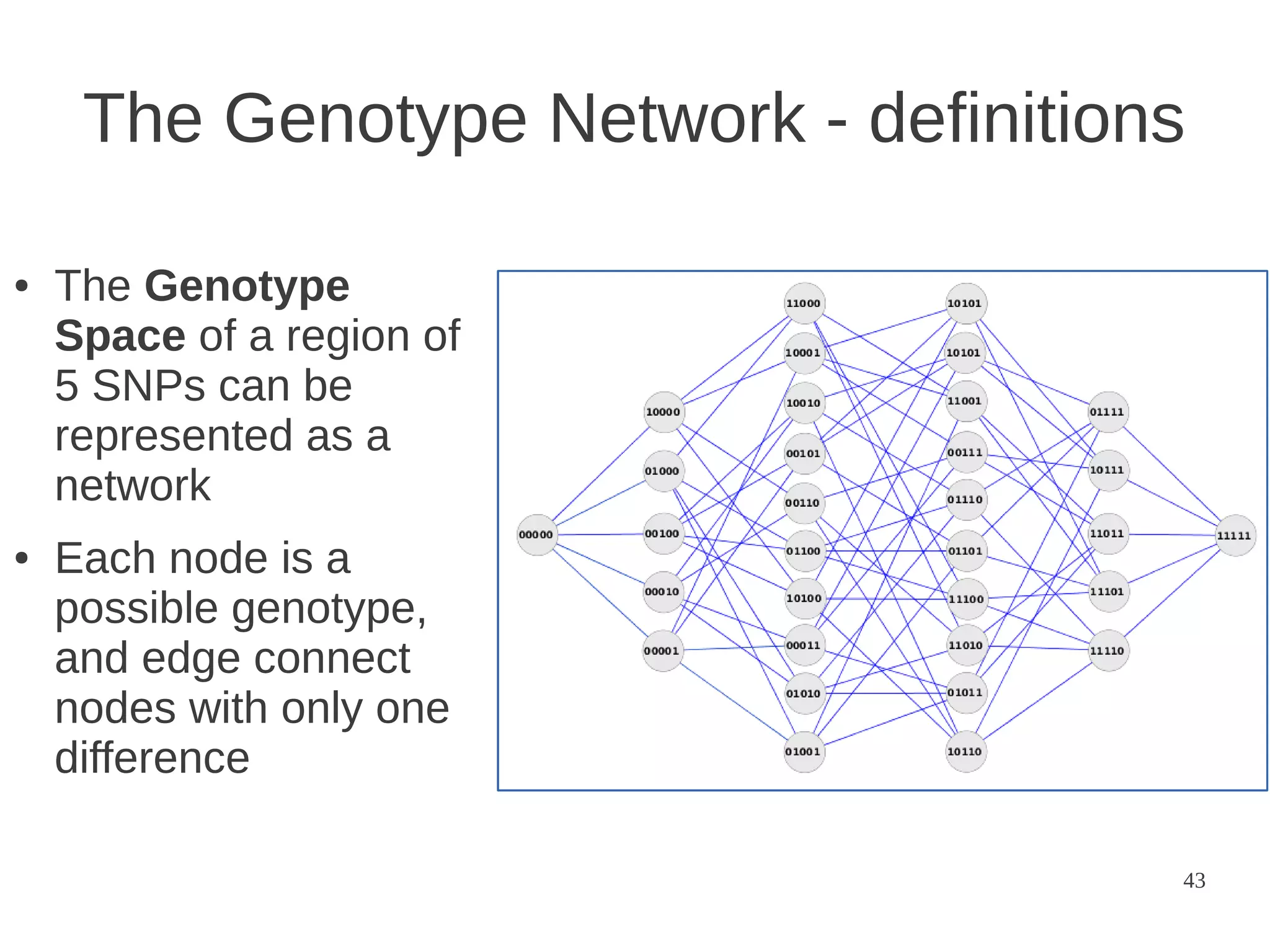
The Genotype Network - definitions
●

●

The Genotype
Space of a region of
5 SNPs can be
represented as a
network
Each node is a
possible genotype,
and edge connect
nodes with only one
difference
43
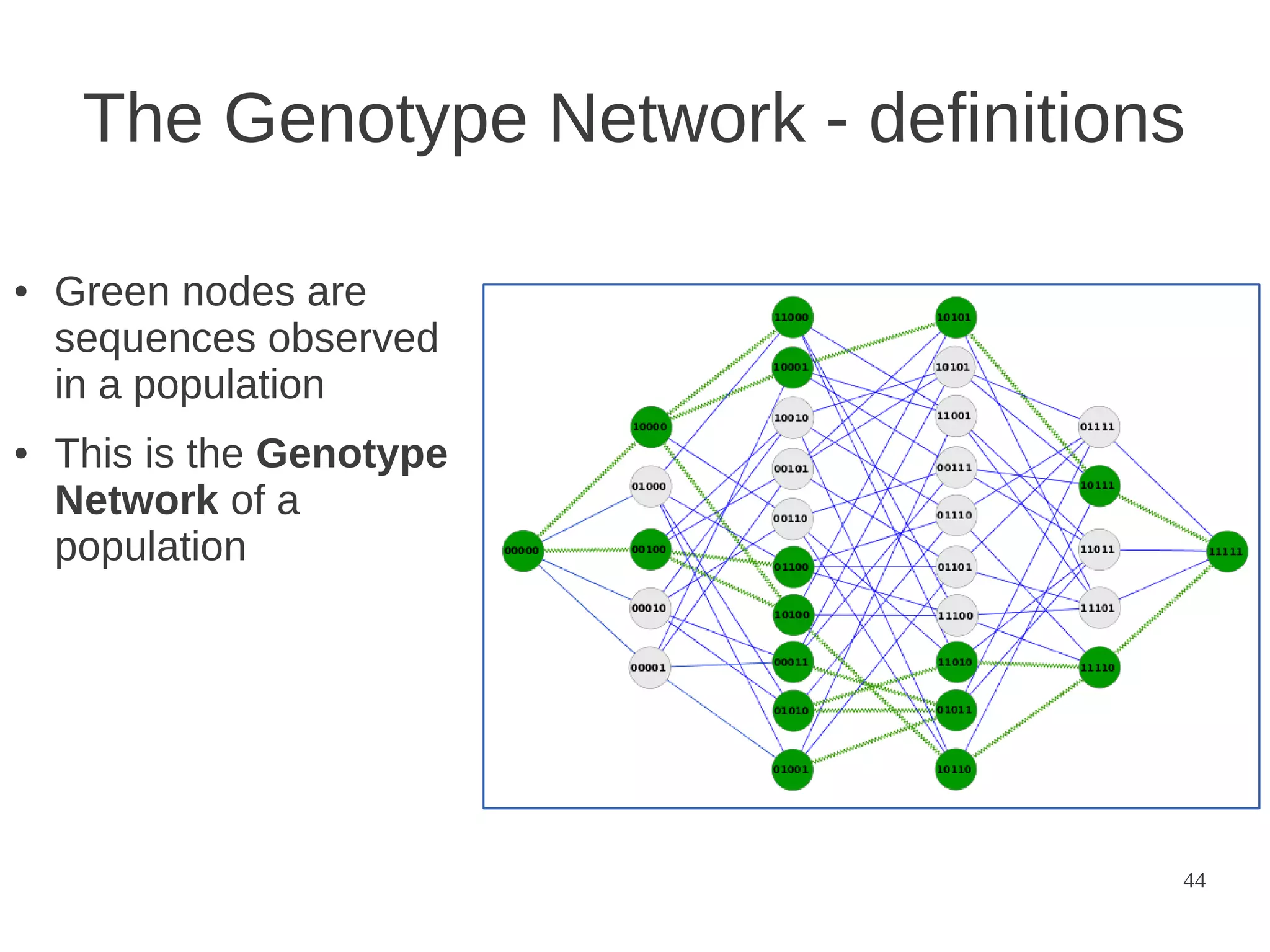
The Genotype Network - definitions
●

●

Green nodes are
sequences observed
in a population
This is the Genotype
Network of a
population

44
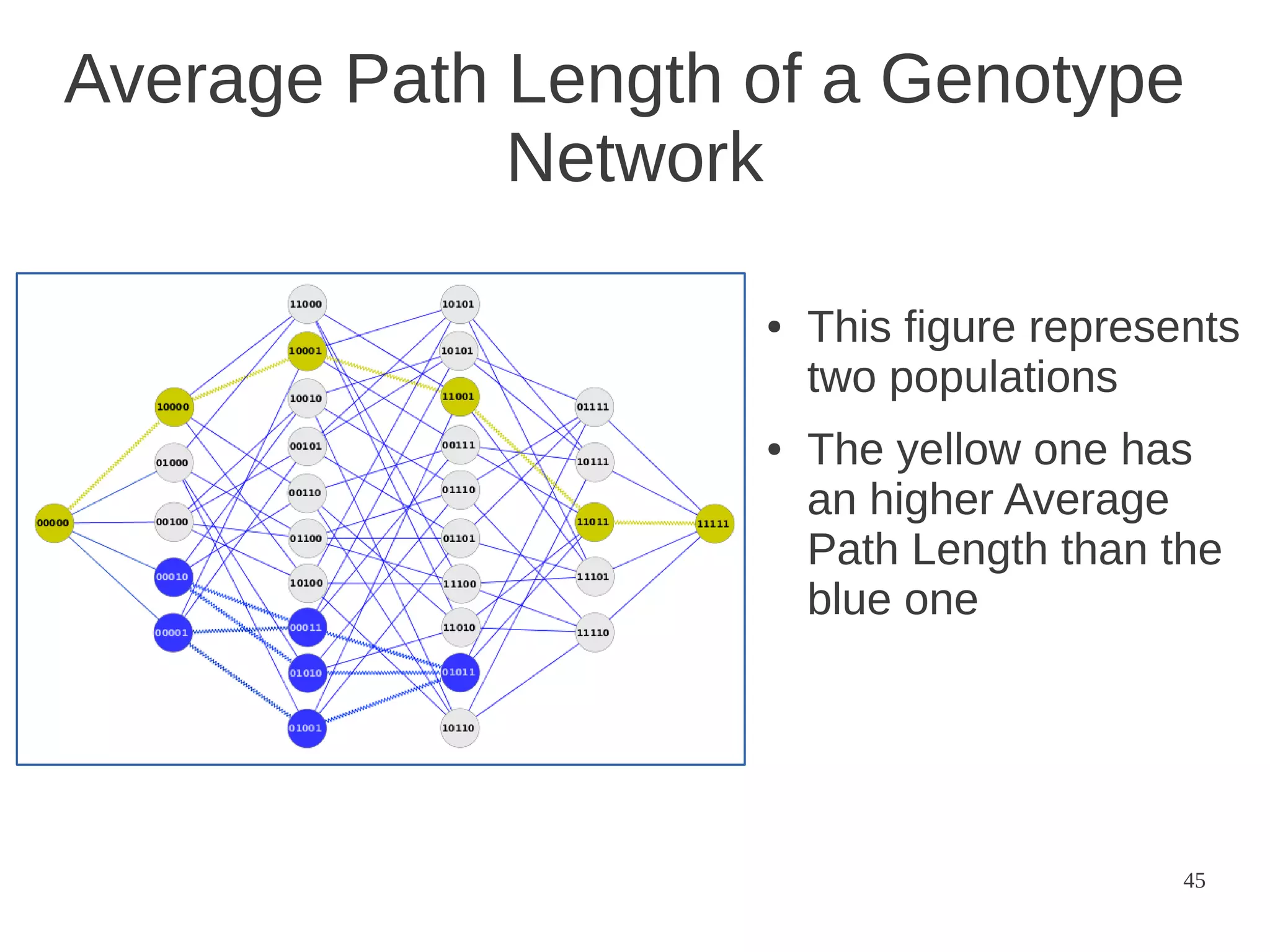
Average Path Length of a Genotype
Network
●

●

This figure represents
two populations
The yellow one has
an higher Average
Path Length than the
blue one

45
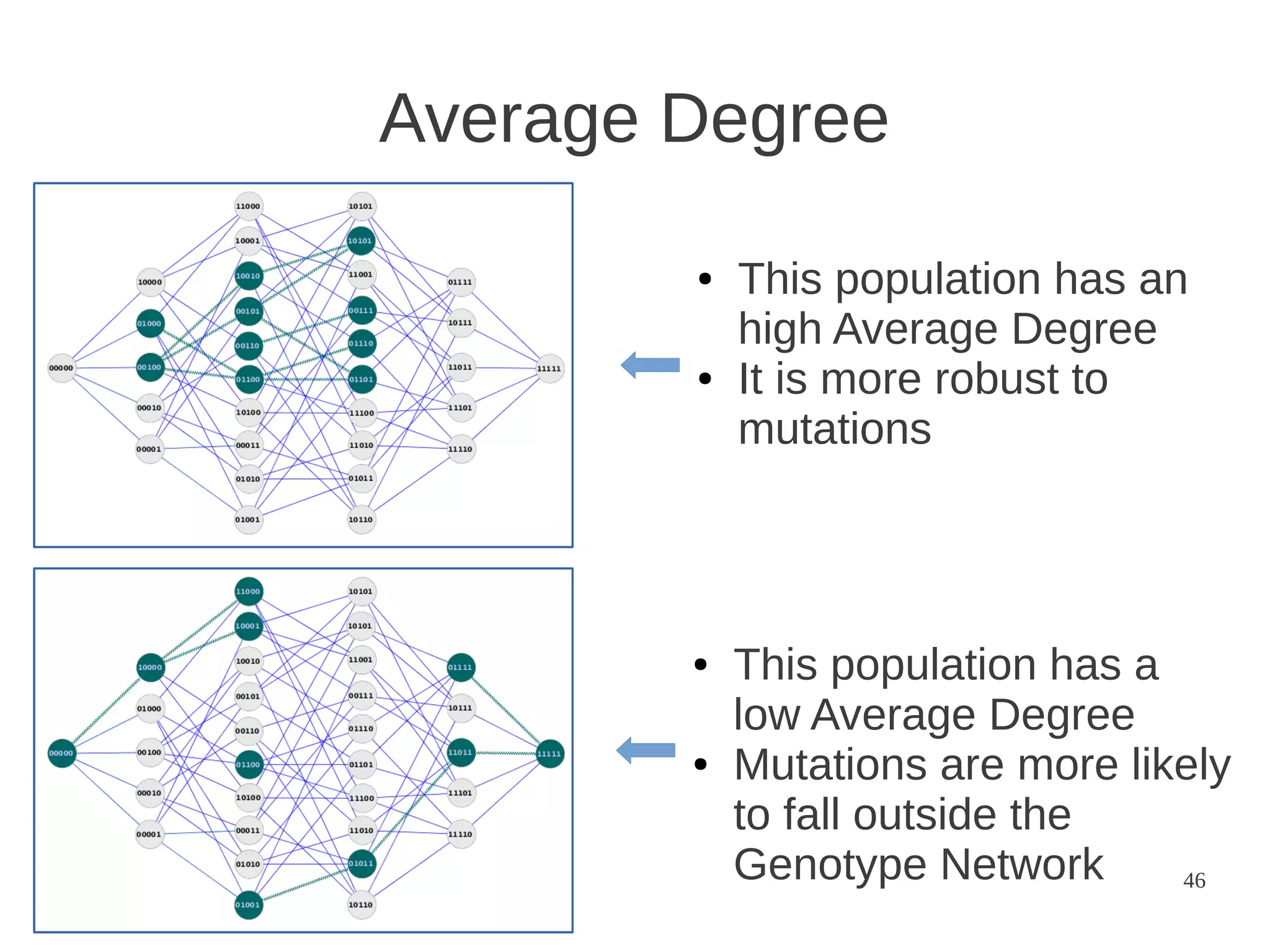
Average Degree
●

●

●

●

This population has an
high Average Degree
It is more robust to
mutations

This population has a
low Average Degree
Mutations are more likely
to fall outside the
Genotype Network
46
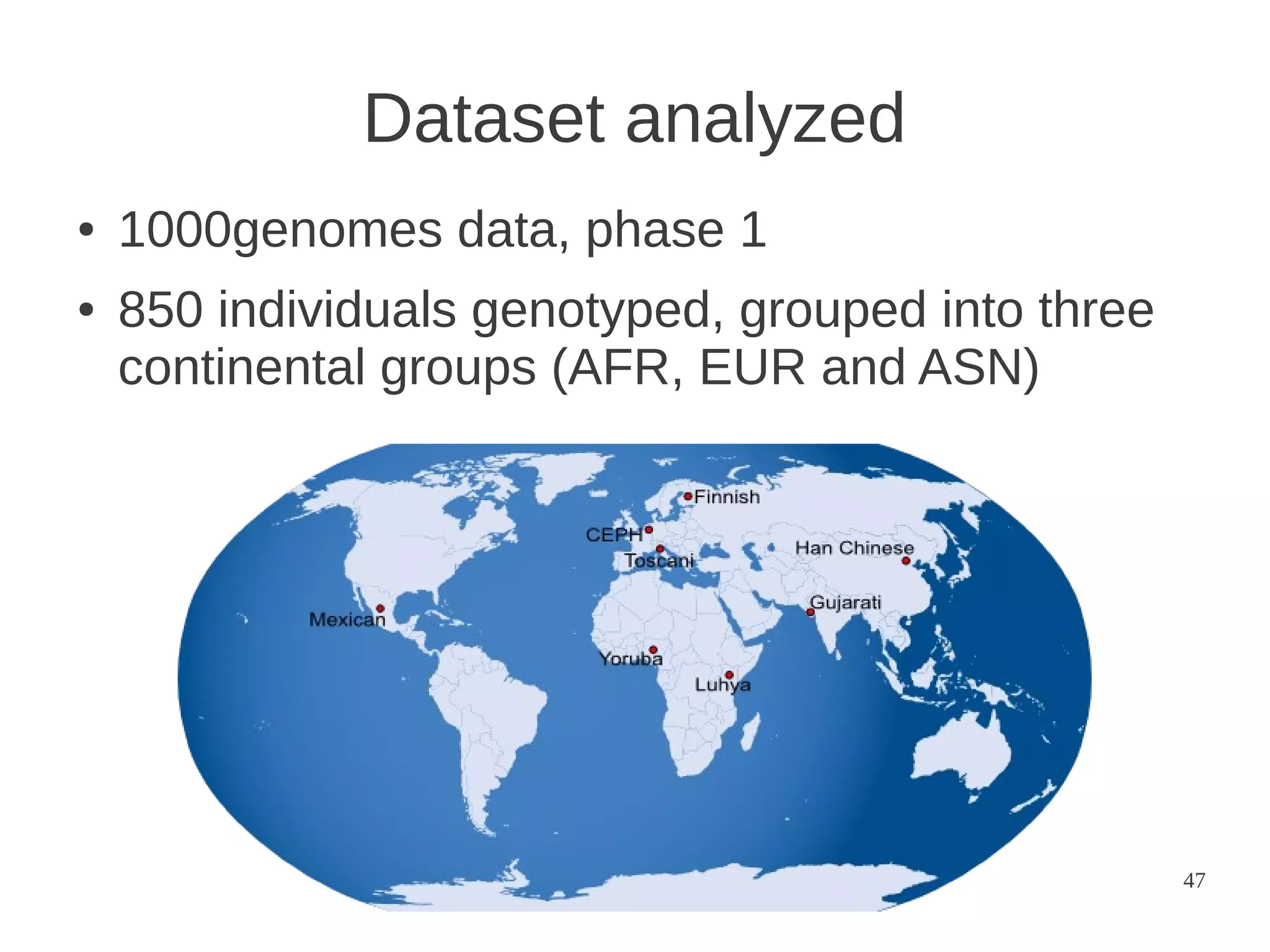
Dataset analyzed
●
●

1000genomes data, phase 1
850 individuals genotyped, grouped into three
continental groups (AFR, EUR and ASN)

47
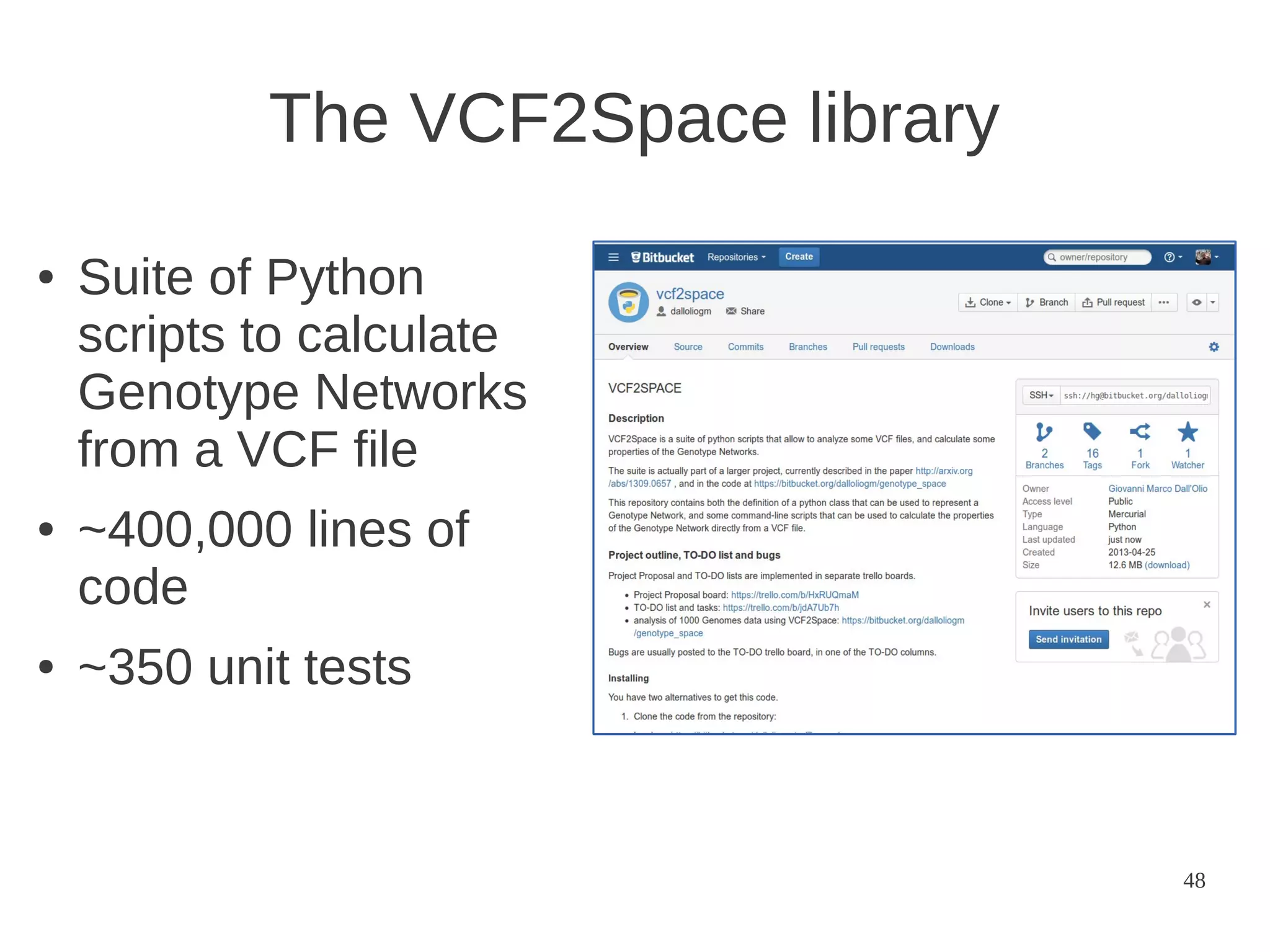
The VCF2Space library
●

●

●

Suite of Python
scripts to calculate
Genotype Networks
from a VCF file
~400,000 lines of
code
~350 unit tests

48
Splitting the genome into windows
of 11 SNPs
●

●

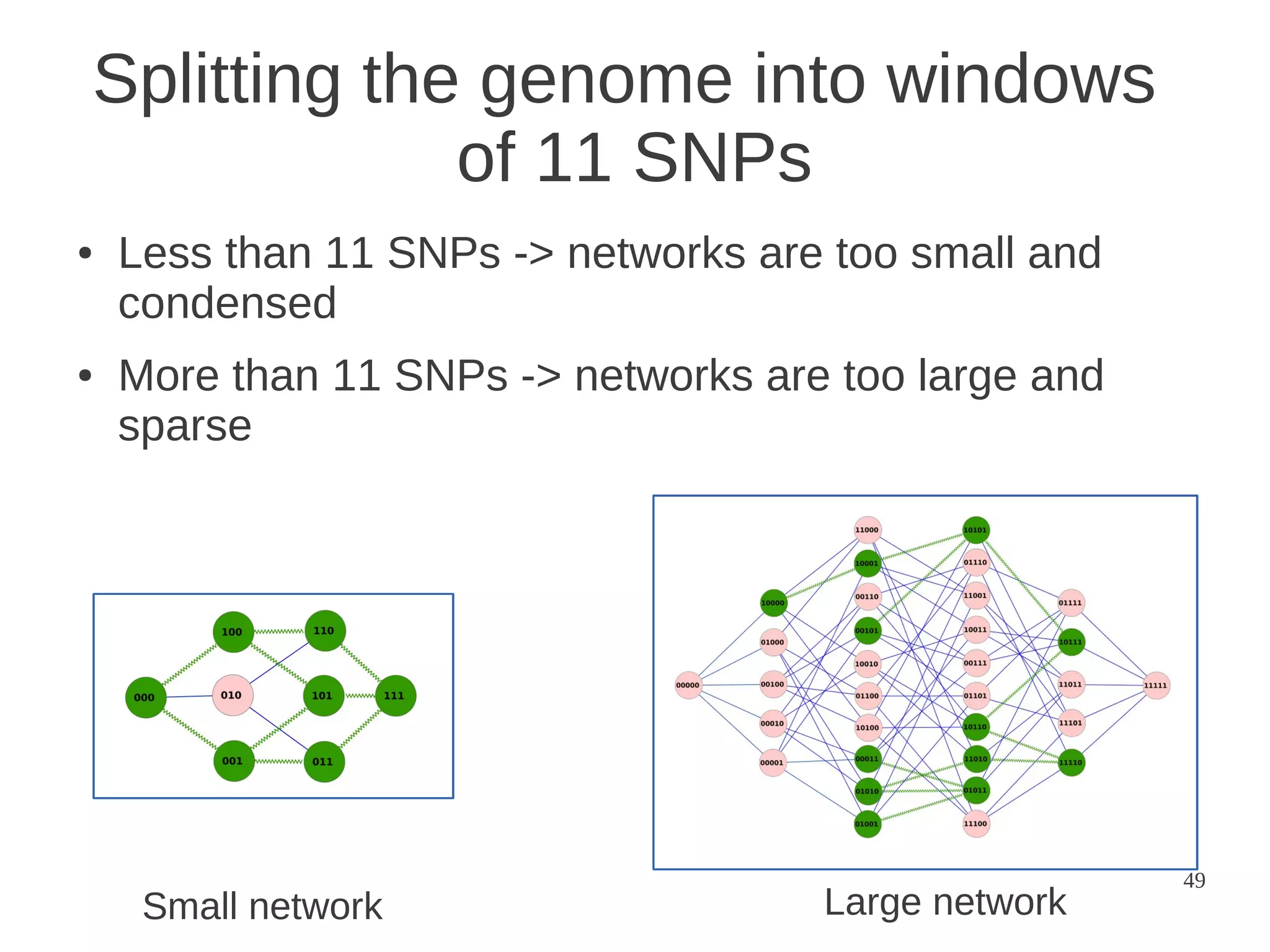
Less than 11 SNPs -> networks are too small and
condensed
More than 11 SNPs -> networks are too large and
sparse

Small network

Large network

49
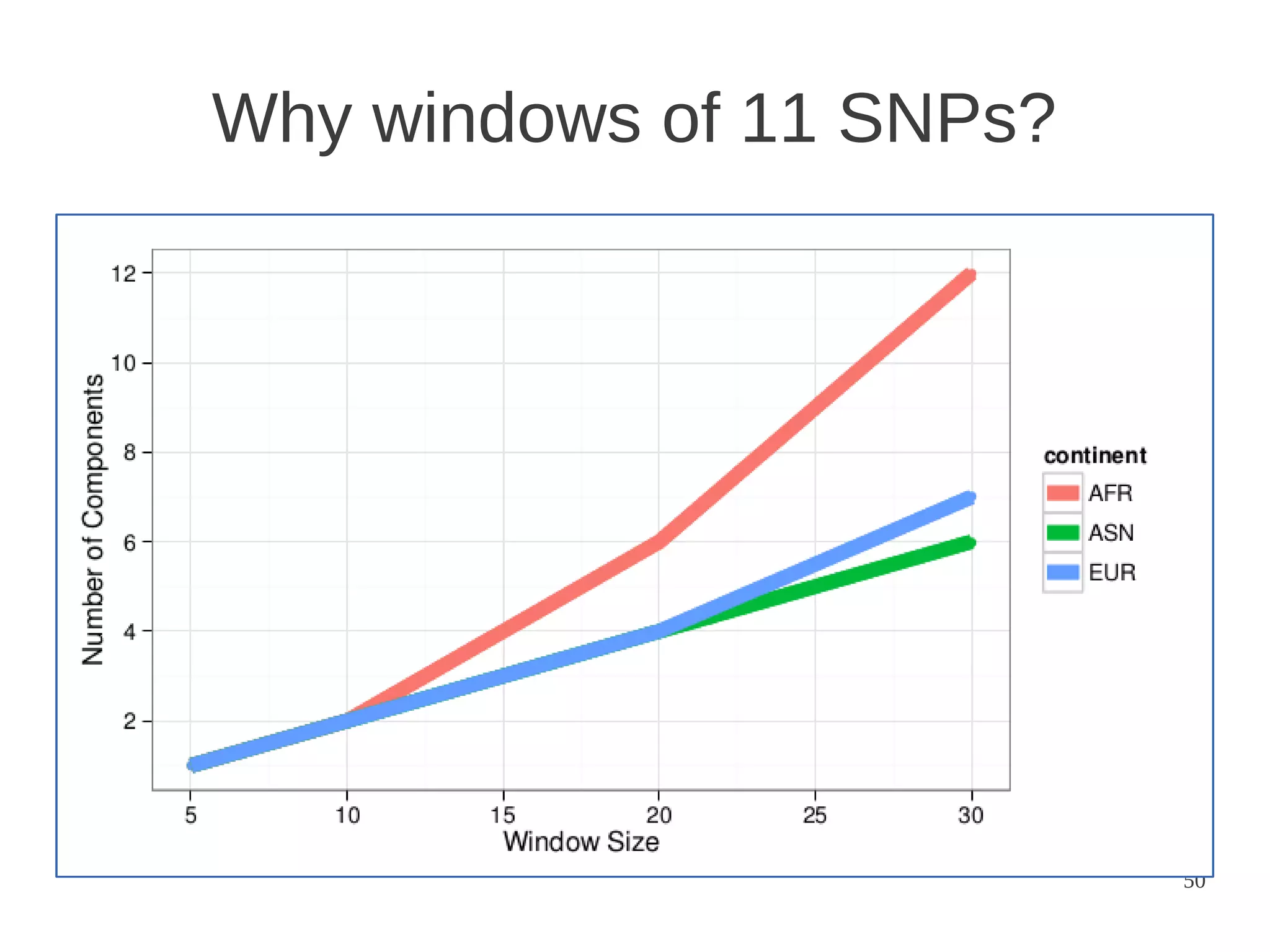
Why windows of 11 SNPs?

50
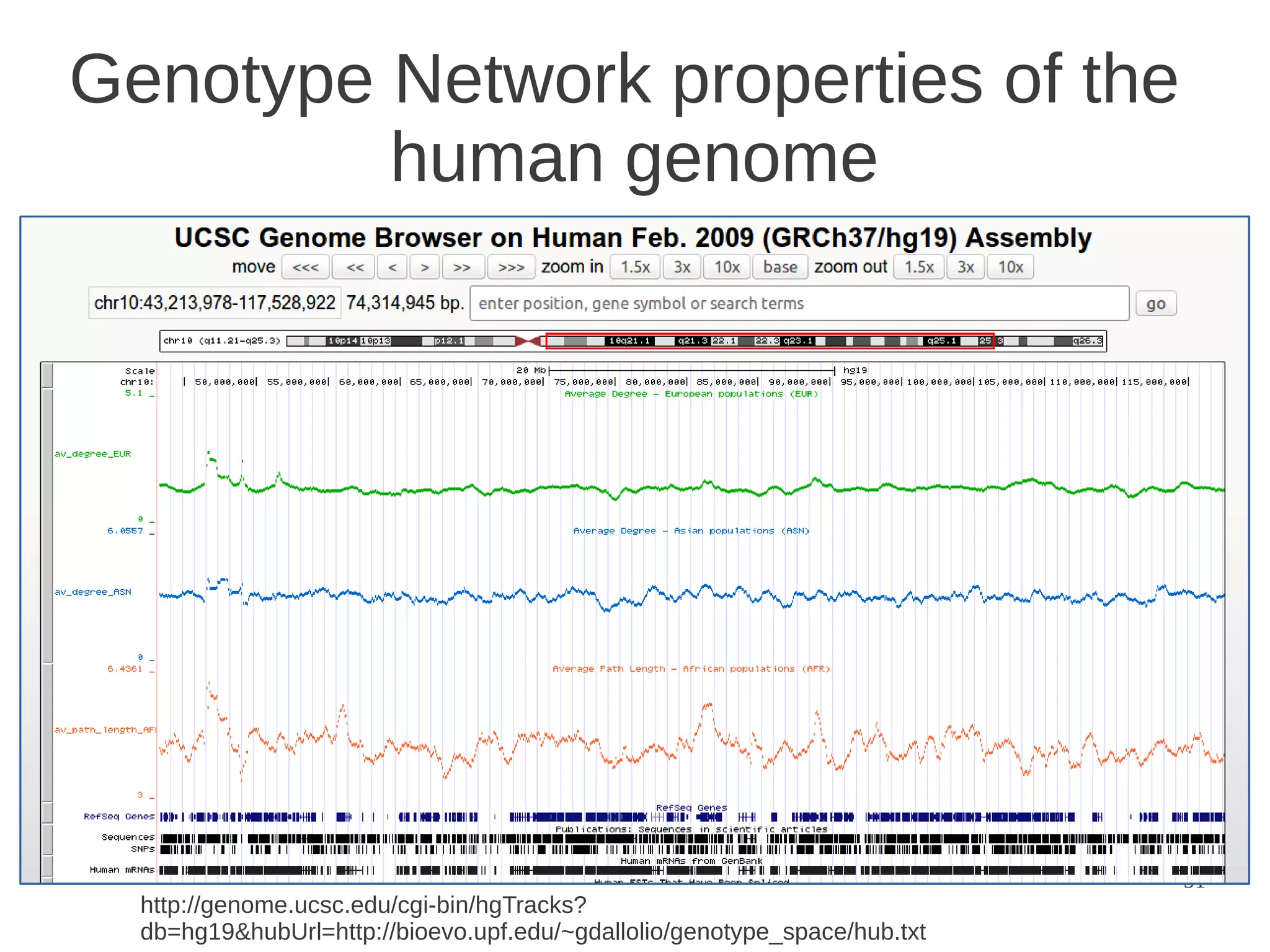
Genotype Network properties of the
human genome

http://genome.ucsc.edu/cgi-bin/hgTracks?
db=hg19&hubUrl=http://bioevo.upf.edu/~gdallolio/genotype_space/hub.txt

51
Coding & Non-Coding regions
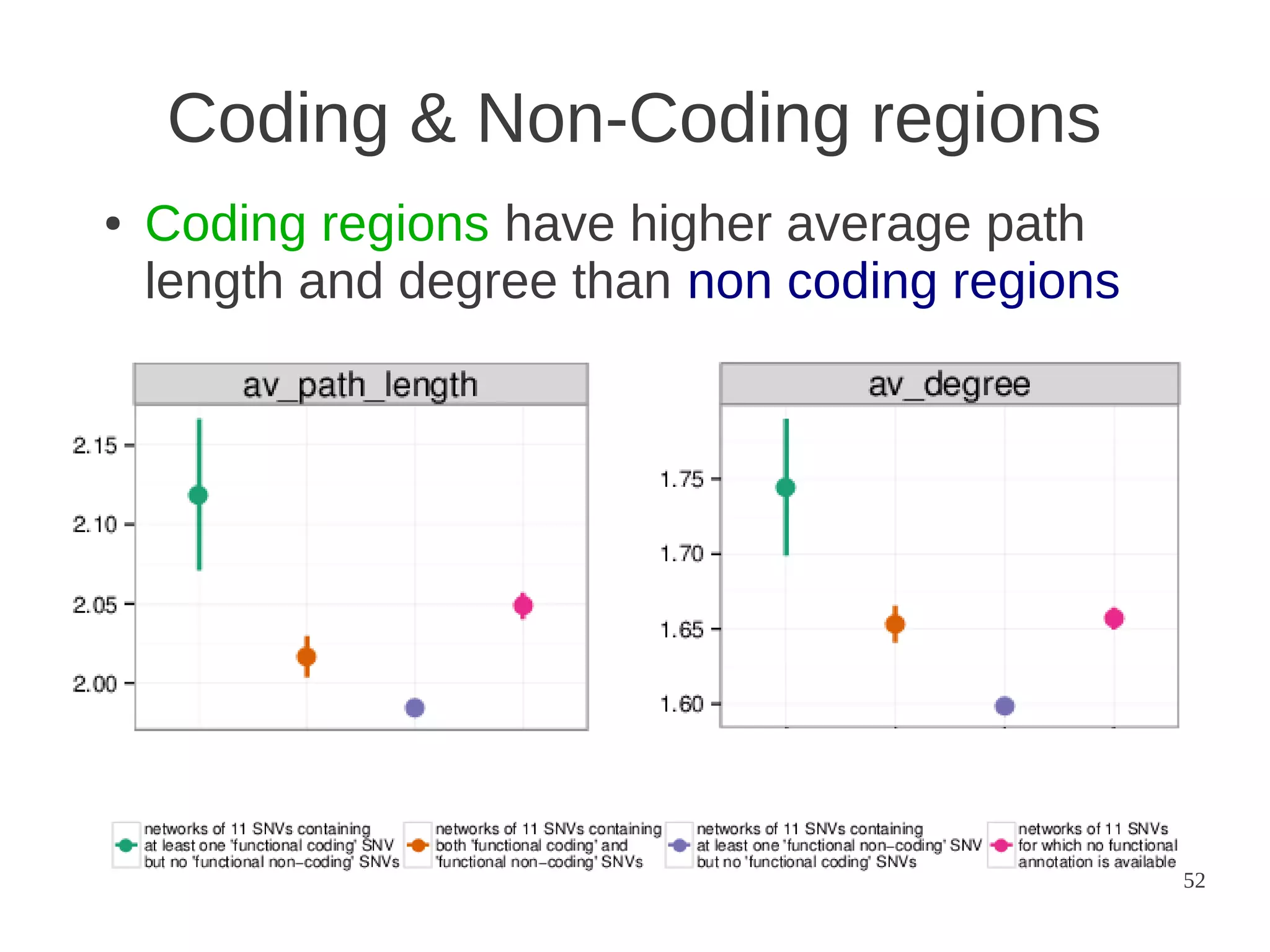
●

Coding regions have higher average path
length and degree than non coding regions

52
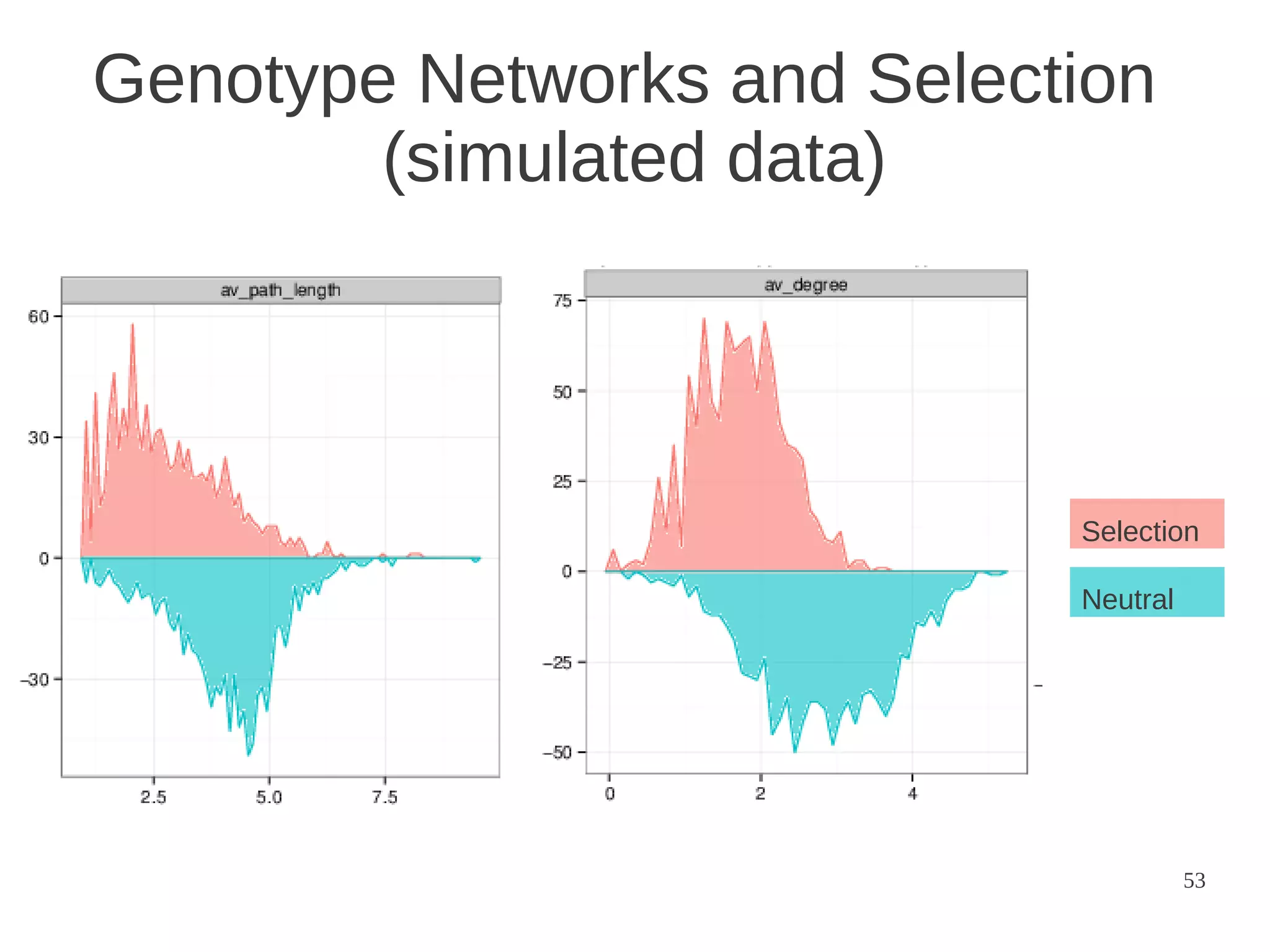
Genotype Networks and Selection
(simulated data)

Selection
Neutral

53
●

●

●

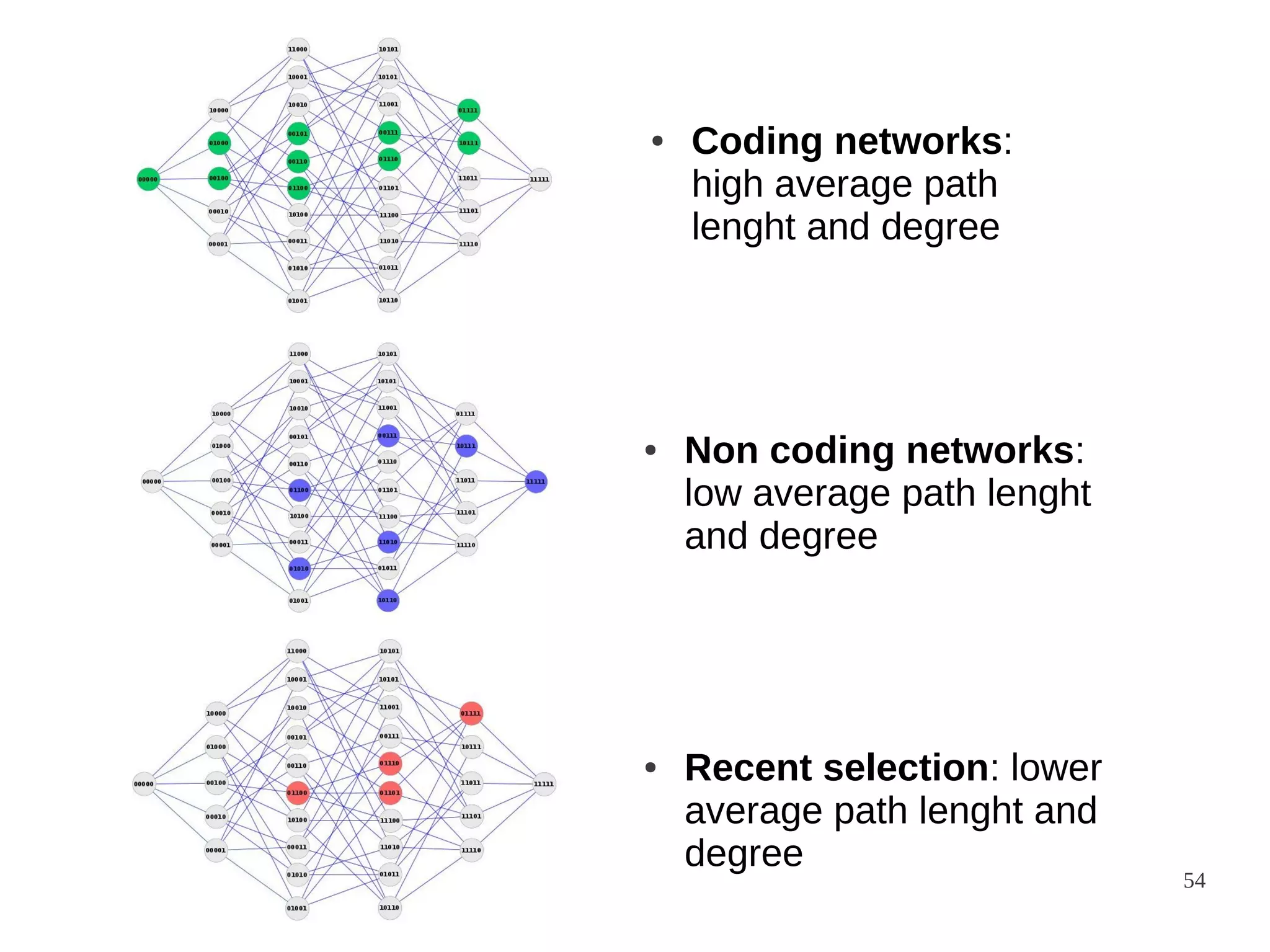
Coding networks:
high average path
lenght and degree

Non coding networks:
low average path lenght
and degree

Recent selection: lower
average path lenght and
degree

54
Genotype Network:
currently under review..

55
Topics
●

Context and motivations

●

My research:
–
–

Pathway approach on the N-Glycosylation pathway

–

The Genotype Network Approach

–
●

Annotating the N-Glycosylation pathway

The Human Selection Browser and Biostar

Conclusions

56
Other works: The Human Selection
Browser
●

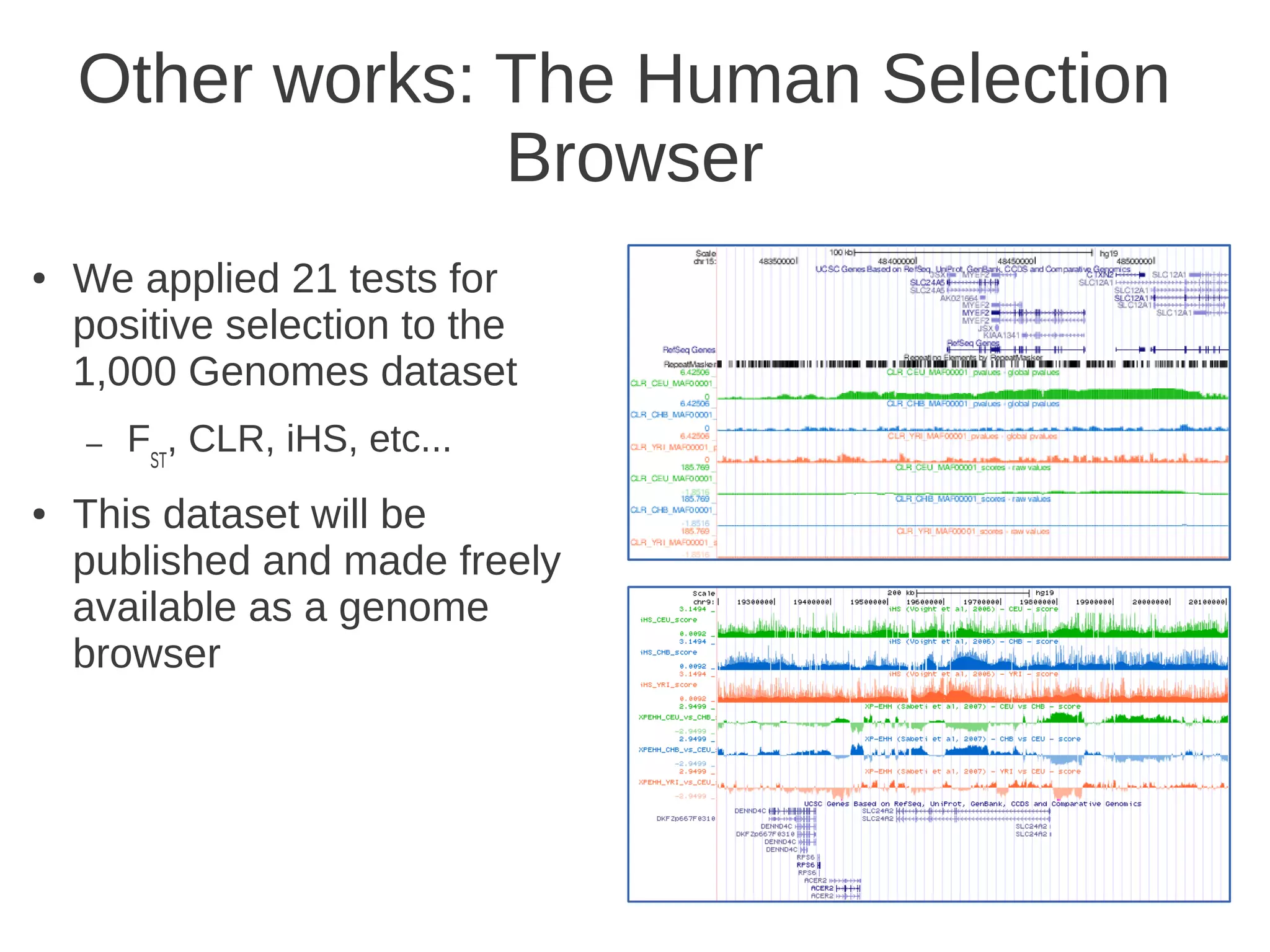
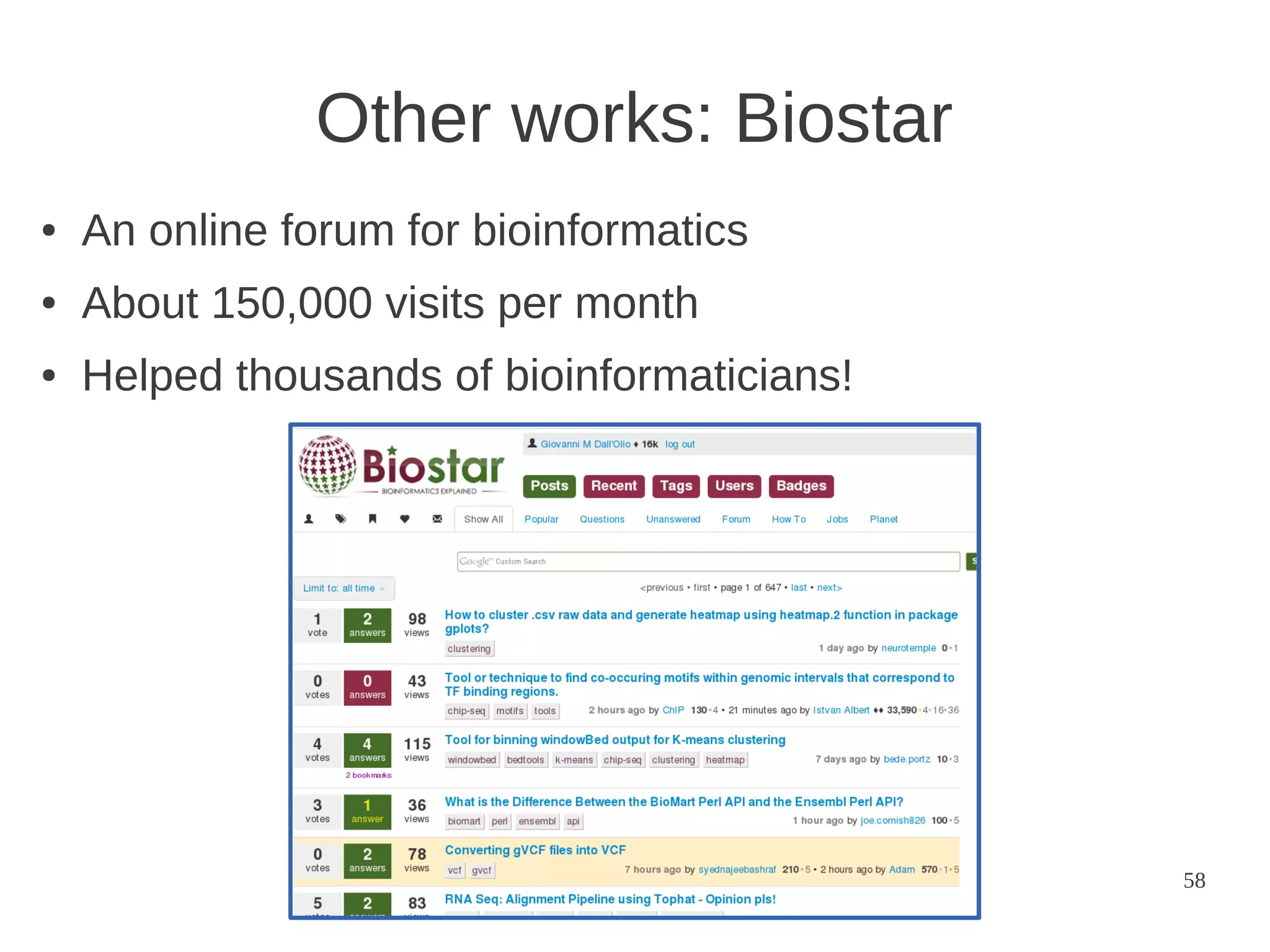
We applied 21 tests for
positive selection to the
1,000 Genomes dataset
–

●

FST, CLR, iHS, etc...

This dataset will be
published and made freely
available as a genome
browser

57
Other works: Biostar
●

An online forum for bioinformatics

●

About 150,000 visits per month

●

Helped thousands of bioinformaticians!

58
Topics
●

Context and motivations

●

My research:
–
–

Pathway approach on the N-Glycosylation pathway

–

The Genotype Network Approach

–
●

Annotating the N-Glycosylation pathway

The Human Selection Browser and Biostar

Conclusions

59
Conclusions (I)
●

●

●

●

We developed two applications of network theory to the study
of human population genetics.
We produced a network model of the N-Glycosylation
pathway, contributing it to the Reactome database and
improving the annotations in other databases.
We showed that the downstream part of the N-Glycosylation
pathway shows more signatures of genetic differentiation than
the upstream part. This is compatible with the role and
structure of this part of the pathway.
We showed that key genes of the N-Glycosylation pathway,
such as GCS1, MGAT3 and MAN2A1, show signatures of
recent positive selection in human populations.
60
Conclusions (II)
●

●

●

We produced a suite of Python scripts, called
VCF2Space, to apply the concept of Genotype
Networks to Single Nucleotide Polimorphism data
Our genome-wide application of Genotype Networks
showed that coding regions tend to have networks
with higher average degree and path length than
non-coding regions
We contributed positively to the bioinformatics
community, providing resources such as the 1000
Genomes Selection Browser and Biostar
61
63
Figures credits
●

●

●

Slide 5:
humans: http://blogs.ancestry.com/ancestry/
star trek: http://en.wikipedia.org/wiki/Star_Trek:_The_Original_Series
Slide 6:
Malaria: http://science.psu.edu/news-and-events/2012-news/Read7-2012
Climates: http://www.ancienteco.com/2012/03/climate-change-drives-human-evolution.html
Agriculture: http://en.wikipedia.org/wiki/History_of_agriculture
Slide 7:
–

●

Slide 14:
–

●

Cover of Science, 23 March 2001

Slide 15:
–

●

1000 Genomes, CEPH-HGDP panel, UK10K, Hapmap websites

Adapted from Stanley, P., Schachter, H., & Taniguchi, N. (2009).
N-Glycans. Essentials of Glycobiology.

Slide 17:
–

Glycosylation, downstream: Hossler, P., Mulukutla, B. C., & Hu, W.-S. (2007). Systems analysis of
N-glycan processing in mammalian cells. PloS one, 2(1), e713. doi:10.1371/journal.pone.0000713
64
Figures credits
●

●

●

●

Slide 27:
http://www.cephb.fr/en/hgdp/diversity.php/
Slide 29:
http://www.rationalskepticism.org
Slide 32
Adapted from Vitti et al, 2012
Slide 42:
–

wikipedia

65
The Pathway approach
Stronger Selection on
Genes with high
connectivity or
upstream of a
pathway

66
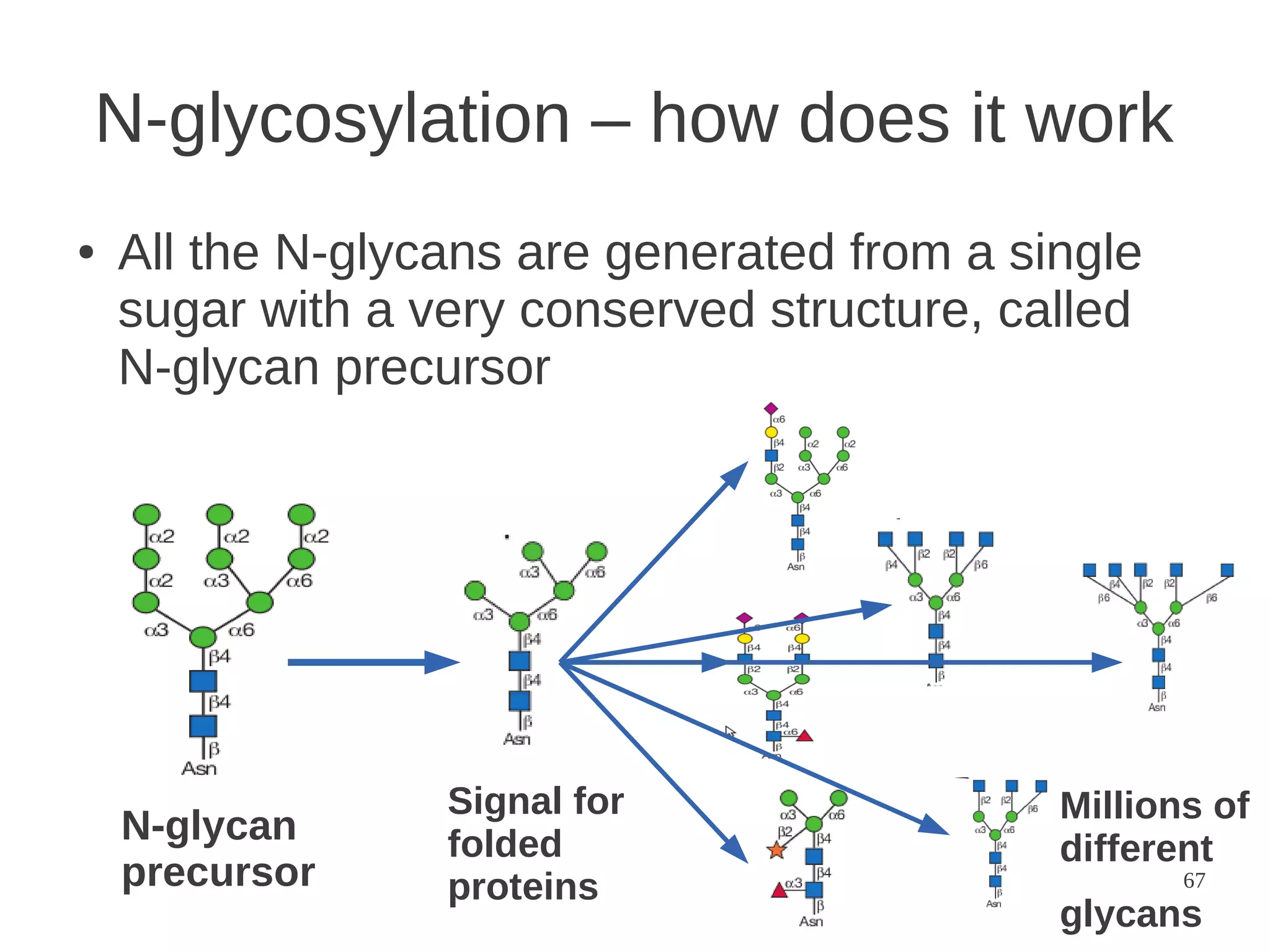
N-glycosylation – how does it work
●

All the N-glycans are generated from a single
sugar with a very conserved structure, called
N-glycan precursor

N-glycan
precursor

Signal for
folded
proteins

Millions of
different
67

glycans
The FST test

Almost all the highest
signals of FST are in
genes of the
downstream part

68
The iHS test

GCS1 in
EUR

MAN2A1 in
SSAFR and
EASIA

MGAT3 in
EASIA

69
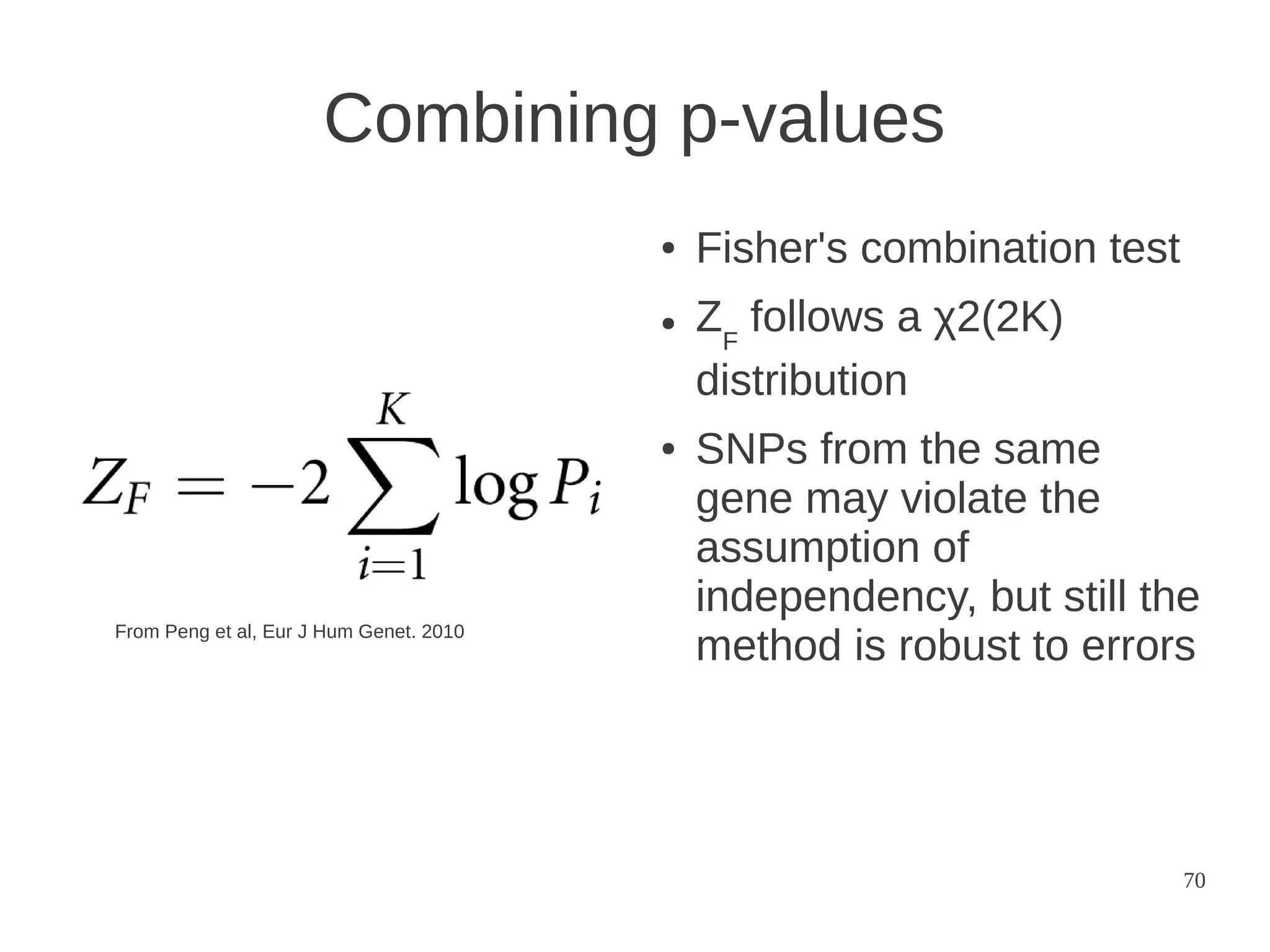
Combining p-values
●

●

●

From Peng et al, Eur J Hum Genet. 2010

Fisher's combination test
ZF follows a χ2(2K)
distribution
SNPs from the same
gene may violate the
assumption of
independency, but still the
method is robust to errors

70
Comparing upstream and
downstream N-Glycosylation
●

χ2 test comparing the
number of events
observed in the each
part of the pathway,
against what is the
number expected if
there were no
pathway structure

71
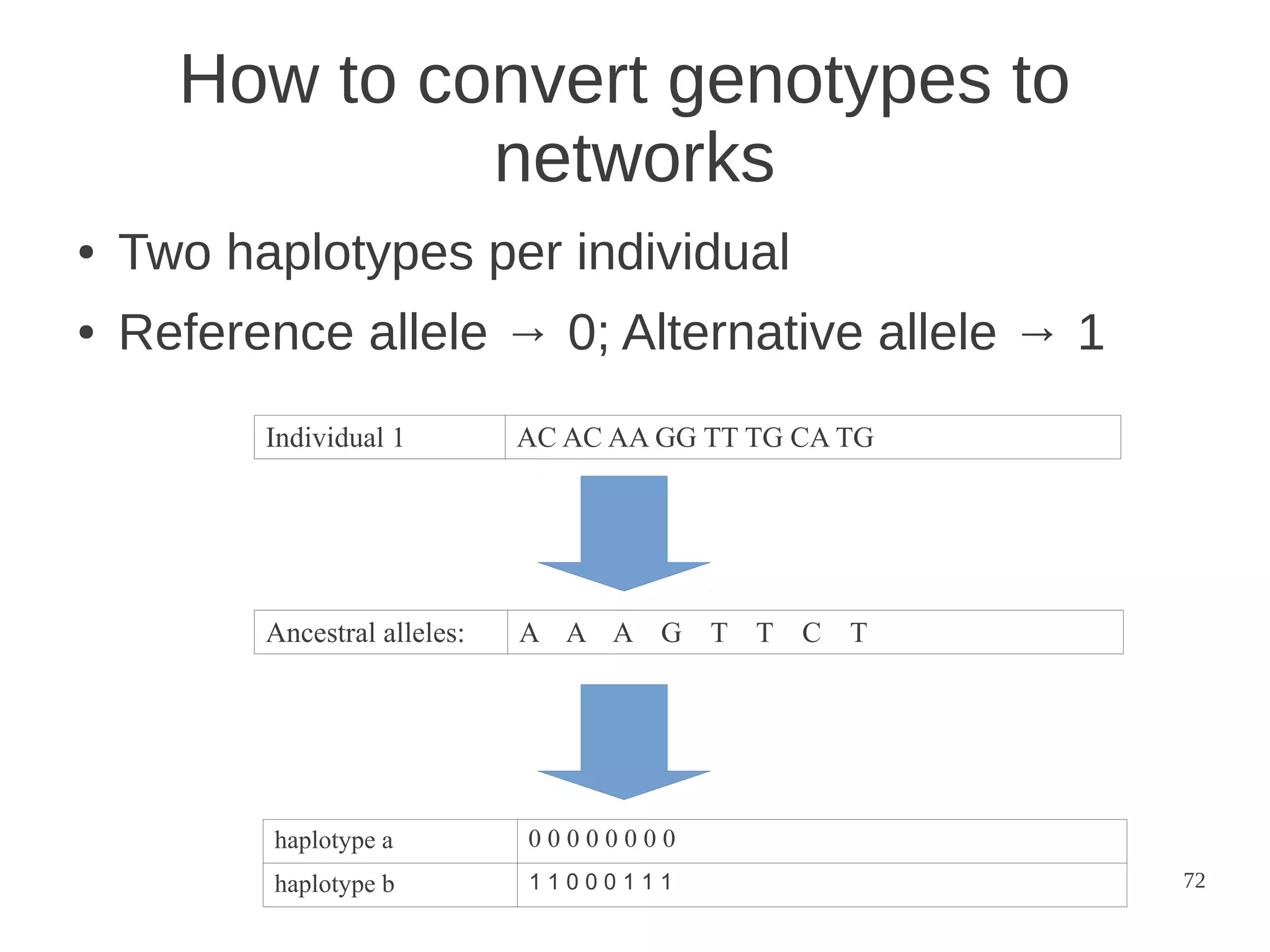
How to convert genotypes to
networks
●

Two haplotypes per individual

●

Reference allele → 0; Alternative allele → 1
Individual 1

AC AC AA GG TT TG CA TG

Ancestral alleles:

A A A G T T C T

haplotype a

00000000

haplotype b

11000111

72

Thesis defence of Dall'Olio Giovanni Marco. Applications of network theory to human population genetics: from pathways to genotype networks

  • 1.
    Applications of networktheory to human population genetics: from pathways to genotype networks Giovanni Marco Dall'Olio Pompeu Fabra University, Barcelona Advisors: Jaume Bertranpetit and Hafid Laayouni
  • 2.
    Acknowledgments ● I would liketo thank: – My PhD supervisors, Jaume Bertranpetit and Hafid Laayouni – My committee: Dr. Mauro Santos, Dr. Ricard Solé, Prof. Guido Barbujani, Dr. Ferran Casals, Dra. Yolanda Espinosa – The Evolutionary Systems Biology group at UPF – The Institut of Biologia Evolutiva 2
  • 3.
    Topics ● Context and motivations ● Myresearch: – – Pathway approach on the N-Glycosylation pathway – The Genotype Network Approach – ● Annotating the N-Glycosylation pathway The Human Selection Browser and Biostar Conclusions 3
  • 4.
    Context of thethesis ● ● The first anatomically modern humans appeared about 200,000 years ago How can we understand the signals of genetic adaptation in our genome, since then? 4
  • 5.
    Factors that influencedrecent human evolution New climates Diseases Agriculture 5
  • 6.
    The opportunity ● ● We haveaccess to large datasets of human sequences Better annotations on gene function and role 6
  • 7.
    Contributions ● Find applications ofnetwork theory to understand genetic adaptation in the human species 7
  • 8.
    Applications of networktheory ● ● The Pathway approach The Genotype Network approach 8
  • 9.
    Topics ● Context and motivations ● Myresearch: – – Pathway approach on the N-Glycosylation pathway – The Genotype Network Approach – ● Annotating the N-Glycosylation pathway The Human Selection Browser and Biostar Conclusions 9
  • 10.
    The Pathway approach ● ● Genesare organized in pathways Any eventual selection constraint will be distributed among all the genes of a pathway 10
  • 11.
    Distribution of Selectionforces in a pathway ● Some positions of the pathway will be more likely to have stronger signals of selection 11
  • 12.
    Pathway Approach -outline ● ● ● Build a Network representation of a pathway Execute a test for positive selection on each gene Determine how the signals of selection are distributed on the network 12
  • 13.
    Pathway approach onthe N-Glycosylation pathway ● ● Asparagine N-Glycosylation is a metabolic pathway for a type of protein modification The structure of this pathway is easy to represent as a network 13
  • 14.
    N-glycosylation - upstreampart ● ● Produces a single sugar called “N-Glycan precursor” This sugar is required for the proper folding of most membrane proteins 14 Adapted from Stanley, P., Schachter, H., & Taniguchi, N. (2009). N-Glycans. Essentials of Glycobiology.
  • 15.
    N-Glycosylation and proteinfolding ● The product of the upstream part of N-glycosylation is used as a signal to distinguish folded and unfolded proteins Folded protein Un-Folded protein 15
  • 16.
    N-glycosylation - downstreampart ● ● Complex pathway composed by thousands of reactions Produces multiple glycans, important for cell-to-cell interactions 16 Hossler, P., Mulukutla, B. C., & Hu, W.-S. (2007). Systems analysis of N-glycan processing in mammalian cells. PloS one, 2(1), e713. doi:10.1371/journal.pone.0000713
  • 17.
    Glycans on thecell surface ● ● The surface of a cell is similar to a forest of glycosylated proteins Each organism and cell has a specific repertoire of glycans 17 A. Doeer, Glycoproteomics. Nature Methods, 2011. doi:10.1038/nmeth.1821
  • 18.
    Annotating the N-Glycosylation pathway ● Inorder to build a correct network model for the N-Glycosylation pathway, we annotated it first in the Reactome database 18
  • 19.
  • 20.
    The KEGG entryfor N-Glycosylation is incomplete Downstream N-Glycosylation in KEGG Real representation of downstream N-Glycosylation 20
  • 21.
    Another error forN-Glycosylation in KEGG 21
  • 22.
    Erroneous annotation inString ● There are two genes with the symbol ALG2: – – ● ALG2 (Asparagine Linked Glycosylation 2) ALG-2 (Apoptosis Linked Gene – 2) In String, these two were confused 22
  • 23.
    Ambigous interpretation ofthe term N-Glycosylation in GO N-Glycosylated pathway Merged N-Glycosylated protein 23
  • 24.
    Annotating the N-Glycosylation pathway ● Annotated~100 reactions in Reactome ● Fixed ~50 Gene Ontology terms ● Fixed key errors in String and KEGG 24
  • 25.
  • 26.
    Dataset used ● The CEPH-HGDP650,000 Illumina chip dataset ● 940 individuals, from 50 human populations 26
  • 27.
    Methods used ● ● The FSTindex → measure of population differentiation The iHS test → identification of signals of recent positive selection 27
  • 28.
    FST – Populationdifferentiation ● ● FST is a measure of population differentiation If the FST between two population is 1, it means that the two populations are fixed for different alleles 28
  • 29.
    Signatures of populationdifferentiation in the N-Glycosylation pathway FST signals are concentrated in the downstream part, and in the substrates biosynthesis 29
  • 30.
    Population Differentiation and networkposition ● ● Node degree correlates with the distribution of FST signals Genes with high FST are generally more connected 30
  • 31.
    IHS and Longrange haplotypes ● ● A selective sweep may cause the appearance of long homozygous haplotypes at a high frequency Example: a long homozygous haplotype present in the LCT gene in North-European populations Vitti et al, Trends in genetics, 2012 31
  • 32.
    IHS and Longrange haplotypes: iHS: Compares the Extended Haplotype Homozygosity decay (EHH decay) between ancestral and derived allele Voight et al., PLoS Genetics 2006 32
  • 33.
    Signatures of selectionin the N-Glycosylation pathway No difference in the distribution of iHS signals between upstream and downstream 33
  • 34.
    Signatures of selectionin the N-Glycosylation pathway GCS1: redirects to protein folding quality control MGAT3: redirects to Hybrid Glycans MAN2A1: redirects to Complex Glycans 34
  • 35.
    Pathway approach onN-Glycosylation ● There is a difference in the patterns of population differentiation between the two parts of the N-Glycosylation pathway ● Signals of positive selection are more likely on key genes ● One of the few works applying the pathway approach on human genetics 35
  • 36.
    Topics ● Context and motivations ● Myresearch: – – Pathway approach on the N-Glycosylation pathway – The Genotype Network Approach – ● Annotating the N-Glycosylation pathway The Human Selection Browser and Biostar Conclusions 36
  • 37.
    The Genotype Networkapproach ● Genotype Networks have been used to study the “innovability” and evolvability of a genetic system 37
  • 38.
    The Genotype Networkapproach ● ● Genotype Networks have been used to study the “innovability” and evolvability of a genetic system Never applied to population genetics data, because they require too much data! 38
  • 39.
    Genotype Networks -theory ● John Maynard-Smith: the concept of a Protein Space, which is explored by populations 39
  • 40.
    Genotype Networks -theory ● John Maynard-Smith: the concept of a Protein Space, which is explored by populations “if evolution by natural selection is to occur, functional proteins [or DNA sequences] must form a continuous network which can be traversed by unit mutational steps without passing through nonfunctional intermediates” 40
  • 41.
    Neutralism and Selectionism ● ● Neutralism:most mutations are neutral or deleterious Selectionism: positive mutations drive evolution 41
  • 42.
    Genotype Networks helprecoincile Neutralism and Selectionism ● ● Cycles of Neutral evolution, alterned by cycles of Selection Even neutral or negative mutations can beneficial on the long run, because they allow to explore the genotype space 42
  • 43.
    The Genotype Network- definitions ● ● The Genotype Space of a region of 5 SNPs can be represented as a network Each node is a possible genotype, and edge connect nodes with only one difference 43
  • 44.
    The Genotype Network- definitions ● ● Green nodes are sequences observed in a population This is the Genotype Network of a population 44
  • 45.
    Average Path Lengthof a Genotype Network ● ● This figure represents two populations The yellow one has an higher Average Path Length than the blue one 45
  • 46.
    Average Degree ● ● ● ● This populationhas an high Average Degree It is more robust to mutations This population has a low Average Degree Mutations are more likely to fall outside the Genotype Network 46
  • 47.
    Dataset analyzed ● ● 1000genomes data,phase 1 850 individuals genotyped, grouped into three continental groups (AFR, EUR and ASN) 47
  • 48.
    The VCF2Space library ● ● ● Suiteof Python scripts to calculate Genotype Networks from a VCF file ~400,000 lines of code ~350 unit tests 48
  • 49.
    Splitting the genomeinto windows of 11 SNPs ● ● Less than 11 SNPs -> networks are too small and condensed More than 11 SNPs -> networks are too large and sparse Small network Large network 49
  • 50.
    Why windows of11 SNPs? 50
  • 51.
    Genotype Network propertiesof the human genome http://genome.ucsc.edu/cgi-bin/hgTracks? db=hg19&hubUrl=http://bioevo.upf.edu/~gdallolio/genotype_space/hub.txt 51
  • 52.
    Coding & Non-Codingregions ● Coding regions have higher average path length and degree than non coding regions 52
  • 53.
    Genotype Networks andSelection (simulated data) Selection Neutral 53
  • 54.
    ● ● ● Coding networks: high averagepath lenght and degree Non coding networks: low average path lenght and degree Recent selection: lower average path lenght and degree 54
  • 55.
  • 56.
    Topics ● Context and motivations ● Myresearch: – – Pathway approach on the N-Glycosylation pathway – The Genotype Network Approach – ● Annotating the N-Glycosylation pathway The Human Selection Browser and Biostar Conclusions 56
  • 57.
    Other works: TheHuman Selection Browser ● We applied 21 tests for positive selection to the 1,000 Genomes dataset – ● FST, CLR, iHS, etc... This dataset will be published and made freely available as a genome browser 57
  • 58.
    Other works: Biostar ● Anonline forum for bioinformatics ● About 150,000 visits per month ● Helped thousands of bioinformaticians! 58
  • 59.
    Topics ● Context and motivations ● Myresearch: – – Pathway approach on the N-Glycosylation pathway – The Genotype Network Approach – ● Annotating the N-Glycosylation pathway The Human Selection Browser and Biostar Conclusions 59
  • 60.
    Conclusions (I) ● ● ● ● We developedtwo applications of network theory to the study of human population genetics. We produced a network model of the N-Glycosylation pathway, contributing it to the Reactome database and improving the annotations in other databases. We showed that the downstream part of the N-Glycosylation pathway shows more signatures of genetic differentiation than the upstream part. This is compatible with the role and structure of this part of the pathway. We showed that key genes of the N-Glycosylation pathway, such as GCS1, MGAT3 and MAN2A1, show signatures of recent positive selection in human populations. 60
  • 61.
    Conclusions (II) ● ● ● We produceda suite of Python scripts, called VCF2Space, to apply the concept of Genotype Networks to Single Nucleotide Polimorphism data Our genome-wide application of Genotype Networks showed that coding regions tend to have networks with higher average degree and path length than non-coding regions We contributed positively to the bioinformatics community, providing resources such as the 1000 Genomes Selection Browser and Biostar 61
  • 62.
  • 63.
    Figures credits ● ● ● Slide 5: humans:http://blogs.ancestry.com/ancestry/ star trek: http://en.wikipedia.org/wiki/Star_Trek:_The_Original_Series Slide 6: Malaria: http://science.psu.edu/news-and-events/2012-news/Read7-2012 Climates: http://www.ancienteco.com/2012/03/climate-change-drives-human-evolution.html Agriculture: http://en.wikipedia.org/wiki/History_of_agriculture Slide 7: – ● Slide 14: – ● Cover of Science, 23 March 2001 Slide 15: – ● 1000 Genomes, CEPH-HGDP panel, UK10K, Hapmap websites Adapted from Stanley, P., Schachter, H., & Taniguchi, N. (2009). N-Glycans. Essentials of Glycobiology. Slide 17: – Glycosylation, downstream: Hossler, P., Mulukutla, B. C., & Hu, W.-S. (2007). Systems analysis of N-glycan processing in mammalian cells. PloS one, 2(1), e713. doi:10.1371/journal.pone.0000713 64
  • 64.
    Figures credits ● ● ● ● Slide 27: http://www.cephb.fr/en/hgdp/diversity.php/ Slide29: http://www.rationalskepticism.org Slide 32 Adapted from Vitti et al, 2012 Slide 42: – wikipedia 65
  • 65.
    The Pathway approach StrongerSelection on Genes with high connectivity or upstream of a pathway 66
  • 66.
    N-glycosylation – howdoes it work ● All the N-glycans are generated from a single sugar with a very conserved structure, called N-glycan precursor N-glycan precursor Signal for folded proteins Millions of different 67 glycans
  • 67.
    The FST test Almostall the highest signals of FST are in genes of the downstream part 68
  • 68.
    The iHS test GCS1in EUR MAN2A1 in SSAFR and EASIA MGAT3 in EASIA 69
  • 69.
    Combining p-values ● ● ● From Penget al, Eur J Hum Genet. 2010 Fisher's combination test ZF follows a χ2(2K) distribution SNPs from the same gene may violate the assumption of independency, but still the method is robust to errors 70
  • 70.
    Comparing upstream and downstreamN-Glycosylation ● χ2 test comparing the number of events observed in the each part of the pathway, against what is the number expected if there were no pathway structure 71
  • 71.
    How to convertgenotypes to networks ● Two haplotypes per individual ● Reference allele → 0; Alternative allele → 1 Individual 1 AC AC AA GG TT TG CA TG Ancestral alleles: A A A G T T C T haplotype a 00000000 haplotype b 11000111 72