SYSTEM PROGRAMMING
OLUFEMI OLOLADE
OLAEWE
ASSISTANT SOFTWARE
DEVELOPER
[BSc. , M.PHIL]
INTRODUCTION TO AWK UTILITY
AWK is a programming language created by Aho, Kernighan, and
Weinberger.
It is useful for:
manipulation of data files,
text retrieval and processing,
generation of reports, and
for prototyping and experimenting with algorithms.
Versions: awk, nawk, mawk, pgawk, and gawk (GNU).
AWK CONTD
An AWK program is a sequence of pattern {action} pairs and function
definitions.
Short programs are entered on the command line usually enclosed in '
' to avoid shell
interpretation.
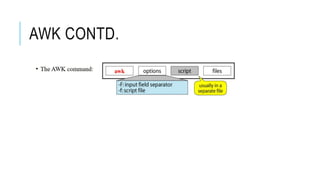
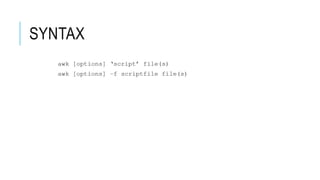
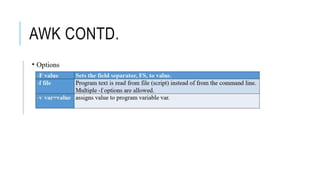
Longer programs can be read in from a file with the -f option.
AWK CONTD.
SYNTAX
AWK CONTD.
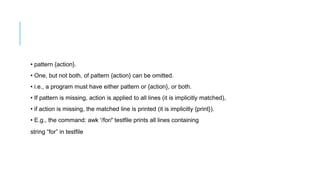
• pattern {action}.
• One, but not both, of pattern {action} can be omitted.
• i.e., a program must have either pattern or {action}, or both.
• If pattern is missing, action is applied to all lines (it is implicitly matched),
• if action is missing, the matched line is printed (it is implicitly {print}).
• E.g., the command: awk '/for/' testfile prints all lines containing
string “for” in testfile
BASIC TERMINOLOGY OF INPUT
FILES
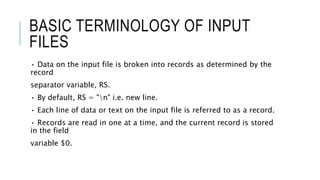
• Data on the input file is broken into records as determined by the
record
separator variable, RS.
• By default, RS = "n" i.e. new line.
• Each line of data or text on the input file is referred to as a record.
• Records are read in one at a time, and the current record is stored
in the field
variable $0.
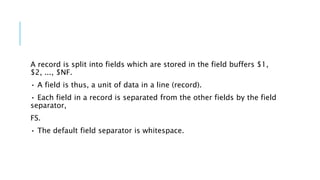
A record is split into fields which are stored in the field buffers $1,
$2, ..., $NF.
• A field is thus, a unit of data in a line (record).
• Each field in a record is separated from the other fields by the field
separator,
FS.
• The default field separator is whitespace.
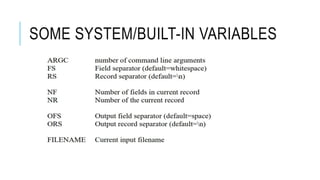
SOME SYSTEM/BUILT-IN VARIABLES
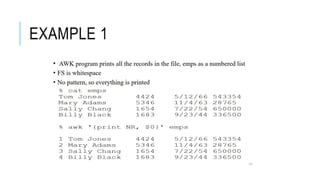
EXAMPLE 1
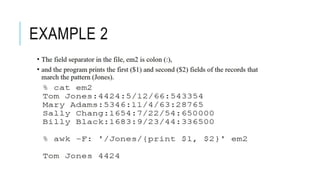
EXAMPLE 2
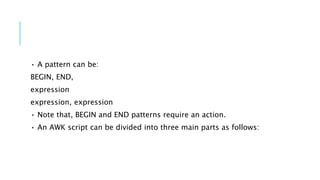
• A pattern can be:
BEGIN, END,
expression
expression, expression
• Note that, BEGIN and END patterns require an action.
• An AWK script can be divided into three main parts as follows:
• BEGIN: performs pre-processing that must be completed before awk
starts
reading records from the input file.
• Mostly to initialize variables and to create report headings.
• BODY: contains main processing logic to be applied to input records,
• like a loop that processes input data one record at a time:
• the body executes mostly ones for each record.
• END: post-processing contains logic to be executed after all input
data have
been processed.
• Logic such as printing report grand total are performed in this part of
the
script.
STATEMENTS
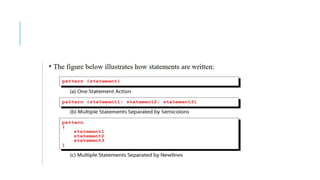
• Statements in an AWK program are terminated by newlines, semi-
colons or both.
• Groups of statements such as actions or loop bodies are blocked via
{...} as in C.
• The last statement in a block doesn't need a terminator.
• Blank lines have no meaning; an empty statement is terminated with a
semicolon.
• Long statements can be continued with a backslash, .
• A statement can be broken without a backslash after a comma, left
brace, &&, ||,
do, else, the right parenthesis of an if, while or for statement, and the
right
parenthesis of a function definition.
EXPRESSIONS AND OPERATORS
Primary AWK expressions are
– numeric constants,
– string constants,
– variables,
– fields,
– arrays and
– function calls.
The identifier for a variable, array or function can be a sequence of
– letters, digits and underscores
– and does not start with a digit.
• Variables are not declared; they exist when first referenced and are initialized to
null.
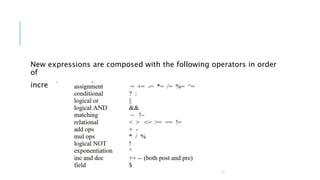
New expressions are composed with the following operators in order
of
increasing precedence.
EXPRESSION PATTERN TYPES
• uses marching
• either searches through an entire record for a possible march using
regular
expression enclosed by ‘/’s
• or explicitly searches for a march in a particular field or group of
fields using
the expressions ~ (march) or !~ (not march).
Introduction to AWK utility on unix.pptx

Introduction to AWK utility on unix.pptx

  • 1.
    SYSTEM PROGRAMMING OLUFEMI OLOLADE OLAEWE ASSISTANTSOFTWARE DEVELOPER [BSc. , M.PHIL]
  • 2.
    INTRODUCTION TO AWKUTILITY AWK is a programming language created by Aho, Kernighan, and Weinberger. It is useful for: manipulation of data files, text retrieval and processing, generation of reports, and for prototyping and experimenting with algorithms.
  • 3.
    Versions: awk, nawk,mawk, pgawk, and gawk (GNU).
  • 4.
    AWK CONTD An AWKprogram is a sequence of pattern {action} pairs and function definitions. Short programs are entered on the command line usually enclosed in ' ' to avoid shell interpretation. Longer programs can be read in from a file with the -f option.
  • 5.
  • 6.
  • 7.
  • 8.
    • pattern {action}. •One, but not both, of pattern {action} can be omitted. • i.e., a program must have either pattern or {action}, or both. • If pattern is missing, action is applied to all lines (it is implicitly matched), • if action is missing, the matched line is printed (it is implicitly {print}). • E.g., the command: awk '/for/' testfile prints all lines containing string “for” in testfile
  • 9.
    BASIC TERMINOLOGY OFINPUT FILES • Data on the input file is broken into records as determined by the record separator variable, RS. • By default, RS = "n" i.e. new line. • Each line of data or text on the input file is referred to as a record. • Records are read in one at a time, and the current record is stored in the field variable $0.
  • 10.
    A record issplit into fields which are stored in the field buffers $1, $2, ..., $NF. • A field is thus, a unit of data in a line (record). • Each field in a record is separated from the other fields by the field separator, FS. • The default field separator is whitespace.
  • 11.
  • 12.
  • 13.
  • 14.
    • A patterncan be: BEGIN, END, expression expression, expression • Note that, BEGIN and END patterns require an action. • An AWK script can be divided into three main parts as follows:
  • 16.
    • BEGIN: performspre-processing that must be completed before awk starts reading records from the input file. • Mostly to initialize variables and to create report headings. • BODY: contains main processing logic to be applied to input records, • like a loop that processes input data one record at a time: • the body executes mostly ones for each record. • END: post-processing contains logic to be executed after all input data have been processed. • Logic such as printing report grand total are performed in this part of the script.
  • 17.
    STATEMENTS • Statements inan AWK program are terminated by newlines, semi- colons or both. • Groups of statements such as actions or loop bodies are blocked via {...} as in C. • The last statement in a block doesn't need a terminator. • Blank lines have no meaning; an empty statement is terminated with a semicolon. • Long statements can be continued with a backslash, . • A statement can be broken without a backslash after a comma, left brace, &&, ||, do, else, the right parenthesis of an if, while or for statement, and the right parenthesis of a function definition.
  • 19.
    EXPRESSIONS AND OPERATORS PrimaryAWK expressions are – numeric constants, – string constants, – variables, – fields, – arrays and – function calls.
  • 20.
    The identifier fora variable, array or function can be a sequence of – letters, digits and underscores – and does not start with a digit. • Variables are not declared; they exist when first referenced and are initialized to null.
  • 21.
    New expressions arecomposed with the following operators in order of increasing precedence.
  • 22.
    EXPRESSION PATTERN TYPES •uses marching • either searches through an entire record for a possible march using regular expression enclosed by ‘/’s • or explicitly searches for a march in a particular field or group of fields using the expressions ~ (march) or !~ (not march).