MORPHOLOGY

Berkay Firtina 100908013

Serhat Gokce 100908001
MORPHOLOGY

       What’s the morphology ?

Which types of a word can explain this?
OUTLINE
• Morphology? Hmm.. 
• Terminologies
  – Word
  – Morpheme
  – Parts of Speech
• Classification of Morphemes
  – Free Morp.
  – Bound Morp.
OUTLINE
• Making new words
  – Coining
  – Meaning Change
  – Compounding


• Division of Morphemes
MORPHOLOGY

• Morphology is the study of the forms and formation
  of words.


• Word is a sound or sound groups articulated that
  express a idea.
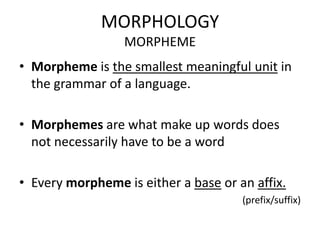
MORPHOLOGY
                  MORPHEME
• Morpheme is the smallest meaningful unit in
  the grammar of a language.

• Morphemes are what make up words does
  not necessarily have to be a word

• Every morpheme is either a base or an affix.
                                      (prefix/suffix)
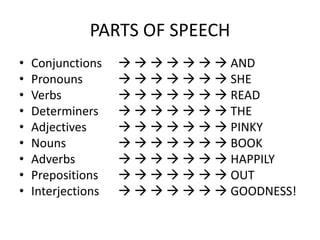
PARTS OF SPEECH
•   Conjunctions           AND
•   Pronouns               SHE
•   Verbs                  READ
•   Determiners            THE
•   Adjectives             PINKY
•   Nouns                  BOOK
•   Adverbs                HAPPILY
•   Prepositions           OUT
•   Interjections          GOODNESS!
CLASSIFICATION OF MORPHEMES

• Free Morphemes
  – Open Class Morphemes
  – Closed Class Morphemes


• Bound Morphemes
CLASSIFICATION OF MORPHEMES

• Free morphemes-units that can stand alone as
  words by themselves.
                               TREE

• Bound morphemes-units that must be
  attached or bound to a free morpheme
                                TREES
CLASSIFICATION OF MORPHEMES
         TYPES OF FREE MORPHEME


• Free Morphemes

  – Open Class Morphemes

  – Closed Class Morphemes
CLASSIFICATION OF MORPHEMES
          TYPES OF FREE MORPHEME
                Open Morphemes


• Open Morpheme has independent meaning.

• It can stand alone.

• Also known as “content” words.
CLASSIFICATION OF MORPHEMES
          TYPES OF FREE MORPHEME
                Closed Morphemes


• Closed Morpheme has dependent meaning.

• It can not stand alone.

• Closed Class are not re-productive.
CLASSIFICATION OF MORPHEMES
          TYPES OF FREE MORPHEME
                    Closed Morphemes


• They serve a function.
  – Definiteness
  – Comparison
  – Quantity
  – Conjoining
           » Etc.
CLASSIFICATION OF MORPHEMES
             BOUND MORPHEME


• Bound morphemes(affixes) must be attached
  to the word.

• They are two kinds of bound morphemes.
  – Contractible Morphemes
  – Affixes
CLASSIFICATION OF MORPHEMES
              BOUND MORPHEME
                Contractible Morpheme


• Contractible morphemes are like;
  – I will  I’ll
  – They had  They’d

  So, they are auxiliary modals such as will, shall,
    has, have, had and would can be contracted in
    informal style of language.
CLASSIFICATION OF MORPHEMES
               BOUND MORPHEME
                      Affixes


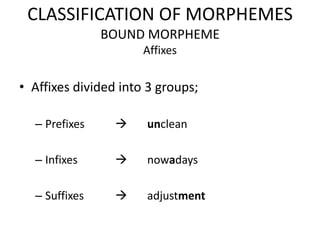
• Affixes divided into 3 groups;

  – Prefixes         unclean

  – Infixes          nowadays

  – Suffixes         adjustment
CLASSIFICATION OF MORPHEMES
                BOUND MORPHEME
             Derivational versus Inflectional


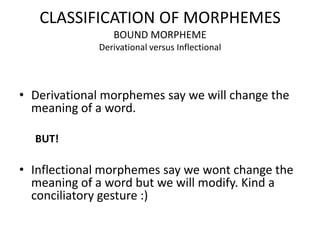
• Derivational morphemes say we will change the
  meaning of a word.

  BUT!

• Inflectional morphemes say we wont change the
  meaning of a word but we will modify. Kind a
  conciliatory gesture :)
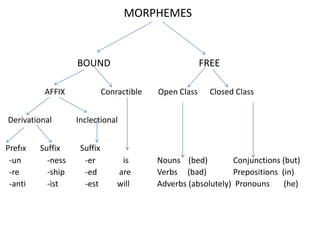
MORPHEMES


                   BOUND                                FREE

          AFFIX              Conractible   Open Class     Closed Class


Derivational       Inclectional


Prefıx   Suffix     Suffix
 -un       -ness     -er          is       Nouns (bed)         Conjunctions (but)
 -re       -ship     -ed         are       Verbs (bad)         Prepositions (in)
 -anti     -ist      -est        will      Adverbs (absolutely) Pronouns     (he)
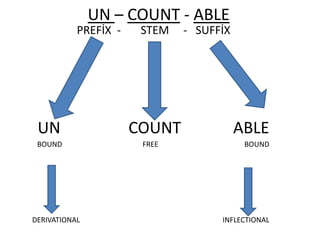
UN – COUNT - ABLE
           PREFİX -    STEM   - SUFFİX


 UN                   COUNT              ABLE
 BOUND                 FREE               BOUND


DERIVATIONAL                        INFLECTIONAL
MAKING NEW WORDS
                    Categories


• These techniques could be included in 3 major
  categories;

     • Coining
     • Meaning Change
     • Compounding
MAKING NEW WORDS
                                   Coining
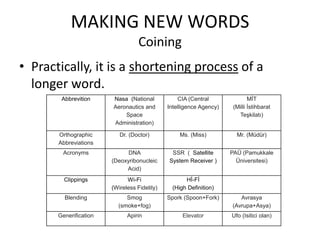
• Practically, it is a shortening process of a
  longer word.
        Abbrevition     Nasa (National            CIA (Central               MİT
                        Aeronautics and       Intelligence Agency)    (Milli İstihbarat
                            Space                                       Teşkilatı)
                        Administration)

       Orthographic        Dr. (Doctor)           Ms. (Miss)           Mr. (Müdür)
       Abbreviations
        Acronyms              DNA              SSR ( Satellite       PAÜ (Pamukkale
                        (Deoxyribonucleic     System Receiver )        Üniversitesi)
                             Acid)
         Clippings            Wi-Fi                 Hİ-Fİ
                        (Wireless Fidelity)    (High Definition)
         Blending            Smog             Spork (Spoon+Fork)        Avrasya
                          (smoke+fog)                                (Avrupa+Asya)
       Generification         Apirin               Elevator          Ufo (Isitici olan)
MAKING NEW WORDS
                       Meaning Change


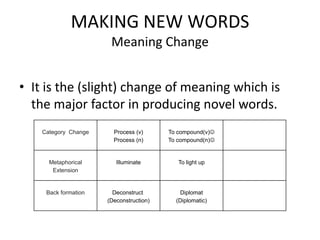
• It is the (slight) change of meaning which is
  the major factor in producing novel words.
    Category Change     Process (v)      To compound(v)
                        Process (n)      To compound(n)


      Metaphorical       Illuminate         To light up
       Extension


     Back formation     Deconstruct          Diplomat
                      (Deconstruction)     (Diplomatic)
MAKING NEW WORDS
                      Compounding

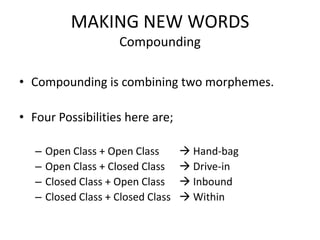
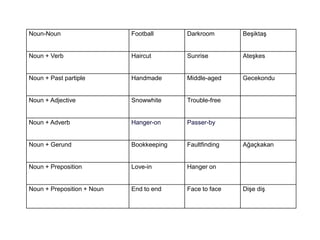
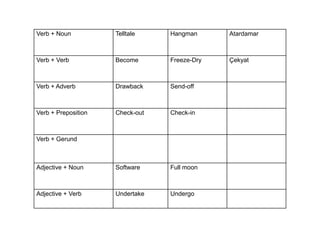
• Compounding is combining two morphemes.

• Four Possibilities here are;

   –   Open Class + Open Class        Hand-bag
   –   Open Class + Closed Class      Drive-in
   –   Closed Class + Open Class      Inbound
   –   Closed Class + Closed Class    Within
Noun-Noun                   Football      Darkroom       Beşiktaş


Noun + Verb                 Haircut       Sunrise        Ateşkes


Noun + Past partiple        Handmade      Middle-aged    Gecekondu


Noun + Adjective            Snowwhite     Trouble-free


Noun + Adverb               Hanger-on     Passer-by


Noun + Gerund               Bookkeeping   Faultfinding   Ağaçkakan


Noun + Preposition          Love-in       Hanger on


Noun + Preposition + Noun   End to end    Face to face   Dişe diş
Verb + Noun          Telltale    Hangman      Atardamar


Verb + Verb          Become      Freeze-Dry   Çekyat


Verb + Adverb        Drawback    Send-off


Verb + Preposition   Check-out   Check-in


Verb + Gerund


Adjective + Noun     Software    Full moon


Adjective + Verb     Undertake   Undergo
Division of Morphemes
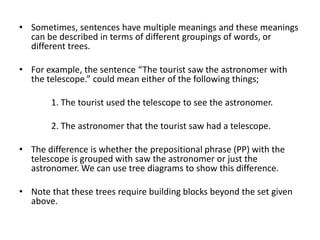
• Sometimes, sentences have multiple meanings and these meanings
  can be described in terms of different groupings of words, or
  different trees.

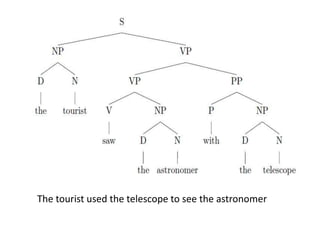
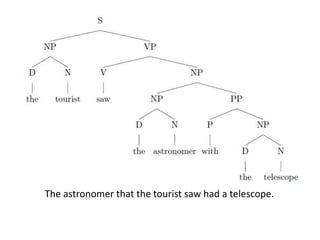
• For example, the sentence “The tourist saw the astronomer with
  the telescope.” could mean either of the following things;

       1. The tourist used the telescope to see the astronomer.

       2. The astronomer that the tourist saw had a telescope.

• The difference is whether the prepositional phrase (PP) with the
  telescope is grouped with saw the astronomer or just the
  astronomer. We can use tree diagrams to show this difference.

• Note that these trees require building blocks beyond the set given
  above.
The tourist used the telescope to see the astronomer
The astronomer that the tourist saw had a telescope.

Linguistic morp

  • 1.
  • 2.
    MORPHOLOGY What’s the morphology ? Which types of a word can explain this?
  • 3.
    OUTLINE • Morphology? Hmm.. • Terminologies – Word – Morpheme – Parts of Speech • Classification of Morphemes – Free Morp. – Bound Morp.
  • 4.
    OUTLINE • Making newwords – Coining – Meaning Change – Compounding • Division of Morphemes
  • 5.
    MORPHOLOGY • Morphology isthe study of the forms and formation of words. • Word is a sound or sound groups articulated that express a idea.
  • 6.
    MORPHOLOGY MORPHEME • Morpheme is the smallest meaningful unit in the grammar of a language. • Morphemes are what make up words does not necessarily have to be a word • Every morpheme is either a base or an affix. (prefix/suffix)
  • 7.
    PARTS OF SPEECH • Conjunctions        AND • Pronouns        SHE • Verbs        READ • Determiners        THE • Adjectives        PINKY • Nouns        BOOK • Adverbs        HAPPILY • Prepositions        OUT • Interjections        GOODNESS!
  • 8.
    CLASSIFICATION OF MORPHEMES •Free Morphemes – Open Class Morphemes – Closed Class Morphemes • Bound Morphemes
  • 9.
    CLASSIFICATION OF MORPHEMES •Free morphemes-units that can stand alone as words by themselves. TREE • Bound morphemes-units that must be attached or bound to a free morpheme TREES
  • 10.
    CLASSIFICATION OF MORPHEMES TYPES OF FREE MORPHEME • Free Morphemes – Open Class Morphemes – Closed Class Morphemes
  • 11.
    CLASSIFICATION OF MORPHEMES TYPES OF FREE MORPHEME Open Morphemes • Open Morpheme has independent meaning. • It can stand alone. • Also known as “content” words.
  • 12.
    CLASSIFICATION OF MORPHEMES TYPES OF FREE MORPHEME Closed Morphemes • Closed Morpheme has dependent meaning. • It can not stand alone. • Closed Class are not re-productive.
  • 13.
    CLASSIFICATION OF MORPHEMES TYPES OF FREE MORPHEME Closed Morphemes • They serve a function. – Definiteness – Comparison – Quantity – Conjoining » Etc.
  • 14.
    CLASSIFICATION OF MORPHEMES BOUND MORPHEME • Bound morphemes(affixes) must be attached to the word. • They are two kinds of bound morphemes. – Contractible Morphemes – Affixes
  • 15.
    CLASSIFICATION OF MORPHEMES BOUND MORPHEME Contractible Morpheme • Contractible morphemes are like; – I will  I’ll – They had  They’d So, they are auxiliary modals such as will, shall, has, have, had and would can be contracted in informal style of language.
  • 16.
    CLASSIFICATION OF MORPHEMES BOUND MORPHEME Affixes • Affixes divided into 3 groups; – Prefixes  unclean – Infixes  nowadays – Suffixes  adjustment
  • 17.
    CLASSIFICATION OF MORPHEMES BOUND MORPHEME Derivational versus Inflectional • Derivational morphemes say we will change the meaning of a word. BUT! • Inflectional morphemes say we wont change the meaning of a word but we will modify. Kind a conciliatory gesture :)
  • 18.
    MORPHEMES BOUND FREE AFFIX Conractible Open Class Closed Class Derivational Inclectional Prefıx Suffix Suffix -un -ness -er is Nouns (bed) Conjunctions (but) -re -ship -ed are Verbs (bad) Prepositions (in) -anti -ist -est will Adverbs (absolutely) Pronouns (he)
  • 19.
    UN – COUNT- ABLE PREFİX - STEM - SUFFİX UN COUNT ABLE BOUND FREE BOUND DERIVATIONAL INFLECTIONAL
  • 20.
    MAKING NEW WORDS Categories • These techniques could be included in 3 major categories; • Coining • Meaning Change • Compounding
  • 21.
    MAKING NEW WORDS Coining • Practically, it is a shortening process of a longer word. Abbrevition Nasa (National CIA (Central MİT Aeronautics and Intelligence Agency) (Milli İstihbarat Space Teşkilatı) Administration) Orthographic Dr. (Doctor) Ms. (Miss) Mr. (Müdür) Abbreviations Acronyms DNA SSR ( Satellite PAÜ (Pamukkale (Deoxyribonucleic System Receiver ) Üniversitesi) Acid) Clippings Wi-Fi Hİ-Fİ (Wireless Fidelity) (High Definition) Blending Smog Spork (Spoon+Fork) Avrasya (smoke+fog) (Avrupa+Asya) Generification Apirin Elevator Ufo (Isitici olan)
  • 22.
    MAKING NEW WORDS Meaning Change • It is the (slight) change of meaning which is the major factor in producing novel words. Category Change Process (v) To compound(v) Process (n) To compound(n) Metaphorical Illuminate To light up Extension Back formation Deconstruct Diplomat (Deconstruction) (Diplomatic)
  • 23.
    MAKING NEW WORDS Compounding • Compounding is combining two morphemes. • Four Possibilities here are; – Open Class + Open Class  Hand-bag – Open Class + Closed Class  Drive-in – Closed Class + Open Class  Inbound – Closed Class + Closed Class  Within
  • 24.
    Noun-Noun Football Darkroom Beşiktaş Noun + Verb Haircut Sunrise Ateşkes Noun + Past partiple Handmade Middle-aged Gecekondu Noun + Adjective Snowwhite Trouble-free Noun + Adverb Hanger-on Passer-by Noun + Gerund Bookkeeping Faultfinding Ağaçkakan Noun + Preposition Love-in Hanger on Noun + Preposition + Noun End to end Face to face Dişe diş
  • 25.
    Verb + Noun Telltale Hangman Atardamar Verb + Verb Become Freeze-Dry Çekyat Verb + Adverb Drawback Send-off Verb + Preposition Check-out Check-in Verb + Gerund Adjective + Noun Software Full moon Adjective + Verb Undertake Undergo
  • 26.
  • 27.
    • Sometimes, sentenceshave multiple meanings and these meanings can be described in terms of different groupings of words, or different trees. • For example, the sentence “The tourist saw the astronomer with the telescope.” could mean either of the following things; 1. The tourist used the telescope to see the astronomer. 2. The astronomer that the tourist saw had a telescope. • The difference is whether the prepositional phrase (PP) with the telescope is grouped with saw the astronomer or just the astronomer. We can use tree diagrams to show this difference. • Note that these trees require building blocks beyond the set given above.
  • 28.
    The tourist usedthe telescope to see the astronomer
  • 29.
    The astronomer thatthe tourist saw had a telescope.