QUANTIFIERS
quantifiers
   Quantifiers are words that are used to
    state quantity . They answer the
    questions "How many?" and "How
    much?"

   Quantifiers can be used with plural
    countable nouns, uncountable nouns
    or both.
Large quantities (+)
   Use a lot of/lots of :

    They have a lot of/lots of money.

   Lots of is more informal.

   Use a lot when there is no noun:

    I like speaking in English a lot

Mainly used in affirmative sentences.
Large quantities: (-) & (?)
   Use much with uncountable nouns.

    Do you watch much TV?
    I don’t have much money.

   Use many with countable nouns.

    Are there many students in your class?
    There aren’t many cafés near here.

   In both cases you can also use a lot of.
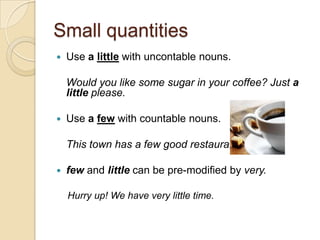
Small quantities
   Use a little with uncontable nouns.

    Would you like some sugar in your coffee? Just a
    little please.

   Use a few with countable nouns.

    This town has a few good restaurants.

   few and little can be pre-modified by very.

    Hurry up! We have very little time.
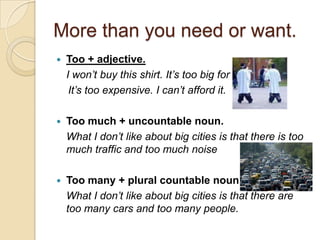
More than you need or want.
   Too + adjective.
    I won’t buy this shirt. It’s too big for me.
     It’s too expensive. I can’t afford it.

   Too much + uncountable noun.
    What I don’t like about big cities is that there is too
    much traffic and too much noise

   Too many + plural countable noun.
    What I don’t like about big cities is that there are
    too many cars and too many people.
Less than you need.
  Not enough + noun
  There aren’t enough car parks in this
  city.
 Sorry, I haven't got enough food for
  everyone.
 Adjective + enough
   You're not working fast enough, you
  won't finish on time
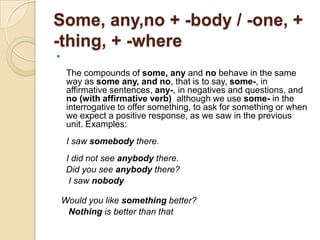
Some, any,no + -body / -one, +
-thing, + -where


     The compounds of some, any and no behave in the same
     way as some any, and no, that is to say, some-, in
     affirmative sentences, any-, in negatives and questions, and
     no (with affirmative verb) although we use some- in the
     interrogative to offer something, to ask for something or when
     we expect a positive response, as we saw in the previous
     unit. Examples:
     I saw somebody there.
     I did not see anybody there.
     Did you see anybody there?
      I saw nobody

    Would you like something better?
     Nothing is better than that
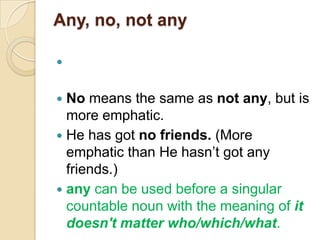
Any, no, not any




 No means the same as not any, but is
  more emphatic.
 He has got no friends. (More
  emphatic than He hasn’t got any
  friends.)
 any can be used before a singular
  countable noun with the meaning of it
  doesn't matter who/which/what.

Quantifiers unit 0

  • 1.
  • 2.
    quantifiers  Quantifiers are words that are used to state quantity . They answer the questions "How many?" and "How much?"  Quantifiers can be used with plural countable nouns, uncountable nouns or both.
  • 3.
    Large quantities (+)  Use a lot of/lots of : They have a lot of/lots of money.  Lots of is more informal.  Use a lot when there is no noun: I like speaking in English a lot Mainly used in affirmative sentences.
  • 4.
    Large quantities: (-)& (?)  Use much with uncountable nouns. Do you watch much TV? I don’t have much money.  Use many with countable nouns. Are there many students in your class? There aren’t many cafés near here.  In both cases you can also use a lot of.
  • 5.
    Small quantities  Use a little with uncontable nouns. Would you like some sugar in your coffee? Just a little please.  Use a few with countable nouns. This town has a few good restaurants.  few and little can be pre-modified by very. Hurry up! We have very little time.
  • 6.
    More than youneed or want.  Too + adjective. I won’t buy this shirt. It’s too big for me. It’s too expensive. I can’t afford it.  Too much + uncountable noun. What I don’t like about big cities is that there is too much traffic and too much noise  Too many + plural countable noun. What I don’t like about big cities is that there are too many cars and too many people.
  • 7.
    Less than youneed.  Not enough + noun There aren’t enough car parks in this city. Sorry, I haven't got enough food for everyone.  Adjective + enough You're not working fast enough, you won't finish on time
  • 8.
    Some, any,no +-body / -one, + -thing, + -where  The compounds of some, any and no behave in the same way as some any, and no, that is to say, some-, in affirmative sentences, any-, in negatives and questions, and no (with affirmative verb) although we use some- in the interrogative to offer something, to ask for something or when we expect a positive response, as we saw in the previous unit. Examples: I saw somebody there. I did not see anybody there. Did you see anybody there? I saw nobody Would you like something better? Nothing is better than that
  • 9.
    Any, no, notany   No means the same as not any, but is more emphatic.  He has got no friends. (More emphatic than He hasn’t got any friends.)  any can be used before a singular countable noun with the meaning of it doesn't matter who/which/what.