Its etymology is Greek: morph- means
‘shape, form’, and morphology is the
study of form or forms.
 In linguistics morphology refers to
the mental system involved in word
formation or to the branch of
linguistics that deals with words,
their internal structure, and how they
are formed.
Morphology is the study of structure
and formation of words.
• Just as sentences can be broken down into
smaller units (words), we can break words
into smaller, meaningful parts.
• The smallest meaningful part of a word is
called a morpheme.
Two important changes of
children’s language
 Sentences get longer
 Gradual appearance of a few
inflections and other closed-class
terms.
The process of acquiring the major
grammatical morpheme in English is
gradual and lengthy.
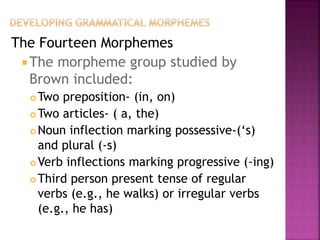
The Fourteen Morphemes
 The morpheme group studied by
Brown included:
 Two preposition- (in, on)
 Two articles- ( a, the)
 Noun inflection marking possessive-(‘s)
and plural (-s)
 Verb inflections marking progressive (-ing)
 Third person present tense of regular
verbs (e.g., he walks) or irregular verbs
(e.g., he has)
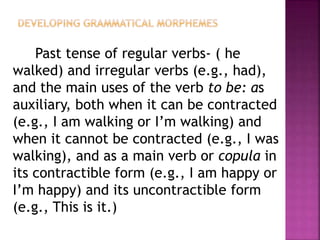
Past tense of regular verbs- ( he
walked) and irregular verbs (e.g., had),
and the main uses of the verb to be: as
auxiliary, both when it can be contracted
(e.g., I am walking or I’m walking) and
when it cannot be contracted (e.g., I was
walking), and as a main verb or copula in
its contractible form (e.g., I am happy or
I’m happy) and its uncontractible form
(e.g., This is it.)
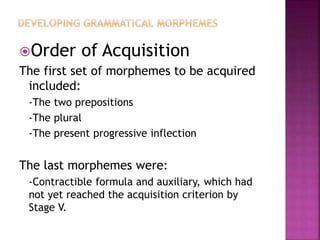
Order of Acquisition
The first set of morphemes to be acquired
included:
-The two prepositions
-The plural
-The present progressive inflection
The last morphemes were:
-Contractible formula and auxiliary, which had
not yet reached the acquisition criterion by
Stage V.
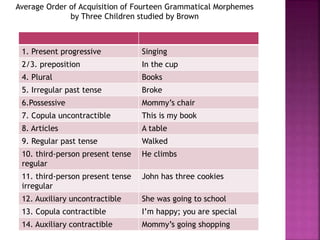
Average Order of Acquisition of Fourteen Grammatical Morphemes
by Three Children studied by Brown
1. Present progressive Singing
2/3. preposition In the cup
4. Plural Books
5. Irregular past tense Broke
6.Possessive Mommy’s chair
7. Copula uncontractible This is my book
8. Articles A table
9. Regular past tense Walked
10. third-person present tense
regular
He climbs
11. third-person present tense
irregular
John has three cookies
12. Auxiliary uncontractible She was going to school
13. Copula contractible I’m happy; you are special
14. Auxiliary contractible Mommy’s going shopping
Productivity of Children’s Morphology
 By age three or four there is clear evidence
that that children are indeed acquiring a
rule-governed system.
 For example, children frequently add the
plural –s to exceptional nouns (mans, foots,
teeths, peoples) or use of regular past
tense –ed on irregular verbs (falled, goed,
broked), even when the correct irregular
form has previously been used.
Productivity of Children’s
Morphology
 Overregularization errors like the
examples are an excellent source of
evidence for the productivity and
creativity of child’s morphology;
these are the forms no children would
have heard from an adult.
 This implies that children do not
learn through imitating
Morphology

Morphology

  • 2.
    Its etymology isGreek: morph- means ‘shape, form’, and morphology is the study of form or forms.  In linguistics morphology refers to the mental system involved in word formation or to the branch of linguistics that deals with words, their internal structure, and how they are formed.
  • 3.
    Morphology is thestudy of structure and formation of words. • Just as sentences can be broken down into smaller units (words), we can break words into smaller, meaningful parts. • The smallest meaningful part of a word is called a morpheme.
  • 5.
    Two important changesof children’s language  Sentences get longer  Gradual appearance of a few inflections and other closed-class terms. The process of acquiring the major grammatical morpheme in English is gradual and lengthy.
  • 6.
    The Fourteen Morphemes The morpheme group studied by Brown included:  Two preposition- (in, on)  Two articles- ( a, the)  Noun inflection marking possessive-(‘s) and plural (-s)  Verb inflections marking progressive (-ing)  Third person present tense of regular verbs (e.g., he walks) or irregular verbs (e.g., he has)
  • 7.
    Past tense ofregular verbs- ( he walked) and irregular verbs (e.g., had), and the main uses of the verb to be: as auxiliary, both when it can be contracted (e.g., I am walking or I’m walking) and when it cannot be contracted (e.g., I was walking), and as a main verb or copula in its contractible form (e.g., I am happy or I’m happy) and its uncontractible form (e.g., This is it.)
  • 8.
    Order of Acquisition Thefirst set of morphemes to be acquired included: -The two prepositions -The plural -The present progressive inflection The last morphemes were: -Contractible formula and auxiliary, which had not yet reached the acquisition criterion by Stage V.
  • 9.
    Average Order ofAcquisition of Fourteen Grammatical Morphemes by Three Children studied by Brown 1. Present progressive Singing 2/3. preposition In the cup 4. Plural Books 5. Irregular past tense Broke 6.Possessive Mommy’s chair 7. Copula uncontractible This is my book 8. Articles A table 9. Regular past tense Walked 10. third-person present tense regular He climbs 11. third-person present tense irregular John has three cookies 12. Auxiliary uncontractible She was going to school 13. Copula contractible I’m happy; you are special 14. Auxiliary contractible Mommy’s going shopping
  • 10.
    Productivity of Children’sMorphology  By age three or four there is clear evidence that that children are indeed acquiring a rule-governed system.  For example, children frequently add the plural –s to exceptional nouns (mans, foots, teeths, peoples) or use of regular past tense –ed on irregular verbs (falled, goed, broked), even when the correct irregular form has previously been used.
  • 11.
    Productivity of Children’s Morphology Overregularization errors like the examples are an excellent source of evidence for the productivity and creativity of child’s morphology; these are the forms no children would have heard from an adult.  This implies that children do not learn through imitating