Introduction to
1. Nguyễn Ngọc Phương Vy 1057010283
2. Trần Thị Thanh Hoa 1057010067
3. Bùi Xuân Trang 1157010255
4. Dương Thị Hiền 1157010066
5. Nguyễn Phương Vi 1057010275
Group 2
Agenda
 Word & Word formation processes
 Morphology
Words
-
Word formation
process
Word-formation processses
• Coinage
• Borrowing
• Blending
• Clipping
• Backformation
• Conversion
• Acronyms
• Derivation
• Affixes
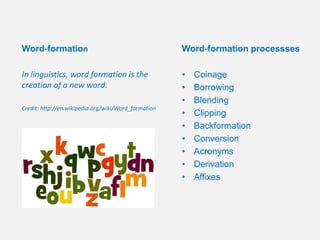
Word-formation
In linguistics, word formation is the
creation of a new word.
Credit: http://en.wikipedia.org/wiki/Word_formation
 One of the least common processes of word formation in English
 The invention of totally new terms.
Ex: Google, nylon ,etc.
 New products and concepts and new activities are usual sources of coinage
 Note: new words base on the name of a person or place are called eponyms.
Ex : sandwich , jeans, fahrenheit
Coinage
 One of the most common sources of new words in English is the process
simply labeled borrowing - the taking over of words from other language
Ex: croissant (French), piano (Italian), pretzel (German), sofa (Arabic)...
 Note: other languages borrow terms from English.
Ex: supermarket = suupaamaaketto (Japanese)
le stress & weekend (French)
Borrowing
 There is joining of two separate words to produce a single form
Ex: N+N : bookcase, fingerprint, wallpaper, waterbed
Ad + N :fast-food, full-time
Ad + Ad : good-looking, low-paid
 Note: this is very common in languages such as German and English but much
less common in languages such as French and Spanish.
Compounding
 The process that is combination of two separate forms to produce a single new
term
Ex: alcopop (alcohol + pop)
bash (bat + mash)
motel (hotel + motor)
Blending
 The element of reduction that is noticeable in blending is even more apparent
in the process
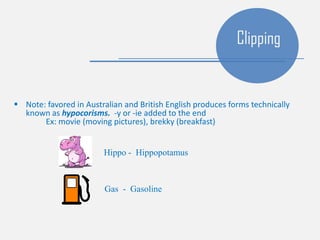
Ex: gas (gasoline), ad (advertisement), fan (fanatic)
 Occurs when a word of more than one syllable is reduced to a shorter form
 Usually in casual speech
Clipping
 Note: favored in Australian and British English produces forms technically
known as hypocorisms. -y or -ie added to the end
Ex: movie (moving pictures), brekky (breakfast)
Clipping
Hippo - Hippopotamus
Gas - Gasoline
 A word of one type is reduced to form a word of another type (usually a noun
 a verb
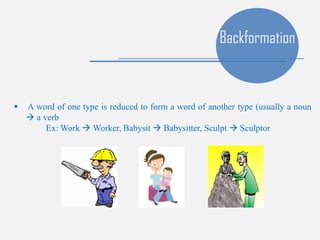
Ex: Work  Worker, Babysit  Babysitter, Sculpt  Sculptor
Backformation
 A change in the function of a word
 Assigning an already existing word to a new syntactic category
Ex: dirty (adj)  to dirty (v), see through (v)  see-through (adj),
up (prep)  the ups (n)
My grandmother put the juice in a bottle (N) and the pickles in a can (N)
My grandmother bottled (V) the juice and canned (V) the pickles.
Conversion
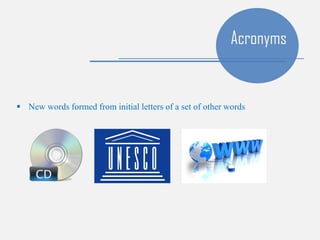
 New words formed from initial letters of a set of other words
Acronyms
 Prefixes and suffixes
 Infixes
 Kamhmu
Derivation
 Prefixes and suffixes
• Prefixes: affixes is added to the beginning of the word
Ex: misrepresent, prejudge, impossible
• Suffixes: affixes is added to the end of the word
Ex: joyful, careless, foolishness
• Both: disrespectful
Derivation
Derivation
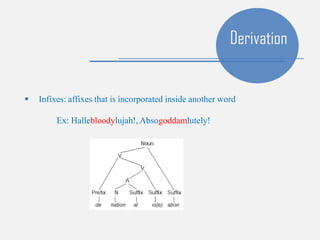
 Infixes: affixes that is incorporated inside another word
Ex: Hallebloodylujah!, Absogoddamlutely!
 The creation of particular word involves more than one process
Ex: Problems with the project have snowballed
snow + ball  compound
snowball (N)  (V) conversion
Multiple
processes
Morphology
• Morphology
• Morphemes
• Free and bound morphemes
• Derivational and inflectional morphemes
• Morphological description
• Morphs and allomorphs
Morphology
Morphology is the study of
morphemes and their different forms
(allomorphs ), and the way they
combine in word formation
Ex: unhappy
The negative prefix un- + free
morpheme happy
Morphemes
 A morpheme is a minimal unit of meaning
or grammatical function.
 The symbol of morphemes : { }
 A morpheme is a short segment of
language that meets three criteria:
1. It is a word or a part of a word that has
meaning.
2. It cannot be divided into smaller
meaningful parts without violation of its
meaning or without meaningless
remainders.
3. It occurs in differing verbal environments
with a relatively stable meaning.
Ex: happy; happiness; un-do; un-reason-able
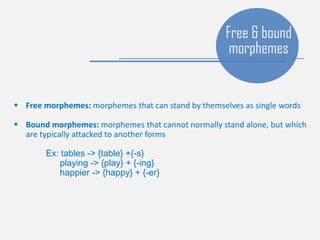
 Free morphemes: morphemes that can stand by themselves as single words
 Bound morphemes: morphemes that cannot normally stand alone, but which
are typically attacked to another forms
Ex: tables -> {table} +{-s}
playing -> {play} + {-ing}
happier -> {happy} + {-er}
Free & bound
morphemes
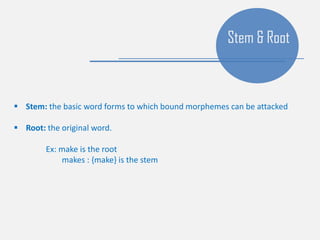
 Stem: the basic word forms to which bound morphemes can be attacked
 Root: the original word.
Ex: make is the root
makes : {make} is the stem
Stem & Root
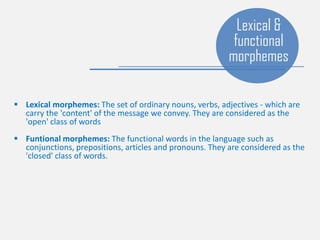
 Lexical morphemes: The set of ordinary nouns, verbs, adjectives - which are
carry the 'content' of the message we convey. They are considered as the
'open' class of words
 Funtional morphemes: The functional words in the language such as
conjunctions, prepositions, articles and pronouns. They are considered as the
'closed' class of words.
Lexical &
functional
morphemes
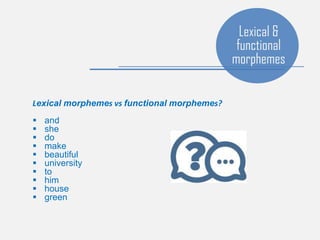
Lexical morphemes vs functional morphemes?
 and
 she
 do
 make
 beautiful
 university
 to
 him
 house
 green
Lexical &
functional
morphemes
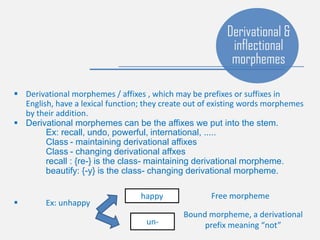
 Derivational morphemes / affixes , which may be prefixes or suffixes in
English, have a lexical function; they create out of existing words morphemes
by their addition.
 Derivational morphemes can be the affixes we put into the stem.
Ex: recall, undo, powerful, international, .....
Class - maintaining derivational affixes
Class - changing derivational affxes
recall : {re-} is the class- maintaining derivational morpheme.
beautify: {-y} is the class- changing derivational morpheme.
 Ex: unhappy
Derivational &
inflectional
morphemes
happy
un-
Free morpheme
Bound morpheme, a derivational
prefix meaning “not”
 Inflectional morphemes are forms of words, typically by means of affixes,
that express grammatical contrast
Ex: pianist -> pianists (plural)
big -> bigger ( comparative)
want -> wanted ( simple past, past participle)
Derivational &
inflectional
morphemes
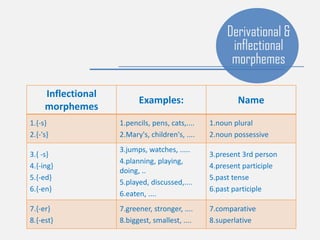
{-s}, {-er}, {-ed} are the inflectional morphemes
Derivational &
inflectional
morphemes
Inflectional
morphemes
Examples: Name
1.{-s}
2.{-'s}
1.pencils, pens, cats,....
2.Mary's, children's, ....
1.noun plural
2.noun possessive
3.{ -s}
4.{-ing}
5.{-ed}
6.{-en}
3.jumps, watches, .....
4.planning, playing,
doing, ..
5.played, discussed,....
6.eaten, ....
3.present 3rd person
4.present participle
5.past tense
6.past participle
7.{-er}
8.{-est}
7.greener, stronger, ....
8.biggest, smallest, ....
7.comparative
8.superlative
Morphological
description
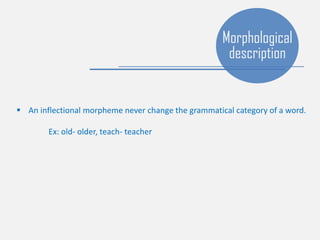
 An inflectional morpheme never change the grammatical category of a word.
Ex: old- older, teach- teacher
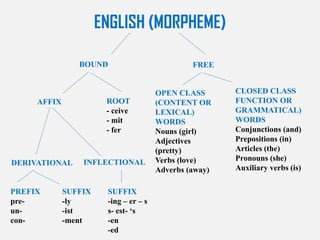
ENGLISH (MORPHEME)
FREEBOUND
AFFIX ROOT
- ceive
- mit
- fer
OPEN CLASS
(CONTENT OR
LEXICAL)
WORDS
Nouns (girl)
Adjectives
(pretty)
Verbs (love)
Adverbs (away)
CLOSED CLASS
FUNCTION OR
GRAMMATICAL)
WORDS
Conjunctions (and)
Prepositions (in)
Articles (the)
Pronouns (she)
Auxiliary verbs (is)
DERIVATIONAL INFLECTIONAL
SUFFIX
-ing – er – s
s- est- ‘s
-en
-ed
SUFFIX
-ly
-ist
-ment
PREFIX
pre-
un-
con-
Morphs &
allomorphs
 Morphs: The smallest meaningful phonetic segments of an utterance on the
level of parole
 A morph: A realization of a morpheme. The basic example of it is the plural „s‟
Ex: Bus – Buses, Girl - Girls, Baby - babies, Sheep - sheep
 Allomorphs: Variants of a morpheme that differ in pronunciation but are
semantically identical
 An allomorph: a member of a set of morphs which represent the same
morpheme
Ex: in English, the plural marker -(e)s of regular nouns can be pronounced
/-z/, /-s/, or /-iz/, depending on the final sound of the noun's singular form.
Morphs &
allomorphs
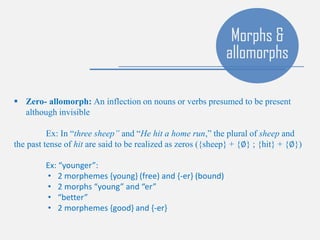
 Zero- allomorph: An inflection on nouns or verbs presumed to be present
although invisible
Ex: In “three sheep” and “He hit a home run,” the plural of sheep and
the past tense of hit are said to be realized as zeros ({sheep} + {∅} ; {hit} + {∅})
Ex: “younger”:
• 2 morphemes {young} (free) and {-er} (bound)
• 2 morphs “young” and “er”
• “better”
• 2 morphemes {good} and {-er}
Quiz
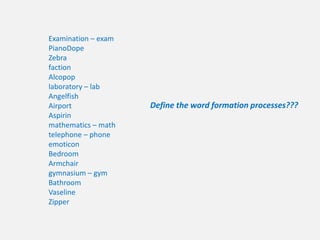
Examination – exam
PianoDope
Zebra
faction
Alcopop
laboratory – lab
Angelfish
Airport
Aspirin
mathematics – math
telephone – phone
emoticon
Bedroom
Armchair
gymnasium – gym
Bathroom
Vaseline
Zipper
Define the word formation processes???
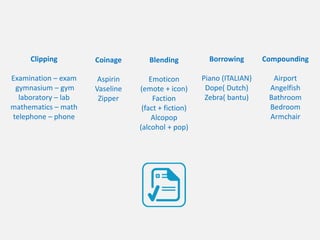
Clipping
Examination – exam
gymnasium – gym
laboratory – lab
mathematics – math
telephone – phone
Blending
Emoticon
(emote + icon)
Faction
(fact + fiction)
Alcopop
(alcohol + pop)
Compounding
Airport
Angelfish
Bathroom
Bedroom
Armchair
Coinage
Aspirin
Vaseline
Zipper
Borrowing
Piano (ITALIAN}
Dope( Dutch)
Zebra( bantu)
Linguistic 06.08

Linguistic 06.08

  • 1.
  • 2.
    1. Nguyễn NgọcPhương Vy 1057010283 2. Trần Thị Thanh Hoa 1057010067 3. Bùi Xuân Trang 1157010255 4. Dương Thị Hiền 1157010066 5. Nguyễn Phương Vi 1057010275 Group 2
  • 3.
    Agenda  Word &Word formation processes  Morphology
  • 4.
  • 5.
    Word-formation processses • Coinage •Borrowing • Blending • Clipping • Backformation • Conversion • Acronyms • Derivation • Affixes Word-formation In linguistics, word formation is the creation of a new word. Credit: http://en.wikipedia.org/wiki/Word_formation
  • 6.
     One ofthe least common processes of word formation in English  The invention of totally new terms. Ex: Google, nylon ,etc.  New products and concepts and new activities are usual sources of coinage  Note: new words base on the name of a person or place are called eponyms. Ex : sandwich , jeans, fahrenheit Coinage
  • 7.
     One ofthe most common sources of new words in English is the process simply labeled borrowing - the taking over of words from other language Ex: croissant (French), piano (Italian), pretzel (German), sofa (Arabic)...  Note: other languages borrow terms from English. Ex: supermarket = suupaamaaketto (Japanese) le stress & weekend (French) Borrowing
  • 8.
     There isjoining of two separate words to produce a single form Ex: N+N : bookcase, fingerprint, wallpaper, waterbed Ad + N :fast-food, full-time Ad + Ad : good-looking, low-paid  Note: this is very common in languages such as German and English but much less common in languages such as French and Spanish. Compounding
  • 9.
     The processthat is combination of two separate forms to produce a single new term Ex: alcopop (alcohol + pop) bash (bat + mash) motel (hotel + motor) Blending
  • 10.
     The elementof reduction that is noticeable in blending is even more apparent in the process Ex: gas (gasoline), ad (advertisement), fan (fanatic)  Occurs when a word of more than one syllable is reduced to a shorter form  Usually in casual speech Clipping
  • 11.
     Note: favoredin Australian and British English produces forms technically known as hypocorisms. -y or -ie added to the end Ex: movie (moving pictures), brekky (breakfast) Clipping Hippo - Hippopotamus Gas - Gasoline
  • 12.
     A wordof one type is reduced to form a word of another type (usually a noun  a verb Ex: Work  Worker, Babysit  Babysitter, Sculpt  Sculptor Backformation
  • 13.
     A changein the function of a word  Assigning an already existing word to a new syntactic category Ex: dirty (adj)  to dirty (v), see through (v)  see-through (adj), up (prep)  the ups (n) My grandmother put the juice in a bottle (N) and the pickles in a can (N) My grandmother bottled (V) the juice and canned (V) the pickles. Conversion
  • 14.
     New wordsformed from initial letters of a set of other words Acronyms
  • 15.
     Prefixes andsuffixes  Infixes  Kamhmu Derivation
  • 16.
     Prefixes andsuffixes • Prefixes: affixes is added to the beginning of the word Ex: misrepresent, prejudge, impossible • Suffixes: affixes is added to the end of the word Ex: joyful, careless, foolishness • Both: disrespectful Derivation
  • 17.
    Derivation  Infixes: affixesthat is incorporated inside another word Ex: Hallebloodylujah!, Absogoddamlutely!
  • 18.
     The creationof particular word involves more than one process Ex: Problems with the project have snowballed snow + ball  compound snowball (N)  (V) conversion Multiple processes
  • 19.
    Morphology • Morphology • Morphemes •Free and bound morphemes • Derivational and inflectional morphemes • Morphological description • Morphs and allomorphs
  • 20.
    Morphology Morphology is thestudy of morphemes and their different forms (allomorphs ), and the way they combine in word formation Ex: unhappy The negative prefix un- + free morpheme happy Morphemes  A morpheme is a minimal unit of meaning or grammatical function.  The symbol of morphemes : { }  A morpheme is a short segment of language that meets three criteria: 1. It is a word or a part of a word that has meaning. 2. It cannot be divided into smaller meaningful parts without violation of its meaning or without meaningless remainders. 3. It occurs in differing verbal environments with a relatively stable meaning. Ex: happy; happiness; un-do; un-reason-able
  • 21.
     Free morphemes:morphemes that can stand by themselves as single words  Bound morphemes: morphemes that cannot normally stand alone, but which are typically attacked to another forms Ex: tables -> {table} +{-s} playing -> {play} + {-ing} happier -> {happy} + {-er} Free & bound morphemes
  • 22.
     Stem: thebasic word forms to which bound morphemes can be attacked  Root: the original word. Ex: make is the root makes : {make} is the stem Stem & Root
  • 23.
     Lexical morphemes:The set of ordinary nouns, verbs, adjectives - which are carry the 'content' of the message we convey. They are considered as the 'open' class of words  Funtional morphemes: The functional words in the language such as conjunctions, prepositions, articles and pronouns. They are considered as the 'closed' class of words. Lexical & functional morphemes
  • 24.
    Lexical morphemes vsfunctional morphemes?  and  she  do  make  beautiful  university  to  him  house  green Lexical & functional morphemes
  • 25.
     Derivational morphemes/ affixes , which may be prefixes or suffixes in English, have a lexical function; they create out of existing words morphemes by their addition.  Derivational morphemes can be the affixes we put into the stem. Ex: recall, undo, powerful, international, ..... Class - maintaining derivational affixes Class - changing derivational affxes recall : {re-} is the class- maintaining derivational morpheme. beautify: {-y} is the class- changing derivational morpheme.  Ex: unhappy Derivational & inflectional morphemes happy un- Free morpheme Bound morpheme, a derivational prefix meaning “not”
  • 26.
     Inflectional morphemesare forms of words, typically by means of affixes, that express grammatical contrast Ex: pianist -> pianists (plural) big -> bigger ( comparative) want -> wanted ( simple past, past participle) Derivational & inflectional morphemes {-s}, {-er}, {-ed} are the inflectional morphemes
  • 27.
    Derivational & inflectional morphemes Inflectional morphemes Examples: Name 1.{-s} 2.{-'s} 1.pencils,pens, cats,.... 2.Mary's, children's, .... 1.noun plural 2.noun possessive 3.{ -s} 4.{-ing} 5.{-ed} 6.{-en} 3.jumps, watches, ..... 4.planning, playing, doing, .. 5.played, discussed,.... 6.eaten, .... 3.present 3rd person 4.present participle 5.past tense 6.past participle 7.{-er} 8.{-est} 7.greener, stronger, .... 8.biggest, smallest, .... 7.comparative 8.superlative
  • 28.
    Morphological description  An inflectionalmorpheme never change the grammatical category of a word. Ex: old- older, teach- teacher
  • 29.
    ENGLISH (MORPHEME) FREEBOUND AFFIX ROOT -ceive - mit - fer OPEN CLASS (CONTENT OR LEXICAL) WORDS Nouns (girl) Adjectives (pretty) Verbs (love) Adverbs (away) CLOSED CLASS FUNCTION OR GRAMMATICAL) WORDS Conjunctions (and) Prepositions (in) Articles (the) Pronouns (she) Auxiliary verbs (is) DERIVATIONAL INFLECTIONAL SUFFIX -ing – er – s s- est- ‘s -en -ed SUFFIX -ly -ist -ment PREFIX pre- un- con-
  • 30.
    Morphs & allomorphs  Morphs:The smallest meaningful phonetic segments of an utterance on the level of parole  A morph: A realization of a morpheme. The basic example of it is the plural „s‟ Ex: Bus – Buses, Girl - Girls, Baby - babies, Sheep - sheep  Allomorphs: Variants of a morpheme that differ in pronunciation but are semantically identical  An allomorph: a member of a set of morphs which represent the same morpheme Ex: in English, the plural marker -(e)s of regular nouns can be pronounced /-z/, /-s/, or /-iz/, depending on the final sound of the noun's singular form.
  • 31.
    Morphs & allomorphs  Zero-allomorph: An inflection on nouns or verbs presumed to be present although invisible Ex: In “three sheep” and “He hit a home run,” the plural of sheep and the past tense of hit are said to be realized as zeros ({sheep} + {∅} ; {hit} + {∅}) Ex: “younger”: • 2 morphemes {young} (free) and {-er} (bound) • 2 morphs “young” and “er” • “better” • 2 morphemes {good} and {-er}
  • 32.
  • 33.
    Examination – exam PianoDope Zebra faction Alcopop laboratory– lab Angelfish Airport Aspirin mathematics – math telephone – phone emoticon Bedroom Armchair gymnasium – gym Bathroom Vaseline Zipper Define the word formation processes???
  • 34.
    Clipping Examination – exam gymnasium– gym laboratory – lab mathematics – math telephone – phone Blending Emoticon (emote + icon) Faction (fact + fiction) Alcopop (alcohol + pop) Compounding Airport Angelfish Bathroom Bedroom Armchair Coinage Aspirin Vaseline Zipper Borrowing Piano (ITALIAN} Dope( Dutch) Zebra( bantu)