Iakob Gogebashvili Telavi State University
School of Humanities
Department of English Language and Literature
Bachelor’s program in English Language and
Literature
Bachelor’s Thesis
Semantic Field In Fairy Tales
Submitted by: Tamar Papalashvili
Supervisor: Doctor, Professor – Manana Garibashvili
Content :
I. Introduction
II. What is semantics ?
III. What is semantic field ?
IV. What is fairy tale?
V. The examples of SF in fairy
tales;
VI. Conclusion.
Introduction :
I. Short review of lexical-
semantic field;
II. The goal of the thesis;
III. The research questions of
the thesis.
I. What is semantics?
• Branch of linguistics;, which is study of
language.
• It is the relationship between words and their
meanings. Semantics tries to understand what
meaning is an element of language and how it is
constructed by language.
1.1. What is semantic analysis?
Semantic analysis is the study of
semantics, or the structure and
meaning of speech. It is the job of
a semantic analyst to discover
grammatical patterns, the
meanings of colloquial speech,
and to uncover specific meanings
to words in foreign languages.
II. Essence of Semantic Field Theory
• Semantic field is the organization of related words and expressions into
a system, which shows their relationship to one another.
• It helps students to review and associate the words related.
E.g.
Animal
The founders of semantic
Wilhelm Humboldt (German linguist)- the
founder of common linguistics,, from the middle
of 19th century.
Jost Trier (German scholar ) - the semantic field
theory into its puberty in the 1930s, whose
version is seen as a new phase in the history of
semantics.
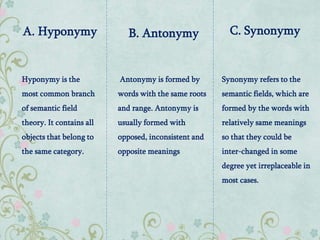
A. Hyponymy B. Antonymy C. Synonymy
Hyponymy is the
most common branch
of semantic field
theory. It contains all
objects that belong to
the same category.
Antonymy is formed by
words with the same roots
and range. Antonymy is
usually formed with
opposed, inconsistent and
opposite meanings
Synonymy refers to the
semantic fields, which are
formed by the words with
relatively same meanings
so that they could be
inter-changed in some
degree yet irreplaceable in
most cases.
3. Semantic Field in Fairy Tales: Corpus-Based
Approach
Fairy tales are short stories with simple plots.
Contrary to romances or novels
The number of characters is small
characters often represent stereotypes. e.g.,
the princess, a king.
A fairy tale often tells the story of an
individual.
Fairy tales have been popular with people all
over the world from earliest times.
Example of SF in fairy tale : 1
Example of SF in fairy tale: 2
Evil
“The princess and
the dragon”
“Don't be afraid dear
princess, I won’t hurt
you. I just want you to
be my bride.”
Example of SF in fairy tale: 3
Conclusion :
Semantic field Semantic field provide useful ways for learners to have a
deeper understanding for vocabulary language. This theory helps to
learn many unknown Words, belonging to the same semantic field
easily.
With the analysis and examples given, it is obvious that semantic field
theory really play a reliable and practical role in English literature.
References:
1. 1. Agraval A.J., Implementation of Semantic Analysis Using Domain Ontology, IOSR Journal of Computer Engineering (IOSR-JCE) e-ISSN: 2278-
0661, p- ISSN: 2278-8727Volume 11, Issue 3 (May. - Jun. 2013), PP 22-34 www.iosrjournals.org
2. 2. Gao, Ch., Xu.B., The Application of Semantic Field Theory to English Vocabulary Learning, Theory and Practice in Language Studies, Vol. 3, No.
11, pp. 2030-2035, November 2013
3. 3. Guo, Changhong. (2010). The Application of the Semantic Field Theory in College English Vocabulary Instruction. Chinese Journal of Applied
Linguistics, 33,
4. 4. Korzybski. A., (2010), Selections from Science and Sanity: An Introduction to Non-Aristotelian Systems and General Semantics, Second Edition,
Institute of General Semantics
5. 5. Leech, G.N., (1990) Semantics: The Study of Meaning, Penguin bookს
6. 6. Martin, J. (1962). The Five Clocks. Bloomington:Indiana University Research Center in Anthropology, Folklore and Linguistics.
7. 7. Mei, Jiaju, Zhu Yiming, Gao Yunqi & Yin Hongxiang. (1987). Semantic Field and Semantic System. Foreign Languages, 49,
8. 8. Wu,Qianguang. (1988). Introduction to Semantics. Changsha: Hunan Education Press
9. 9. Zhang, Yunfei. (2004). An Introduction to Modern English Lexicology. Beijing: Beijing Normal University Press.
10. 10. Zhou, Weijie. (2001). A New Research on English Semantic Field. Journalof Beijing International StudiesUniversity,
11. 11. http://www.wisegeek.com/what-is-general-semantics.htm
12. 12. http://www.wisegeek.com/what-is-semantic-analysis.htm
13. 13. https://sites.google.com/a/sheffield.ac.uk/all-about-linguistics/branches/semantics/what-is-semantics
14. 14. https://sites.google.com/a/sheffield.ac.uk/all-about-linguistics/branches/semantics/what-is-semantics
Thank you for your attention !

semantic field in fairy tales

  • 1.
    Iakob Gogebashvili TelaviState University School of Humanities Department of English Language and Literature Bachelor’s program in English Language and Literature Bachelor’s Thesis Semantic Field In Fairy Tales Submitted by: Tamar Papalashvili Supervisor: Doctor, Professor – Manana Garibashvili
  • 2.
    Content : I. Introduction II.What is semantics ? III. What is semantic field ? IV. What is fairy tale? V. The examples of SF in fairy tales; VI. Conclusion.
  • 3.
    Introduction : I. Shortreview of lexical- semantic field; II. The goal of the thesis; III. The research questions of the thesis.
  • 4.
    I. What issemantics? • Branch of linguistics;, which is study of language. • It is the relationship between words and their meanings. Semantics tries to understand what meaning is an element of language and how it is constructed by language.
  • 5.
    1.1. What issemantic analysis? Semantic analysis is the study of semantics, or the structure and meaning of speech. It is the job of a semantic analyst to discover grammatical patterns, the meanings of colloquial speech, and to uncover specific meanings to words in foreign languages.
  • 6.
    II. Essence ofSemantic Field Theory • Semantic field is the organization of related words and expressions into a system, which shows their relationship to one another. • It helps students to review and associate the words related. E.g. Animal
  • 7.
    The founders ofsemantic Wilhelm Humboldt (German linguist)- the founder of common linguistics,, from the middle of 19th century. Jost Trier (German scholar ) - the semantic field theory into its puberty in the 1930s, whose version is seen as a new phase in the history of semantics.
  • 8.
    A. Hyponymy B.Antonymy C. Synonymy Hyponymy is the most common branch of semantic field theory. It contains all objects that belong to the same category. Antonymy is formed by words with the same roots and range. Antonymy is usually formed with opposed, inconsistent and opposite meanings Synonymy refers to the semantic fields, which are formed by the words with relatively same meanings so that they could be inter-changed in some degree yet irreplaceable in most cases.
  • 9.
    3. Semantic Fieldin Fairy Tales: Corpus-Based Approach Fairy tales are short stories with simple plots. Contrary to romances or novels The number of characters is small characters often represent stereotypes. e.g., the princess, a king. A fairy tale often tells the story of an individual. Fairy tales have been popular with people all over the world from earliest times.
  • 10.
    Example of SFin fairy tale : 1
  • 11.
    Example of SFin fairy tale: 2 Evil
  • 12.
    “The princess and thedragon” “Don't be afraid dear princess, I won’t hurt you. I just want you to be my bride.”
  • 13.
    Example of SFin fairy tale: 3
  • 14.
    Conclusion : Semantic fieldSemantic field provide useful ways for learners to have a deeper understanding for vocabulary language. This theory helps to learn many unknown Words, belonging to the same semantic field easily. With the analysis and examples given, it is obvious that semantic field theory really play a reliable and practical role in English literature.
  • 15.
    References: 1. 1. AgravalA.J., Implementation of Semantic Analysis Using Domain Ontology, IOSR Journal of Computer Engineering (IOSR-JCE) e-ISSN: 2278- 0661, p- ISSN: 2278-8727Volume 11, Issue 3 (May. - Jun. 2013), PP 22-34 www.iosrjournals.org 2. 2. Gao, Ch., Xu.B., The Application of Semantic Field Theory to English Vocabulary Learning, Theory and Practice in Language Studies, Vol. 3, No. 11, pp. 2030-2035, November 2013 3. 3. Guo, Changhong. (2010). The Application of the Semantic Field Theory in College English Vocabulary Instruction. Chinese Journal of Applied Linguistics, 33, 4. 4. Korzybski. A., (2010), Selections from Science and Sanity: An Introduction to Non-Aristotelian Systems and General Semantics, Second Edition, Institute of General Semantics 5. 5. Leech, G.N., (1990) Semantics: The Study of Meaning, Penguin bookს 6. 6. Martin, J. (1962). The Five Clocks. Bloomington:Indiana University Research Center in Anthropology, Folklore and Linguistics. 7. 7. Mei, Jiaju, Zhu Yiming, Gao Yunqi & Yin Hongxiang. (1987). Semantic Field and Semantic System. Foreign Languages, 49, 8. 8. Wu,Qianguang. (1988). Introduction to Semantics. Changsha: Hunan Education Press 9. 9. Zhang, Yunfei. (2004). An Introduction to Modern English Lexicology. Beijing: Beijing Normal University Press. 10. 10. Zhou, Weijie. (2001). A New Research on English Semantic Field. Journalof Beijing International StudiesUniversity, 11. 11. http://www.wisegeek.com/what-is-general-semantics.htm 12. 12. http://www.wisegeek.com/what-is-semantic-analysis.htm 13. 13. https://sites.google.com/a/sheffield.ac.uk/all-about-linguistics/branches/semantics/what-is-semantics 14. 14. https://sites.google.com/a/sheffield.ac.uk/all-about-linguistics/branches/semantics/what-is-semantics
  • 16.
    Thank you foryour attention !