Introduction to Morphology
Lecture: 1
Content Words and Function
Words
Definition and distinction
Check these words:
Nouns Verbs
• houseenjoy
• computer purchase
• student visit
• lake understand
• Peter believe
• science look forward to
Adjectives Adverbs
• heavy slowly
• difficult carefully
• careful sometimes
• expensive thoughtfully
• soft often
• fast suddenly
CONTENT words
• Nouns, verbs, adjectives, and adverbs
• They denote concepts such as objects, actions, attributes,
and ideas that we can think about like children, build,
beautiful, and seldom.
• They are also called open class words because we can and
regularly do add new words to these classes, such as
Facebook (noun), blog (noun, verb), frack (verb), online
(adjective, adverb), and blingy (adjective).
Check these words:
Auxiliary Verbs Prepositions
• do in
• has at
• will though
• is over
• has been between
• did under
Articles Conjunction Pronouns
• a and I
• an but you
• the for him
FUNCTION words
• These words do not have clear lexical meanings or obvious concepts
associated with them, including conjunctions such as and, or, and
but; prepositions such as in and of; the articles the and a/an, and
pronouns such as it.
• These kinds of words are called function words because they
specify grammatical relations and have little or no semantic content.
• For example, the articles indicate whether a noun is definite or
indefinite—the boy or a boy. The it in it’s raining and the archbishop
found it advisable are further examples of words whose function is
purely grammatical—they are required by the rules of syntax and
we can hardly do without them.
Continued:
• Function words are sometimes called closed class words.
This is because it is difficult to think of any conjunctions,
prepositions, or pronouns that have recently entered the
language.
• The small set of personal pronouns such as I, me, mine, he,
she, and so on are part of this class
Morphemes:
The Minimal
Units of Meaning
Morphemes: The Minimal
Units of Meaning
• The linguistic term for the most elemental unit of
grammatical form is morpheme. The word is derived from
the Greek word morphe, meaning ‘form.’
un = not
desirable undesirable
likely unlikely
inspired uninspired
happy unhappy
developed undeveloped
Morphology
• The study of the internal structure of words, and of the rules
by which words are formed, is morphology.
• This word itself consists of two morphemes, morph + ology.
• The suffix -ology means ‘branch of knowledge,’ so the
meaning of morphology is ‘the branch of knowledge
concerning (word) forms.’
• Morphology also refers to our internal grammatical
knowledge concerning the words of our language, and like
most linguistic knowledge we are not consciously aware of
it.
• A morpheme—the minimal/smallest linguistic unit—is an arbitrary union of a
sound and a meaning (or grammatical function) that cannot be further analyzed.
• Examples:
• One morpheme: boy, desire, meditate
• two morphemes: boy + ish, desire + able, meditate + tion
• three morphemes: boy + ish + ness. desire + able + ity
• four morphemes: gentle + man + li + ness, un + desire + able + ity
• more than four: un + gentle + man + li + ness
• Every word in every language is composed of one or more morphemes.
• A single morpheme is called: a monomorphemic word.
In all languages, sound units combine to form
morphemes, morphemes combine to form words, and
words combine to form larger units—phrases and
sentences.
Discreetness
• Look at this example:
• Sing singer sing + er
• Write writer write+er
• Shop shopper shop+er
er = doer of the action/verb it is attached to (noun)
• These are two morphemes attached to make a new word with a new
meaning.
• Now check these words:
• Finger, matter, slipper
• These words cannot be broken down even if they end with an ‘er’
Discreetness
• Discreteness is an important part of linguistic creativity. We can combine morphemes
in new ways to create new words whose meaning will be apparent to other speakers
of the language.
• For example:
• a writable DVD
• a rewritable DVD
• unrewritable DVD
• You know the meanings of all these words by virtue of your knowledge of
the discrete morphemes write, re-, -able, and un-, and the rules for their
combination.
• Thus, the break down of words into morphemes shows one of the basic
characteristics of human language—discreteness—a feature that sets it
apart from the animal communication systems.
Free And Bound Morphemes
Free Morphemes:
• One of the things we know about particular morphemes is whether
they can stand alone or whether they must be attached to a base
morpheme. Some morphemes like boy, desire, gentle, and man may
constitute words by themselves. These are free morphemes.
• Other morphemes like -ish, -ness, -ly, pre-, trans-, and un- are never
words by themselves but are always parts of words. These affixes are
bound morphemes and they may attach at the beginning, the end, in
the middle, or both at the beginning and end of a word.
Affixes:
Prefixes and
Suffixes
• We know whether an affix precedes or follows other
morphemes, for example that un-, pre- (unmarried,
premature), and bi- (bipolar, bimonthly) are prefixes. They
can occur before other morphemes.
• Some morphemes occur only as suffixes, following other
morphemes. English examples of suffix morphemes are -ing
(sleeping, eating,running, climbing), -er (singer, performer,
reader), -ist (typist, pianist, novelist, linguist), and -ly (manly,
sickly, friendly)
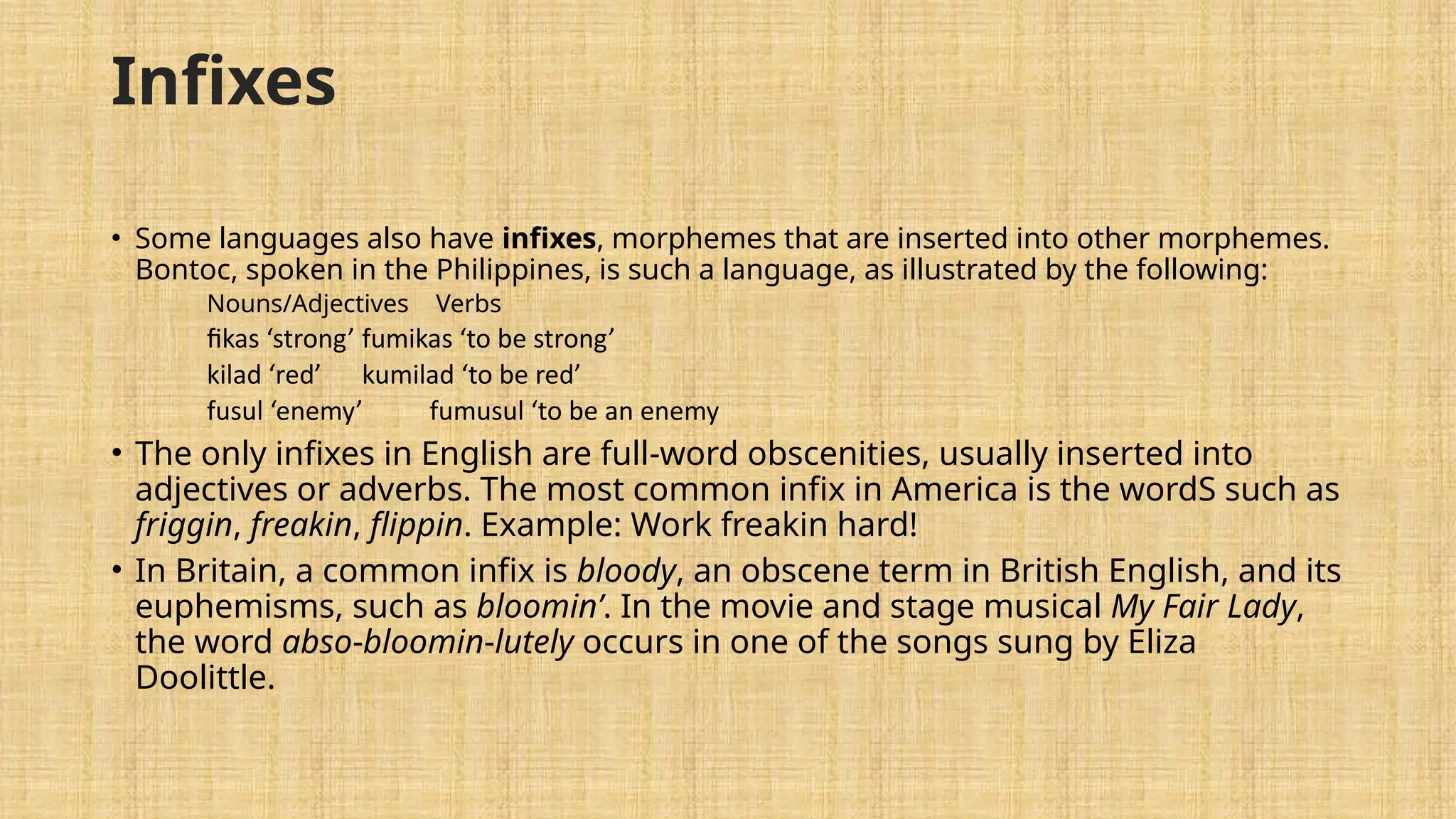
Infixes
• Some languages also have infixes, morphemes that are inserted into other morphemes.
Bontoc, spoken in the Philippines, is such a language, as illustrated by the following:
Nouns/Adjectives Verbs
fikas ‘strong’ fumikas ‘to be strong’
kilad ‘red’ kumilad ‘to be red’
fusul ‘enemy’ fumusul ‘to be an enemy
• The only infixes in English are full-word obscenities, usually inserted into
adjectives or adverbs. The most common infix in America is the wordS such as
friggin, freakin, flippin. Example: Work freakin hard!
• In Britain, a common infix is bloody, an obscene term in British English, and its
euphemisms, such as bloomin’. In the movie and stage musical My Fair Lady,
the word abso-bloomin-lutely occurs in one of the songs sung by Eliza
Doolittle.
Circumfixes
• Some languages have circumfixes, morphemes that are
attached to a base morpheme both initially and finally.
These are sometimes called discontinuous morphemes.
• Example:
• Im.prison.ment
• Un.healthi.ness
• Dis.agree.ment
• In.human.ity
Roots and Stems
Roots and Stems
• Morphologically complex words consist of a morpheme root
and one or more affixes.
• A root may or may not stand alone as a word (paint in painter
and read in reader do; ceive in conceive or receive and ling in
linguist or linguistics or lingual don’t).
• In languages that have circumfixes, the root is the form around
which the circumfix attaches.
• For example in Semitic language like Arabic: nouns and verbs
are built on a foundation of three consonants, and one derives
related words by varying the pattern of vowels and syllables.
For example, the root for ‘write’ in Arabic is ktb ‫ب‬ ‫ت‬ ‫ك‬, from
which the following words (among others) are formed by
infixing vowels:
• katab ‘he wrote’ ‫كتب‬
• kaatib ‘writer’ ‫كاتب‬
• kitáab ‘book’ ‫كتاب‬
• kútub ‘books’ ‫كتب‬
• When a root morpheme is combined with an affix, it forms a stem. Other
affixes can be added to a stem to form a more complex stem, as shown in the
following:
With the addition of each new affix, a new stem and a new word are formed.
Linguists sometimes use the word base to mean any root or stem to which an affix is attached. For
example, system, systematic, unsystematic, and unsystematically are bases.
Root Stem Word
Silk Silky Silkiness
Noun Noun + Suffix Noun + Suffix + Suffix
Depend Dependable Undependable
Verb Verb + Suffix Prefix+ Verb + Suffix
Friend Friendly Friendliness Unfriendliness
Noun Noun + Suffix Noun + Suffix + Suffix Prefix + Noun + Suffix +
Suffix
Bound roots
• Bound roots do not occur in isolation and they acquire meaning
only in combination with other morphemes.
• For example, words of Latin origin such as receive, conceive,
perceive, and deceive share a common root, -ceive;
• and the words remit, permit, commit, submit, transmit, and admit
share the root -mit.
• For the original Latin speakers, the morphemes corresponding to
ceive and mit had clear meanings, but for modern English
speakers, Latinate morphemes such as ceive and mit have no
independent meaning. Their meaning depends on the entire
word in which they occur.
A similar class of words is made of a prefix affixed to a bound root
morpheme.
• Examples are:
• ungainly, but no *gainly
• discern, but no *cern
• disheartened but no *heartened
• Recogize but no cognize
• The morpheme huckle, when joined with berry, has the meaning of a berry that is small, round, and purplish
blue; luke when combined with warm has the meaning ‘somewhat.’ Both these morphemes and others like
them (cran, blue, black, or straw + berry) are bound morphemes that convey meaning only in combination.
Derivational Morphology
Let’s start it with an example:
• Beauty (Adj)
• Beauty + ify = Beautify (Verb) {to make something look beautiful}
• Beauty + ify + cation = Beautification (Noun) { The process of making something
look beautiful}
• Ugly (Adj)
• Verb?
Uglify
• Noun?
Uglification
We know the meaning of its individual
parts—the root ugly and the affixes -ify
and -cation
Adjective + ify → Verb ‘to make Adjective’
Verb + cation → Noun ‘the process of making
Adjective’
Definition of Derivational Morphemes
• Bound morphemes like -ify, -cation and -arian are called derivational
morphemes. When they are added to a base, a new word with a new
meaning is derived.
• Example: The addition of -ify to pure—purify—means ‘to make pure,’
and the addition of -cation—purification—means ‘the process of
making pure.’
• The form that results from the addition of a derivational morpheme is
called a derived word.
Characteristics of Derivational Morphemes:
• Derivational morphemes have clear semantic content.
• They are like content words, except that they are not words.
• When a derivational morpheme is added to a base, it adds meaning.
• The derived word may also be of a different grammatical class than
the original word.
• Refer Page 45 for detailed examples.
• An_introduction_to_language.pdf (pg69 in some PDF copies)
Categories of DM
• Derivational affixes appear to come in two classes:
1. In one class, the addition of a suffix triggers subtle changes in
pronunciation. For example, sane/sanity, deduce/deductive,
critic/criticize.
2. Suffixes such as -er, -ful, -ish, -less, -ly, and -ness may be tacked onto a
base word without affecting the pronunciation, as in baker, wishful,
boyish, needless, sanely, and fullness.
3. Affixes from the first class cannot be attached to a base containing an
affix from the second class: *need + less + ity, *moral + ize + ive; but
affixes from the second class may attach to bases with either kind of affix:
moral + iz(e) + er, need + less + ness.
Inflectional Morphology
1. “He has three desserts.”
2. “This is Betty’s dessert.”
3. “Bill usually eats dessert.”
4. “He baked the dessert yesterday.”
5. “He has always eaten dessert.”
6. “He is eating the dessert now.”
7. “His dessert is larger than mine.”
8. “Her dessert is the largest.”
Look at these sentences:
English has eight inflectional suffixes:
1. Noun plural {-s} – “He has three desserts.”
2. Noun possessive {-s} – “This is Betty’s dessert.”
3. Verb present tense {-s} – “Bill usually eats dessert.”
4. Verb past tense {-ed} – “He baked the dessert yesterday.”
5. Verb past participle {-en} – “He has always eaten dessert.”
6. Verb present participle {-ing} – “He is eating the dessert now.”
7. Adjective comparative {-er} – “His dessert is larger than mine.”
8. Adjective superlative {-est} – “Her dessert is the largest.”
Definition:
• Many languages, including English, also have bound
morphemes that have a strictly grammatical function. They
mark properties such as tense, number, person, and so forth.
Such bound morphemes are called inflectional morphemes.
Unlike derivational morphemes, they never change the
grammatical category of the stems to which they are attached.
Consider the forms of the verb in the following sentences:
• 1. I sail the ocean blue.
• 2. He sails the ocean blue.
• 3. John sailed the ocean blue.
• 4. John has sailed the ocean blue.
• 5. John is sailing the ocean blue.
English Inflectional Morphemes Showing Relationships:
Inflectional morphemes represent relationships between different parts
of a sentence.
English Inflectional Morphemes Examples
-s third-person singular present She wait-s at home.
-ed past tense She wait-ed at home.
-ing progressive She is eat-ing the donut.
-en Past participle Mary has eat-en the donuts.
-s plural She ate the donut-s.
-’s possessive Disa’s hair is short.
-er comparative Disa has short-er hair than Karin.
-est superlative Disa has the short-est hair
Inflectional Morphemes Eng vs Other
Languages:
Compared to many languages of the world, English has
relatively little inflectional morphology.
• Even the more familiar European languages have many
more inflectional endings than English.
• Russian has a system of inflectional suffixes for nouns that
indicates the nouns grammatical relation—whether a
subject, object, possessor, and so on— something English
does with word order.
• Example:
• For example, in English, the sentence:
• Maxim defends Victor
means something different from
• Victor defends Maxim.
• The order of the words is critical.
But in Russian, all of the following sentences mean ‘Maxim defends Victor’ (the č is
pronounced like the ch in cheese; the š like the sh in shoe; the j like the y in yet):
• Maksim zašiščajt Viktora.
• Maksim Viktora zašiščajet.
• Viktora Maksim zašiščajet.
• Viktora zašiščajet Maksim.
• The inflectional suffix -a added to the name Viktor to derive Viktora shows that
• Victor, not Maxim, is defended. The suffix designates the object of the verb,
• irrespective of word order.
Case Morphology
• The grammatical relation of a noun in a sentence is called the case of
the noun. When case is marked by inflectional morphemes, the
process is referred to as case morphology.
• Russian has a rich case morphology, whereas English case morphology
is limited to the one possessive -’s and to its system of pronouns.
• Many of the grammatical relations that Russian expresses with its
case morphology are expressed in English with prepositions.
World Languages and Inflectional Morphemes
• German uses circumfixes to inflect a verb stem to produce a past particle: lieb
to geliebt, similar to the -ed ending of English.
• Arabic infixes vowels for inflectional purposes: kitáab ‘book’ but kútub ‘books.’
• Samoan uses a process of reduplication—inflecting a word through the
repetition of part or all of the word: savali ‘he travels,’ but savavali ‘they travel.’
Malay does the same with whole words: orang ‘person,’ but orang orang
‘people.’
• Languages such as Finnish have an extraordinarily complex case morphology
• Mandarin Chinese lacks case morphology entirely.
• English spoken 1,000 years ago had considerably more inflectional
morphology than Modern English.
A Comparison between:
Inflectional Morphemes
• Grammatical function
• No word class change
• Small or no meaning change
• Often required by rules of
grammar
• Follow derivational
morphemes in a word
• Productive
Derivational Morphemes
• Lexical function
• May cause word class change
• Some meaning change
• Never required by rules of
grammar
• Precede inflectional morphemes
in a word
• Some productive, many
nonproductive
Classification of English morphemes
The Hierarchical Structure of Words
Rules of word formation
• We saw earlier that morphemes are added in a certain fixed order.
This order reflects the hierarchical structure of the word.
• A word is not a simple or arbitrary sequence of morphemes.
• It has an internal structure.
• For example: affixes un, able, ness have a determined place when
attached to the root word “reason”
Unreasonableness
Lets consider the example below:
• For example, the word unsystematic is composed of three
morphemes:
Un system atic
• The root is system, a noun,
• to which we add the suffix -atic, resulting in an adjective, systematic.
• To this adjective, we add the prefix un-, forming a new adjective,
unsystematic
Tree diagrams
• In order to represent the hierarchical organization of words (and sentences),
linguists use tree diagrams. The tree diagram for unsystematic is as follows:
• This tree represents the application of two morphological rules:
• 1. Noun + atic Adjective
→
• 2. un + Adjective Adjective
→
Tree Diagrams
Tree diagrams make explicit the way
speakers represent the internal
structure of the morphologically
complex words in their language.
In speaking and writing, we appear
to string morphemes together
sequentially as in un + system + atic.
However, our mental representation
of words is hierarchical as well as
linear, and this is shown by tree
diagrams.
So what is hierarchical structure?
• Hierarchical structure is an essential property of human language.
• Words (and sentences) have component parts, which relate to each
other in specific, rule-governed ways.
• Although at first glance it may seem that, aside from order, the
morphemes un- and -atic each relate to the root system in the same
way, this is not the case.
• The root system is “closer” to -atic than it is to un-, and un- is actually
connected to the adjective systematic, and not directly to system.
Indeed, *unsystem is not a word.
The Rules:
• Rule 1 The derivational suffix –atic attaches to the
root noun, forming an adjective.
• Rule 2 The adjective formed by rule 1 attaches the
derivational prefix un-.
The diagram shows that the entire word—
unsystematic—is an adjective that is composed of an
adjective—systematic—plus un. The adjective is itself
composed of a noun—system—plus the suffix -atic.
Suffix –al Rule
•Rule 3: English has a derivational suffix -al, as in
egotistical, fantastical, and astronomical. In
these cases, -al is added to an adjective—
egotistic, fantastic, astronomic—to form a new
adjective. The rule for -al is as follows:
Adjective + al Adjective
→
Suffix –ly Rule
•Rule 3: Another affix is -ly, which is added to
adjectives—happy, lazy, hopeful—to form
adverbs happily, lazily, hopefully. Following is
the rule for -ly:
Adjective + ly Adverb
→
Applying these two rules to the derived form
unsystematic, we get the following tree for
unsystematically:
Rule 4: Rule productivity (-able and un+able)
We have noted that some morphological processes, inflection in particular,
are productive, meaning that they can be used freely to form new words
from the list of free and bound morphemes.
• Among derivational morphemes, the suffix -able can be
conjoined with any verb to derive an adjective with the
meaning of the verb and the meaning of -able, which is
something like ‘able to be’ as in accept + able, laugh + able, pass
+ able, change + able, breathe + able, adapt + able, and so on.
• Example: The productivity of this rule is illustrated by the fact that we
• find -able affixed to new verbs such as downloadable and faxable.
Contined:
• The prefix un- derives same-class words with an opposite meaning:
unafraid, unfit, un-American, and so on. Additionally, un- can be added to
derived adjectives that have been formed by morphological rules, resulting
in perfectly acceptable words such as:
• un + believe + able or un + pick + up + able.
• Yet un- is not fully productive. We find happy and unhappy, cowardly and
uncowardly, but not sad and *unsad, brave and *unbrave, or obvious and
*unobvious.
• It appears that the “un-Rule” is most productive for adjectives that are
derived from verbs, such as unenlightened, unsimplified, uncharacterized,
unauthorized, undistinguished, and so on.
Rule 5: The rule of -er
• The rule that adds an -er to verbs in English to produce a noun
meaning ‘one who does’ is a nearly productive morphological rule,
giving us examiner, exam-taker, analyzer, lover, hunter
• but fails full productivity owing to “unwords” like *chairer, which is
not ‘one who chairs.’
• The “other” -er suffix, the one that means ‘more’ as in greedier, also
fails to be entirely productive. The more syllables a word has, the less
likely -er will work and we will need the word more, as in more
beautiful (but not *beautifuler) compared with the well-formed nicer
or prettier.
Exceptions and Suppletions
• The morphological rule that forms plural nouns from singular nouns
does not apply to words like child, man, foot, and mouse. These
words are exceptions to the rule. Similarly, verbs like go, sing, bring,
run, and know are exceptions to the inflectional rule for producing
past-tense verbs in English.
• Irregular, or suppletive, forms are treated separately in the grammar.
You cannot use the regular rules to add affixes to words that are
exceptions like child/children but must replace the uninflected form
with another word.
• When a new word enters the language, the regular inflectional rules
generally apply. The plural of geek, when it was a new word in
English, was geeks, not *geeken, although we are advised that some
geeks wanted the plural of fax to be *faxen, like oxen, when fax
entered the language as a shortened form of facsimile. Never fear: its
plural is faxes.
• The exception to this may be a word “borrowed” from a foreign
language. For example, the plural of Latin datum has always been
data, never datums, though nowadays data, the one-time plural, is
treated by many as a singular word like information.
Lexical Gaps
• “Words” that conform to the rules
of word formation but are not
truly part of the vocabulary are
called accidental gaps or lexical
gaps. Accidental gaps are well-
formed but nonexisting words.
Back-Formations
• A new word may enter the language because of an incorrect
morphological analysis.
• For example, peddle was derived from peddler on the mistaken
assumption that the -er was the agentive suffix.
• Such words are called backformations.
• The verbs hawk, stoke, swindle, burgle and edit all came into the
language as back-formations—of hawker, stoker, swindler, burglar and
editor.
• Pea was derived from a singular word, pease, by speakers who thought
pease was a plural.
Compounds
• Two or more words may be joined to form new,
compound words. English is very flexible in the
kinds of combinations permitted, as the following
table of compounds shows.
Some compounds that have been introduced fairly recently into English are Facebook, linkedIn, android apps, m-
commerce, and crowdsourcing (the practice of obtaining information from a large group of people who contribute
online).
Rule:
• When the two words are in the same grammatical category, the compound will also be in this
category:
• noun + noun = noun, as in girlfriend, fighterbomber, paper clip, elevator-operator, landlord,
mailman;
• adjective + adjective = adjective, as in icy-cold, red-hot, worldly wise.
• In English, the rightmost word in a compound is the head of the compound.
• The head is the part of a word or phrase that determines its broad meaning and grammatical
category. Thus, when the two words fall into different categories, the class of the second or final
word determines the grammatical category of the compound: noun + adjective = adjective, as in
headstrong; verb + noun = noun, as in pickpocket.
• On the other hand, compounds formed with a preposition are in the category of the
nonprepositional part of the compound, such as (to) overtake or (the) sundown. This is further
evidence that prepositions form a closed class category that does not readily admit new members.
“Pullet Surprises”
• Our knowledge of the morphemes and morphological rules of our
language is often revealed by the “errors” we make. We may guess
the meaning of a word we do not know. Sometimes we guess wrong,
but our wrong guesses are nevertheless “intelligent.”
• Amsel Greene collected errors made by her students in vocabulary-
building classes and published them in a book called Pullet Surprises.
The title is taken from a sentence written by one of her high school
students: “In 1957 Eugene O’Neill won a Pullet Surprise.”
• What is most interesting about these errors is how much they reveal
about the students’ knowledge of English morphology.
Example
• shedding the leaves
annually, as certain trees
and shrubs.
• a long individual life
• happening or produced by
chance
• easily deceived or cheated.
Morphological Analysis:
Identifying Morphemes
• Case Studies
Case study 1
Analysis:
• To determine what the morphemes are in such a list, the first thing a
field linguist would do is to see whether some forms mean the same
thing in different words, that is, to look for recurring forms.
• We find them: ugly occurs in ugly, uglier, and ugliest, all of which
include the meaning ‘very unattractive.’
• We also find that -er occurs in prettier and taller, adding the meaning
‘more’ to the adjectives to which it is attached.
• Similarly, -est adds the meaning ‘most.’
• We can therefore conclude that the following morphemes occur in
English:
Exception:
• As we proceed we find other words that end with -er (e.g., singer,
lover, bomber, writer, teacher) in which the -er ending does not mean
‘comparative’ but, when attached to a verb, changes it to ‘a noun who
“verbs,”’ (e.g., sings, loves, bombs, writes, teaches).
• So we conclude that this is a different morpheme, even though it is
pronounced the same as the comparative - and therefore these words
must be monomorphemic.
Case studies 2,3, and 4
Refer page 61 from the textbook.
Definition:
• Morphological analysis is the process of identifying
form-meaning units in a language, taking into
account small differences in pronunciation, so that
prefixes in- and im- are seen to be variants of the
“same” prefix in English (cf. intolerable, impeccable)
just as democrat and democrac are stem variants of
the same morpheme, which shows up in democratic
with its “t” and in democracy with its “c.

Introduction to Morphology and synatax.pptx

  • 1.
  • 2.
    Content Words andFunction Words Definition and distinction
  • 3.
    Check these words: NounsVerbs • houseenjoy • computer purchase • student visit • lake understand • Peter believe • science look forward to Adjectives Adverbs • heavy slowly • difficult carefully • careful sometimes • expensive thoughtfully • soft often • fast suddenly
  • 4.
    CONTENT words • Nouns,verbs, adjectives, and adverbs • They denote concepts such as objects, actions, attributes, and ideas that we can think about like children, build, beautiful, and seldom. • They are also called open class words because we can and regularly do add new words to these classes, such as Facebook (noun), blog (noun, verb), frack (verb), online (adjective, adverb), and blingy (adjective).
  • 5.
    Check these words: AuxiliaryVerbs Prepositions • do in • has at • will though • is over • has been between • did under Articles Conjunction Pronouns • a and I • an but you • the for him
  • 6.
    FUNCTION words • Thesewords do not have clear lexical meanings or obvious concepts associated with them, including conjunctions such as and, or, and but; prepositions such as in and of; the articles the and a/an, and pronouns such as it. • These kinds of words are called function words because they specify grammatical relations and have little or no semantic content. • For example, the articles indicate whether a noun is definite or indefinite—the boy or a boy. The it in it’s raining and the archbishop found it advisable are further examples of words whose function is purely grammatical—they are required by the rules of syntax and we can hardly do without them.
  • 7.
    Continued: • Function wordsare sometimes called closed class words. This is because it is difficult to think of any conjunctions, prepositions, or pronouns that have recently entered the language. • The small set of personal pronouns such as I, me, mine, he, she, and so on are part of this class
  • 8.
  • 9.
    Morphemes: The Minimal Unitsof Meaning • The linguistic term for the most elemental unit of grammatical form is morpheme. The word is derived from the Greek word morphe, meaning ‘form.’ un = not desirable undesirable likely unlikely inspired uninspired happy unhappy developed undeveloped
  • 10.
    Morphology • The studyof the internal structure of words, and of the rules by which words are formed, is morphology. • This word itself consists of two morphemes, morph + ology. • The suffix -ology means ‘branch of knowledge,’ so the meaning of morphology is ‘the branch of knowledge concerning (word) forms.’ • Morphology also refers to our internal grammatical knowledge concerning the words of our language, and like most linguistic knowledge we are not consciously aware of it.
  • 11.
    • A morpheme—theminimal/smallest linguistic unit—is an arbitrary union of a sound and a meaning (or grammatical function) that cannot be further analyzed. • Examples: • One morpheme: boy, desire, meditate • two morphemes: boy + ish, desire + able, meditate + tion • three morphemes: boy + ish + ness. desire + able + ity • four morphemes: gentle + man + li + ness, un + desire + able + ity • more than four: un + gentle + man + li + ness • Every word in every language is composed of one or more morphemes. • A single morpheme is called: a monomorphemic word.
  • 12.
    In all languages,sound units combine to form morphemes, morphemes combine to form words, and words combine to form larger units—phrases and sentences.
  • 13.
    Discreetness • Look atthis example: • Sing singer sing + er • Write writer write+er • Shop shopper shop+er er = doer of the action/verb it is attached to (noun) • These are two morphemes attached to make a new word with a new meaning. • Now check these words: • Finger, matter, slipper • These words cannot be broken down even if they end with an ‘er’
  • 14.
    Discreetness • Discreteness isan important part of linguistic creativity. We can combine morphemes in new ways to create new words whose meaning will be apparent to other speakers of the language. • For example: • a writable DVD • a rewritable DVD • unrewritable DVD • You know the meanings of all these words by virtue of your knowledge of the discrete morphemes write, re-, -able, and un-, and the rules for their combination. • Thus, the break down of words into morphemes shows one of the basic characteristics of human language—discreteness—a feature that sets it apart from the animal communication systems.
  • 15.
    Free And BoundMorphemes
  • 16.
    Free Morphemes: • Oneof the things we know about particular morphemes is whether they can stand alone or whether they must be attached to a base morpheme. Some morphemes like boy, desire, gentle, and man may constitute words by themselves. These are free morphemes. • Other morphemes like -ish, -ness, -ly, pre-, trans-, and un- are never words by themselves but are always parts of words. These affixes are bound morphemes and they may attach at the beginning, the end, in the middle, or both at the beginning and end of a word.
  • 17.
  • 18.
    • We knowwhether an affix precedes or follows other morphemes, for example that un-, pre- (unmarried, premature), and bi- (bipolar, bimonthly) are prefixes. They can occur before other morphemes. • Some morphemes occur only as suffixes, following other morphemes. English examples of suffix morphemes are -ing (sleeping, eating,running, climbing), -er (singer, performer, reader), -ist (typist, pianist, novelist, linguist), and -ly (manly, sickly, friendly)
  • 19.
    Infixes • Some languagesalso have infixes, morphemes that are inserted into other morphemes. Bontoc, spoken in the Philippines, is such a language, as illustrated by the following: Nouns/Adjectives Verbs fikas ‘strong’ fumikas ‘to be strong’ kilad ‘red’ kumilad ‘to be red’ fusul ‘enemy’ fumusul ‘to be an enemy • The only infixes in English are full-word obscenities, usually inserted into adjectives or adverbs. The most common infix in America is the wordS such as friggin, freakin, flippin. Example: Work freakin hard! • In Britain, a common infix is bloody, an obscene term in British English, and its euphemisms, such as bloomin’. In the movie and stage musical My Fair Lady, the word abso-bloomin-lutely occurs in one of the songs sung by Eliza Doolittle.
  • 20.
    Circumfixes • Some languageshave circumfixes, morphemes that are attached to a base morpheme both initially and finally. These are sometimes called discontinuous morphemes. • Example: • Im.prison.ment • Un.healthi.ness • Dis.agree.ment • In.human.ity
  • 21.
  • 22.
    Roots and Stems •Morphologically complex words consist of a morpheme root and one or more affixes. • A root may or may not stand alone as a word (paint in painter and read in reader do; ceive in conceive or receive and ling in linguist or linguistics or lingual don’t). • In languages that have circumfixes, the root is the form around which the circumfix attaches. • For example in Semitic language like Arabic: nouns and verbs are built on a foundation of three consonants, and one derives related words by varying the pattern of vowels and syllables.
  • 23.
    For example, theroot for ‘write’ in Arabic is ktb ‫ب‬ ‫ت‬ ‫ك‬, from which the following words (among others) are formed by infixing vowels: • katab ‘he wrote’ ‫كتب‬ • kaatib ‘writer’ ‫كاتب‬ • kitáab ‘book’ ‫كتاب‬ • kútub ‘books’ ‫كتب‬
  • 24.
    • When aroot morpheme is combined with an affix, it forms a stem. Other affixes can be added to a stem to form a more complex stem, as shown in the following: With the addition of each new affix, a new stem and a new word are formed. Linguists sometimes use the word base to mean any root or stem to which an affix is attached. For example, system, systematic, unsystematic, and unsystematically are bases. Root Stem Word Silk Silky Silkiness Noun Noun + Suffix Noun + Suffix + Suffix Depend Dependable Undependable Verb Verb + Suffix Prefix+ Verb + Suffix Friend Friendly Friendliness Unfriendliness Noun Noun + Suffix Noun + Suffix + Suffix Prefix + Noun + Suffix + Suffix
  • 25.
    Bound roots • Boundroots do not occur in isolation and they acquire meaning only in combination with other morphemes. • For example, words of Latin origin such as receive, conceive, perceive, and deceive share a common root, -ceive; • and the words remit, permit, commit, submit, transmit, and admit share the root -mit. • For the original Latin speakers, the morphemes corresponding to ceive and mit had clear meanings, but for modern English speakers, Latinate morphemes such as ceive and mit have no independent meaning. Their meaning depends on the entire word in which they occur.
  • 26.
    A similar classof words is made of a prefix affixed to a bound root morpheme. • Examples are: • ungainly, but no *gainly • discern, but no *cern • disheartened but no *heartened • Recogize but no cognize • The morpheme huckle, when joined with berry, has the meaning of a berry that is small, round, and purplish blue; luke when combined with warm has the meaning ‘somewhat.’ Both these morphemes and others like them (cran, blue, black, or straw + berry) are bound morphemes that convey meaning only in combination.
  • 27.
  • 28.
    Let’s start itwith an example: • Beauty (Adj) • Beauty + ify = Beautify (Verb) {to make something look beautiful} • Beauty + ify + cation = Beautification (Noun) { The process of making something look beautiful} • Ugly (Adj) • Verb? Uglify • Noun? Uglification We know the meaning of its individual parts—the root ugly and the affixes -ify and -cation Adjective + ify → Verb ‘to make Adjective’ Verb + cation → Noun ‘the process of making Adjective’
  • 29.
    Definition of DerivationalMorphemes • Bound morphemes like -ify, -cation and -arian are called derivational morphemes. When they are added to a base, a new word with a new meaning is derived. • Example: The addition of -ify to pure—purify—means ‘to make pure,’ and the addition of -cation—purification—means ‘the process of making pure.’ • The form that results from the addition of a derivational morpheme is called a derived word.
  • 30.
    Characteristics of DerivationalMorphemes: • Derivational morphemes have clear semantic content. • They are like content words, except that they are not words. • When a derivational morpheme is added to a base, it adds meaning. • The derived word may also be of a different grammatical class than the original word. • Refer Page 45 for detailed examples. • An_introduction_to_language.pdf (pg69 in some PDF copies)
  • 31.
    Categories of DM •Derivational affixes appear to come in two classes: 1. In one class, the addition of a suffix triggers subtle changes in pronunciation. For example, sane/sanity, deduce/deductive, critic/criticize. 2. Suffixes such as -er, -ful, -ish, -less, -ly, and -ness may be tacked onto a base word without affecting the pronunciation, as in baker, wishful, boyish, needless, sanely, and fullness. 3. Affixes from the first class cannot be attached to a base containing an affix from the second class: *need + less + ity, *moral + ize + ive; but affixes from the second class may attach to bases with either kind of affix: moral + iz(e) + er, need + less + ness.
  • 32.
  • 33.
    1. “He hasthree desserts.” 2. “This is Betty’s dessert.” 3. “Bill usually eats dessert.” 4. “He baked the dessert yesterday.” 5. “He has always eaten dessert.” 6. “He is eating the dessert now.” 7. “His dessert is larger than mine.” 8. “Her dessert is the largest.” Look at these sentences:
  • 34.
    English has eightinflectional suffixes: 1. Noun plural {-s} – “He has three desserts.” 2. Noun possessive {-s} – “This is Betty’s dessert.” 3. Verb present tense {-s} – “Bill usually eats dessert.” 4. Verb past tense {-ed} – “He baked the dessert yesterday.” 5. Verb past participle {-en} – “He has always eaten dessert.” 6. Verb present participle {-ing} – “He is eating the dessert now.” 7. Adjective comparative {-er} – “His dessert is larger than mine.” 8. Adjective superlative {-est} – “Her dessert is the largest.”
  • 35.
    Definition: • Many languages,including English, also have bound morphemes that have a strictly grammatical function. They mark properties such as tense, number, person, and so forth. Such bound morphemes are called inflectional morphemes. Unlike derivational morphemes, they never change the grammatical category of the stems to which they are attached. Consider the forms of the verb in the following sentences: • 1. I sail the ocean blue. • 2. He sails the ocean blue. • 3. John sailed the ocean blue. • 4. John has sailed the ocean blue. • 5. John is sailing the ocean blue.
  • 36.
    English Inflectional MorphemesShowing Relationships: Inflectional morphemes represent relationships between different parts of a sentence. English Inflectional Morphemes Examples -s third-person singular present She wait-s at home. -ed past tense She wait-ed at home. -ing progressive She is eat-ing the donut. -en Past participle Mary has eat-en the donuts. -s plural She ate the donut-s. -’s possessive Disa’s hair is short. -er comparative Disa has short-er hair than Karin. -est superlative Disa has the short-est hair
  • 37.
    Inflectional Morphemes Engvs Other Languages: Compared to many languages of the world, English has relatively little inflectional morphology. • Even the more familiar European languages have many more inflectional endings than English. • Russian has a system of inflectional suffixes for nouns that indicates the nouns grammatical relation—whether a subject, object, possessor, and so on— something English does with word order. • Example:
  • 38.
    • For example,in English, the sentence: • Maxim defends Victor means something different from • Victor defends Maxim. • The order of the words is critical.
  • 39.
    But in Russian,all of the following sentences mean ‘Maxim defends Victor’ (the č is pronounced like the ch in cheese; the š like the sh in shoe; the j like the y in yet): • Maksim zašiščajt Viktora. • Maksim Viktora zašiščajet. • Viktora Maksim zašiščajet. • Viktora zašiščajet Maksim. • The inflectional suffix -a added to the name Viktor to derive Viktora shows that • Victor, not Maxim, is defended. The suffix designates the object of the verb, • irrespective of word order.
  • 40.
    Case Morphology • Thegrammatical relation of a noun in a sentence is called the case of the noun. When case is marked by inflectional morphemes, the process is referred to as case morphology. • Russian has a rich case morphology, whereas English case morphology is limited to the one possessive -’s and to its system of pronouns. • Many of the grammatical relations that Russian expresses with its case morphology are expressed in English with prepositions.
  • 41.
    World Languages andInflectional Morphemes • German uses circumfixes to inflect a verb stem to produce a past particle: lieb to geliebt, similar to the -ed ending of English. • Arabic infixes vowels for inflectional purposes: kitáab ‘book’ but kútub ‘books.’ • Samoan uses a process of reduplication—inflecting a word through the repetition of part or all of the word: savali ‘he travels,’ but savavali ‘they travel.’ Malay does the same with whole words: orang ‘person,’ but orang orang ‘people.’ • Languages such as Finnish have an extraordinarily complex case morphology • Mandarin Chinese lacks case morphology entirely. • English spoken 1,000 years ago had considerably more inflectional morphology than Modern English.
  • 42.
    A Comparison between: InflectionalMorphemes • Grammatical function • No word class change • Small or no meaning change • Often required by rules of grammar • Follow derivational morphemes in a word • Productive Derivational Morphemes • Lexical function • May cause word class change • Some meaning change • Never required by rules of grammar • Precede inflectional morphemes in a word • Some productive, many nonproductive
  • 43.
  • 44.
    The Hierarchical Structureof Words Rules of word formation
  • 45.
    • We sawearlier that morphemes are added in a certain fixed order. This order reflects the hierarchical structure of the word. • A word is not a simple or arbitrary sequence of morphemes. • It has an internal structure. • For example: affixes un, able, ness have a determined place when attached to the root word “reason” Unreasonableness
  • 46.
    Lets consider theexample below: • For example, the word unsystematic is composed of three morphemes: Un system atic • The root is system, a noun, • to which we add the suffix -atic, resulting in an adjective, systematic. • To this adjective, we add the prefix un-, forming a new adjective, unsystematic
  • 47.
    Tree diagrams • Inorder to represent the hierarchical organization of words (and sentences), linguists use tree diagrams. The tree diagram for unsystematic is as follows: • This tree represents the application of two morphological rules: • 1. Noun + atic Adjective → • 2. un + Adjective Adjective →
  • 48.
    Tree Diagrams Tree diagramsmake explicit the way speakers represent the internal structure of the morphologically complex words in their language. In speaking and writing, we appear to string morphemes together sequentially as in un + system + atic. However, our mental representation of words is hierarchical as well as linear, and this is shown by tree diagrams.
  • 49.
    So what ishierarchical structure? • Hierarchical structure is an essential property of human language. • Words (and sentences) have component parts, which relate to each other in specific, rule-governed ways. • Although at first glance it may seem that, aside from order, the morphemes un- and -atic each relate to the root system in the same way, this is not the case. • The root system is “closer” to -atic than it is to un-, and un- is actually connected to the adjective systematic, and not directly to system. Indeed, *unsystem is not a word.
  • 51.
    The Rules: • Rule1 The derivational suffix –atic attaches to the root noun, forming an adjective. • Rule 2 The adjective formed by rule 1 attaches the derivational prefix un-. The diagram shows that the entire word— unsystematic—is an adjective that is composed of an adjective—systematic—plus un. The adjective is itself composed of a noun—system—plus the suffix -atic.
  • 52.
    Suffix –al Rule •Rule3: English has a derivational suffix -al, as in egotistical, fantastical, and astronomical. In these cases, -al is added to an adjective— egotistic, fantastic, astronomic—to form a new adjective. The rule for -al is as follows: Adjective + al Adjective →
  • 53.
    Suffix –ly Rule •Rule3: Another affix is -ly, which is added to adjectives—happy, lazy, hopeful—to form adverbs happily, lazily, hopefully. Following is the rule for -ly: Adjective + ly Adverb →
  • 54.
    Applying these tworules to the derived form unsystematic, we get the following tree for unsystematically:
  • 55.
    Rule 4: Ruleproductivity (-able and un+able) We have noted that some morphological processes, inflection in particular, are productive, meaning that they can be used freely to form new words from the list of free and bound morphemes. • Among derivational morphemes, the suffix -able can be conjoined with any verb to derive an adjective with the meaning of the verb and the meaning of -able, which is something like ‘able to be’ as in accept + able, laugh + able, pass + able, change + able, breathe + able, adapt + able, and so on. • Example: The productivity of this rule is illustrated by the fact that we • find -able affixed to new verbs such as downloadable and faxable.
  • 56.
    Contined: • The prefixun- derives same-class words with an opposite meaning: unafraid, unfit, un-American, and so on. Additionally, un- can be added to derived adjectives that have been formed by morphological rules, resulting in perfectly acceptable words such as: • un + believe + able or un + pick + up + able. • Yet un- is not fully productive. We find happy and unhappy, cowardly and uncowardly, but not sad and *unsad, brave and *unbrave, or obvious and *unobvious. • It appears that the “un-Rule” is most productive for adjectives that are derived from verbs, such as unenlightened, unsimplified, uncharacterized, unauthorized, undistinguished, and so on.
  • 57.
    Rule 5: Therule of -er • The rule that adds an -er to verbs in English to produce a noun meaning ‘one who does’ is a nearly productive morphological rule, giving us examiner, exam-taker, analyzer, lover, hunter • but fails full productivity owing to “unwords” like *chairer, which is not ‘one who chairs.’ • The “other” -er suffix, the one that means ‘more’ as in greedier, also fails to be entirely productive. The more syllables a word has, the less likely -er will work and we will need the word more, as in more beautiful (but not *beautifuler) compared with the well-formed nicer or prettier.
  • 58.
    Exceptions and Suppletions •The morphological rule that forms plural nouns from singular nouns does not apply to words like child, man, foot, and mouse. These words are exceptions to the rule. Similarly, verbs like go, sing, bring, run, and know are exceptions to the inflectional rule for producing past-tense verbs in English. • Irregular, or suppletive, forms are treated separately in the grammar. You cannot use the regular rules to add affixes to words that are exceptions like child/children but must replace the uninflected form with another word.
  • 59.
    • When anew word enters the language, the regular inflectional rules generally apply. The plural of geek, when it was a new word in English, was geeks, not *geeken, although we are advised that some geeks wanted the plural of fax to be *faxen, like oxen, when fax entered the language as a shortened form of facsimile. Never fear: its plural is faxes. • The exception to this may be a word “borrowed” from a foreign language. For example, the plural of Latin datum has always been data, never datums, though nowadays data, the one-time plural, is treated by many as a singular word like information.
  • 60.
    Lexical Gaps • “Words”that conform to the rules of word formation but are not truly part of the vocabulary are called accidental gaps or lexical gaps. Accidental gaps are well- formed but nonexisting words.
  • 61.
    Back-Formations • A newword may enter the language because of an incorrect morphological analysis. • For example, peddle was derived from peddler on the mistaken assumption that the -er was the agentive suffix. • Such words are called backformations. • The verbs hawk, stoke, swindle, burgle and edit all came into the language as back-formations—of hawker, stoker, swindler, burglar and editor. • Pea was derived from a singular word, pease, by speakers who thought pease was a plural.
  • 62.
    Compounds • Two ormore words may be joined to form new, compound words. English is very flexible in the kinds of combinations permitted, as the following table of compounds shows. Some compounds that have been introduced fairly recently into English are Facebook, linkedIn, android apps, m- commerce, and crowdsourcing (the practice of obtaining information from a large group of people who contribute online).
  • 63.
    Rule: • When thetwo words are in the same grammatical category, the compound will also be in this category: • noun + noun = noun, as in girlfriend, fighterbomber, paper clip, elevator-operator, landlord, mailman; • adjective + adjective = adjective, as in icy-cold, red-hot, worldly wise. • In English, the rightmost word in a compound is the head of the compound. • The head is the part of a word or phrase that determines its broad meaning and grammatical category. Thus, when the two words fall into different categories, the class of the second or final word determines the grammatical category of the compound: noun + adjective = adjective, as in headstrong; verb + noun = noun, as in pickpocket. • On the other hand, compounds formed with a preposition are in the category of the nonprepositional part of the compound, such as (to) overtake or (the) sundown. This is further evidence that prepositions form a closed class category that does not readily admit new members.
  • 64.
    “Pullet Surprises” • Ourknowledge of the morphemes and morphological rules of our language is often revealed by the “errors” we make. We may guess the meaning of a word we do not know. Sometimes we guess wrong, but our wrong guesses are nevertheless “intelligent.” • Amsel Greene collected errors made by her students in vocabulary- building classes and published them in a book called Pullet Surprises. The title is taken from a sentence written by one of her high school students: “In 1957 Eugene O’Neill won a Pullet Surprise.” • What is most interesting about these errors is how much they reveal about the students’ knowledge of English morphology.
  • 65.
    Example • shedding theleaves annually, as certain trees and shrubs. • a long individual life • happening or produced by chance • easily deceived or cheated.
  • 66.
  • 67.
  • 68.
    Analysis: • To determinewhat the morphemes are in such a list, the first thing a field linguist would do is to see whether some forms mean the same thing in different words, that is, to look for recurring forms. • We find them: ugly occurs in ugly, uglier, and ugliest, all of which include the meaning ‘very unattractive.’ • We also find that -er occurs in prettier and taller, adding the meaning ‘more’ to the adjectives to which it is attached. • Similarly, -est adds the meaning ‘most.’
  • 69.
    • We cantherefore conclude that the following morphemes occur in English:
  • 70.
    Exception: • As weproceed we find other words that end with -er (e.g., singer, lover, bomber, writer, teacher) in which the -er ending does not mean ‘comparative’ but, when attached to a verb, changes it to ‘a noun who “verbs,”’ (e.g., sings, loves, bombs, writes, teaches). • So we conclude that this is a different morpheme, even though it is pronounced the same as the comparative - and therefore these words must be monomorphemic.
  • 71.
    Case studies 2,3,and 4 Refer page 61 from the textbook.
  • 72.
    Definition: • Morphological analysisis the process of identifying form-meaning units in a language, taking into account small differences in pronunciation, so that prefixes in- and im- are seen to be variants of the “same” prefix in English (cf. intolerable, impeccable) just as democrat and democrac are stem variants of the same morpheme, which shows up in democratic with its “t” and in democracy with its “c.