Morphological Change
Morphology
is the branch of linguistics
that studies the structure
and classification of words
and the units that make up
words
Morphemes
The smallest meaningful units
of a language.
Morpheme & word
 A morpheme and a word are not equivalent
terms.
Ex.
“coat” – 1 morpheme
(monomorphemic word)
“coats” – 2 morphemes
 Coat is word and so is coats
 -s is a morpheme, but it definitely is not a
word
Two Types of Morpheme
1. Free morphemes – are
morphemes that can stand alone
ex. phone, play, run
2. Bound morphemes – are
meaningful grammatical unit that
cannot occur alone and must be
attached to another morpheme
ex. tele, -er, -ing
Free Morpheme
 a free morpheme may also be a
root
 a root is a morpheme, usually but
not always a free morpheme.
 words can be built by adding
morphemes to the root
 These words are called affixes
Kinds of Words
1. Open classes of words (content
words)- are types words that grow in
number in a language.
 Nouns, adjectives, verbs and
adverbs
2. Closed classes of words (Function
words) – are types of words the growth
of which is very limited.
 Pronouns, prepositions, conjunctions,
interjections
Bound morphemes
 Added bound morphemes are called
affixes
Types of affixes:
1. Prefix-added before a root (un-
happy)
2. Infix-added inside a root (fan-
damn-tastic)
3. Suffix-added after a root (happi-
ness)
4. Circumfix-added surrounding the
Types of bound morphemes
 A bound morpheme can be classified on the
basis of the function it serves
1. Derivational morphemes – are bound
morphemes that change the meaning or lexical
category (part of speech) of a word.
For example:
happy → unhappy
 Both words are adjectives, but the meaning
changes.
quick → quickness
 The affix changes both meaning and word class -
adjective to a noun.
Types of bound morphemes
2. Inflectional morphemes – are
bound morphemes that do not
change the essential meaning or
lexical category of a word. They
change grammatical functions.
For example:
 Cat → cats (-s plural marker)
 walk → walking (-ing tense
marker)
8 inflectional bound morphemes
1. The plural marker (-s)
 Both chairs are broken”
2. The possessive (-’s and –s’)
 “The chair’s leg is broken”
3. The third person, present singular (-s)
 “He waits”
4. The progressive (-ing)
 “He is waiting”
8 inflectional bound morphemes
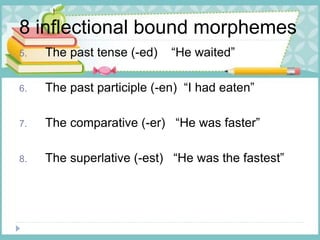
5. The past tense (-ed) “He waited”
6. The past participle (-en) “I had eaten”
7. The comparative (-er) “He was faster”
8. The superlative (-est) “He was the fastest”
Types of Word-Formation Processes
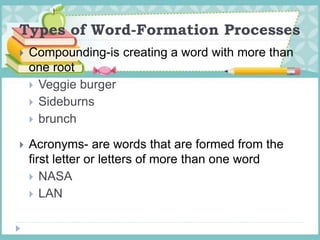
 Compounding-is creating a word with more than
one root
 Veggie burger
 Sideburns
 brunch
 Acronyms- are words that are formed from the
first letter or letters of more than one word
 NASA
 LAN
Types of Word-Formation Processes
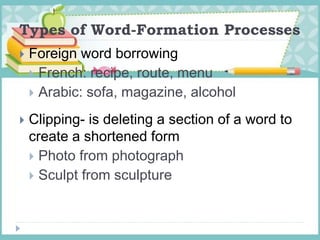
 Foreign word borrowing
 French: recipe, route, menu
 Arabic: sofa, magazine, alcohol
 Clipping- is deleting a section of a word to
create a shortened form
 Photo from photograph
 Sculpt from sculpture
Types of Word-Formation Processes
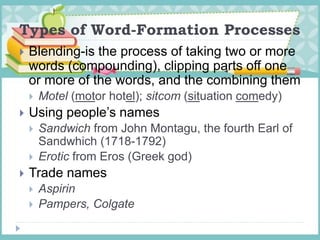
 Blending-is the process of taking two or more
words (compounding), clipping parts off one
or more of the words, and the combining them
 Motel (motor hotel); sitcom (situation comedy)
 Using people’s names
 Sandwich from John Montagu, the fourth Earl of
Sandwhich (1718-1792)
 Erotic from Eros (Greek god)
 Trade names
 Aspirin
 Pampers, Colgate

Morphological change

  • 1.
  • 2.
    Morphology is the branchof linguistics that studies the structure and classification of words and the units that make up words
  • 3.
  • 4.
    Morpheme & word A morpheme and a word are not equivalent terms. Ex. “coat” – 1 morpheme (monomorphemic word) “coats” – 2 morphemes  Coat is word and so is coats  -s is a morpheme, but it definitely is not a word
  • 5.
    Two Types ofMorpheme 1. Free morphemes – are morphemes that can stand alone ex. phone, play, run 2. Bound morphemes – are meaningful grammatical unit that cannot occur alone and must be attached to another morpheme ex. tele, -er, -ing
  • 6.
    Free Morpheme  afree morpheme may also be a root  a root is a morpheme, usually but not always a free morpheme.  words can be built by adding morphemes to the root  These words are called affixes
  • 7.
    Kinds of Words 1.Open classes of words (content words)- are types words that grow in number in a language.  Nouns, adjectives, verbs and adverbs 2. Closed classes of words (Function words) – are types of words the growth of which is very limited.  Pronouns, prepositions, conjunctions, interjections
  • 8.
    Bound morphemes  Addedbound morphemes are called affixes Types of affixes: 1. Prefix-added before a root (un- happy) 2. Infix-added inside a root (fan- damn-tastic) 3. Suffix-added after a root (happi- ness) 4. Circumfix-added surrounding the
  • 9.
    Types of boundmorphemes  A bound morpheme can be classified on the basis of the function it serves 1. Derivational morphemes – are bound morphemes that change the meaning or lexical category (part of speech) of a word. For example: happy → unhappy  Both words are adjectives, but the meaning changes. quick → quickness  The affix changes both meaning and word class - adjective to a noun.
  • 10.
    Types of boundmorphemes 2. Inflectional morphemes – are bound morphemes that do not change the essential meaning or lexical category of a word. They change grammatical functions. For example:  Cat → cats (-s plural marker)  walk → walking (-ing tense marker)
  • 11.
    8 inflectional boundmorphemes 1. The plural marker (-s)  Both chairs are broken” 2. The possessive (-’s and –s’)  “The chair’s leg is broken” 3. The third person, present singular (-s)  “He waits” 4. The progressive (-ing)  “He is waiting”
  • 12.
    8 inflectional boundmorphemes 5. The past tense (-ed) “He waited” 6. The past participle (-en) “I had eaten” 7. The comparative (-er) “He was faster” 8. The superlative (-est) “He was the fastest”
  • 13.
    Types of Word-FormationProcesses  Compounding-is creating a word with more than one root  Veggie burger  Sideburns  brunch  Acronyms- are words that are formed from the first letter or letters of more than one word  NASA  LAN
  • 14.
    Types of Word-FormationProcesses  Foreign word borrowing  French: recipe, route, menu  Arabic: sofa, magazine, alcohol  Clipping- is deleting a section of a word to create a shortened form  Photo from photograph  Sculpt from sculpture
  • 15.
    Types of Word-FormationProcesses  Blending-is the process of taking two or more words (compounding), clipping parts off one or more of the words, and the combining them  Motel (motor hotel); sitcom (situation comedy)  Using people’s names  Sandwich from John Montagu, the fourth Earl of Sandwhich (1718-1792)  Erotic from Eros (Greek god)  Trade names  Aspirin  Pampers, Colgate