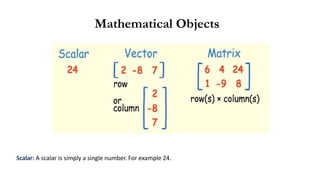
Linear algebra concepts such as scalars, vectors, matrices, and tensors are central to deep learning. Vectors are arrays with a single index, matrices are 2D arrays with row and column indices, and tensors generalize this to multiple indices. Computational rules for linear algebra include performing element-wise operations on scalars and matrices, multiplying matrices by following the row-column dot product rule, and properties such as non-commutativity but associativity of matrix multiplication. The identity matrix leaves other matrices unchanged when multiplied.
Introduction
• Linear Algebrais a continuous form of mathematics and also central
to almost all areas of mathematics like geometry and functional
analysis.
• In Linear Algebra, data is represented by linear equations, which are
presented in the form of matrices and vectors.
Vector
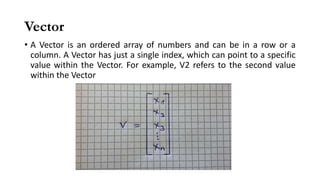
• A Vectoris an ordered array of numbers and can be in a row or a
column. A Vector has just a single index, which can point to a specific
value within the Vector. For example, V2 refers to the second value
within the Vector
5.
Matrix
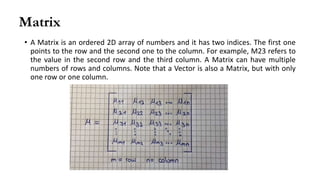
• A Matrixis an ordered 2D array of numbers and it has two indices. The first one
points to the row and the second one to the column. For example, M23 refers to
the value in the second row and the third column. A Matrix can have multiple
numbers of rows and columns. Note that a Vector is also a Matrix, but with only
one row or one column.
6.
Tensor
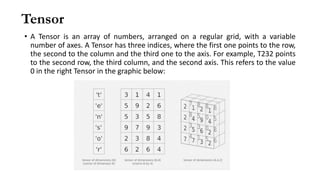
• A Tensoris an array of numbers, arranged on a regular grid, with a variable
number of axes. A Tensor has three indices, where the first one points to the row,
the second to the column and the third one to the axis. For example, T232 points
to the second row, the third column, and the second axis. This refers to the value
0 in the right Tensor in the graphic below:
7.
Contd…
• Tensor isthe most general term for all of these concepts above
because a Tensor is a multidimensional array and it can be a Vector
and a Matrix, depending on the number of indices it has. For
example, a first-order Tensor would be a Vector (1 index). A second-
order Tensor is a Matrix (2 indices) and third-order Tensors (3 indices)
and higher are called Higher-Order Tensors (3 or more indices).
8.
Computational Rules
1. Matrix-ScalarOperations
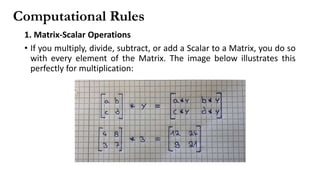
• If you multiply, divide, subtract, or add a Scalar to a Matrix, you do so
with every element of the Matrix. The image below illustrates this
perfectly for multiplication:
9.
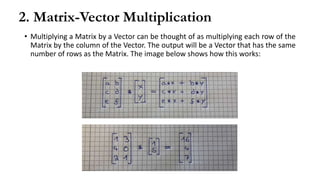
2. Matrix-Vector Multiplication
•Multiplying a Matrix by a Vector can be thought of as multiplying each row of the
Matrix by the column of the Vector. The output will be a Vector that has the same
number of rows as the Matrix. The image below shows how this works:
10.
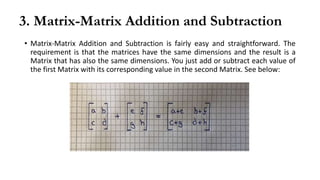
3. Matrix-Matrix Additionand Subtraction
• Matrix-Matrix Addition and Subtraction is fairly easy and straightforward. The
requirement is that the matrices have the same dimensions and the result is a
Matrix that has also the same dimensions. You just add or subtract each value of
the first Matrix with its corresponding value in the second Matrix. See below:
11.
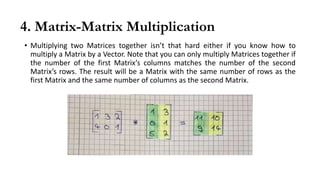
4. Matrix-Matrix Multiplication
•Multiplying two Matrices together isn’t that hard either if you know how to
multiply a Matrix by a Vector. Note that you can only multiply Matrices together if
the number of the first Matrix’s columns matches the number of the second
Matrix’s rows. The result will be a Matrix with the same number of rows as the
first Matrix and the same number of columns as the second Matrix.
12.
Matrix Multiplication Properties
•Matrix Multiplication has several properties that allow us to bundle a
lot of computation into one Matrix multiplication. We will discuss
them one by one below. We will start by explaining these concepts
with Scalars and then with Matrices because this will give you a better
understanding of the process.
13.
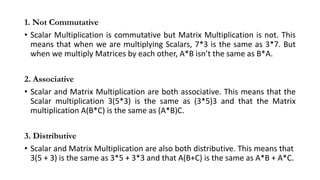
1. Not Commutative
•Scalar Multiplication is commutative but Matrix Multiplication is not. This
means that when we are multiplying Scalars, 7*3 is the same as 3*7. But
when we multiply Matrices by each other, A*B isn’t the same as B*A.
2. Associative
• Scalar and Matrix Multiplication are both associative. This means that the
Scalar multiplication 3(5*3) is the same as (3*5)3 and that the Matrix
multiplication A(B*C) is the same as (A*B)C.
3. Distributive
• Scalar and Matrix Multiplication are also both distributive. This means that
3(5 + 3) is the same as 3*5 + 3*3 and that A(B+C) is the same as A*B + A*C.
14.
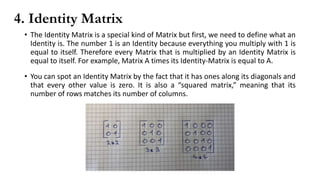
4. Identity Matrix
•The Identity Matrix is a special kind of Matrix but first, we need to define what an
Identity is. The number 1 is an Identity because everything you multiply with 1 is
equal to itself. Therefore every Matrix that is multiplied by an Identity Matrix is
equal to itself. For example, Matrix A times its Identity-Matrix is equal to A.
• You can spot an Identity Matrix by the fact that it has ones along its diagonals and
that every other value is zero. It is also a “squared matrix,” meaning that its
number of rows matches its number of columns.