Seminar Series on
Linear Algebra for Machine Learning
Part 1: Linear Systems
Dr. Ceni Babaoglu
Ryerson University
cenibabaoglu.com
Dr. Ceni Babaoglu cenibabaoglu.com
Linear Algebra for Machine Learning: Linear Systems
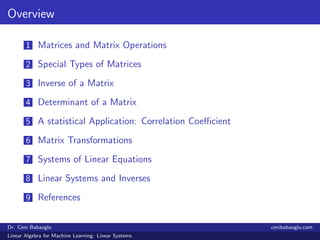
Overview
1 Matrices and Matrix Operations
2 Special Types of Matrices
3 Inverse of a Matrix
4 Determinant of a Matrix
5 A statistical Application: Correlation Coefficient
6 Matrix Transformations
7 Systems of Linear Equations
8 Linear Systems and Inverses
9 References
Dr. Ceni Babaoglu cenibabaoglu.com
Linear Algebra for Machine Learning: Linear Systems
Matrices
An m × n matrix
A =





a11 a12 a13 . . . a1n
a21 a22 a23 . . . a2n
...
...
...
...
...
am1 am2 am3 . . . amn





= [aij ]
The i th row of A is
A = ai1 ai2 ai3 . . . ain , (1 ≤ i ≤ m)
The j th column of A is
A =





a1j
a2j
...
amj





, (1 ≤ j ≤ n)
Dr. Ceni Babaoglu cenibabaoglu.com
Linear Algebra for Machine Learning: Linear Systems
Matrix Operations
Matrix Addition
A + B = [aij ] + [bij ] , C = [cij ]
cij = aij + bij , i = 1, 2, · · · , m, j = 1, 2, · · · , n.
Scalar Multiplication
rA = r [aij ] , C = [cij ]
cij = r aij , i = 1, 2, · · · , m, j = 1, 2, · · · , n.
Transpose of a Matrix
AT
= aT
ij , aT
ij = aji
Dr. Ceni Babaoglu cenibabaoglu.com
Linear Algebra for Machine Learning: Linear Systems
Special Types of Matrices
Diagonal Matrix
An n × n matrix A = [aij ] is called a diagonal matrix if aij = 0
for i = j 




a 0 . . . 0
0 1 . . . 0
...
...
...
...
0 0 . . . 1





Identity Matrix
The scalar matrix In = [dij ], where dii = 1 and dij = 0 for
i = j, is called the n × n identity matrix





1 0 . . . 0
0 1 . . . 0
...
...
...
...
0 0 . . . 1





Dr. Ceni Babaoglu cenibabaoglu.com
Linear Algebra for Machine Learning: Linear Systems
Special Types of Matrices
Upper Triangular Matrix
An n × n matrix A = [aij ] is called upper triangular if aij = 0
for i > j 

2 b c
0 3 0
0 0 1


Lower Triangular Matrix
An n × n matrix A = [aij ] is called lower triangular if aij = 0
for i < j 

2 0 0
0 3 0
a b 1


Dr. Ceni Babaoglu cenibabaoglu.com
Linear Algebra for Machine Learning: Linear Systems
Special Types of Matrices
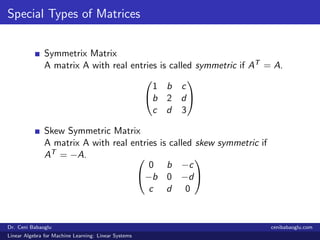
Symmetrix Matrix
A matrix A with real entries is called symmetric if AT = A.


1 b c
b 2 d
c d 3


Skew Symmetric Matrix
A matrix A with real entries is called skew symmetric if
AT = −A. 

0 b −c
−b 0 −d
c d 0


Dr. Ceni Babaoglu cenibabaoglu.com
Linear Algebra for Machine Learning: Linear Systems
Matrix Operations
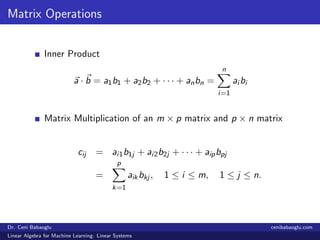
Inner Product
a · b = a1b1 + a2b2 + · · · + anbn =
n
i=1
ai bi
Matrix Multiplication of an m × p matrix and p × n matrix
cij = ai1b1j + ai2b2j + · · · + aipbpj
=
p
k=1
aikbkj , 1 ≤ i ≤ m, 1 ≤ j ≤ n.
Dr. Ceni Babaoglu cenibabaoglu.com
Linear Algebra for Machine Learning: Linear Systems
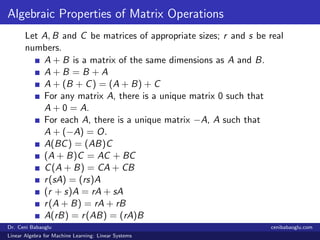
Algebraic Properties of Matrix Operations
Let A, B and C be matrices of appropriate sizes; r and s be real
numbers.
A + B is a matrix of the same dimensions as A and B.
A + B = B + A
A + (B + C) = (A + B) + C
For any matrix A, there is a unique matrix 0 such that
A + 0 = A.
For each A, there is a unique matrix −A, A such that
A + (−A) = O.
A(BC) = (AB)C
(A + B)C = AC + BC
C(A + B) = CA + CB
r(sA) = (rs)A
(r + s)A = rA + sA
r(A + B) = rA + rB
A(rB) = r(AB) = (rA)B
Dr. Ceni Babaoglu cenibabaoglu.com
Linear Algebra for Machine Learning: Linear Systems
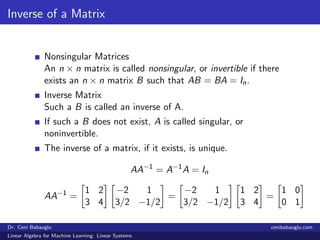
Inverse of a Matrix
Nonsingular Matrices
An n × n matrix is called nonsingular, or invertible if there
exists an n × n matrix B such that AB = BA = In.
Inverse Matrix
Such a B is called an inverse of A.
If such a B does not exist, A is called singular, or
noninvertible.
The inverse of a matrix, if it exists, is unique.
AA−1
= A−1
A = In
AA−1
=
1 2
3 4
−2 1
3/2 −1/2
=
−2 1
3/2 −1/2
1 2
3 4
=
1 0
0 1
Dr. Ceni Babaoglu cenibabaoglu.com
Linear Algebra for Machine Learning: Linear Systems
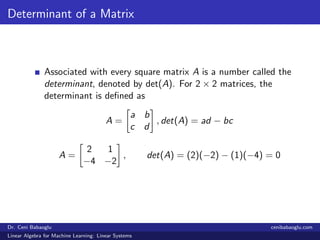
Determinant of a Matrix
Associated with every square matrix A is a number called the
determinant, denoted by det(A). For 2 × 2 matrices, the
determinant is defined as
A =
a b
c d
, det(A) = ad − bc
A =
2 1
−4 −2
, det(A) = (2)(−2) − (1)(−4) = 0
Dr. Ceni Babaoglu cenibabaoglu.com
Linear Algebra for Machine Learning: Linear Systems
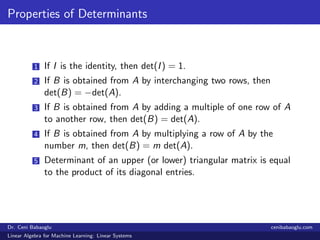
Properties of Determinants
1 If I is the identity, then det(I) = 1.
2 If B is obtained from A by interchanging two rows, then
det(B) = −det(A).
3 If B is obtained from A by adding a multiple of one row of A
to another row, then det(B) = det(A).
4 If B is obtained from A by multiplying a row of A by the
number m, then det(B) = m det(A).
5 Determinant of an upper (or lower) triangular matrix is equal
to the product of its diagonal entries.
Dr. Ceni Babaoglu cenibabaoglu.com
Linear Algebra for Machine Learning: Linear Systems
Determinant of an n × n matrix
Minor
Suppose that in an n × n matrix A we delete the ith row and
jth column to obtain an (n − 1) × (n − 1) matrix. The
determinant of this sub-matrix is called the (i, j)th minor of A
and is denoted by Mij .
Cofactor
The number (−1)i+j Mij is called the (i, j)th cofactor of A
and is denoted by Cij .
Determinant
Let A be an n × n matrix. Then det(A) can be evaluated by
expanding by cofactors along any row or any column:
det(A) = ai1Ci1 + ai2Ci2 + · · · + ainCin, 1 ≤ i ≤ n.
or
det(A) = a1j C1j + a2j C2j + · · · + anj Cnj , 1 ≤ j ≤ n.
Dr. Ceni Babaoglu cenibabaoglu.com
Linear Algebra for Machine Learning: Linear Systems
Example
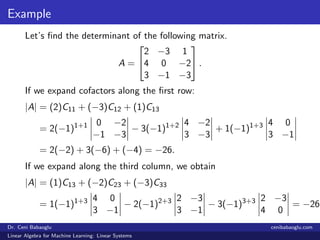
Let’s find the determinant of the following matrix.
A =


2 −3 1
4 0 −2
3 −1 −3

 .
If we expand cofactors along the first row:
|A| = (2)C11 + (−3)C12 + (1)C13
= 2(−1)1+1 0 −2
−1 −3
− 3(−1)1+2 4 −2
3 −3
+ 1(−1)1+3 4 0
3 −1
= 2(−2) + 3(−6) + (−4) = −26.
If we expand along the third column, we obtain
|A| = (1)C13 + (−2)C23 + (−3)C33
= 1(−1)1+3 4 0
3 −1
− 2(−1)2+3 2 −3
3 −1
− 3(−1)3+3 2 −3
4 0
= −26.
Dr. Ceni Babaoglu cenibabaoglu.com
Linear Algebra for Machine Learning: Linear Systems
Angle between to vectors
The length of n-vector
v =







v1
v2
...
vn−1
vn







is defines as
v = v2
1 + v2
2 + · · · + v2
n−1 + v2
n .
The angle between the two nonzero vectors is determined by
cos(θ) =
u · v
u v
.
−1
u · v
u v
1, 0 θ π
Dr. Ceni Babaoglu cenibabaoglu.com
Linear Algebra for Machine Learning: Linear Systems
A statistical application: Correlation Coefficient
Sample means of two attributes
¯x =
1
n
n
i=1
x, ¯y =
1
n
n
i=1
y
Centered form
xc = [x1 − ¯x x2 − ¯x · · · xn − ¯x]T
yc = [y1 − ¯y y2 − ¯y · · · yn − ¯y]T
Correlation coefficient
Cor(xc, yc) =
xc · yc
xc yc
r =
n
i=1(xi − ¯x)(yi − ¯y)
n
i=1(xi − ¯x)2 n
i=1(yi − ¯y)2
Dr. Ceni Babaoglu cenibabaoglu.com
Linear Algebra for Machine Learning: Linear Systems
Linear Algebra vs Data Science
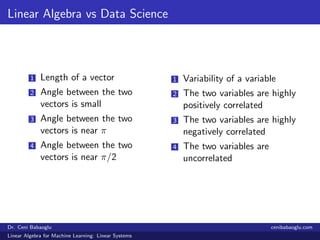
1 Length of a vector
2 Angle between the two
vectors is small
3 Angle between the two
vectors is near π
4 Angle between the two
vectors is near π/2
1 Variability of a variable
2 The two variables are highly
positively correlated
3 The two variables are highly
negatively correlated
4 The two variables are
uncorrelated
Dr. Ceni Babaoglu cenibabaoglu.com
Linear Algebra for Machine Learning: Linear Systems
Matrix Transformations
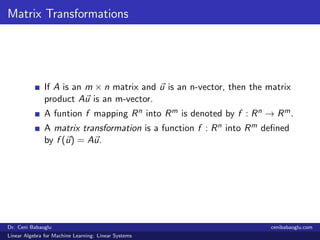
If A is an m × n matrix and u is an n-vector, then the matrix
product Au is an m-vector.
A funtion f mapping Rn into Rm is denoted by f : Rn → Rm.
A matrix transformation is a function f : Rn into Rm defined
by f (u) = Au.
Dr. Ceni Babaoglu cenibabaoglu.com
Linear Algebra for Machine Learning: Linear Systems
Example
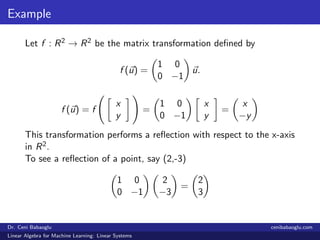
Let f : R2 → R2 be the matrix transformation defined by
f (u) =
1 0
0 −1
u.
f (u) = f
x
y
=
1 0
0 −1
x
y
=
x
−y
This transformation performs a reflection with respect to the x-axis
in R2.
To see a reflection of a point, say (2,-3)
1 0
0 −1
2
−3
=
2
3
Dr. Ceni Babaoglu cenibabaoglu.com
Linear Algebra for Machine Learning: Linear Systems
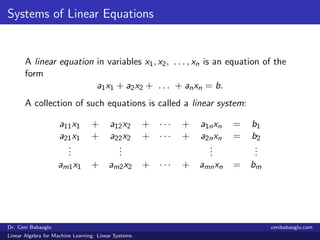
Systems of Linear Equations
A linear equation in variables x1, x2, . . . , xn is an equation of the
form
a1x1 + a2x2 + . . . + anxn = b.
A collection of such equations is called a linear system:
a11x1 + a12x2 + · · · + a1nxn = b1
a21x1 + a22x2 + · · · + a2nxn = b2
...
...
...
...
am1x1 + am2x2 + · · · + amnxn = bm
Dr. Ceni Babaoglu cenibabaoglu.com
Linear Algebra for Machine Learning: Linear Systems
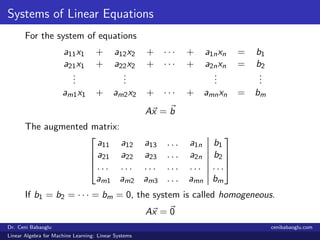
Systems of Linear Equations
For the system of equations
a11x1 + a12x2 + · · · + a1nxn = b1
a21x1 + a22x2 + · · · + a2nxn = b2
...
...
...
...
am1x1 + am2x2 + · · · + amnxn = bm
Ax = b
The augmented matrix:




a11 a12 a13 . . . a1n b1
a21 a22 a23 . . . a2n b2
. . . . . . . . . . . . . . . . . .
am1 am2 am3 . . . amn bm




If b1 = b2 = · · · = bm = 0, the system is called homogeneous.
Ax = 0
Dr. Ceni Babaoglu cenibabaoglu.com
Linear Algebra for Machine Learning: Linear Systems
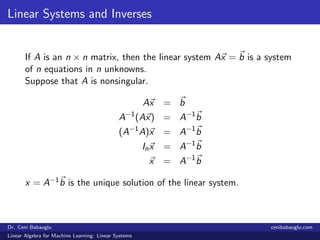
Linear Systems and Inverses
If A is an n × n matrix, then the linear system Ax = b is a system
of n equations in n unknowns.
Suppose that A is nonsingular.
Ax = b
A−1
(Ax) = A−1
b
(A−1
A)x = A−1
b
Inx = A−1
b
x = A−1
b
x = A−1b is the unique solution of the linear system.
Dr. Ceni Babaoglu cenibabaoglu.com
Linear Algebra for Machine Learning: Linear Systems
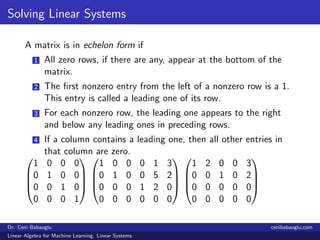
Solving Linear Systems
A matrix is in echelon form if
1 All zero rows, if there are any, appear at the bottom of the
matrix.
2 The first nonzero entry from the left of a nonzero row is a 1.
This entry is called a leading one of its row.
3 For each nonzero row, the leading one appears to the right
and below any leading ones in preceding rows.
4 If a column contains a leading one, then all other entries in
that column are zero.



1 0 0 0
0 1 0 0
0 0 1 0
0 0 0 1








1 0 0 0 1 3
0 1 0 0 5 2
0 0 0 1 2 0
0 0 0 0 0 0








1 2 0 0 3
0 0 1 0 2
0 0 0 0 0
0 0 0 0 0




Dr. Ceni Babaoglu cenibabaoglu.com
Linear Algebra for Machine Learning: Linear Systems
Solving Linear Systems
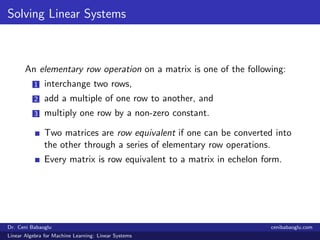
An elementary row operation on a matrix is one of the following:
1 interchange two rows,
2 add a multiple of one row to another, and
3 multiply one row by a non-zero constant.
Two matrices are row equivalent if one can be converted into
the other through a series of elementary row operations.
Every matrix is row equivalent to a matrix in echelon form.
Dr. Ceni Babaoglu cenibabaoglu.com
Linear Algebra for Machine Learning: Linear Systems
Solving Linear Systems
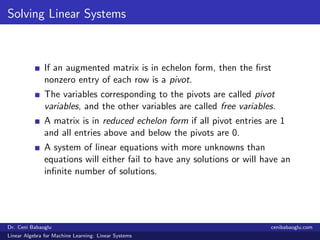
If an augmented matrix is in echelon form, then the first
nonzero entry of each row is a pivot.
The variables corresponding to the pivots are called pivot
variables, and the other variables are called free variables.
A matrix is in reduced echelon form if all pivot entries are 1
and all entries above and below the pivots are 0.
A system of linear equations with more unknowns than
equations will either fail to have any solutions or will have an
infinite number of solutions.
Dr. Ceni Babaoglu cenibabaoglu.com
Linear Algebra for Machine Learning: Linear Systems
Example: Let’s solve the following system.
x1 − 3 x2 + x3 = 1
2 x1 + x2 − x3 = 2
4 x1 + 4 x2 − 2 x3 = 1
5 x1 − 8 x2 + 2 x3 = 5




1 −3 1
2 1 −1
4 4 −2
5 −8 2
1
2
1
5




R2−2R1→R2
R3−4R1→R3
R4−5R1→R4
−−−−−−−→




1 −3 1
0 7 −3
0 16 −6
0 7 −3
1
0
−3
0




R2/7→R2
−−−−−→




1 −3 1
0 1 −3/7
0 16 −6
0 7 −3
1
0
−3
0




R1+3R2→R1
R3−16R2→R3
R4−7R2→R4
−−−−−−−−→




1 0 −2/7
0 1 −3/7
0 0 6/7
0 0 0
1
0
−3
0




7R3/6→R3
−−−−−−→




1 0 −2/7
0 1 −3/7
0 0 1
0 0 0
1
0
−7/2
0




R1+2R3/7→R1
R2+3R3/7→R2
−−−−−−−−→




1 0 0
0 1 0
0 0 1
0 0 0
0
−3/2
−7/2
0




⇔ x1 = 0, x2 = −3/2, x3 = −7/2
Dr. Ceni Babaoglu cenibabaoglu.com
Linear Algebra for Machine Learning: Linear Systems
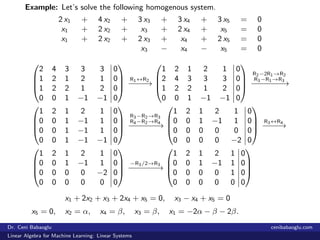
Example: Let’s solve the following homogenous system.
2 x1 + 4 x2 + 3 x3 + 3 x4 + 3 x5 = 0
x1 + 2 x2 + x3 + 2 x4 + x5 = 0
x1 + 2 x2 + 2 x3 + x4 + 2 x5 = 0
x3 − x4 − x5 = 0




2 4 3 3 3
1 2 1 2 1
1 2 2 1 2
0 0 1 −1 −1
0
0
0
0




R1↔R2
−−−−→




1 2 1 2 1
2 4 3 3 3
1 2 2 1 2
0 0 1 −1 −1
0
0
0
0




R2−2R1→R2
R3−R1→R3
−−−−−−−→




1 2 1 2 1
0 0 1 −1 1
0 0 1 −1 1
0 0 1 −1 −1
0
0
0
0




R3−R2→R3
R4−R2→R4
−−−−−−−→




1 2 1 2 1
0 0 1 −1 1
0 0 0 0 0
0 0 0 0 −2
0
0
0
0




R3↔R4
−−−−→




1 2 1 2 1
0 0 1 −1 1
0 0 0 0 −2
0 0 0 0 0
0
0
0
0




−R3/2→R3
−−−−−−−→




1 2 1 2 1
0 0 1 −1 1
0 0 0 0 1
0 0 0 0 0
0
0
0
0




x1 + 2x2 + x3 + 2x4 + x5 = 0, x3 − x4 + x5 = 0
x5 = 0, x2 = α, x4 = β, x3 = β, x1 = −2α − β − 2β.
Dr. Ceni Babaoglu cenibabaoglu.com
Linear Algebra for Machine Learning: Linear Systems
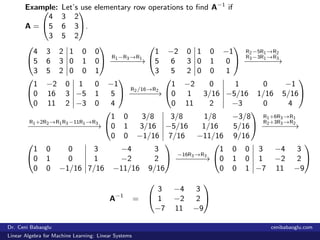
Example: Let’s use elementary row operations to find A−1
if
A =


4 3 2
5 6 3
3 5 2

.


4 3 2
5 6 3
3 5 2
1 0 0
0 1 0
0 0 1

 R1−R3→R1
−−−−−−−→


1 −2 0
5 6 3
3 5 2
1 0 −1
0 1 0
0 0 1


R2−5R1→R2
R3−3R1→R3
−−−−−−−→


1 −2 0
0 16 3
0 11 2
1 0 −1
−5 1 5
−3 0 4

 R2/16→R2
−−−−−−→


1 −2 0
0 1 3/16
0 11 2
1 0 −1
−5/16 1/16 5/16
−3 0 4


R1+2R2→R1R3−11R1→R3
−−−−−−−−−−−−−−−→


1 0 3/8
0 1 3/16
0 0 −1/16
3/8 1/8 −3/8
−5/16 1/16 5/16
7/16 −11/16 9/16


R1+6R3→R1
R2+3R3→R2
−−−−−−−→


1 0 0
0 1 0
0 0 −1/16
3 −4 3
1 −2 2
7/16 −11/16 9/16

 −16R3→R3
−−−−−−→


1 0 0
0 1 0
0 0 1
3 −4 3
1 −2 2
−7 11 −9


A−1
=


3 −4 3
1 −2 2
−7 11 −9


Dr. Ceni Babaoglu cenibabaoglu.com
Linear Algebra for Machine Learning: Linear Systems
References
Linear Algebra With Applications, 7th Edition
by Steven J. Leon.
Elementary Linear Algebra with Applications, 9th Edition
by Bernard Kolman and David Hill.
Dr. Ceni Babaoglu cenibabaoglu.com
Linear Algebra for Machine Learning: Linear Systems

1. Linear Algebra for Machine Learning: Linear Systems

  • 1.
    Seminar Series on LinearAlgebra for Machine Learning Part 1: Linear Systems Dr. Ceni Babaoglu Ryerson University cenibabaoglu.com Dr. Ceni Babaoglu cenibabaoglu.com Linear Algebra for Machine Learning: Linear Systems
  • 2.
    Overview 1 Matrices andMatrix Operations 2 Special Types of Matrices 3 Inverse of a Matrix 4 Determinant of a Matrix 5 A statistical Application: Correlation Coefficient 6 Matrix Transformations 7 Systems of Linear Equations 8 Linear Systems and Inverses 9 References Dr. Ceni Babaoglu cenibabaoglu.com Linear Algebra for Machine Learning: Linear Systems
  • 3.
    Matrices An m ×n matrix A =      a11 a12 a13 . . . a1n a21 a22 a23 . . . a2n ... ... ... ... ... am1 am2 am3 . . . amn      = [aij ] The i th row of A is A = ai1 ai2 ai3 . . . ain , (1 ≤ i ≤ m) The j th column of A is A =      a1j a2j ... amj      , (1 ≤ j ≤ n) Dr. Ceni Babaoglu cenibabaoglu.com Linear Algebra for Machine Learning: Linear Systems
  • 4.
    Matrix Operations Matrix Addition A+ B = [aij ] + [bij ] , C = [cij ] cij = aij + bij , i = 1, 2, · · · , m, j = 1, 2, · · · , n. Scalar Multiplication rA = r [aij ] , C = [cij ] cij = r aij , i = 1, 2, · · · , m, j = 1, 2, · · · , n. Transpose of a Matrix AT = aT ij , aT ij = aji Dr. Ceni Babaoglu cenibabaoglu.com Linear Algebra for Machine Learning: Linear Systems
  • 5.
    Special Types ofMatrices Diagonal Matrix An n × n matrix A = [aij ] is called a diagonal matrix if aij = 0 for i = j      a 0 . . . 0 0 1 . . . 0 ... ... ... ... 0 0 . . . 1      Identity Matrix The scalar matrix In = [dij ], where dii = 1 and dij = 0 for i = j, is called the n × n identity matrix      1 0 . . . 0 0 1 . . . 0 ... ... ... ... 0 0 . . . 1      Dr. Ceni Babaoglu cenibabaoglu.com Linear Algebra for Machine Learning: Linear Systems
  • 6.
    Special Types ofMatrices Upper Triangular Matrix An n × n matrix A = [aij ] is called upper triangular if aij = 0 for i > j   2 b c 0 3 0 0 0 1   Lower Triangular Matrix An n × n matrix A = [aij ] is called lower triangular if aij = 0 for i < j   2 0 0 0 3 0 a b 1   Dr. Ceni Babaoglu cenibabaoglu.com Linear Algebra for Machine Learning: Linear Systems
  • 7.
    Special Types ofMatrices Symmetrix Matrix A matrix A with real entries is called symmetric if AT = A.   1 b c b 2 d c d 3   Skew Symmetric Matrix A matrix A with real entries is called skew symmetric if AT = −A.   0 b −c −b 0 −d c d 0   Dr. Ceni Babaoglu cenibabaoglu.com Linear Algebra for Machine Learning: Linear Systems
  • 8.
    Matrix Operations Inner Product a· b = a1b1 + a2b2 + · · · + anbn = n i=1 ai bi Matrix Multiplication of an m × p matrix and p × n matrix cij = ai1b1j + ai2b2j + · · · + aipbpj = p k=1 aikbkj , 1 ≤ i ≤ m, 1 ≤ j ≤ n. Dr. Ceni Babaoglu cenibabaoglu.com Linear Algebra for Machine Learning: Linear Systems
  • 9.
    Algebraic Properties ofMatrix Operations Let A, B and C be matrices of appropriate sizes; r and s be real numbers. A + B is a matrix of the same dimensions as A and B. A + B = B + A A + (B + C) = (A + B) + C For any matrix A, there is a unique matrix 0 such that A + 0 = A. For each A, there is a unique matrix −A, A such that A + (−A) = O. A(BC) = (AB)C (A + B)C = AC + BC C(A + B) = CA + CB r(sA) = (rs)A (r + s)A = rA + sA r(A + B) = rA + rB A(rB) = r(AB) = (rA)B Dr. Ceni Babaoglu cenibabaoglu.com Linear Algebra for Machine Learning: Linear Systems
  • 10.
    Inverse of aMatrix Nonsingular Matrices An n × n matrix is called nonsingular, or invertible if there exists an n × n matrix B such that AB = BA = In. Inverse Matrix Such a B is called an inverse of A. If such a B does not exist, A is called singular, or noninvertible. The inverse of a matrix, if it exists, is unique. AA−1 = A−1 A = In AA−1 = 1 2 3 4 −2 1 3/2 −1/2 = −2 1 3/2 −1/2 1 2 3 4 = 1 0 0 1 Dr. Ceni Babaoglu cenibabaoglu.com Linear Algebra for Machine Learning: Linear Systems
  • 11.
    Determinant of aMatrix Associated with every square matrix A is a number called the determinant, denoted by det(A). For 2 × 2 matrices, the determinant is defined as A = a b c d , det(A) = ad − bc A = 2 1 −4 −2 , det(A) = (2)(−2) − (1)(−4) = 0 Dr. Ceni Babaoglu cenibabaoglu.com Linear Algebra for Machine Learning: Linear Systems
  • 12.
    Properties of Determinants 1If I is the identity, then det(I) = 1. 2 If B is obtained from A by interchanging two rows, then det(B) = −det(A). 3 If B is obtained from A by adding a multiple of one row of A to another row, then det(B) = det(A). 4 If B is obtained from A by multiplying a row of A by the number m, then det(B) = m det(A). 5 Determinant of an upper (or lower) triangular matrix is equal to the product of its diagonal entries. Dr. Ceni Babaoglu cenibabaoglu.com Linear Algebra for Machine Learning: Linear Systems
  • 13.
    Determinant of ann × n matrix Minor Suppose that in an n × n matrix A we delete the ith row and jth column to obtain an (n − 1) × (n − 1) matrix. The determinant of this sub-matrix is called the (i, j)th minor of A and is denoted by Mij . Cofactor The number (−1)i+j Mij is called the (i, j)th cofactor of A and is denoted by Cij . Determinant Let A be an n × n matrix. Then det(A) can be evaluated by expanding by cofactors along any row or any column: det(A) = ai1Ci1 + ai2Ci2 + · · · + ainCin, 1 ≤ i ≤ n. or det(A) = a1j C1j + a2j C2j + · · · + anj Cnj , 1 ≤ j ≤ n. Dr. Ceni Babaoglu cenibabaoglu.com Linear Algebra for Machine Learning: Linear Systems
  • 14.
    Example Let’s find thedeterminant of the following matrix. A =   2 −3 1 4 0 −2 3 −1 −3   . If we expand cofactors along the first row: |A| = (2)C11 + (−3)C12 + (1)C13 = 2(−1)1+1 0 −2 −1 −3 − 3(−1)1+2 4 −2 3 −3 + 1(−1)1+3 4 0 3 −1 = 2(−2) + 3(−6) + (−4) = −26. If we expand along the third column, we obtain |A| = (1)C13 + (−2)C23 + (−3)C33 = 1(−1)1+3 4 0 3 −1 − 2(−1)2+3 2 −3 3 −1 − 3(−1)3+3 2 −3 4 0 = −26. Dr. Ceni Babaoglu cenibabaoglu.com Linear Algebra for Machine Learning: Linear Systems
  • 15.
    Angle between tovectors The length of n-vector v =        v1 v2 ... vn−1 vn        is defines as v = v2 1 + v2 2 + · · · + v2 n−1 + v2 n . The angle between the two nonzero vectors is determined by cos(θ) = u · v u v . −1 u · v u v 1, 0 θ π Dr. Ceni Babaoglu cenibabaoglu.com Linear Algebra for Machine Learning: Linear Systems
  • 16.
    A statistical application:Correlation Coefficient Sample means of two attributes ¯x = 1 n n i=1 x, ¯y = 1 n n i=1 y Centered form xc = [x1 − ¯x x2 − ¯x · · · xn − ¯x]T yc = [y1 − ¯y y2 − ¯y · · · yn − ¯y]T Correlation coefficient Cor(xc, yc) = xc · yc xc yc r = n i=1(xi − ¯x)(yi − ¯y) n i=1(xi − ¯x)2 n i=1(yi − ¯y)2 Dr. Ceni Babaoglu cenibabaoglu.com Linear Algebra for Machine Learning: Linear Systems
  • 17.
    Linear Algebra vsData Science 1 Length of a vector 2 Angle between the two vectors is small 3 Angle between the two vectors is near π 4 Angle between the two vectors is near π/2 1 Variability of a variable 2 The two variables are highly positively correlated 3 The two variables are highly negatively correlated 4 The two variables are uncorrelated Dr. Ceni Babaoglu cenibabaoglu.com Linear Algebra for Machine Learning: Linear Systems
  • 18.
    Matrix Transformations If Ais an m × n matrix and u is an n-vector, then the matrix product Au is an m-vector. A funtion f mapping Rn into Rm is denoted by f : Rn → Rm. A matrix transformation is a function f : Rn into Rm defined by f (u) = Au. Dr. Ceni Babaoglu cenibabaoglu.com Linear Algebra for Machine Learning: Linear Systems
  • 19.
    Example Let f :R2 → R2 be the matrix transformation defined by f (u) = 1 0 0 −1 u. f (u) = f x y = 1 0 0 −1 x y = x −y This transformation performs a reflection with respect to the x-axis in R2. To see a reflection of a point, say (2,-3) 1 0 0 −1 2 −3 = 2 3 Dr. Ceni Babaoglu cenibabaoglu.com Linear Algebra for Machine Learning: Linear Systems
  • 20.
    Systems of LinearEquations A linear equation in variables x1, x2, . . . , xn is an equation of the form a1x1 + a2x2 + . . . + anxn = b. A collection of such equations is called a linear system: a11x1 + a12x2 + · · · + a1nxn = b1 a21x1 + a22x2 + · · · + a2nxn = b2 ... ... ... ... am1x1 + am2x2 + · · · + amnxn = bm Dr. Ceni Babaoglu cenibabaoglu.com Linear Algebra for Machine Learning: Linear Systems
  • 21.
    Systems of LinearEquations For the system of equations a11x1 + a12x2 + · · · + a1nxn = b1 a21x1 + a22x2 + · · · + a2nxn = b2 ... ... ... ... am1x1 + am2x2 + · · · + amnxn = bm Ax = b The augmented matrix:     a11 a12 a13 . . . a1n b1 a21 a22 a23 . . . a2n b2 . . . . . . . . . . . . . . . . . . am1 am2 am3 . . . amn bm     If b1 = b2 = · · · = bm = 0, the system is called homogeneous. Ax = 0 Dr. Ceni Babaoglu cenibabaoglu.com Linear Algebra for Machine Learning: Linear Systems
  • 22.
    Linear Systems andInverses If A is an n × n matrix, then the linear system Ax = b is a system of n equations in n unknowns. Suppose that A is nonsingular. Ax = b A−1 (Ax) = A−1 b (A−1 A)x = A−1 b Inx = A−1 b x = A−1 b x = A−1b is the unique solution of the linear system. Dr. Ceni Babaoglu cenibabaoglu.com Linear Algebra for Machine Learning: Linear Systems
  • 23.
    Solving Linear Systems Amatrix is in echelon form if 1 All zero rows, if there are any, appear at the bottom of the matrix. 2 The first nonzero entry from the left of a nonzero row is a 1. This entry is called a leading one of its row. 3 For each nonzero row, the leading one appears to the right and below any leading ones in preceding rows. 4 If a column contains a leading one, then all other entries in that column are zero.    1 0 0 0 0 1 0 0 0 0 1 0 0 0 0 1         1 0 0 0 1 3 0 1 0 0 5 2 0 0 0 1 2 0 0 0 0 0 0 0         1 2 0 0 3 0 0 1 0 2 0 0 0 0 0 0 0 0 0 0     Dr. Ceni Babaoglu cenibabaoglu.com Linear Algebra for Machine Learning: Linear Systems
  • 24.
    Solving Linear Systems Anelementary row operation on a matrix is one of the following: 1 interchange two rows, 2 add a multiple of one row to another, and 3 multiply one row by a non-zero constant. Two matrices are row equivalent if one can be converted into the other through a series of elementary row operations. Every matrix is row equivalent to a matrix in echelon form. Dr. Ceni Babaoglu cenibabaoglu.com Linear Algebra for Machine Learning: Linear Systems
  • 25.
    Solving Linear Systems Ifan augmented matrix is in echelon form, then the first nonzero entry of each row is a pivot. The variables corresponding to the pivots are called pivot variables, and the other variables are called free variables. A matrix is in reduced echelon form if all pivot entries are 1 and all entries above and below the pivots are 0. A system of linear equations with more unknowns than equations will either fail to have any solutions or will have an infinite number of solutions. Dr. Ceni Babaoglu cenibabaoglu.com Linear Algebra for Machine Learning: Linear Systems
  • 26.
    Example: Let’s solvethe following system. x1 − 3 x2 + x3 = 1 2 x1 + x2 − x3 = 2 4 x1 + 4 x2 − 2 x3 = 1 5 x1 − 8 x2 + 2 x3 = 5     1 −3 1 2 1 −1 4 4 −2 5 −8 2 1 2 1 5     R2−2R1→R2 R3−4R1→R3 R4−5R1→R4 −−−−−−−→     1 −3 1 0 7 −3 0 16 −6 0 7 −3 1 0 −3 0     R2/7→R2 −−−−−→     1 −3 1 0 1 −3/7 0 16 −6 0 7 −3 1 0 −3 0     R1+3R2→R1 R3−16R2→R3 R4−7R2→R4 −−−−−−−−→     1 0 −2/7 0 1 −3/7 0 0 6/7 0 0 0 1 0 −3 0     7R3/6→R3 −−−−−−→     1 0 −2/7 0 1 −3/7 0 0 1 0 0 0 1 0 −7/2 0     R1+2R3/7→R1 R2+3R3/7→R2 −−−−−−−−→     1 0 0 0 1 0 0 0 1 0 0 0 0 −3/2 −7/2 0     ⇔ x1 = 0, x2 = −3/2, x3 = −7/2 Dr. Ceni Babaoglu cenibabaoglu.com Linear Algebra for Machine Learning: Linear Systems
  • 27.
    Example: Let’s solvethe following homogenous system. 2 x1 + 4 x2 + 3 x3 + 3 x4 + 3 x5 = 0 x1 + 2 x2 + x3 + 2 x4 + x5 = 0 x1 + 2 x2 + 2 x3 + x4 + 2 x5 = 0 x3 − x4 − x5 = 0     2 4 3 3 3 1 2 1 2 1 1 2 2 1 2 0 0 1 −1 −1 0 0 0 0     R1↔R2 −−−−→     1 2 1 2 1 2 4 3 3 3 1 2 2 1 2 0 0 1 −1 −1 0 0 0 0     R2−2R1→R2 R3−R1→R3 −−−−−−−→     1 2 1 2 1 0 0 1 −1 1 0 0 1 −1 1 0 0 1 −1 −1 0 0 0 0     R3−R2→R3 R4−R2→R4 −−−−−−−→     1 2 1 2 1 0 0 1 −1 1 0 0 0 0 0 0 0 0 0 −2 0 0 0 0     R3↔R4 −−−−→     1 2 1 2 1 0 0 1 −1 1 0 0 0 0 −2 0 0 0 0 0 0 0 0 0     −R3/2→R3 −−−−−−−→     1 2 1 2 1 0 0 1 −1 1 0 0 0 0 1 0 0 0 0 0 0 0 0 0     x1 + 2x2 + x3 + 2x4 + x5 = 0, x3 − x4 + x5 = 0 x5 = 0, x2 = α, x4 = β, x3 = β, x1 = −2α − β − 2β. Dr. Ceni Babaoglu cenibabaoglu.com Linear Algebra for Machine Learning: Linear Systems
  • 28.
    Example: Let’s useelementary row operations to find A−1 if A =   4 3 2 5 6 3 3 5 2  .   4 3 2 5 6 3 3 5 2 1 0 0 0 1 0 0 0 1   R1−R3→R1 −−−−−−−→   1 −2 0 5 6 3 3 5 2 1 0 −1 0 1 0 0 0 1   R2−5R1→R2 R3−3R1→R3 −−−−−−−→   1 −2 0 0 16 3 0 11 2 1 0 −1 −5 1 5 −3 0 4   R2/16→R2 −−−−−−→   1 −2 0 0 1 3/16 0 11 2 1 0 −1 −5/16 1/16 5/16 −3 0 4   R1+2R2→R1R3−11R1→R3 −−−−−−−−−−−−−−−→   1 0 3/8 0 1 3/16 0 0 −1/16 3/8 1/8 −3/8 −5/16 1/16 5/16 7/16 −11/16 9/16   R1+6R3→R1 R2+3R3→R2 −−−−−−−→   1 0 0 0 1 0 0 0 −1/16 3 −4 3 1 −2 2 7/16 −11/16 9/16   −16R3→R3 −−−−−−→   1 0 0 0 1 0 0 0 1 3 −4 3 1 −2 2 −7 11 −9   A−1 =   3 −4 3 1 −2 2 −7 11 −9   Dr. Ceni Babaoglu cenibabaoglu.com Linear Algebra for Machine Learning: Linear Systems
  • 29.
    References Linear Algebra WithApplications, 7th Edition by Steven J. Leon. Elementary Linear Algebra with Applications, 9th Edition by Bernard Kolman and David Hill. Dr. Ceni Babaoglu cenibabaoglu.com Linear Algebra for Machine Learning: Linear Systems