Sets & Set Operations
Lecture 6, CMSC 56
Allyn Joy D. Calcaben
Definition 1
A set is an unordered collection of objects, called elements or
members of the set. A set is said to contain its elements. We
write a ∈ A to denote that a is an element of the set A. The
notation a ∈ A denotes that a is not an element of the set A.
Set
Definition 1
A set is an unordered collection of objects, called elements or
members of the set. A set is said to contain its elements. We
write a ∈ A to denote that a is an element of the set A. The
notation a ∈ A denotes that a is not an element of the set A.
Number of objects in a set can be finite or infinite.
Set
a set of chairs
Example
a set of chairs
the set of nobel laureates in the world
Example
a set of chairs
the set of nobel laureates in the world
the set of integers
Example
a set of chairs
the set of nobel laureates in the world
the set of integers
the set of natural numbers less than 10
Example
a set of chairs
the set of nobel laureates in the world
the set of integers
the set of natural numbers less than 10
the set of students in this class who passed the quizzes
Example
One way of describing a set.
All members of the set are listed between curly braces, and
separated by comma.
Roster Method
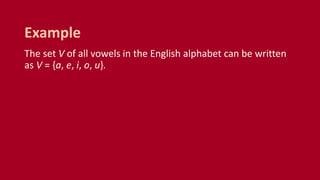
The set V of all vowels in the English alphabet can be written
as V = {a, e, i, o, u}.
Example
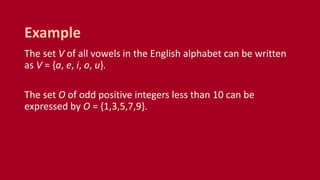
The set V of all vowels in the English alphabet can be written
as V = {a, e, i, o, u}.
The set O of odd positive integers less than 10 can be
expressed by O = {1,3,5,7,9}.
Example
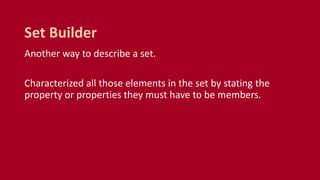
Another way to describe a set.
Characterized all those elements in the set by stating the
property or properties they must have to be members.
Set Builder
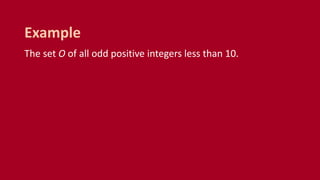
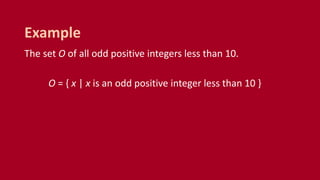
The set O of all odd positive integers less than 10.
Example
The set O of all odd positive integers less than 10.
O = { x | x is an odd positive integer less than 10 }
Example
The set O of all odd positive integers less than 10.
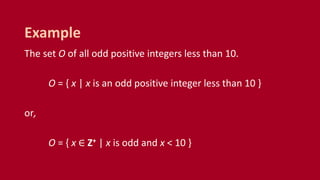
O = { x | x is an odd positive integer less than 10 }
or,
O = { x ∈ Z+ | x is odd and x < 10 }
Example
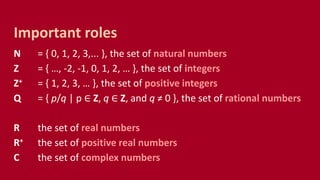
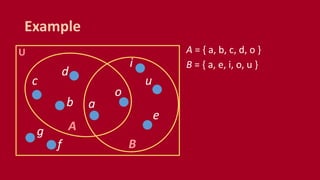
N = { 0, 1, 2, 3,... }, the set of natural numbers
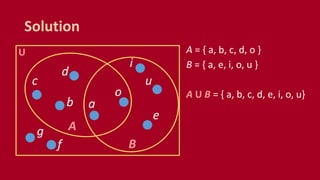
Z = { …, -2, -1, 0, 1, 2, … }, the set of integers
Z+ = { 1, 2, 3, … }, the set of positive integers
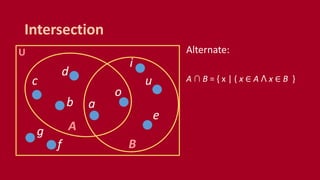
Q = { p/q | p ∈ Z, q ∈ Z, and q ≠ 0 }, the set of rational numbers
R the set of real numbers
R+ the set of positive real numbers
C the set of complex numbers
Important roles
When a and b are real numbers with a < b, we write
[ a , b ] = { x | a ≤ x ≤ b }
[ a , b ) = { x | a ≤ x < b }
( a , b ] = { x | a < x ≤ b }
( a , b ) = { x | a < x < b }
Intervals of real numbers
When a and b are real numbers with a < b, we write
[ a , b ] = { x | a ≤ x ≤ b }
[ a , b ) = { x | a ≤ x < b }
( a , b ] = { x | a < x ≤ b }
( a , b ) = { x | a < x < b }
Note that: [ a , b ] is called the closed interval from a to b.
( a , b ) is called the open interval from a to b.
Intervals of real numbers
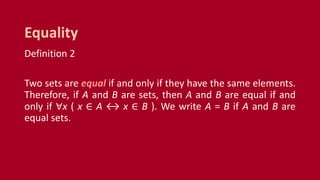
Definition 2
Two sets are equal if and only if they have the same elements.
Therefore, if A and B are sets, then A and B are equal if and
only if ∀x ( x ∈ A ↔ x ∈ B ). We write A = B if A and B are
equal sets.
Equality
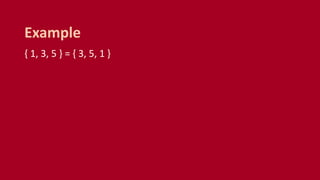
{ 1, 3, 5 } = { 3, 5, 1 }
Example
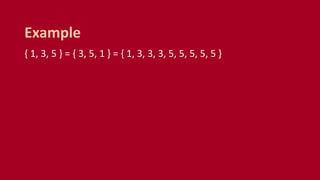
{ 1, 3, 5 } = { 3, 5, 1 } = { 1, 3, 3, 3, 5, 5, 5, 5, 5 }
Example
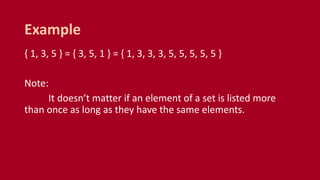
{ 1, 3, 5 } = { 3, 5, 1 } = { 1, 3, 3, 3, 5, 5, 5, 5, 5 }
Note:
It doesn’t matter if an element of a set is listed more
than once as long as they have the same elements.
Example
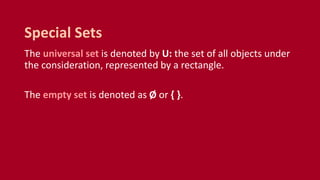
The universal set is denoted by U: the set of all objects under
the consideration, represented by a rectangle.
The empty set is denoted as Ø or { }.
Special Sets
Venn Diagrams
U
Example
A Venn Diagram that
represents V which has
the set of vowels in the
English alphabet.
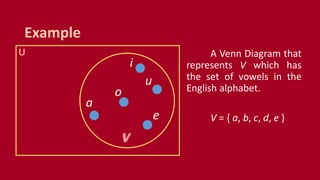
U
Example
A Venn Diagram that
represents V which has
the set of vowels in the
English alphabet.
V = { a, b, c, d, e }
a
e
i
o
u
VV
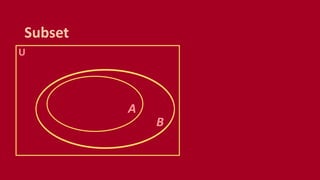
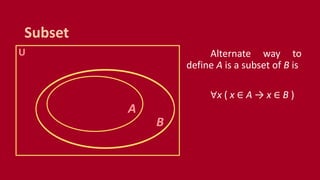
Definition 3
The set A is a subset of B if and only if every element of A is
also an element of B. We use the notation A ⊆ B to indicate
that A is a subset of the set B.
Subset
Subset
U
B
A
Subset
U
B
A
Alternate way to
define A is a subset of B is
∀x ( x ∈ A → x ∈ B )
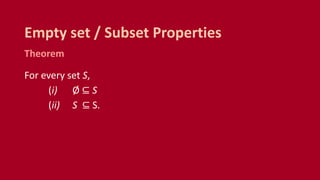
Theorem
For every set S,
(i) Ø ⊆ S
(ii) S ⊆ S.
Empty set / Subset Properties
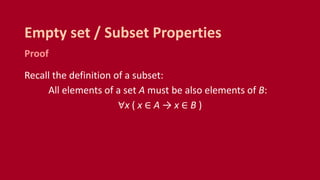
Proof
Recall the definition of a subset:
All elements of a set A must be also elements of B:
∀x ( x ∈ A → x ∈ B )
Empty set / Subset Properties
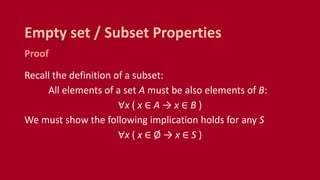
Proof
Recall the definition of a subset:
All elements of a set A must be also elements of B:
∀x ( x ∈ A → x ∈ B )
We must show the following implication holds for any S
∀x ( x ∈ Ø → x ∈ S )
Empty set / Subset Properties
Proof
Recall the definition of a subset:
All elements of a set A must be also elements of B:
∀x ( x ∈ A → x ∈ B )
We must show the following implication holds for any S
∀x ( x ∈ Ø → x ∈ S )
Since the empty set does not contain any element,
x ∈ Ø is always FALSE.
Empty set / Subset Properties
Proof
Recall the definition of a subset:
All elements of a set A must be also elements of B:
∀x ( x ∈ A → x ∈ B )
We must show the following implication holds for any S
∀x ( x ∈ Ø → x ∈ S )
Since the empty set does not contain any element,
x ∈ Ø is always FALSE. Then the implication is always TRUE.
Empty set / Subset Properties
Definition 3.5
A set A is said to be a proper subset of B if and only if A ⊆ B
and A ≠ B. We denote that A is a proper subset of B with the
notation A ⊂ B
Proper Subset
Example
U
B
A
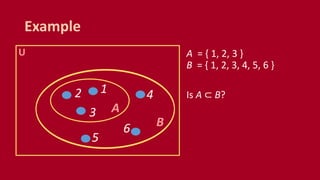
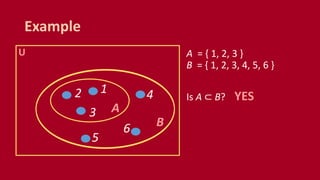
A = { 1, 2, 3 }
B = { 1, 2, 3, 4, 5, 6 }
Is A ⊂ B?12
3
4
5
6
Example
U
B
A
A = { 1, 2, 3 }
B = { 1, 2, 3, 4, 5, 6 }
Is A ⊂ B? YES
12
3
4
5
6
Cardinality
Definition 4
Let S be a set. It there are exactly n distinct elements in S
where n is a nonnegative integer, we say that S is a finite set
and that n is the cardinality of S. The cardinality of S is
denoted by |S|.
Cardinality
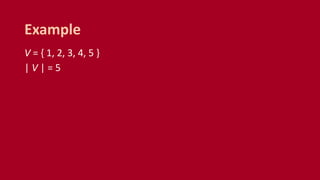
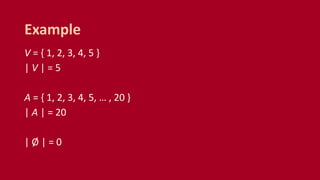
V = { 1, 2, 3, 4, 5 }
| V | = 5
Example
V = { 1, 2, 3, 4, 5 }
| V | = 5
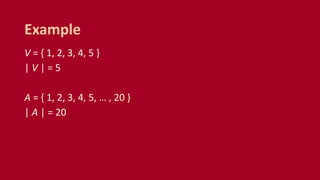
A = { 1, 2, 3, 4, 5, … , 20 }
| A | = 20
Example
V = { 1, 2, 3, 4, 5 }
| V | = 5
A = { 1, 2, 3, 4, 5, … , 20 }
| A | = 20
| Ø | = 0
Example
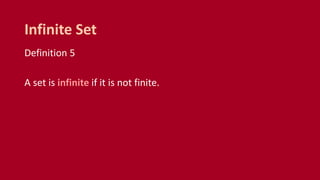
Definition 5
A set is infinite if it is not finite.
Infinite Set
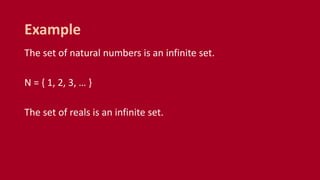
The set of natural numbers is an infinite set.
N = { 1, 2, 3, … }
The set of reals is an infinite set.
Example
Power Sets
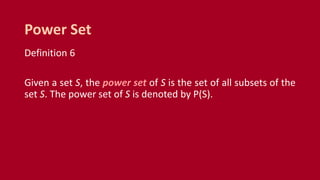
Definition 6
Given a set S, the power set of S is the set of all subsets of the
set S. The power set of S is denoted by P(S).
Power Set
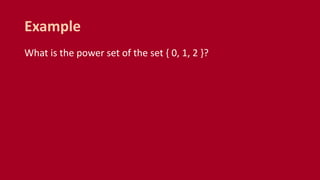
What is the power set of the set { 0, 1, 2 }?
Example
What is the power set of the set { 0, 1, 2 }?
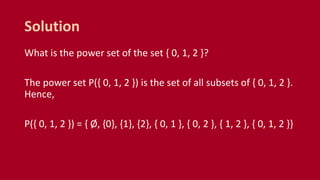
The power set P({ 0, 1, 2 }) is the set of all subsets of { 0, 1, 2 }.
Hence,
P({ 0, 1, 2 }) = { Ø, {0}, {1}, {2}, { 0, 1 }, { 0, 2 }, { 1, 2 }, { 0, 1, 2 }}
Solution
Cartesian Products
Definition 7
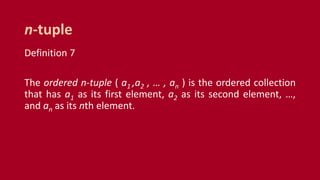
The ordered n-tuple ( a1 ,a2 , … , an ) is the ordered collection
that has a1 as its first element, a2 as its second element, …,
and an as its nth element.
n-tuple
Definition 8
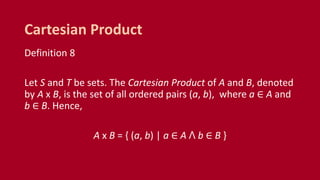
Let S and T be sets. The Cartesian Product of A and B, denoted
by A x B, is the set of all ordered pairs (a, b), where a ∈ A and
b ∈ B. Hence,
A x B = { (a, b) | a ∈ A ꓥ b ∈ B }
Cartesian Product
What is the Cartesian Product of A = { 2, 5 } and B = { x, y, z }?
Example
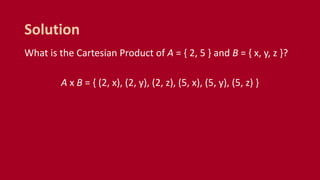
What is the Cartesian Product of A = { 2, 5 } and B = { x, y, z }?
A x B = { (2, x), (2, y), (2, z), (5, x), (5, y), (5, z) }
Solution
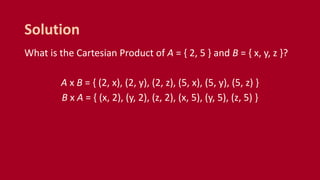
What is the Cartesian Product of A = { 2, 5 } and B = { x, y, z }?
A x B = { (2, x), (2, y), (2, z), (5, x), (5, y), (5, z) }
B x A = { (x, 2), (y, 2), (z, 2), (x, 5), (y, 5), (z, 5) }
Solution
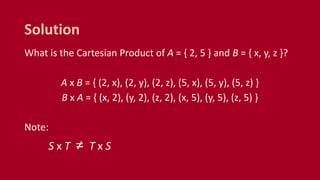
What is the Cartesian Product of A = { 2, 5 } and B = { x, y, z }?
A x B = { (2, x), (2, y), (2, z), (5, x), (5, y), (5, z) }
B x A = { (x, 2), (y, 2), (z, 2), (x, 5), (y, 5), (z, 5) }
Note:
S x T ≠ T x S
Solution
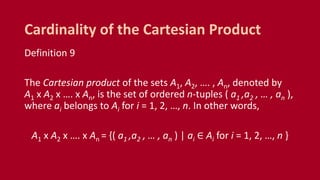
Definition 9
The Cartesian product of the sets A1, A2, …. , An, denoted by
A1 x A2 x …. x An, is the set of ordered n-tuples ( a1 ,a2 , … , an ),
where ai belongs to Ai for i = 1, 2, …, n. In other words,
A1 x A2 x …. x An = {( a1 ,a2 , … , an ) | ai ∈ Ai for i = 1, 2, …, n }
Cardinality of the Cartesian Product
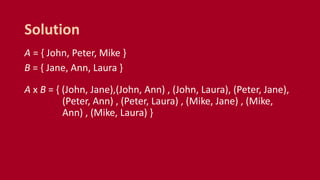
A = { John, Peter, Mike }
B = { Jane, Ann, Laura }
A x B =
Example
A = { John, Peter, Mike }
B = { Jane, Ann, Laura }
A x B = { (John, Jane),(John, Ann) , (John, Laura), (Peter, Jane),
(Peter, Ann) , (Peter, Laura) , (Mike, Jane) , (Mike,
Ann) , (Mike, Laura) }
Solution
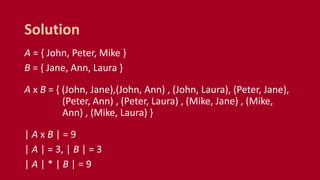
A = { John, Peter, Mike }
B = { Jane, Ann, Laura }
A x B = { (John, Jane),(John, Ann) , (John, Laura), (Peter, Jane),
(Peter, Ann) , (Peter, Laura) , (Mike, Jane) , (Mike,
Ann) , (Mike, Laura) }
| A x B | = 9
| A | = 3, | B | = 3
| A | * | B | = 9
Solution
Set Operations
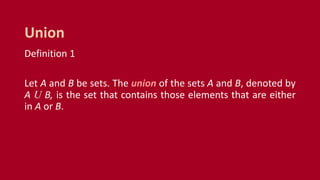
Definition 1
Let A and B be sets. The union of the sets A and B, denoted by
A U B, is the set that contains those elements that are either
in A or B.
Union
U
Example
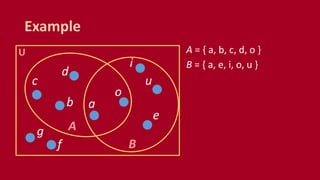
A = { a, b, c, d, o }
B = { a, e, i, o, u }
a
e
i
o
u
A
B
b
c
d
f
g
U
Solution
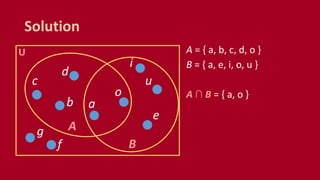
A = { a, b, c, d, o }
B = { a, e, i, o, u }
A U B = { a, b, c, d, e, i, o, u}
a
e
i
o
u
A
B
b
c
d
f
g
Definition 2
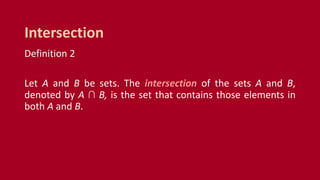
Let A and B be sets. The intersection of the sets A and B,
denoted by A ∩ B, is the set that contains those elements in
both A and B.
Intersection
U
Intersection
Alternate:
A ∩ B = { x | ( x ∈ A ꓥ x ∈ B }
a
e
i
o
u
A
B
b
c
d
f
g
U
Example
A = { a, b, c, d, o }
B = { a, e, i, o, u }
a
e
i
o
u
A
B
b
c
d
f
g
U
Solution
A = { a, b, c, d, o }
B = { a, e, i, o, u }
A ∩ B = { a, o }
a
e
i
o
u
A
B
b
c
d
f
g
Definition 3
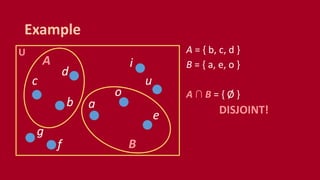
Two sets are called disjoint if their intersection is the empty
set.
Disjoint Sets
U
Disjoint
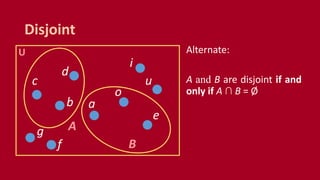
Alternate:
A and B are disjoint if and
only if A ∩ B = Ø
a
e
i
o
u
A
B
b
c
d
f
g
U
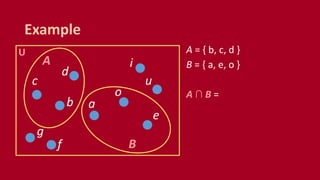
Example
A = { b, c, d }
B = { a, e, o }
A ∩ B =
a
e
i
o
u
A
B
b
c
d
f
g
U
Example
A = { b, c, d }
B = { a, e, o }
A ∩ B = { Ø }
DISJOINT!a
e
i
o
u
A
B
b
c
d
f
g
Definition 4
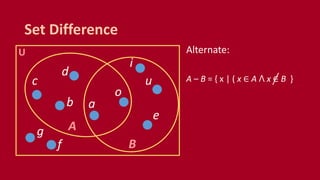
Let A and B be sets. The difference of the sets A and B,
denoted by A – B, is the set that contains those elements that
are in A but not in B. The difference of A and B is also called
the compliment of B with respect to A.
Set Difference
Definition 4
Let A and B be sets. The difference of the sets A and B,
denoted by A – B, is the set that contains those elements that
are in A but not in B. The difference of A and B is also called
the compliment of B with respect to A.
Note: It is sometimes denoted by AB
Set Difference
U
Set Difference
Alternate:
A – B = { x | ( x ∈ A ꓥ x ∈ B }
a
e
i
o
u
A
B
b
c
d
f
g
U
Example
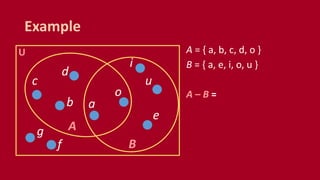
A = { a, b, c, d, o }
B = { a, e, i, o, u }
A – B =
a
e
i
o
u
A
B
b
c
d
f
g
U
Example
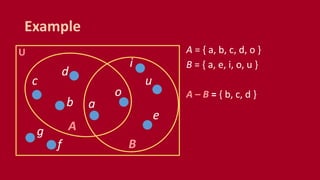
A = { a, b, c, d, o }
B = { a, e, i, o, u }
A – B = { b, c, d }
a
e
i
o
u
A
B
b
c
d
f
g
Definition 5
Let U be the universal set. The compliment of the set A,
denoted by Ā, is the compliment of A with respect to U.
Therefore, the compliment of the set A is U – A.
Compliment
Let A = { a, e, i, o, u }
where the universal set is the set of letters of the English
Alphabet.
Example
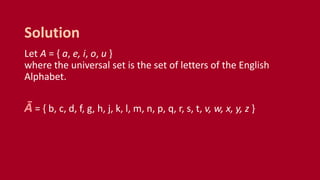
Let A = { a, e, i, o, u }
where the universal set is the set of letters of the English
Alphabet.
Ā = { b, c, d, f, g, h, j, k, l, m, n, p, q, r, s, t, v, w, x, y, z }
Solution
Any Question?

CMSC 56 | Lecture 6: Sets & Set Operations

  • 1.
    Sets & SetOperations Lecture 6, CMSC 56 Allyn Joy D. Calcaben
  • 2.
    Definition 1 A setis an unordered collection of objects, called elements or members of the set. A set is said to contain its elements. We write a ∈ A to denote that a is an element of the set A. The notation a ∈ A denotes that a is not an element of the set A. Set
  • 3.
    Definition 1 A setis an unordered collection of objects, called elements or members of the set. A set is said to contain its elements. We write a ∈ A to denote that a is an element of the set A. The notation a ∈ A denotes that a is not an element of the set A. Number of objects in a set can be finite or infinite. Set
  • 4.
    a set ofchairs Example
  • 5.
    a set ofchairs the set of nobel laureates in the world Example
  • 6.
    a set ofchairs the set of nobel laureates in the world the set of integers Example
  • 7.
    a set ofchairs the set of nobel laureates in the world the set of integers the set of natural numbers less than 10 Example
  • 8.
    a set ofchairs the set of nobel laureates in the world the set of integers the set of natural numbers less than 10 the set of students in this class who passed the quizzes Example
  • 9.
    One way ofdescribing a set. All members of the set are listed between curly braces, and separated by comma. Roster Method
  • 10.
    The set Vof all vowels in the English alphabet can be written as V = {a, e, i, o, u}. Example
  • 11.
    The set Vof all vowels in the English alphabet can be written as V = {a, e, i, o, u}. The set O of odd positive integers less than 10 can be expressed by O = {1,3,5,7,9}. Example
  • 12.
    Another way todescribe a set. Characterized all those elements in the set by stating the property or properties they must have to be members. Set Builder
  • 13.
    The set Oof all odd positive integers less than 10. Example
  • 14.
    The set Oof all odd positive integers less than 10. O = { x | x is an odd positive integer less than 10 } Example
  • 15.
    The set Oof all odd positive integers less than 10. O = { x | x is an odd positive integer less than 10 } or, O = { x ∈ Z+ | x is odd and x < 10 } Example
  • 16.
    N = {0, 1, 2, 3,... }, the set of natural numbers Z = { …, -2, -1, 0, 1, 2, … }, the set of integers Z+ = { 1, 2, 3, … }, the set of positive integers Q = { p/q | p ∈ Z, q ∈ Z, and q ≠ 0 }, the set of rational numbers R the set of real numbers R+ the set of positive real numbers C the set of complex numbers Important roles
  • 17.
    When a andb are real numbers with a < b, we write [ a , b ] = { x | a ≤ x ≤ b } [ a , b ) = { x | a ≤ x < b } ( a , b ] = { x | a < x ≤ b } ( a , b ) = { x | a < x < b } Intervals of real numbers
  • 18.
    When a andb are real numbers with a < b, we write [ a , b ] = { x | a ≤ x ≤ b } [ a , b ) = { x | a ≤ x < b } ( a , b ] = { x | a < x ≤ b } ( a , b ) = { x | a < x < b } Note that: [ a , b ] is called the closed interval from a to b. ( a , b ) is called the open interval from a to b. Intervals of real numbers
  • 19.
    Definition 2 Two setsare equal if and only if they have the same elements. Therefore, if A and B are sets, then A and B are equal if and only if ∀x ( x ∈ A ↔ x ∈ B ). We write A = B if A and B are equal sets. Equality
  • 20.
    { 1, 3,5 } = { 3, 5, 1 } Example
  • 21.
    { 1, 3,5 } = { 3, 5, 1 } = { 1, 3, 3, 3, 5, 5, 5, 5, 5 } Example
  • 22.
    { 1, 3,5 } = { 3, 5, 1 } = { 1, 3, 3, 3, 5, 5, 5, 5, 5 } Note: It doesn’t matter if an element of a set is listed more than once as long as they have the same elements. Example
  • 23.
    The universal setis denoted by U: the set of all objects under the consideration, represented by a rectangle. The empty set is denoted as Ø or { }. Special Sets
  • 24.
  • 25.
    U Example A Venn Diagramthat represents V which has the set of vowels in the English alphabet.
  • 26.
    U Example A Venn Diagramthat represents V which has the set of vowels in the English alphabet. V = { a, b, c, d, e } a e i o u VV
  • 27.
    Definition 3 The setA is a subset of B if and only if every element of A is also an element of B. We use the notation A ⊆ B to indicate that A is a subset of the set B. Subset
  • 28.
  • 29.
    Subset U B A Alternate way to defineA is a subset of B is ∀x ( x ∈ A → x ∈ B )
  • 30.
    Theorem For every setS, (i) Ø ⊆ S (ii) S ⊆ S. Empty set / Subset Properties
  • 31.
    Proof Recall the definitionof a subset: All elements of a set A must be also elements of B: ∀x ( x ∈ A → x ∈ B ) Empty set / Subset Properties
  • 32.
    Proof Recall the definitionof a subset: All elements of a set A must be also elements of B: ∀x ( x ∈ A → x ∈ B ) We must show the following implication holds for any S ∀x ( x ∈ Ø → x ∈ S ) Empty set / Subset Properties
  • 33.
    Proof Recall the definitionof a subset: All elements of a set A must be also elements of B: ∀x ( x ∈ A → x ∈ B ) We must show the following implication holds for any S ∀x ( x ∈ Ø → x ∈ S ) Since the empty set does not contain any element, x ∈ Ø is always FALSE. Empty set / Subset Properties
  • 34.
    Proof Recall the definitionof a subset: All elements of a set A must be also elements of B: ∀x ( x ∈ A → x ∈ B ) We must show the following implication holds for any S ∀x ( x ∈ Ø → x ∈ S ) Since the empty set does not contain any element, x ∈ Ø is always FALSE. Then the implication is always TRUE. Empty set / Subset Properties
  • 35.
    Definition 3.5 A setA is said to be a proper subset of B if and only if A ⊆ B and A ≠ B. We denote that A is a proper subset of B with the notation A ⊂ B Proper Subset
  • 36.
    Example U B A A = {1, 2, 3 } B = { 1, 2, 3, 4, 5, 6 } Is A ⊂ B?12 3 4 5 6
  • 37.
    Example U B A A = {1, 2, 3 } B = { 1, 2, 3, 4, 5, 6 } Is A ⊂ B? YES 12 3 4 5 6
  • 38.
  • 39.
    Definition 4 Let Sbe a set. It there are exactly n distinct elements in S where n is a nonnegative integer, we say that S is a finite set and that n is the cardinality of S. The cardinality of S is denoted by |S|. Cardinality
  • 40.
    V = {1, 2, 3, 4, 5 } | V | = 5 Example
  • 41.
    V = {1, 2, 3, 4, 5 } | V | = 5 A = { 1, 2, 3, 4, 5, … , 20 } | A | = 20 Example
  • 42.
    V = {1, 2, 3, 4, 5 } | V | = 5 A = { 1, 2, 3, 4, 5, … , 20 } | A | = 20 | Ø | = 0 Example
  • 43.
    Definition 5 A setis infinite if it is not finite. Infinite Set
  • 44.
    The set ofnatural numbers is an infinite set. N = { 1, 2, 3, … } The set of reals is an infinite set. Example
  • 45.
  • 46.
    Definition 6 Given aset S, the power set of S is the set of all subsets of the set S. The power set of S is denoted by P(S). Power Set
  • 47.
    What is thepower set of the set { 0, 1, 2 }? Example
  • 48.
    What is thepower set of the set { 0, 1, 2 }? The power set P({ 0, 1, 2 }) is the set of all subsets of { 0, 1, 2 }. Hence, P({ 0, 1, 2 }) = { Ø, {0}, {1}, {2}, { 0, 1 }, { 0, 2 }, { 1, 2 }, { 0, 1, 2 }} Solution
  • 49.
  • 50.
    Definition 7 The orderedn-tuple ( a1 ,a2 , … , an ) is the ordered collection that has a1 as its first element, a2 as its second element, …, and an as its nth element. n-tuple
  • 51.
    Definition 8 Let Sand T be sets. The Cartesian Product of A and B, denoted by A x B, is the set of all ordered pairs (a, b), where a ∈ A and b ∈ B. Hence, A x B = { (a, b) | a ∈ A ꓥ b ∈ B } Cartesian Product
  • 52.
    What is theCartesian Product of A = { 2, 5 } and B = { x, y, z }? Example
  • 53.
    What is theCartesian Product of A = { 2, 5 } and B = { x, y, z }? A x B = { (2, x), (2, y), (2, z), (5, x), (5, y), (5, z) } Solution
  • 54.
    What is theCartesian Product of A = { 2, 5 } and B = { x, y, z }? A x B = { (2, x), (2, y), (2, z), (5, x), (5, y), (5, z) } B x A = { (x, 2), (y, 2), (z, 2), (x, 5), (y, 5), (z, 5) } Solution
  • 55.
    What is theCartesian Product of A = { 2, 5 } and B = { x, y, z }? A x B = { (2, x), (2, y), (2, z), (5, x), (5, y), (5, z) } B x A = { (x, 2), (y, 2), (z, 2), (x, 5), (y, 5), (z, 5) } Note: S x T ≠ T x S Solution
  • 56.
    Definition 9 The Cartesianproduct of the sets A1, A2, …. , An, denoted by A1 x A2 x …. x An, is the set of ordered n-tuples ( a1 ,a2 , … , an ), where ai belongs to Ai for i = 1, 2, …, n. In other words, A1 x A2 x …. x An = {( a1 ,a2 , … , an ) | ai ∈ Ai for i = 1, 2, …, n } Cardinality of the Cartesian Product
  • 57.
    A = {John, Peter, Mike } B = { Jane, Ann, Laura } A x B = Example
  • 58.
    A = {John, Peter, Mike } B = { Jane, Ann, Laura } A x B = { (John, Jane),(John, Ann) , (John, Laura), (Peter, Jane), (Peter, Ann) , (Peter, Laura) , (Mike, Jane) , (Mike, Ann) , (Mike, Laura) } Solution
  • 59.
    A = {John, Peter, Mike } B = { Jane, Ann, Laura } A x B = { (John, Jane),(John, Ann) , (John, Laura), (Peter, Jane), (Peter, Ann) , (Peter, Laura) , (Mike, Jane) , (Mike, Ann) , (Mike, Laura) } | A x B | = 9 | A | = 3, | B | = 3 | A | * | B | = 9 Solution
  • 60.
  • 61.
    Definition 1 Let Aand B be sets. The union of the sets A and B, denoted by A U B, is the set that contains those elements that are either in A or B. Union
  • 62.
    U Example A = {a, b, c, d, o } B = { a, e, i, o, u } a e i o u A B b c d f g
  • 63.
    U Solution A = {a, b, c, d, o } B = { a, e, i, o, u } A U B = { a, b, c, d, e, i, o, u} a e i o u A B b c d f g
  • 64.
    Definition 2 Let Aand B be sets. The intersection of the sets A and B, denoted by A ∩ B, is the set that contains those elements in both A and B. Intersection
  • 65.
    U Intersection Alternate: A ∩ B= { x | ( x ∈ A ꓥ x ∈ B } a e i o u A B b c d f g
  • 66.
    U Example A = {a, b, c, d, o } B = { a, e, i, o, u } a e i o u A B b c d f g
  • 67.
    U Solution A = {a, b, c, d, o } B = { a, e, i, o, u } A ∩ B = { a, o } a e i o u A B b c d f g
  • 68.
    Definition 3 Two setsare called disjoint if their intersection is the empty set. Disjoint Sets
  • 69.
    U Disjoint Alternate: A and Bare disjoint if and only if A ∩ B = Ø a e i o u A B b c d f g
  • 70.
    U Example A = {b, c, d } B = { a, e, o } A ∩ B = a e i o u A B b c d f g
  • 71.
    U Example A = {b, c, d } B = { a, e, o } A ∩ B = { Ø } DISJOINT!a e i o u A B b c d f g
  • 72.
    Definition 4 Let Aand B be sets. The difference of the sets A and B, denoted by A – B, is the set that contains those elements that are in A but not in B. The difference of A and B is also called the compliment of B with respect to A. Set Difference
  • 73.
    Definition 4 Let Aand B be sets. The difference of the sets A and B, denoted by A – B, is the set that contains those elements that are in A but not in B. The difference of A and B is also called the compliment of B with respect to A. Note: It is sometimes denoted by AB Set Difference
  • 74.
    U Set Difference Alternate: A –B = { x | ( x ∈ A ꓥ x ∈ B } a e i o u A B b c d f g
  • 75.
    U Example A = {a, b, c, d, o } B = { a, e, i, o, u } A – B = a e i o u A B b c d f g
  • 76.
    U Example A = {a, b, c, d, o } B = { a, e, i, o, u } A – B = { b, c, d } a e i o u A B b c d f g
  • 77.
    Definition 5 Let Ube the universal set. The compliment of the set A, denoted by Ā, is the compliment of A with respect to U. Therefore, the compliment of the set A is U – A. Compliment
  • 78.
    Let A ={ a, e, i, o, u } where the universal set is the set of letters of the English Alphabet. Example
  • 79.
    Let A ={ a, e, i, o, u } where the universal set is the set of letters of the English Alphabet. Ā = { b, c, d, f, g, h, j, k, l, m, n, p, q, r, s, t, v, w, x, y, z } Solution
  • 80.

Editor's Notes

  • #29 We see that A ⊆ B if and only if the quantification ∀x ( x ∈ A → x ∈ B ) is true. Note that to show that A is not a subset of B we need only find one element x ∈ A with x ∈ B. Such an x is a counterexample to the claim that x ∈ A implies x ∈ B.
  • #30 We see that A ⊆ B if and only if the quantification ∀x ( x ∈ A → x ∈ B ) is true. Note that to show that A is not a subset of B we need only find one element x ∈ A with x ∈ B. Such an x is a counterexample to the claim that x ∈ A implies x ∈ B.
  • #37 We see that A ⊆ B if and only if the quantification ∀x ( x ∈ A → x ∈ B ) is true. Note that to show that A is not a subset of B we need only find one element x ∈ A with x ∈ B. Such an x is a counterexample to the claim that x ∈ A implies x ∈ B.
  • #38 We see that A ⊆ B if and only if the quantification ∀x ( x ∈ A → x ∈ B ) is true. Note that to show that A is not a subset of B we need only find one element x ∈ A with x ∈ B. Such an x is a counterexample to the claim that x ∈ A implies x ∈ B.
  • #49 Note that the empty set and the set itself are members of this set of subsets.
  • #51  Sets are used to represent unordered collections. Ordered-n tuples are used to represent an ordered collection.