Instruction Pipeline
By
Sandip Kumar Ladi
Instruction Pipeline
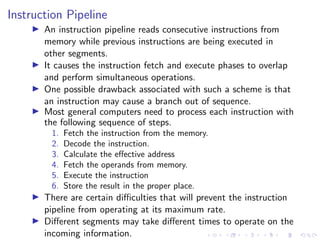
▶ An instruction pipeline reads consecutive instructions from
memory while previous instructions are being executed in
other segments.
▶ It causes the instruction fetch and execute phases to overlap
and perform simultaneous operations.
▶ One possible drawback associated with such a scheme is that
an instruction may cause a branch out of sequence.
▶ Most general computers need to process each instruction with
the following sequence of steps.
1. Fetch the instruction from the memory.
2. Decode the instruction.
3. Calculate the effective address
4. Fetch the operands from memory.
5. Execute the instruction
6. Store the result in the proper place.
▶ There are certain difficulties that will prevent the instruction
pipeline from operating at its maximum rate.
▶ Different segments may take different times to operate on the
incoming information.
Example
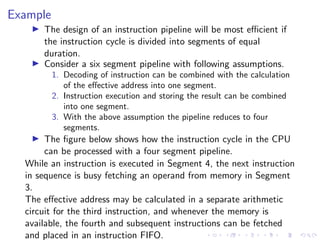
▶ The design of an instruction pipeline will be most efficient if
the instruction cycle is divided into segments of equal
duration.
▶ Consider a six segment pipeline with following assumptions.
1. Decoding of instruction can be combined with the calculation
of the effective address into one segment.
2. Instruction execution and storing the result can be combined
into one segment.
3. With the above assumption the pipeline reduces to four
segments.
▶ The figure below shows how the instruction cycle in the CPU
can be processed with a four segment pipeline.
While an instruction is executed in Segment 4, the next instruction
in sequence is busy fetching an operand from memory in Segment
3.
The effective address may be calculated in a separate arithmetic
circuit for the third instruction, and whenever the memory is
available, the fourth and subsequent instructions can be fetched
and placed in an instruction FIFO.
Example
fetch instrcn
from memory
decode instrcn
and calc
effctive addrs
Branch ?
fetch oprnd
frm memory
Execute
Instruction
Interrupt ?
interrupt
handling
Update PC
Empty pipe Segment1
Segment2
Segment3
Segment4
Y
No
No
Yes
Example
Thus upto four suboperations in the instruction cycle can overlap
and upto four different instructions can be in progress of being
processed at the same time.
Once in a while, an instruction in the sequence may be a program
control type that causes a branch out of normal sequence. In that
case the pending operations in the last two segments are completed
and all information stored in the instruction buffer is deleted.
The pipeline then starts from the new address stored in the
program counter. Similarly, an interrupt request, when
acknowledged, will cause the pipeline to empty and start again
from a new address value.
Example
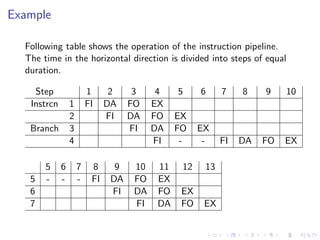
Following table shows the operation of the instruction pipeline.
The time in the horizontal direction is divided into steps of equal
duration.
Step 1 2 3 4 5 6 7 8 9 10
Instrcn 1 FI DA FO EX
2 FI DA FO EX
Branch 3 FI DA FO EX
4 FI - - FI DA FO EX
5 6 7 8 9 10 11 12 13
5 - - - FI DA FO EX
6 FI DA FO EX
7 FI DA FO EX
Example
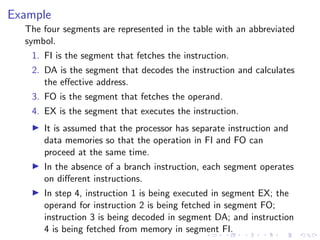
The four segments are represented in the table with an abbreviated
symbol.
1. FI is the segment that fetches the instruction.
2. DA is the segment that decodes the instruction and calculates
the effective address.
3. FO is the segment that fetches the operand.
4. EX is the segment that executes the instruction.
▶ It is assumed that the processor has separate instruction and
data memories so that the operation in FI and FO can
proceed at the same time.
▶ In the absence of a branch instruction, each segment operates
on different instructions.
▶ In step 4, instruction 1 is being executed in segment EX; the
operand for instruction 2 is being fetched in segment FO;
instruction 3 is being decoded in segment DA; and instruction
4 is being fetched from memory in segment FI.
Example
▶ Assume that instruction 3 is a branch instruction.
▶ As soon as this instruction is decoded in segment DA in step
4, the transfer from FI to DA of the other instruction is halted
until the branch instruction is executed in step 6.
▶ If the branch is taken, a new instruction is fetched in step 7.
▶ If the branch is not taken, the instruction fetched previously in
step 4 can be used.
▶ The pipeline then continues until a new branch instruction is
encountered.
▶ Another delay may occur in the pipeline if the EX segment
needs to store the result of the operation in the data memory
while the FO segment needs to fetch an operand. In that
case, segment FO must wait until segment EX has finished
it’s operation.
Pipeline Hazards
A pipeline hazard is a situation that prevents an instruction from
executing during its designated clock cycles. In general there are
three major categories of hazards.
1. Structural hazard: Structural hazards are caused by conflicts
among the instructions executing in the pipeline in accessing
certain resources. Such resource conflicts can be resolved by
providing separate resources.
Example: A single memory storing both data and instructions
can be resolved by providing separate memory for instruction
and data.
Von neumann computer has a single memory for both
instructions and data which may lead to structural hazard in
pipeline mode. Wheras the Harvard architecture provides
separate data and instruction memory.
Structural hazard cannot arise in Harvard architecture.
Almost every present day processor is designed based on
Harvard architecture.
Pipeline Hazards
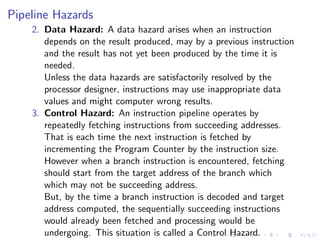
2. Data Hazard: A data hazard arises when an instruction
depends on the result produced, may by a previous instruction
and the result has not yet been produced by the time it is
needed.
Unless the data hazards are satisfactorily resolved by the
processor designer, instructions may use inappropriate data
values and might computer wrong results.
3. Control Hazard: An instruction pipeline operates by
repeatedly fetching instructions from succeeding addresses.
That is each time the next instruction is fetched by
incrementing the Program Counter by the instruction size.
However when a branch instruction is encountered, fetching
should start from the target address of the branch which
which may not be succeeding address.
But, by the time a branch instruction is decoded and target
address computed, the sequentially succeeding instructions
would already been fetched and processing would be
undergoing. This situation is called a Control Hazard.
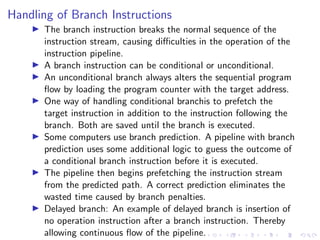
Handling of Branch Instructions
▶ The branch instruction breaks the normal sequence of the
instruction stream, causing difficulties in the operation of the
instruction pipeline.
▶ A branch instruction can be conditional or unconditional.
▶ An unconditional branch always alters the sequential program
flow by loading the program counter with the target address.
▶ One way of handling conditional branchis to prefetch the
target instruction in addition to the instruction following the
branch. Both are saved until the branch is executed.
▶ Some computers use branch prediction. A pipeline with branch
prediction uses some additional logic to guess the outcome of
a conditional branch instruction before it is executed.
▶ The pipeline then begins prefetching the instruction stream
from the predicted path. A correct prediction eliminates the
wasted time caused by branch penalties.
▶ Delayed branch: An example of delayed branch is insertion of
no operation instruction after a branch instruction. Thereby
allowing continuous flow of the pipeline.

instruction pipeline in computer architecture and organization.pdf

  • 1.
  • 2.
    Instruction Pipeline ▶ Aninstruction pipeline reads consecutive instructions from memory while previous instructions are being executed in other segments. ▶ It causes the instruction fetch and execute phases to overlap and perform simultaneous operations. ▶ One possible drawback associated with such a scheme is that an instruction may cause a branch out of sequence. ▶ Most general computers need to process each instruction with the following sequence of steps. 1. Fetch the instruction from the memory. 2. Decode the instruction. 3. Calculate the effective address 4. Fetch the operands from memory. 5. Execute the instruction 6. Store the result in the proper place. ▶ There are certain difficulties that will prevent the instruction pipeline from operating at its maximum rate. ▶ Different segments may take different times to operate on the incoming information.
  • 3.
    Example ▶ The designof an instruction pipeline will be most efficient if the instruction cycle is divided into segments of equal duration. ▶ Consider a six segment pipeline with following assumptions. 1. Decoding of instruction can be combined with the calculation of the effective address into one segment. 2. Instruction execution and storing the result can be combined into one segment. 3. With the above assumption the pipeline reduces to four segments. ▶ The figure below shows how the instruction cycle in the CPU can be processed with a four segment pipeline. While an instruction is executed in Segment 4, the next instruction in sequence is busy fetching an operand from memory in Segment 3. The effective address may be calculated in a separate arithmetic circuit for the third instruction, and whenever the memory is available, the fourth and subsequent instructions can be fetched and placed in an instruction FIFO.
  • 4.
    Example fetch instrcn from memory decodeinstrcn and calc effctive addrs Branch ? fetch oprnd frm memory Execute Instruction Interrupt ? interrupt handling Update PC Empty pipe Segment1 Segment2 Segment3 Segment4 Y No No Yes
  • 5.
    Example Thus upto foursuboperations in the instruction cycle can overlap and upto four different instructions can be in progress of being processed at the same time. Once in a while, an instruction in the sequence may be a program control type that causes a branch out of normal sequence. In that case the pending operations in the last two segments are completed and all information stored in the instruction buffer is deleted. The pipeline then starts from the new address stored in the program counter. Similarly, an interrupt request, when acknowledged, will cause the pipeline to empty and start again from a new address value.
  • 6.
    Example Following table showsthe operation of the instruction pipeline. The time in the horizontal direction is divided into steps of equal duration. Step 1 2 3 4 5 6 7 8 9 10 Instrcn 1 FI DA FO EX 2 FI DA FO EX Branch 3 FI DA FO EX 4 FI - - FI DA FO EX 5 6 7 8 9 10 11 12 13 5 - - - FI DA FO EX 6 FI DA FO EX 7 FI DA FO EX
  • 7.
    Example The four segmentsare represented in the table with an abbreviated symbol. 1. FI is the segment that fetches the instruction. 2. DA is the segment that decodes the instruction and calculates the effective address. 3. FO is the segment that fetches the operand. 4. EX is the segment that executes the instruction. ▶ It is assumed that the processor has separate instruction and data memories so that the operation in FI and FO can proceed at the same time. ▶ In the absence of a branch instruction, each segment operates on different instructions. ▶ In step 4, instruction 1 is being executed in segment EX; the operand for instruction 2 is being fetched in segment FO; instruction 3 is being decoded in segment DA; and instruction 4 is being fetched from memory in segment FI.
  • 8.
    Example ▶ Assume thatinstruction 3 is a branch instruction. ▶ As soon as this instruction is decoded in segment DA in step 4, the transfer from FI to DA of the other instruction is halted until the branch instruction is executed in step 6. ▶ If the branch is taken, a new instruction is fetched in step 7. ▶ If the branch is not taken, the instruction fetched previously in step 4 can be used. ▶ The pipeline then continues until a new branch instruction is encountered. ▶ Another delay may occur in the pipeline if the EX segment needs to store the result of the operation in the data memory while the FO segment needs to fetch an operand. In that case, segment FO must wait until segment EX has finished it’s operation.
  • 9.
    Pipeline Hazards A pipelinehazard is a situation that prevents an instruction from executing during its designated clock cycles. In general there are three major categories of hazards. 1. Structural hazard: Structural hazards are caused by conflicts among the instructions executing in the pipeline in accessing certain resources. Such resource conflicts can be resolved by providing separate resources. Example: A single memory storing both data and instructions can be resolved by providing separate memory for instruction and data. Von neumann computer has a single memory for both instructions and data which may lead to structural hazard in pipeline mode. Wheras the Harvard architecture provides separate data and instruction memory. Structural hazard cannot arise in Harvard architecture. Almost every present day processor is designed based on Harvard architecture.
  • 10.
    Pipeline Hazards 2. DataHazard: A data hazard arises when an instruction depends on the result produced, may by a previous instruction and the result has not yet been produced by the time it is needed. Unless the data hazards are satisfactorily resolved by the processor designer, instructions may use inappropriate data values and might computer wrong results. 3. Control Hazard: An instruction pipeline operates by repeatedly fetching instructions from succeeding addresses. That is each time the next instruction is fetched by incrementing the Program Counter by the instruction size. However when a branch instruction is encountered, fetching should start from the target address of the branch which which may not be succeeding address. But, by the time a branch instruction is decoded and target address computed, the sequentially succeeding instructions would already been fetched and processing would be undergoing. This situation is called a Control Hazard.
  • 11.
    Handling of BranchInstructions ▶ The branch instruction breaks the normal sequence of the instruction stream, causing difficulties in the operation of the instruction pipeline. ▶ A branch instruction can be conditional or unconditional. ▶ An unconditional branch always alters the sequential program flow by loading the program counter with the target address. ▶ One way of handling conditional branchis to prefetch the target instruction in addition to the instruction following the branch. Both are saved until the branch is executed. ▶ Some computers use branch prediction. A pipeline with branch prediction uses some additional logic to guess the outcome of a conditional branch instruction before it is executed. ▶ The pipeline then begins prefetching the instruction stream from the predicted path. A correct prediction eliminates the wasted time caused by branch penalties. ▶ Delayed branch: An example of delayed branch is insertion of no operation instruction after a branch instruction. Thereby allowing continuous flow of the pipeline.