Copyright © 2012 Pearson Canada Inc., Toronto, Ontario
Probability
Conditional Probability
Copyright © 2012 Pearson Canada Inc., Toronto, Ontario Slide 15- 2
Conditional Probability
 When we want the probability of an event from a
conditional distribution, we write P(B|A) and
pronounce it “the probability of B given A.”
 A probability that takes into account a given
condition is called a conditional probability.
Copyright © 2012 Pearson Canada Inc., Toronto, Ontario Slide 15- 3
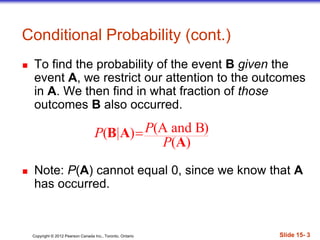
Conditional Probability (cont.)
 To find the probability of the event B given the
event A, we restrict our attention to the outcomes
in A. We then find in what fraction of those
outcomes B also occurred.
 Note: P(A) cannot equal 0, since we know that A
has occurred.
(A and B)( | )
( )
PP
P
B A
A
Copyright © 2012 Pearson Canada Inc., Toronto, Ontario Slide 15- 4
Independence
 Independence of two events means that the
outcome of one event does not influence the
probability of the other.
 With our new notation for conditional
probabilities, we can now formalize this definition:
 Events A and B are independent whenever
P(B|A) = P(B). (Equivalently, events A and B
are independent whenever P(A|B) = P(A).)
Copyright © 2012 Pearson Canada Inc., Toronto, Ontario Slide 15- 5
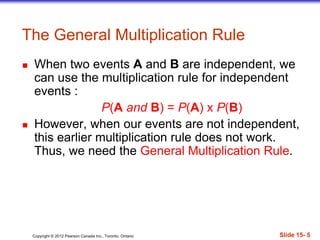
The General Multiplication Rule
 When two events A and B are independent, we
can use the multiplication rule for independent
events :
P(A and B) = P(A) x P(B)
 However, when our events are not independent,
this earlier multiplication rule does not work.
Thus, we need the General Multiplication Rule.
Copyright © 2012 Pearson Canada Inc., Toronto, Ontario Slide 15- 6
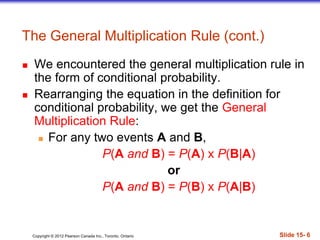
The General Multiplication Rule (cont.)
 We encountered the general multiplication rule in
the form of conditional probability.
 Rearranging the equation in the definition for
conditional probability, we get the General
Multiplication Rule:
 For any two events A and B,
P(A and B) = P(A) x P(B|A)
or
P(A and B) = P(B) x P(A|B)
Copyright © 2012 Pearson Canada Inc., Toronto, Ontario Slide 15- 7
Independent ≠ Disjoint
 Disjoint events cannot be independent! Well, why not?
 Since we know that disjoint events have no outcomes
in common, knowing that one occurred means the
other didn’t.
 Thus, the probability of the second occurring changed
based on our knowledge that the first occurred.
 It follows, then, that the two events are not
independent.
 A common error is to treat disjoint events as if they were
independent, and apply the Multiplication Rule for
independent events—don’t make that mistake.
Copyright © 2012 Pearson Canada Inc., Toronto, Ontario Slide 15- 8
Depending on Independence
 It’s much easier to think about independent
events than to deal with conditional probabilities.
 It seems that most people’s natural intuition for
probabilities breaks down when it comes to
conditional probabilities.
 Don’t fall into this trap: whenever you see
probabilities multiplied together, stop and ask
whether you think they are really independent.
Copyright © 2012 Pearson Canada Inc., Toronto, Ontario Slide 15- 9
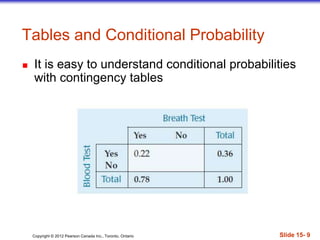
Tables and Conditional Probability
 It is easy to understand conditional probabilities
with contingency tables

Conditional probability

  • 1.
    Copyright © 2012Pearson Canada Inc., Toronto, Ontario Probability Conditional Probability
  • 2.
    Copyright © 2012Pearson Canada Inc., Toronto, Ontario Slide 15- 2 Conditional Probability  When we want the probability of an event from a conditional distribution, we write P(B|A) and pronounce it “the probability of B given A.”  A probability that takes into account a given condition is called a conditional probability.
  • 3.
    Copyright © 2012Pearson Canada Inc., Toronto, Ontario Slide 15- 3 Conditional Probability (cont.)  To find the probability of the event B given the event A, we restrict our attention to the outcomes in A. We then find in what fraction of those outcomes B also occurred.  Note: P(A) cannot equal 0, since we know that A has occurred. (A and B)( | ) ( ) PP P B A A
  • 4.
    Copyright © 2012Pearson Canada Inc., Toronto, Ontario Slide 15- 4 Independence  Independence of two events means that the outcome of one event does not influence the probability of the other.  With our new notation for conditional probabilities, we can now formalize this definition:  Events A and B are independent whenever P(B|A) = P(B). (Equivalently, events A and B are independent whenever P(A|B) = P(A).)
  • 5.
    Copyright © 2012Pearson Canada Inc., Toronto, Ontario Slide 15- 5 The General Multiplication Rule  When two events A and B are independent, we can use the multiplication rule for independent events : P(A and B) = P(A) x P(B)  However, when our events are not independent, this earlier multiplication rule does not work. Thus, we need the General Multiplication Rule.
  • 6.
    Copyright © 2012Pearson Canada Inc., Toronto, Ontario Slide 15- 6 The General Multiplication Rule (cont.)  We encountered the general multiplication rule in the form of conditional probability.  Rearranging the equation in the definition for conditional probability, we get the General Multiplication Rule:  For any two events A and B, P(A and B) = P(A) x P(B|A) or P(A and B) = P(B) x P(A|B)
  • 7.
    Copyright © 2012Pearson Canada Inc., Toronto, Ontario Slide 15- 7 Independent ≠ Disjoint  Disjoint events cannot be independent! Well, why not?  Since we know that disjoint events have no outcomes in common, knowing that one occurred means the other didn’t.  Thus, the probability of the second occurring changed based on our knowledge that the first occurred.  It follows, then, that the two events are not independent.  A common error is to treat disjoint events as if they were independent, and apply the Multiplication Rule for independent events—don’t make that mistake.
  • 8.
    Copyright © 2012Pearson Canada Inc., Toronto, Ontario Slide 15- 8 Depending on Independence  It’s much easier to think about independent events than to deal with conditional probabilities.  It seems that most people’s natural intuition for probabilities breaks down when it comes to conditional probabilities.  Don’t fall into this trap: whenever you see probabilities multiplied together, stop and ask whether you think they are really independent.
  • 9.
    Copyright © 2012Pearson Canada Inc., Toronto, Ontario Slide 15- 9 Tables and Conditional Probability  It is easy to understand conditional probabilities with contingency tables