PRAYAG RANJAN SETHI EC200127172 Presented by Under the guidance of LIGHT EMITTING POLYMERS
INTRODUCTION LEP is an emissive technology that emits light as a function of electrical operation. It exhibits electroluminescent characteristics. It emits light under the application of electric field.e.g-  polyvinyl chloride. LEP was discovered in 1990 PRAYAG RANJAN SETHI EC200127172  
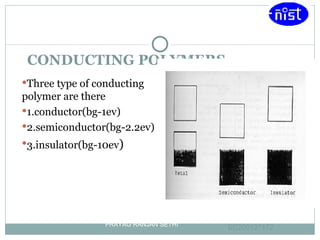
CONDUCTING POLYMERS   Three type of conducting polymer are there 1.conductor(bg-1ev) 2.semiconductor(bg-2.2ev) 3.insulator(bg-10ev )  PRAYAG RANJAN SETHI EC200127172  
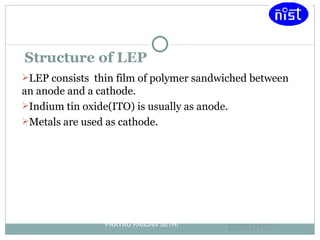
Structure of LEP LEP consists  thin film of polymer sandwiched between an anode and a cathode. Indium tin oxide(ITO) is usually as anode. Metals are used as cathode. PRAYAG RANJAN SETHI EC200127172  
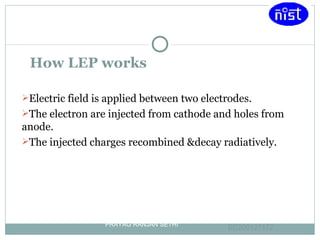
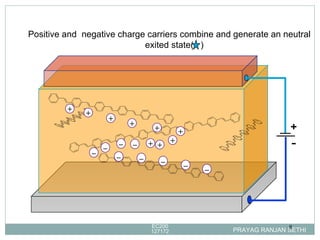
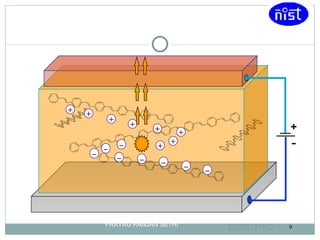
How LEP works Electric field is applied between two electrodes. The electron are injected from cathode and holes from anode. The injected charges recombined &decay radiatively. PRAYAG RANJAN SETHI EC200127172    
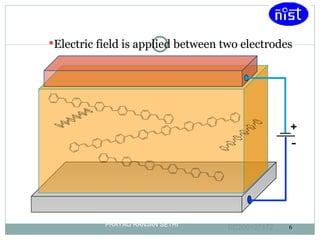
Electric field is applied between two electrodes PRAYAG RANJAN SETHI EC200127172 + -
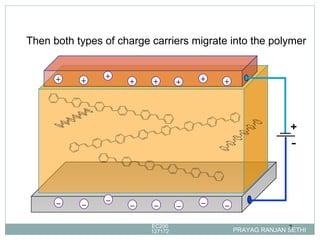
PRAYAG RANJAN SETHI EC200127172 + - Then both types of charge carriers migrate into the polymer + – + – + – + – + – + – + – + –
PRAYAG RANJAN SETHI EC200127172 + - + – + – + – + – – + – + + – – + – + Positive and  negative charge carriers combine and generate an neutral exited state( )
PRAYAG RANJAN SETHI EC200127172 + - + – + – + – + – – + – + + – – +
Fabrication First the polymer coated on the ITO surface. Then four steps are done. cleaning. spin coating depositing testing PRAYAG RANJAN SETHI EC200127172
Cleaning Each surface is cleaned by alcohol based cleaner. Then it is put to a UV ozone cleaner where it is bombarded by UV rays. PRAYAG RANJAN SETHI EC200127172
SPINCOATING ITO is placed on the spinning apparatus. Next several polymeric drop smeared on the surface. Once coating completed it is taken to the surface scanner for close scanning. The ITOs are placed on the spinner and than the polymer is speed over the surface. PRAYAG RANJAN SETHI EC200127172  
DEPOSITING The samples are placed above the electrodes. The electrodes are connected via high resistance metal alloy. Once voltage is increased the airborne molecules scatters and deposited on the glass. The thickness deposited depends upon the properties of polymer & glass. PRAYAG RANJAN SETHI EC200127172
TESTING   Once deposition is completed,the samples are tested for light emittance. This simply done by creating electric potential between the electrodes of the substrate. PRAYAG RANJAN SETHI EC200127172
ADVANTAGES PRAYAG RANJAN SETHI EC200127172 Low energy consumption Usefull for large area lighting Simple   to use technology Permits flexibl e  lighting and   displays  A technology   for the   future
It has both electrical and optical property. It is simpler &cheaper.  It permits flexible lighting and display . It is technology fi\or the future. PRAYAG RANJAN SETHI EC200127172 Conclusion
THANK  U  !!   PRAYAG RANJAN SETHI EC200127172

Light Emitting Polymers

  • 1.
    PRAYAG RANJAN SETHIEC200127172 Presented by Under the guidance of LIGHT EMITTING POLYMERS
  • 2.
    INTRODUCTION LEP isan emissive technology that emits light as a function of electrical operation. It exhibits electroluminescent characteristics. It emits light under the application of electric field.e.g- polyvinyl chloride. LEP was discovered in 1990 PRAYAG RANJAN SETHI EC200127172  
  • 3.
    CONDUCTING POLYMERS Three type of conducting polymer are there 1.conductor(bg-1ev) 2.semiconductor(bg-2.2ev) 3.insulator(bg-10ev ) PRAYAG RANJAN SETHI EC200127172  
  • 4.
    Structure of LEPLEP consists thin film of polymer sandwiched between an anode and a cathode. Indium tin oxide(ITO) is usually as anode. Metals are used as cathode. PRAYAG RANJAN SETHI EC200127172  
  • 5.
    How LEP worksElectric field is applied between two electrodes. The electron are injected from cathode and holes from anode. The injected charges recombined &decay radiatively. PRAYAG RANJAN SETHI EC200127172    
  • 6.
    Electric field isapplied between two electrodes PRAYAG RANJAN SETHI EC200127172 + -
  • 7.
    PRAYAG RANJAN SETHIEC200127172 + - Then both types of charge carriers migrate into the polymer + – + – + – + – + – + – + – + –
  • 8.
    PRAYAG RANJAN SETHIEC200127172 + - + – + – + – + – – + – + + – – + – + Positive and negative charge carriers combine and generate an neutral exited state( )
  • 9.
    PRAYAG RANJAN SETHIEC200127172 + - + – + – + – + – – + – + + – – +
  • 10.
    Fabrication First thepolymer coated on the ITO surface. Then four steps are done. cleaning. spin coating depositing testing PRAYAG RANJAN SETHI EC200127172
  • 11.
    Cleaning Each surfaceis cleaned by alcohol based cleaner. Then it is put to a UV ozone cleaner where it is bombarded by UV rays. PRAYAG RANJAN SETHI EC200127172
  • 12.
    SPINCOATING ITO isplaced on the spinning apparatus. Next several polymeric drop smeared on the surface. Once coating completed it is taken to the surface scanner for close scanning. The ITOs are placed on the spinner and than the polymer is speed over the surface. PRAYAG RANJAN SETHI EC200127172  
  • 13.
    DEPOSITING The samplesare placed above the electrodes. The electrodes are connected via high resistance metal alloy. Once voltage is increased the airborne molecules scatters and deposited on the glass. The thickness deposited depends upon the properties of polymer & glass. PRAYAG RANJAN SETHI EC200127172
  • 14.
    TESTING Once deposition is completed,the samples are tested for light emittance. This simply done by creating electric potential between the electrodes of the substrate. PRAYAG RANJAN SETHI EC200127172
  • 15.
    ADVANTAGES PRAYAG RANJANSETHI EC200127172 Low energy consumption Usefull for large area lighting Simple to use technology Permits flexibl e lighting and displays A technology for the future
  • 16.
    It has bothelectrical and optical property. It is simpler &cheaper. It permits flexible lighting and display . It is technology fi\or the future. PRAYAG RANJAN SETHI EC200127172 Conclusion
  • 17.
    THANK U !! PRAYAG RANJAN SETHI EC200127172