Wimax (802.16)
A Road to Mobile Life


              SUBMITTED BY:
              PRATIK ANAND
              354/09
              7TH SEM.
               ECE
TOPICS

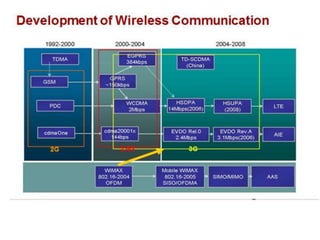
    Development of Wireless Communication
    Wi-MAX Introduction
    WiMAX Forum
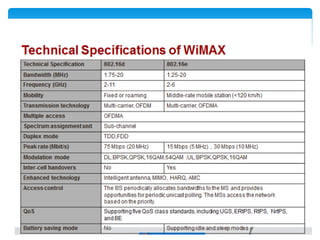
    Technical specifications
    Network Architecture
    WiMAX Key Technology: OFDMA, TDD, MIMO
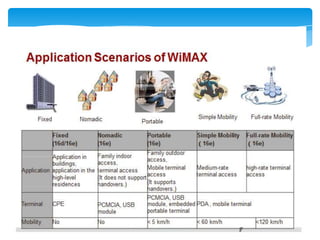
    Application Scenarios


2
What is WiMAX
WiMAX or “Worldwide Interoperability for Microwave Access” had
its origins in backhaul connectivity using microwave access such
as LMDS/MMDS
WiMAX has become a “hot topic” in the wireless industry, with
visible and aggressive backing from INTEL, among others
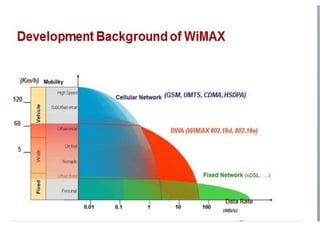
WiMAX is designed to provide “last-mile” or “backhaul”
connectivity using wireless
   “Last-mile” refers to a wireless connection from a major trunk
   line to a business or residential user
   Using IEEE 802.16 Broadband Wireless Access (BWA)
   standard, approved in January 2003, to provide operations in
   the <11GHz spectrum range
                                                         5
WiMAX Forum


  In April of 2001, the WiMAX forum is set up. This forum participates in
   authenticating the standardization and interoperability of the broadband
   radio access products based on IEEE 802.16 and ETSI HiperMAN.
  This forum is organized by many radio communication equipment suppliers,
 component suppliers, operators, which is a nonprofit organization.
  In November of 2004, the Network Working Group (NWG) is set up, which
 participates in setting downing the network standards for the IEEE 802.16d
 and IEEE 802.16e.
IEEE 802.16 Working Group

   In 1999, the IEEE working group is set up, which studies the
     broadband radio access technology standard. The aim of this group is
  IEEE 802.16 Working Group
     to establish a global broadband radio access standard.
   This group sets down the broadband access system standards,
     including the air interface standards and associated standards.
   At the beginning of 2003, this group issues the 802.16a standard that
     defines the 2 GHz to 11 GHz NLOS fixed access system.
      On October 1 of 2004, this group issues the 802.16d fixed access
    standard.
   In the end of 2005, this group issues the 802.16e standard. Now, the
    802.16e Release3 has been issued.
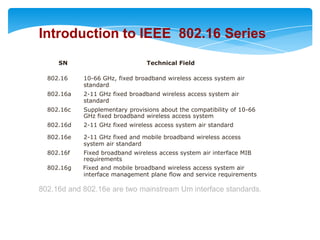
Introduction to IEEE 802.16 Series
     SN                          Technical Field

  802.16    10-66 GHz, fixed broadband wireless access system air
            standard
  802.16a   2-11 GHz fixed broadband wireless access system air
            standard
  802.16c   Supplementary provisions about the compatibility of 10-66
            GHz fixed broadband wireless access system
  802.16d   2-11 GHz fixed wireless access system air standard

  802.16e   2-11 GHz fixed and mobile broadband wireless access
            system air standard
  802.16f   Fixed broadband wireless access system air interface MIB
            requirements
  802.16g   Fixed and mobile broadband wireless access system air
            interface management plane flow and service requirements

802.16d and 802.16e are two mainstream Um interface standards.
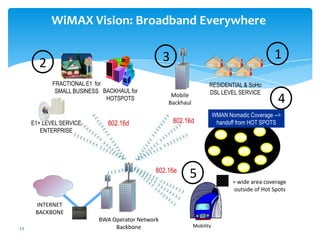
WiMAX Vision: Broadband Everywhere

                                                  3                                                   1
       2
            FRACTIONAL E1 for                                       RESIDENTIAL & SoHo
             SMALL BUSINESS BACKHAUL for                            DSL LEVEL SERVICE
                              HOTSPOTS
                                                   Mobile
                                                  Backhaul                                            4
                                                                        WMAN Nomadic Coverage -->
     E1+ LEVEL SERVICE        802.16d                 802.16d            handoff from HOT SPOTS
        ENTERPRISE                                                                            H
                                                                            H         H

                                                                        H                         H
                                                                                          H
                                                                                H             H
                                              802.16e                                  H
                                                           5                        = wide area coverage
                                                                                    outside of Hot Spots

      INTERNET
      BACKBONE
                           BWA Operator Network
                                Backbone                     Mobility
11
12
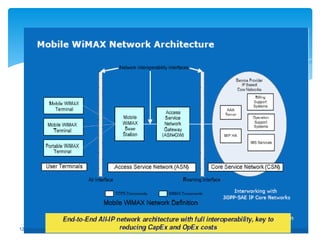
Access Service Network (ASN)
The ASN consists of BS and ASN-GW. The ASN can
access to multiple connectivity service networks
(CSNs) and provide radio access service to the CSN
of different network service providers (NSPs). The
ASN manages the air interface of IEEE 802.16 and
provides radio access to the WiMAX subscribers.
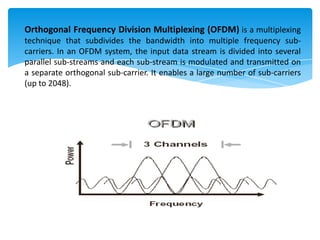
Orthogonal Frequency Division Multiplexing (OFDM) is a multiplexing
technique that subdivides the bandwidth into multiple frequency sub-
carriers. In an OFDM system, the input data stream is divided into several
parallel sub-streams and each sub-stream is modulated and transmitted on
a separate orthogonal sub-carrier. It enables a large number of sub-carriers
(up to 2048).
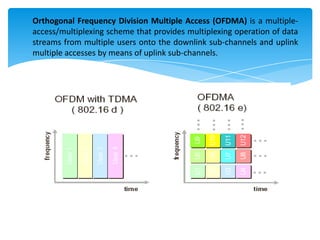
Orthogonal Frequency Division Multiple Access (OFDMA) is a multiple-
access/multiplexing scheme that provides multiplexing operation of data
streams from multiple users onto the downlink sub-channels and uplink
multiple accesses by means of uplink sub-channels.
TDD Frame Structure
The 802.16e supports TDD operation; however the initial release of Mobile
WiMAX certification profiles will only include TDD. With ongoing releases,
FDD profiles will be considered by the WiMAX Forum to address specific
market opportunities where local spectrum regulatory requirements either
prohibit TDD or are more suitable for FDD deployments. TDD is the preferred
duplexing mode for the following reasons:
TDD enables adjustment of the downlink/uplink ratio to efficiently support
asymmetric downlink/ uplink traffic, while with FDD, downlink and uplink
always have fixed and generally, equal DL and UL bandwidths.
TDD assures channel reciprocity for better support of link adaptation,
MIMO and other closed loop advanced antenna technologies.
Unlike FDD, which requires a pair of channels, TDD only requires a single
channel for both downlink and uplink providing greater flexibility for
adaptation to varied global spectrum allocations.
Transceiver designs for TDD implementations are less complex and
therefore less expensive.
Advanced Features of WiMAX Technology

Adaptive Modulation and Coding (AMC): Support for QPSK,16QAM &
  64QAM are mandatory in the DL with Mobile WiMAX.


Hybrid Automatic Repeat Request (HARQ): supported by Mobile WiMAX.
  HARQ is enabled using “Stop and Wait” protocol which provides fast
  response to packet errors and improves cell edge coverage. A dedicated
  ACK channel is provided in the uplink for HARQ ACK/NACK signaling.
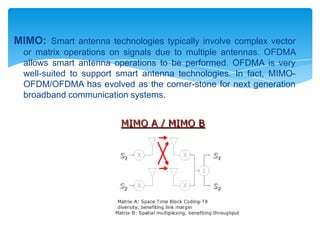
MIMO: Smart antenna technologies typically involve complex vector
  or matrix operations on signals due to multiple antennas. OFDMA
  allows smart antenna operations to be performed. OFDMA is very
  well-suited to support smart antenna technologies. In fact, MIMO-
  OFDM/OFDMA has evolved as the corner-stone for next generation
  broadband communication systems.
APPLICATIONS


 Connectivity for SMBs
 Wimax Backhaul
 Nomadic Broadband
 Private Networks
wimax Ppt for seminar

wimax Ppt for seminar

  • 1.
    Wimax (802.16) A Roadto Mobile Life SUBMITTED BY: PRATIK ANAND 354/09 7TH SEM. ECE
  • 2.
    TOPICS Development of Wireless Communication Wi-MAX Introduction WiMAX Forum Technical specifications Network Architecture WiMAX Key Technology: OFDMA, TDD, MIMO Application Scenarios 2
  • 5.
    What is WiMAX WiMAXor “Worldwide Interoperability for Microwave Access” had its origins in backhaul connectivity using microwave access such as LMDS/MMDS WiMAX has become a “hot topic” in the wireless industry, with visible and aggressive backing from INTEL, among others WiMAX is designed to provide “last-mile” or “backhaul” connectivity using wireless “Last-mile” refers to a wireless connection from a major trunk line to a business or residential user Using IEEE 802.16 Broadband Wireless Access (BWA) standard, approved in January 2003, to provide operations in the <11GHz spectrum range 5
  • 6.
    WiMAX Forum In April of 2001, the WiMAX forum is set up. This forum participates in authenticating the standardization and interoperability of the broadband radio access products based on IEEE 802.16 and ETSI HiperMAN.  This forum is organized by many radio communication equipment suppliers, component suppliers, operators, which is a nonprofit organization.  In November of 2004, the Network Working Group (NWG) is set up, which participates in setting downing the network standards for the IEEE 802.16d and IEEE 802.16e.
  • 7.
    IEEE 802.16 WorkingGroup  In 1999, the IEEE working group is set up, which studies the broadband radio access technology standard. The aim of this group is IEEE 802.16 Working Group to establish a global broadband radio access standard.  This group sets down the broadband access system standards, including the air interface standards and associated standards.  At the beginning of 2003, this group issues the 802.16a standard that defines the 2 GHz to 11 GHz NLOS fixed access system.  On October 1 of 2004, this group issues the 802.16d fixed access standard.  In the end of 2005, this group issues the 802.16e standard. Now, the 802.16e Release3 has been issued.
  • 8.
    Introduction to IEEE802.16 Series SN Technical Field 802.16 10-66 GHz, fixed broadband wireless access system air standard 802.16a 2-11 GHz fixed broadband wireless access system air standard 802.16c Supplementary provisions about the compatibility of 10-66 GHz fixed broadband wireless access system 802.16d 2-11 GHz fixed wireless access system air standard 802.16e 2-11 GHz fixed and mobile broadband wireless access system air standard 802.16f Fixed broadband wireless access system air interface MIB requirements 802.16g Fixed and mobile broadband wireless access system air interface management plane flow and service requirements 802.16d and 802.16e are two mainstream Um interface standards.
  • 11.
    WiMAX Vision: BroadbandEverywhere 3 1 2 FRACTIONAL E1 for RESIDENTIAL & SoHo SMALL BUSINESS BACKHAUL for DSL LEVEL SERVICE HOTSPOTS Mobile Backhaul 4 WMAN Nomadic Coverage --> E1+ LEVEL SERVICE 802.16d 802.16d handoff from HOT SPOTS ENTERPRISE H H H H H H H H 802.16e H 5 = wide area coverage outside of Hot Spots INTERNET BACKBONE BWA Operator Network Backbone Mobility 11
  • 12.
  • 13.
    Access Service Network(ASN) The ASN consists of BS and ASN-GW. The ASN can access to multiple connectivity service networks (CSNs) and provide radio access service to the CSN of different network service providers (NSPs). The ASN manages the air interface of IEEE 802.16 and provides radio access to the WiMAX subscribers.
  • 14.
    Orthogonal Frequency DivisionMultiplexing (OFDM) is a multiplexing technique that subdivides the bandwidth into multiple frequency sub- carriers. In an OFDM system, the input data stream is divided into several parallel sub-streams and each sub-stream is modulated and transmitted on a separate orthogonal sub-carrier. It enables a large number of sub-carriers (up to 2048).
  • 15.
    Orthogonal Frequency DivisionMultiple Access (OFDMA) is a multiple- access/multiplexing scheme that provides multiplexing operation of data streams from multiple users onto the downlink sub-channels and uplink multiple accesses by means of uplink sub-channels.
  • 16.
    TDD Frame Structure The802.16e supports TDD operation; however the initial release of Mobile WiMAX certification profiles will only include TDD. With ongoing releases, FDD profiles will be considered by the WiMAX Forum to address specific market opportunities where local spectrum regulatory requirements either prohibit TDD or are more suitable for FDD deployments. TDD is the preferred duplexing mode for the following reasons: TDD enables adjustment of the downlink/uplink ratio to efficiently support asymmetric downlink/ uplink traffic, while with FDD, downlink and uplink always have fixed and generally, equal DL and UL bandwidths. TDD assures channel reciprocity for better support of link adaptation, MIMO and other closed loop advanced antenna technologies. Unlike FDD, which requires a pair of channels, TDD only requires a single channel for both downlink and uplink providing greater flexibility for adaptation to varied global spectrum allocations. Transceiver designs for TDD implementations are less complex and therefore less expensive.
  • 17.
    Advanced Features ofWiMAX Technology Adaptive Modulation and Coding (AMC): Support for QPSK,16QAM & 64QAM are mandatory in the DL with Mobile WiMAX. Hybrid Automatic Repeat Request (HARQ): supported by Mobile WiMAX. HARQ is enabled using “Stop and Wait” protocol which provides fast response to packet errors and improves cell edge coverage. A dedicated ACK channel is provided in the uplink for HARQ ACK/NACK signaling.
  • 18.
    MIMO: Smart antennatechnologies typically involve complex vector or matrix operations on signals due to multiple antennas. OFDMA allows smart antenna operations to be performed. OFDMA is very well-suited to support smart antenna technologies. In fact, MIMO- OFDM/OFDMA has evolved as the corner-stone for next generation broadband communication systems.
  • 19.
    APPLICATIONS  Connectivity forSMBs  Wimax Backhaul  Nomadic Broadband  Private Networks