Luminescence Basic Concepts Applications And Instrumentation H S Virk
Luminescence Basic Concepts Applications And Instrumentation H S Virk
Luminescence Basic Concepts Applications And Instrumentation H S Virk
Luminescence Basic Concepts Applications And Instrumentation H S Virk
Luminescence Basic Concepts Applications And Instrumentation H S Virk
1.
Luminescence Basic ConceptsApplications And
Instrumentation H S Virk download
https://ebookbell.com/product/luminescence-basic-concepts-
applications-and-instrumentation-h-s-virk-4764018
Explore and download more ebooks at ebookbell.com
2.
Here are somerecommended products that we believe you will be
interested in. You can click the link to download.
Luminescence Nanomaterials And Applications Wei Chen Derong Chao
https://ebookbell.com/product/luminescence-nanomaterials-and-
applications-wei-chen-derong-chao-49606246
Luminescence Theory And Applications Of Rare Earth Activated Phosphors
Ratnesh Tiwari Editor Vikas Dubey Editor Vijay Singh Editor Mara Elena
Zayas Saucedo Editor
https://ebookbell.com/product/luminescence-theory-and-applications-of-
rare-earth-activated-phosphors-ratnesh-tiwari-editor-vikas-dubey-
editor-vijay-singh-editor-mara-elena-zayas-saucedo-editor-51028828
Luminescence Applied In Sensor Science 1st Edition A Prasanna De Silva
https://ebookbell.com/product/luminescence-applied-in-sensor-
science-1st-edition-a-prasanna-de-silva-2267392
Luminescence Data Analysis And Modeling Using R Vasilis Pagonis
https://ebookbell.com/product/luminescence-data-analysis-and-modeling-
using-r-vasilis-pagonis-27971116
3.
Luminescence Spectroscopy OfSemiconductors Ivan Pelant Jan Valenta
https://ebookbell.com/product/luminescence-spectroscopy-of-
semiconductors-ivan-pelant-jan-valenta-32863276
Luminescence Dating In Archaeology Anthropology And Geoarchaeology An
Overview 1st Edition Ioannis Liritzis
https://ebookbell.com/product/luminescence-dating-in-archaeology-
anthropology-and-geoarchaeology-an-overview-1st-edition-ioannis-
liritzis-4252416
Luminescence Signal Analysis Using Python 1st Ed 2022 Vasilis Pagonis
https://ebookbell.com/product/luminescence-signal-analysis-using-
python-1st-ed-2022-vasilis-pagonis-42526692
Luminescence The Instrumental Key To The Future Of Nanotechnology 1st
Edition Adam M Gilmore
https://ebookbell.com/product/luminescence-the-instrumental-key-to-
the-future-of-nanotechnology-1st-edition-adam-m-gilmore-4748614
Luminescence Of Lanthanide Ions In Coordination Compounds And
Nanomaterials 1st Edition Ana De Bettencourtdias
https://ebookbell.com/product/luminescence-of-lanthanide-ions-in-
coordination-compounds-and-nanomaterials-1st-edition-ana-de-
bettencourtdias-4762900
Copyright 2014Trans Tech Publications Ltd, Switzerland
All rights reserved. No part of the contents of this publication may be reproduced or
transmitted in any form or by any means without the written permission of the
publisher.
Trans Tech Publications Ltd
Churerstrasse 20
CH-8808 Pfaffikon
Switzerland
http://www.ttp.net
Volume 357 of
Defect and Diffusion Forum
ISSN print 1012-0386
ISSN cd 1662-9515
ISSN web 1662-9507
(Pt. A of Diffusion and Defect Data – Solid State Data ISSN 0377-6883)
Full text available online at http://www.scientific.net
Distributed worldwide by and in the Americas by
Trans Tech Publications Ltd Trans Tech Publications Inc.
Churerstrasse 20 PO Box 699, May Street
CH-8808 Pfaffikon Enfield, NH 03748
Switzerland USA
Phone: +1 (603) 632-7377
Fax: +41 (44) 922 10 33 Fax: +1 (603) 632-5611
e-mail: sales@ttp.net e-mail: sales-usa@ttp.net
9.
Editor’s Note
The wordluminescence was first used by a German physicist, Eilhardt Wiedemann, in 1888.
He also classified luminescence into six kinds according to the method of excitation. No
better basis of classification is available today. He recognized photoluminescence,
thermoluminescence, electroluminescence, crystalloluminescence, triboluminescence, and
chemiluminescence. The designations are obvious, characterized by the prefix.
This Volume consists of 9 Chapters, including 8 Review Papers and one Case Study. The
first two papers are based on OLEDs. Organic light emitting diodes (OLEDs) have been the
focus of intense study since the late 1980s. Since that time, research has continued to
demonstrate the potential of OLEDs as viable systems for displays and eco-friendly lighting
applications. Thejokalyani and Sanjay Dhoble have given historical introduction to OLEDs in
the first chapter under the title “Importance of Eco-friendly OLED Lighting”. They describe
core fabrication technologies and applications of OLEDs in their paper. V. K. Chandra et al.
have covered both theoretical and experimental aspects in their paper, “Organic Light -
Emitting Diodes and their Applications” in the most rigorous way. This Chapter describes the
salient features of OLEDs and discusses the applications of OLEDs in displays and solid state
lighting devices.
Organic-inorganic hybrid nanocomposite materials have been of great interest for their
extraordinary performances. Interaction between the polymer matrix and nanocrystalline
fillers produces wonderful features, viz. thermal, magnetic, mechanical, electrical and optical
properties to these materials. S.K. Tripathi et al. have reviewed the present status of II-VI
polymer nanocomposites from the photoluminescence studies point of view in the 3rd
Chapter. Electroluminescence in undoped and doped chalcogenide nanocrystals and
nanocomposites is reviewed in 4th
Chapter by Meera et al. Nanocrystalline powder samples
of CdS, CdSe, ZnS and ZnSe nanocrystals and their composites with PVA and PVK have
been prepared by chemical route and investigated in detail. Chapters 5 and 6 are contributed
by RK Gartia on two important topics: “Thermoluminescence of Persistent Luminescent
Materials” and “Design of Inorganic Scintillators: Role of Thermoluminescence”. The author
has demonstrated the application of TL, by virtue of its inherent sensitivity coupled with its
universal applicability, to investigate practically all semiconducting/inorganic materials in
terms of their trap- spectroscopy.
Chapter 7 by Rabiul Biswas deals with application of luminescence to earth and planetary
sciences. The author discusses some landmarks and recent developments in this field of
luminescence dating with stress on extending the dating range. Chapter 8 by Jain and Bøtter-
Jensen is focused on the developments around the Risø-TL/OSL reader which is popular
amongst the dating community. The 9th Chapter is added as a case study. The authors, JN
Reddy and KVR Murthy, claim that the primary objective of their PC Controlled TL Reader
is to bring out versatile TL instrumentation system and also to make it affordable to many of
the researchers in the Universities and other areas, including Radio-therapy and Medical
Physics.
Editor thanks all the authors for their valuable contributions and reviewers for their timely
help. Trans Tech Publishers deserve my appreciation for bringing out this volume in time.
H.S. Virk
Editor
10.
Table of Contents
Editor'sNote
Importance of Eco-Friendly OLED Lighting
N. Thejokalyani and S.J. Dhoble 1
Organic Light - Emitting Diodes and their Applications
V.K. Chandra, B.P. Chandra and P. Jha 29
Photoluminescence Studies in II-VI Nanoparticles Embedded in Polymer Matrix
S.K. Tripathi, J. Kaur and R. Kaur 95
Electroluminescence in Chalcogenide Nanocrystals and Nanocomposites
M. Ramrakhiani, N. Gautam, K. Kushwaha, S. Sahare and P. Singh 127
Thermoluminescence of Persistent Luminescent Materials
R.K. Gartia and N. Chandrasekhar 171
Design of Inorganic Scintillators: Role of Thermoluminescence
R.K. Gartia 193
Development and Application of Luminescence to Earth and Planetary Sciences: Some
Landmarks
R.H. Biswas 217
Luminescence Instrumentation
M. Jain and L. Bøtter-Jensen 245
TLD Instrumentation: A Case Study of PC Controlled TL Reader
J.N. Reddy and K.V.R. Murthy 261
6.3. Incandescent Lamps
6.4.Fluorescent Lamps
6.5. Compact Fluorescent Lamps (CFLs)
7. Solid State Lighting (SSL)
7.1. Color Rendering Index (CRI)
7.2. Correlated Color Temperature (CCT)
7.3. CIE Co-ordinates
7.4. Light Emitting Diodes (LEDs)
7.5. Organic Light Emitting Diodes (OLEDs)
8. OLEDs -The Emerging Displays
8.1. Organic Semiconductors
8.2. HOMO and LUMO in Organic Semiconductors
8.3. Electronic Excitation in Organic Molecules
8.4. Types of Absorbing Electrons
8.5. OLED Anatomy
8.6. Materials for Different Layers of OLEDs
8.7. Light Emitting Mechanism from OLED Device
9. Core Fabrication Technologies
9.1. Vacuum Thermal Evaporation
9.2. Physical Vacuum Deposition
9.3. Solution Techniques
9.4. Spin-coating
9.5. Ink-jet Printing
9.6. Screen Printing
10. Encapsulation
11. Bouquets and Brickbats
12. Research Challenges Ahead
13. Applications of OLEDs and Displays
14. Conclusions
References
1. Light
Light is a physical quantity which is emitted by a luminous body and when incident on the eye
causes the sensation of sight through nerves. It is electromagnetic radiation that is visible to the
human eyes. It constitutes a tiny proportion of the whole electromagnetic spectrum. It extends from
deepest violet to the deepest red ranging between 400 nm - 800 nm. Light travels in the form of
wave, characterized by frequency and wavelength. According to the wavelength and frequency, the
color of light also changes and hence a spectrum of VIBGYOR can be observed. In VIBGYOR red
occupies more space and hence reaches our eyes first. RGB occupies two-third of the spectrum and
combination of which gives white light. Visible spectrum, its wavelength range and band width of
different colors of VIS spectrum are shown in Fig. 1 and Table 1, respectively.
Fig.1: Visible spectrum [1]
2 Luminescence
13.
Table 1: Wavelengthrange and band width of different colors of visible spectrum
2. Lighting
Lighting is the application of light. It is the purposeful use of light to attain a realistic visual effect.
Lighting includes the use of both artificial light sources like lamps, light fittings etc. and natural day
light emitted by the sun. Lighting is a basic human need like clean water, food, sanitation and
shelter. In this new era of information technology, lighting can be considered as the basic human
right. Lighting can enhance task performance; improve the look of an area. Even today one-third of
humanity still has no access to electricity; they live in darkness after sunset. This stands as a
significant barrier to the human development. They use fuel based lighting as an alternative source
of electricity. Such lighting offers poor level of illumination and leads to health disorders. The
quality of life of millions of people around the world can have a tremendous change by the new
eco-friendly and energy efficient Solid state lighting (SSL). In developing countries, delivering SSL
to the people who are in need is a great challenge [1, 2].
2.1. Natural Lighting. Light emitted by the sun is considered as natural lighting. Lighting obtained
from sun is the most abundant source of natural lighting available in nature. Day lighting is the
oldest method of interior lighting. Use of this natural day lighting in an effective manner simply
decreases the cost and energy consumption during day time. Due to a lack of information that
indicate the likely energy savings, day lighting schemes are not yet popular among most buildings
[3-4].
2.2. Artificial Lighting. The importance of artificial light to humans and human society has long
been recognized. It is a significant factor contributing to the quality and productivity of human life.
Though fire was used by our primate ancestors 2–6 million years ago, it is still thought of as the
quintessential human invention. Indeed, artificial light is so integrated [5] into the human lifestyle
as to be barely noticeable. Artificial light extends the day and enables us to extend our work at night
[6]. It consumes a significant part of all electrical energy consumed worldwide. Around 33% of
total energy consumed is due to lighting [7]. It is valuable to provide the correct light intensity and
color spectrum for each task or environment. Otherwise, this artificial energy could not only be
wasted but over illumination can lead to adverse health and psychological effects. Light pollution is
one of the growing problems, which involves the emission of carbon dioxide from some artificial
lamps [8, 9].
3. Classification of Lighting
Based on the purpose, distribution of the light produced by the fixture and applications, lighting is
classified as task lighting, accent lighting and ambient lighting.
3.1. Task Lighting. This type of lighting helps us to perform specific tasks such as reading, sewing,
cooking, homework, hobbies, games, surgical procedures with lighting levels up to 1500 lux. Such
lighting is provided by lower-level track lighting, pendant lighting, and portable lamps. Task
lighting should be free of disturbing glare and shadows and bright enough to prevent eye strain.
Colour Wavelength range
(nm)
Band width
(nm)
Red 620 - 800 nm 180
Orange 580 - 600 nm 20
Yellow 560 - 580 nm 20
Green 490 - 560 nm 70
Blue 430 - 490 nm 60
Indigo 415- 430 nm 15
Violet 400 - 415nm 15
Defect and Diffusion Forum Vol. 357 3
14.
3.2. Accent Lighting.This type of lighting is mainly used for decorative purposes, interior
designing and landscaping. As a part of a decorating design, it is used to spotlight paintings, house
plants, sculpture, to highlight the texture of a wall, outdoor landscaping etc. It requires at least three
times as much light on the focal point as the general lighting around it. Such lighting is provided by
track, recessed or wall-mounted fixtures.
3.3. Ambient Lighting. This type of lighting is mainly used for general illumination of an area. It
radiates comfortable level of brightness. It is also known as general lighting. It can be accomplished
with ceiling or wall-mounted fixtures, track lights, and lanterns.
4. Lighting Terms
Various terminologies used in lighting are illustrated below:
4.1 Luminaire. A luminaire is a complete lighting unit, consisting of lamp housing, ballast, sockets
and any other necessary components placed together.
4.2. Luminaire Efficiency. The ratio of lumens emitted by a luminaire to the total lumens emitted
from the light source within the luminaire is known as luminaire efficiency.
4.3. Luminance. It is a measure of the density of luminous intensity in particular direction. It
describes the amount of light that passes through or emitted from a particular area within a given
solid angle. The SI unit for luminance is candela/m2
, while its CGS unit is stilb.
2
cm
/
Candela
1
stilb
1
4.4. Luminous Flux. This is the quantity of useful light emitted by a light source, measured in
lumen (lm).
4.5. Luminous Efficacy. It measures the amount of usable light emanating from the fixture per
used energy, i.e., it measures the conversion efficiency (electricity into visible light) of the source; it
is expressed in lumen/watt. Efficacy is higher for transparent lighting fixtures.
4.6. Lumen. It is a measure of the total amount of visible light emitted by a light source. It is a unit
to measure the output of visible light. This unit only quantifies the visible radiation, and excludes
invisible infrared and ultraviolet light [10].
4.7. Illuminance. It is defined as the light arriving at a surface, expressed in lumens per unit area,
measured in lux.
4.8. Lux. This is the quantity of light falling on a unit area of a surface.
2
m
lumen /
1
lux
1
5. History of Lighting
In ancient days artificial lighting started with the discovery of fire. Later, a hollow rock, shell was
filled with animal fat, and ignited. Wicks were later added to control the rate of burning. In 18th
century, the central burner, a major improvement in lamp design, was invented by Ami Argand, a
Swiss chemist. Small glass chimneys were added to lamps to protect the flame as well as to control
the flow of air to the flame. Later coal, natural gas and kerosene lamps grew popular. First
commercial use of gas lighting began in 1792. Electric carbon arc lamp was invented later in 1801.
The invention of the incandescent light bulb has a history spanning from the early 1800s. With the
development of electricity and the incandescent light bulb, the luminosity of artificial lighting
improved and became popular for indoors. They became widely popular and extended the working
time of the people. However, only about 15% of the consumed energy is emitted in the form of light
and the rest as heat. Incandescent lamps are the least expensive to buy but the most expensive to
operate. Gas lighting for streets gave way to low pressure sodium and high pressure mercury
lighting in 1930s and the development of the electric lighting in 19th
century replaced gas lighting in
homes. Later with the invention of fluorescent lamps and Compact fluorescent lamps (CFLs),
4 Luminescence
15.
incandescent lamps losttheir popularity. These lamps are excited by mercury. They are harmful,
non-disposable; life time is only of the order of 1000 hrs. Around 33% of electricity is utilized due
to this lighting system. In contrast the use of OLEDs, which is self-illuminating, eco-friendly and
power saving for even solid-state lighting. Instead of the present lighting system, SSL could solve
the ever-decreasing energy resources and the growing threat of climate change. Many governments
have put a tremendous emphasis in developing new energy efficient sources and the saving-energy
technologies which offer advantages such as low power consumption, long lifetime (>100,000 h),
and environmental friendliness. It is estimated that the use of SSL, could cut 62% of electricity that
is used for current lighting. However, few issues are lying behind for commercialization, if
succeeded SSL brings quality to light and redefine the way we see [11-12].
6. Time-line of Artificial Lighting Technology
Artificial lighting technology has a history of thousands of years, and continues to be refined even
today. Until 1800s, available light sources consisted of fire, candles, kerosene-oil lanterns; next are
gas lamps, halogen lamps, hot filament bulbs and later fluorescent lamps, compact fluorescent
lamps, LED sources and in near future it will be the OLED lighting. Lamps are the removable and
replaceable part of a light fixture, which converts electrical energy into electromagnetic radiation.
The time line of artificial lighting system is shown in Fig. 2.
6.1. Fire. The first lighting technology is fire. This technology involves burning a chemical in order
to heat a gas or solid that emits broadband blackbody light. The history of fire can be viewed as
attempts to control the mechanism for fuel transport and burning to increase the temperature of the
emitting gas, and to enhance visible-light emission. Hence, the evolution from open fires to wax
candles, oil and kerosene lamps. The culmination of fire can be thought of as gas-fired lamps, first
introduced by William Murdock in 1792, in which the fuel is converted into a continuous incoming
stream of gas before being burned.
6.2. Kerosene-oil Lamps. Later, kerosene-oil lamps were used as fuel source for lighting the
lanterns, which creates diverse problems of poor indoor air quality. Kerosene was cheap, easy to
produce and could be burned in existing lamps. But these lamps may catch fire; emit carbon-
monoxide and odorous gases, making them problematic for asthmatic people [13]. Even in this era
of information and globalization, few people still rely on fuel- based poor level illumination
kerosene-oil lamps, which are dangerous and unhealthy. The road map of lighting system is shown
in Fig. 2.
Defect and Diffusion Forum Vol. 357 5
16.
Fig. 2: Theroad map of lighting system [14-15]
6.3. Incandescent Lamps
The history of incandescence can be viewed as an attempt to increase the temperature of the
emitting filament while maintaining appreciable life time. Incandescence culmination can be
thought of as the tungsten-filament lamp with a trace amount of lifetime-enhancing halogen gases.
It is the second most used lamp in the world today behind fluorescent lamps and second form of
electric light developed for commercial use after carbon arc lamp. They are great for small area
lighting with good colour rendering index of 100, with no toxic materials to dispose. Their life time
is around 750-1000 hrs. Its life can be greatly extended by using the lamp at a lower than normal
voltage. However, it is not energy efficient as only 10% makes visible light and the remaining 90%
of energy is wasted in the form of heat emitted in the infrared spectrum which is just below visible
light. Hence incandescence is also an intrinsically inefficient light source. They are not useful for
lighting large areas. When electric current is passed through a filament material, the resistance
creates heat. Atoms in the material absorb energy and electrons are excited to the higher energy
states. When the electron jumps to the lower energy state after its life time, it emits extra energy in
the form of a photon. Incandescence is thermal radiation, which involves the emission of heat.
However, because the fuel is electricity, it can be transported more easily into a small emitting zone
than chemical fuels, thereby near visible portion of the spectrum can be achieved. Hence
incandescence efficiency can be much higher than that of fire. Inventors of the modern incandescent
lamp are pointed in Fig. 3.
6 Luminescence
17.
Fig.3: Inventors ofthe modern incandescent lamp [16]
6.4. Fluorescent Lamps. It is a low pressure mercury vapor gas discharge lamp emerged as a
potent alternative of incandescent bulb. They use the phenomenon of fluorescence to generate white
light. An electric current in the gas excites mercury vapor which produces short-wave ultraviolet
light that then causes a phosphor varnish on the walls of the bulb to glow. It has a low pressure of
mercury vapor and emits a small amount of blue/green radiation, but the majority is in the UV at
253.7nm and 185nm. The inner wall of the glass has a thin phosphor coating, selected to absorb the
UV radiation and transmit it in the visible region. This process is approximately 50% efficient.
These lamps convert 6.6-8.8% of input power to light; they are about 3 to 5 times as efficient as
standard incandescent lamps and can last for about 10 to 20 times longer. They are available in
screw-in or pin-based configurations, in many sizes and shapes with life time around 7-10,000
hours of use. The luminous efficacy of a fluorescent light bulb can exceed the efficacy of an
incandescent bulb with comparable light output. As they contain mercury, many fluorescent lamps
are classified as hazardous waste. The United States Environmental Protection Agency recommends
that fluorescent lamps be segregated from general waste for recycling or safe disposal [17-18].
6.5. Compact Fluorescent Lamps (CFLs). They are designed to replace incandescent lamps and
fluorescent lamps; they consume less power to supply the same amount of light as an incandescent
lamp. Due to the ability to reduce electric consumption, many organizations have undertaken
measures to encourage the adoption of CFLs. They need a very little time to warm up and reach
full brightness. However they contain mercury which is a dispose hazard. In CFLs, the luminescent
materials interact strongly with the Hg-plasma, which is used to excite the phosphors. This can lead
to sizeable Hg consumption and in this way to a loss in light output. Compared to incandescent
lamps giving the same amount of visible light, CFLs use one-fifth to one-third the electric power,
and last eight to fifteen times longer. A CFL has a higher purchase price than an incandescent lamp,
but can save over five times its purchase price in electricity costs over the lamp's lifetime. Like all
fluorescent lamps, CFLs also contain toxic mercury which complicates their disposal. CFL exhibits
operation optimum performance at 200
C and its efficiency decreases at higher and lower
Defect and Diffusion Forum Vol. 357 7
18.
temperatures [19-22]. Theyare available in tubular type, helical integrated CFLs etc. These lamps
lower the green house gas emission.
7. Solid State Lighting (SSL)
The term solid state lighting refers to light emitted by solid-state devices like light emitting diodes
(LEDs), organic light emitting diodes (OLEDs), and Polymer light emitting diodes (PLEDs) as
sources of illumination, where light emission is due to recombination of electron-hole pairs. It is
intended to be a cost-effective, high quality replacement for incandescent and fluorescent lamps.
This technology promises performance features and efficiencies well beyond those of traditional
artificial lighting. They are accompanied by potentially massive shifts in (a) the consumption of
light, (b) the human productivity and energy use associated with that consumption, and (c) the
semiconductor chip area inventory and turnover required to support that consumption. It is now
possible to create white light by combining the light of separate LEDs (red, green, and blue), or by
creating white LEDs themselves by means of doping. Solid-state lighting using hybrid light-
emitting diodes is poised to reduce this value by at least 50%. With the advent of high performance
LEDs and the emergence of OLEDs for lighting, rapid evolution of new lighting systems emerged
to deliver improved illumination and new lighting features based on the electronically controllable
properties of SSL. Unlike incandescent bulbs or fluorescent tubes, visible light is generated with
reduced heat liberation or energy dissipation. With smaller mass of solid-state electronic lighting
devices provide greater resistance to shock and vibration compared to brittle glass tubes/bulbs and
filament wires. They also eliminate filament evaporation, potentially increasing the life time of the
illumination device to a greater extent. Recent reviews give a ray of hope to cherish long-term
performance targets for SSL. This green technology brings quality to light and claims revitalization
in the field of lighting, expanding the excellence in display solutions. The color of the light source
is judged by three parameters, namely correlated color temperature (CCT), which hints the apparent
warmth or coolness of the light emitted by a source, and (ii) Color rendering index (CRI), which
indicates the ability of the light source to make objects appear natural, and (iii) CIE coordinates,
which characterizes the color of a light source [23, 24].
7.1. Color Rendering Index (CRI). It is a measure of ability of the light source to demonstrate
accurate color of the object. It is a unit less quantity, which quantifies how different a set of test
colors appears when illuminated by the source compared to the same test colors when illuminated
by the standard illuminant with the same correlated color temperature. It is measured in 1-100
scale. CRI will be high when there is no difference in color rendering between the light source and
the standard illuminant.
7.2. Correlated Color Temperature (CCT). It is a numerical scale, which measures the color of
light source. The CCT of a white light source is the temperature in Kelvin of a theoretical black
body emitter that most narrowly matches the spectral characteristics of the lamp. Warm white (4100
K) glows brighter than cool white (2700 K). Color temperature for white light sources also affects
their use for certain applications. An incandescent bulb has a color temperature around 2800 to
3000 Kelvin; for daylight it is around 6400 Kelvin. For high quality white light illumination, the
CCT should lie between 2500 K to 6500 K.
7.3. CIE Co-ordinates. The color of a light source is typically characterized in terms of
Commission International de l’Eclairage (CIE) system. Any color can be expressed by the
chromaticity coordinates x and y on the CIE chromaticity diagram. Using this method the
composition of any color in terms of three primaries can be described. Artificial colours, denoted by
X, Y, Z are called tristimulus values. By a piece of mathematical legerdemain, it is necessary that
the quantity of two of the reference stimuli to define a color since the three quantities (x, y, z) are
made always to sum to 1 [25]. The ratios of X, Y, Z of the light to the sum of the three tristimulus
values, are called chromaticity coordinates [26, 27]. The life time CIE, CRI and CCT, efficiency of
common white light sources are given in Table 2 for comparison [28- 30].
8 Luminescence
19.
Fig. 4: CIEchromaticity diagram [31]
Table 2: The CIE, CRI and CCT for common white light sources
Technology Life time (hrs) CIE coordinates CRI CCT(K) Efficiency
(lumen/watt)
Incandescent lamp 750-1,500 (0.44,0.40) 100 2854 12-18
Fluorescent lamp 6,000-10,000 (0.37,0.36) 89 4080 60-70
LEDs 30,000-50,000 Depends on the colour 85 >4500 64
White OLEDs 10000 (0.33,0.36) 92 5410 64
7.4. Light Emitting Diodes (LEDs). LEDs have been advocated as the most modern and best
environmental lighting system in the visible range with a very narrow spectral band and much
longer life time up to 50,000 hours. They can generate white light, accomplished by means of either
a red-blue-green array or a phosphor-coated blue LED lamp. They consume much less power
compared to a standard incandescent, fluorescent and halogen lamps, making their way into copious
lighting applications including traffic signals, exit signs, under-cabinet lights, and various
decorative applications. As they are point sources, the number of LEDs is to be arranged in a
systematic way in order to develop a display. Even if a single LED fails in its function, the display
device gives bad visual effect. The large amount of light emitted from a light emitting diode (LED)
being trapped inside the semiconductor structure is the consequence of the large value of the
refractive index [32]. They cannot meet the requirement of general illumination due to their poor
color rendering index and unsatisfactory high color temperature because of weak red emission [33,
34]. One of the biggest challenges in these inorganic SSL devices is the issue of self heating which
negatively impacts luminous efficiency and lifetime of the device and hence a shift ahead in search
of organic materials suitable for same applications [35-37].
Defect and Diffusion Forum Vol. 357 9
20.
7.5. Organic LightEmitting Diodes (OLEDs). In this era of exciting technology, trend of using
eco-friendly products emerged in every field of human walk. At present, copious corporations and
academic institutions are investing enormous raw materials in quest of organic light emitting
technology to create advanced displays. Due to their high power efficiency, outstanding contrast,
low cost of manufacture, durability, and the fact that they are light weight with blazing fast response
times, OLEDs represent the future of visual displays for portable electronic devices. They are
optoelectronic devices finished by placing a layer of organic material between two electrodes.
When a voltage potential is applied to these electrodes and current is injected through the organic
material, visible light is emitted. There are several different types of OLEDs, namely:
Top-light emitting OLED
Bottom–light emitting OLED
Transparent OLED
Foldable OLED
White OLED
Stacked OLEDs
Top light emitting OLED consists of conducting layer of anode at the bottom, emissive layer and
cathode are formed one on the other. When it is turned on, it allows light to pass through the top and
hence the name top emitting OLED. In contrast, bottom light emitting OLED consists of conducting
anode layer at the top, emissive layer and cathode are formed one on the other. When turned on, it
allows light to pass through the bottom and hence the name bottom emitting OLED. Substrate,
cathode and anode of transparent OLEDs are as transparent as their substrate. When turned on, it
allows light to pass in both directions. They can be used for heads-up displays. Transparent OLEDS
can create displays that can be made to be only top- emitting or only bottom- emitting or both top
and bottom emitting. They greatly improve contrast, making it much easier to view displays even in
bright sunlight. A foldable light emitting diode involves an electroluminescent conductive flexible
polymer that emits light when subjected to an electric current. They are used in full spectrum color
displays, they require very small amount of power to generate. Such flexible OLEDS are made on
flexible substrates such as plastic or metallic foil and the emissive materials can be applied on the
substrate by a technique derived from commercial inkjet printing. White OLEDs can be mainly
used for solid state lighting, they emit white light that is brighter, more uniform and more energy
efficient than that emitted by fluorescent tubes and incandescent lights. Their use could potentially
reduce energy costs for lighting. In order to achieve maximum efficiency and high color purity,
white light should be composed of three discrete peaks in the blue, green and red region. The
materials used for these devices include conjugated polymers, metal complexes and organic dyes.
Differing from the other colors the white emission from OLEDs have some special advantage that it
can be used as back light in LCDs which is as thin as a piece of paper. In order to obtain efficient
and pure white light, either a good combination of red, green and blue light emitting materials or a
combination of yellow and blue are essential. Stacked OLED was conceived by Dr. Stephen R.
Forrest and his team at Princeton University, which employs award-winning pixel architecture. It
stacks the red, green, and blue sub pixels on top of one another, instead of side-by-side as is CRTs
and LCDs. In such vertically-integrated OLED structure, intensity, color and gray scale can be
independently tuned to achieve high-resolution full-color. They can be used in high-resolution pixel
approach lighting. This improves display resolution up to three-fold and enhances full-color quality.
Structure of top and bottom emitting; transparent and stacked OLEDs [37, 40] is shown in Fig. 5.
10 Luminescence
21.
Fig.5: Structure of(a) top emitting, (b) bottom emitting, (c) transparent and (d) stacked
OLED [38-41].
8. OLEDs -The Emerging Displays
Light emitting diodes made of organic substances are chemically compatible, possess the properties
of plastics and semiconductors and hence easy to handle. These displays are very versatile and
innovative, which offer low cost and low power consumption with improved colour performance,
fast response, self emitting type with superior features of high luminescence, high visibility, tough
to temperature conditions and ultra thin than the earlier displays. OLED is a thin film optoelectronic
device, in which a single layer or double layer or multilayer of organic materials is sandwiched
between two electrodes, at least one of which is transparent. The emissive electroluminescent layer
comprises a thin-film of certain organic compound of either small molecule or dendrimers or
polymeric substance that allows the deposition. OLEDs can also be used in light sources for general
space illumination. OLEDs typically emit less light per area than inorganic solid-state based LEDs
which are usually designed for use as point light sources. They do not require a backlight to
function, they draw far less power from a battery, can operate longer on the same charge. They can
be printed onto a foil, paper, fabric or even clear plastic. One of the advantages of OLEDs is that
pixels directly emit light and the displays boast of a higher brightness and resolution at wider
viewing angles than backlit LCDs. They are also thinner, lighter and more power-efficient. OLEDs
are expected to be easier and cheaper to make, because they avoid the need of polarizes and filters
inherent in LCD technology. In principle, although OLED displays are constructed on glass or
silicon substrate at present, plastic substrates will ultimately enable roll-to-roll processing and bring
the benefits of cost-effective mass-production [42]. Device operating lifetimes and the perfection of
full-colour performance are particularly important for larger-screen applications. However,
degradation of OLED materials has limited the use of these materials.
Defect and Diffusion Forum Vol. 357 11
22.
8.1. Organic Semiconductors.Organic semiconductor refers to organic materials that display
semi- conductive properties, which occurs for single molecules, short chains of molecules and long
polymer chains depending on the material. Small molecule semiconductors include rubrene,
anthracene, etc. while larger molecules are fullerenes and their derivatives. Most of the organics are
soluble in most of the common solvents; this allows the possibility of solution processing which can
produce devices with inexpensive fabrication methods. In order to achieve high performance
devices, inorganic semiconductors require an annealing step, generally around 500o
C (for silicon),
but organic materials require very low annealing temperature, paving a path towards flexibility of
substrate choice. They can be doped based on the requirement. Highly doped organic
semiconductors are known as organic metals. They combine novel semi conducting properties with
the scope for easy shaping and manufacture of plastics. This remarkable combination of properties
made the organic semiconductors to open up new directions to electronic and opto-electronic
materials and these organic semi- conductors can be used to make a wide range of semiconducting
electronic devices such as transistors, LEDs, Solar cells, lasers with novel properties and much
simpler manufacturing process than conventional inorganic semiconductors. When voltage is
applied to a thin film of semiconducting material, it gives out light providing the basis of new
display technologies. They are known to have extremely high fluorescence quantum efficiencies in
VIS spectrum including blue region, some approaching 100%. Furthermore, because of their
chemical compatibility, most of the organic luminescent compounds with a variety of substrates can
be used to deposit organic thin films on plastic so that flexible transparent unbreakable displays can
be fabricated [43].
8.2. HOMO and LUMO in Organic Semiconductors. HOMO and LUMO are acronyms for
highest occupied molecular orbital and lowest unoccupied molecular orbital, respectively. The
difference of the energies of the HOMO and LUMO, known as band gap serve as a measure of the
excitability of the molecule. The HOMO level serves as valence band and LUMO as conduction
band. HOMO and LUMO are called the frontier orbitals [44], they establish the way in which the
molecule interacts with other species. HOMO and LUMO of organic compounds are basic
parameters for the design and fabrication of an OLED device. When the molecule forms a dimer or
an aggregate, the closeness of the orbitals of the different molecules induce the splitting of the
HOMO and LUMO energy levels. This splitting produces vibrational sublevels with their own
energy, slightly different from one another. The number of vibrational sublevels is equal to the
number of vibrational energy levels molecules that interact together. When large number of
molecules influences each other, there are so many sublevels that we no longer perceive their
discrete nature: they form a continuum and we consider it as energy bands. Formation of rotational
and vibrational energy levels in organic semiconductors is illustrated in Fig. 6.
Fig. 6: Formation of rotational and vibrational energy levels in organic semiconductors
Orbital states can be described with several terms:
Filled - An orbital that contains the maximum number of electrons it can hold is said to be
filled.
12 Luminescence
23.
Empty -An orbital that contains no electrons is said to be empty.
Occupied - An orbital that contains at least one electron is said to be occupied.
Unoccupied - An orbital that contains at least one open space for an electron is said to be
unoccupied.
A filled orbital is occupied, but an occupied orbital is not necessarily filled. Also, an orbital can be
both occupied and unoccupied. A good way to remember this is that occupied means that one space
is occupied by an electron, and unoccupied means at least one space is free to accept an electron.
All the electrons in all molecular orbits determine the structure of the molecule, but the highest
occupied and the lowest unoccupied molecular orbits in terms of energy are the most important for
the judgment of reactivity. The energy of the specific molecular structure depends on energy of its
electrons in occupied molecular orbitals. Usually, the HOMO corresponds to a filled π-type orbital
and the LUMO corresponds to an empty π*-type orbital or to an empty σ* orbital. When biased,
charge is injected into HOMO at the anode and the LUMO at the cathode. These injected charges
migrate to the applied field until two charges of opposite polarity encounter each other and at that
point they annihilate to produce radioactive state. HOMO, LUMO and energy gap of some
materials, used for OLED device fabrication are given in Table 3.
Table 3: HOMO, LUMO and energy gap of some materials, used for OLED device fabrication
S.No Material LUMO
(eV)
HOMO
(eV)
Energy
gap (eV)
Application Ref.
1. ITO
4.7 - Anode
[45]
2. N,N'-bis(naphthalen-1-yl)-N,N'-
bis(phenyl)-2,2'-dimethylbenzidine
(α-NPD)
2.3 5.4 2.9 HTL [45]
3. tris(8-hydroxyquinoline)aluminium
(Alq3)
3.1 5.8 2.7 ETL [45]
4. 2,9-dimethyl-4,7-diphenyl-1,10-
phenanthroline(BCP)
2.9 6.4 3.5 ETL [45]
5. Mg:Ag 3.7 - - Cathode [45]
6. Poly( vinylcarbozole) (PVK)
2.3 5.8 3.5
Conducting
polymer
[46]
7. N,N'-bis(3-methyl phenyl)-N,N'-
bis(phenyl)-benzidine (TPD)
2.3 5.5 3.2 HTL [46]
8. Phthalocyanine, copper
complex(CuPC)
3.6 5.3 1.7 HIL [46]
9. Al 4.3 - - Cathode [46]
10. N,N'-bis (naphthalen-1-yl)-N,N'-bis
(phenyl)-benzidine(NPB)
2.3 5.3 3.0 HTL [47]
11. LiF/Al 2.6 - - Cathode [47]
12. 2,2',2"-(1,3,5-benzinetriyl)-tris(1-
phenyl-1-H-benzimidazole) (TPBi)
2.8 6.3 3.5 Host [48]
13. LiF 4.1 - - Cathode [48]
14. 3-(4-biphenyl)-4-phenyl-5-tert-
butylphenyl-1,2,4-triazole(TAZ)
2.7 6.3 3.6 ETL [48]
15. Ba/Al 2.8 - - Cathode [48]
16. PEDOT:PSS - 5.2 - Anode [48]
Defect and Diffusion Forum Vol. 357 13
24.
8.3. Electronic Excitationin Organic Molecules. When an atom or molecule of the sample are
exposed to light having an energy that matches a possible electronic transition within the molecule,
some light energy is absorbed by the electron and it jumps to a higher energy orbital. These atoms
can rotate and vibrate with respect to each other. These vibrations and rotations also have discrete
energy levels, which can be considered as being packed on top of each electronic level. Absorption
of ultraviolet and visible radiation in organic molecules is restricted to chromophores with valence
electrons of low excitation energy. The spectrum of a molecule containing these chromophores is
complex. This is because the superposition of rotational and vibrational transitions on the electronic
transitions gives a combination of overlapping lines. This appears as a continuous absorption band.
8.4. Types of Absorbing Electrons. The electrons that contribute to absorption by a molecule are:
(i) those that participate directly in bond formation between atoms, (ii) nonbonding or unshared
outer electrons that are largely localized such atoms as oxygen, the halogens, sulfur, and nitrogen.
The molecular orbitals associated with single bonds are designated as sigma () orbitals and the
corresponding electrons are electrons. The double bond in a molecule contains two types of
molecular orbitals: a sigma () orbital and a pi () molecular orbital. Pi orbitals are formed by the
parallel overlap of atomic p orbitals. In addition to and electrons, many compounds contain
nonbonding electrons. These unshared electrons are designated by the symbol n. The energies for
the various types of molecular orbitals differ significantly. The energy level of a nonbonding
electron lies between the energy levels of the bonding and the anti-bonding and orbitals.
Electronic transitions among certain of the energy levels can be brought about by the absorption of
radiation. Various electronic excitations that occur in organic molecules is shown in Fig.7. Of the
six transitions outlined, only the two lowest energy ones (n→ π* and π → π*) are achieved by the
energies available in the 200 to 800 nm spectrum. As a rule, energetically favoured electron
promotion will be from HOMO to LUMO and the resulting species is called an excited state [49-
52].
Fig. 7: Various electronic excitations that occur in organic molecules
σ → σ*
transitions
An electron in a bonding σ orbital is excited to the corresponding anti-bonding orbital. The energy
required is large. For example, methane with only C-H bonds can undergo σ → σ*
transitions and
exhibits an absorbance maximum at 125 nm. Absorption maxima due to σ → σ*
transitions cannot
be viewed in typical UV-Visible spectra.
n → σ*
Transitions
Saturated compounds containing atoms with non-bonding electrons are capable of n → σ*
transitions. These transitions usually need less energy than σ → σ*
transitions. They can be initiated
by light whose wavelength is in the range 150 - 250 nm. The number of organic functional groups
with n → σ*
peaks is considerably in the UV region.
14 Luminescence
25.
n → π*
andπ → π*
transitions
Most absorption spectroscopy of organic compounds is based on transitions of n or π electrons to
the π*
excited state. This is because the absorption peaks for these transitions fall in the visible
region of electromagnetic spectrum. These transitions need an unsaturated group in the molecule to
provide the π electrons. Molar absorptivities from n→π*
transitions are relatively low, and range
from 10 to100 L mol-1
cm-1
. π→π*
transitions normally give molar absorptivities between 1000 and
10,000 L mol-1
cm-1
. The solvent in which the absorbing species is dissolved also has an effect on
the spectrum of the species. Peaks resulting from n→π*
transitions are shifted to shorter
wavelengths (blue shift) with increasing solvent polarity. This arises from increased solvation of the
lone pair, which lowers the energy of the n orbital. Often red shift is observed for π→π*
transitions.
This is caused by attractive polarisation forces between the solvent and the absorber, which lower
the energy levels of both the excited and unexcited states. This effect is superior for the excited
state, and so the energy difference between the excited and unexcited states is slightly reduced,
resulting in a minute red shift. This effect also influences n→π*
transitions but is overshadowed by
the blue shift resulting from solvation of lone pairs. Various terminologies used for absorption shifts
are given in Table 4.
Table 4: Terminology of absorption shifts [53-55]
Terminology of absorption shifts
Nature of Shift Descriptive Term
To Longer Wavelength Bathochromic
To Shorter Wavelength Hypsochromic
To Greater Absorbance Hyperchromic
Lower Absorbance Hypochromic
Absorbance is directly proportional to the path length, b, and the concentration, c, of the absorbing
species. Beer's law states that A = εbc, where ε is a constant of proportionality, called the
absorptivity. Absorbance usually ranges from 0 (no absorption) to 2 (99% absorption). Because the
absorbance of a sample is proportional to the number of absorbing molecules in the spectrometer
light beam, it is necessary to correct the absorbance value and other operational factors if the
spectra of different compounds are to be compared in a consequential way. The corrected
absorption value is called molar absorptivity, and is particularly useful when comparing the spectra
of different compounds and determining the relative strength of chromophores (light absorbing
functions). Molar absorptivity (ε) is defined as:
cl
A
where A= absorbance, c = sample
concentration in moles/liter and = length of light path through the sample in cm.
8.5. OLED Anatomy. The anatomy of OLED can be a single layer or double layer or triple layer or
multilayer as shown in Fig.1. A single-layer OLED is made up of a single organic layer sandwiched
between anode and cathode. Additional layers can be added in order to improve charge
transportation and injection. In a two-layer OLED, one organic layer transport holes and the other
transport electrons. Excitons recombine at the interface of HTL and ETL and generate
electroluminescence. In a three-layer OLED an additional layer is placed between HTL and ETL.
In a multilayer device, anode, hole-injection layer (HIL), hole-transport layer (HTL), emission layer
(EML), electron-transport layer (ETL), cathode and sometimes hole blocking layer (HBL) are used.
Defect and Diffusion Forum Vol. 357 15
26.
Fig. 8: Structureof OLEDS
In the single layer device described in Fig. 8, the organic emissive layer (EML) must be capable of
maintaining high quantum efficiency as well as good hole and electron injection and mobility. The
introduction of one or more layers of charge transport materials in addition to the emissive layer
provides a powerful means to control charge injection, transport, and recombination in OLEDs. The
presence of an ETL layer in three -layer OLED configuration lowers the barrier for electron
injection and also block holes as the ionization potential of ETLs are generally large. Since hole
mobility is greater than electron mobility in most emissive organic semiconductors, the existence of
an ETL layer can dramatically reduce the hole current in the OLED by virtue of the band offset and
the greater electron mobility than hole mobility in the ETL. Since most materials cannot meet the
required demand, multi-layer devices have been designed to improve charge injection and mobility.
Indeed, charge injection and transport are the limiting factors in determining operating voltage and
luminance efficiency. Generally, the efficiency of an OLED is determined by charge balance,
radiative decay of excitons, and light extraction. In OLEDs, the hole current is limited by injection,
and the electron current is strongly influenced by the presence of traps owing to metal–organic
interactions. In order to enhance carrier injection the selection of efficiently electron-injecting
cathode materials and the use of appropriate surface treatments of anodes are of great importance.
Fig. 9: Demonstration of RGB and white OLEDs
Energy-level diagrams of single-layer OLED and a multilayer OLED with a hole transporting layer
(HTL) and an electron transporting layer sandwiching an emissive layer are shown in Fig. 10.
Fig. 10: Energy-level diagrams of (a) a single-layer OLED, and (b) a multilayer OLED [56]
16 Luminescence
27.
Critical factors inconstructing efficient electroluminescent devices are the barriers to hole and
electron injection. If there is a large mismatch in energy between the HOMO and the anode work
function (Φa) or the LUMO and the cathode work function (Φc), charge injection will be poor.
Incorporation of a layer with either good hole or electron affinity between the emissive layer and
the electrode reduces the energy barrier to charge injection. Substantial improvements in external
quantum efficiencies and brightness were realized by fine tuning the charge injection barriers in
OLEDs. This has been achieved using separate electron and hole transport materials to improve and
control charge injection and transport in OLEDs. RGB and white OLEDs are demonstrated in Fig.
9.
8.6. Materials for Different Layers of OLEDs. Different layers of OLED employ different
materials, depending on their requirement. The substrate of the OLED device is a glass plate,
usually coated with transparent material with high work function, good conductivity high chemical
stability. Indium Tin Oxide (ITO) is gifted with all the above said requirements and hence the
popular anode material. The performance of the diode strongly depends on the materials of
electrodes that they employ. An ITO-free flexible organic light-emitting device (OLED) with
improved efficiency has been demonstrated by Yue-Feng Liu et al. [57] by employing a template
stripping process to create an ultra smooth PEDOT: PSS anode on a photopolymer substrate. The
device performance has been improved and 38% enhancement in efficiency has been obtained
owing to lowered surface roughness of the PEDOT: PSS anode. The role of HTL is to transport
holes within the HOMO level. Materials possessing low ionization potential and high hole mobility
are selected as HTL. Materials with hole injecting ability, high mobility, high glass transition
temperature and electron blocking capacity are generally preferred to deposit on to the ITO glass
substrate. There are three main classes of emissive materials with high efficiency; lifetime and
colour purity that can be selected as emissive material for OLEDs, namely (i) Small molecules, (ii)
Conjugated polymers and (iii) Conjugated dendrimers. Conjugated polymers have attracted an
increasing amount of attention in recent years for various organic electronic devices because of their
potential advantages over inorganic and small-molecule organic semiconductors. Chemists can
design and synthesize a variety of conjugated polymers with different architectures and functional
moieties to meet the requirements of these organic devices [58]. In such OLEDs, generation of light
from the emissive layer is due to recombination of electrons and holes. The difference of energy
between the conduction band and valence band is radiated in the form of light energy. If Eg
represent the semiconductor band gap, then the light emitted by the diode can be calculated by the
relation:
g
g
E
hc
hc
h
E
Where h is Planck’s constant, c is velocity of light, λ is the wavelength of emitted radiation. So,
depending on the characteristic wavelength required, energy gap of the emission material can be
calculated by the above relation and accordingly materials are selected. Energy gap of the
synthesized emissive layers can be determined by the optical absorption spectra [59, 60]. Emissive
materials with superior electron mobilities consume low power. An effective approach to voltage
reduction is doping the emissive layer. Cathode is usually low work function material in order to
have injection of electrons at an appreciable rate. For the application of OLEDS one electrode must
be transparent in order to allow the emission of light from the OLED device.
8.7. Light Emitting Mechanism from OLED Device. OLEDs hold appeal for lighting as well as
for displays. When voltage is applied across such devices, electrons from the cathode and holes
from the anode move towards the emissive layer, recombine and leads to current flow through the
device [61]. The colour of the light emitted depends on the type of organic molecule selected as
emissive layer and the energy difference between HOMO and LUMO of the emitting material. The
intensity of the light depends on the amount of current passing through the device. Consequently by
changing active materials, emission colour can be varied across the entire visible spectrum. The
Defect and Diffusion Forum Vol. 357 17
28.
progress in thefield of OLEDs for large display applications were recently highlighted by the
demonstration of active matrix display drivers by amorphous TFT. Multilayer device structure
eliminates exciton quenching and leakage of organic layers and the metal contacts. Structure and
light emitting mechanism of a multi- layer OLED involves: (1) injection of electrons and holes from
electrodes to organic emissive layer (EML), (2) formation of an electron-hole pair, and (3) radiative
recombination of this exciton leads to a photon emission of particular wavelength as shown in Fig.
11.
Fig. 11: Electroluminescence mechanism in an OLED [58].
In OLEDs, recombination of electrons and holes in emitting layer gives rise to the formation of
25% singlet excitons and 75% triplet ones. For conventional fluorescent OLEDs, however, the 75%
triplet excitons are usually lost due to the forbidden transition from the triplet to the ground state
during electroluminescence process. To achieve high electroluminescence efficiency, efficient
luminescent materials that can harness both singlet excitons and the spin-forbidden triplet excitons
are highly desired [62]. In order to improve the power efficiency and concurrently lower the
operation voltage, the concept of electrical doping, which is adopted from OLEDs, is widely
employed. It has been shown that OLEDs with p-doped hole transport layer and/or n-doped electron
transport layer can provide efficient carrier injection and transport, which can be used to regulate
the position of recombination/emission zone [63].
9. Core Fabrication Technologies
Rapid advances in materials and manufacturing technology are making OLEDs as the leading
technology for new generation OLED displays. The most popularly used technique for the
fabrication of multilayer architecture of OLEDs is vacuum sublimation. Recently, solution
techniques such as spin coating, inkjet printing and screen-printing have gained momentum as they
can be used for low-cost, large-area organic devices. During deposition, extremely uniform
thickness of each layer is necessary for device fabrication; if not, it may lead to localized
overheating and localized surges of electric current, leading to gradual destruction of the device.
The complexity in fabricating organic materials is still challenging. Various OLED fabrication
techniques are given as follows.
9.1. Vacuum Thermal Evaporation. This process is commonly used for depositing small organic
molecules for manufacturing smaller devices and displays. This is the simplest way of fabricating
devices but moderately expensive. In this type, the organic molecules are gently heated in a vacuum
chamber held at 10-5
to 10-7
Torr, so as to avoid interaction between the vapour and atmospheric
molecules. They are allowed to evaporate until the material is deposited on the substrate and
18 Luminescence
29.
condensed as thinfilms onto cooled substrates [64]. Polymers cannot be deposited by this technique
because their structure leads to high conductance. The advantages of this technique are: thickness
can be controlled; two dimensional combinatorial arrays of OLEDs can be easily fabricated by
single deposition. However, it is very expensive, not flexible and has no control to direct the
deposition materials on to the desired areas.
9.2. Physical Vacuum Deposition. It is a three step process. Firstly, evaporant from the source
material is created and then transported from the source to the substrate. Lastly, evaporant is
condensed onto the substrate to form a deposit of thin film. The deposition rate significantly reduces
due to the presence of oxygen, reactive metal and collisions between evaporant from source and the
gas molecules during their transport towards the substrate. This method offers, high chemical
purity, control over mechanical stress in the film, good adhesion between the thin film and substrate
deposition of very thin layers and multiple layers of different materials [65]. Substrate temperature,
kinetic energy of the atoms, rate of deposition of thin film, gas scattering during transport of the
evaporant and energy applied to the film during growth are some of the parameters that can be
controlled to achieve the materials having different mechanical strength, magnetic properties,
density, adhesion, optical reflectivity and electrical resistivity.
9.3 Solution Techniques. Solution based processing methods are cheaper and has the potential to
lead to a large area reel-to-reel production. Designing multilayers by solution techniques is very
crucial because the earlier deposited layers should be absolutely resistant against the solvent used
for deposition of the subsequent layers.
9.4. Spin-coating. This process is used for the depositing soluble polymers onto a substrate as it is
cheap, gives film thickness as low as 10 nm. In this technique, drop of the emissive material is
deposited on the flat substrate, which is uniform across its surface and rotated at high speed until it
is spread to the desired thickness. The thickness of the layers depends on the concentration and
composition of the polymer solution and the thickness of the film on the substrate depend on a
number of parameters, namely, rotational speed of spin-coater, spin time, fluids volatility and
viscosity, surface wetting on substrate, fume extraction, and temperature.
9.5. Ink-jet Printing. In this technique, OLED materials are sprayed onto the substrates during the
process of manufacturing displays [66]. It is inexpensive and offers a path to print low information
content displays as large films. Substrate, press bed, ink, stencil, squeegee and screen constitute the
elements of screen printing.
9.6. Screen Printing. In this method ink is squeezed through a well defined screen mask to obtain
print patterns and this printed pattern is then transferred on to the substrate. This method is widely
used in commercial printed circuit boards and by many research groups to print active polymer
layers as well as electrodes for organic transistors and simple circuits. For materials with high
viscosity like conducting polymers and dielectric, the resolution of screen printing is limited to
above 75 µm. Particle size must be sufficiently large so that they will not block the screen. This
technique is more versatile, simple, cheap, and reduces the usage of material because materials are
directed onto the printed areas faster than inkjet printing.
10. Encapsulation
OLEDs are extremely sensitive to moisture, if not encapsulated; non-emissive dark spots develop
initially and lead to the degradation of devices. This remarkably limits the lifetime and hence the
device needs protection by a hermetic encapsulation. Encapsulation is the process of bonding a
metal sheet on to the substrate glass using UV cured epoxy [67]. Encapsulation is carried out in a
glove box, which is free from oxygen and water.
Defect and Diffusion Forum Vol. 357 19
30.
11. Bouquets andBrickbats
The radically diverse manufacturing process of OLED’s lent itself to many advantages over
traditional flat panel displays. Since they can be printed onto a substrate using traditional ink jet
technology, they are cheap up to 20% to 50%. The change of colours, brightness and viewing angle
possible with OLED’s is extremely high because OLED pixels directly emit light without the
necessity of back light. Because of this, OLED pixel colors appear correct and unshifted, even as
the viewing angle approaches 90 degrees from the axis perpendicular to the display. OLED displays
have good brightness and clarity, produce consistent image quality, paper-thin with better viewing
angle, good contrast and high luminescence efficiency, quick responsiveness, energy efficient and
eco-friendly. OLED pixels turn on and off as fast as any other light bulb and hence they exhibit fast
response time. In typical image and video applications, OLED displays typically use only 25% of
their maximum power consumption. Use of plastic substrates makes them tougher and rugged. They
consume less power to run (3 to 4 volts). OLEDs can provide full range of colours, best in cellular
phones. These remarkable characteristics can be attributed to the advances in several key areas; new
materials, doped guest-host emitters, multilayer device structures, low impedance contacts and a
better understanding of the EL process. They can be operated at wide temperatures ranging between
-200C to +700C. They can be constructed on flexible plastic substrates, as a result of which size and
weight of the display is reduced.
Despite of many advantages in OLEDs there are many tribulations to overcome through. OLEDs
are still in the development phases of production. The biggest technical problem left to overcome is
the limited lifetime of the organic materials. After a month of use, the screen becomes non-uniform.
Stability of OLED devices could be improved by protecting them from atmosphere as it has major
role on device performance. Deposition condition on film morphology may also affect the device
performance. Intrusion of water into displays damages and destroys the organics. Hence improved
sealing processes are important for practical manufacturing. Depending upon the materials and the
device architectures used, the degradation mechanism can be very different. The material used to
produce blue light in OLED have been found to degrade at a much faster rate than the other colors.
The differing color output over the long run will then result in an overall color that is much less
well balanced. Improvement in power conversion efficiency and reduction in driving voltage is
essential before they are marketed [68-70].
12. Research Challenges Ahead
Though the research in the field of organic electronics is vibrant and ever expanding, the challenges
regarding OLEDS are still significant and these are to be sorted out in order to achieve practical
goals and serve the bright future of OLEDs. Enormous amount of research work as well as
commercial interest has focused on the new field of conjugated organic display materials. Efficient
and stable blue phosphorescent materials are not yet available and remain a challenge for the
researchers. Improvement in quantum efficiency is one of the challenges ahead. The
electroluminescent efficiency (ηL), given by
I
L
L
, where L is luminescence in cd/m2
and I is
current density in A/m2
. Many research groups around the world are investigating to develop
cheaper techniques to synthesise RGB light emitting hybrid organic materials and to develop OLED
devices and displays by easy and cheaper fabrication techniques and patenting their great ideas. Till
date, OLED efficacies and lifetime is beyond tungsten bulbs. White OLEDs are under worldwide
investigation as source for general illumination. There is vast scope for discovering novel
properties, which make various applications for making life comfortable. Materials with specific
properties are needed for making innovations possible. Currently more than 80 companies, nearly
70 universities and other non-industrial laboratories worldwide are engaged in the field of OLEDs.
Research and development abroad has substantial contribution in modern technologies, available to
us.
20 Luminescence
31.
13. Applications ofOLEDs and Displays
Fascinating applications of organic OLEDs include light sources, wall decorators, OLED drivers,
luminous cloth, digital cameras, flat panel displays, flexible displays, computer displays, mobile
phones, televisions and many more. OLED displays’ high-definition images and video are inspiring
next-generation devices. There exists tremendous demand for advanced high definition visual
displays having flat screen with lower power consumption. OLED technology can be used to great
benefit for both direct view and micro display applications. In both the cases OLEDs offer high
efficiency and lower weight than competing LCDs. Since they don’t require back light or reflective
light sources, these are very important attributes for head mounted and portable products. The
progress in the field of OLEDs for display applications were recently highlighted by the
demonstration of 20-inch full colour active matrix OLED display drivers by amorphous Si thin film
transistor. OLED displays’ slimmer, lighter, brightness, high readability, self luminous and energy-
efficient adjustability allow consumer electronics manufacturers to optimize other product features
and functions. Such portable applications favor the high light output of OLEDs for readability in
sunlight, combined with their low power drain. These features make OLED technology ideal for
portable DVD players and entertainment applications such as back-of-seat screens in automobiles
and airplanes. Phones are getting smaller, and service providers are offering more sophisticated
functions and games. Drivers can focus on the road because OLED displays’ 170-degree viewing
angle offers at-a-glance visibility. Illustration of OLED applications is reflected in Fig.12. OLED
road map from now into the near future is shown in Fig. 13.
Fig. 12: Illustration of OLED applications [71]
Defect and Diffusion Forum Vol. 357 21
32.
Fig. 13: OLEDroad map [72]
Low-power OLED displays are used in a growing numbers of applications supporting dismounted
soldiers and commanders in situational awareness, thermal imaging, simulation and training. In
military, Top-emitting OLED (TOLED) applications could include wrist-mounted, featherweight,
rugged PDAs and wearable electronic displays such as display sleeves, high-contrast automotive
instrument panels, windshield displays, etc. More futuristic applications could be utilized in
camouflage systems, smart light emitting windows/shades, etc. The clamshell types of flip phones
have two displays, a small display on the outer side and the main one inside. Since constraints in
manufacturing techniques make OLEDs unsuitable for larger displays, they have been targeting the
sub-display segment. This has resulted in about 90% of flip phones having sub-displays adopting
OLEDs. Now, with the integration of cameras with phones, OLEDs are finding new use as the
viewfinder, since they are more powerful and efficient than LCDs.
14. Conclusions
Considering the growing importance of energy saving and environment friendliness, eco-friendly
solid state lighting is emerging a highly competent and viable alternative to the existing lighting
technologies. It is one of the most disruptive technologies on which various research organizations
and government labs are currently working towards finding the ideal white light, which would usher
in a new era of lighting. If and when the technological hurdles are overcome, it will lead to both
environmental and economical long-term benefits. Surface modifications in hole and electron
injection layer, high mobility materials for hole and electron transport layer, use of high efficiency
emitter dopants as emissive layer are the three important processes that govern the effectiveness of
OLED device, but the formation of quenching centers in the emissive zone by rapid dopant
diffusion is a prime concern. OLED seems to be the perfect technology for all types of displays but
challenges are still ahead including high production costs, longevity issues for blue organics. They
are sensitive to water vapour, water can damage OLED displays easily and hence perfect sealing of
the display is warranted. Many research institutes and researchers all over India started peeping
deep in search of suitable materials for OLEDs. Once we succeed in achieving the underlying
hurdles, within next five years the world of lighting is going to witness power efficient and energy
saving lighting technology by sold state lighting. Review on the status and future outlook of these
OLEDs strongly reveals that this technology has the potential to transform the way we light our
world and it is going to emerge within next few years.
22 Luminescence
33.
References
[1] http://www2.chemistry.msu.edu/faculty/reusch/virttxtjml/spectrpy/uv-vis/spectrum.htm
[2] N.Thejo Kalyani, S.J. Dhoble, Novel approaches for energy efficient solid state lighting by
RGB organic light emitting diodes–A review, Renew Sustainable Energy Reviews 32 (2014) 448–
467.
[3] D. Li, K. Cheung, S. Wong, T. Lam, An analysis of energy-efficient light fittings and lighting
controls, Applied Energy 87(2) (2010) 558-567.
[4] R.S. Ulrich, View through a window may influence recovery from surgery, Science
(Washington DC); 224 (4647) (1984) 420-421.
[5] F.D. Burton, Fire: The Spark that Ignited Human Evolution, University of New Mexico Press,
2009.
[6] B. Bowers, Lengthening the Day: A History of Lighting Technology, Oxford University Press,
1998.
[7] Paul Hawken, Amory B. Lovins, L. Hunter Lovins, Natural Capitalism: Creating the Next
Industrial Revolution, Boston: Back Bay Books, 2000.
[8] M. Velds, User acceptance studies to evaluate discomfort glare in day-lit room, Solar Energy 73
(2) (2002) 95–103.
[9] C. Israel, N. Bleeker, Sustainable Lighting Strategies, Electrical Wholesaling, 89(9) (2008) 38-
41.
[10] Roger Fouquet, Heat, Power and Light: Revolutions in Energy Services, Edward Elgar
Publishing (2008) p. 411, ISBN 1-84542-660-6.
[11] E.F. Schubert, J.K. Kim, Solid-state light sources getting smart, Science 308 (2005) 1274 –
1278.
[12] K. Shioi, N. Hirosaki, R. Xie, T. Takeda, Y.Q. Li, Photoluminescence properties of rare earth
doped α-Si3N4, J. Alloys Compd. 504 (2010) 579–584.
[14] Z. Bilkadi (University of California, Berkeley), The Oil Weapons, Saudi Aramco World,
1995, pp. 20–27.
[15] Information on Southeastcons.com
[16] Information on energy.sandia.gov
[17] Information on www.edisontechcentre.org/lighting.html
[18] Information on http://www.epa.gov/waste/hazard/wastetypes/universal/lamps/index.htm
[19] M. Yen William, S. Shigeo, Y. Hajime, Practical Applications of Phosphors, CRC Press, 2006,
pp. 84-85, ISBN 1-4200-4369-2.
Defect and Diffusion Forum Vol. 357 23
34.
[20] Philips TornadoAsian Compact Fluorescent, Lamptech.co.uk. (2013), www.lamptech.co.uk/
Spec%20Sheets/Philips%20CFL%20Tornado.htm.
[21] Compact Fluorescent Light Bulbs, en.wikipedia.org/wiki/Compact_fluorescent_lamp, Energy
Star, Retrieved 2010-09-30.
[22] Information on "74198 specifications from GE Commercial Light Products".
[23] N.Thejo Kalyani, S. J. Dhoble; Organic Light Emitting Diodes: Novel Energy Saving Lighting
Technology-A review Renew. Sustainable Energy Reviews 16 (2012) 2696-2723.
[24] Q.Y. Zhang, K. Pita, W .Ye, W.X. Que, Influence of annealing atmosphere and temperature on
photoluminescence of Tb3+
or Eu3+
activated zinc silicate thin film phosphors via sol-gel method,
Chem. Phys. Letters 351 (2002) 163-170.
[25] Q.Y. Zhang, K. Pita,S. Buddhudu, C.H. Kam, Luminescent properties of rare earth ions doped
yttrium silicate thin films phosphors for a full color display, J. Phys. D: Appl. Phys. 35 (2002)
3085–3090.
[26] W.R. Stevens, Building Physics: Lighting; London: Pergamon Press, 1969, p. 66.
[27] J.E. Kaufman, J.F. Christensen, Lighting handbook, Maryland: Waverly Press 1972, p. 48.
[28] C. Adachi, M.A. Baldo, S.R. Forrest, M.E. Thompson, High-efficiency green phosphorescent
organic light-emitting devices with chemically doped layers, Appl. Phys. Letters 77(2000)
904–906.
[29] CFL Bulbs Have One Hitch: Toxic Mercury, National Public Radio, Retrieved 2007-02-15;
www.npr.org › News › Science › Environment.
[30] E. Masamitsu, The Best Compact Fluorescent Light Bulbs: PM Lab Test Popular Mechanics,
Retrieved 2007-05-15; en.wikipedia.org/wiki/Compact_fluorescent_lamp.
[31] L. Prize-winner_media-kit.pdf, U.S. Department of Energy, Archived from the original on 6
August 2011, Retrieved 11 March, 2013.
[32] Information avalable on http://hyperphysics.phy-astr.gsu.edu/hbase/vision/cie.html
[33] A.I. Zhmakin, Enhancement of light extraction from light emitting diodes, Physics Reports 498
(2011) 189–241.
[34] D. Chitnis, N. Thejo Kalyani, S.J. Dhoble, Lighting up lives with eco-friendly and energy
efficient OLEDs for solid state lighting, Bio Nano Frontier: Material Science 2 (2012) 346-348.
[35] A.K. Sahu, B. Kore, P.S. Chowdhary, V. Nayar, S.J. Dhoble, Systematic study of
photoluminescence, lyoluminescence and mechanoluminescence in Ce3+
and Eu3+
activated
Li3PO4 phosphors, Luminescence: The J. Bio. Chem. Lumin. 29(1) (2014) 58-64.
[36] N. Thejo Kalyani, S.J. Dhoble, R.B. Pode, Optical energy gap of EuxLn(1-x)(TTA)3Phen
organic complexes in polymer matrix, Int. J. of Know. Engg. 3(1) (2012) 47-49.
24 Luminescence
35.
[37] M.V. Malhar,N. Thejo Kalyani, S.J. Dhoble, R.G. Atram, Synthesis and characterization of
La(1-x)Eux(TTA)3Phen organic complexes for OLEDs, Int. J. of Know. Engg. 3(1) (2012) 154-156.
[38] J. Kido, W. Ikeda, M. Kaimura, K. Nagai, White-Light-Emitting Organic Electroluminescent
Device Using Lanthanide Complexes, Japan J. of Applied Physics 35 (1996) L394.
[39] J. Kido, M. Kaimura, K. Nagai, Multilayer white light-emitting organic electroluminescent
device, Science 267(1995)1332-1334.
[40] S. Tasch, E.J.W. List, O. Ekstrom, W. Graupner. G. Leising, Efficient organic light emitting
diodes realized with new processable blends of conjugated polymers, Appl. Phys. Lett. 71
(1997) 2883-2888.
[41] J. Kido, H. Hayase, K. Hongawa, K. Nagai, K. Okuana, Bright red light emitting organic
electroluminescent devices having a europium complex as an emitter, Appl. Phys. Lett. 65 (1994)
2124–2128.
[42] Information available at www.oled-info.com. OLED-Info is the web's leading resource on
OLED TVs, displays and lighting.
[43] N. Thejo-Kalyani, S.J. Dhoble and R.B. Pode, Enhancement of Photoluminescence in various
EuxRe(1-x)(TTA)3Phen (Re = Y, Tb Complexes) molecularly doped in PMMA, Indian Journal of
Physics 86(7) (2012) 613-618.
[44] Information available at GA Tech Chemistry, Frontier Orbitals, 1999, pp. 2- 67.
[45] M.A. Baldo, M.E. Thompson, S.R. Forest, Phosphorescent materials for application to organic
light emitting devices, Pure Appl. Chem. 71(11) (1999) 2095-2106.
[46] S.K. Kim, T.G. Chung, D.H. Chung, H.S. Lee, M.J. Song, J.W. Park, J.U. Lee, T.W. Kim,
Improvement of efficiency in organic light emitting diodes using PVK and CuPC buffer layer,
Optical Materials 21(2002)159-164.
[47] S.L. Lai, S.L. Tao, M.Y. Chan, T.W. Ng, M.F. Lo, C.S. Zee, X.H. Zhang, S.T. Lee, Efficient
white organic light emitting devices based on phosphorescent iridium complexes, Organic
Electronics 11(2010)1511-1515.
[48] Y. Ling, W. Jing, Z. Rong-er, M. Wu, Organic white-light emitting devices laser technology,
28(1) (2004) 68-73.
[49] C. Terence Morrill, M. Robert Silverstein, G. Clayton Bassler, Spectrometric identification of
organic compounds, Wiley, New York, 1981.
[50] S. Crouch, Douglas A. Skoog, Principles of instrumental analysis. Australia: Thomson Brooks/
Cole, 2007, pp. 335–398; en.wikipedia.org/wiki/Molecular_electronic_transition.
[51] A. Burawoy,Licht-Absorption und Konstitution, I. Mitteil: Homöopolare organische
Verbindungen. Berichte der deutschen chemischen Gesellschaft (A and B Series) 63 (1930) 3155.
[52] H. Benesi, J. Hildebrand, A Spectro-photometric Investigation of the Interaction of Iodine
with Aromatic Hydrocarbons, J. Am. Chem. Soc. 71(8) (1949) 2703-2707.
Defect and Diffusion Forum Vol. 357 25
36.
[53] A. Vogler,H. Kunkely, Photochemistry induced by metal-to-ligand charge transfer excitation,
Coord. Chem. Rev. 208 (2000) 321.
[54] C.E. Housecroft, A.G. Sharpe, Inorganic Chemistry (3rd
ed.), Prentice Hall, 2008, p. 541.
[55] Duoli Sun, Sergiy V. Rosokha, Jay K. Kochi, Through-Space (Co-facial) -Delocalization
among Multiple Aromatic Centers: Toroidal Conjugation in Hexaphenylbenzene-like Radical
Cations, Angew. Chem. Int. Ed. 44 (32) (2005) 5133–5136.
[56] Y. Karzazi, Organic Light Emitting Diodes: Devices and Applications, J. Mater. Environ. Sci.
5 (1) (2014) 1-12.
[57] Yue-Feng Liu , Jing Feng , Yi-Fan Zhang , Hai-Feng Cui , Da Yin , Yan-Gang Bi , Jun- Feng
Song, Qi-Dai Chen, Hong-Bo Sun, Improved efficiency of indium-tin-oxide-free flexible
organic light-emitting devices, Organic Electronics 15 (2014) 478–483.
[58] Xin Guo, Martin Baumgarten, Klaus Mullen, Designing pi-conjugated polymers for Organic
Electronics, Progress in Polymer Science 38 (2013) 1832– 1908.
[59] S. Morita, T. Akashi, A. Fujii, M. Yoshida,Y. Ohmari K. Yoshimoto, T. Kawai, A.A.
Zakhidov, S.B. Lee, K. Yoshino, Unique electrical and optical characteristics in poly(p-phenylene)-
C-60 system, Synthetic Metals 69 (1995) 433-434.
[60] N. Thejo Kalyani, S.J. Dhoble, R.B. Pode, Optical Properties of Eux Re(1-x)(TTA)3Phen
Organic Complexes in different Solvents, J. Korean Physical Society 57(4) (2010) 746-751.
[61] N. Thejo Kalyani, S.J. Dhoble, R.B. Pode, Fabrication of Red Organic Light Emitting Diodes
(OLEDs) using EuxY(1-x) (TTA)3Phen Organic Complexes for Solid State Lighting, Advanced
Materials Letters 2(1) (2011) 65-70.
[62] Hong Li, Yong-Ming Yin, Hong-Tao Cao, Hai-Zhu Sun, Li Wang, Guo-Gang Shan, Dong-Xia
Zhu, Zhong-Min Su, Wen-Fa Xie, Efficient greenish-blue phosphorescent iridium(III) complexes
containing carbene and triazole chromophores for organic light-emitting diodes, J. Organo-metallic
Chemistry 753 (2014) 55-62.
[63] P. Zhou, F. Wang, H. Lin, X. Li, L. Tong, N. Wei, Z. Gao, B. Wei, Chromatic-stability white
organic light emitting diodes based on phosphorescence doped electron transport layer, Solid-State
Electronics 94 (2014) 6–10.
[64] P. Peumans, Organic thin-film photodiodes, Ph. D. Thesis, University of Princeton, 2007.
[65] Information on www.ewh.ieee.org.
[66] www.opera 2015.org.
[67] Pioneer patent EPO 776 147 AI, (1997).
[68] J.S. Park, M. Song, Y.S. Gal, J.W. Lee, S.H. Jin, Synthesis and characterization of red iridium
(III) complexes containing phenothiazine - phenylquinoline based on main ligand for solution
processed phosphorescent organic light emitting diodes, Synthetic Metals 161 (2011) 213- 218.
26 Luminescence
37.
[69] P. Petrova,R. Tomova, Materials used for organic light emitting diodes-electro active
compounds, Bulgarian Chemical Communications 41 (3) (2009) 211-225.
[70] S.A. Bhagat, S.V. Borghate, N.S. Koche, N. Thejo-Kalyani, S.J. Dhoble, Synthesis and
characterization of pure and Li+
activated Alq3 complexes for green and blue organic light emitting
diodes and display devices, Luminescence: The Journal of Biological and Chemical Luminescence
(wileyonlinelibrary.com) 2014 (in press), DOI 10.1002/bio.2566.
[71] Information available on LEDs Magazine, www.ledsmagazine.com.
[72] Information on mawords.com/haowandeyeyou.com
Defect and Diffusion Forum Vol. 357 27
Contents of Paper
1.Introduction
2. Organic semiconductors
3. Singlet and triplet excitons
4. Carrier injection
4.1. Barrier lowering by image charge
4.2. Thermionic emission
4.3. Field emission
4.4. Tunneling through the triangular barrier
4.5. Primary carrier penetration over the image force barrier
4.6. Strong gradient js(x)
4.7. The one-dimensional Onsager model
5. Space charge limited current
6. Trap charge limited current (TCLC)
7. Langevin and Thomson recombinations
8. Energy and charge transfer
9. Construction, Components, Fabrication and Operation of OLEDs
9.1. Construction of OLEDs
9.2. Components of OLEDs
9.3. OLED fabrication procedures
9.3.1. Thermal vacuum evaporation
9.3.2. Wet-coating techniques
9.3.3. Ink-jet printing
9.4. Operation of fluorescent OLEDs
10. High Efficiency Phosphorescent OLEDs
11. OLEDs based on thermally activated delayed fluorescence (TADF)
12. Efficiency of OLEDs
12.1. Quantum efficiency
12.2. Power efficiency
12.3. Recombination efficiency
12.4. Luminescence quantum yield
12.5. Various techniques to improve the efficiency of OLEDs
13. Characterization Techniques of OLEDs
13.1. Emission intensity
13.2. I-V characteristics
13.3. J-V-L characteristics
13.4. Electroluminescence spectra
13.5. OLED efficiency
13.6. Commission International d’Eclairage (CIE) coordinates
13.7. Colour rendering index (CRI)
13.8. Correlated colour temperature (CRT)
13.9. Lifetime of OLEDs
13.10. Light outcoupling
14. Device Architectures
15. Differences between OLEDs and LEDs
16. Advantages and drawbacks of OLEDs
16.1. Advantages of OLEDs
16.2. Drawbacks of OLEDs
30 Luminescence
40.
17. Applications ofOLEDs
17.1. Applications of OLEDs in displays
17.2. Applications of OLEDs in solid state lighting
17.3 OLED efficacy: current status and targets
18. Conclusions
References
1. Introduction
Organic light emitting diode (OLED) is a thin-film optoelectronic device consisting of a single
layer, double layer or multilayer of organic materials sandwiched between two electrodes, at least
one of which is transparent or semi-transparent for the transmission of light. Organic light emitting
diodes have been the focus of intense study since the late 1980s, when the low voltage organic
electroluminescence in small organic molecules such as Alq3, and large organic molecules such as
polymers (PPV), were reported [1, 2]. Since that time, research has continued to demonstrate the
potential of OLEDs as viable systems for displays and eco-friendly lighting applications. The recent
rapid development of organic light-emitting diodes (OLEDs) has resulted in the commercialization
of simple dot-matrix OLED displays. The great success of OLED devices has also introduced many
new organic semiconductors. From a fundamental perspective, these devices work by injection of
charge carriers (holes and electrons) from metal electrodes into organic semiconducting layers
which transport through the device and recombine to form excited states (excitons) that emit light
upon relaxation. Many OLED displays have been commercialized and now, the researchers are
trying hard to commercialize the OLED-based solid state lighting devices.
Organic materials have previously been considered for the fabrication of electroluminescent
devices. The primary reason is that a large number of organic materials are known to have
extremely high florescence quantum efficiencies in visible spectrum, including blue region. The
first observations of electroluminescence (EL) in organic materials were made in the early 1950s by
Andre Bernanose and co-workers [3-5] at the Nancy University, France. They applied high voltage
alternating current fields in air to materials such as acridine orange, either deposited on or dissolved
in cellulose or cellophane thin films. The proposed mechanism was either direct excitation of the
dye molecules or excitation of electrons. Although they insisted on the similar excitation and
emission mechanisms that had been established in inorganic EL in those days, it was understood by
Short and Hercules et al. [6] that the emission was induced from the secondary ultraviolet light by a
glow discharge between two electrodes.
In the 1960s, research moved towards the carrier-injection type of electroluminescence, namely
OLED, in which a highly purified condensed aromatic single crystal, especially an anthracene was
used. Martin Pope and co-workers at New York University [7, 8] and W. Helfrich and Schneider [9,
10], in particular, performed experiment related to carrier recombination and the emission
mechanism, and the physical interpretation proposed by them is still considered very useful today.
While a highly purified zone-refined anthracene single crystal essentially shows a conductivity of
10−20
S/cm, double injection of holes and electrons were achieved efficiently which was based on
space-charge-limited current (SCLC) with the equipment of charge-carrier-injection electrodes, and
such experiment resulted in a successive carrier recombination, the creation of singlet and triplet
excitons, and the radiative decay of them. In this way, the basic EL process has been established
since the 1960s. Pope’s group also first observed DC electroluminescence under vacuum on a pure
single crystal of anthracene and on anthracene crystals doped with tetracene in 1963 using a small
area silver electrode at 400V. The proposed mechanism was field-accelerated electron excitation of
molecular fluorescence.
Defect and Diffusion Forum Vol. 357 31
41.
In 1965, Pope’sgroup reported that in the absence of an external field, the electroluminescence in
anthracene crystals is caused by the recombination of a thermalized electron and hole, and that the
conducting level of anthracene is higher in energy than the exciton energy level. Also in 1965,
Schneider [9, 10] of the National Research Council in Canada produced double injection
recombination electroluminescence for the first time in an anthracene single crystal using hole and
electron injecting electrodes, the forerunner of modern double injection devices. In the same year,
Dow Chemical researchers patented a method of preparing electroluminescent cells using high
voltage (500-1500V). Their proposed mechanism involved electronic excitation at the contacts
between the graphite particles and the anthracene molecules.
In 1976, Kalinowski et al. reported EL from tetracene crystals [11]. In other works from the 1970s
to the 1980s, in addition to the studies on the EL mechanism [12-21] the focus of research shifted
from single crystals to organic thin films. Based on the successful studies on anthracene single
crystals, various aromatic compounds were examined by using vacuum vapour deposition [22-25].
While the morphology of polycrystalline films was reported to be insufficient for stable current
injection and transport. Subsequently, another thin-film fabrication method, namely, the Langumir–
Blodgett method was examined; however, similar unstable behaviour prevented further
consideration [26]. As such, for the EL studies in the thin-film devices, the following two major
target areas for efficient EL were pointed out [27]: (i) Improvement of the carrier-injection
electrodes, in particular, electron injection, and (ii) formation of pinhole-free thin films. Such basic
research on thin-film devices was extremely important and it provided a foundation for the
continuation of EL development.
In 1983, the most important research report was made by Partridge at the National Physical
Laboratory in United Kingdom on the EL in poly(vinyl carbazole) (PVCz) thin films [28-31]. He
was the first to report the EL from polymer films. In his experiment, he used the 500 nm thick
PVCz thin films doped with fluorescent molecules as an emissive centre, equipped with the
efficient hole-injection electrode (SbC15/PVCz) and the electron-injection electrode (Cesium) as a
low work function metal. Although no quantitative measurement of luminance was described
related to that experiment, surprisingly, very high injection current density reached in the range of 1
mA/cm2
. In recent years, one can fabricate very similar OLED devices with superior EL
performance. As such, Partridge’s device contributed to establish the prototypes of present OLED
devices. The results of the project were patented in 1975 and published in 1983.
In the 1980s, the organic multilayer structures, which are another key technology of present high-
performance OLEDs, were reported. In 1986, Hayashi et al. [32] noticed a remarkable reduction of
the driving voltage when a polythiophene - electropolymerized thin film was inserted between an
indium–tin–oxide (ITO) anode and a perylene-deposited film. In fact, the insertion of the
polythiophene thin film greatly enhanced the hole-injection efficiency and also the device stability.
Thus, Hayashi et al. made the first report on an organic double layer consisting of a combination of
a hole-transport layer (HTL) and an electron-transport layer (ETL).
Bright organic EL at low voltage was first announced by C.W. Tang and S.A. Van Slyke [1] of
Corporate Research Laboratories, Rochester, New York, USA in 1987 on 8-hydroxyquinoline
aluminium (Alq3). They proposed the astonishing double-layer OLED device composed of
ITO/HTL/ETL/MgAg, where an electron transport layer (ETL) was combined with an emitter
function [1]. With a 1,1-bis(4-di-p-tolylaminophenyl)-cyclohexane (TPAC) as an hole transport
layer (HTL) and Alq3 as an electron transport layer (ETL), high EL quantum efficiency (1%), high
luminous efficiency (1 lm/W), and fairly good stability (100 h) were demonstrated. Adachi and
Tsutsui [27] have stated that, in the field of low voltage EL, Tang et al.’s OLED explored the
following three major improvements: (i) The adequate combination of HTL and ETL, which is
quite different from an inorganic p-n junction. In particular, TPAC had a unipolar hole-transport
32 Luminescence
42.
characteristic, and therefore,this layer could block electrons effectively, provided that there were
efficient carrier recombination sites at the TPAC/Alq interface. (ii) The use of pinhole-free
amorphous films. In the studies made previously, no one examined such a thin-organic-film device
at around 50–100 nm, because of the possibility of a strong electrical short circuit. While the use of
amorphous morphology enabled to construct sub-micrometer-sized devices. Furthermore, the
thorough cleaning of ITO substrates, namely, the preparation of minute dust-free substrates, was
another significant practical point, which was unknown. (iii) The utilization of a Mg:Ag alloy as
cathode, which remains fairly stable with efficient electron injection due to the low-work function
of Mg atoms. It is to be noted that the bilayer OLED demonstrated by Tang and S.A. VanSlyke [1]
resulted in low operating voltage and also the improvement in efficiency, and it led to the current
era of OLED research and device production. Thus, the OLED technology has taken nearly 35 years
for having the potential to become commercialized.
Another breakthrough in organic EL came in 1990 through the publication of J.H. Burroughes and
his co-workers [2] of Cavendish Laboratories, Cambridge, United Kingdom on light emitting
diodes based on conjugated polymer poly(p-phenylenevinylene) (PPV). Greenham [33], in 1993,
was first to report the bilayer polymer OLED. In the 1990s, the research on OLED devices has
proceeded from various aspects [33]. In addition to the low-molecular materials, the polymer
materials have also been widely examined. Baldo’s work [34] in 1998 broke the 25% internal
efficiency limit by harvesting triplet excitons using the phosphorescent dopant material, platinum
octaethylporphine (PtOEP), in a fluorescent material as the emissive layer (EML). In this case, the
peak external quantum efficiency (EQE) of 4% was achieved. This set another milestone since
Tang’s discovery in 1987 [1]. Later on, Adachi et al. [35] pushed the EQE to ~22%, which
translates to ~100% internal quantum efficiency, using a phosphorescent dopant in a high band-gap
host. In 2007, Hack et al. [36] reported the technology for flexible OLED display. The investigation
of phosphorescent OLEDs has made a revolution in the field of OLED research.
Recently, in 2012, Adachi and his co-workers [37] of Kyushu University, Fukuoka, Japan, have
reported a class of metal-free organic electroluminescent molecules in which the energy gap
between the singlet and triplet excited states is minimized by design, thereby promoting highly
efficient spin up-conversion from non-radiative triplet states to radiative singlet states while
maintaining high radiative decay rates of more than 106
decays per second. In other words, these
molecules harness both singlet and triplet excitons for light emission through fluorescence decay
channels and provides an intrinsic fluorescence efficiency in excess of 90 per cent and a very high
external electroluminescence efficiency of more than 19 per cent, which is comparable to that
achieved in high-efficiency phosphorescence-based OLEDs. Uoyama et al. [37] have designed a
series of highly efficient thermally activated delayed fluorescence (TADF) emitters based on
carbazolyldicyanobenzenes (CDCBs), with carbazole as a donor and dicyanobenzene as an electron
acceptor. Such OLEDs are called thermally activated delayed fluorescent OLEDs. The fluorescent
OLEDs are called first generation OLEDs, the phosphorescent OLEDs are called second generation
OLEDs, and the thermally activated delayed fluorescent OLEDs are called third generation OLEDs.
History of fundamental investigations in the field of electroluminescence of organic materials,
OLEDs and display is presented in Table 1.
In recent years, organic light emitting diodes are attracting attention of scientists, technologists and
industrialists as a new technology for multicolour displays. They show potential applicability to
large area flat panel displays with a broad range of colours and easy processing as compared to
semiconductor technologies. Impressive scientific and technological advances have been achieved
in the field of organic light emitting diodes in the last two decades. Fundamental research to gain
better understanding of the behaviour of charge carriers in organic semiconductors, for example,
injection from electrodes, transport and radiative recombination have also been motivated by
prospects to improve device performance [38-50].
Defect and Diffusion Forum Vol. 357 33
43.
The present paperdescribes the salient features of OLEDs such as history, organic semiconductors,
singlet and triplet excitons, carrier injection, space charge limited current, trap charge limited
current, Langevin and Thomson recombinations, and energy and charge transfer in OLEDs. Then, it
describes the construction, components, and fabrication procedures of OLEDs, operation of
fluorescent OLEDs, high efficiency phosphorescent OLEDs, OLEDs based on thermally activated
delayed fluorescence (TADF) and characterization techniques of OLEDs. Subsequently, the device
architectures, differences between OLEDs and LEDs, advantages and drawbacks of OLEDs, and
applications of OLEDs are discussed. Finally, salient features of OLEDs are reported and the
challenges in the field of OLEDs are explored.
Table 1: History of the investigations in the field of electroluminescence in organic materials
Year Authors and references Materials, structures and
emission
1953 Bernanose et al. [3-5] (Acridine orange and
quinacrine thin films)
molecularly dispersed
polymer films
1963, 1965
1965, 1966
Pope et al. [7,8],
Helfrich and W. G. Schneider [9, 10]
EL from anthracene crystals
1976 Kalinowski et al. [11] EL from tetracene crystals
1983 Partridge [28-31] EL from polymers
1987 Tang and Van Slyke [1] Double-layer organic solid
LED
1990 Burroughes et al. [2] Polymer LED
1998 Baldo et al. [34] Phosphorescent OLED
2012 Adachi et al. [37] Thermally activated delayed
fluorescent OLEDs.
2. Organic Semiconductors
The semiconducting behaviour of organic materials arises from the presence of conjugated
molecules, whereby the term conjugated refers to the existence of alternating single and double
carbon-carbon bonds. Semi-conductivity appears in small organic molecules, short chain
(oligomers), and organic polymers. Some examples of semiconducting small molecules (aromatic
hydrocarbons) and semiconducting polymers are shown in Figs. 1 and 2, respectively.
34 Luminescence
44.
Fig. 1: Thechemical structure of some small molecule organic semiconductors useful for OLEDs:
Alq3 is used as an emissive layer but also as electron transport layer, PBD is used as an electron
transport layer, and TPD and NPB are used as hole transport layers.
Fig. 2: The chemical structure of some polymers used in OLEDs: (a) poly(phenylenevinylene)
(PPV) is used as green fluorescent emitting layer, (b) poly(2-methoxy-5-(2’-ethylhexoxy)-1,4-
phenylenevenylene) (MEH-PPV) (where R=CH2CH(Et)Bu) is used as orange red emitting layer, (c)
Poly(p-phenylene) (PPP) emits light in blue region, and (d) Poly(9,9-dioctylfluorene) (PFO) has
band gap energy of 2.85 eV and emits light in blue region.
We know that the outermost electron configuration in carbon is s2
p2
. Carbon shows different types
of bonding, for example, in diamond, carbon is tetrahedrally coordinated (sp3
) where every carbon
atom is bonded to four other carbon atoms. On the other hand, in Benzene, the bonding is sp2
, and
therefore, the structure is planar. In this case, each carbon atom has three sp2
hybrid orbitals (Fig.
3a), in which the two orbitals bind to the two nearby carbon atoms forming a σ-bond plane; and
the other one orbital binds to a hydrogen atom (Fig. 3b). The wave function of the fourth electron is
pz as shown schematically in Fig. 3a, and it is perpendicular to the plane of the molecule. In this
case, the weak overlapping between the pz orbitals of two adjacent carbon atoms forms the π-bond
(Fig. 3c).These bonds cause the formation of deep bonding and anti-bonding orbitals. When more
carbon atoms are introduced, according to the Pauli exclusion principle, then as shown in Fig. 4,
there will be additional splitting of the energy levels that eventually form two semi-continuous
“bands” which consist of the highest-occupied molecular orbital (HOMO) and lowest unoccupied
Defect and Diffusion Forum Vol. 357 35
45.
molecular orbital (LUMO).It is to be noted that, unlike the continuous valence and conduction
bands in inorganic semiconductors, HOMO and LUMO consist of numerous discrete energy levels.
These electrons are free to move around the ring, and therefore, they behave as free electrons. Fig.
4b qualitatively shows the relative energies of the π and σ bonds. The highest occupied molecular
orbitals (HOMO) and the lowest unoccupied molecular orbitals (LUMO) correspond to these π
orbitals. Because these electrons are delocalized over the ring, they also contribute to electrical
conductivity. Graphite is an example of a sp2
bonded system in which the electrons are responsible
for high electrical conductivity. On the other hand, diamond which is purely σ –bonded system has
very low electrical conductivity. In analogy to inorganic semiconductors, the HOMO is like the
valence band and the LUMO is like the conduction band. The excited state of the molecule can be
in a singlet state or a triplet state. The difference in energy between the triplet and the singlet state is
typically given by the exchange energy. The triplet state is about 1 eV below the excited singlet
state. Although the triplet state is lower in energy than the excited singlet state, it cannot be directly
excited in an optical transition. Hence, in literature, the excited singlet state is referred to as the
LUMO level.
In organic solids, the molecules are weakly bonded together by van der Waals forces. In contrast to
inorganic solids, there is an absence of long range order as commonly found in inorganic crystals.
Therefore, the molecular orientation and energetic profile in organic molecular solids are
intrinsically disordered. The localization radius of an electron is of the order of the magnitude of the
molecular geometry (~10 Å), and the wave function overlaps between molecules are very limited.
Therefore, the carrier mobility in most organic semiconductors is much smaller as compared to that
in their inorganic counterparts. In fact, the molecular orbitals play an important role in determining
the carrier transport properties of organic conductors. Because the semiconducting behaviour of
both conjugated polymers and small molecule semiconductors has its origin in the properties of
carbon atoms, the physics of both classes of materials are fairly similar.
On the other hand, a crystalline inorganic semiconductor with covalent/ionic inter-atomic bonding
throughout the material, because of periodicity of the lattice, allows the description of the electronic
states in reciprocal space. According to this description, an inorganic semiconductor has an
occupied valence band and an empty conduction band, which are separated by a band gap. Thus, an
analogy between valence band and HOMO level, and conduction band and LUMO level is possible.
But, the width of the energy bands in organic semiconductors is much less, and therefore, it has a
consequence on the mechanism of the charge transport.
Table 2 shows the comparison between the properties of inorganic and organic semiconductors. It is
evident that the bondings are different in inorganic and organic semiconductors. Whereas, there are
free charge carriers in form of electrons and holes in inorganic semiconductors, the organic
semiconductors generally do not support free electrons and holes. The charge in this case is in the
form of a positive or negative polaron (an electron accompanied by a kind of electrical
displacement of negative charges constitutes a polaron). In inorganic semiconductors, the positive
and negative charges form Wannier-Mott type excitons with small binding energies; therefore, the
excitons are rarely observed at room temperature in common semiconductors. On the other hand,
organic semiconductors possess Frenkel type excitons with large binding energies, and therefore,
they play an important role in determining the optical behaviour of the organic semiconductors.
Furthermore, the effective mass of charge carriers in organic semiconductors is very high compared
to that in common inorganic semiconductors, and therefore, the mobility for charge transport is
poor. While the transport of charge in inorganic semiconductors takes place through bands, in
organic semiconductors it occurs by a hopping mechanism for transport.
36 Luminescence
46.
Fig. 3:(a) Carbonatom orbitals: sp2
hybrid orbitals and the pz orbitals (left-hand-side), (b) a
benzene ring with the structural σ bonds originated by the sp2
orbital overlapping (centre) and the
delocalized electron cloud caused by the pz orbital overlapping forming the π bonds, and (c)
delocalized electrons in π bonds.
Fig. 4: Molecule with σ and π bonds. The molecular bonding leads to bonding (occupied) and anti-
bonding (empty) states, both corresponding to σ and π bonding orbitals, In fact, in solid form, the
resulting HOMO and LUMO states take a form of bands, similar to that in crystalline
semiconductors, but the band-widths are significantly smaller.
Defect and Diffusion Forum Vol. 357 37
47.
Table 2: Comparisonbetween molecular/organic and crystalline/inorganic solids [51]
Property Crystalline/Inorganic solids Molecular/Organic solids
1. Bonding In such solids, ionic, covalent, and
metallic bondings exist (2-4 eV).
Although ionic or covalent bonding
exists within molecule (intra-
molecular), the solid is held together
by Van der Waal force (0.01eV).
Hence, the behaviour of solid to a
large extent is governed by
individual molecules and increased
vibrational modes.
2. Charge
carriers
Charge carriers are: electrons, holes,
ions
Charge carriers are: polarons,
excitons (though neutral)
3. Transport Through bands By hopping
4. Mobility Generally, much high as compared to
organic solids :102
-104
cm2
/Vs
Generally, much less as compared to
inorganic solids:
10-6
-1 cm2
/Vs
5. Exciton Wannier-Mott type Frenkel type, charge transfer
6.Luminescence Caused by band to band recombination
(at practical temperature)
Caused by exciton recombination.
3. Singlet and Triplet Excitons
The electron-hole bound pair is known as exciton. There are two kinds of excitons: the Wannier (or
Wannier-Mott) exciton and the Frenkel exciton. The Wannier exciton model expresses an exciton as
composed of an electron in the conduction band and a hole in the valence band bound together by
the Coulomb interaction. In other words, a Wannier exciton is analogous to a hydrogen atom. This
model works well for inorganic semiconductors such as IIIb-Vb and IIb-VIb compounds. The
Wannier exciton moves in a crystal but does not contribute to electrical conduction as its total
charge is zero. It emits luminescence by the recombination of the electron and hole composing it.
The expanse of the wave functions of electron and hole in a Wannier exciton is usually much larger
than the lattice constant. Wannier excitons are stable only at relatively low temperatures, where the
binding energies of excitons are higher than the thermal energy. Luminescence of Wannier excitons
is observed only at low temperatures. At higher temperature of the materials, where the thermal
energy is higher, the excitons are no longer stable and in such condition band-to-band luminescence
appears. In contrast, the Frenkel exciton model is used in cases where the expanse of the electron
and hole wavefunctions is smaller than the lattice constant. Typical examples of the materials
producing Frenkel excitons are: organic molecular crystals such as anthracene, Alq3, PPV, etc. and
inorganic complex salts including transition-metal ions such as vanadets (e.g. YVO4), tungstates
(CaWO4), cyanoplatinates [BaPt(CN)4.4H2O] and uranyl salts (Cs2UO2Cl4). In fact, in these
materials, luminescence characteristics are similar to those of isolated molecules or complex ions.
Fig. 5 shows the spatial discrimination of exciton types. It is seen that the Frenkel exciton is
localized on or around a molecule (site) and the Wanier exciton is more extended.
38 Luminescence
48.
Fig. 5: Thespatial discrimination of exciton types. (a) The Frenkel exciton is localized on or around
a molecule (site), and (b) the Wanier exciton is more extended.
On the basis of their spin or optical activity the excitons can be classified as singlet excitons and
triplet excitons. Prior to the process of excitation, the Pauli’s exclusion principle states that two
electrons occupying the same orbital must be ‘paired’ – that is, they must have opposite spins. After
excitation the two electrons may have either paired or parallel spins because they now occupy
different orbitals. For understanding the nature of the triplet state, let us consider the electrons of the
system. We know that an electron is an electrically charged particle which generates a magnetic
angular momentum because of its spin. The angular momentum of electron is termed electronic
spin, S, and it is represented as a vector. The electronic spin must precess about an axis so that the
uncertainty principle is not violated, and this axis will be the direction of the strongest magnetic
field that the electron experiences. In fact, quantum mechanics requires that the electronic spin S is
quantized, and therefore, only two measurable orientations of the spin are allowed to occur.
Therefore, the electron can be described as either ‘spin up’, +1/2 ( ↑
↑
↑
↑) or ‘spin down’, -1/2 )
(↓
↓
↓
↓ with
respect to the z – axis.
Let us consider a two – spin system described by ψiψj, with associated spins of Si and Sj. The two
spins may not only be either spin up or spin down, but they may also precess either in or out of
phase. In the case of ‘in phase’, the two spins always point in the same direction. On the other hand,
in the case of ‘out of’ phase, the two spins always point in opposite directions in the xy – plane.
Thus, as shown in Fig. 6, there are four possible spin vector representations to characterize the two
– spin system. In fact, the spin quantum number, S, may be either 0 or 1. For S=0, there is only one
possibility for the magnetic quantum number M, that is, M=0, and therefore, the S = 0 state is called
the “singlet” state. On the other hand, if S=1, there are three possible integer values for M (1,0, -1),
which give rise to three degenerate states, which are collectively called as the ‘triplet’ state. In fact,
for any given system of two electrons there are following four possible orientations of their
collective spin: ↑↑
↑↑
↑↑
↑↑ , ↑↓
↑↓
↑↓
↑↓ , ↓↓
↓↓
↓↓
↓↓ , and ↓↑
↓↑
↓↑
↓↑ . Out of these four possibilities, only one satisfies the anti-
symmetric requirement of the Pauli’s exclusion principle once we apply particle exchange. Thus,
we can write
{
{
{
{ }
}
}
} 0
2
1
=
=
=
=
↓↑
↓↑
↓↑
↓↑
−
−
−
−
↑↓
↑↓
↑↓
↑↓
=
=
=
=
S
The other possibilities yield a net spin of 1 and each is symmetric under particle exchange. Thus,
we can write
{
{
{
{ }
}
}
} 1
2
1
=
=
=
=
↓↑
↓↑
↓↑
↓↑
+
+
+
+
↑↓
↑↓
↑↓
↑↓
=
=
=
=
S
1
=↑↑=
=↑↑=
=↑↑=
=↑↑=
S
and, 1
=↓↓=
=↓↓=
=↓↓=
=↓↓=
S
Defect and Diffusion Forum Vol. 357 39
49.
We can understandwhy one case of spin-opposite pairing is a singlet while the other is a triplet, in
the following way:
(i) If both i and j are ‘spin up’, they give a resultant spin vector,S =1, and a magnetic moment,
M=1.
(ii) If both i and j are ‘spin down’, they give a resultant spin vector, S =1, and a magnetic
moment, M= -1. Both (i) and (ii) discussed above, are triplet configurations because S=1, in
both the cases.
(iii)If one spin is ‘up’ (arbitrary chosen) and the other is ‘down’ with respect to the z – axis, then
there is no resultant magnetic moment and M=0. However, this may still be a triplet
configuration if the spin vectors are precessing in – phase, which gives rise to a spin vector
perpendicular to the z – axis (S=1).
(iv)If, as in the case of (iii), there is one spin ‘up’ and the other is ‘down’ with respect to the z –
axis, then there is no resultant magnetic moment and M=0. As, in this case, the spin vectors
are precessing out of phase, they are in opposite directions, In this case, no overall spin
vector exists and S=0, and therefore, a singlet state is obtained.
Figure 6 gives vector representation to illustrate how there exist four possible spin orientations for
two electrons. In the rightmost example both electrons are what might be called spin opposite, but
their resultant spin is actually non-zero in the xy plane because their dipoles are not out-of-phase.
Only when both spins are opposite and out-of-phase, then we get a total zero, resultant in a singlet
state.
It is to be noted that the three triplet configurations are effectively degenerate, but will be separated
in energy in a magnetic field.
In fact, in molecules there exist a large number of orbitals whose wavefunctions can be either
antisymmetric (singlets) or symmetric (triplets); however, ground state configurations for most
organic molecules contain orbitals that are all singlets. Theoretically, infinite number of singlet
states exists for any molecule and are numbered in order of increasing energy, for example, S1 to Sn.
The ground state is often expressed as S0, because it is also a singlet and the lowest in energy.
Molecules also possess potential triplet state configurations, though they are rarely populated when
the molecule is not in an excited state. Triplet states are also numbered by increasing energy from
T1 to Tn. In fact, ‘T0’ does not exist for most organic compounds because there is no ground state
triplet (molecular oxygen is a notable exception). Ground states in nearly all organic molecules are
fully bonded or paired requiring all orbitals to be singlets. In fact, chemists can think of electrons in
triplet states as diradicals: the excited state molecule contains two non-bonding unpaired electrons.
It is to be noted that, in the triplet state, the Pauli’s exclusion principle operates to make the two
parallel spins avoid one another more effectively than in the singlet state where the spins are paired.
Such increased avoidance minimizes electron-electron repulsions and causes the triplet state of any
particular energy level to be stabilized with respect to the corresponding singlet state by a quantity
known as the exchange energy.
40 Luminescence
50.
Fig. 6: Thespin vectors showing singlet and triplet states. S and Ms are the total and magnetic spin
quantum numbers, respectively, and α and β are the spin "up"and "down," respectively.
4. Carrier Injection
In fact, in organic materials the disorder, low bandwidth, electron phonon interactions and
temperature all work together to localize charge carriers. Consequently, the primary injection event
consists of a transition from an extended band-like state in the metal electrodes into a localized
molecular polaronic state in the organic material. Due to the highly insulating nature of most
organic solids and the low charge carrier mobility resulting from weak intermolecular interaction
and disorder, the standard semiconductor techniques do not become applicable to study their
electronic properties [52]. It is to be noted that despite these difficulties, J. Kalinowski made a
thorough theoretical analysis of the mechanism of carrier injection [38].
4.1. Barrier lowering by image charge. When carriers are injected from a metal electrode into the
organic layers (Fig. 7),for electron injection the electrons encounter the injection barrier qΦm, which
is the energy difference between the Fermi level EFc of the cathode metal and the LUMO level
ELUMO. Similarly, holes encounter a barrier, which is the difference between the Fermi level EFa of
anode material and EHOMO. After the injection, many electrons remain on the surface of the organic
layer at distance +x from the metal-organic interface. These electrons induce equivalent hole
charges in the metal layer at –x, in which the hole charges are called the image charges. Thus, the
potential experienced by the electron due to the image charge is given by
)
x
16
/(
2
q
image πε
−
=
φ (1)
Where, ε= ε0 εr.
As a result of these image charges, the new potential of the metal-organic interface system is given
by
( ) qFx
x
16
q
qFx
x
16
q
x
2
2
2
m −
πε
−
φ
=
−
πε
−
χ
−
φ
=
ψ (2)
Where, xmis the distance at which the sum of the field and image charge term has a maximum.
Defect and Diffusion Forum Vol. 357 41
51.
The barrier loweringcan be expressed as
πε
−
=
φ
∆
4
F
q 3
(3)
Now, the effective potential barrier height can be expressed as
( ) πε
−
χ
−
φ
=
φ 4
/
F
q3
m
B (4)
Where,фmis metal work function, χ is electron affinity, F is electric field and q isthe electron
charge.
Fig. 7 shows the energy diagram related to the barrier lowering by image charge.
Fig.7: Effect of the image force of barriers on the electron injection at the metal-organic interface.
m
φ : injection barrier (not considering image charge effect), B
φ : injection barrier (considering image
charge effect), and φ
∆
q : barrier lowered.
4.2. Thermionic emission. In fact, the current-voltage characteristics of OLED depend critically on
the electronic states at the metal-organic interface. Charge injection at low applied bias is primarily
due to thermal emission of charge carriers over the interface potential barrier when the barrier is not
too high for thermal injection. The essential assumption of this model is that an electron from the
metal can be injected, once it acquires a thermal energy sufficient to surpass the potential energy
maximum resulting from the superposition of image charge and external field contributions.
Obviously, it has temperature dependence and it can be expressed by the following Richardson-
Schottky formula:
)
kT
exp(
AT
J b
2
th
φ
−
= (5)
Where, A is Richardson constant, and b
φ is the barrier height modified by the image charge, k is the
Boltzmann constant and T is the absolute temperature. The value of A is given by
42 Luminescence
52.
3
2
h
qmk
4
A
π
= (6)
in whichm is the effective mass of the carrier.
As the applied field causes decrease in the barrier height, Jth increases with increasing bias. This
represents the greatest current that can flow across the interface when no scattering occurs.
However, when both the mobility of the ejected carrier and the applied field are low, the charge
carriers can backflow into the electrode. In fact, in this regime, the current is diffusion-controlled.
Emtage and O’Dwyer [53] have solved the diffusion-drift equation for injection into a wide
bandgap semiconductor and specified the condition for diffusion-limited case, which is ,
/
5
4
3
<<
<<
<<
<<
E
µ
in which µ is in the unit of cm2
/V.s and E in MV/cm. It has been derived that
(1) In the low field limit, 3
2
2
4
q
T
k
F
πε
<<
<<
<<
<< , J can be expressed as
)
kT
q
exp(
F
N
J 0
φ
−
εµ
= (7)
(2) In the high field limit,
µ
= N
J
π
kT
4 )
kT
q
exp(
F b
3 φ
−
ε (8)
Where, 0
φ is the original barrier, and b
φ is the image charge-modified barrier. This thermal injection
process has been proved by both Monte Carlo simulations [54] and experiments [55].
Although it has not been explicitly shown, the backflow current is present. The origin of the
backflow in wide bandgap organic semiconductors is disorder. The existence of disorder in organic
semiconductors creates an obstacle to the injected carriers. The disorder causes a distribution of site
energies, and therefore, the injected carriers, the molecular sites in contact with electrodes and also
at the low-energy end of the distribution. For moving further into the organic materials, the injected
carriers are required to overcome random energy barriers in addition to the image potential. This
fact causes most injected carriers to backflow into the electrode at low applied field strength. When
the electric field increases, the efficiency of injection increment becomes more significant as
compared to that in the case when only image force is considered. Such thermal injection process
has been proved both by Monte Carlo simulation [54] as well as by experiment [55].
4.3. Field emission. At low temperatures and high fields, field-assisted tunneling can be important
compared to thermionic emission. In fact, field emission is the process whereby carriers tunnel
through a barrier in the presence of a high electric field. When the barrier is triangular, the tunneling
is called Fowler- Nordheim (FN) tunneling. Fowler-Nordheim (FN) tunneling model ignores the
image charge effects and invokes tunneling of electrons from the metal through a triangular barrier,
which can be made thin by applying a high field. When the forward field across the 100nm thin
OLED is increased, the triangular energy barrier becomes shallower (Fig. 7)[56]. For example, it is
typically ~2 nm wide at an applied field of 2 MV/cm, whereby the width is sufficiently thin and
tunneling becomes possible. For a triangular barrier, the FN current density is expressed
)
F
/
F
exp(
AF
J 0
2
FN −
= (9)
Where, the parameters A and F0 are related to the potential barrier and are given by
Defect and Diffusion Forum Vol. 357 43
53.
qh
3
m
2
8
F
,
hm
8
mq
A
3
B
o
B
3
φ
π
=
φ
π
=
∗
∗
Because of theimage-force lowering effect, the barrier фB itself is a function of field F. It has been
found that for low electric fields (<2 MV/cm) the thermionic current dominates, and for high
electric fields (>2 MV/cm), the tunneling current dominates [57].
Clearly the FN tunneling current has stronger electrical field dependence than thermionic emission
current. Yang et al. [58]have reported the FN tunneling type of unipolar conduction in poly[2-
methoxy-5-(2'-ethyl-hexyloxy)-1,4-phenylene vinylene] (MEH-PPV)-based OLEDs at high fields
ranging from ~0.5 to ~1.5x10⁵
V/cm. Using this model, the barrier height at polyaniline
(PANI)/MEH-PPV interface comes out to benearly half of that at ITO/MEH-PPV interface, which
is consistent with the I-V characteristic. However, the FN tunneling theory does not consider the
image charge lowering, which amounts to 0.06-0.28 eV at electrical fields between 105
and
2x10⁶
V/cm in a dielectric with εr= 3.5.
4.4. Tunneling through the triangular barrier. In fact, the charge injection without thermal
activation is called cold emission. Godlewski and Kalinowski [59] have reported that two different
cases of such an emission can be distinguished: (i) tunneling through the triangular barrier; and (ii)
primary carrier penetration over the image force barrier. The classic Fowler–Nordheim treatment is
the electron injection tunneling through the triangular barrier, in which the image force barrier and
hot-electron contribution to the collected current are ignored [60]. It yields the current given by Eq.
(9).
4.5. Primary carrier penetration over the image force barrier. In this case the charge carriers
emitted into the medium from a metallic emitter at x=0 (primary or hot carriers) are subjected to a
scattering that is characterized by a mean free path L. The probability that a carrier injected at a
certain angle will reach the distance xm to the image force potential maximum without scattering is
exp(-xm/L). Thus, the current resulting from those carriers which escape over the image force
barrier can be expressed as [59]
( )
2
/
1
0 F
/
c
exp
j
j −
= (10)
Where, c is a constant and j0 is the current which would flow in the absence of scattering processes.
4.6. Strong gradient js(x). As the general solution of the equation for Field-assisted thermionic
injection over the image force barrier is complex and difficult (if possible) to compare with
experiment [38].In this connection some approximations have been made to obtain tractable
solutions. One of the approximations is based on the strong gradient js(x); while the other
approximation known as one-dimensional Onsager model with a weak gradient function js(x) or
x→0 is based on js(x) to be a strongly decreasing function of x and x0<<xm = (e/16πε0εF)1/2
(but x0 is
not very close to zero) [59, 61]. The high-field regime solution of equation for Field-assisted
thermionic injection over the image force barrier can be expressed as [38]
( )
[ ] ( )
2
/
1
s
4
/
3
2
/
1
2
/
1
4
/
3
F
a
exp
AF
F
kT
/
e
2
exp
AF
j =
β
=
(11)
Where, β =e2
/16πε0εkT, and A(F) = const.
44 Luminescence
54.
4.7. The one-dimensionalOnsager model. If the contact is characterized by a weak gradient
function js(x) which in a limiting case is expressed by a function defined as js(x) =j0 for x ≤ l (l is
the mean free path) and js(x) = 0 for x > l, but l <<xm, then the solution of equation for Field-
assisted thermionic injection over the image force barrier for high fields can be expressed as [59]
( )
[ ] ( )
2
/
1
s
4
/
3
0
2
/
1
2
/
1
4
/
3
0 F
a
exp
F
A
F
kT
/
e
2
exp
F
A
j =
β
= (12)
It is to be noted that the functional shape of j(F) given by Eq.(12) is identical to that of expression
[11]. The difference appears in the constant A0(F) which, in case 4.7depends on the parameter l,
which does not exist for the strong gradient case of js(x) given by Eq. (11).
Parmenter and Ruppel [62] have reported two-carrier space-charge-limited current in a trap-free
insulator for different conditions of electrodes such as both contacts are ohmic, one contact highly
blocking or the mobility of one of carriers is zero, slightly blocking contact, and both the contacts
are blocking. Godlewski [63] has reported the role of interface between molecular material and
electrode on currents and photocurrents, in which the mechanisms of charge carrier injection,
electrode recombination and transport are discussed. Particularly thermal, excitonic, photo and
tunneling injection of charge carriers, diffusion in presence of image force, interface barrier
between electrode and organic materials and two organic materials, non-uniformity of electrodes
and other phenomena on charge carrier injection have been taken into consideration. It is shown
that the considered phenomena are very important for the analysis of many practical problems for
molecular electronic devices such as rectification of current, organic transistors,
electroluminescence, photovoltaic effects and some similar problems.
Although there are many processes for carrier injection in OLEDs several workers, for examples,
Braun et al. [64], Parker et al. [65], Huby et al. [66] and others have reported that the current
injection in OLEDs at low electric field followsRichardson-Schottky thermonic emission model;
however, the current injection in OLEDs at high electric field follows Fowler-Nordheim tunneling
model. Mendez- Pinzon [67] have reported that the I-V characteristics of ITO / PEDOT:PSS /
MDMO-PPV / Metal OLEDs follows the model based on carriers by thermionic emission. Scott
[68] have described the charge injection process as thermally assisted tunneling from the
delocalized states of the metal into the localized states of the semiconductor, whose energy includes
contributions from the mean barrier height, the image potential, the energetic disorder, and the
applied electric field. Godlewski and Kalinowski [59] have reported that, for tetracene single
crystals the plot of log (j/F3/4
) versus F1/2
plot is a straight line with positive slope. Similar relation
has also been found by Kalinowski [38] for ITO/(PC + 75%TPD)/Alq3/Mg double layers OLEDs.
5. Space Charge Limited Current
In modern OLEDs [50], standard electroluminescence operation requires current injection >3
mA/cm2
. However, the carrier mobility is low, being 10-6
-10-4
cm2
/(V.s) for electrons and 10-5
-10-
3
cm2
/(V.s) for holes. Such strong injection into low mobility materials inevitably leads to charge
accumulation in organic materials. In this case, the I-V relation follows Mott-Gurney relation, also
known as Child’s law, for trap-free unipolar conduction. If the contact between the metal and the
organic semiconductor is Ohmic with a contact resistance much lower than the resistance of the
bulk material, then in this case, the current is easily injected into the organic material and the
transport of charge is dominated by the bulk [69]. In fact, by Ohmic contact we mean that the
electrode is an infinite reservoir of charge, which can maintain a steady state space-charge limited
current (SCLC) in the device [70]. In contrast, in the case where the injected charge dramatically
changes the electric field configuration in the materials, that is, effectively screens the source-drain
field, and the transport becomes space-charge limited. In this case, the I-V curves look linear if the
field due to the applied bias is the dominant electric-field in the device. In this case, the conduction
Defect and Diffusion Forum Vol. 357 45
More than theghosts of duns departed, perhaps unpaid; more than
the heart-burnings of that visionary fellowship, for which we were
beaten (we verily believe, unfairly) by a neck; more than that loved
and lost ideal of a first class, which we deserved, but did not get
(the opinions of our examiners not coinciding in that point with our
own); yes, more than all these, comes forcibly to many minds, the
self-accusing silent voice that whispers of time wasted and talents
misapplied—kind advice, which the heat of youth misconstrued or
neglected—jewels of price that once lay strewed upon the golden
sands of life, then wantonly disregarded, or picked up but to be
flung away, and which the tide of advancing years has covered from
our view for ever—blessed opportunities of acquiring wisdom,
human and divine, which never can return.
Yet in spite of all this, if there be any man who can say that Oxford
is not to him a land of pleasant memories, "Μήτ' ἐμοὶ παρέστιος
γένοιτο"—which is, being freely translated, "May he never put his
legs under my mahogany"—that's all. I never knew him yet, and
have no wish to make his acquaintance. He may have carried off
every possible university honour for what I care; he is more
hopelessly stupid, in my view of things, than if he had been plucked
fifteen times. If he was fond of reading, or of talking about reading;
fond of hunting, or talking about hunting; fond of walking, riding,
rowing, leaping, or any possible exercise besides dancing; if he loved
pleasant gardens or solemn cloisters; learned retirement or
unlearned jollification—in a word, if he had any imaginable human
sympathies, and cared for anything besides himself, he would have
liked Oxford. Men's tastes differ, no doubt; but to have spent four
years of the spring of one's life in one of the most magnificent cities
and best societies in the world, and not to have enjoyed it—this is
not a variety of taste, but its privation.
I fancy there is a mistaken opinion very prevalent, that young and
foolish, older and wiser, are synonymous terms. Stout gentlemen of
a certain age, brimful of proprieties, shake their heads alarmingly,
and talk of the folly of boys; as if they were the only fools. And if at
57.
any time, inthe fulness of their hearts, they refer to some freak of
their own youth, they appear to do it with a sort of apology to
themselves, that such wise individuals as they are now should ever
have done such things! And as the world stands at present, it is the
old story of the Lion and the Painter; the elderly gentlemen are likely
to have it their own way; they say what they like, while the young
ones are content to do what they like. And the more absurdity a
man displays in his teens (and some, it must be confessed, are
absurd enough), the more insupportable an air of wisdom does he
put on when he gets settled. As there is no hope of these sedate
gentry being sent to College again to teach the rising generation of
under-graduates the art of precocious gravity, and still less hope of
their arriving at it of themselves, perhaps there is no harm in
mooting the question on neutral ground, whether such a
consummation as that of putting old heads upon young shoulders is
altogether desirable.
Wherefore, I, Frank Hawthorne—being of the age of nine-and-
twenty, or thereabouts, and of sound mind, and about to renounce
for ever all claim and title to be considered a young man; having
married a wife, and left sack and all other bad habits; having no
longer any fellowship with under-graduates, or army subs, or
medical students, or young men about town, or any other class of
the heterogeneous irregulars who make up "Young England"—being
a perfectly disinterested party in the question, inasmuch as having
lost my reputation for youth, I have never acquired one for wisdom
—hereby raise my voice against the intolerable cant, which assumes
every man to be a harebrained scapegrace at twenty, and a Solomon
at forty-five. Youth sows wild oats, it may be; too many men in more
advanced life seem to me to sow no crop of any kind. There are
empty fools at all ages; but "an old fool"——(musty as the proverb
is, it is rather from neglect than over-application). I have known men
by the dozen, who in their youth were either empty-headed
coxcombs or noisy sots; does my reader think that any given
number of additional years has made them able statesmen, sound
lawyers, or erudite divines? that because they have become
58.
honourable by aseat in Parliament, learned by courtesy, reverend by
office, they are therefore really more useful members of society than
when they lounged the High Street, or woke the midnight echoes of
the quadrangle? Nay, life is too short for the leopard to change his
spots, or the Ethiopian his skin; one can but pare the claws of the
first, and put a suit of the last European fashion upon the other.
Let any man run over in his own mind the list of those school and
college companions with whom, after the lapse of ten years or so,
he has still an opportunity of occasionally renewing his acquaintance,
and judging of the effect which time has had upon their habits and
characters. In how many cases can he trace any material alteration,
beyond what results from the mere accidents of time and place? He
finds, it is to be hoped, good principles developed, warm impulses
ripened into active habits, exaggerations softened down (for I am
giving him credit for not choosing his companions, even in youth,
among the vicious in heart and principle); but if he finds in any what
he can call a change at all, then I ask, in how many instances is it a
change for the better? or does he not find it rather where there was
no sterling value in the metal, which, as the gloss of youth wears off,
loses its only charm?
Thirty is the turning-point of a man's life; when marrying becomes a
now-or-never sort of business, and dinners begin to delight him
more than dancing. As I said just now, then, I stand just at the
corner; and, looking round before I turn it, I own somewhat of a
shyness for the company of those "grave and reverend seniors" who
are to be my fellow-travellers hereafter through life. There are
certain points on which I fear we are scarce prepared to agree. I
must have one window open for the first few miles of the journey at
all events—that I may look behind me. Life's a fast train, and one
can't expect to be allowed to get out at the stations; still less to ask
the engineer to put back, because we have left our youth behind us.
Yet there are some things in which I hope always to be a boy; I
hope ever to prefer thoughtlessness to heartlessness, imprudence to
selfishness, impulse to calculation. It is hard enough to part with all
59.
the fiery spirits,the glowing imaginations, the elasticity of mind and
body which we lose as age creeps on; but if, with the bright summer
weather and cloudless skies of youth, to which we are content to bid
farewell, we must lose, too, the "sunshine of the breast"—the
"bloom of heart"—then well might the poet count him happy who
died in early spring—who knew nothing of life but its fair promises,
and passed away in happy scepticism of the winter which was to
come.
Talk of putting old heads upon young shoulders! Heaven forbid! It
would but be making them stoop prematurely. If indeed we could
put young hearts into old bodies occasionally, we might do some
good; or if there could ever be combined in some fortunate
individual, throughout his life, the good qualities peculiar to each
successive climacteric; if we could mix just enough of the acid and
the bitter, which are apt to predominate so unhappily after a long
rubbing through the world, to qualify the fiery spirit of youth, and
prevent its sweetness from cloying, the compound would
undoubtedly be a very pleasant one. But this, it is to be feared, like
many other desiderata, is too good to be attainable; and the
experience which we undoubtedly want in early life, we acquire too
often at the cost of that freshness of heart, which nature intended
as a gift still more valuable.
Nowhere does the old Stagyrite display a more consummate
knowledge of what men are made of, than in his contrasted
characters of youth and age. I wonder how many of the old
gentlemen who call themselves philosophers in this degenerate age,
ever read or remember what he says on the subject. It is a great
comfort, when one is arguing against so much collective wisdom, to
feel that one has such authority to fall back upon; and I have the
less hesitation in bringing my old friend Aristotle forward to help me,
because I can assure my unlearned readers, ladies and others, that I
am not going to quote any thing nearly so grave and sensible as
modern philosophy. "Stingy, illnatured, suspicious, selfish, narrow-
minded"—these, with scarce a redeeming quality, are some of the
60.
choice epithets whichhe strings together as the characteristics of
the respectable old governors and dowagers of his day; while the
young, although, as he confesses, somewhat too much the creatures
of impulse, and indebted to it for some of their virtues as well as
vices, are trustful towards others, honest in themselves, open-
handed and open-hearted, warm friends and brave enemies. It is
true, he observes, they have, in a large degree, the fault common to
all honest men, they are "easily humbugged;" an admitted failing
which perhaps may let us into the secret of their sitting down so
quietly under the imputation of a hundred others. He urges, too,
elsewhere, a fact I am not disposed to battle about, that young men
do not make good philosophers; but this is in a book which he wrote
for the use of his own son, wherein he probably thought it his duty
to take the conceit out of his heir-apparent; but if he ever allowed
the young philosopher to get a sight of the other book containing
the two characters aforesaid, it may be doubted whether he found
him as "easily humbugged" afterwards.
Remember, reader, as I said before, I claim to occupy neutral
ground. If I essay to defend youth from some injustice which it
suffers at the hands of partial judges, it is as an amateur advocate
rather than an accredited champion—for I am young no longer. If I
am rash enough to couch a lance against that venerable phantom,
which, under the name of Wisdom, hovers round grey hairs, I am
but preparing a rod for my own back—for I feel myself growing old.
I admit it with a sigh; but the sigh is not for the past only, but even
more for the present. I mourn not so much for that which Time has
taken away, as for the insufficiency of that which it brings instead. I
would rejoice to be relieved from the dominion of the hot follies of
youth, if I could escape at the same time the degrading yoke of the
cooler vices of maturity. I do not find men grow better as they grow
older; wiser they may grow, but it is the wisdom of the serpent. We
scarce grow less sensual, less vain, less eager after what we think
pleasure; I would we continued as generous and as warm. We gain
the cunning to veil our passions, to regulate even our vices
according to the scale (and that no parsimonious one) which what
61.
we call "society"allows; we lose the enthusiasm which in some
degree excused our follies, with the light-heartedness which made
them delightful. Few men among us are they who can look back
upon the years gone by, and not feel that, if these may justly be
charged with folly, the writing of the accusation that stands against
their riper age is of a graver sort.
It is melancholy, rather than amusing, to hear men of a certain age
rail against the faults and extravagance of their juniors. Angry that
they themselves are no longer young, they visit with a rod of iron
such an intolerable offence in others. Even newspapers are always
eloquent against the disgusting immoralities of breaking knockers
and bonneting policemen. The Times turns censor upon such an
"ungentlemanly outrage;" the Weekly Despatch has its propriety
shocked by such "freaks of the aristocracy;" and both, in their zeal
to reprobate offences so dangerous to the best interests of society,
sacrifice somewhat of that "valuable space" which should have been
devoted to the bulletin of the health, or the history of the travels, of
the "gallant officer" who last deliberately shot his friend in a duel; or
the piquant details of the last crim. con., with the extraordinary
disclosures expected to be made by the "noble defendant." Society
has no sympathy with vices to which it has no temptation; it might
have done foolish things in its day, but has long ago seen the folly of
them. So we make a graceful acknowledgment of having been
wrong once, for the sake of congratulating ourselves upon being so
very right now.
Let me then, for some few moments, recall those scenes which, on
the stage of life, have passed away for ever; and forgetting, as
memory loves to do, the evil that was in them, let it be not idle
repining to lament the good.
Oh! dark yet pleasant quadrangle, round whose wide area I might
wander now, a stranger among strangers, where are they who once
gave life and mirth to cheer those ancient walls? There were full a
score of rooms, congenial lares, in which no hour of day or night
would have found me other than a welcome guest. I had friends,
62.
yea, friends, withinthose prison-like windows—warm hearts walled
in by thy cold grey stones—friends that had thoughts, and feelings,
and pursuits in common—who were not hospitable in words alone,
suffering each other's presence with well-concealed ennui—but
friends in something more than in the name. In vain, among the
cold conventionalities of life, shall I look for the warm and kindly
welcome, the sympathy of feeling, the unrestrained yet courteous
familiarity of intercourse, which was part and parcel of a college life;
and if for this only I should say of Oxford, that I shall not look upon
its like again—if for this only, I doubt whether the years of my
youthful pilgrimage were altogether evil, who shall gainsay me?
Where, or in what society of wise, and orderly, and respectable
"grown-up children," shall I find the sincerity and warm-heartedness
that once were the atmosphere of my daily life? Where is the friend
of my maturer choosing, into whose house I can walk at any time,
and feel sure I am no intruder? Where is the man, among those with
whom I am by hard fate compelled to associate, who does not
measure his regard, his hospitality, his very smiles, by my income,
my station in society—anything but by myself? Older and wiser!—oh
yes!—youthful friendship is very foolish in such matters.
But I suppose I must put up, as I best may, with the accumulating
weight of years and wisdom. It won't do to give up one's degree,
and begin again at the university, even if they leave us a university
worth going to. At all events, one could not go back and find there
those "old familiar faces" that made it what it was; and it is more
pleasant to look upon it all—the place and its old occupants—as still
existing in some dream-land or other, than to return to find an old
acquaintance in every stick and stone, while every human face and
voice is strange to us.
Yet one does meet friends in old scenes, sometimes, when the
meeting is as unexpected as delightful. And just so, in my last visit
to Oxford, did I stumble upon Horace Leicester. We met in the
quadrangle where we had parted some six years back, just as we
might if we had supped together the night before; whereas we had
63.
been all thetime hundreds of miles asunder: and we met as
unrestrainedly, only far more cordially. Neither of us had much time
to spare in Oxford, but we dined together of course; talked over old
friends, and told old stories. As to the first, it was strange enough to
moralise upon the after-fortunes of some of our contemporaries.
One—of whom, for habitual absence from lectures, and other
misdemeanours many and various, the tutors had prophesied all
manner of evil, and who had been dismissed by the Principal at his
final leave-taking, with the remark that he was the luckiest man he
had ever known, inasmuch as he had been perseveringly idle
without being plucked, and mixed up in every row without being
rusticated—was now working hard day and night as a barrister,
engaged as a junior on committee business the whole Session, and
never taking a holiday except on the Derby day. The ugliest little
rascal of our acquaintance, and as stupid as a post, was married to a
pretty girl with a fortune of thirty thousand. Another, and one of the
best of us—Charley White—who united the business-habits of a man
with the frolic of a schoolboy, and who ought to have been added to
the roll of the College benefactors, as having been the founder of
the Cricket and the Whist Club, and having restored to its old place
on the river, at much cost and pains, the boat which had been
withdrawn for the last five years, and reduced the sundry desultory
idlenesses of the under-graduates into something like method and
order—Charley White was now rector of a poor and populous parish
in Yorkshire, busily engaged in building a new church and schools,
opening Provident Societies, and shutting up beer-shops, and
instructing the rising generation of his parishioners in catechism and
cricket alternately. While the steadiest (I was very near saying the
only steady man) among our mutual acquaintance, who looked at
every sixpence before he spent it, checked his own washing-lists,
went to bed at ten o'clock, and was, in short, an exemplary
character (he was held out to me, on my first entrance, as a
valuable acquaintance for any young man, but I soon despaired of
successfully imitating so bright a model)—well, this gentleman
having been taken into partnership, somewhat prematurely perhaps
on the strength of the aforesaid reputation, by his father's firm—
64.
they were Liverpoolmerchants of high standing—had thought
proper, disgusted probably with the dissipations and immoralities of
trade, to retire to America in search of purity and independence,
without going through the form of closing his accounts with the
house. The Liverpudleians, indeed, according to Horace's account,
gave a somewhat ugly name to the transaction; he had been cashier
to the firm, they said, who were minus some tens of thousands
thereby; but as the senior partner was known to have smoked cigars
at a preparatory school (thereby showing what he would have done
had he been sent to Oxford), whereas our friend was always "a
steady man," I leave the reader to judge which party is entitled to
the most credit.
It was after we had separated that a friend of mine, not an Oxford
man, who had dined with us, and appeared much amused by some
of Horace's reminiscences, asked me the very puzzling question,
"Was your friend Leicester what they call a 'rowing man' at College?"
Now, I protest altogether against the division of under-graduates
into reading men and rowing men, as arbitrary and most illogical;
there being a great many who have no claim to be reckoned either
in one class or the other, and a great many who hover between
both. And this imaginary distinction, existing as it notoriously does at
Oxford, and fostered and impressed upon men by the tutors (often
unintentionally, or with the very best intentions), is productive in
many cases of a great deal of harm. A man (or boy if you please) is
taught to believe, upon his very first entrance, that one of these
characters will infallibly cling to him, and that he has only to choose
between the two. For the imaginary division creates a real one; in
many colleges, a man who joins a boat's crew, or a cricket club, or
goes out now and then with the harriers, is looked upon with
suspicion by the authorities at once; and by a very natural
consequence, a man who wants to read his five or six hours a-day
quietly, finds that some of his pleasantest companions look upon him
as a slow coach. So, probably before the end of his first term, he is
hopelessly committed, at nineteen, to a consistency of character
rarely met with at fifty. If he lays claim to the reputation of a reading
65.
man, and hasan eye to the loaves and fishes in the way of
scholarships and fellowships, he is compelled, by the laws of his
caste, to renounce some of the most sensible and healthful
amusements which a university life offers. He must lead a very
humdrum sort of life indeed. It is not enough that he should be free
from the stains of vice and immorality; that his principles and habits
should be those of a gentleman; that he should avoid excesses, and
be observant of discipline; this the university would have a right to
expect from all who are candidates for her honours and
emoluments. But there is a conventional character which he must
put on besides this. I say "put on;" because, however natural it may
be to some men, it cannot possibly be so to all. His exercise must be
taken at stated times and places: it must consist principally of
walking, whether he be fond of it or not, varied occasionally by a
solitary skiffing expedition down the river, or a game of billiards with
some very steady friend on the sly. His dress must exhibit either the
negligence of a sloven (in case he be an aspirant for very high
honours indeed), or the grave precision of a respectable gentleman
of forty. He must eschew all such vanities as white trousers and well-
cut boots. He must be profoundly ignorant of all university
intelligence that does not bear in some way on the schools; must be
utterly indifferent what boat is at the head of the river, or whether
Drake's hounds are fox or harriers. He must never be seen out of his
rooms, except at lecture, before two o'clock, and never return to a
wine-party after chapel. His judgment of the merits of port and
sherry must be confined principally to the fact of one being red and
the other white, and the compounding of punch must be to him a
mystery unfathomable. Now, if he can be, or assume to be, all this,
then he will be admitted into the most orthodox and steady set in his
college; and if he have, besides, an ordinary amount of scholarship,
and tact enough to talk judiciously about his books and his reading,
he may get up a very fair reputation indeed. And when at his final
examination he makes, as nine-tenths of such men do make, a
grand crash, and his name comes out in the third or fourth class, or
he gets "gulfed" altogether—it is two to one but his friends and his
tutor look upon him, and talk of him, as rather an ill-used individual.
66.
He was "unluckyin his examination"—"the essay did not suit him"—
they were "quite surprised at his failure"—"his health was not good
the last term or two"—"he was too nervous." These are cases which
have occurred in every man's experience: men read ten hours a-day,
with a watch by their side, cramming in stuff that they do not
understand, are talked about as "sure firsts" till one gets sick of their
very names, assume all the airs which really able men seldom do
assume, and take at last an equal degree with others who have
been acquiring the same amount of knowledge with infinitely less
pretension, and who, without moping the best part of their lives in
an artificial existence, will make more useful members of society in
the end. "How was it," said an old lady in the country to me one day,
"that young Mr C—— did not get a first class? I understand he read
very hard, and I know he refused every invitation to dinner when he
was down here in the summer vacation?" "That was the very reason,
my dear madam," said I; "you may depend upon it." She stared, of
course; but I believe I was not far out.
Let men read as much as they will, and as hard as they will, on any
subjects for which they have the ability and inclination; but never let
them suppose they are to lay down one code of practice to suit all
tempers and constitutions. Cannot a man be a scholar, and a
gentleman, and a good fellow at the same time?
And, after all, where is the broad moral distinction between these
soi-disant steady men, and those whom they are pleased to consider
as "rowing" characters? it has always seemed to me rather
apocryphal. If a man thinks proper to amuse himself with a chorus in
his own rooms at one o'clock in the morning, it seems hardly
material whether it be Greek or English—Sophocles or Tom Moore.
It's a matter of taste, and tastes differ. Nor do I think the morality of
Horace or Aristophanes, or the theology of Lucretius, so peculiarly
admirable, as to render them, per se, fitter subjects for the exclusive
exercise of a young man's faculties than "the Pickwick Papers," or
"The Rod and the Gun." I have heard—(I never saw, nor will I
believe it)—of the profanity of certain sporting under-graduates, who
67.
took into chapelthe racing calendar, bound in red morocco, instead
of a prayer-book; I hold it to have been the malicious fiction of some
would-be university reformer; but, even if true, I am not sure that I
much prefer that provident piety which I have noticed getting up its
Greek within the same walls by means of a Septuagint and Greek
liturgy. Religion is one thing, classical learning another, and sporting
information another; all totally distinct, and totally different; the first
immeasurably above the other two, but standing equidistant from
both. It does not make a man one whit the better to know that
Coræbus won the cup at Olympia B.C. 776, than it does to know that
Priam did not win the St Leger at Doncaster A.D. 1830; from all I can
make out, the Greeks on the turf at present are not much worse
than their old namesakes; I dare say there was a fair amount of
black-legism on both occasions. Men injure their moral and physical
health by reading as much as by other things; it takes quite as much
out of a man, and puts as little in him to any good purpose, to get
up his logic as to pull in an eight-oar.
Besides, if one is to read and enter into the spirit of a dozen
different authors, one dull monotonous round of physical existence
seems ill-fitted to call out the requisite variety of mental powers. I
hold that there are divers and sundry fit times, and places, and
states of mind, suited to different lines of reading. If a man is at
work upon history, by all means let him sport oak rigidly against all
visitors; let him pile up his authorities and references on every
vacant chair all round him, and get a clear notion of it by five or six
hours' uninterrupted and careful study. Or, if he has a system of
philosophy to get up, let him sit down with his head cool, his window
open (not the one looking into quad.), let him banish from his mind
all minor matters, and not break off in the chain of argument so long
as he can keep his brain clear and his eyes open. Even then, a good
gallop afterwards, or a cigar and a glass of punch, with some lively
fellow who is no philosopher, will do him far more good than a
fagging walk of so many measured miles, with the studious
companion whose head is stuffed as full of such matter as his own,
and whose talk will be of disputed passages, and dispiriting
68.
anticipations of a"dead floorer" in the schools. But if a man wants to
make acquaintance with such books as Juvenal, or Horace, or
Aristophanes, he may surely do it to quite as good purpose, and with
far more relish, basking under a tree in summer, or with a friend
over a bottle in winter.
The false tone of society of which I have been speaking had its
influence upon Horace Leicester. Coming up to the university from a
public school, with a high character, a fair amount of scholarship,
and a host of acquaintances, he won the good-will at once of dons
and of under-graduates, and bid fair to be as universal a favourite at
college as he had been at Harrow. Never did a man enter upon an
academic life under happier auspices, nor, I believe, with a more
thorough determination to enjoy it in every way. He did not look
upon his emancipation from school discipline as a license for
idleness, nor intend to read the less because he could now read
what he pleased, and when he pleased. For, not to mention that
Horace was ambitious, and had at one time an eye to the class list—
he had a taste for reading, and a strong natural talent to appreciate
what he read. But if he had a taste for reading, he had other tastes
as well, and, as he thought, not incompatible; much as he admired
his Roman namesake, he could not devote his evenings exclusively
to his society, but preferred carrying his precepts into practice
occasionally with more modern companions; and he had no notion
that during the next four years of his life he was to take an interest
in no sports but those of the old Greeks and Romans, and mount no
horse but Pegasus. For a term or two, Leicester got on very well;
attended lectures, read steadily till one or two o'clock, when there
was nothing particular going on, kept a horse, hired an alarm, and
seldom cut morning chapel, or missed a meet if within reasonable
distance. It was a course of life which, in after days, he often
referred to with a sigh as having been most exemplary; and I doubt
whether he was far wrong. But it did not last. For a time his
gentlemanly manners, good humour, and good taste, carried it off
with all parties; but it was against the ordinary routine, and could
not hold up against the popular prejudice. The reading men eyed his
69.
top-boots with suspicion;the rowing men complained he was
growing a regular sap, always sporting oak when they wanted him.
Then his wine-parties were a source of endless tribulation to him.
First of all, he asked all those with whom he was most intimate
among his old schoolfellows to meet each other, adding one or two
of his new acquaintances: and a pretty mess he made of it. Men
who had sat on the same form with him and with each other at
Harrow, and had betrayed no such marked differences in their tastes
as to prevent their associating very pleasantly there, at Oxford, he
found, had been separated wide as the poles by this invisible, but
impassable, line of demarcation: to such a degree, indeed, that
although all had called upon Horace, as they had upon each other,
before it seemed decided on which side they were to settle, yet
when they now met at his rooms, they had become strangers
beyond a mere civil recognition, and had not a single subject to
converse upon in common. In fact, they were rather surprised than
pleased to meet at all; and it was in vain their host tried to get them
to amalgamate. Many seemed to take a pleasure in showing how
decidedly they belonged to one set or the other. One would talk of
nothing on earth besides hunting, and sat silent and sulky when
Horace turned the conversation; another affected an utter ignorance
of all that was going on in the University that was not connected
with class-lists, scholarships, &c. What provoked him most was, that
some of those who gave themselves the most pedantic airs, and
would have been double first-class men undeniably, if talking could
have done it, were those whose heads he well knew were as empty
as the last bottle, and which made him think that some men must
take to reading at Oxford, simply because they had faculties for
nothing else.
At all events, Horace found the mixed system would not answer for
entertaining his friends. So the next time he asked a few of the
reading men, some of whom he knew used to be good fellows,
together; and as he really had a kindred taste with them on many
subjects, he found an hour or so pass away very pleasantly: when
just as he was passing the wine about the third round, and his own
70.
brilliancy and good-humourwere beginning to infect some of his
guests—so that one grave genius of twenty had actually so far
forgotten himself as to fill a bumper by mistake—up jumped the
senior man of the party, and declaring that he had an engagement
to walk with a friend at seven, politely took his leave. This was the
signal for a general dispersion; in vain did Horace assure them they
should have some coffee in the course of an hour, and entreat some
one or two to return. Off they all went, with sundry smiles and
shakes of the head, and left their unfortunate host sitting alone in
his glory over the first glass of a newly opened bottle of claret.
I happened to be crossing the quadrangle from chapel in company
with Savile, at the moment when Leicester put his head out of his
window as if to inquire of the world in general what on earth he was
to do with himself for the next hour or two. Savile he hailed at once,
and begged him to come up; and though I knew but little of him,
and had never been in his rooms before, still, as I was one or two
terms his senior, there was nothing contrary even to Oxford etiquette
in my accompanying Savile. We laughed heartily when he explained
his disappointment. Savile tried to comfort him by the assurance
that, as he had an hour to spare, he would sit down and help him to
finish a bottle or two of claret with a great deal of pleasure; and was
inclined to attribute the failure of the evening, in a great measure, to
his name not having been included in the list of invitations—an
omission by which he declared all parties had been the losers;
Horace's reading friends standing very much in need of some one to
put a little life into them, and himself, as a candidate for a degree,
having missed a fair opportunity of meeting, among so many choice
fellows, some one to "put him up to the examiners' dodges." But
Leicester was irrecoverably disgusted. Nothing, he declared, would
ever induce him to ask a party of reading men to his rooms again;
and from that hour he seemed to eschew fellowship with the whole
fraternity. Not that he became idle all at once; on the contrary, I
believe, for some time he worked on steadily, or at least tried to
work; but he was naturally fond of society, and having failed to find
what he wanted, was reduced to make the best of such as he could
71.
find. So hegradually became acquainted with a set of men who,
whatever their good qualities might be, had certainly no claim
whatever to be considered hard readers, and who would have
considered a symposium which broke up at seven o'clock as
unsatisfactory as a tale without a conclusion. Amongst these, his
gentlemanly manners and kindness of heart made him beloved,
while his talents gave him a kind of influence; and, though he must
have felt occasionally that he was not altogether in his right place,
and that, besides his popular qualities, he had higher tastes and
endowments with which the majority of his companions could hardly
sympathise, he was too light-hearted to philosophise much on the
subject, and contented himself with enjoying his popularity,
occasionally falling back upon his own resources, and keeping up, in
a desultory kind of way, his acquaintance with scholarship and
literature. The reading men of course looked upon him as a lost
sheep; the tutors shook their heads about him; if he did well, it was
set down as the result of accident; while all his misdoings were
labouring in his vocation. For, agreeably to the grand division
aforesaid, Horace was now set down as a "rowing-man;" and he
soon made the discovery, and did more thereupon to deserve the
character than he ever would have done otherwise. He was very
willing to go on in his own way, if all parties would but let him alone;
he was not going to be made a proselyte to long walks, and toast
and water, nor had he any conscientious abhorrence of supper-
parties; and, as his prospects in life were in no way dependent upon
a class or a scholarship, and he seemed to be tacitly repudiated by
the literati of his college, young and old, on account of some of his
aforesaid heterodox notions on the subject of study, he accustomed
himself gradually to set their opinions at defiance; while the
moderate reading, which encouragement and emulation had made
easy at school, became every day more and more distasteful.
Horace's tottering reputation was at last completely overset in the
eyes of the authorities by a little affair which was absurd enough,
but in which he himself was as innocent as they were. It happened
that a youthful cousin of his, whose sole occupation for the last
72.
twelve months ofhis life had been the not over-profitable one of
waiting for a commission, had come up to Oxford for two or three
days, pursuant to invitation, to see a little of the manners and
customs of the inhabitants. I think he had some slight acquaintance
with our then vice-principal—a good-natured, easy man—and Horace
had got leave for him to occupy a set of very small, dark rooms,
which, as the college was not very full, had been suffered to remain
vacant for the last two or three terms; they were so very
unattractive a domicile that the last Freshman to whom they were
offered as a Hobson's choice, was currently reported, in the
plenitude of his disgust, to have taken his name off the books
instanter. It is not usual to allow strangers to sleep within college
walls at all; but our discipline was somewhat lax in those days. So
Mr Carey had a bed put up for him in the aforesaid quarters. He
was, of course, duly fêted, and made much of by Horace and his
friends; and a dozen of us sat down to a capital dinner in the rooms
of the former, on the strength of having to entertain a "stranger
from the country;" the hospitality of Oxford relaxing its rules even in
favour of under-graduates upon such occasions. It must have been
somewhere towards the next morning, when two or three of us
accompanied young Carey down to No. 8; and, after chatting with
him till he was half undressed, left him, as we thought, safe and
quiet. However, soon after we had retired, some noisy individual in
the same staircase thought proper to give a view-hollo out of his
window, for the purpose of wishing the public good-night. Now there
was one of the Fellows, a choleric little old gentleman, always in
residence, holding some office, in which there was as little to do,
and as much to get as might be, and who seldom troubled himself
much about college discipline, and looked upon under-graduates
with a sort of silent contempt; never interfering with them, as he
declared himself, so long as they did not interfere with him. But one
point there was, in which they did interfere with his personal comfort
occasionally, and whereby his peace of mind and rest of body were
equally disturbed. Mr Perkins always took a tumbler of negus at ten
precisely, and turned in as the college clock struck the quarter past;
by the half-hour he was generally asleep, for his digestion was good
73.
and his caresfew. But his slumbers were not heavy, and anything
like a row in the quadrangle infallibly awoke him, and then he was
like a lion roused. He was wont to jump up, throw up his window,
thrust out a red face and a white nightcap, and after listening a few
seconds for the chance of the odious sounds being repeated, would
put the very pertinent question usual in such circumstances, to
which one so seldom gets an equally pertinent reply—"Who's that?"
In case this intimation of Mr Perkins being wide awake proved
sufficient, as it often did, to restore quiet, then after the lapse of a
few more seconds the head and the nightcap disappeared, and the
window was shut down again. But if the noise was continued, as
occasionally it was out of pure mischief, then in a minute or two the
said nightcap would be seen to emerge hastily from the staircase
below, in company with a dressing-gown and slippers, and Mr
Perkins in this disguise would proceed to the scene of disturbance as
fast as his short legs could carry him. He seldom succeeded in
effecting a capture; but if he had that luck, or if he could distinguish
the tone of any individual voice so as to be able to identify the
performer, he had him up before the "seniority" next morning, where
his influence as one of the senior fellows insured a heavy sentence.
But he had been engaged in so many unsuccessful chases of the
kind, and his short orations from his window so often elicited only a
laugh, though including sometimes brief but explicit threats of
rustication against the noisy unknown, strengthened by little
expletives which, when quoted by under-graduates, were made to
sound somewhat doubtfully—that at last he altered his tactics, and
began to act in silence. And so he did, when upon opening his
window he saw a light in the ground-floor rooms of the staircase
whence the sounds proceeded on the evening in question. Carey, by
his own account, was proceeding quietly in his preparations for bed,
singing to himself an occasional stanza of some classical ditty which
he had picked up in the course of the evening, and admiring the
power of the man's lungs in the room above him, when he heard a
short quick step, and then a double rap at his door. He was quite
sufficiently acquainted, by this time, with the ways of the place, not
to be much surprised at the late visit, and at the same time to
74.
consider it prudentto learn the name and status of his visitor before
admitting him; so he retorted upon Mr Perkins, quite unconsciously,
his own favourite query—"Who's that?" his first and obvious
impression being that it was one of the party he had just quitted,
coming probably in the plenitude of good fellowship, to bring him an
invitation to wine or breakfast next day.
"It's me, sir—open the door," was the reply from a deep baritone,
which the initiated would never have mistaken.
"Who are you?" said Carey again.
"My name is Perkins, sir: have the goodness to let me in." He was
getting more angry, and consequently more polite.
"Perkins," said Carey, pausing in his operations, in the vain
endeavour to recall the name among the score or two to whom he
had been introduced. "I'm just in bed—were you up at Leicester's?"
"Open the door, sir, if you please, immediately," and then came what
our friend took for a smothered laugh, but was really a sort of shiver,
for there was a draft in the passage playing all manner of pranks
with the dressing-gown, and Mr Perkins was getting cold.
An indistinct notion came into Carey's mind, that some one who had
met him in College might have taken him for a Freshman, and had
some practical joke in view; so he contented himself with repeating
that he was going to bed, and could let no one in.
"I tell you, sir, I'm Mr Perkins; don't you know me?"
"I wish you a very good night, Mr Perkins."
"What's your name, sir? eh? You impudent young puppy, what's your
infernal name? I'll have you rusticated, you dog—do you hear me,
sir?"
On a sudden it struck Carey that this might possibly be a domiciliary
visit from one of the authorities, and that his best plan was to open
75.
the door atonce, though what had procured him such an honour he
was at a loss to imagine. He drew back the spring lock, therefore,
and the next moment stood face to face with the irate Mr Perkins.
His first impulse was to laugh at the curious figure before him; but
when demands for his name, and threats of unknown penalties,
were thundered forth upon him with no pause for a reply, then he
began to think that he had made a mistake in opening the door at
all—that he might get Leicester into a scrape if not himself—and as
his person was as unknown to Mr Perkins as that gentleman's to
him, it struck him that if he could give him the slip at once it would
be all right. In a moment he blew out his solitary candle, bolted
through the open door, all but upsetting his new acquaintance,
whom he left storming in the most unconnected manner, alone, and
in total darkness. Up to Leicester's rooms he rushed, related his
adventure, and was rather surprised that his cousin did not applaud
it as a very clever thing.
What Mr Perkins thought or said to himself, what degree of patience
he exhibited in such trying circumstances, or in what terms he
apostrophised his flying enemy, must ever remain a secret with
himself. Five minutes after, Solomon the porter, summoned from his
bed just as he had made himself snug once more after letting out
Horace's out-college friends, confronted Mr Perkins in about as
sweet a temper as that worthy individual himself, with this
difference, that one was sulky and the other furious.
"Who lives in the ground-floor on the left in No. 8?"
"What, in 'Coventry?' Why, nobody, sir."
"Nobody! you stupid old sinner, you're asleep."
"No, sir, I ain't," and Solomon flashed his lantern in Mr Perkins's face
as if to ascertain whether his eyes were open. Mr Perkins started
back, and Solomon turned half round as if to disappear again.
76.
"Who lives there,Solomon, I ask you? Do you mean to tell me you
don't know? You are not fit——"
"I knows every gentleman's rooms well enough: nobody hasn't lived
in them as you means not these four terms. Mr Pears kept his fox in
'em one time, till the vice-principal got wind of him. There may be
some varmint in 'em now for all I knows—they a'n't fit for much
else."
"There's some confounded puppy of a Freshman in them now—at
least there was—and he lives there too."
"I know there be'n't," said the persevering Solomon. And, without
deigning a word more, he set off with his lantern towards the place
in dispute, followed by Mr Perkins, who contented himself with an
angry "Now you'll see."
"Ay, now we shall see," replied Solomon, as, somewhat to Mr
Perkins's astonishment, they found the oak sported. Having made a
selection from a huge bunch of keys, the porter succeeded, after
some fumbling, in getting the door open. The room bore no traces of
recent occupation. Three or four broken chairs and a rickety table
were the only furniture: as far as the light of Solomon's lantern could
penetrate, it looked the very picture of desolation. Solomon
chuckled.
"There is a man living here. I'll swear there is. He was undressing
when I came. Look in the bedroom."
They opened the door, and saw a bare feather-bed and bolster, the
usual matériel in an unoccupied college chamber. "Seeing's
believing," said the porter.
But, with Mr Perkins, seeing was not believing. He saw Solomon, and
he saw the empty room, but he did not believe either. But he had
evidently the worst side of the argument as it stood, so he wished
the porter a sulky good-night, and retreated.
77.
The fact was,that the noisy gentleman in the rooms above, as soon
as he caught the tones of Mr Perkins's voice at Carey's door, had
entered into the joke with exceeding gusto, well aware that the visit
was really intended as a compliment to his own vocal powers.
Carey's sudden bolt puzzled him rather; but as soon as he heard Mr
Perkins's foot-steps take the direction of the porter's lodge, he
walked softly down-stairs to the field of action, and, anticipating in
some degree what would follow, bundled up together sheets,
blankets, pillow, dressing apparatus, and all other signs and tokens
of occupation, and made off with them to his own rooms, sporting
the oak behind him, and thus completing the mystification.
As the facts of the case were pretty sure to transpire in course of
time, Horace took the safe course of getting his cousin out of college
next morning, and calling on Mr Perkins with a full explanation of the
circumstances, and apologies for Carey as a stranger unacquainted
with the police regulations of their learned body, and the respect due
thereto. Of course the man in authority was obliged to be gracious,
as Leicester could not well be answerable for all the faults of his
family; but there never from that time forth happened a row of any
kind with which he did not in his own mind, probably unconsciously,
associate poor Horace.
Whether my readers will set down Horace Leicester as a rowing man
or not, is a point which I leave to their merciful consideration: a
reading man was a title which he never aspired to. He took a very
creditable degree in due season, and was placed in the fourth class
with a man who took up a very long list of books, and was supposed
to have read himself stupid.
"He ought to have done a good deal more," said one of the tutors;
"he had it in him." "I think he was lucky not to have been plucked,
myself," said Mr Perkins; "he was a very noisy man."
78.
"H
THE EMERALD STUDS
AREMINISCENCE OF THE CIRCUIT.
BY PROFESSOR AYTOUN.
[MAGA. August 1847.]
CHAPTER I.
allo, Tom! Are you not up yet? Why, man, the judges have
gone down to the court half an hour ago, escorted by the
most ragged regiment of ruffians that ever handled a
Lochaberaxe."
Such was my matutinal salutation to my friend Thomas Strachan, as
I entered his room on a splendid spring morning. Tom and I were
early college allies. We had attended, or rather, to speak more
correctly, taken out tickets for the different law classes during the
same sessions. We had fulminated together within the walls of the
Juridical Society on legal topics which might have broken the heart
of Erskine, and rewarded ourselves diligently thereafter with the
usual relaxations of a crab and a comfortable tumbler. We had
aggravated the same grinder with our deplorable exposition of the
Pandects; and finally assumed, on the same day, the full-blown
honours of the Advocate's wig and gown. Nor did our fraternal
parallel end there: for although we had walked the boards of the
Parliament House with praiseworthy diligence for a couple of
sessions, neither of us had experienced the dulcet sensation which is
79.
communicated to thepalm by the contact of the first professional
guinea. In vain did we attempt to insinuate ourselves into the good
graces of the agents, and coin our intellects into such jocular
remarks as are supposed to find most favour in the eyes of facetious
practitioners. In vain did I carry about with me, for a whole week, an
artificial process most skilfully made up; and in vain did Tom
compound and circulate a delectable ditty, entitled "The Song of the
Multiplepoinding." Not a single solicitor would listen to our wooing,
or even intrust us with the task of making the simplest motion. I
believe they thought me too fast, and Tom too much of a genius;
and, therefore, both of us were left among the ranks of the briefless
army of the stove. This would not do. Our souls burned within us
with a noble thirst for legal fame and fees. We held a consultation
(without an agent) at the Rainbow, and finally determined that since
Edinburgh would not hear us, Jedburgh should have the privilege of
monopolising our maiden eloquence at the ensuing justiciary circuit.
Jedburgh presents a capital field to the ambition of a youthful
advocate. Very few counsel go that way; the cases are usually
trifling, and the juries easily bamboozled. It has besides this
immense advantage—that should you by any accident happen to
break down, nobody will in all probability be the wiser for it,
provided you have the good sense to ingratiate yourself with the
circuit-clerk.
Tom and I arrived at Jedburgh the afternoon before the circuit
began. I was not acquainted with a human being within the
parliamentary boundaries of that respectable borough, and therefore
experienced but a slight spasm of disappointment when informed by
the waiter at the inn, that no inquiries had yet been made after me,
on the part of writers desirous of professional assistance. Strachan
had been wiser. Somehow or other, he had got a letter of
introduction to one Bailie Beerie, a notable civic dignitary of the
place; and, accordingly, on presenting his credentials, was invited by
that functionary to dinner, with a hint that he "might maybe see a
wheen real leddies in the evening." This pointed so plainly to a white
choker and dress boots, that Strachan durst not take the liberty of
80.
volunteering the attendanceof his friend; and accordingly I had
been left alone to wile away, as I best might, the tedium of a
sluggish evening. Before starting, however, Tom pledged himself to
return in time for supper; as he entertained a painful conviction that
the party would be excessively slow.
So long as it was light, I amused myself pretty well by strolling along
the banks of the river, and enunciating a splendid speech for the
panel in an imaginary case of murder. However, before I reached the
peroration (which was to consist of a vivid picture of the deathbed of
a despairing jury-man, conscience-stricken by the recollection of an
erroneous verdict), the shades of evening began to close in; the
trouts ceased to leap in the pool, and the rooks desisted from their
cawing. I returned to discuss my solitary mutton at the inn; and
then, having nothing to do, sat down to a moderate libation, and an
odd number of the Temperance Magazine, which valuable tract had
been left for the reformation of the traveller by some peripatetic
disciple of Father Mathew.
Nine o'clock came, but so did not Strachan. I began to wax wroth,
muttered anathemas against my faithless friend, rang for the waiter,
and—having ascertained the fact that a Masonic Lodge was that
evening engaged in celebrating the festival of its peculiar patron—I
set out for the purpose of assisting in the pious and mystic labours
of the Brethren of the Jedburgh St Jeremy. At twelve, when I
returned to my quarters, escorted by the junior deacon, I was
informed that Strachan had not made his appearance, and
accordingly I went to bed.
Next morning I found Tom, as already mentioned, in his couch.
There was a fine air of negligence in the manner in which his
habiliments were scattered over the room. One glazed boot lay
within the fender, whilst the other had been chucked into a coal-
scuttle; and there were evident marks of mud on the surface of his
glossy kerseymeres. Strachan himself looked excessively pale, and
the sole rejoinder he made to my preliminary remark was, a request
for soda-water.
81.
"Tom," said I,inexpressibly shocked at the implied confession of the
nature of his vespers—"I wonder you are not ashamed of yourself!
Have you no higher regard for the dignity of the bar you represent,
than to expose yourself before a Jedburgh Bailie?"
"Dignity be hanged!" replied the incorrigible Strachan. "Bailie Beerie
is a brick, and I won't hear a word against him. But, O Fred! if you
only knew what you missed last night! Such a splendid woman—by
Jove, sir, a thoroughbred angel. A bust like one of Titian's beauties,
and the voice of a lovelorn nightingale!"
"One of the Misses Beerie, I presume. Come, Tom, I think I can fill
up your portrait. Hair of the auburn complexion, slightly running into
the carrot—skin fair, but freckled—greenish eyes—red elbows—
culpable ankles—elephantine waist—and sentiments savouring of the
Secession."
"Ring the bell for the waiter, and hold your impious tongue. You
never were farther from the mark in your life. The wing of the raven
is not more glossy than her hair—and oh, the depth and melting
lustre of those dark unfathomable eyes! Waiter! a bottle of soda-
water, and you may put in a thimbleful of cognac."
"Come, Tom!—none of your ravings. Is this an actual Armida, or a
new freak of your own imagination?"
"Bonâ fide—an angel in everything, barring the wings."
"Then how the deuce did such a phenomenon happen to emerge at
the Bailie's?"
"That's the very question I was asking myself during the whole time
of dinner. She was clearly not a Scotswoman. When she spoke, it
was in the sweet low accents of a southern clime; and she waved
away the proffered haggis with an air of the prettiest disgust!"
"But the Bailie knew her?"
82.
"Of course hedid. I got the whole story out of him after dinner, and,
upon my honour, I think it is the most romantic one I ever heard.
About a week ago, the lady arrived here without attendants. Some
say she came in the mail-coach—others in a dark travelling chariot
and pair. However, what matters it? the jewel can derive no lustre or
value from the casket!"
"Yes—but one always likes to have some kind of idea of the setting.
Get on."
"She seemed in great distress, and inquired whether there were any
letters at the post-office addressed to the Honourable Dorothea
Percy. No such epistle was to be found. She then interrogated the
landlord, whether an elderly lady, whose appearance she minutely
described, had been seen in the neighbourhood of Jedburgh; but
except old Mrs Slammingham of Summertrees, who has been bed-
ridden for years, there was nobody in the county who at all
answered to the description. On hearing this, the lady seemed
profoundly agitated—shut herself up in a private parlour, and refused
all sustenance."
"Had she not a reticule with sandwiches, Tom?"
"Do not tempt me to commit justifiable homicide—you see I am in
the act of shaving.—At last the landlady, who is a most respectable
person, and who felt deeply interested at the desolate situation of
the poor young lady, ventured to solicit an interview. She was
admitted. There are moments when the sympathy of even the
humblest friend is precious. Miss Percy felt grateful for the interest
so displayed, and confided the tale of her griefs to the matronly
bosom of the hostess."
"And she told you?"
"No,—but she told Bailie Beerie. That active magistrate thought it his
duty to interfere. He waited upon Miss Percy, and from her lips he
gathered the full particulars of her history. Percy is not her real
name, but she is the daughter of an English peer of very ancient
83.
family. Her fatherhaving married a second time, Dorothea was
exposed to the persecutions of a low-minded vulgar woman, whose
whole ideas were of that mean and mercenary description which
characterise the Caucasian race. Naomi Shekels was the offspring of
a Jew, and she hated, whilst she envied, the superior charms of the
noble Norman maiden. But she had gained an enormous supremacy
over the wavering intellect of the elderly Viscount; and Dorothea
was commanded to receive, with submission, the addresses of a
loathsome apostate, who had made a prodigious fortune in the
railways."
"One of the tribe of Issachar?"
"Exactly. A miscreant whose natural function was the vending of cast
habiliments. Conceive, Fred, what the fair young creature must have
felt at the bare idea of such shocking spousals! She besought,
prayed, implored,—but all in vain. Mammon had taken too deep a
root in the paternal heart,—the old coronet had been furbished up
by means of Israelitish gold, and the father could not see any
degradation in forcing upon his child an alliance similar to his own."
"You interest me excessively."
"Is it not a strange tale?" continued Thomas, adjusting a false collar
round his neck. "I knew you would agree with me when I came to
the pathetic part. Well, Fred, the altar was decked, the ornaments
ready, the Rabbi bespoke——"
"Do you mean to say, Strachan, that Lady Dorothea was to have
been married after the fashion of the Jews?"
"I don't know exactly. I think Beerie said it was a Rabbi; but that
may have been a flight of his own imagination. However, somebody
was ready to have tied the nuptial knot, and all the joys of
existence, and its hopes, were about to fade for ever from the vision
of my poor Dorothea!"
84.
"Your Dorothea!" criedI in amazement. "Why, Tom—you don't mean
to insinuate that you have gone that length already?"
"Did I say mine?" repeated Strachan, looking somewhat
embarrassed. "It was a mere figure of speech: you always take one
up so uncommonly short.—Nothing remained for her but flight, or
submission to the cruel mandate. Like a heroic girl, in whose veins
the blood of the old crusaders was bounding, she preferred the
former alternative. The only relation to whom she could apply in so
delicate a juncture, was an aged aunt, residing somewhere in the
north of Scotland. To her she wrote, beseeching her, as she regarded
the memory of her buried sister, to receive her miserable child; and
she appointed this town, Jedburgh, as the place of meeting."
"But where's the aunt?"
"That's just the mysterious part of the business. The crisis was so
imminent that Dorothea could not wait for a reply. She disguised
herself,—packed up a few jewels which had been bequeathed to her
by her mother,—and, at the dead of night, escaped from her father's
mansion. Judge of her terror when, on arriving here, panting and
perhaps pursued, she could obtain no trace whatever of her
venerable relative. Alone, inexperienced and unfriended, I tremble to
think what might have been her fate, had it not been for the kind
humanity of Beerie."
"And what was the Bailie's line of conduct?"
"He behaved to her, Fred, like a parent. He supplied her wants, and
invited her to make his house her home, at least until the aunt
should appear. But the noble creature would not subject herself to
the weight of so many obligations. She accepted, indeed, his
assistance, but preferred remaining here until she could place herself
beneath legitimate guardianship. And doubtless," continued Strachan
with fervour, "her good angel is watching over her."
"And this is the whole story?"
85.
"The whole."
"Do youknow, Tom, it looks uncommonly like a piece of deliberate
humbug!"
"Your ignorance misleads you, Fred. You would not say so had you
seen her. So sweet—so gentle—with such a tinge of melancholy
resignation in her eye, like that of a virgin martyr about to suffer at
the stake! No one could look upon her for a moment and doubt her
purity and truth."
"Perhaps. But you must allow that we are not living exactly in the
age of romance. An elopement with an officer of dragoons is about
the farthest extent of legitimate enterprise which is left to a modern
damsel; and, upon my word, I think the story would have told better,
had some such hero been inserted as a sort of counterpoise to the
Jew. But what's the matter? Have you lost anything?"
"It is very odd!" said Strachan, "I am perfectly certain that I had on
my emerald studs last night. I recollect that Dorothea admired them
exceedingly. Where on earth can I have put them?"
"I don't know, I'm sure. I suspect, Tom, you and the Bailie were
rather convivial after supper. Is your watch wound up?"
"Of course it is. I assure you you are quite wrong. It was a mere
matter of four or five tumblers. Very odd this! Why—I can't find my
watch neither!"
"Hallo! what the deuce! Have we fallen into a den of thieves? This is
a nice beginning to our circuit practice."
"I could swear, Fred, that I put it below my pillow before I went to
sleep. I remember, now, that it was some time before I could fit in
the key. What can have become of it?"
"And you have not left your room since?"
"No, on my word of honour!"
86.
"Pooh—pooh! Then itcan't possibly be gone. Look beneath the
bolster."
But in vain did we search beneath bolster, mattress, and blankets;
yea, even downwards to the fundamental straw. Not a trace was to
be seen of Cox Savoury's horizontal lever, jewelled, as Tom
pathetically remarked, in four special holes, and warranted to go for
a year without more than a minute's deviation. Neither were the
emerald studs, the pride of Strachan's heart, forthcoming. Boots,
chambermaid, and waiter were collectively summoned—all assisted
in the search, and all asseverated their own integrity.
"Are ye sure, sir, that ye brocht them hame?" said the waiter, an
acute lad, who had served his apprenticeship at a commercial tavern
in the Gorbals; "Ye was gey an' fou when ye cam in here yestreen."
"What do you mean, you rascal?"
"Ye ken ye wadna gang to bed till ye had anither tumbler."
"Don't talk trash! It was the weakest cold-without in the creation."
"And then ye had a sair fecht on politics wi' anither man in the
coffee-room."
"Ha! I remember now—the bagman, who is a member of the
League! Where is the commercial villain?"
"He gaed aff at sax preceesely, this morning, in his gig, to Kelso."
"Then, by the head of Thistlewood!" cried Strachan, frantically, "my
ticker will be turned into tracts against the Corn-laws!"
"Hoot na!" said the waiter, "I canna think that. He looked an unco
respectable-like man."
"No man can be respectable," replied the aristocratic Thomas, "who
sports such infernal opinions as I heard him utter last night. My poor
studs! Fred—they were a gift from Mary Rivers before we quarrelled,
87.
Welcome to ourwebsite – the perfect destination for book lovers and
knowledge seekers. We believe that every book holds a new world,
offering opportunities for learning, discovery, and personal growth.
That’s why we are dedicated to bringing you a diverse collection of
books, ranging from classic literature and specialized publications to
self-development guides and children's books.
More than just a book-buying platform, we strive to be a bridge
connecting you with timeless cultural and intellectual values. With an
elegant, user-friendly interface and a smart search system, you can
quickly find the books that best suit your interests. Additionally,
our special promotions and home delivery services help you save time
and fully enjoy the joy of reading.
Join us on a journey of knowledge exploration, passion nurturing, and
personal growth every day!
ebookbell.com


![6.3. Incandescent Lamps
6.4. Fluorescent Lamps
6.5. Compact Fluorescent Lamps (CFLs)
7. Solid State Lighting (SSL)
7.1. Color Rendering Index (CRI)
7.2. Correlated Color Temperature (CCT)
7.3. CIE Co-ordinates
7.4. Light Emitting Diodes (LEDs)
7.5. Organic Light Emitting Diodes (OLEDs)
8. OLEDs -The Emerging Displays
8.1. Organic Semiconductors
8.2. HOMO and LUMO in Organic Semiconductors
8.3. Electronic Excitation in Organic Molecules
8.4. Types of Absorbing Electrons
8.5. OLED Anatomy
8.6. Materials for Different Layers of OLEDs
8.7. Light Emitting Mechanism from OLED Device
9. Core Fabrication Technologies
9.1. Vacuum Thermal Evaporation
9.2. Physical Vacuum Deposition
9.3. Solution Techniques
9.4. Spin-coating
9.5. Ink-jet Printing
9.6. Screen Printing
10. Encapsulation
11. Bouquets and Brickbats
12. Research Challenges Ahead
13. Applications of OLEDs and Displays
14. Conclusions
References
1. Light
Light is a physical quantity which is emitted by a luminous body and when incident on the eye
causes the sensation of sight through nerves. It is electromagnetic radiation that is visible to the
human eyes. It constitutes a tiny proportion of the whole electromagnetic spectrum. It extends from
deepest violet to the deepest red ranging between 400 nm - 800 nm. Light travels in the form of
wave, characterized by frequency and wavelength. According to the wavelength and frequency, the
color of light also changes and hence a spectrum of VIBGYOR can be observed. In VIBGYOR red
occupies more space and hence reaches our eyes first. RGB occupies two-third of the spectrum and
combination of which gives white light. Visible spectrum, its wavelength range and band width of
different colors of VIS spectrum are shown in Fig. 1 and Table 1, respectively.
Fig.1: Visible spectrum [1]
2 Luminescence](https://image.slidesharecdn.com/2382009-250604185639-434f3bfb/85/Luminescence-Basic-Concepts-Applications-And-Instrumentation-H-S-Virk-12-320.jpg)
![Table 1: Wavelength range and band width of different colors of visible spectrum
2. Lighting
Lighting is the application of light. It is the purposeful use of light to attain a realistic visual effect.
Lighting includes the use of both artificial light sources like lamps, light fittings etc. and natural day
light emitted by the sun. Lighting is a basic human need like clean water, food, sanitation and
shelter. In this new era of information technology, lighting can be considered as the basic human
right. Lighting can enhance task performance; improve the look of an area. Even today one-third of
humanity still has no access to electricity; they live in darkness after sunset. This stands as a
significant barrier to the human development. They use fuel based lighting as an alternative source
of electricity. Such lighting offers poor level of illumination and leads to health disorders. The
quality of life of millions of people around the world can have a tremendous change by the new
eco-friendly and energy efficient Solid state lighting (SSL). In developing countries, delivering SSL
to the people who are in need is a great challenge [1, 2].
2.1. Natural Lighting. Light emitted by the sun is considered as natural lighting. Lighting obtained
from sun is the most abundant source of natural lighting available in nature. Day lighting is the
oldest method of interior lighting. Use of this natural day lighting in an effective manner simply
decreases the cost and energy consumption during day time. Due to a lack of information that
indicate the likely energy savings, day lighting schemes are not yet popular among most buildings
[3-4].
2.2. Artificial Lighting. The importance of artificial light to humans and human society has long
been recognized. It is a significant factor contributing to the quality and productivity of human life.
Though fire was used by our primate ancestors 2–6 million years ago, it is still thought of as the
quintessential human invention. Indeed, artificial light is so integrated [5] into the human lifestyle
as to be barely noticeable. Artificial light extends the day and enables us to extend our work at night
[6]. It consumes a significant part of all electrical energy consumed worldwide. Around 33% of
total energy consumed is due to lighting [7]. It is valuable to provide the correct light intensity and
color spectrum for each task or environment. Otherwise, this artificial energy could not only be
wasted but over illumination can lead to adverse health and psychological effects. Light pollution is
one of the growing problems, which involves the emission of carbon dioxide from some artificial
lamps [8, 9].
3. Classification of Lighting
Based on the purpose, distribution of the light produced by the fixture and applications, lighting is
classified as task lighting, accent lighting and ambient lighting.
3.1. Task Lighting. This type of lighting helps us to perform specific tasks such as reading, sewing,
cooking, homework, hobbies, games, surgical procedures with lighting levels up to 1500 lux. Such
lighting is provided by lower-level track lighting, pendant lighting, and portable lamps. Task
lighting should be free of disturbing glare and shadows and bright enough to prevent eye strain.
Colour Wavelength range
(nm)
Band width
(nm)
Red 620 - 800 nm 180
Orange 580 - 600 nm 20
Yellow 560 - 580 nm 20
Green 490 - 560 nm 70
Blue 430 - 490 nm 60
Indigo 415- 430 nm 15
Violet 400 - 415nm 15
Defect and Diffusion Forum Vol. 357 3](https://image.slidesharecdn.com/2382009-250604185639-434f3bfb/85/Luminescence-Basic-Concepts-Applications-And-Instrumentation-H-S-Virk-13-320.jpg)
![3.2. Accent Lighting. This type of lighting is mainly used for decorative purposes, interior
designing and landscaping. As a part of a decorating design, it is used to spotlight paintings, house
plants, sculpture, to highlight the texture of a wall, outdoor landscaping etc. It requires at least three
times as much light on the focal point as the general lighting around it. Such lighting is provided by
track, recessed or wall-mounted fixtures.
3.3. Ambient Lighting. This type of lighting is mainly used for general illumination of an area. It
radiates comfortable level of brightness. It is also known as general lighting. It can be accomplished
with ceiling or wall-mounted fixtures, track lights, and lanterns.
4. Lighting Terms
Various terminologies used in lighting are illustrated below:
4.1 Luminaire. A luminaire is a complete lighting unit, consisting of lamp housing, ballast, sockets
and any other necessary components placed together.
4.2. Luminaire Efficiency. The ratio of lumens emitted by a luminaire to the total lumens emitted
from the light source within the luminaire is known as luminaire efficiency.
4.3. Luminance. It is a measure of the density of luminous intensity in particular direction. It
describes the amount of light that passes through or emitted from a particular area within a given
solid angle. The SI unit for luminance is candela/m2
, while its CGS unit is stilb.
2
cm
/
Candela
1
stilb
1
4.4. Luminous Flux. This is the quantity of useful light emitted by a light source, measured in
lumen (lm).
4.5. Luminous Efficacy. It measures the amount of usable light emanating from the fixture per
used energy, i.e., it measures the conversion efficiency (electricity into visible light) of the source; it
is expressed in lumen/watt. Efficacy is higher for transparent lighting fixtures.
4.6. Lumen. It is a measure of the total amount of visible light emitted by a light source. It is a unit
to measure the output of visible light. This unit only quantifies the visible radiation, and excludes
invisible infrared and ultraviolet light [10].
4.7. Illuminance. It is defined as the light arriving at a surface, expressed in lumens per unit area,
measured in lux.
4.8. Lux. This is the quantity of light falling on a unit area of a surface.
2
m
lumen /
1
lux
1
5. History of Lighting
In ancient days artificial lighting started with the discovery of fire. Later, a hollow rock, shell was
filled with animal fat, and ignited. Wicks were later added to control the rate of burning. In 18th
century, the central burner, a major improvement in lamp design, was invented by Ami Argand, a
Swiss chemist. Small glass chimneys were added to lamps to protect the flame as well as to control
the flow of air to the flame. Later coal, natural gas and kerosene lamps grew popular. First
commercial use of gas lighting began in 1792. Electric carbon arc lamp was invented later in 1801.
The invention of the incandescent light bulb has a history spanning from the early 1800s. With the
development of electricity and the incandescent light bulb, the luminosity of artificial lighting
improved and became popular for indoors. They became widely popular and extended the working
time of the people. However, only about 15% of the consumed energy is emitted in the form of light
and the rest as heat. Incandescent lamps are the least expensive to buy but the most expensive to
operate. Gas lighting for streets gave way to low pressure sodium and high pressure mercury
lighting in 1930s and the development of the electric lighting in 19th
century replaced gas lighting in
homes. Later with the invention of fluorescent lamps and Compact fluorescent lamps (CFLs),
4 Luminescence](https://image.slidesharecdn.com/2382009-250604185639-434f3bfb/85/Luminescence-Basic-Concepts-Applications-And-Instrumentation-H-S-Virk-14-320.jpg)
![incandescent lamps lost their popularity. These lamps are excited by mercury. They are harmful,
non-disposable; life time is only of the order of 1000 hrs. Around 33% of electricity is utilized due
to this lighting system. In contrast the use of OLEDs, which is self-illuminating, eco-friendly and
power saving for even solid-state lighting. Instead of the present lighting system, SSL could solve
the ever-decreasing energy resources and the growing threat of climate change. Many governments
have put a tremendous emphasis in developing new energy efficient sources and the saving-energy
technologies which offer advantages such as low power consumption, long lifetime (>100,000 h),
and environmental friendliness. It is estimated that the use of SSL, could cut 62% of electricity that
is used for current lighting. However, few issues are lying behind for commercialization, if
succeeded SSL brings quality to light and redefine the way we see [11-12].
6. Time-line of Artificial Lighting Technology
Artificial lighting technology has a history of thousands of years, and continues to be refined even
today. Until 1800s, available light sources consisted of fire, candles, kerosene-oil lanterns; next are
gas lamps, halogen lamps, hot filament bulbs and later fluorescent lamps, compact fluorescent
lamps, LED sources and in near future it will be the OLED lighting. Lamps are the removable and
replaceable part of a light fixture, which converts electrical energy into electromagnetic radiation.
The time line of artificial lighting system is shown in Fig. 2.
6.1. Fire. The first lighting technology is fire. This technology involves burning a chemical in order
to heat a gas or solid that emits broadband blackbody light. The history of fire can be viewed as
attempts to control the mechanism for fuel transport and burning to increase the temperature of the
emitting gas, and to enhance visible-light emission. Hence, the evolution from open fires to wax
candles, oil and kerosene lamps. The culmination of fire can be thought of as gas-fired lamps, first
introduced by William Murdock in 1792, in which the fuel is converted into a continuous incoming
stream of gas before being burned.
6.2. Kerosene-oil Lamps. Later, kerosene-oil lamps were used as fuel source for lighting the
lanterns, which creates diverse problems of poor indoor air quality. Kerosene was cheap, easy to
produce and could be burned in existing lamps. But these lamps may catch fire; emit carbon-
monoxide and odorous gases, making them problematic for asthmatic people [13]. Even in this era
of information and globalization, few people still rely on fuel- based poor level illumination
kerosene-oil lamps, which are dangerous and unhealthy. The road map of lighting system is shown
in Fig. 2.
Defect and Diffusion Forum Vol. 357 5](https://image.slidesharecdn.com/2382009-250604185639-434f3bfb/85/Luminescence-Basic-Concepts-Applications-And-Instrumentation-H-S-Virk-15-320.jpg)
![Fig. 2: The road map of lighting system [14-15]
6.3. Incandescent Lamps
The history of incandescence can be viewed as an attempt to increase the temperature of the
emitting filament while maintaining appreciable life time. Incandescence culmination can be
thought of as the tungsten-filament lamp with a trace amount of lifetime-enhancing halogen gases.
It is the second most used lamp in the world today behind fluorescent lamps and second form of
electric light developed for commercial use after carbon arc lamp. They are great for small area
lighting with good colour rendering index of 100, with no toxic materials to dispose. Their life time
is around 750-1000 hrs. Its life can be greatly extended by using the lamp at a lower than normal
voltage. However, it is not energy efficient as only 10% makes visible light and the remaining 90%
of energy is wasted in the form of heat emitted in the infrared spectrum which is just below visible
light. Hence incandescence is also an intrinsically inefficient light source. They are not useful for
lighting large areas. When electric current is passed through a filament material, the resistance
creates heat. Atoms in the material absorb energy and electrons are excited to the higher energy
states. When the electron jumps to the lower energy state after its life time, it emits extra energy in
the form of a photon. Incandescence is thermal radiation, which involves the emission of heat.
However, because the fuel is electricity, it can be transported more easily into a small emitting zone
than chemical fuels, thereby near visible portion of the spectrum can be achieved. Hence
incandescence efficiency can be much higher than that of fire. Inventors of the modern incandescent
lamp are pointed in Fig. 3.
6 Luminescence](https://image.slidesharecdn.com/2382009-250604185639-434f3bfb/85/Luminescence-Basic-Concepts-Applications-And-Instrumentation-H-S-Virk-16-320.jpg)
![Fig.3: Inventors of the modern incandescent lamp [16]
6.4. Fluorescent Lamps. It is a low pressure mercury vapor gas discharge lamp emerged as a
potent alternative of incandescent bulb. They use the phenomenon of fluorescence to generate white
light. An electric current in the gas excites mercury vapor which produces short-wave ultraviolet
light that then causes a phosphor varnish on the walls of the bulb to glow. It has a low pressure of
mercury vapor and emits a small amount of blue/green radiation, but the majority is in the UV at
253.7nm and 185nm. The inner wall of the glass has a thin phosphor coating, selected to absorb the
UV radiation and transmit it in the visible region. This process is approximately 50% efficient.
These lamps convert 6.6-8.8% of input power to light; they are about 3 to 5 times as efficient as
standard incandescent lamps and can last for about 10 to 20 times longer. They are available in
screw-in or pin-based configurations, in many sizes and shapes with life time around 7-10,000
hours of use. The luminous efficacy of a fluorescent light bulb can exceed the efficacy of an
incandescent bulb with comparable light output. As they contain mercury, many fluorescent lamps
are classified as hazardous waste. The United States Environmental Protection Agency recommends
that fluorescent lamps be segregated from general waste for recycling or safe disposal [17-18].
6.5. Compact Fluorescent Lamps (CFLs). They are designed to replace incandescent lamps and
fluorescent lamps; they consume less power to supply the same amount of light as an incandescent
lamp. Due to the ability to reduce electric consumption, many organizations have undertaken
measures to encourage the adoption of CFLs. They need a very little time to warm up and reach
full brightness. However they contain mercury which is a dispose hazard. In CFLs, the luminescent
materials interact strongly with the Hg-plasma, which is used to excite the phosphors. This can lead
to sizeable Hg consumption and in this way to a loss in light output. Compared to incandescent
lamps giving the same amount of visible light, CFLs use one-fifth to one-third the electric power,
and last eight to fifteen times longer. A CFL has a higher purchase price than an incandescent lamp,
but can save over five times its purchase price in electricity costs over the lamp's lifetime. Like all
fluorescent lamps, CFLs also contain toxic mercury which complicates their disposal. CFL exhibits
operation optimum performance at 200
C and its efficiency decreases at higher and lower
Defect and Diffusion Forum Vol. 357 7](https://image.slidesharecdn.com/2382009-250604185639-434f3bfb/85/Luminescence-Basic-Concepts-Applications-And-Instrumentation-H-S-Virk-17-320.jpg)
![temperatures [19-22]. They are available in tubular type, helical integrated CFLs etc. These lamps
lower the green house gas emission.
7. Solid State Lighting (SSL)
The term solid state lighting refers to light emitted by solid-state devices like light emitting diodes
(LEDs), organic light emitting diodes (OLEDs), and Polymer light emitting diodes (PLEDs) as
sources of illumination, where light emission is due to recombination of electron-hole pairs. It is
intended to be a cost-effective, high quality replacement for incandescent and fluorescent lamps.
This technology promises performance features and efficiencies well beyond those of traditional
artificial lighting. They are accompanied by potentially massive shifts in (a) the consumption of
light, (b) the human productivity and energy use associated with that consumption, and (c) the
semiconductor chip area inventory and turnover required to support that consumption. It is now
possible to create white light by combining the light of separate LEDs (red, green, and blue), or by
creating white LEDs themselves by means of doping. Solid-state lighting using hybrid light-
emitting diodes is poised to reduce this value by at least 50%. With the advent of high performance
LEDs and the emergence of OLEDs for lighting, rapid evolution of new lighting systems emerged
to deliver improved illumination and new lighting features based on the electronically controllable
properties of SSL. Unlike incandescent bulbs or fluorescent tubes, visible light is generated with
reduced heat liberation or energy dissipation. With smaller mass of solid-state electronic lighting
devices provide greater resistance to shock and vibration compared to brittle glass tubes/bulbs and
filament wires. They also eliminate filament evaporation, potentially increasing the life time of the
illumination device to a greater extent. Recent reviews give a ray of hope to cherish long-term
performance targets for SSL. This green technology brings quality to light and claims revitalization
in the field of lighting, expanding the excellence in display solutions. The color of the light source
is judged by three parameters, namely correlated color temperature (CCT), which hints the apparent
warmth or coolness of the light emitted by a source, and (ii) Color rendering index (CRI), which
indicates the ability of the light source to make objects appear natural, and (iii) CIE coordinates,
which characterizes the color of a light source [23, 24].
7.1. Color Rendering Index (CRI). It is a measure of ability of the light source to demonstrate
accurate color of the object. It is a unit less quantity, which quantifies how different a set of test
colors appears when illuminated by the source compared to the same test colors when illuminated
by the standard illuminant with the same correlated color temperature. It is measured in 1-100
scale. CRI will be high when there is no difference in color rendering between the light source and
the standard illuminant.
7.2. Correlated Color Temperature (CCT). It is a numerical scale, which measures the color of
light source. The CCT of a white light source is the temperature in Kelvin of a theoretical black
body emitter that most narrowly matches the spectral characteristics of the lamp. Warm white (4100
K) glows brighter than cool white (2700 K). Color temperature for white light sources also affects
their use for certain applications. An incandescent bulb has a color temperature around 2800 to
3000 Kelvin; for daylight it is around 6400 Kelvin. For high quality white light illumination, the
CCT should lie between 2500 K to 6500 K.
7.3. CIE Co-ordinates. The color of a light source is typically characterized in terms of
Commission International de l’Eclairage (CIE) system. Any color can be expressed by the
chromaticity coordinates x and y on the CIE chromaticity diagram. Using this method the
composition of any color in terms of three primaries can be described. Artificial colours, denoted by
X, Y, Z are called tristimulus values. By a piece of mathematical legerdemain, it is necessary that
the quantity of two of the reference stimuli to define a color since the three quantities (x, y, z) are
made always to sum to 1 [25]. The ratios of X, Y, Z of the light to the sum of the three tristimulus
values, are called chromaticity coordinates [26, 27]. The life time CIE, CRI and CCT, efficiency of
common white light sources are given in Table 2 for comparison [28- 30].
8 Luminescence](https://image.slidesharecdn.com/2382009-250604185639-434f3bfb/85/Luminescence-Basic-Concepts-Applications-And-Instrumentation-H-S-Virk-18-320.jpg)
![Fig. 4: CIE chromaticity diagram [31]
Table 2: The CIE, CRI and CCT for common white light sources
Technology Life time (hrs) CIE coordinates CRI CCT(K) Efficiency
(lumen/watt)
Incandescent lamp 750-1,500 (0.44,0.40) 100 2854 12-18
Fluorescent lamp 6,000-10,000 (0.37,0.36) 89 4080 60-70
LEDs 30,000-50,000 Depends on the colour 85 >4500 64
White OLEDs 10000 (0.33,0.36) 92 5410 64
7.4. Light Emitting Diodes (LEDs). LEDs have been advocated as the most modern and best
environmental lighting system in the visible range with a very narrow spectral band and much
longer life time up to 50,000 hours. They can generate white light, accomplished by means of either
a red-blue-green array or a phosphor-coated blue LED lamp. They consume much less power
compared to a standard incandescent, fluorescent and halogen lamps, making their way into copious
lighting applications including traffic signals, exit signs, under-cabinet lights, and various
decorative applications. As they are point sources, the number of LEDs is to be arranged in a
systematic way in order to develop a display. Even if a single LED fails in its function, the display
device gives bad visual effect. The large amount of light emitted from a light emitting diode (LED)
being trapped inside the semiconductor structure is the consequence of the large value of the
refractive index [32]. They cannot meet the requirement of general illumination due to their poor
color rendering index and unsatisfactory high color temperature because of weak red emission [33,
34]. One of the biggest challenges in these inorganic SSL devices is the issue of self heating which
negatively impacts luminous efficiency and lifetime of the device and hence a shift ahead in search
of organic materials suitable for same applications [35-37].
Defect and Diffusion Forum Vol. 357 9](https://image.slidesharecdn.com/2382009-250604185639-434f3bfb/85/Luminescence-Basic-Concepts-Applications-And-Instrumentation-H-S-Virk-19-320.jpg)
![7.5. Organic Light Emitting Diodes (OLEDs). In this era of exciting technology, trend of using
eco-friendly products emerged in every field of human walk. At present, copious corporations and
academic institutions are investing enormous raw materials in quest of organic light emitting
technology to create advanced displays. Due to their high power efficiency, outstanding contrast,
low cost of manufacture, durability, and the fact that they are light weight with blazing fast response
times, OLEDs represent the future of visual displays for portable electronic devices. They are
optoelectronic devices finished by placing a layer of organic material between two electrodes.
When a voltage potential is applied to these electrodes and current is injected through the organic
material, visible light is emitted. There are several different types of OLEDs, namely:
Top-light emitting OLED
Bottom–light emitting OLED
Transparent OLED
Foldable OLED
White OLED
Stacked OLEDs
Top light emitting OLED consists of conducting layer of anode at the bottom, emissive layer and
cathode are formed one on the other. When it is turned on, it allows light to pass through the top and
hence the name top emitting OLED. In contrast, bottom light emitting OLED consists of conducting
anode layer at the top, emissive layer and cathode are formed one on the other. When turned on, it
allows light to pass through the bottom and hence the name bottom emitting OLED. Substrate,
cathode and anode of transparent OLEDs are as transparent as their substrate. When turned on, it
allows light to pass in both directions. They can be used for heads-up displays. Transparent OLEDS
can create displays that can be made to be only top- emitting or only bottom- emitting or both top
and bottom emitting. They greatly improve contrast, making it much easier to view displays even in
bright sunlight. A foldable light emitting diode involves an electroluminescent conductive flexible
polymer that emits light when subjected to an electric current. They are used in full spectrum color
displays, they require very small amount of power to generate. Such flexible OLEDS are made on
flexible substrates such as plastic or metallic foil and the emissive materials can be applied on the
substrate by a technique derived from commercial inkjet printing. White OLEDs can be mainly
used for solid state lighting, they emit white light that is brighter, more uniform and more energy
efficient than that emitted by fluorescent tubes and incandescent lights. Their use could potentially
reduce energy costs for lighting. In order to achieve maximum efficiency and high color purity,
white light should be composed of three discrete peaks in the blue, green and red region. The
materials used for these devices include conjugated polymers, metal complexes and organic dyes.
Differing from the other colors the white emission from OLEDs have some special advantage that it
can be used as back light in LCDs which is as thin as a piece of paper. In order to obtain efficient
and pure white light, either a good combination of red, green and blue light emitting materials or a
combination of yellow and blue are essential. Stacked OLED was conceived by Dr. Stephen R.
Forrest and his team at Princeton University, which employs award-winning pixel architecture. It
stacks the red, green, and blue sub pixels on top of one another, instead of side-by-side as is CRTs
and LCDs. In such vertically-integrated OLED structure, intensity, color and gray scale can be
independently tuned to achieve high-resolution full-color. They can be used in high-resolution pixel
approach lighting. This improves display resolution up to three-fold and enhances full-color quality.
Structure of top and bottom emitting; transparent and stacked OLEDs [37, 40] is shown in Fig. 5.
10 Luminescence](https://image.slidesharecdn.com/2382009-250604185639-434f3bfb/85/Luminescence-Basic-Concepts-Applications-And-Instrumentation-H-S-Virk-20-320.jpg)
![Fig.5: Structure of (a) top emitting, (b) bottom emitting, (c) transparent and (d) stacked
OLED [38-41].
8. OLEDs -The Emerging Displays
Light emitting diodes made of organic substances are chemically compatible, possess the properties
of plastics and semiconductors and hence easy to handle. These displays are very versatile and
innovative, which offer low cost and low power consumption with improved colour performance,
fast response, self emitting type with superior features of high luminescence, high visibility, tough
to temperature conditions and ultra thin than the earlier displays. OLED is a thin film optoelectronic
device, in which a single layer or double layer or multilayer of organic materials is sandwiched
between two electrodes, at least one of which is transparent. The emissive electroluminescent layer
comprises a thin-film of certain organic compound of either small molecule or dendrimers or
polymeric substance that allows the deposition. OLEDs can also be used in light sources for general
space illumination. OLEDs typically emit less light per area than inorganic solid-state based LEDs
which are usually designed for use as point light sources. They do not require a backlight to
function, they draw far less power from a battery, can operate longer on the same charge. They can
be printed onto a foil, paper, fabric or even clear plastic. One of the advantages of OLEDs is that
pixels directly emit light and the displays boast of a higher brightness and resolution at wider
viewing angles than backlit LCDs. They are also thinner, lighter and more power-efficient. OLEDs
are expected to be easier and cheaper to make, because they avoid the need of polarizes and filters
inherent in LCD technology. In principle, although OLED displays are constructed on glass or
silicon substrate at present, plastic substrates will ultimately enable roll-to-roll processing and bring
the benefits of cost-effective mass-production [42]. Device operating lifetimes and the perfection of
full-colour performance are particularly important for larger-screen applications. However,
degradation of OLED materials has limited the use of these materials.
Defect and Diffusion Forum Vol. 357 11](https://image.slidesharecdn.com/2382009-250604185639-434f3bfb/85/Luminescence-Basic-Concepts-Applications-And-Instrumentation-H-S-Virk-21-320.jpg)
![8.1. Organic Semiconductors. Organic semiconductor refers to organic materials that display
semi- conductive properties, which occurs for single molecules, short chains of molecules and long
polymer chains depending on the material. Small molecule semiconductors include rubrene,
anthracene, etc. while larger molecules are fullerenes and their derivatives. Most of the organics are
soluble in most of the common solvents; this allows the possibility of solution processing which can
produce devices with inexpensive fabrication methods. In order to achieve high performance
devices, inorganic semiconductors require an annealing step, generally around 500o
C (for silicon),
but organic materials require very low annealing temperature, paving a path towards flexibility of
substrate choice. They can be doped based on the requirement. Highly doped organic
semiconductors are known as organic metals. They combine novel semi conducting properties with
the scope for easy shaping and manufacture of plastics. This remarkable combination of properties
made the organic semiconductors to open up new directions to electronic and opto-electronic
materials and these organic semi- conductors can be used to make a wide range of semiconducting
electronic devices such as transistors, LEDs, Solar cells, lasers with novel properties and much
simpler manufacturing process than conventional inorganic semiconductors. When voltage is
applied to a thin film of semiconducting material, it gives out light providing the basis of new
display technologies. They are known to have extremely high fluorescence quantum efficiencies in
VIS spectrum including blue region, some approaching 100%. Furthermore, because of their
chemical compatibility, most of the organic luminescent compounds with a variety of substrates can
be used to deposit organic thin films on plastic so that flexible transparent unbreakable displays can
be fabricated [43].
8.2. HOMO and LUMO in Organic Semiconductors. HOMO and LUMO are acronyms for
highest occupied molecular orbital and lowest unoccupied molecular orbital, respectively. The
difference of the energies of the HOMO and LUMO, known as band gap serve as a measure of the
excitability of the molecule. The HOMO level serves as valence band and LUMO as conduction
band. HOMO and LUMO are called the frontier orbitals [44], they establish the way in which the
molecule interacts with other species. HOMO and LUMO of organic compounds are basic
parameters for the design and fabrication of an OLED device. When the molecule forms a dimer or
an aggregate, the closeness of the orbitals of the different molecules induce the splitting of the
HOMO and LUMO energy levels. This splitting produces vibrational sublevels with their own
energy, slightly different from one another. The number of vibrational sublevels is equal to the
number of vibrational energy levels molecules that interact together. When large number of
molecules influences each other, there are so many sublevels that we no longer perceive their
discrete nature: they form a continuum and we consider it as energy bands. Formation of rotational
and vibrational energy levels in organic semiconductors is illustrated in Fig. 6.
Fig. 6: Formation of rotational and vibrational energy levels in organic semiconductors
Orbital states can be described with several terms:
Filled - An orbital that contains the maximum number of electrons it can hold is said to be
filled.
12 Luminescence](https://image.slidesharecdn.com/2382009-250604185639-434f3bfb/85/Luminescence-Basic-Concepts-Applications-And-Instrumentation-H-S-Virk-22-320.jpg)
![ Empty - An orbital that contains no electrons is said to be empty.
Occupied - An orbital that contains at least one electron is said to be occupied.
Unoccupied - An orbital that contains at least one open space for an electron is said to be
unoccupied.
A filled orbital is occupied, but an occupied orbital is not necessarily filled. Also, an orbital can be
both occupied and unoccupied. A good way to remember this is that occupied means that one space
is occupied by an electron, and unoccupied means at least one space is free to accept an electron.
All the electrons in all molecular orbits determine the structure of the molecule, but the highest
occupied and the lowest unoccupied molecular orbits in terms of energy are the most important for
the judgment of reactivity. The energy of the specific molecular structure depends on energy of its
electrons in occupied molecular orbitals. Usually, the HOMO corresponds to a filled π-type orbital
and the LUMO corresponds to an empty π*-type orbital or to an empty σ* orbital. When biased,
charge is injected into HOMO at the anode and the LUMO at the cathode. These injected charges
migrate to the applied field until two charges of opposite polarity encounter each other and at that
point they annihilate to produce radioactive state. HOMO, LUMO and energy gap of some
materials, used for OLED device fabrication are given in Table 3.
Table 3: HOMO, LUMO and energy gap of some materials, used for OLED device fabrication
S.No Material LUMO
(eV)
HOMO
(eV)
Energy
gap (eV)
Application Ref.
1. ITO
4.7 - Anode
[45]
2. N,N'-bis(naphthalen-1-yl)-N,N'-
bis(phenyl)-2,2'-dimethylbenzidine
(α-NPD)
2.3 5.4 2.9 HTL [45]
3. tris(8-hydroxyquinoline)aluminium
(Alq3)
3.1 5.8 2.7 ETL [45]
4. 2,9-dimethyl-4,7-diphenyl-1,10-
phenanthroline(BCP)
2.9 6.4 3.5 ETL [45]
5. Mg:Ag 3.7 - - Cathode [45]
6. Poly( vinylcarbozole) (PVK)
2.3 5.8 3.5
Conducting
polymer
[46]
7. N,N'-bis(3-methyl phenyl)-N,N'-
bis(phenyl)-benzidine (TPD)
2.3 5.5 3.2 HTL [46]
8. Phthalocyanine, copper
complex(CuPC)
3.6 5.3 1.7 HIL [46]
9. Al 4.3 - - Cathode [46]
10. N,N'-bis (naphthalen-1-yl)-N,N'-bis
(phenyl)-benzidine(NPB)
2.3 5.3 3.0 HTL [47]
11. LiF/Al 2.6 - - Cathode [47]
12. 2,2',2"-(1,3,5-benzinetriyl)-tris(1-
phenyl-1-H-benzimidazole) (TPBi)
2.8 6.3 3.5 Host [48]
13. LiF 4.1 - - Cathode [48]
14. 3-(4-biphenyl)-4-phenyl-5-tert-
butylphenyl-1,2,4-triazole(TAZ)
2.7 6.3 3.6 ETL [48]
15. Ba/Al 2.8 - - Cathode [48]
16. PEDOT:PSS - 5.2 - Anode [48]
Defect and Diffusion Forum Vol. 357 13](https://image.slidesharecdn.com/2382009-250604185639-434f3bfb/85/Luminescence-Basic-Concepts-Applications-And-Instrumentation-H-S-Virk-23-320.jpg)
![8.3. Electronic Excitation in Organic Molecules. When an atom or molecule of the sample are
exposed to light having an energy that matches a possible electronic transition within the molecule,
some light energy is absorbed by the electron and it jumps to a higher energy orbital. These atoms
can rotate and vibrate with respect to each other. These vibrations and rotations also have discrete
energy levels, which can be considered as being packed on top of each electronic level. Absorption
of ultraviolet and visible radiation in organic molecules is restricted to chromophores with valence
electrons of low excitation energy. The spectrum of a molecule containing these chromophores is
complex. This is because the superposition of rotational and vibrational transitions on the electronic
transitions gives a combination of overlapping lines. This appears as a continuous absorption band.
8.4. Types of Absorbing Electrons. The electrons that contribute to absorption by a molecule are:
(i) those that participate directly in bond formation between atoms, (ii) nonbonding or unshared
outer electrons that are largely localized such atoms as oxygen, the halogens, sulfur, and nitrogen.
The molecular orbitals associated with single bonds are designated as sigma () orbitals and the
corresponding electrons are electrons. The double bond in a molecule contains two types of
molecular orbitals: a sigma () orbital and a pi () molecular orbital. Pi orbitals are formed by the
parallel overlap of atomic p orbitals. In addition to and electrons, many compounds contain
nonbonding electrons. These unshared electrons are designated by the symbol n. The energies for
the various types of molecular orbitals differ significantly. The energy level of a nonbonding
electron lies between the energy levels of the bonding and the anti-bonding and orbitals.
Electronic transitions among certain of the energy levels can be brought about by the absorption of
radiation. Various electronic excitations that occur in organic molecules is shown in Fig.7. Of the
six transitions outlined, only the two lowest energy ones (n→ π* and π → π*) are achieved by the
energies available in the 200 to 800 nm spectrum. As a rule, energetically favoured electron
promotion will be from HOMO to LUMO and the resulting species is called an excited state [49-
52].
Fig. 7: Various electronic excitations that occur in organic molecules
σ → σ*
transitions
An electron in a bonding σ orbital is excited to the corresponding anti-bonding orbital. The energy
required is large. For example, methane with only C-H bonds can undergo σ → σ*
transitions and
exhibits an absorbance maximum at 125 nm. Absorption maxima due to σ → σ*
transitions cannot
be viewed in typical UV-Visible spectra.
n → σ*
Transitions
Saturated compounds containing atoms with non-bonding electrons are capable of n → σ*
transitions. These transitions usually need less energy than σ → σ*
transitions. They can be initiated
by light whose wavelength is in the range 150 - 250 nm. The number of organic functional groups
with n → σ*
peaks is considerably in the UV region.
14 Luminescence](https://image.slidesharecdn.com/2382009-250604185639-434f3bfb/85/Luminescence-Basic-Concepts-Applications-And-Instrumentation-H-S-Virk-24-320.jpg)
![n → π*
and π → π*
transitions
Most absorption spectroscopy of organic compounds is based on transitions of n or π electrons to
the π*
excited state. This is because the absorption peaks for these transitions fall in the visible
region of electromagnetic spectrum. These transitions need an unsaturated group in the molecule to
provide the π electrons. Molar absorptivities from n→π*
transitions are relatively low, and range
from 10 to100 L mol-1
cm-1
. π→π*
transitions normally give molar absorptivities between 1000 and
10,000 L mol-1
cm-1
. The solvent in which the absorbing species is dissolved also has an effect on
the spectrum of the species. Peaks resulting from n→π*
transitions are shifted to shorter
wavelengths (blue shift) with increasing solvent polarity. This arises from increased solvation of the
lone pair, which lowers the energy of the n orbital. Often red shift is observed for π→π*
transitions.
This is caused by attractive polarisation forces between the solvent and the absorber, which lower
the energy levels of both the excited and unexcited states. This effect is superior for the excited
state, and so the energy difference between the excited and unexcited states is slightly reduced,
resulting in a minute red shift. This effect also influences n→π*
transitions but is overshadowed by
the blue shift resulting from solvation of lone pairs. Various terminologies used for absorption shifts
are given in Table 4.
Table 4: Terminology of absorption shifts [53-55]
Terminology of absorption shifts
Nature of Shift Descriptive Term
To Longer Wavelength Bathochromic
To Shorter Wavelength Hypsochromic
To Greater Absorbance Hyperchromic
Lower Absorbance Hypochromic
Absorbance is directly proportional to the path length, b, and the concentration, c, of the absorbing
species. Beer's law states that A = εbc, where ε is a constant of proportionality, called the
absorptivity. Absorbance usually ranges from 0 (no absorption) to 2 (99% absorption). Because the
absorbance of a sample is proportional to the number of absorbing molecules in the spectrometer
light beam, it is necessary to correct the absorbance value and other operational factors if the
spectra of different compounds are to be compared in a consequential way. The corrected
absorption value is called molar absorptivity, and is particularly useful when comparing the spectra
of different compounds and determining the relative strength of chromophores (light absorbing
functions). Molar absorptivity (ε) is defined as:
cl
A
where A= absorbance, c = sample
concentration in moles/liter and = length of light path through the sample in cm.
8.5. OLED Anatomy. The anatomy of OLED can be a single layer or double layer or triple layer or
multilayer as shown in Fig.1. A single-layer OLED is made up of a single organic layer sandwiched
between anode and cathode. Additional layers can be added in order to improve charge
transportation and injection. In a two-layer OLED, one organic layer transport holes and the other
transport electrons. Excitons recombine at the interface of HTL and ETL and generate
electroluminescence. In a three-layer OLED an additional layer is placed between HTL and ETL.
In a multilayer device, anode, hole-injection layer (HIL), hole-transport layer (HTL), emission layer
(EML), electron-transport layer (ETL), cathode and sometimes hole blocking layer (HBL) are used.
Defect and Diffusion Forum Vol. 357 15](https://image.slidesharecdn.com/2382009-250604185639-434f3bfb/85/Luminescence-Basic-Concepts-Applications-And-Instrumentation-H-S-Virk-25-320.jpg)
![Fig. 8: Structure of OLEDS
In the single layer device described in Fig. 8, the organic emissive layer (EML) must be capable of
maintaining high quantum efficiency as well as good hole and electron injection and mobility. The
introduction of one or more layers of charge transport materials in addition to the emissive layer
provides a powerful means to control charge injection, transport, and recombination in OLEDs. The
presence of an ETL layer in three -layer OLED configuration lowers the barrier for electron
injection and also block holes as the ionization potential of ETLs are generally large. Since hole
mobility is greater than electron mobility in most emissive organic semiconductors, the existence of
an ETL layer can dramatically reduce the hole current in the OLED by virtue of the band offset and
the greater electron mobility than hole mobility in the ETL. Since most materials cannot meet the
required demand, multi-layer devices have been designed to improve charge injection and mobility.
Indeed, charge injection and transport are the limiting factors in determining operating voltage and
luminance efficiency. Generally, the efficiency of an OLED is determined by charge balance,
radiative decay of excitons, and light extraction. In OLEDs, the hole current is limited by injection,
and the electron current is strongly influenced by the presence of traps owing to metal–organic
interactions. In order to enhance carrier injection the selection of efficiently electron-injecting
cathode materials and the use of appropriate surface treatments of anodes are of great importance.
Fig. 9: Demonstration of RGB and white OLEDs
Energy-level diagrams of single-layer OLED and a multilayer OLED with a hole transporting layer
(HTL) and an electron transporting layer sandwiching an emissive layer are shown in Fig. 10.
Fig. 10: Energy-level diagrams of (a) a single-layer OLED, and (b) a multilayer OLED [56]
16 Luminescence](https://image.slidesharecdn.com/2382009-250604185639-434f3bfb/85/Luminescence-Basic-Concepts-Applications-And-Instrumentation-H-S-Virk-26-320.jpg)
![Critical factors in constructing efficient electroluminescent devices are the barriers to hole and
electron injection. If there is a large mismatch in energy between the HOMO and the anode work
function (Φa) or the LUMO and the cathode work function (Φc), charge injection will be poor.
Incorporation of a layer with either good hole or electron affinity between the emissive layer and
the electrode reduces the energy barrier to charge injection. Substantial improvements in external
quantum efficiencies and brightness were realized by fine tuning the charge injection barriers in
OLEDs. This has been achieved using separate electron and hole transport materials to improve and
control charge injection and transport in OLEDs. RGB and white OLEDs are demonstrated in Fig.
9.
8.6. Materials for Different Layers of OLEDs. Different layers of OLED employ different
materials, depending on their requirement. The substrate of the OLED device is a glass plate,
usually coated with transparent material with high work function, good conductivity high chemical
stability. Indium Tin Oxide (ITO) is gifted with all the above said requirements and hence the
popular anode material. The performance of the diode strongly depends on the materials of
electrodes that they employ. An ITO-free flexible organic light-emitting device (OLED) with
improved efficiency has been demonstrated by Yue-Feng Liu et al. [57] by employing a template
stripping process to create an ultra smooth PEDOT: PSS anode on a photopolymer substrate. The
device performance has been improved and 38% enhancement in efficiency has been obtained
owing to lowered surface roughness of the PEDOT: PSS anode. The role of HTL is to transport
holes within the HOMO level. Materials possessing low ionization potential and high hole mobility
are selected as HTL. Materials with hole injecting ability, high mobility, high glass transition
temperature and electron blocking capacity are generally preferred to deposit on to the ITO glass
substrate. There are three main classes of emissive materials with high efficiency; lifetime and
colour purity that can be selected as emissive material for OLEDs, namely (i) Small molecules, (ii)
Conjugated polymers and (iii) Conjugated dendrimers. Conjugated polymers have attracted an
increasing amount of attention in recent years for various organic electronic devices because of their
potential advantages over inorganic and small-molecule organic semiconductors. Chemists can
design and synthesize a variety of conjugated polymers with different architectures and functional
moieties to meet the requirements of these organic devices [58]. In such OLEDs, generation of light
from the emissive layer is due to recombination of electrons and holes. The difference of energy
between the conduction band and valence band is radiated in the form of light energy. If Eg
represent the semiconductor band gap, then the light emitted by the diode can be calculated by the
relation:
g
g
E
hc
hc
h
E
Where h is Planck’s constant, c is velocity of light, λ is the wavelength of emitted radiation. So,
depending on the characteristic wavelength required, energy gap of the emission material can be
calculated by the above relation and accordingly materials are selected. Energy gap of the
synthesized emissive layers can be determined by the optical absorption spectra [59, 60]. Emissive
materials with superior electron mobilities consume low power. An effective approach to voltage
reduction is doping the emissive layer. Cathode is usually low work function material in order to
have injection of electrons at an appreciable rate. For the application of OLEDS one electrode must
be transparent in order to allow the emission of light from the OLED device.
8.7. Light Emitting Mechanism from OLED Device. OLEDs hold appeal for lighting as well as
for displays. When voltage is applied across such devices, electrons from the cathode and holes
from the anode move towards the emissive layer, recombine and leads to current flow through the
device [61]. The colour of the light emitted depends on the type of organic molecule selected as
emissive layer and the energy difference between HOMO and LUMO of the emitting material. The
intensity of the light depends on the amount of current passing through the device. Consequently by
changing active materials, emission colour can be varied across the entire visible spectrum. The
Defect and Diffusion Forum Vol. 357 17](https://image.slidesharecdn.com/2382009-250604185639-434f3bfb/85/Luminescence-Basic-Concepts-Applications-And-Instrumentation-H-S-Virk-27-320.jpg)
![progress in the field of OLEDs for large display applications were recently highlighted by the
demonstration of active matrix display drivers by amorphous TFT. Multilayer device structure
eliminates exciton quenching and leakage of organic layers and the metal contacts. Structure and
light emitting mechanism of a multi- layer OLED involves: (1) injection of electrons and holes from
electrodes to organic emissive layer (EML), (2) formation of an electron-hole pair, and (3) radiative
recombination of this exciton leads to a photon emission of particular wavelength as shown in Fig.
11.
Fig. 11: Electroluminescence mechanism in an OLED [58].
In OLEDs, recombination of electrons and holes in emitting layer gives rise to the formation of
25% singlet excitons and 75% triplet ones. For conventional fluorescent OLEDs, however, the 75%
triplet excitons are usually lost due to the forbidden transition from the triplet to the ground state
during electroluminescence process. To achieve high electroluminescence efficiency, efficient
luminescent materials that can harness both singlet excitons and the spin-forbidden triplet excitons
are highly desired [62]. In order to improve the power efficiency and concurrently lower the
operation voltage, the concept of electrical doping, which is adopted from OLEDs, is widely
employed. It has been shown that OLEDs with p-doped hole transport layer and/or n-doped electron
transport layer can provide efficient carrier injection and transport, which can be used to regulate
the position of recombination/emission zone [63].
9. Core Fabrication Technologies
Rapid advances in materials and manufacturing technology are making OLEDs as the leading
technology for new generation OLED displays. The most popularly used technique for the
fabrication of multilayer architecture of OLEDs is vacuum sublimation. Recently, solution
techniques such as spin coating, inkjet printing and screen-printing have gained momentum as they
can be used for low-cost, large-area organic devices. During deposition, extremely uniform
thickness of each layer is necessary for device fabrication; if not, it may lead to localized
overheating and localized surges of electric current, leading to gradual destruction of the device.
The complexity in fabricating organic materials is still challenging. Various OLED fabrication
techniques are given as follows.
9.1. Vacuum Thermal Evaporation. This process is commonly used for depositing small organic
molecules for manufacturing smaller devices and displays. This is the simplest way of fabricating
devices but moderately expensive. In this type, the organic molecules are gently heated in a vacuum
chamber held at 10-5
to 10-7
Torr, so as to avoid interaction between the vapour and atmospheric
molecules. They are allowed to evaporate until the material is deposited on the substrate and
18 Luminescence](https://image.slidesharecdn.com/2382009-250604185639-434f3bfb/85/Luminescence-Basic-Concepts-Applications-And-Instrumentation-H-S-Virk-28-320.jpg)
![condensed as thin films onto cooled substrates [64]. Polymers cannot be deposited by this technique
because their structure leads to high conductance. The advantages of this technique are: thickness
can be controlled; two dimensional combinatorial arrays of OLEDs can be easily fabricated by
single deposition. However, it is very expensive, not flexible and has no control to direct the
deposition materials on to the desired areas.
9.2. Physical Vacuum Deposition. It is a three step process. Firstly, evaporant from the source
material is created and then transported from the source to the substrate. Lastly, evaporant is
condensed onto the substrate to form a deposit of thin film. The deposition rate significantly reduces
due to the presence of oxygen, reactive metal and collisions between evaporant from source and the
gas molecules during their transport towards the substrate. This method offers, high chemical
purity, control over mechanical stress in the film, good adhesion between the thin film and substrate
deposition of very thin layers and multiple layers of different materials [65]. Substrate temperature,
kinetic energy of the atoms, rate of deposition of thin film, gas scattering during transport of the
evaporant and energy applied to the film during growth are some of the parameters that can be
controlled to achieve the materials having different mechanical strength, magnetic properties,
density, adhesion, optical reflectivity and electrical resistivity.
9.3 Solution Techniques. Solution based processing methods are cheaper and has the potential to
lead to a large area reel-to-reel production. Designing multilayers by solution techniques is very
crucial because the earlier deposited layers should be absolutely resistant against the solvent used
for deposition of the subsequent layers.
9.4. Spin-coating. This process is used for the depositing soluble polymers onto a substrate as it is
cheap, gives film thickness as low as 10 nm. In this technique, drop of the emissive material is
deposited on the flat substrate, which is uniform across its surface and rotated at high speed until it
is spread to the desired thickness. The thickness of the layers depends on the concentration and
composition of the polymer solution and the thickness of the film on the substrate depend on a
number of parameters, namely, rotational speed of spin-coater, spin time, fluids volatility and
viscosity, surface wetting on substrate, fume extraction, and temperature.
9.5. Ink-jet Printing. In this technique, OLED materials are sprayed onto the substrates during the
process of manufacturing displays [66]. It is inexpensive and offers a path to print low information
content displays as large films. Substrate, press bed, ink, stencil, squeegee and screen constitute the
elements of screen printing.
9.6. Screen Printing. In this method ink is squeezed through a well defined screen mask to obtain
print patterns and this printed pattern is then transferred on to the substrate. This method is widely
used in commercial printed circuit boards and by many research groups to print active polymer
layers as well as electrodes for organic transistors and simple circuits. For materials with high
viscosity like conducting polymers and dielectric, the resolution of screen printing is limited to
above 75 µm. Particle size must be sufficiently large so that they will not block the screen. This
technique is more versatile, simple, cheap, and reduces the usage of material because materials are
directed onto the printed areas faster than inkjet printing.
10. Encapsulation
OLEDs are extremely sensitive to moisture, if not encapsulated; non-emissive dark spots develop
initially and lead to the degradation of devices. This remarkably limits the lifetime and hence the
device needs protection by a hermetic encapsulation. Encapsulation is the process of bonding a
metal sheet on to the substrate glass using UV cured epoxy [67]. Encapsulation is carried out in a
glove box, which is free from oxygen and water.
Defect and Diffusion Forum Vol. 357 19](https://image.slidesharecdn.com/2382009-250604185639-434f3bfb/85/Luminescence-Basic-Concepts-Applications-And-Instrumentation-H-S-Virk-29-320.jpg)
![11. Bouquets and Brickbats
The radically diverse manufacturing process of OLED’s lent itself to many advantages over
traditional flat panel displays. Since they can be printed onto a substrate using traditional ink jet
technology, they are cheap up to 20% to 50%. The change of colours, brightness and viewing angle
possible with OLED’s is extremely high because OLED pixels directly emit light without the
necessity of back light. Because of this, OLED pixel colors appear correct and unshifted, even as
the viewing angle approaches 90 degrees from the axis perpendicular to the display. OLED displays
have good brightness and clarity, produce consistent image quality, paper-thin with better viewing
angle, good contrast and high luminescence efficiency, quick responsiveness, energy efficient and
eco-friendly. OLED pixels turn on and off as fast as any other light bulb and hence they exhibit fast
response time. In typical image and video applications, OLED displays typically use only 25% of
their maximum power consumption. Use of plastic substrates makes them tougher and rugged. They
consume less power to run (3 to 4 volts). OLEDs can provide full range of colours, best in cellular
phones. These remarkable characteristics can be attributed to the advances in several key areas; new
materials, doped guest-host emitters, multilayer device structures, low impedance contacts and a
better understanding of the EL process. They can be operated at wide temperatures ranging between
-200C to +700C. They can be constructed on flexible plastic substrates, as a result of which size and
weight of the display is reduced.
Despite of many advantages in OLEDs there are many tribulations to overcome through. OLEDs
are still in the development phases of production. The biggest technical problem left to overcome is
the limited lifetime of the organic materials. After a month of use, the screen becomes non-uniform.
Stability of OLED devices could be improved by protecting them from atmosphere as it has major
role on device performance. Deposition condition on film morphology may also affect the device
performance. Intrusion of water into displays damages and destroys the organics. Hence improved
sealing processes are important for practical manufacturing. Depending upon the materials and the
device architectures used, the degradation mechanism can be very different. The material used to
produce blue light in OLED have been found to degrade at a much faster rate than the other colors.
The differing color output over the long run will then result in an overall color that is much less
well balanced. Improvement in power conversion efficiency and reduction in driving voltage is
essential before they are marketed [68-70].
12. Research Challenges Ahead
Though the research in the field of organic electronics is vibrant and ever expanding, the challenges
regarding OLEDS are still significant and these are to be sorted out in order to achieve practical
goals and serve the bright future of OLEDs. Enormous amount of research work as well as
commercial interest has focused on the new field of conjugated organic display materials. Efficient
and stable blue phosphorescent materials are not yet available and remain a challenge for the
researchers. Improvement in quantum efficiency is one of the challenges ahead. The
electroluminescent efficiency (ηL), given by
I
L
L
, where L is luminescence in cd/m2
and I is
current density in A/m2
. Many research groups around the world are investigating to develop
cheaper techniques to synthesise RGB light emitting hybrid organic materials and to develop OLED
devices and displays by easy and cheaper fabrication techniques and patenting their great ideas. Till
date, OLED efficacies and lifetime is beyond tungsten bulbs. White OLEDs are under worldwide
investigation as source for general illumination. There is vast scope for discovering novel
properties, which make various applications for making life comfortable. Materials with specific
properties are needed for making innovations possible. Currently more than 80 companies, nearly
70 universities and other non-industrial laboratories worldwide are engaged in the field of OLEDs.
Research and development abroad has substantial contribution in modern technologies, available to
us.
20 Luminescence](https://image.slidesharecdn.com/2382009-250604185639-434f3bfb/85/Luminescence-Basic-Concepts-Applications-And-Instrumentation-H-S-Virk-30-320.jpg)
![13. Applications of OLEDs and Displays
Fascinating applications of organic OLEDs include light sources, wall decorators, OLED drivers,
luminous cloth, digital cameras, flat panel displays, flexible displays, computer displays, mobile
phones, televisions and many more. OLED displays’ high-definition images and video are inspiring
next-generation devices. There exists tremendous demand for advanced high definition visual
displays having flat screen with lower power consumption. OLED technology can be used to great
benefit for both direct view and micro display applications. In both the cases OLEDs offer high
efficiency and lower weight than competing LCDs. Since they don’t require back light or reflective
light sources, these are very important attributes for head mounted and portable products. The
progress in the field of OLEDs for display applications were recently highlighted by the
demonstration of 20-inch full colour active matrix OLED display drivers by amorphous Si thin film
transistor. OLED displays’ slimmer, lighter, brightness, high readability, self luminous and energy-
efficient adjustability allow consumer electronics manufacturers to optimize other product features
and functions. Such portable applications favor the high light output of OLEDs for readability in
sunlight, combined with their low power drain. These features make OLED technology ideal for
portable DVD players and entertainment applications such as back-of-seat screens in automobiles
and airplanes. Phones are getting smaller, and service providers are offering more sophisticated
functions and games. Drivers can focus on the road because OLED displays’ 170-degree viewing
angle offers at-a-glance visibility. Illustration of OLED applications is reflected in Fig.12. OLED
road map from now into the near future is shown in Fig. 13.
Fig. 12: Illustration of OLED applications [71]
Defect and Diffusion Forum Vol. 357 21](https://image.slidesharecdn.com/2382009-250604185639-434f3bfb/85/Luminescence-Basic-Concepts-Applications-And-Instrumentation-H-S-Virk-31-320.jpg)
![Fig. 13: OLED road map [72]
Low-power OLED displays are used in a growing numbers of applications supporting dismounted
soldiers and commanders in situational awareness, thermal imaging, simulation and training. In
military, Top-emitting OLED (TOLED) applications could include wrist-mounted, featherweight,
rugged PDAs and wearable electronic displays such as display sleeves, high-contrast automotive
instrument panels, windshield displays, etc. More futuristic applications could be utilized in
camouflage systems, smart light emitting windows/shades, etc. The clamshell types of flip phones
have two displays, a small display on the outer side and the main one inside. Since constraints in
manufacturing techniques make OLEDs unsuitable for larger displays, they have been targeting the
sub-display segment. This has resulted in about 90% of flip phones having sub-displays adopting
OLEDs. Now, with the integration of cameras with phones, OLEDs are finding new use as the
viewfinder, since they are more powerful and efficient than LCDs.
14. Conclusions
Considering the growing importance of energy saving and environment friendliness, eco-friendly
solid state lighting is emerging a highly competent and viable alternative to the existing lighting
technologies. It is one of the most disruptive technologies on which various research organizations
and government labs are currently working towards finding the ideal white light, which would usher
in a new era of lighting. If and when the technological hurdles are overcome, it will lead to both
environmental and economical long-term benefits. Surface modifications in hole and electron
injection layer, high mobility materials for hole and electron transport layer, use of high efficiency
emitter dopants as emissive layer are the three important processes that govern the effectiveness of
OLED device, but the formation of quenching centers in the emissive zone by rapid dopant
diffusion is a prime concern. OLED seems to be the perfect technology for all types of displays but
challenges are still ahead including high production costs, longevity issues for blue organics. They
are sensitive to water vapour, water can damage OLED displays easily and hence perfect sealing of
the display is warranted. Many research institutes and researchers all over India started peeping
deep in search of suitable materials for OLEDs. Once we succeed in achieving the underlying
hurdles, within next five years the world of lighting is going to witness power efficient and energy
saving lighting technology by sold state lighting. Review on the status and future outlook of these
OLEDs strongly reveals that this technology has the potential to transform the way we light our
world and it is going to emerge within next few years.
22 Luminescence](https://image.slidesharecdn.com/2382009-250604185639-434f3bfb/85/Luminescence-Basic-Concepts-Applications-And-Instrumentation-H-S-Virk-32-320.jpg)
![References
[1] http://www2.chemistry.msu.edu/faculty/reusch/virttxtjml/spectrpy/uv-vis/spectrum.htm
[2] N. Thejo Kalyani, S.J. Dhoble, Novel approaches for energy efficient solid state lighting by
RGB organic light emitting diodes–A review, Renew Sustainable Energy Reviews 32 (2014) 448–
467.
[3] D. Li, K. Cheung, S. Wong, T. Lam, An analysis of energy-efficient light fittings and lighting
controls, Applied Energy 87(2) (2010) 558-567.
[4] R.S. Ulrich, View through a window may influence recovery from surgery, Science
(Washington DC); 224 (4647) (1984) 420-421.
[5] F.D. Burton, Fire: The Spark that Ignited Human Evolution, University of New Mexico Press,
2009.
[6] B. Bowers, Lengthening the Day: A History of Lighting Technology, Oxford University Press,
1998.
[7] Paul Hawken, Amory B. Lovins, L. Hunter Lovins, Natural Capitalism: Creating the Next
Industrial Revolution, Boston: Back Bay Books, 2000.
[8] M. Velds, User acceptance studies to evaluate discomfort glare in day-lit room, Solar Energy 73
(2) (2002) 95–103.
[9] C. Israel, N. Bleeker, Sustainable Lighting Strategies, Electrical Wholesaling, 89(9) (2008) 38-
41.
[10] Roger Fouquet, Heat, Power and Light: Revolutions in Energy Services, Edward Elgar
Publishing (2008) p. 411, ISBN 1-84542-660-6.
[11] E.F. Schubert, J.K. Kim, Solid-state light sources getting smart, Science 308 (2005) 1274 –
1278.
[12] K. Shioi, N. Hirosaki, R. Xie, T. Takeda, Y.Q. Li, Photoluminescence properties of rare earth
doped α-Si3N4, J. Alloys Compd. 504 (2010) 579–584.
[14] Z. Bilkadi (University of California, Berkeley), The Oil Weapons, Saudi Aramco World,
1995, pp. 20–27.
[15] Information on Southeastcons.com
[16] Information on energy.sandia.gov
[17] Information on www.edisontechcentre.org/lighting.html
[18] Information on http://www.epa.gov/waste/hazard/wastetypes/universal/lamps/index.htm
[19] M. Yen William, S. Shigeo, Y. Hajime, Practical Applications of Phosphors, CRC Press, 2006,
pp. 84-85, ISBN 1-4200-4369-2.
Defect and Diffusion Forum Vol. 357 23](https://image.slidesharecdn.com/2382009-250604185639-434f3bfb/85/Luminescence-Basic-Concepts-Applications-And-Instrumentation-H-S-Virk-33-320.jpg)
![[20] Philips Tornado Asian Compact Fluorescent, Lamptech.co.uk. (2013), www.lamptech.co.uk/
Spec%20Sheets/Philips%20CFL%20Tornado.htm.
[21] Compact Fluorescent Light Bulbs, en.wikipedia.org/wiki/Compact_fluorescent_lamp, Energy
Star, Retrieved 2010-09-30.
[22] Information on "74198 specifications from GE Commercial Light Products".
[23] N.Thejo Kalyani, S. J. Dhoble; Organic Light Emitting Diodes: Novel Energy Saving Lighting
Technology-A review Renew. Sustainable Energy Reviews 16 (2012) 2696-2723.
[24] Q.Y. Zhang, K. Pita, W .Ye, W.X. Que, Influence of annealing atmosphere and temperature on
photoluminescence of Tb3+
or Eu3+
activated zinc silicate thin film phosphors via sol-gel method,
Chem. Phys. Letters 351 (2002) 163-170.
[25] Q.Y. Zhang, K. Pita,S. Buddhudu, C.H. Kam, Luminescent properties of rare earth ions doped
yttrium silicate thin films phosphors for a full color display, J. Phys. D: Appl. Phys. 35 (2002)
3085–3090.
[26] W.R. Stevens, Building Physics: Lighting; London: Pergamon Press, 1969, p. 66.
[27] J.E. Kaufman, J.F. Christensen, Lighting handbook, Maryland: Waverly Press 1972, p. 48.
[28] C. Adachi, M.A. Baldo, S.R. Forrest, M.E. Thompson, High-efficiency green phosphorescent
organic light-emitting devices with chemically doped layers, Appl. Phys. Letters 77(2000)
904–906.
[29] CFL Bulbs Have One Hitch: Toxic Mercury, National Public Radio, Retrieved 2007-02-15;
www.npr.org › News › Science › Environment.
[30] E. Masamitsu, The Best Compact Fluorescent Light Bulbs: PM Lab Test Popular Mechanics,
Retrieved 2007-05-15; en.wikipedia.org/wiki/Compact_fluorescent_lamp.
[31] L. Prize-winner_media-kit.pdf, U.S. Department of Energy, Archived from the original on 6
August 2011, Retrieved 11 March, 2013.
[32] Information avalable on http://hyperphysics.phy-astr.gsu.edu/hbase/vision/cie.html
[33] A.I. Zhmakin, Enhancement of light extraction from light emitting diodes, Physics Reports 498
(2011) 189–241.
[34] D. Chitnis, N. Thejo Kalyani, S.J. Dhoble, Lighting up lives with eco-friendly and energy
efficient OLEDs for solid state lighting, Bio Nano Frontier: Material Science 2 (2012) 346-348.
[35] A.K. Sahu, B. Kore, P.S. Chowdhary, V. Nayar, S.J. Dhoble, Systematic study of
photoluminescence, lyoluminescence and mechanoluminescence in Ce3+
and Eu3+
activated
Li3PO4 phosphors, Luminescence: The J. Bio. Chem. Lumin. 29(1) (2014) 58-64.
[36] N. Thejo Kalyani, S.J. Dhoble, R.B. Pode, Optical energy gap of EuxLn(1-x)(TTA)3Phen
organic complexes in polymer matrix, Int. J. of Know. Engg. 3(1) (2012) 47-49.
24 Luminescence](https://image.slidesharecdn.com/2382009-250604185639-434f3bfb/85/Luminescence-Basic-Concepts-Applications-And-Instrumentation-H-S-Virk-34-320.jpg)
![[37] M.V. Malhar, N. Thejo Kalyani, S.J. Dhoble, R.G. Atram, Synthesis and characterization of
La(1-x)Eux(TTA)3Phen organic complexes for OLEDs, Int. J. of Know. Engg. 3(1) (2012) 154-156.
[38] J. Kido, W. Ikeda, M. Kaimura, K. Nagai, White-Light-Emitting Organic Electroluminescent
Device Using Lanthanide Complexes, Japan J. of Applied Physics 35 (1996) L394.
[39] J. Kido, M. Kaimura, K. Nagai, Multilayer white light-emitting organic electroluminescent
device, Science 267(1995)1332-1334.
[40] S. Tasch, E.J.W. List, O. Ekstrom, W. Graupner. G. Leising, Efficient organic light emitting
diodes realized with new processable blends of conjugated polymers, Appl. Phys. Lett. 71
(1997) 2883-2888.
[41] J. Kido, H. Hayase, K. Hongawa, K. Nagai, K. Okuana, Bright red light emitting organic
electroluminescent devices having a europium complex as an emitter, Appl. Phys. Lett. 65 (1994)
2124–2128.
[42] Information available at www.oled-info.com. OLED-Info is the web's leading resource on
OLED TVs, displays and lighting.
[43] N. Thejo-Kalyani, S.J. Dhoble and R.B. Pode, Enhancement of Photoluminescence in various
EuxRe(1-x)(TTA)3Phen (Re = Y, Tb Complexes) molecularly doped in PMMA, Indian Journal of
Physics 86(7) (2012) 613-618.
[44] Information available at GA Tech Chemistry, Frontier Orbitals, 1999, pp. 2- 67.
[45] M.A. Baldo, M.E. Thompson, S.R. Forest, Phosphorescent materials for application to organic
light emitting devices, Pure Appl. Chem. 71(11) (1999) 2095-2106.
[46] S.K. Kim, T.G. Chung, D.H. Chung, H.S. Lee, M.J. Song, J.W. Park, J.U. Lee, T.W. Kim,
Improvement of efficiency in organic light emitting diodes using PVK and CuPC buffer layer,
Optical Materials 21(2002)159-164.
[47] S.L. Lai, S.L. Tao, M.Y. Chan, T.W. Ng, M.F. Lo, C.S. Zee, X.H. Zhang, S.T. Lee, Efficient
white organic light emitting devices based on phosphorescent iridium complexes, Organic
Electronics 11(2010)1511-1515.
[48] Y. Ling, W. Jing, Z. Rong-er, M. Wu, Organic white-light emitting devices laser technology,
28(1) (2004) 68-73.
[49] C. Terence Morrill, M. Robert Silverstein, G. Clayton Bassler, Spectrometric identification of
organic compounds, Wiley, New York, 1981.
[50] S. Crouch, Douglas A. Skoog, Principles of instrumental analysis. Australia: Thomson Brooks/
Cole, 2007, pp. 335–398; en.wikipedia.org/wiki/Molecular_electronic_transition.
[51] A. Burawoy,Licht-Absorption und Konstitution, I. Mitteil: Homöopolare organische
Verbindungen. Berichte der deutschen chemischen Gesellschaft (A and B Series) 63 (1930) 3155.
[52] H. Benesi, J. Hildebrand, A Spectro-photometric Investigation of the Interaction of Iodine
with Aromatic Hydrocarbons, J. Am. Chem. Soc. 71(8) (1949) 2703-2707.
Defect and Diffusion Forum Vol. 357 25](https://image.slidesharecdn.com/2382009-250604185639-434f3bfb/85/Luminescence-Basic-Concepts-Applications-And-Instrumentation-H-S-Virk-35-320.jpg)
![[53] A. Vogler, H. Kunkely, Photochemistry induced by metal-to-ligand charge transfer excitation,
Coord. Chem. Rev. 208 (2000) 321.
[54] C.E. Housecroft, A.G. Sharpe, Inorganic Chemistry (3rd
ed.), Prentice Hall, 2008, p. 541.
[55] Duoli Sun, Sergiy V. Rosokha, Jay K. Kochi, Through-Space (Co-facial) -Delocalization
among Multiple Aromatic Centers: Toroidal Conjugation in Hexaphenylbenzene-like Radical
Cations, Angew. Chem. Int. Ed. 44 (32) (2005) 5133–5136.
[56] Y. Karzazi, Organic Light Emitting Diodes: Devices and Applications, J. Mater. Environ. Sci.
5 (1) (2014) 1-12.
[57] Yue-Feng Liu , Jing Feng , Yi-Fan Zhang , Hai-Feng Cui , Da Yin , Yan-Gang Bi , Jun- Feng
Song, Qi-Dai Chen, Hong-Bo Sun, Improved efficiency of indium-tin-oxide-free flexible
organic light-emitting devices, Organic Electronics 15 (2014) 478–483.
[58] Xin Guo, Martin Baumgarten, Klaus Mullen, Designing pi-conjugated polymers for Organic
Electronics, Progress in Polymer Science 38 (2013) 1832– 1908.
[59] S. Morita, T. Akashi, A. Fujii, M. Yoshida,Y. Ohmari K. Yoshimoto, T. Kawai, A.A.
Zakhidov, S.B. Lee, K. Yoshino, Unique electrical and optical characteristics in poly(p-phenylene)-
C-60 system, Synthetic Metals 69 (1995) 433-434.
[60] N. Thejo Kalyani, S.J. Dhoble, R.B. Pode, Optical Properties of Eux Re(1-x)(TTA)3Phen
Organic Complexes in different Solvents, J. Korean Physical Society 57(4) (2010) 746-751.
[61] N. Thejo Kalyani, S.J. Dhoble, R.B. Pode, Fabrication of Red Organic Light Emitting Diodes
(OLEDs) using EuxY(1-x) (TTA)3Phen Organic Complexes for Solid State Lighting, Advanced
Materials Letters 2(1) (2011) 65-70.
[62] Hong Li, Yong-Ming Yin, Hong-Tao Cao, Hai-Zhu Sun, Li Wang, Guo-Gang Shan, Dong-Xia
Zhu, Zhong-Min Su, Wen-Fa Xie, Efficient greenish-blue phosphorescent iridium(III) complexes
containing carbene and triazole chromophores for organic light-emitting diodes, J. Organo-metallic
Chemistry 753 (2014) 55-62.
[63] P. Zhou, F. Wang, H. Lin, X. Li, L. Tong, N. Wei, Z. Gao, B. Wei, Chromatic-stability white
organic light emitting diodes based on phosphorescence doped electron transport layer, Solid-State
Electronics 94 (2014) 6–10.
[64] P. Peumans, Organic thin-film photodiodes, Ph. D. Thesis, University of Princeton, 2007.
[65] Information on www.ewh.ieee.org.
[66] www.opera 2015.org.
[67] Pioneer patent EPO 776 147 AI, (1997).
[68] J.S. Park, M. Song, Y.S. Gal, J.W. Lee, S.H. Jin, Synthesis and characterization of red iridium
(III) complexes containing phenothiazine - phenylquinoline based on main ligand for solution
processed phosphorescent organic light emitting diodes, Synthetic Metals 161 (2011) 213- 218.
26 Luminescence](https://image.slidesharecdn.com/2382009-250604185639-434f3bfb/85/Luminescence-Basic-Concepts-Applications-And-Instrumentation-H-S-Virk-36-320.jpg)
![[69] P. Petrova, R. Tomova, Materials used for organic light emitting diodes-electro active
compounds, Bulgarian Chemical Communications 41 (3) (2009) 211-225.
[70] S.A. Bhagat, S.V. Borghate, N.S. Koche, N. Thejo-Kalyani, S.J. Dhoble, Synthesis and
characterization of pure and Li+
activated Alq3 complexes for green and blue organic light emitting
diodes and display devices, Luminescence: The Journal of Biological and Chemical Luminescence
(wileyonlinelibrary.com) 2014 (in press), DOI 10.1002/bio.2566.
[71] Information available on LEDs Magazine, www.ledsmagazine.com.
[72] Information on mawords.com/haowandeyeyou.com
Defect and Diffusion Forum Vol. 357 27](https://image.slidesharecdn.com/2382009-250604185639-434f3bfb/85/Luminescence-Basic-Concepts-Applications-And-Instrumentation-H-S-Virk-37-320.jpg)
![17. Applications of OLEDs
17.1. Applications of OLEDs in displays
17.2. Applications of OLEDs in solid state lighting
17.3 OLED efficacy: current status and targets
18. Conclusions
References
1. Introduction
Organic light emitting diode (OLED) is a thin-film optoelectronic device consisting of a single
layer, double layer or multilayer of organic materials sandwiched between two electrodes, at least
one of which is transparent or semi-transparent for the transmission of light. Organic light emitting
diodes have been the focus of intense study since the late 1980s, when the low voltage organic
electroluminescence in small organic molecules such as Alq3, and large organic molecules such as
polymers (PPV), were reported [1, 2]. Since that time, research has continued to demonstrate the
potential of OLEDs as viable systems for displays and eco-friendly lighting applications. The recent
rapid development of organic light-emitting diodes (OLEDs) has resulted in the commercialization
of simple dot-matrix OLED displays. The great success of OLED devices has also introduced many
new organic semiconductors. From a fundamental perspective, these devices work by injection of
charge carriers (holes and electrons) from metal electrodes into organic semiconducting layers
which transport through the device and recombine to form excited states (excitons) that emit light
upon relaxation. Many OLED displays have been commercialized and now, the researchers are
trying hard to commercialize the OLED-based solid state lighting devices.
Organic materials have previously been considered for the fabrication of electroluminescent
devices. The primary reason is that a large number of organic materials are known to have
extremely high florescence quantum efficiencies in visible spectrum, including blue region. The
first observations of electroluminescence (EL) in organic materials were made in the early 1950s by
Andre Bernanose and co-workers [3-5] at the Nancy University, France. They applied high voltage
alternating current fields in air to materials such as acridine orange, either deposited on or dissolved
in cellulose or cellophane thin films. The proposed mechanism was either direct excitation of the
dye molecules or excitation of electrons. Although they insisted on the similar excitation and
emission mechanisms that had been established in inorganic EL in those days, it was understood by
Short and Hercules et al. [6] that the emission was induced from the secondary ultraviolet light by a
glow discharge between two electrodes.
In the 1960s, research moved towards the carrier-injection type of electroluminescence, namely
OLED, in which a highly purified condensed aromatic single crystal, especially an anthracene was
used. Martin Pope and co-workers at New York University [7, 8] and W. Helfrich and Schneider [9,
10], in particular, performed experiment related to carrier recombination and the emission
mechanism, and the physical interpretation proposed by them is still considered very useful today.
While a highly purified zone-refined anthracene single crystal essentially shows a conductivity of
10−20
S/cm, double injection of holes and electrons were achieved efficiently which was based on
space-charge-limited current (SCLC) with the equipment of charge-carrier-injection electrodes, and
such experiment resulted in a successive carrier recombination, the creation of singlet and triplet
excitons, and the radiative decay of them. In this way, the basic EL process has been established
since the 1960s. Pope’s group also first observed DC electroluminescence under vacuum on a pure
single crystal of anthracene and on anthracene crystals doped with tetracene in 1963 using a small
area silver electrode at 400V. The proposed mechanism was field-accelerated electron excitation of
molecular fluorescence.
Defect and Diffusion Forum Vol. 357 31](https://image.slidesharecdn.com/2382009-250604185639-434f3bfb/85/Luminescence-Basic-Concepts-Applications-And-Instrumentation-H-S-Virk-40-320.jpg)
![In 1965, Pope’s group reported that in the absence of an external field, the electroluminescence in
anthracene crystals is caused by the recombination of a thermalized electron and hole, and that the
conducting level of anthracene is higher in energy than the exciton energy level. Also in 1965,
Schneider [9, 10] of the National Research Council in Canada produced double injection
recombination electroluminescence for the first time in an anthracene single crystal using hole and
electron injecting electrodes, the forerunner of modern double injection devices. In the same year,
Dow Chemical researchers patented a method of preparing electroluminescent cells using high
voltage (500-1500V). Their proposed mechanism involved electronic excitation at the contacts
between the graphite particles and the anthracene molecules.
In 1976, Kalinowski et al. reported EL from tetracene crystals [11]. In other works from the 1970s
to the 1980s, in addition to the studies on the EL mechanism [12-21] the focus of research shifted
from single crystals to organic thin films. Based on the successful studies on anthracene single
crystals, various aromatic compounds were examined by using vacuum vapour deposition [22-25].
While the morphology of polycrystalline films was reported to be insufficient for stable current
injection and transport. Subsequently, another thin-film fabrication method, namely, the Langumir–
Blodgett method was examined; however, similar unstable behaviour prevented further
consideration [26]. As such, for the EL studies in the thin-film devices, the following two major
target areas for efficient EL were pointed out [27]: (i) Improvement of the carrier-injection
electrodes, in particular, electron injection, and (ii) formation of pinhole-free thin films. Such basic
research on thin-film devices was extremely important and it provided a foundation for the
continuation of EL development.
In 1983, the most important research report was made by Partridge at the National Physical
Laboratory in United Kingdom on the EL in poly(vinyl carbazole) (PVCz) thin films [28-31]. He
was the first to report the EL from polymer films. In his experiment, he used the 500 nm thick
PVCz thin films doped with fluorescent molecules as an emissive centre, equipped with the
efficient hole-injection electrode (SbC15/PVCz) and the electron-injection electrode (Cesium) as a
low work function metal. Although no quantitative measurement of luminance was described
related to that experiment, surprisingly, very high injection current density reached in the range of 1
mA/cm2
. In recent years, one can fabricate very similar OLED devices with superior EL
performance. As such, Partridge’s device contributed to establish the prototypes of present OLED
devices. The results of the project were patented in 1975 and published in 1983.
In the 1980s, the organic multilayer structures, which are another key technology of present high-
performance OLEDs, were reported. In 1986, Hayashi et al. [32] noticed a remarkable reduction of
the driving voltage when a polythiophene - electropolymerized thin film was inserted between an
indium–tin–oxide (ITO) anode and a perylene-deposited film. In fact, the insertion of the
polythiophene thin film greatly enhanced the hole-injection efficiency and also the device stability.
Thus, Hayashi et al. made the first report on an organic double layer consisting of a combination of
a hole-transport layer (HTL) and an electron-transport layer (ETL).
Bright organic EL at low voltage was first announced by C.W. Tang and S.A. Van Slyke [1] of
Corporate Research Laboratories, Rochester, New York, USA in 1987 on 8-hydroxyquinoline
aluminium (Alq3). They proposed the astonishing double-layer OLED device composed of
ITO/HTL/ETL/MgAg, where an electron transport layer (ETL) was combined with an emitter
function [1]. With a 1,1-bis(4-di-p-tolylaminophenyl)-cyclohexane (TPAC) as an hole transport
layer (HTL) and Alq3 as an electron transport layer (ETL), high EL quantum efficiency (1%), high
luminous efficiency (1 lm/W), and fairly good stability (100 h) were demonstrated. Adachi and
Tsutsui [27] have stated that, in the field of low voltage EL, Tang et al.’s OLED explored the
following three major improvements: (i) The adequate combination of HTL and ETL, which is
quite different from an inorganic p-n junction. In particular, TPAC had a unipolar hole-transport
32 Luminescence](https://image.slidesharecdn.com/2382009-250604185639-434f3bfb/85/Luminescence-Basic-Concepts-Applications-And-Instrumentation-H-S-Virk-41-320.jpg)
![characteristic, and therefore, this layer could block electrons effectively, provided that there were
efficient carrier recombination sites at the TPAC/Alq interface. (ii) The use of pinhole-free
amorphous films. In the studies made previously, no one examined such a thin-organic-film device
at around 50–100 nm, because of the possibility of a strong electrical short circuit. While the use of
amorphous morphology enabled to construct sub-micrometer-sized devices. Furthermore, the
thorough cleaning of ITO substrates, namely, the preparation of minute dust-free substrates, was
another significant practical point, which was unknown. (iii) The utilization of a Mg:Ag alloy as
cathode, which remains fairly stable with efficient electron injection due to the low-work function
of Mg atoms. It is to be noted that the bilayer OLED demonstrated by Tang and S.A. VanSlyke [1]
resulted in low operating voltage and also the improvement in efficiency, and it led to the current
era of OLED research and device production. Thus, the OLED technology has taken nearly 35 years
for having the potential to become commercialized.
Another breakthrough in organic EL came in 1990 through the publication of J.H. Burroughes and
his co-workers [2] of Cavendish Laboratories, Cambridge, United Kingdom on light emitting
diodes based on conjugated polymer poly(p-phenylenevinylene) (PPV). Greenham [33], in 1993,
was first to report the bilayer polymer OLED. In the 1990s, the research on OLED devices has
proceeded from various aspects [33]. In addition to the low-molecular materials, the polymer
materials have also been widely examined. Baldo’s work [34] in 1998 broke the 25% internal
efficiency limit by harvesting triplet excitons using the phosphorescent dopant material, platinum
octaethylporphine (PtOEP), in a fluorescent material as the emissive layer (EML). In this case, the
peak external quantum efficiency (EQE) of 4% was achieved. This set another milestone since
Tang’s discovery in 1987 [1]. Later on, Adachi et al. [35] pushed the EQE to ~22%, which
translates to ~100% internal quantum efficiency, using a phosphorescent dopant in a high band-gap
host. In 2007, Hack et al. [36] reported the technology for flexible OLED display. The investigation
of phosphorescent OLEDs has made a revolution in the field of OLED research.
Recently, in 2012, Adachi and his co-workers [37] of Kyushu University, Fukuoka, Japan, have
reported a class of metal-free organic electroluminescent molecules in which the energy gap
between the singlet and triplet excited states is minimized by design, thereby promoting highly
efficient spin up-conversion from non-radiative triplet states to radiative singlet states while
maintaining high radiative decay rates of more than 106
decays per second. In other words, these
molecules harness both singlet and triplet excitons for light emission through fluorescence decay
channels and provides an intrinsic fluorescence efficiency in excess of 90 per cent and a very high
external electroluminescence efficiency of more than 19 per cent, which is comparable to that
achieved in high-efficiency phosphorescence-based OLEDs. Uoyama et al. [37] have designed a
series of highly efficient thermally activated delayed fluorescence (TADF) emitters based on
carbazolyldicyanobenzenes (CDCBs), with carbazole as a donor and dicyanobenzene as an electron
acceptor. Such OLEDs are called thermally activated delayed fluorescent OLEDs. The fluorescent
OLEDs are called first generation OLEDs, the phosphorescent OLEDs are called second generation
OLEDs, and the thermally activated delayed fluorescent OLEDs are called third generation OLEDs.
History of fundamental investigations in the field of electroluminescence of organic materials,
OLEDs and display is presented in Table 1.
In recent years, organic light emitting diodes are attracting attention of scientists, technologists and
industrialists as a new technology for multicolour displays. They show potential applicability to
large area flat panel displays with a broad range of colours and easy processing as compared to
semiconductor technologies. Impressive scientific and technological advances have been achieved
in the field of organic light emitting diodes in the last two decades. Fundamental research to gain
better understanding of the behaviour of charge carriers in organic semiconductors, for example,
injection from electrodes, transport and radiative recombination have also been motivated by
prospects to improve device performance [38-50].
Defect and Diffusion Forum Vol. 357 33](https://image.slidesharecdn.com/2382009-250604185639-434f3bfb/85/Luminescence-Basic-Concepts-Applications-And-Instrumentation-H-S-Virk-42-320.jpg)
![The present paper describes the salient features of OLEDs such as history, organic semiconductors,
singlet and triplet excitons, carrier injection, space charge limited current, trap charge limited
current, Langevin and Thomson recombinations, and energy and charge transfer in OLEDs. Then, it
describes the construction, components, and fabrication procedures of OLEDs, operation of
fluorescent OLEDs, high efficiency phosphorescent OLEDs, OLEDs based on thermally activated
delayed fluorescence (TADF) and characterization techniques of OLEDs. Subsequently, the device
architectures, differences between OLEDs and LEDs, advantages and drawbacks of OLEDs, and
applications of OLEDs are discussed. Finally, salient features of OLEDs are reported and the
challenges in the field of OLEDs are explored.
Table 1: History of the investigations in the field of electroluminescence in organic materials
Year Authors and references Materials, structures and
emission
1953 Bernanose et al. [3-5] (Acridine orange and
quinacrine thin films)
molecularly dispersed
polymer films
1963, 1965
1965, 1966
Pope et al. [7,8],
Helfrich and W. G. Schneider [9, 10]
EL from anthracene crystals
1976 Kalinowski et al. [11] EL from tetracene crystals
1983 Partridge [28-31] EL from polymers
1987 Tang and Van Slyke [1] Double-layer organic solid
LED
1990 Burroughes et al. [2] Polymer LED
1998 Baldo et al. [34] Phosphorescent OLED
2012 Adachi et al. [37] Thermally activated delayed
fluorescent OLEDs.
2. Organic Semiconductors
The semiconducting behaviour of organic materials arises from the presence of conjugated
molecules, whereby the term conjugated refers to the existence of alternating single and double
carbon-carbon bonds. Semi-conductivity appears in small organic molecules, short chain
(oligomers), and organic polymers. Some examples of semiconducting small molecules (aromatic
hydrocarbons) and semiconducting polymers are shown in Figs. 1 and 2, respectively.
34 Luminescence](https://image.slidesharecdn.com/2382009-250604185639-434f3bfb/85/Luminescence-Basic-Concepts-Applications-And-Instrumentation-H-S-Virk-43-320.jpg)
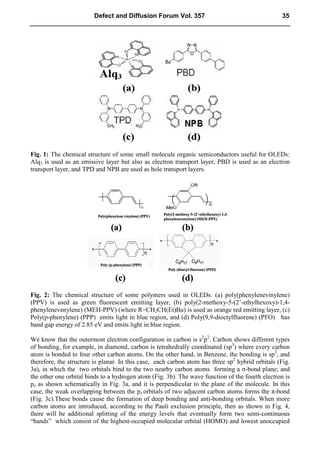
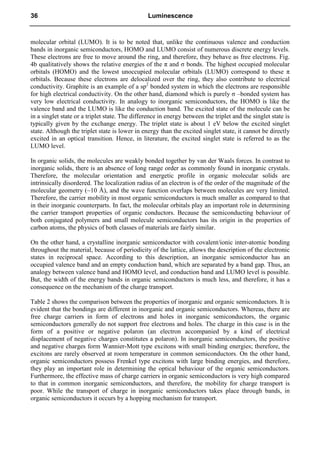
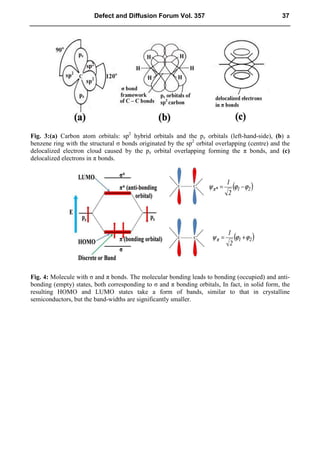
![Table 2: Comparison between molecular/organic and crystalline/inorganic solids [51]
Property Crystalline/Inorganic solids Molecular/Organic solids
1. Bonding In such solids, ionic, covalent, and
metallic bondings exist (2-4 eV).
Although ionic or covalent bonding
exists within molecule (intra-
molecular), the solid is held together
by Van der Waal force (0.01eV).
Hence, the behaviour of solid to a
large extent is governed by
individual molecules and increased
vibrational modes.
2. Charge
carriers
Charge carriers are: electrons, holes,
ions
Charge carriers are: polarons,
excitons (though neutral)
3. Transport Through bands By hopping
4. Mobility Generally, much high as compared to
organic solids :102
-104
cm2
/Vs
Generally, much less as compared to
inorganic solids:
10-6
-1 cm2
/Vs
5. Exciton Wannier-Mott type Frenkel type, charge transfer
6.Luminescence Caused by band to band recombination
(at practical temperature)
Caused by exciton recombination.
3. Singlet and Triplet Excitons
The electron-hole bound pair is known as exciton. There are two kinds of excitons: the Wannier (or
Wannier-Mott) exciton and the Frenkel exciton. The Wannier exciton model expresses an exciton as
composed of an electron in the conduction band and a hole in the valence band bound together by
the Coulomb interaction. In other words, a Wannier exciton is analogous to a hydrogen atom. This
model works well for inorganic semiconductors such as IIIb-Vb and IIb-VIb compounds. The
Wannier exciton moves in a crystal but does not contribute to electrical conduction as its total
charge is zero. It emits luminescence by the recombination of the electron and hole composing it.
The expanse of the wave functions of electron and hole in a Wannier exciton is usually much larger
than the lattice constant. Wannier excitons are stable only at relatively low temperatures, where the
binding energies of excitons are higher than the thermal energy. Luminescence of Wannier excitons
is observed only at low temperatures. At higher temperature of the materials, where the thermal
energy is higher, the excitons are no longer stable and in such condition band-to-band luminescence
appears. In contrast, the Frenkel exciton model is used in cases where the expanse of the electron
and hole wavefunctions is smaller than the lattice constant. Typical examples of the materials
producing Frenkel excitons are: organic molecular crystals such as anthracene, Alq3, PPV, etc. and
inorganic complex salts including transition-metal ions such as vanadets (e.g. YVO4), tungstates
(CaWO4), cyanoplatinates [BaPt(CN)4.4H2O] and uranyl salts (Cs2UO2Cl4). In fact, in these
materials, luminescence characteristics are similar to those of isolated molecules or complex ions.
Fig. 5 shows the spatial discrimination of exciton types. It is seen that the Frenkel exciton is
localized on or around a molecule (site) and the Wanier exciton is more extended.
38 Luminescence](https://image.slidesharecdn.com/2382009-250604185639-434f3bfb/85/Luminescence-Basic-Concepts-Applications-And-Instrumentation-H-S-Virk-47-320.jpg)
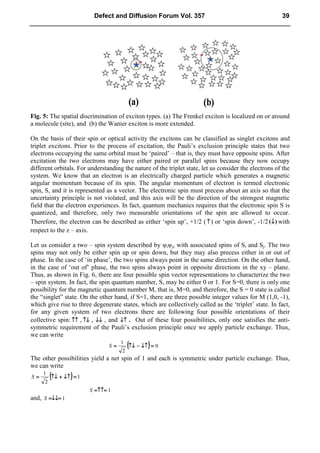
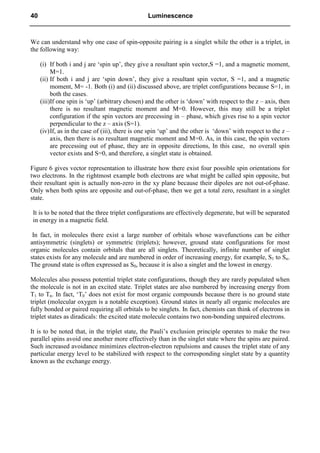
![Fig. 6: The spin vectors showing singlet and triplet states. S and Ms are the total and magnetic spin
quantum numbers, respectively, and α and β are the spin "up"and "down," respectively.
4. Carrier Injection
In fact, in organic materials the disorder, low bandwidth, electron phonon interactions and
temperature all work together to localize charge carriers. Consequently, the primary injection event
consists of a transition from an extended band-like state in the metal electrodes into a localized
molecular polaronic state in the organic material. Due to the highly insulating nature of most
organic solids and the low charge carrier mobility resulting from weak intermolecular interaction
and disorder, the standard semiconductor techniques do not become applicable to study their
electronic properties [52]. It is to be noted that despite these difficulties, J. Kalinowski made a
thorough theoretical analysis of the mechanism of carrier injection [38].
4.1. Barrier lowering by image charge. When carriers are injected from a metal electrode into the
organic layers (Fig. 7),for electron injection the electrons encounter the injection barrier qΦm, which
is the energy difference between the Fermi level EFc of the cathode metal and the LUMO level
ELUMO. Similarly, holes encounter a barrier, which is the difference between the Fermi level EFa of
anode material and EHOMO. After the injection, many electrons remain on the surface of the organic
layer at distance +x from the metal-organic interface. These electrons induce equivalent hole
charges in the metal layer at –x, in which the hole charges are called the image charges. Thus, the
potential experienced by the electron due to the image charge is given by
)
x
16
/(
2
q
image πε
−
=
φ (1)
Where, ε= ε0 εr.
As a result of these image charges, the new potential of the metal-organic interface system is given
by
( ) qFx
x
16
q
qFx
x
16
q
x
2
2
2
m −
πε
−
φ
=
−
πε
−
χ
−
φ
=
ψ (2)
Where, xmis the distance at which the sum of the field and image charge term has a maximum.
Defect and Diffusion Forum Vol. 357 41](https://image.slidesharecdn.com/2382009-250604185639-434f3bfb/85/Luminescence-Basic-Concepts-Applications-And-Instrumentation-H-S-Virk-50-320.jpg)
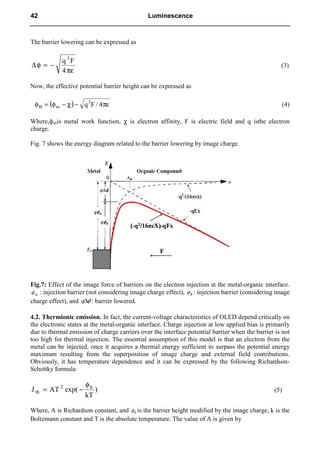
![3
2
h
qmk
4
A
π
= (6)
in which m is the effective mass of the carrier.
As the applied field causes decrease in the barrier height, Jth increases with increasing bias. This
represents the greatest current that can flow across the interface when no scattering occurs.
However, when both the mobility of the ejected carrier and the applied field are low, the charge
carriers can backflow into the electrode. In fact, in this regime, the current is diffusion-controlled.
Emtage and O’Dwyer [53] have solved the diffusion-drift equation for injection into a wide
bandgap semiconductor and specified the condition for diffusion-limited case, which is ,
/
5
4
3
<<
<<
<<
<<
E
µ
in which µ is in the unit of cm2
/V.s and E in MV/cm. It has been derived that
(1) In the low field limit, 3
2
2
4
q
T
k
F
πε
<<
<<
<<
<< , J can be expressed as
)
kT
q
exp(
F
N
J 0
φ
−
εµ
= (7)
(2) In the high field limit,
µ
= N
J
π
kT
4 )
kT
q
exp(
F b
3 φ
−
ε (8)
Where, 0
φ is the original barrier, and b
φ is the image charge-modified barrier. This thermal injection
process has been proved by both Monte Carlo simulations [54] and experiments [55].
Although it has not been explicitly shown, the backflow current is present. The origin of the
backflow in wide bandgap organic semiconductors is disorder. The existence of disorder in organic
semiconductors creates an obstacle to the injected carriers. The disorder causes a distribution of site
energies, and therefore, the injected carriers, the molecular sites in contact with electrodes and also
at the low-energy end of the distribution. For moving further into the organic materials, the injected
carriers are required to overcome random energy barriers in addition to the image potential. This
fact causes most injected carriers to backflow into the electrode at low applied field strength. When
the electric field increases, the efficiency of injection increment becomes more significant as
compared to that in the case when only image force is considered. Such thermal injection process
has been proved both by Monte Carlo simulation [54] as well as by experiment [55].
4.3. Field emission. At low temperatures and high fields, field-assisted tunneling can be important
compared to thermionic emission. In fact, field emission is the process whereby carriers tunnel
through a barrier in the presence of a high electric field. When the barrier is triangular, the tunneling
is called Fowler- Nordheim (FN) tunneling. Fowler-Nordheim (FN) tunneling model ignores the
image charge effects and invokes tunneling of electrons from the metal through a triangular barrier,
which can be made thin by applying a high field. When the forward field across the 100nm thin
OLED is increased, the triangular energy barrier becomes shallower (Fig. 7)[56]. For example, it is
typically ~2 nm wide at an applied field of 2 MV/cm, whereby the width is sufficiently thin and
tunneling becomes possible. For a triangular barrier, the FN current density is expressed
)
F
/
F
exp(
AF
J 0
2
FN −
= (9)
Where, the parameters A and F0 are related to the potential barrier and are given by
Defect and Diffusion Forum Vol. 357 43](https://image.slidesharecdn.com/2382009-250604185639-434f3bfb/85/Luminescence-Basic-Concepts-Applications-And-Instrumentation-H-S-Virk-52-320.jpg)
![qh
3
m
2
8
F
,
hm
8
mq
A
3
B
o
B
3
φ
π
=
φ
π
=
∗
∗
Because of the image-force lowering effect, the barrier фB itself is a function of field F. It has been
found that for low electric fields (<2 MV/cm) the thermionic current dominates, and for high
electric fields (>2 MV/cm), the tunneling current dominates [57].
Clearly the FN tunneling current has stronger electrical field dependence than thermionic emission
current. Yang et al. [58]have reported the FN tunneling type of unipolar conduction in poly[2-
methoxy-5-(2'-ethyl-hexyloxy)-1,4-phenylene vinylene] (MEH-PPV)-based OLEDs at high fields
ranging from ~0.5 to ~1.5x10⁵
V/cm. Using this model, the barrier height at polyaniline
(PANI)/MEH-PPV interface comes out to benearly half of that at ITO/MEH-PPV interface, which
is consistent with the I-V characteristic. However, the FN tunneling theory does not consider the
image charge lowering, which amounts to 0.06-0.28 eV at electrical fields between 105
and
2x10⁶
V/cm in a dielectric with εr= 3.5.
4.4. Tunneling through the triangular barrier. In fact, the charge injection without thermal
activation is called cold emission. Godlewski and Kalinowski [59] have reported that two different
cases of such an emission can be distinguished: (i) tunneling through the triangular barrier; and (ii)
primary carrier penetration over the image force barrier. The classic Fowler–Nordheim treatment is
the electron injection tunneling through the triangular barrier, in which the image force barrier and
hot-electron contribution to the collected current are ignored [60]. It yields the current given by Eq.
(9).
4.5. Primary carrier penetration over the image force barrier. In this case the charge carriers
emitted into the medium from a metallic emitter at x=0 (primary or hot carriers) are subjected to a
scattering that is characterized by a mean free path L. The probability that a carrier injected at a
certain angle will reach the distance xm to the image force potential maximum without scattering is
exp(-xm/L). Thus, the current resulting from those carriers which escape over the image force
barrier can be expressed as [59]
( )
2
/
1
0 F
/
c
exp
j
j −
= (10)
Where, c is a constant and j0 is the current which would flow in the absence of scattering processes.
4.6. Strong gradient js(x). As the general solution of the equation for Field-assisted thermionic
injection over the image force barrier is complex and difficult (if possible) to compare with
experiment [38].In this connection some approximations have been made to obtain tractable
solutions. One of the approximations is based on the strong gradient js(x); while the other
approximation known as one-dimensional Onsager model with a weak gradient function js(x) or
x→0 is based on js(x) to be a strongly decreasing function of x and x0<<xm = (e/16πε0εF)1/2
(but x0 is
not very close to zero) [59, 61]. The high-field regime solution of equation for Field-assisted
thermionic injection over the image force barrier can be expressed as [38]
( )
[ ] ( )
2
/
1
s
4
/
3
2
/
1
2
/
1
4
/
3
F
a
exp
AF
F
kT
/
e
2
exp
AF
j =
β
=
(11)
Where, β =e2
/16πε0εkT, and A(F) = const.
44 Luminescence](https://image.slidesharecdn.com/2382009-250604185639-434f3bfb/85/Luminescence-Basic-Concepts-Applications-And-Instrumentation-H-S-Virk-53-320.jpg)
![4.7. The one-dimensional Onsager model. If the contact is characterized by a weak gradient
function js(x) which in a limiting case is expressed by a function defined as js(x) =j0 for x ≤ l (l is
the mean free path) and js(x) = 0 for x > l, but l <<xm, then the solution of equation for Field-
assisted thermionic injection over the image force barrier for high fields can be expressed as [59]
( )
[ ] ( )
2
/
1
s
4
/
3
0
2
/
1
2
/
1
4
/
3
0 F
a
exp
F
A
F
kT
/
e
2
exp
F
A
j =
β
= (12)
It is to be noted that the functional shape of j(F) given by Eq.(12) is identical to that of expression
[11]. The difference appears in the constant A0(F) which, in case 4.7depends on the parameter l,
which does not exist for the strong gradient case of js(x) given by Eq. (11).
Parmenter and Ruppel [62] have reported two-carrier space-charge-limited current in a trap-free
insulator for different conditions of electrodes such as both contacts are ohmic, one contact highly
blocking or the mobility of one of carriers is zero, slightly blocking contact, and both the contacts
are blocking. Godlewski [63] has reported the role of interface between molecular material and
electrode on currents and photocurrents, in which the mechanisms of charge carrier injection,
electrode recombination and transport are discussed. Particularly thermal, excitonic, photo and
tunneling injection of charge carriers, diffusion in presence of image force, interface barrier
between electrode and organic materials and two organic materials, non-uniformity of electrodes
and other phenomena on charge carrier injection have been taken into consideration. It is shown
that the considered phenomena are very important for the analysis of many practical problems for
molecular electronic devices such as rectification of current, organic transistors,
electroluminescence, photovoltaic effects and some similar problems.
Although there are many processes for carrier injection in OLEDs several workers, for examples,
Braun et al. [64], Parker et al. [65], Huby et al. [66] and others have reported that the current
injection in OLEDs at low electric field followsRichardson-Schottky thermonic emission model;
however, the current injection in OLEDs at high electric field follows Fowler-Nordheim tunneling
model. Mendez- Pinzon [67] have reported that the I-V characteristics of ITO / PEDOT:PSS /
MDMO-PPV / Metal OLEDs follows the model based on carriers by thermionic emission. Scott
[68] have described the charge injection process as thermally assisted tunneling from the
delocalized states of the metal into the localized states of the semiconductor, whose energy includes
contributions from the mean barrier height, the image potential, the energetic disorder, and the
applied electric field. Godlewski and Kalinowski [59] have reported that, for tetracene single
crystals the plot of log (j/F3/4
) versus F1/2
plot is a straight line with positive slope. Similar relation
has also been found by Kalinowski [38] for ITO/(PC + 75%TPD)/Alq3/Mg double layers OLEDs.
5. Space Charge Limited Current
In modern OLEDs [50], standard electroluminescence operation requires current injection >3
mA/cm2
. However, the carrier mobility is low, being 10-6
-10-4
cm2
/(V.s) for electrons and 10-5
-10-
3
cm2
/(V.s) for holes. Such strong injection into low mobility materials inevitably leads to charge
accumulation in organic materials. In this case, the I-V relation follows Mott-Gurney relation, also
known as Child’s law, for trap-free unipolar conduction. If the contact between the metal and the
organic semiconductor is Ohmic with a contact resistance much lower than the resistance of the
bulk material, then in this case, the current is easily injected into the organic material and the
transport of charge is dominated by the bulk [69]. In fact, by Ohmic contact we mean that the
electrode is an infinite reservoir of charge, which can maintain a steady state space-charge limited
current (SCLC) in the device [70]. In contrast, in the case where the injected charge dramatically
changes the electric field configuration in the materials, that is, effectively screens the source-drain
field, and the transport becomes space-charge limited. In this case, the I-V curves look linear if the
field due to the applied bias is the dominant electric-field in the device. In this case, the conduction
Defect and Diffusion Forum Vol. 357 45](https://image.slidesharecdn.com/2382009-250604185639-434f3bfb/85/Luminescence-Basic-Concepts-Applications-And-Instrumentation-H-S-Virk-54-320.jpg)



!["H
THE EMERALD STUDS
A REMINISCENCE OF THE CIRCUIT.
BY PROFESSOR AYTOUN.
[MAGA. August 1847.]
CHAPTER I.
allo, Tom! Are you not up yet? Why, man, the judges have
gone down to the court half an hour ago, escorted by the
most ragged regiment of ruffians that ever handled a
Lochaberaxe."
Such was my matutinal salutation to my friend Thomas Strachan, as
I entered his room on a splendid spring morning. Tom and I were
early college allies. We had attended, or rather, to speak more
correctly, taken out tickets for the different law classes during the
same sessions. We had fulminated together within the walls of the
Juridical Society on legal topics which might have broken the heart
of Erskine, and rewarded ourselves diligently thereafter with the
usual relaxations of a crab and a comfortable tumbler. We had
aggravated the same grinder with our deplorable exposition of the
Pandects; and finally assumed, on the same day, the full-blown
honours of the Advocate's wig and gown. Nor did our fraternal
parallel end there: for although we had walked the boards of the
Parliament House with praiseworthy diligence for a couple of
sessions, neither of us had experienced the dulcet sensation which is](https://image.slidesharecdn.com/2382009-250604185639-434f3bfb/85/Luminescence-Basic-Concepts-Applications-And-Instrumentation-H-S-Virk-78-320.jpg)




![[Marco mazzeo] organic_light_emitting_diode(book_zz.org)](https://cdn.slidesharecdn.com/ss_thumbnails/marcomazzeoorganiclightemittingdiodebookzz-150114151251-conversion-gate01-thumbnail.jpg?width=640&height=640&fit=bounds)


