Wouldn't it be great if we could control individual atoms?
Just imagine if we could "turn" them on and off to store bits of
information, make them light up with different colours, or
control them in all kinds of other ways.
APPLICATION OF QUANTUM DOTS IN DISPLAY
TECHNOLOGY (QLED)
- Shrirang Pathak
National Centre for Nanoscience & Nanotechnology
Out line :-
1. Introduction
a. What are quantum dots
b. How do quantum dots work/ Role of quantum dots in display technology
2. How do you make quantum dots
3. Quantum dot material
3. Range of applications
4. Types of systems –
1) photo enhanced
2) photo emissive
3) electro emissive
5. conclusion
6. Reference
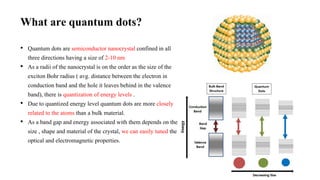
• Quantum dots are semiconductor nanocrystal confined in all
three directions having a size of 2-10 nm
• As a radii of the nanocrystal is on the order as the size of the
exciton Bohr radius ( avg. distance between the electron in
conduction band and the hole it leaves behind in the valence
band), there is quantization of energy levels .
• Due to quantized energy level quantum dots are more closely
related to the atoms than a bulk material.
• As a band gap and energy associated with them depends on the
size , shape and material of the crystal, we can easily tuned the
optical and electromagnetic properties.
What are quantum dots?
Role of quantum dots in display technology :-
• These materials are tiny crystals with the remarkable
ability to emit light of specific frequencies if electricity
or light is applied to them, and these frequencies can be
precisely tuned by changing the dot size, shape, and
material.
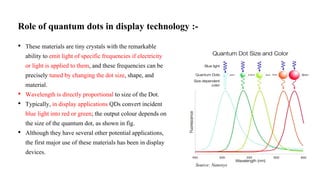
• Wavelength is directly proportional to size of the Dot.
• Typically, in display applications QDs convert incident
blue light into red or green; the output colour depends on
the size of the quantum dot, as shown in fig.
• Although they have several other potential applications,
the first major use of these materials has been in display
devices.
Source: Nanosys
METHODS
TO CREATE
QUANTUM
DOTS
MOLECULAR
BEAM
EPITAXY
X-RAY
LITHOGRAPHY
OTHER
BIOLOGICAL
METHODS
ION
IMPLANTATION
Methods to create quantum dots :-
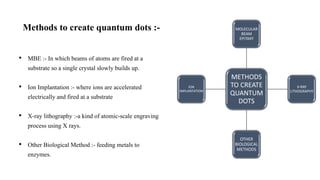
• MBE :- In which beams of atoms are fired at a
substrate so a single crystal slowly builds up.
• Ion Implantation :- where ions are accelerated
electrically and fired at a substrate
• X-ray lithography :-a kind of atomic-scale engraving
process using X rays.
• Other Biological Method :- feeding metals to
enzymes.
Quantum Dot Materials :-
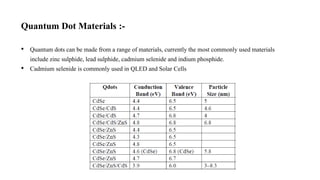
• Quantum dots can be made from a range of materials, currently the most commonly used materials
include zinc sulphide, lead sulphide, cadmium selenide and indium phosphide.
• Cadmium selenide is commonly used in QLED and Solar Cells
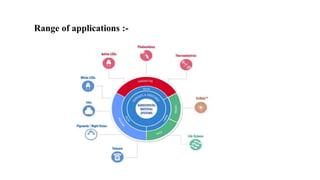
Range of applications :-
TYPES OF QLED DISPLAY SYSTEMS
1.Photo-Enhanced Quantum Dot Display Systems.
• Quantum dots are integrated within the LED backlight of an existing LCD.
• In this type of system illuminated quantum dots which are tuned to give of red and green
light.
• Red , blue and green colours produced in the quantum dot set are very pure they can shine
through those filters with less wasted light than tv’s that uses the white light.
• In this method quantum dots are used to enhanced the quality of emitted light.
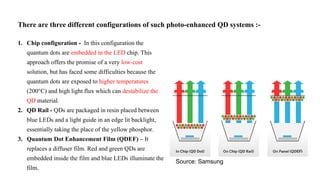
There are three different configurations of such photo-enhanced QD systems :-
1. Chip configuration - In this configuration the
quantum dots are embedded in the LED chip. This
approach offers the promise of a very low-cost
solution, but has faced some difficulties because the
quantum dots are exposed to higher temperatures
(200°C) and high light flux which can destabilize the
QD material.
2. QD Rail - QDs are packaged in resin placed between
blue LEDs and a light guide in an edge lit backlight,
essentially taking the place of the yellow phosphor.
3. Quantum Dot Enhancement Film (QDEF) – It
replaces a diffuser film. Red and green QDs are
embedded inside the film and blue LEDs illuminate the
film.
Source: Samsung
Setback and its solution :-
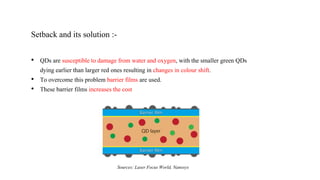
• QDs are susceptible to damage from water and oxygen, with the smaller green QDs
dying earlier than larger red ones resulting in changes in colour shift.
• To overcome this problem barrier films are used.
• These barrier films increases the cost
Sources: Laser Focus World, Nanosys
2.Photo-Emissive Quantum Dot Display Systems
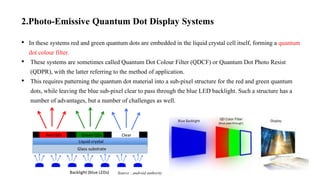
• In these systems red and green quantum dots are embedded in the liquid crystal cell itself, forming a quantum
dot colour filter.
• These systems are sometimes called Quantum Dot Colour Filter (QDCF) or Quantum Dot Photo Resist
(QDPR), with the latter referring to the method of application.
• This requires patterning the quantum dot material into a sub-pixel structure for the red and green quantum
dots, while leaving the blue sub-pixel clear to pass through the blue LED backlight. Such a structure has a
number of advantages, but a number of challenges as well.
Source : android authority
Advantages of a photo-emissive quantum dot display system
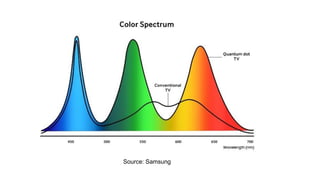
• Like photo-enhanced system, the photo-emissive systems can achieve extremely pure colours and
thereby achieve a wide colour spectrum, because the light output of the quantum dots has a much
narrower spectrum than that from the yellow phosphors used to make white LEDs.
• Because the blue sub-pixel is (mostly) unfiltered, and the red and green sub-pixels are converting
blue light to their individual colours, in principle all of the backlight energy is used (as opposed to
2/3 of the light being filtered by the colour filter). Therefore, a photo-emissive system can be
highly efficient in generating light, up to 2-3 times more efficient. This higher efficiency can be
translated into higher brightness, or cost savings with fewer LEDs, or (most likely) a combination
of both.
• Because the light from the red and green pixels is originating at the front of the display, in front of
the LC layer and polarizers, a photo-emissive display will have much better viewing angle
performance; it will appear as an emissive display, one of the advantages ascribed to OLEDs.
• The structure of a photo-emissive quantum dot display will eliminate the light scattering that
occurs in the colour filter, in between the two polarizer layers, and therefore the display will show
improved contrast.
• Because the quantum dots are placed in front of the liquid crystal, and they emit non-polarized Light
• The sub-pixels in the photo-emissive system must absorb all the blue light of the LED, otherwise blue light
leaking into the red or green sub-pixels will quickly degrade colour purity.
• Because quantum dots emit light isotropically (equally in all directions), some of the light from the red and
green sub-pixels is directed backward . In the most likely configurations of QDCF, this backward-directed
light is lost, foregoing some of the efficiency benefit of the system, but the efficiency of QDCF remains
substantially better than other LCD-based designs.
• Since the red and green quantum dots can be excited by ambient light just as well as from the backlight,
some mechanism must be added in front of the quantum dots to reduce the ambient light (especially blue
ambient light) from hitting the QDCF layer.
• It is possible that additional mask steps could be required for the quantum dot colour filter. If necessary, this
could be achieved by adding new equipment or sacrificing capacity (running slower).
The challenges:
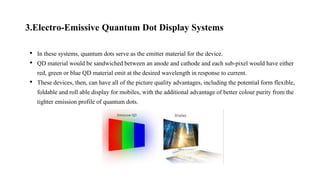
3.Electro-Emissive Quantum Dot Display Systems
• In these systems, quantum dots serve as the emitter material for the device.
• QD material would be sandwiched between an anode and cathode and each sub-pixel would have either
red, green or blue QD material emit at the desired wavelength in response to current.
• These devices, then, can have all of the picture quality advantages, including the potential form flexible,
foldable and roll able display for mobiles, with the additional advantage of better colour purity from the
tighter emission profile of quantum dots.
Source: Samsung
Conclusion
• The next few years will see a flurry of innovation in Quantum Dot technology, as a
variety of QLED products will compete with OLED displays at the premium end of the
TV market.
• The flexibility of quantum dots for use in display architectures via films, colour filters
and even emitting materials will allow several paths for growth, delivering continuing
improvements in picture quality.
• There are many possible applications of quantum dots in many different areas of
industry/science.
• The future looks bight and exciting on all the possible applications of quantum dots.
References
• QLEDs – Quantum Dot Technology and the Future of TVs By Ross Young, Bob O’Brien and Yoshio Tamura Display Supply Chain Consultants
November 15, 2017
• Mattoussi, H.; Radzilowski, L.H.; Dabbousi, B.O.; Fogg, D.E.; Schrock, R.R.; Thomas, E.L.; Rubner, M.F.; Bawendi, M.G. Composite thin films of
CdSe nanocrystals and a surface passivating/electron transporting block copolymer: Correlations between film microstructure by transmission electron
microscopy and electroluminescence. J. Appl. Phys. 1999, 86, 4390–4399.
• Quantum Dots and Their Multimodal Applications: A Review Debasis Bera , Lei Qian, Teng-Kuan Tseng and Paul H. Holloway
• http://www.nanosysinc.com/
• http://www.explainstuff.com/
• Ashoori, R. C. (1996). "Electrons in artificial atoms". Nature. 379 (6564): 413–419. Bibcode:1996Natur.379..413A. doi:10.1038/379413a0.
• ^ Kastner, M. A. (1993). "Artificial Atoms". Physics Today. 46 (1): 24–31. Bibcode:1993PhT....46a..24K. doi:10.1063/1.881393.
• ^ Jump up to:a b Murray, C. B.; Kagan, C. R.; Bawendi, M. G. (2000). "Synthesis and Characterization of Monodisperse Nanocrystals and Close-
Packed Nanocrystal Assemblies". Annual Review of Materials Research. 30 (1): 545–
610. Bibcode:2000AnRMS..30..545M. doi:10.1146/annurev.matsci.30.1.545.
• ^ Brus, L.E. (2007). "Chemistry and Physics of Semiconductor Nanocrystals" (PDF). Retrieved 7 July 2009.
• ^ "Quantum Dots". Nanosys – Quantum Dot Pioneers. Retrieved 2015-12-04.
• ^ Ramírez, H. Y., Flórez J., and Camacho A. S., (2015). "Efficient control of coulomb enhanced second harmonic generation from excitonic
transitions in quantum dot ensembles". Phys. Chem. Chem. Phys. 17 (37): 23938–
46. Bibcode:2015PCCP...1723938R. doi:10.1039/C5CP03349G. PMID 26313884.

Quantum dot LED (QLED)

  • 1.
    Wouldn't it begreat if we could control individual atoms? Just imagine if we could "turn" them on and off to store bits of information, make them light up with different colours, or control them in all kinds of other ways.
  • 2.
    APPLICATION OF QUANTUMDOTS IN DISPLAY TECHNOLOGY (QLED) - Shrirang Pathak National Centre for Nanoscience & Nanotechnology
  • 3.
    Out line :- 1.Introduction a. What are quantum dots b. How do quantum dots work/ Role of quantum dots in display technology 2. How do you make quantum dots 3. Quantum dot material 3. Range of applications 4. Types of systems – 1) photo enhanced 2) photo emissive 3) electro emissive 5. conclusion 6. Reference
  • 4.
    • Quantum dotsare semiconductor nanocrystal confined in all three directions having a size of 2-10 nm • As a radii of the nanocrystal is on the order as the size of the exciton Bohr radius ( avg. distance between the electron in conduction band and the hole it leaves behind in the valence band), there is quantization of energy levels . • Due to quantized energy level quantum dots are more closely related to the atoms than a bulk material. • As a band gap and energy associated with them depends on the size , shape and material of the crystal, we can easily tuned the optical and electromagnetic properties. What are quantum dots?
  • 5.
    Role of quantumdots in display technology :- • These materials are tiny crystals with the remarkable ability to emit light of specific frequencies if electricity or light is applied to them, and these frequencies can be precisely tuned by changing the dot size, shape, and material. • Wavelength is directly proportional to size of the Dot. • Typically, in display applications QDs convert incident blue light into red or green; the output colour depends on the size of the quantum dot, as shown in fig. • Although they have several other potential applications, the first major use of these materials has been in display devices. Source: Nanosys
  • 6.
    METHODS TO CREATE QUANTUM DOTS MOLECULAR BEAM EPITAXY X-RAY LITHOGRAPHY OTHER BIOLOGICAL METHODS ION IMPLANTATION Methods tocreate quantum dots :- • MBE :- In which beams of atoms are fired at a substrate so a single crystal slowly builds up. • Ion Implantation :- where ions are accelerated electrically and fired at a substrate • X-ray lithography :-a kind of atomic-scale engraving process using X rays. • Other Biological Method :- feeding metals to enzymes.
  • 7.
    Quantum Dot Materials:- • Quantum dots can be made from a range of materials, currently the most commonly used materials include zinc sulphide, lead sulphide, cadmium selenide and indium phosphide. • Cadmium selenide is commonly used in QLED and Solar Cells
  • 8.
  • 9.
    TYPES OF QLEDDISPLAY SYSTEMS
  • 10.
    1.Photo-Enhanced Quantum DotDisplay Systems. • Quantum dots are integrated within the LED backlight of an existing LCD. • In this type of system illuminated quantum dots which are tuned to give of red and green light. • Red , blue and green colours produced in the quantum dot set are very pure they can shine through those filters with less wasted light than tv’s that uses the white light. • In this method quantum dots are used to enhanced the quality of emitted light.
  • 11.
    There are threedifferent configurations of such photo-enhanced QD systems :- 1. Chip configuration - In this configuration the quantum dots are embedded in the LED chip. This approach offers the promise of a very low-cost solution, but has faced some difficulties because the quantum dots are exposed to higher temperatures (200°C) and high light flux which can destabilize the QD material. 2. QD Rail - QDs are packaged in resin placed between blue LEDs and a light guide in an edge lit backlight, essentially taking the place of the yellow phosphor. 3. Quantum Dot Enhancement Film (QDEF) – It replaces a diffuser film. Red and green QDs are embedded inside the film and blue LEDs illuminate the film. Source: Samsung
  • 12.
    Setback and itssolution :- • QDs are susceptible to damage from water and oxygen, with the smaller green QDs dying earlier than larger red ones resulting in changes in colour shift. • To overcome this problem barrier films are used. • These barrier films increases the cost Sources: Laser Focus World, Nanosys
  • 13.
    2.Photo-Emissive Quantum DotDisplay Systems • In these systems red and green quantum dots are embedded in the liquid crystal cell itself, forming a quantum dot colour filter. • These systems are sometimes called Quantum Dot Colour Filter (QDCF) or Quantum Dot Photo Resist (QDPR), with the latter referring to the method of application. • This requires patterning the quantum dot material into a sub-pixel structure for the red and green quantum dots, while leaving the blue sub-pixel clear to pass through the blue LED backlight. Such a structure has a number of advantages, but a number of challenges as well. Source : android authority
  • 14.
    Advantages of aphoto-emissive quantum dot display system • Like photo-enhanced system, the photo-emissive systems can achieve extremely pure colours and thereby achieve a wide colour spectrum, because the light output of the quantum dots has a much narrower spectrum than that from the yellow phosphors used to make white LEDs. • Because the blue sub-pixel is (mostly) unfiltered, and the red and green sub-pixels are converting blue light to their individual colours, in principle all of the backlight energy is used (as opposed to 2/3 of the light being filtered by the colour filter). Therefore, a photo-emissive system can be highly efficient in generating light, up to 2-3 times more efficient. This higher efficiency can be translated into higher brightness, or cost savings with fewer LEDs, or (most likely) a combination of both. • Because the light from the red and green pixels is originating at the front of the display, in front of the LC layer and polarizers, a photo-emissive display will have much better viewing angle performance; it will appear as an emissive display, one of the advantages ascribed to OLEDs. • The structure of a photo-emissive quantum dot display will eliminate the light scattering that occurs in the colour filter, in between the two polarizer layers, and therefore the display will show improved contrast.
  • 15.
    • Because thequantum dots are placed in front of the liquid crystal, and they emit non-polarized Light • The sub-pixels in the photo-emissive system must absorb all the blue light of the LED, otherwise blue light leaking into the red or green sub-pixels will quickly degrade colour purity. • Because quantum dots emit light isotropically (equally in all directions), some of the light from the red and green sub-pixels is directed backward . In the most likely configurations of QDCF, this backward-directed light is lost, foregoing some of the efficiency benefit of the system, but the efficiency of QDCF remains substantially better than other LCD-based designs. • Since the red and green quantum dots can be excited by ambient light just as well as from the backlight, some mechanism must be added in front of the quantum dots to reduce the ambient light (especially blue ambient light) from hitting the QDCF layer. • It is possible that additional mask steps could be required for the quantum dot colour filter. If necessary, this could be achieved by adding new equipment or sacrificing capacity (running slower). The challenges:
  • 16.
    3.Electro-Emissive Quantum DotDisplay Systems • In these systems, quantum dots serve as the emitter material for the device. • QD material would be sandwiched between an anode and cathode and each sub-pixel would have either red, green or blue QD material emit at the desired wavelength in response to current. • These devices, then, can have all of the picture quality advantages, including the potential form flexible, foldable and roll able display for mobiles, with the additional advantage of better colour purity from the tighter emission profile of quantum dots.
  • 17.
  • 18.
    Conclusion • The nextfew years will see a flurry of innovation in Quantum Dot technology, as a variety of QLED products will compete with OLED displays at the premium end of the TV market. • The flexibility of quantum dots for use in display architectures via films, colour filters and even emitting materials will allow several paths for growth, delivering continuing improvements in picture quality. • There are many possible applications of quantum dots in many different areas of industry/science. • The future looks bight and exciting on all the possible applications of quantum dots.
  • 19.
    References • QLEDs –Quantum Dot Technology and the Future of TVs By Ross Young, Bob O’Brien and Yoshio Tamura Display Supply Chain Consultants November 15, 2017 • Mattoussi, H.; Radzilowski, L.H.; Dabbousi, B.O.; Fogg, D.E.; Schrock, R.R.; Thomas, E.L.; Rubner, M.F.; Bawendi, M.G. Composite thin films of CdSe nanocrystals and a surface passivating/electron transporting block copolymer: Correlations between film microstructure by transmission electron microscopy and electroluminescence. J. Appl. Phys. 1999, 86, 4390–4399. • Quantum Dots and Their Multimodal Applications: A Review Debasis Bera , Lei Qian, Teng-Kuan Tseng and Paul H. Holloway • http://www.nanosysinc.com/ • http://www.explainstuff.com/ • Ashoori, R. C. (1996). "Electrons in artificial atoms". Nature. 379 (6564): 413–419. Bibcode:1996Natur.379..413A. doi:10.1038/379413a0. • ^ Kastner, M. A. (1993). "Artificial Atoms". Physics Today. 46 (1): 24–31. Bibcode:1993PhT....46a..24K. doi:10.1063/1.881393. • ^ Jump up to:a b Murray, C. B.; Kagan, C. R.; Bawendi, M. G. (2000). "Synthesis and Characterization of Monodisperse Nanocrystals and Close- Packed Nanocrystal Assemblies". Annual Review of Materials Research. 30 (1): 545– 610. Bibcode:2000AnRMS..30..545M. doi:10.1146/annurev.matsci.30.1.545. • ^ Brus, L.E. (2007). "Chemistry and Physics of Semiconductor Nanocrystals" (PDF). Retrieved 7 July 2009. • ^ "Quantum Dots". Nanosys – Quantum Dot Pioneers. Retrieved 2015-12-04. • ^ Ramírez, H. Y., Flórez J., and Camacho A. S., (2015). "Efficient control of coulomb enhanced second harmonic generation from excitonic transitions in quantum dot ensembles". Phys. Chem. Chem. Phys. 17 (37): 23938– 46. Bibcode:2015PCCP...1723938R. doi:10.1039/C5CP03349G. PMID 26313884.