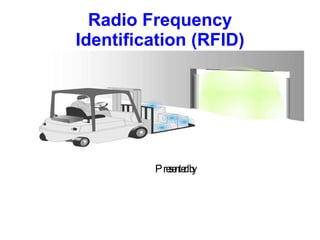

Radio Frequency  Identification (RFID) Presented by
Outlines Automatic Identification Data Capturing Technology  What is RFID? Why RFID? Components of RFID Transponder Applications Pros & Cons Conclusion
Automatic Identification  Data Capturing Technology Optical  :  Barcodes Magnetic :  Magnetic stripe travel cards etc. Electronic : RFID tags, smart cards, simcards
What is RFID Radio frequency identification (RFID) is an automated data capture technology that can be used to electronically identify, track, and store information contained on a tag that is attached to or embedded in an object, such as a product, case, or pallet.
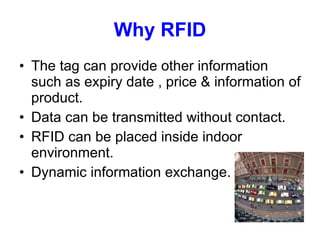
Why RFID The tag can provide other information such as expiry date , price & information of product. Data can be transmitted without contact. RFID can be placed inside indoor environment. Dynamic information exchange.
Components for RFID
Transponder Different types of RFID tags Micro tag Transmitter +  Responder
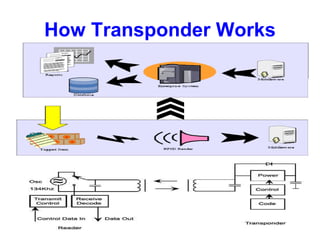
How Transponder Works
Contd.. When reader is to be read the reader sends a 134.2 KHz to antenna for 50ms. Magnetic field generated is collected by tag & tag is tuned to that frequency. The energy is rectified & stored in small capacitor. When power pulse is finished the tag transmits data using stored energy of capacitor as power source. Once transmission is over capacitor is discharged & tag ready for next cycle. The period of transmission pulses is 20 to 50ms. Transmission technique is FSK.
Types of Transponder Passive Simplest in version. Power source absent. Tag responds to reader radio wave and derives power from the energy waves transmitted by reader .
Contd…… Semi passive Do not initiate communication with reader. Contains batteries that allow tag to perform other operations such as powering tag’s internal electronics. Active Contains power source & a transmitter. Sends continuous signal & initiates communication with reader.
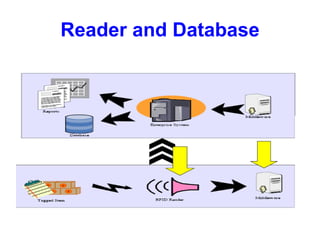
Reader and Database
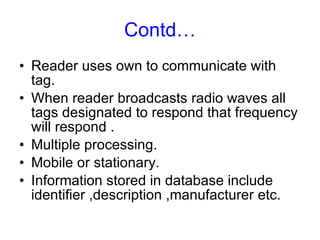
Contd… Reader uses own to communicate with tag. When reader broadcasts radio waves all tags designated to respond that frequency will respond . Multiple processing. Mobile or stationary. Information stored in database include identifier ,description ,manufacturer etc.
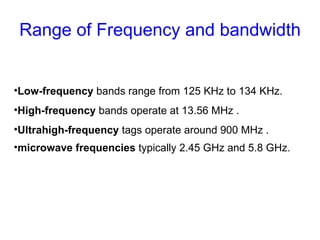
Range of Frequency and bandwidth Low-frequency  bands range from 125 KHz to 134 KHz.  High-frequency  bands operate at 13.56 MHz . Ultrahigh-frequency  tags operate around 900 MHz . microwave frequencies  typically 2.45 GHz and 5.8 GHz.
Reading range of reader Reading range changes with the direction of the tag w.r.t. the reader
Security Encrypting the data in the tags. verifying the claimed identity of a user. …
 
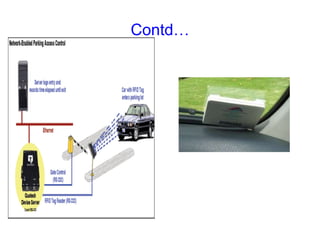
Contd…
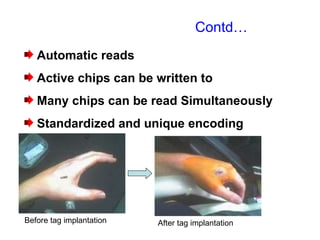
Automatic reads Active chips can be written to Many chips can be read Simultaneously Standardized and unique encoding Contd… Before tag implantation After tag implantation
 
Conclusion Use of RFID is likely to increase in the near future. At present, it is unclear whether the effects of the use of RFID technology will be evident in broad measures of economic activity like output or productivity growth. As businesses gain experience with RFID, they may be able to redesign business  processes to take advantage of the strengths of the technology and the information that flows from its use.
Web Resources www.rf-id.com www.kolinahr.cc www.rfid-radar.com www.rfidvirus.org www.thewirelessreport.com www.northenapex-rfid.com www.ac-rfid.com
THANK U
Qns

Radio Frequency1

  • 1.
    Radio Frequency Identification (RFID) Presented by
  • 2.
    Outlines Automatic IdentificationData Capturing Technology What is RFID? Why RFID? Components of RFID Transponder Applications Pros & Cons Conclusion
  • 3.
    Automatic Identification Data Capturing Technology Optical : Barcodes Magnetic : Magnetic stripe travel cards etc. Electronic : RFID tags, smart cards, simcards
  • 4.
    What is RFIDRadio frequency identification (RFID) is an automated data capture technology that can be used to electronically identify, track, and store information contained on a tag that is attached to or embedded in an object, such as a product, case, or pallet.
  • 5.
    Why RFID Thetag can provide other information such as expiry date , price & information of product. Data can be transmitted without contact. RFID can be placed inside indoor environment. Dynamic information exchange.
  • 6.
  • 7.
    Transponder Different typesof RFID tags Micro tag Transmitter + Responder
  • 8.
  • 9.
    Contd.. When readeris to be read the reader sends a 134.2 KHz to antenna for 50ms. Magnetic field generated is collected by tag & tag is tuned to that frequency. The energy is rectified & stored in small capacitor. When power pulse is finished the tag transmits data using stored energy of capacitor as power source. Once transmission is over capacitor is discharged & tag ready for next cycle. The period of transmission pulses is 20 to 50ms. Transmission technique is FSK.
  • 10.
    Types of TransponderPassive Simplest in version. Power source absent. Tag responds to reader radio wave and derives power from the energy waves transmitted by reader .
  • 11.
    Contd…… Semi passiveDo not initiate communication with reader. Contains batteries that allow tag to perform other operations such as powering tag’s internal electronics. Active Contains power source & a transmitter. Sends continuous signal & initiates communication with reader.
  • 12.
  • 13.
    Contd… Reader usesown to communicate with tag. When reader broadcasts radio waves all tags designated to respond that frequency will respond . Multiple processing. Mobile or stationary. Information stored in database include identifier ,description ,manufacturer etc.
  • 14.
    Range of Frequencyand bandwidth Low-frequency bands range from 125 KHz to 134 KHz. High-frequency bands operate at 13.56 MHz . Ultrahigh-frequency tags operate around 900 MHz . microwave frequencies typically 2.45 GHz and 5.8 GHz.
  • 15.
    Reading range ofreader Reading range changes with the direction of the tag w.r.t. the reader
  • 16.
    Security Encrypting thedata in the tags. verifying the claimed identity of a user. …
  • 17.
  • 18.
  • 19.
    Automatic reads Activechips can be written to Many chips can be read Simultaneously Standardized and unique encoding Contd… Before tag implantation After tag implantation
  • 20.
  • 21.
    Conclusion Use ofRFID is likely to increase in the near future. At present, it is unclear whether the effects of the use of RFID technology will be evident in broad measures of economic activity like output or productivity growth. As businesses gain experience with RFID, they may be able to redesign business processes to take advantage of the strengths of the technology and the information that flows from its use.
  • 22.
    Web Resources www.rf-id.comwww.kolinahr.cc www.rfid-radar.com www.rfidvirus.org www.thewirelessreport.com www.northenapex-rfid.com www.ac-rfid.com
  • 23.
  • 24.