POLYMER LIGHT EMITTING DIODE
Biswajit Acharya
M.Tech,AEIE,1st Year
Heritage Institute of
Technology.
OUTLINE…
Introduction to LED, its classes, polymers
and LEP
Need to go for P-LEDs
Structure and operation of the P-LED
Fabrication Steps of P-LED
Various characteristics of P-LEDs
P-LED Manufacturers, Applications and
Challenges.
Conclusion and References..
2Polymer Light Emitting Diode 5/14/2014
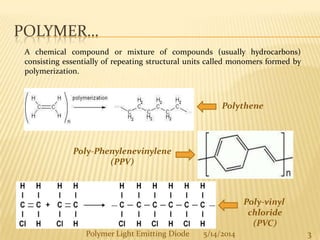
POLYMER…
A chemical compound or mixture of compounds (usually hydrocarbons)
consisting essentially of repeating structural units called monomers formed by
polymerization.
Polythene
Poly-vinyl
chloride
(PVC)
Poly-Phenylenevinylene
(PPV)
3Polymer Light Emitting Diode 5/14/2014
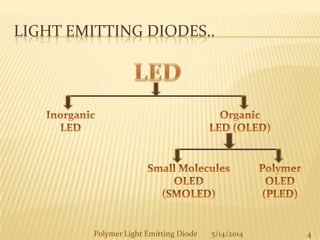
LIGHT EMITTING DIODES..
4Polymer Light Emitting Diode 5/14/2014
LIGHT EMITTING POLYMER
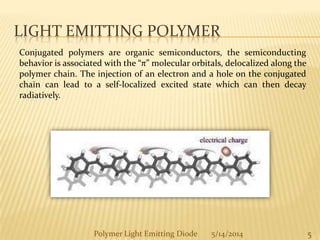
Conjugated polymers are organic semiconductors, the semiconducting
behavior is associated with the “π” molecular orbitals, delocalized along the
polymer chain. The injection of an electron and a hole on the conjugated
chain can lead to a self-localized excited state which can then decay
radiatively.
5Polymer Light Emitting Diode 5/14/2014
LIGHT EMITTING POLYMERS…
HOW IT ALL BEGAN
A light emitting polymer is an electro-luminescent plastic. The
molecules of this plastic emit light when an electric field is applied.
The first observations of electroluminescence in organic materials were in
the early 1950s by André Bernanose, in France.
Electroluminescence from polymer films was first observed by Roger
Partridge at the National Physical Laboratory in the United Kingdom in
1983.
The first diode device was reported by Ching W. Tang and Steven Van
Slyke in 1987.
J. H. Burroughes reported a high efficiency green light-emitting polymer
based device in 1990.
6Polymer Light Emitting Diode 5/14/2014
7
Just
Imagine
Viewing a HD TV that is 80 inches wide and less than a quarter-inch
thick, consumes less power than most TVs on the market today and can be
rolled up when not in use.!!!
What if you could have a "heads up" display in your car.!!!
How about a display monitor built into
your clothing…..!!!
Polymer Light Emitting Diode 5/14/2014
WHY P-LEDS ???
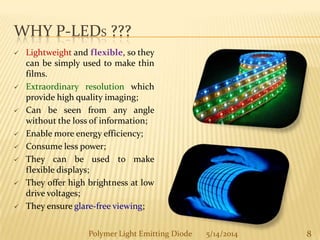
 Lightweight and flexible, so they
can be simply used to make thin
films.
 Extraordinary resolution which
provide high quality imaging;
 Can be seen from any angle
without the loss of information;
 Enable more energy efficiency;
 Consume less power;
 They can be used to make
flexible displays;
 They offer high brightness at low
drive voltages;
 They ensure glare-free viewing;
8Polymer Light Emitting Diode 5/14/2014
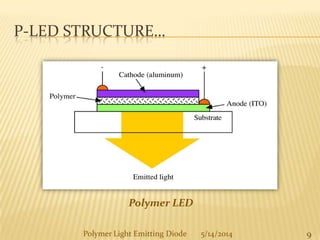
P-LED STRUCTURE…
9
Polymer LED
Polymer Light Emitting Diode 5/14/2014
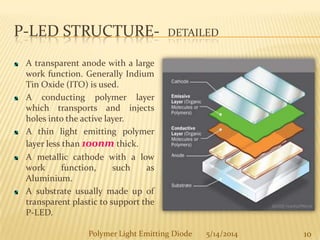
P-LED STRUCTURE- DETAILED
A transparent anode with a large
work function. Generally Indium
Tin Oxide (ITO) is used.
A conducting polymer layer
which transports and injects
holes into the active layer.
A thin light emitting polymer
layer less than 100nm thick.
A metallic cathode with a low
work function, such as
Aluminium.
A substrate usually made up of
transparent plastic to support the
P-LED.
10Polymer Light Emitting Diode 5/14/2014
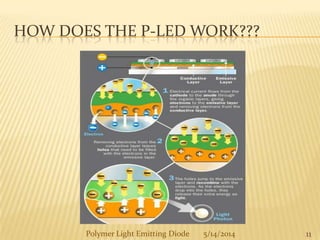
HOW DOES THE P-LED WORK???
11Polymer Light Emitting Diode 5/14/2014
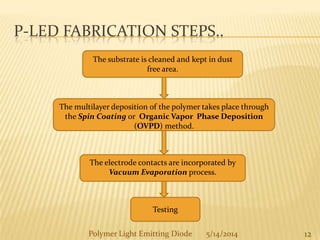
P-LED FABRICATION STEPS..
The substrate is cleaned and kept in dust
free area.
The electrode contacts are incorporated by
Vacuum Evaporation process.
Testing
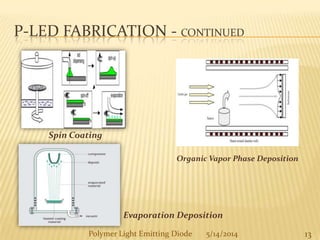
The multilayer deposition of the polymer takes place through
the Spin Coating or Organic Vapor Phase Deposition
(OVPD) method.
12Polymer Light Emitting Diode 5/14/2014
P-LED FABRICATION - CONTINUED
Spin Coating
Evaporation Deposition
13Polymer Light Emitting Diode 5/14/2014
Organic Vapor Phase Deposition
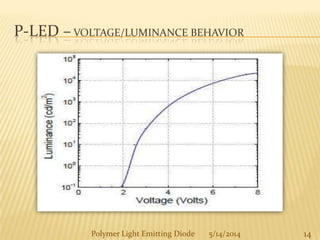
P-LED –VOLTAGE/LUMINANCE BEHAVIOR
14Polymer Light Emitting Diode 5/14/2014
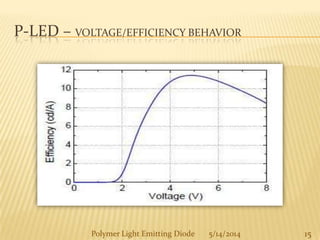
P-LED – VOLTAGE/EFFICIENCY BEHAVIOR
15Polymer Light Emitting Diode 5/14/2014
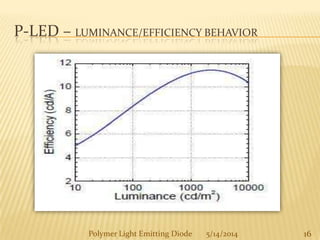
P-LED – LUMINANCE/EFFICIENCY BEHAVIOR
16Polymer Light Emitting Diode 5/14/2014
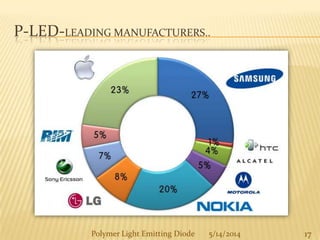
P-LED-LEADING MANUFACTURERS..
17Polymer Light Emitting Diode 5/14/2014
P-LED- INDUSTRIAL APPLICATIONS…
23%
19%
16%
12%
8%
6%
4%
12%
Lighting Imaging Technology Developers
Display Manufacturers Materials Automotive
Academic Other
18Polymer Light Emitting Diode 5/14/2014
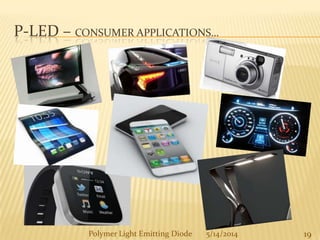
P-LED – CONSUMER APPLICATIONS…
19Polymer Light Emitting Diode 5/14/2014
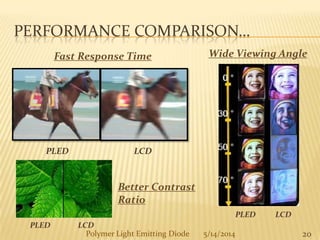
PERFORMANCE COMPARISON…
20
PLED LCD
Polymer Light Emitting Diode 5/14/2014
Fast Response Time Wide Viewing Angle
PLED LCD
Better Contrast
Ratio
PLED LCD
CHALLENGES…
 Limited lifetime of the organic materials.
"After 1,000 hours:
the blue luminance gets degraded by 12%,
the red by 7% and
the green by 8%.”
 Color Balance.
 Water Damage.
 More power is consumed when used against white background.
 The metallic cathode in an OLED acts as a mirror, with reflectance
approaching 80%, leading to poor readability in bright ambient light such
as outdoors.
21Polymer Light Emitting Diode 5/14/2014
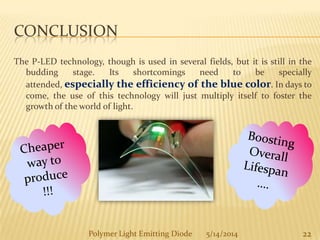
CONCLUSION
The P-LED technology, though is used in several fields, but it is still in the
budding stage. Its shortcomings need to be specially
attended, especially the efficiency of the blue color. In days to
come, the use of this technology will just multiply itself to foster the
growth of the world of light.
22Polymer Light Emitting Diode 5/14/2014
REFERENCES..
 http://www.ewh.ieee.org/soc/cpmt/presentations/cpmt0401a.pdf
 http://www.cdtltd.co.uk/technology/introduction-to-p-oleds/
 http://www.nature.com/physics/looking-back/burroughes/index.html
 https://www.rochester.edu/news/show.php?id=829
 http://electronics.howstuffworks.com/oled.htm
 Research journal on ADVANCED MATERIALS by C.W. Tang
 Research journal on LIGHT EMITTING POLYMERS by Dmitrii F.
Perepichka, Igor F. Perepichka, Hong Meng, Fred Wudl.
 Research journal on POLYMER LEDs by Christian Wenning.
 Research journal on PROGRESS IN POLYMER OLED EFFICIENCY by
M. Roberts, N. Akino, K. Asada, P. Benzie, H. Hamamatsu, M. Hatcher, S.
King, E. Snedden, A. Stevens, S. Tanaka, J. Toner, R. Wilson, W.Young, T.
Yamada
23Polymer Light Emitting Diode 5/14/2014
Polymer Light Emitting Diode

Polymer Light Emitting Diode

  • 1.
    POLYMER LIGHT EMITTINGDIODE Biswajit Acharya M.Tech,AEIE,1st Year Heritage Institute of Technology.
  • 2.
    OUTLINE… Introduction to LED,its classes, polymers and LEP Need to go for P-LEDs Structure and operation of the P-LED Fabrication Steps of P-LED Various characteristics of P-LEDs P-LED Manufacturers, Applications and Challenges. Conclusion and References.. 2Polymer Light Emitting Diode 5/14/2014
  • 3.
    POLYMER… A chemical compoundor mixture of compounds (usually hydrocarbons) consisting essentially of repeating structural units called monomers formed by polymerization. Polythene Poly-vinyl chloride (PVC) Poly-Phenylenevinylene (PPV) 3Polymer Light Emitting Diode 5/14/2014
  • 4.
    LIGHT EMITTING DIODES.. 4PolymerLight Emitting Diode 5/14/2014
  • 5.
    LIGHT EMITTING POLYMER Conjugatedpolymers are organic semiconductors, the semiconducting behavior is associated with the “π” molecular orbitals, delocalized along the polymer chain. The injection of an electron and a hole on the conjugated chain can lead to a self-localized excited state which can then decay radiatively. 5Polymer Light Emitting Diode 5/14/2014
  • 6.
    LIGHT EMITTING POLYMERS… HOWIT ALL BEGAN A light emitting polymer is an electro-luminescent plastic. The molecules of this plastic emit light when an electric field is applied. The first observations of electroluminescence in organic materials were in the early 1950s by André Bernanose, in France. Electroluminescence from polymer films was first observed by Roger Partridge at the National Physical Laboratory in the United Kingdom in 1983. The first diode device was reported by Ching W. Tang and Steven Van Slyke in 1987. J. H. Burroughes reported a high efficiency green light-emitting polymer based device in 1990. 6Polymer Light Emitting Diode 5/14/2014
  • 7.
    7 Just Imagine Viewing a HDTV that is 80 inches wide and less than a quarter-inch thick, consumes less power than most TVs on the market today and can be rolled up when not in use.!!! What if you could have a "heads up" display in your car.!!! How about a display monitor built into your clothing…..!!! Polymer Light Emitting Diode 5/14/2014
  • 8.
    WHY P-LEDS ??? Lightweight and flexible, so they can be simply used to make thin films.  Extraordinary resolution which provide high quality imaging;  Can be seen from any angle without the loss of information;  Enable more energy efficiency;  Consume less power;  They can be used to make flexible displays;  They offer high brightness at low drive voltages;  They ensure glare-free viewing; 8Polymer Light Emitting Diode 5/14/2014
  • 9.
    P-LED STRUCTURE… 9 Polymer LED PolymerLight Emitting Diode 5/14/2014
  • 10.
    P-LED STRUCTURE- DETAILED Atransparent anode with a large work function. Generally Indium Tin Oxide (ITO) is used. A conducting polymer layer which transports and injects holes into the active layer. A thin light emitting polymer layer less than 100nm thick. A metallic cathode with a low work function, such as Aluminium. A substrate usually made up of transparent plastic to support the P-LED. 10Polymer Light Emitting Diode 5/14/2014
  • 11.
    HOW DOES THEP-LED WORK??? 11Polymer Light Emitting Diode 5/14/2014
  • 12.
    P-LED FABRICATION STEPS.. Thesubstrate is cleaned and kept in dust free area. The electrode contacts are incorporated by Vacuum Evaporation process. Testing The multilayer deposition of the polymer takes place through the Spin Coating or Organic Vapor Phase Deposition (OVPD) method. 12Polymer Light Emitting Diode 5/14/2014
  • 13.
    P-LED FABRICATION -CONTINUED Spin Coating Evaporation Deposition 13Polymer Light Emitting Diode 5/14/2014 Organic Vapor Phase Deposition
  • 14.
    P-LED –VOLTAGE/LUMINANCE BEHAVIOR 14PolymerLight Emitting Diode 5/14/2014
  • 15.
    P-LED – VOLTAGE/EFFICIENCYBEHAVIOR 15Polymer Light Emitting Diode 5/14/2014
  • 16.
    P-LED – LUMINANCE/EFFICIENCYBEHAVIOR 16Polymer Light Emitting Diode 5/14/2014
  • 17.
  • 18.
    P-LED- INDUSTRIAL APPLICATIONS… 23% 19% 16% 12% 8% 6% 4% 12% LightingImaging Technology Developers Display Manufacturers Materials Automotive Academic Other 18Polymer Light Emitting Diode 5/14/2014
  • 19.
    P-LED – CONSUMERAPPLICATIONS… 19Polymer Light Emitting Diode 5/14/2014
  • 20.
    PERFORMANCE COMPARISON… 20 PLED LCD PolymerLight Emitting Diode 5/14/2014 Fast Response Time Wide Viewing Angle PLED LCD Better Contrast Ratio PLED LCD
  • 21.
    CHALLENGES…  Limited lifetimeof the organic materials. "After 1,000 hours: the blue luminance gets degraded by 12%, the red by 7% and the green by 8%.”  Color Balance.  Water Damage.  More power is consumed when used against white background.  The metallic cathode in an OLED acts as a mirror, with reflectance approaching 80%, leading to poor readability in bright ambient light such as outdoors. 21Polymer Light Emitting Diode 5/14/2014
  • 22.
    CONCLUSION The P-LED technology,though is used in several fields, but it is still in the budding stage. Its shortcomings need to be specially attended, especially the efficiency of the blue color. In days to come, the use of this technology will just multiply itself to foster the growth of the world of light. 22Polymer Light Emitting Diode 5/14/2014
  • 23.
    REFERENCES..  http://www.ewh.ieee.org/soc/cpmt/presentations/cpmt0401a.pdf  http://www.cdtltd.co.uk/technology/introduction-to-p-oleds/ http://www.nature.com/physics/looking-back/burroughes/index.html  https://www.rochester.edu/news/show.php?id=829  http://electronics.howstuffworks.com/oled.htm  Research journal on ADVANCED MATERIALS by C.W. Tang  Research journal on LIGHT EMITTING POLYMERS by Dmitrii F. Perepichka, Igor F. Perepichka, Hong Meng, Fred Wudl.  Research journal on POLYMER LEDs by Christian Wenning.  Research journal on PROGRESS IN POLYMER OLED EFFICIENCY by M. Roberts, N. Akino, K. Asada, P. Benzie, H. Hamamatsu, M. Hatcher, S. King, E. Snedden, A. Stevens, S. Tanaka, J. Toner, R. Wilson, W.Young, T. Yamada 23Polymer Light Emitting Diode 5/14/2014