MICROPOWERSYSTEMSBy:____________________________________________________________________________________________________________
TopicsDriving forces for micro power systemsEnergy scavenging/ collecting systemsEnergy reservoir/ power generation systems
What is Micro Power??Generation of small amounts of electricity from sources close to where it's used. Eliminates the need for both excess production by the traditional generating stations powered by coal, oil or nuclear power, and transmission grids to deliver that power.
Why Micro Power Now??
Why Micro Power ??renewable, on the site energy and reducing greenhouse gas emissions plan not to replace the traditional electrical grid providing reliable service in remote communities waste energy scavenger concepts
Energy Scavenging Areas       1.Solar/Ambient Light		 2.Temperature Gradients		 3.Human Power		 4.Air Flow		 5.Pressure Gradients		 6.Vibrations
Solar and Ambient LightSourcesNoon on a sunny day - 100 mW/cm2Office Lights: 7.2 mW/cm2CollectorsSC Silicon15% - 30% efficientPoly-Silicon 10% - 15% efficientPhotoelectric Dyes5% to 10% efficientSolar Powered Pico Radio Node
Solar PV ArraysSolar Photo Voltaic (solar PV) is the direct conversion of solar energy into electricity They are formed using semi-conductor materials like SiLight energy bounces the electrons away from their atoms	   † flow of electrons	   † current
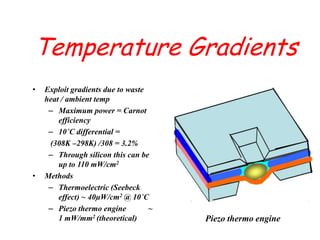
Temperature GradientsExploit gradients due to waste heat / ambient temp Maximum power = Carnot efficiency10˚C differential = (308K –298K) /308 = 3.2%Through silicon this can be up to 110 mW/cm2MethodsThermoelectric (Seebeck effect) ~ 40µW/cm2 @ 10˚CPiezo thermo engine           ~ 1 mW/mm2 (theoretical)Piezo thermo engine
Autonomous nodes can only become reality when research on ultra-low-power electronics and micro-power generators join forcesThermal energy scavengers that use Seebeck effect to transform the temperature difference between the environment and the human body into electricityGenerators are mounted on a bracelet - 150μW Bismuth telluride thermoelectric block, consisting of about 3000 thermocouplesFlexible wireless sensor moduleattached to this bracelet and powered by the thermoelectric generator
Air FlowPower output/ efficiencies vary with velocity and motorsApplications exist where average air flow may be on the order of 5 m/sAt 100% efficiency ~1 mWMEMS turbines may be viable
Pressure GradientsUsing ambient pressure variationsOn a given day, for a change of .2 inches Hg, density on the order of  nW/cm3Manipulating temperatureUsing 1 cm3 of helium, assuming 10˚C and ideal gas behavior, ~ µW/cm3No active research on pressure gradient manipulation
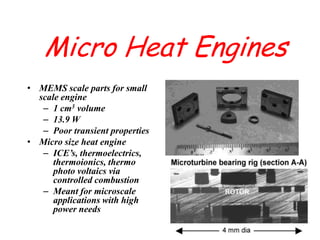
Micro Heat EnginesMEMS scale parts for small scale engine1 cm3 volume13.9 WPoor transient propertiesMicro size heat engineICE’s, thermoelectrics, thermoionics, thermo photo voltaics via controlled combustionMeant for microscale applications with high power needs
Solar PV ArraysSolar Photo Voltaic (solar PV) is the direct conversion of solar energy into electricity They are formed using semi-conductor materials like SiLight energy bounces the electrons away from their atoms	   † flow of electrons	   † current
Temperature GradientsExploit gradients due to waste heat / ambient temp Maximum power = Carnot efficiency10˚C differential = (308K –298K) /308 = 3.2%Through silicon this can be up to 110 mW/cm2MethodsThermoelectric (Seebeck effect) ~ 40µW/cm2 @ 10˚CPiezo thermo engine           ~ 1 mW/mm2 (theoretical)Piezo thermo engine
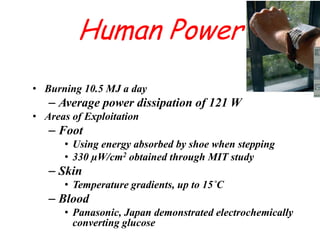
Human PowerBurning 10.5 MJ a dayAverage power dissipation of 121 WAreas of ExploitationFootUsing energy absorbed by shoe when stepping330 µW/cm2 obtained through MIT studySkinTemperature gradients, up to 15˚CBloodPanasonic, Japan demonstrated electrochemically converting glucose
Autonomous nodes can only become reality when research on ultra-low-power electronics and micro-power generators join forcesThermal energy scavengers that use Seebeck effect to transform the temperature difference between the environment and the human body into electricityGenerators are mounted on a bracelet - 150μW Bismuth telluride thermoelectric block, consisting of about 3000 thermocouplesFlexible wireless sensor moduleattached to this bracelet and powered by the thermoelectric generator
Air FlowPower output/ efficiencies vary with velocity and motorsApplications exist where average air flow may be on the order of 5 m/sAt 100% efficiency ~1 mWMEMS turbines may be viable
Pressure GradientsUsing ambient pressure variationsOn a given day, for a change of .2 inches Hg, density on the order of  nW/cm3Manipulating temperatureUsing 1 cm3 of helium, assuming 10˚C and ideal gas behavior, ~ µW/cm3No active research on pressure gradient manipulation
Energy Reservoirs/Power Generation   Batteries	Fuel Cells	Capacitors	Heat Engines	Radioactive Sources
BatteriesMacro Batteries - too bigZinc air (3500 J/cm3), Alkaline (1800 J/cm3),		Lithium (1000 - 2880 J/cm3)Micro Batteries - on the wayLithium		(i) Thin film Li (1-D micro scale, 2-D macro scale )		(ii) 3-D Lithium Ion (in initial stages)Ni/ NaOH /Zn
MEMS Fuel CellCurrent GenerationToshiba 1 cm3 hydrogen reactorProduces 1wattNext GenerationPlanar ArraysFraunhofer - 100 mW/cm2Stanford - > 40 mW/cm2 (more room for improvement)FraunhoferStanford University
CapacitorsCapacitorsEnergy density too low to be a real secondary storage componentUltra capacitorsEnergy density on order of 75 J/cm3Work being done to shrink them
Micro Heat EnginesMEMS scale parts for small scale engine1 cm3 volume13.9 WPoor transient propertiesMicro size heat engineICE’s, thermoelectrics, thermoionics, thermo photo voltaics via controlled combustionMeant for microscale applications with high power needs
Radioactive Approaches!!High theoretical energy densityPower density inversely proportional to half lifeDemonstrated power on the order of nanowattsEnvironmental concerns
CONCLUSIONProduce high quality competitive R&DMicropower: The Next Electrical Era Emergency Micro-Power SystemsSqueezed every wasted kilowatt-hour or leaking calorie of heat out of our homes and businesses
REFERENCESterrain.orgpowerconnect.commicropower-connect.orgthe-infoshop.com
THANK YOU

Micro Power Stations

  • 1.
  • 2.
    TopicsDriving forces formicro power systemsEnergy scavenging/ collecting systemsEnergy reservoir/ power generation systems
  • 3.
    What is MicroPower??Generation of small amounts of electricity from sources close to where it's used. Eliminates the need for both excess production by the traditional generating stations powered by coal, oil or nuclear power, and transmission grids to deliver that power.
  • 4.
  • 5.
    Why Micro Power??renewable, on the site energy and reducing greenhouse gas emissions plan not to replace the traditional electrical grid providing reliable service in remote communities waste energy scavenger concepts
  • 6.
    Energy Scavenging Areas 1.Solar/Ambient Light 2.Temperature Gradients 3.Human Power 4.Air Flow 5.Pressure Gradients 6.Vibrations
  • 7.
    Solar and AmbientLightSourcesNoon on a sunny day - 100 mW/cm2Office Lights: 7.2 mW/cm2CollectorsSC Silicon15% - 30% efficientPoly-Silicon 10% - 15% efficientPhotoelectric Dyes5% to 10% efficientSolar Powered Pico Radio Node
  • 8.
    Solar PV ArraysSolarPhoto Voltaic (solar PV) is the direct conversion of solar energy into electricity They are formed using semi-conductor materials like SiLight energy bounces the electrons away from their atoms † flow of electrons † current
  • 9.
    Solar PV ArraysSolarPhoto Voltaic (solar PV) is the direct conversion of solar energy into electricity They are formed using semi-conductor materials like SiLight energy bounces the electrons away from their atoms † flow of electrons † current
  • 10.
    Temperature GradientsExploit gradientsdue to waste heat / ambient temp Maximum power = Carnot efficiency10˚C differential = (308K –298K) /308 = 3.2%Through silicon this can be up to 110 mW/cm2MethodsThermoelectric (Seebeck effect) ~ 40µW/cm2 @ 10˚CPiezo thermo engine ~ 1 mW/mm2 (theoretical)Piezo thermo engine
  • 11.
    Autonomous nodes canonly become reality when research on ultra-low-power electronics and micro-power generators join forcesThermal energy scavengers that use Seebeck effect to transform the temperature difference between the environment and the human body into electricityGenerators are mounted on a bracelet - 150μW Bismuth telluride thermoelectric block, consisting of about 3000 thermocouplesFlexible wireless sensor moduleattached to this bracelet and powered by the thermoelectric generator
  • 12.
    Air FlowPower output/efficiencies vary with velocity and motorsApplications exist where average air flow may be on the order of 5 m/sAt 100% efficiency ~1 mWMEMS turbines may be viable
  • 13.
    Pressure GradientsUsing ambientpressure variationsOn a given day, for a change of .2 inches Hg, density on the order of nW/cm3Manipulating temperatureUsing 1 cm3 of helium, assuming 10˚C and ideal gas behavior, ~ µW/cm3No active research on pressure gradient manipulation
  • 14.
    Micro Heat EnginesMEMSscale parts for small scale engine1 cm3 volume13.9 WPoor transient propertiesMicro size heat engineICE’s, thermoelectrics, thermoionics, thermo photo voltaics via controlled combustionMeant for microscale applications with high power needs
  • 15.
    Solar PV ArraysSolarPhoto Voltaic (solar PV) is the direct conversion of solar energy into electricity They are formed using semi-conductor materials like SiLight energy bounces the electrons away from their atoms † flow of electrons † current
  • 16.
    Temperature GradientsExploit gradientsdue to waste heat / ambient temp Maximum power = Carnot efficiency10˚C differential = (308K –298K) /308 = 3.2%Through silicon this can be up to 110 mW/cm2MethodsThermoelectric (Seebeck effect) ~ 40µW/cm2 @ 10˚CPiezo thermo engine ~ 1 mW/mm2 (theoretical)Piezo thermo engine
  • 17.
    Human PowerBurning 10.5MJ a dayAverage power dissipation of 121 WAreas of ExploitationFootUsing energy absorbed by shoe when stepping330 µW/cm2 obtained through MIT studySkinTemperature gradients, up to 15˚CBloodPanasonic, Japan demonstrated electrochemically converting glucose
  • 18.
    Autonomous nodes canonly become reality when research on ultra-low-power electronics and micro-power generators join forcesThermal energy scavengers that use Seebeck effect to transform the temperature difference between the environment and the human body into electricityGenerators are mounted on a bracelet - 150μW Bismuth telluride thermoelectric block, consisting of about 3000 thermocouplesFlexible wireless sensor moduleattached to this bracelet and powered by the thermoelectric generator
  • 19.
    Air FlowPower output/efficiencies vary with velocity and motorsApplications exist where average air flow may be on the order of 5 m/sAt 100% efficiency ~1 mWMEMS turbines may be viable
  • 20.
    Pressure GradientsUsing ambientpressure variationsOn a given day, for a change of .2 inches Hg, density on the order of nW/cm3Manipulating temperatureUsing 1 cm3 of helium, assuming 10˚C and ideal gas behavior, ~ µW/cm3No active research on pressure gradient manipulation
  • 21.
    Energy Reservoirs/Power Generation Batteries Fuel Cells Capacitors Heat Engines Radioactive Sources
  • 22.
    BatteriesMacro Batteries -too bigZinc air (3500 J/cm3), Alkaline (1800 J/cm3), Lithium (1000 - 2880 J/cm3)Micro Batteries - on the wayLithium (i) Thin film Li (1-D micro scale, 2-D macro scale ) (ii) 3-D Lithium Ion (in initial stages)Ni/ NaOH /Zn
  • 23.
    MEMS Fuel CellCurrentGenerationToshiba 1 cm3 hydrogen reactorProduces 1wattNext GenerationPlanar ArraysFraunhofer - 100 mW/cm2Stanford - > 40 mW/cm2 (more room for improvement)FraunhoferStanford University
  • 24.
    CapacitorsCapacitorsEnergy density toolow to be a real secondary storage componentUltra capacitorsEnergy density on order of 75 J/cm3Work being done to shrink them
  • 25.
    Micro Heat EnginesMEMSscale parts for small scale engine1 cm3 volume13.9 WPoor transient propertiesMicro size heat engineICE’s, thermoelectrics, thermoionics, thermo photo voltaics via controlled combustionMeant for microscale applications with high power needs
  • 26.
    Radioactive Approaches!!High theoreticalenergy densityPower density inversely proportional to half lifeDemonstrated power on the order of nanowattsEnvironmental concerns
  • 27.
    CONCLUSIONProduce high qualitycompetitive R&DMicropower: The Next Electrical Era Emergency Micro-Power SystemsSqueezed every wasted kilowatt-hour or leaking calorie of heat out of our homes and businesses
  • 28.
  • 29.