Tsunami   Detector
Tsunami A sea wave of local or distant origin that results from large-scale seafloor displacements associated with large earthquakes, major submarine slides, or exploding volcanic islands.
Regular Wind Generated Wave 10 Feet 300 Feet Speed: 10-20 mph
Tsunami in Deep Ocean 1-2 Feet 316,800 Feet Speed: 450-650 mph
Tsunami Approaching Shore 10-100+ Feet 5,000 – 10,000 Feet Speed: 35-220 mph
Tsunami Cycle Tidal Surge Underlying Geological Event Water Displaced Wave Propagation Tidal Withdraw Detection Opportunities
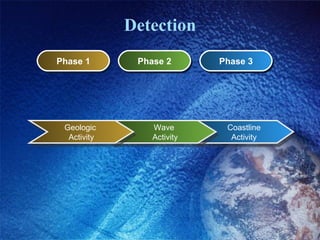
Detection Coastline Activity Wave  Activity Geologic  Activity Phase 1 Phase 2 Phase 3
Current State of the Art 5,000 M Surface Buoy Hydrophone Anchor Tsunami Detector Acoustic Link Satellite Gonzalez, F.I. (1999): Tsunami!. Scientific American, 280(5), 56-65
Advantages & Drawbacks Advantages Deep water pressure produces relatively low false-positives as wind-driven waves do not generate deep pressure differentials Multiple sensors can triangulate epicenter of water displacement and wave propagation can be predicted. Good advance warning Drawbacks Expensive equipment High maintenance Requires multiple communication links: Sonar Satellite uplink Satellite downlink Last-mile notification to authorities Authorities must notify coastal dwellers
Genesis Tsunami Coastal Alert Deep sea pressure Seismic Events Surface anomalies Coastal Alarm & Detection
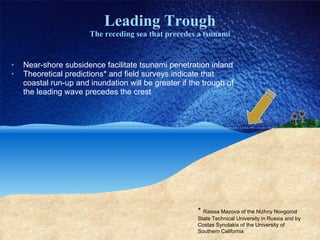
Leading Trough The receding sea that precedes a tsunami Near-shore subsidence facilitate tsunami penetration inland  Theoretical predictions *  and field surveys indicate that coastal run-up and inundation will be greater if the trough of the leading wave precedes the crest  *   Raissa Mazova of the Nizhny Novgorod State Technical University in Russia and by Costas Synolakis of the University of Southern California
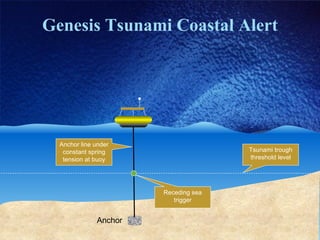
Genesis Tsunami Coastal Alert Anchor Tsunami trough threshold level Receding sea trigger Anchor line under constant spring tension at buoy
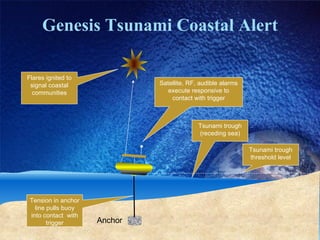
Genesis Tsunami Coastal Alert Anchor Tsunami trough threshold level Tsunami trough (receding sea) Tension in anchor line pulls buoy into contact  with trigger Flares ignited to signal coastal communities Satellite, RF, audible alarms execute responsive to contact with trigger
Genesis Tsunami Coastal Alert Buoy measures tsunami crest – broadcasts satellite data for emergency response in other areas.
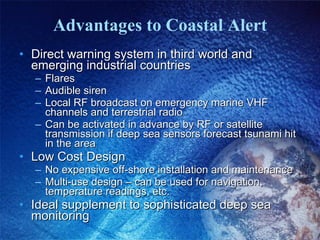
Advantages to Coastal Alert Direct warning system in third world and emerging industrial countries Flares Audible siren Local RF broadcast on emergency marine VHF channels and terrestrial radio Can be activated in advance by RF or satellite transmission if deep sea sensors forecast tsunami hit in the area Low Cost Design No expensive off-shore installation and maintenance Multi-use design – can be used for navigation, temperature readings, etc. Ideal supplement to sophisticated deep sea monitoring
Genesis Tsunami Offshore Alert Responsive to seismic event GTOA releases non-buoyant pressure sensors at multiple depths below normal wave action. Genesis Offshore 02
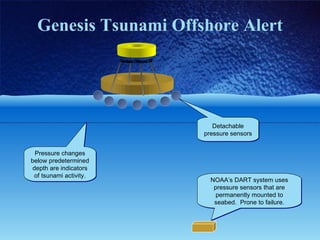
Genesis Tsunami Offshore Alert Detachable pressure sensors Pressure changes below predetermined depth are indicators of tsunami activity. NOAA’s DART system uses pressure sensors that are permanently mounted to seabed.  Prone to failure. Genesis Offshore 02
Genesis Tsunami Offshore Alert Detachable pressure sensors Pressure changes below predetermined depth are indicators of tsunami activity. Seismic event detected – Genesis Offshore buoys drop pressure sensors to multiple depths. Pressure Wave Genesis Offshore 02
Genesis Tsunami Offshore Alert Detachable pressure sensors Pressure changes below predetermined depth are indicators of tsunami activity. Pressure readings are relayed to monitoring station.  Multiple readings provide more accurate analysis of deep pressure readings. Satellite Genesis Offshore 02
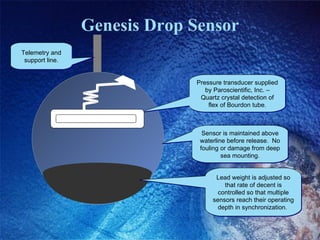
Genesis Drop Sensor Lead weight is adjusted so that rate of decent is controlled so that multiple sensors reach their operating depth in synchronization.  Sensor is maintained above waterline before release.  No fouling or damage from deep sea mounting. Pressure transducer supplied by Paroscientific, Inc. – Quartz crystal detection of flex of Bourdon tube. Telemetry and support line.
Genesis Tsunami Offshore Alert No permanent seabed pressure sensor Pressure readings at multiple depths Pressure transducer equipment kept out of hostile environment until deployed Redundancy if a sensor fails Lower false positives No ROV needed for maintenance or deployment
Genesis Tsunami System Costal detection and notification Offshore monitoring and early warning Integrated systems provide prediction, notification and warning in a single package. Low costs for deployment and maintenance Superior data capture and uptime
Deep Sea P Sensor
Deep-sea pressure sensors (Germany)
 
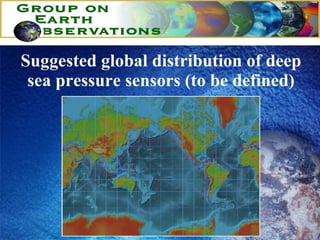
Suggested global distribution of deep sea pressure sensors (to be defined)
Suggested placement of new seismographic and deep sea pressure sensors (India)
Suggested real-time sea level stations (India)
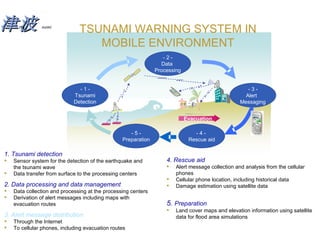
TSUNAMI WARNING SYSTEM IN MOBILE ENVIRONMENT SOURCE:  earth.observation@vtt.fi  www.vtt.fi/space 1. Tsunami detection   Sensor system for the detection of the earthquake and the tsunami wave  Data transfer from surface to the processing centers 2. Data processing and data management Data collection and processing at the processing centers Derivation of alert messages including maps with evacuation routes 3. Alert message distribution Through the Internet To cellular phones, including evacuation routes 4. Rescue aid  Alert message collection and analysis from the cellular phones Cellular phone location, including historical data Damage estimation using satellite data   5.  Preparation Land cover maps and elevation information using satellite data for flood area simulations 津波   tsu  nami  
Local Tsunami – Alert System * Earthquake->Tsunami Seismic recording Civil Defense – to local administrations, 10 min Evacuation wave arrives in   45 minutes! Analysis – Seismic data center Automatic procedures: -Broad band sensor Small seismic array Virtual regional network Radio, TV stations – to population, 2 min Cellular phone –to local population, 2 min 10 min ? human factor 3 min
Civil defence communication system Chinandega (El viejo) 1.- Venecia 2.- Aposentillo 3.- Jiquilillo 4.- Aserraderos 5.- Los Zorros 6.- Padre Ramos 7.- Mechapa 8.- Punta Nata 9.- Potosí Chinandega (Corinto) 10.- Corinto 11.- Isla del Cardón 12.- Isla del Amor Chinandega   (El   Realejo ) 13.- Isla Maderas Negras 14.- Isla Paredones 15.- Paso Caballos León 16.- El Tránsito  17.- Puerto Sandino 18.- Salinas Grandes 19.- Poneloya 20.- Las Peñitas 21.- Los Brasiles Managua 22.- Salamina 23.- Montelimar 24.- Masachapa 25.- Pochomil 26.- San Diego 27.- Gran Pacífica 28.- Miraflores Carazo 29.- Casares 30.- La Boquita 31.- Bocana de Masapa Jinotepe 32.- Tipilapa 33.- Huehuete 34.- La Bocana Rivas 35.- El Ostional 36.- San Juan del Sur 37.- El Menco 38.- El Gigante 39.- San Martín 40.- Las Salinas 41.- El Astillero 42.- La Flor (130,000)  under risk 1 34 38 37 2 3 4 6 5 8 7 9 10 11 12 13 14 15 16 17 18 19 20 21 22 23 24 25 26 27 28 29 30 31 32 33 35 36 39 40 41 42 Source Defensa Civil, 2005 INETER CODE DEFENSA CIVIL 90 kms 45 min
New communication methods (in development) Alert messenger to PC screen of radio/TV presenters (under testing) SMS cell phone to decision maker (under testing) SMS cell phone to large sectors of population (under development )
 
Thank   you

Tsunami Detector1 Ppt

  • 1.
    Tsunami Detector
  • 2.
    Tsunami A seawave of local or distant origin that results from large-scale seafloor displacements associated with large earthquakes, major submarine slides, or exploding volcanic islands.
  • 3.
    Regular Wind GeneratedWave 10 Feet 300 Feet Speed: 10-20 mph
  • 4.
    Tsunami in DeepOcean 1-2 Feet 316,800 Feet Speed: 450-650 mph
  • 5.
    Tsunami Approaching Shore10-100+ Feet 5,000 – 10,000 Feet Speed: 35-220 mph
  • 6.
    Tsunami Cycle TidalSurge Underlying Geological Event Water Displaced Wave Propagation Tidal Withdraw Detection Opportunities
  • 7.
    Detection Coastline ActivityWave Activity Geologic Activity Phase 1 Phase 2 Phase 3
  • 8.
    Current State ofthe Art 5,000 M Surface Buoy Hydrophone Anchor Tsunami Detector Acoustic Link Satellite Gonzalez, F.I. (1999): Tsunami!. Scientific American, 280(5), 56-65
  • 9.
    Advantages & DrawbacksAdvantages Deep water pressure produces relatively low false-positives as wind-driven waves do not generate deep pressure differentials Multiple sensors can triangulate epicenter of water displacement and wave propagation can be predicted. Good advance warning Drawbacks Expensive equipment High maintenance Requires multiple communication links: Sonar Satellite uplink Satellite downlink Last-mile notification to authorities Authorities must notify coastal dwellers
  • 10.
    Genesis Tsunami CoastalAlert Deep sea pressure Seismic Events Surface anomalies Coastal Alarm & Detection
  • 11.
    Leading Trough Thereceding sea that precedes a tsunami Near-shore subsidence facilitate tsunami penetration inland Theoretical predictions * and field surveys indicate that coastal run-up and inundation will be greater if the trough of the leading wave precedes the crest * Raissa Mazova of the Nizhny Novgorod State Technical University in Russia and by Costas Synolakis of the University of Southern California
  • 12.
    Genesis Tsunami CoastalAlert Anchor Tsunami trough threshold level Receding sea trigger Anchor line under constant spring tension at buoy
  • 13.
    Genesis Tsunami CoastalAlert Anchor Tsunami trough threshold level Tsunami trough (receding sea) Tension in anchor line pulls buoy into contact with trigger Flares ignited to signal coastal communities Satellite, RF, audible alarms execute responsive to contact with trigger
  • 14.
    Genesis Tsunami CoastalAlert Buoy measures tsunami crest – broadcasts satellite data for emergency response in other areas.
  • 15.
    Advantages to CoastalAlert Direct warning system in third world and emerging industrial countries Flares Audible siren Local RF broadcast on emergency marine VHF channels and terrestrial radio Can be activated in advance by RF or satellite transmission if deep sea sensors forecast tsunami hit in the area Low Cost Design No expensive off-shore installation and maintenance Multi-use design – can be used for navigation, temperature readings, etc. Ideal supplement to sophisticated deep sea monitoring
  • 16.
    Genesis Tsunami OffshoreAlert Responsive to seismic event GTOA releases non-buoyant pressure sensors at multiple depths below normal wave action. Genesis Offshore 02
  • 17.
    Genesis Tsunami OffshoreAlert Detachable pressure sensors Pressure changes below predetermined depth are indicators of tsunami activity. NOAA’s DART system uses pressure sensors that are permanently mounted to seabed. Prone to failure. Genesis Offshore 02
  • 18.
    Genesis Tsunami OffshoreAlert Detachable pressure sensors Pressure changes below predetermined depth are indicators of tsunami activity. Seismic event detected – Genesis Offshore buoys drop pressure sensors to multiple depths. Pressure Wave Genesis Offshore 02
  • 19.
    Genesis Tsunami OffshoreAlert Detachable pressure sensors Pressure changes below predetermined depth are indicators of tsunami activity. Pressure readings are relayed to monitoring station. Multiple readings provide more accurate analysis of deep pressure readings. Satellite Genesis Offshore 02
  • 20.
    Genesis Drop SensorLead weight is adjusted so that rate of decent is controlled so that multiple sensors reach their operating depth in synchronization. Sensor is maintained above waterline before release. No fouling or damage from deep sea mounting. Pressure transducer supplied by Paroscientific, Inc. – Quartz crystal detection of flex of Bourdon tube. Telemetry and support line.
  • 21.
    Genesis Tsunami OffshoreAlert No permanent seabed pressure sensor Pressure readings at multiple depths Pressure transducer equipment kept out of hostile environment until deployed Redundancy if a sensor fails Lower false positives No ROV needed for maintenance or deployment
  • 22.
    Genesis Tsunami SystemCostal detection and notification Offshore monitoring and early warning Integrated systems provide prediction, notification and warning in a single package. Low costs for deployment and maintenance Superior data capture and uptime
  • 23.
    Deep Sea PSensor
  • 24.
  • 25.
  • 26.
    Suggested global distributionof deep sea pressure sensors (to be defined)
  • 27.
    Suggested placement ofnew seismographic and deep sea pressure sensors (India)
  • 28.
    Suggested real-time sealevel stations (India)
  • 29.
    TSUNAMI WARNING SYSTEMIN MOBILE ENVIRONMENT SOURCE: earth.observation@vtt.fi www.vtt.fi/space 1. Tsunami detection Sensor system for the detection of the earthquake and the tsunami wave Data transfer from surface to the processing centers 2. Data processing and data management Data collection and processing at the processing centers Derivation of alert messages including maps with evacuation routes 3. Alert message distribution Through the Internet To cellular phones, including evacuation routes 4. Rescue aid Alert message collection and analysis from the cellular phones Cellular phone location, including historical data Damage estimation using satellite data 5. Preparation Land cover maps and elevation information using satellite data for flood area simulations 津波   tsu nami  
  • 30.
    Local Tsunami –Alert System * Earthquake->Tsunami Seismic recording Civil Defense – to local administrations, 10 min Evacuation wave arrives in 45 minutes! Analysis – Seismic data center Automatic procedures: -Broad band sensor Small seismic array Virtual regional network Radio, TV stations – to population, 2 min Cellular phone –to local population, 2 min 10 min ? human factor 3 min
  • 31.
    Civil defence communicationsystem Chinandega (El viejo) 1.- Venecia 2.- Aposentillo 3.- Jiquilillo 4.- Aserraderos 5.- Los Zorros 6.- Padre Ramos 7.- Mechapa 8.- Punta Nata 9.- Potosí Chinandega (Corinto) 10.- Corinto 11.- Isla del Cardón 12.- Isla del Amor Chinandega (El Realejo ) 13.- Isla Maderas Negras 14.- Isla Paredones 15.- Paso Caballos León 16.- El Tránsito 17.- Puerto Sandino 18.- Salinas Grandes 19.- Poneloya 20.- Las Peñitas 21.- Los Brasiles Managua 22.- Salamina 23.- Montelimar 24.- Masachapa 25.- Pochomil 26.- San Diego 27.- Gran Pacífica 28.- Miraflores Carazo 29.- Casares 30.- La Boquita 31.- Bocana de Masapa Jinotepe 32.- Tipilapa 33.- Huehuete 34.- La Bocana Rivas 35.- El Ostional 36.- San Juan del Sur 37.- El Menco 38.- El Gigante 39.- San Martín 40.- Las Salinas 41.- El Astillero 42.- La Flor (130,000) under risk 1 34 38 37 2 3 4 6 5 8 7 9 10 11 12 13 14 15 16 17 18 19 20 21 22 23 24 25 26 27 28 29 30 31 32 33 35 36 39 40 41 42 Source Defensa Civil, 2005 INETER CODE DEFENSA CIVIL 90 kms 45 min
  • 32.
    New communication methods(in development) Alert messenger to PC screen of radio/TV presenters (under testing) SMS cell phone to decision maker (under testing) SMS cell phone to large sectors of population (under development )
  • 33.
  • 34.
    Thank you

Editor's Notes

  • #24 Figure 2. DART tsunameters are now used in a few strategic locations in the deep ocean to measure tsunami waves unaltered by shoaling and refl ections at a coast. The tsunameters sense the pressure induced on the ocean bottom by passing tsunami waves, transmit these data by acoustic modem to an oceansurface buoy moored nearby, and from the buoy the data are sent via satellite to the warning centers.