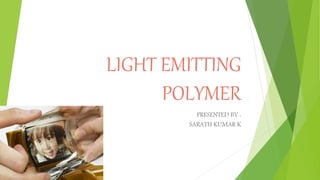
LIGHT EMITTING
POLYMER
PRESENTED BY :
SARATH KUMAR K
CONTENTS
 Introduction
 What is LEP?
 Chemistry behind LEP
 Structure And Working
 Types of LEPs
 Manufacturing
 Advantages
 Limitations
 Applications
 Conclusions
INTRODUCTION
 It’s a rapidly emerging technology for next generation flat panel
displays
 It promises thin , light weight emissive display with low drive
voltage , low power consumption , high contrast , wide viewing
angle and fast switching times
 LEPs are inexpensive and consume much less power than any
other flat panel display
 One interesting application of these displays is electronic paper
that can be rolled up like newspaper
 Light emitting polymers are superiors than other displays like
liquid crystal displays (LCDs),vacuum fluorescence displays and
electroluminescence displays.
 The technology uses a light-emitting polymer (LEP) that costs
much less to manufacture and run than CRTs because the active
material used is plastic.
WHAT IS LEP?
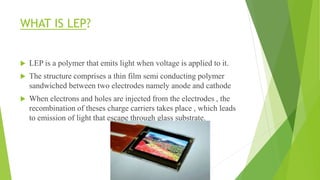
 LEP is a polymer that emits light when voltage is applied to it.
 The structure comprises a thin film semi conducting polymer
sandwiched between two electrodes namely anode and cathode
 When electrons and holes are injected from the electrodes , the
recombination of theses charge carriers takes place , which leads
to emission of light that escape through glass substrate.
 The first polymer LEPs used poly phinylene vinylene(PPV) as the
emitting layer
 The band gap determines the wave length and colour of emitted
light
STRUCTURE AND WORKING
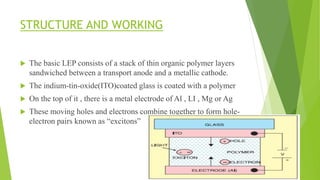
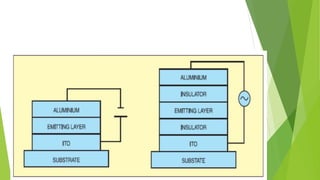
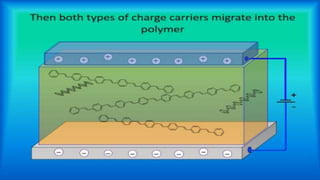
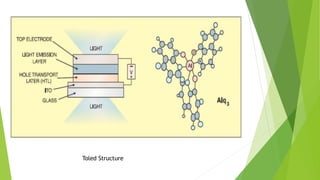
 The basic LEP consists of a stack of thin organic polymer layers
sandwiched between a transport anode and a metallic cathode.
 The indium-tin-oxide(ITO)coated glass is coated with a polymer
 On the top of it , there is a metal electrode of Al , LI , Mg or Ag
 These moving holes and electrons combine together to form hole-
electron pairs known as “excitons”
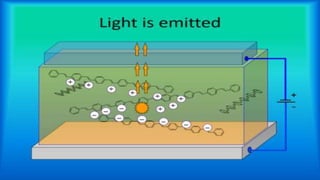
 When this energy drop occurs light comes out from the device .
this phenomenon is called electroluminescence
 Indium-tin oxide is typically used for the anode
TYPES OF LEPs
 Flexible organic LEPs
 Stacked organic LEPs
 Transparent organic LEPs
Flexible organic LEPs
 They are built on flexible substrates instead of glass substrates.
 These materials provide the ability to conform , bend or roll a
display into any shape.
 On helmet face shields , military uniforms , shirtsleeves and
automotive windshields
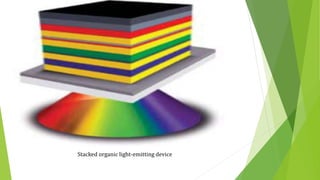
Stacked organic LEPs
 They use pixel architecture and offers high-definition display
resolution and true-colour quality for the next generations display
applications
 Each pixel emits the desired colour and thus is perceived
correctly , no matter what size it is and from where it is viewed
Stacked organic light-emitting device
Transparent organic LEPs
 They can be top , bottom or both top and bottom emitting
(transparent).
 Bi-directional LEPs will provide two independent displays
emitting from opposite faces of the display
 Transparent LEPs are a great way to double the display area for
the same display size
Toled Structure
MANUFACTURING
 SPIN COATING PROCESS
 This technique involve spinning a disk , that is glass substrate at a
fixed angular velocity and letting a small amount of polymer
solution to drop on the top of the disk
 The robot pours the plastic over the rotating plate , which in turn ,
evenly spreads the polymer on the plate. This results in an
extremely fine layer of the polymer having a thickness of 100
nanometer.
: Spin Coating Process
 INK JET PRINTING
 Use of inkjet printing for PLED displays
 Red , green and blue polymer solutions are jetted into well
defined areas with an angle of flight deviation of less than 5
 The film thickness uniformity may have to be better than +
2percentage
Printer Based Technique
ADVANTAGES
 Require only 3.3 volt and have lifetime of more than 30,000
hours
 Great power efficiency than all other flat panel displays
 No directional or blurring effects
 Can be viewed at any angle
 Glare free view up to 160 degree
 Cost much less to manufacture and run than CRTs , because the
active material used is plastic
 Can scale from tiny device millimeters in dimension to definition
device up to 5.1 meter in diameter
 Fast switching speed , 1000 times faster than LCDs
LIMITATIONS
 AGING OF LEP
 One of the major barriers to the commercial development of LEP
is its usefull lifetime The light intensity gradually decreases and
some discrete regions become totally dark. This is called aging of
LEP
 The solution was to do the final soldering in a glass jar filled
nitrogen
 SPACE CHARGE EFFECT
 The effect of space charge on the voltage-current characteristics
and current-voltage characteristics becomes more pronounced
when the difference in the electron hole mobilities is increased.
This will decrease the luminescence and hence decreases the
efficiency
APPLICATIONS
 Multi or full colour cell phone displays
 Full colour high-resolution personal digital assistants
 Heads-up instrumentation for cars
 Lightweight wrist watches
 High definition televisions
 Roll-up daily refreshable electronic newspapers
 Automobile light systems without bulbs
 Window/wall/partitions that double as computer screens
 Military uniforms
 Aircraft cockpit instrumentation panel a lot of others
PHOTOVOLTAICS
 PHOTOVOLTAICS
 PLED technology can be used in reverse, to convert light into
electricity. Devices which convert light into electricity are called
photovoltaic (PV) devices, and are at the heart of solar cells and
light detectors
POLY LED TV
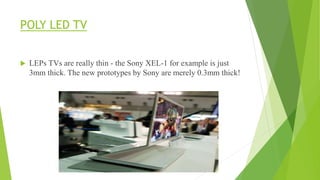
 LEPs TVs are really thin - the Sony XEL-1 for example is just
3mm thick. The new prototypes by Sony are merely 0.3mm thick!
TRANSPARENT OLEDS
 While there seem to be zero to few readily available uses of
transparent OLEDs (TOLEDs) in the consumer market today, the
technology exists for wide spread use in the future
NEWS AND INFORMATION
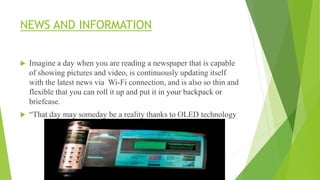
 Imagine a day when you are reading a newspaper that is capable
of showing pictures and video, is continuously updating itself
with the latest news via Wi-Fi connection, and is also so thin and
flexible that you can roll it up and put it in your backpack or
briefcase.
 “That day may someday be a reality thanks to OLED technology
OLED PASSPORT
 Samsung SDI from Germany have designed the OLED passport
which is claimed to be completely manipulation-proof.
 The OLED display will be able to display both video and text
containing information about the passport holder.
ADVANCEMENTS IN THE HOME
 One of the many possibilities is to replace regular walls or
windows with similar sized OLED installations which will “lead
to user-definable window spaces".
 These walls will use transparent OLEDs that will make it possible
to have certain areas opaque while other areas clear, depending on
what the homeowner would like. Additionally, “the wall can be
any color or design that you want.
CONCLUSION
 LEPs are promising , low cost solutions for today’s flat panel
displays. Although not commercialized yet, these replace bulky
and heavy CRT displays in the near future. However research is
underway to improve the efficiency and lifetime of the polymer
display
Bibliography.
 www. cdtltd.co.uk
 www. research.philips.com
 www. covion.com
 www.ieee.com
 D.Rwdinger, R.Farshchi and V.Subramanian. “Inkjet passive
component and plastic substrate”. 2003 IEEE Device Research
conference digest pp.187-188, 2003
 Josephine B.Lee and Vivek Subramanian. “Ink Jet Passive
devices” 2003 IEEE Device Research conference digest, 2003
LIGHT EMITTING POLYMER (LEP)

LIGHT EMITTING POLYMER (LEP)

  • 1.
  • 2.
    CONTENTS  Introduction  Whatis LEP?  Chemistry behind LEP  Structure And Working  Types of LEPs  Manufacturing  Advantages  Limitations  Applications  Conclusions
  • 3.
    INTRODUCTION  It’s arapidly emerging technology for next generation flat panel displays  It promises thin , light weight emissive display with low drive voltage , low power consumption , high contrast , wide viewing angle and fast switching times  LEPs are inexpensive and consume much less power than any other flat panel display  One interesting application of these displays is electronic paper that can be rolled up like newspaper
  • 4.
     Light emittingpolymers are superiors than other displays like liquid crystal displays (LCDs),vacuum fluorescence displays and electroluminescence displays.  The technology uses a light-emitting polymer (LEP) that costs much less to manufacture and run than CRTs because the active material used is plastic.
  • 5.
    WHAT IS LEP? LEP is a polymer that emits light when voltage is applied to it.  The structure comprises a thin film semi conducting polymer sandwiched between two electrodes namely anode and cathode  When electrons and holes are injected from the electrodes , the recombination of theses charge carriers takes place , which leads to emission of light that escape through glass substrate.
  • 6.
     The firstpolymer LEPs used poly phinylene vinylene(PPV) as the emitting layer  The band gap determines the wave length and colour of emitted light
  • 7.
    STRUCTURE AND WORKING The basic LEP consists of a stack of thin organic polymer layers sandwiched between a transport anode and a metallic cathode.  The indium-tin-oxide(ITO)coated glass is coated with a polymer  On the top of it , there is a metal electrode of Al , LI , Mg or Ag  These moving holes and electrons combine together to form hole- electron pairs known as “excitons”
  • 9.
     When thisenergy drop occurs light comes out from the device . this phenomenon is called electroluminescence  Indium-tin oxide is typically used for the anode
  • 13.
    TYPES OF LEPs Flexible organic LEPs  Stacked organic LEPs  Transparent organic LEPs
  • 14.
    Flexible organic LEPs They are built on flexible substrates instead of glass substrates.  These materials provide the ability to conform , bend or roll a display into any shape.  On helmet face shields , military uniforms , shirtsleeves and automotive windshields
  • 15.
    Stacked organic LEPs They use pixel architecture and offers high-definition display resolution and true-colour quality for the next generations display applications  Each pixel emits the desired colour and thus is perceived correctly , no matter what size it is and from where it is viewed
  • 16.
  • 17.
    Transparent organic LEPs They can be top , bottom or both top and bottom emitting (transparent).  Bi-directional LEPs will provide two independent displays emitting from opposite faces of the display  Transparent LEPs are a great way to double the display area for the same display size
  • 18.
  • 19.
    MANUFACTURING  SPIN COATINGPROCESS  This technique involve spinning a disk , that is glass substrate at a fixed angular velocity and letting a small amount of polymer solution to drop on the top of the disk  The robot pours the plastic over the rotating plate , which in turn , evenly spreads the polymer on the plate. This results in an extremely fine layer of the polymer having a thickness of 100 nanometer.
  • 20.
  • 21.
     INK JETPRINTING  Use of inkjet printing for PLED displays  Red , green and blue polymer solutions are jetted into well defined areas with an angle of flight deviation of less than 5  The film thickness uniformity may have to be better than + 2percentage
  • 23.
  • 24.
    ADVANTAGES  Require only3.3 volt and have lifetime of more than 30,000 hours  Great power efficiency than all other flat panel displays  No directional or blurring effects  Can be viewed at any angle  Glare free view up to 160 degree
  • 25.
     Cost muchless to manufacture and run than CRTs , because the active material used is plastic  Can scale from tiny device millimeters in dimension to definition device up to 5.1 meter in diameter  Fast switching speed , 1000 times faster than LCDs
  • 26.
    LIMITATIONS  AGING OFLEP  One of the major barriers to the commercial development of LEP is its usefull lifetime The light intensity gradually decreases and some discrete regions become totally dark. This is called aging of LEP  The solution was to do the final soldering in a glass jar filled nitrogen
  • 27.
     SPACE CHARGEEFFECT  The effect of space charge on the voltage-current characteristics and current-voltage characteristics becomes more pronounced when the difference in the electron hole mobilities is increased. This will decrease the luminescence and hence decreases the efficiency
  • 28.
    APPLICATIONS  Multi orfull colour cell phone displays  Full colour high-resolution personal digital assistants  Heads-up instrumentation for cars  Lightweight wrist watches  High definition televisions
  • 29.
     Roll-up dailyrefreshable electronic newspapers  Automobile light systems without bulbs  Window/wall/partitions that double as computer screens  Military uniforms  Aircraft cockpit instrumentation panel a lot of others
  • 30.
    PHOTOVOLTAICS  PHOTOVOLTAICS  PLEDtechnology can be used in reverse, to convert light into electricity. Devices which convert light into electricity are called photovoltaic (PV) devices, and are at the heart of solar cells and light detectors
  • 31.
    POLY LED TV LEPs TVs are really thin - the Sony XEL-1 for example is just 3mm thick. The new prototypes by Sony are merely 0.3mm thick!
  • 32.
    TRANSPARENT OLEDS  Whilethere seem to be zero to few readily available uses of transparent OLEDs (TOLEDs) in the consumer market today, the technology exists for wide spread use in the future
  • 33.
    NEWS AND INFORMATION Imagine a day when you are reading a newspaper that is capable of showing pictures and video, is continuously updating itself with the latest news via Wi-Fi connection, and is also so thin and flexible that you can roll it up and put it in your backpack or briefcase.  “That day may someday be a reality thanks to OLED technology
  • 34.
    OLED PASSPORT  SamsungSDI from Germany have designed the OLED passport which is claimed to be completely manipulation-proof.  The OLED display will be able to display both video and text containing information about the passport holder.
  • 35.
    ADVANCEMENTS IN THEHOME  One of the many possibilities is to replace regular walls or windows with similar sized OLED installations which will “lead to user-definable window spaces".  These walls will use transparent OLEDs that will make it possible to have certain areas opaque while other areas clear, depending on what the homeowner would like. Additionally, “the wall can be any color or design that you want.
  • 36.
    CONCLUSION  LEPs arepromising , low cost solutions for today’s flat panel displays. Although not commercialized yet, these replace bulky and heavy CRT displays in the near future. However research is underway to improve the efficiency and lifetime of the polymer display
  • 37.
    Bibliography.  www. cdtltd.co.uk www. research.philips.com  www. covion.com  www.ieee.com  D.Rwdinger, R.Farshchi and V.Subramanian. “Inkjet passive component and plastic substrate”. 2003 IEEE Device Research conference digest pp.187-188, 2003  Josephine B.Lee and Vivek Subramanian. “Ink Jet Passive devices” 2003 IEEE Device Research conference digest, 2003