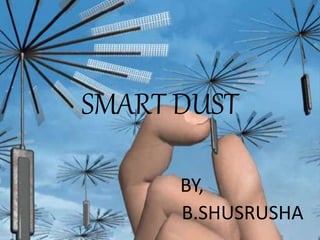
SMART DUST
BY,
B.SHUSRUSHA
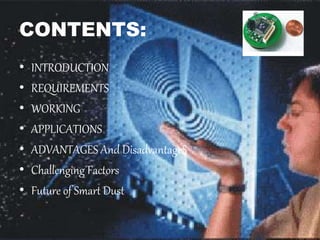
CONTENTS:
• INTRODUCTION
• REQUIREMENTS
• WORKING
• APPLICATIONS
• ADVANTAGES And DisadvantageS
• Challenging Factors
• Future of Smart Dust
INTRODUCTION
• Smart Dust is a self-contained network of tiny motes each having
the capability of sensing and monitoring the environment
conditions.
• Smart Dust concept has been credited to researchers at the
University of California, Bekerley in 1997 by Prof. Kris Pister.
• They contain sensors which have the computational capability.
• They can communicate with a base station or with other motes
depending on the application.
• The transmission is carried out by microscopic devices known as
micro electromechanical system (MEMS).
• They are tiny wireless microelectromechanical sensors (MEMS) that
can detect everything from light to vibrations
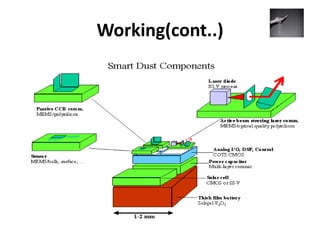
Working Of Smart Dust
• Run by microcontroller
– Determines the task performed by the mote
– Controls power
• Primary constraint of smart dust is volume.
• Most of the time mote if off with only timers
running
• When a timer expires, it powers mote to carry
out a job , then powers off.
Working(cont..)
APPLICATIONS
• Smart Dust may be deployed over a region to
record data for meteorological, geophysical or
planetary research.
• It may be employed to perform
measurements in environments where wired
sensors are unusable or lead to
measurements errors.
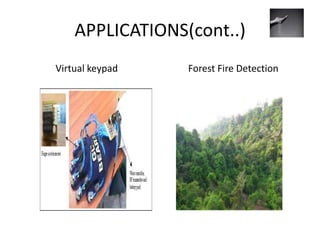
APPLICATIONS(cont..)
Virtual keypad Forest Fire Detection
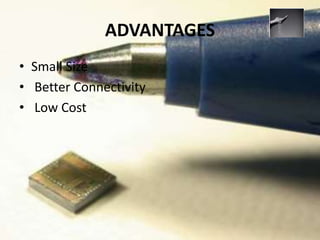
ADVANTAGES
• Small Size
• Better Connectivity
• Low Cost
Disadvantages
• The main concern is privacy.
• This device can be used to spy on people
without their approval.
• The information transmitted through this
sensors
CHALLENGING FACTORS
• Sensor nodes breakdown
• The battery management
• Chance of unique addressing would not be
feasible.
• Maintenance or fixing of the network would
be completely self-governing.
FUTURE SMART DUST
• Smart dust is likely to be the core industries of
the future world.
• Tech Giants, Cisco Systems and IBM have
started investing millions of dollars to employ
smart dusts in systems and networking
technology.
• There may be an opportunity to integrate this
technology into mobile solutions to transform
business processes in the future.
THANK YOU

Smart dust

  • 1.
  • 2.
    CONTENTS: • INTRODUCTION • REQUIREMENTS •WORKING • APPLICATIONS • ADVANTAGES And DisadvantageS • Challenging Factors • Future of Smart Dust
  • 3.
    INTRODUCTION • Smart Dustis a self-contained network of tiny motes each having the capability of sensing and monitoring the environment conditions. • Smart Dust concept has been credited to researchers at the University of California, Bekerley in 1997 by Prof. Kris Pister. • They contain sensors which have the computational capability. • They can communicate with a base station or with other motes depending on the application. • The transmission is carried out by microscopic devices known as micro electromechanical system (MEMS). • They are tiny wireless microelectromechanical sensors (MEMS) that can detect everything from light to vibrations
  • 4.
    Working Of SmartDust • Run by microcontroller – Determines the task performed by the mote – Controls power • Primary constraint of smart dust is volume. • Most of the time mote if off with only timers running • When a timer expires, it powers mote to carry out a job , then powers off.
  • 5.
  • 6.
    APPLICATIONS • Smart Dustmay be deployed over a region to record data for meteorological, geophysical or planetary research. • It may be employed to perform measurements in environments where wired sensors are unusable or lead to measurements errors.
  • 7.
  • 8.
    ADVANTAGES • Small Size •Better Connectivity • Low Cost
  • 9.
    Disadvantages • The mainconcern is privacy. • This device can be used to spy on people without their approval. • The information transmitted through this sensors
  • 10.
    CHALLENGING FACTORS • Sensornodes breakdown • The battery management • Chance of unique addressing would not be feasible. • Maintenance or fixing of the network would be completely self-governing.
  • 11.
    FUTURE SMART DUST •Smart dust is likely to be the core industries of the future world. • Tech Giants, Cisco Systems and IBM have started investing millions of dollars to employ smart dusts in systems and networking technology. • There may be an opportunity to integrate this technology into mobile solutions to transform business processes in the future.
  • 12.