Principle of LCD Display
Contents
• Introduction
• Types of LCD
• Operating principle
• Properties of LCD display
• Conclusion and Reference
Prepared By S ARUN M.Tech LCD Display 1
Introduction to Liquid Crystal
Displays
• Consists of an array of tiny segments (called
pixels) that can be manipulated to present
information.
• Using polarization of lights to display objects.
• Use only ambient light to illuminate the
display.
• Common wrist watch and pocket calculator to
an advanced VGA computer screen
2Prepared By S ARUN M.Tech LCD Display
Different types of LCDs
Passive Matrix LCDs (AMLCD) and
Active Matrix LCDs (AMLCD)
• Passive Twisted Nematic Displays (TNLCD)
• Super Twisted nematic LCD (STNLCD)
• Thin Film Transistor LCD (TFT LCD)
• Reflective LCD
• Rear Projection LCD
3Prepared By S ARUN M.Tech LCD Display
Operating Principle
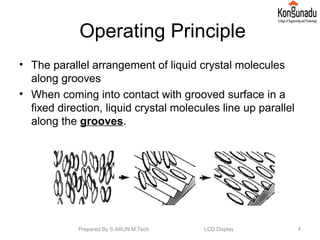
• The parallel arrangement of liquid crystal molecules
along grooves
• When coming into contact with grooved surface in a
fixed direction, liquid crystal molecules line up parallel
along the grooves.
4Prepared By S ARUN M.Tech LCD Display
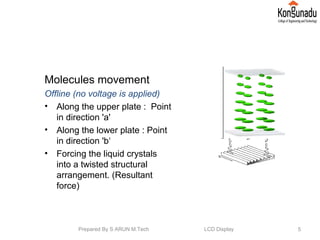
Molecules movement
Offline (no voltage is applied)
• Along the upper plate : Point
in direction 'a'
• Along the lower plate : Point
in direction 'b‘
• Forcing the liquid crystals
into a twisted structural
arrangement. (Resultant
force)
5Prepared By S ARUN M.Tech LCD Display
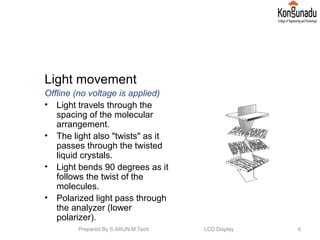
Light movement
Offline (no voltage is applied)
• Light travels through the
spacing of the molecular
arrangement.
• The light also "twists" as it
passes through the twisted
liquid crystals.
• Light bends 90 degrees as it
follows the twist of the
molecules.
• Polarized light pass through
the analyzer (lower
polarizer).
6Prepared By S ARUN M.Tech LCD Display
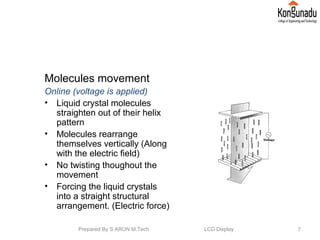
Molecules movement
Online (voltage is applied)
• Liquid crystal molecules
straighten out of their helix
pattern
• Molecules rearrange
themselves vertically (Along
with the electric field)
• No twisting thoughout the
movement
• Forcing the liquid crystals
into a straight structural
arrangement. (Electric force)
7Prepared By S ARUN M.Tech LCD Display
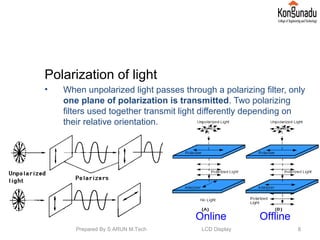
Polarization of light
• When unpolarized light passes through a polarizing filter, only
one plane of polarization is transmitted. Two polarizing
filters used together transmit light differently depending on
their relative orientation.
8
Online Offline
Prepared By S ARUN M.Tech LCD Display
Properties of LCD Display
• Small footprint (approx 1/6 of CRT)
• Light weight (typ. 1/5 of CRT)
• power consumption (typ. 1/4 of CRT)
• Completely flat screen - no geometrical errors
• Crisp pictures - digital and uniform colors
• No electromagnetic emission
• Fully digital signal processing possible
• Large screens (>20 inch) on desktops
• High price (presently 3x CRT)
• Poor viewing angle (typ. 50 degrees)
• Low contrast and luminance (typ. 1:100)
• Low luminance (typ. 200 cd/m2)
9Prepared By S ARUN M.Tech LCD Display
Conclusion
From this presentation came to know about the Liquid Crystal
Display
Reference WebPages
• LCD Principle
http://infochem.hanyang.ac.kr/researches/researches_lcd_english.
html
• Sharp
http://www.sharp.ca/lcd_principles.html
• Liquid Crystals
http://www.ee.calpoly.edu/~dbraun/courses/lcd.html
• PC Technology Guide
http://www.pctechguide.com/07panels.htm
• Casio official homepage
http://www.casio.co.jp/edu_e/product/2line/
10Prepared By S ARUN M.Tech LCD Display

Lcd

  • 1.
    Principle of LCDDisplay Contents • Introduction • Types of LCD • Operating principle • Properties of LCD display • Conclusion and Reference Prepared By S ARUN M.Tech LCD Display 1
  • 2.
    Introduction to LiquidCrystal Displays • Consists of an array of tiny segments (called pixels) that can be manipulated to present information. • Using polarization of lights to display objects. • Use only ambient light to illuminate the display. • Common wrist watch and pocket calculator to an advanced VGA computer screen 2Prepared By S ARUN M.Tech LCD Display
  • 3.
    Different types ofLCDs Passive Matrix LCDs (AMLCD) and Active Matrix LCDs (AMLCD) • Passive Twisted Nematic Displays (TNLCD) • Super Twisted nematic LCD (STNLCD) • Thin Film Transistor LCD (TFT LCD) • Reflective LCD • Rear Projection LCD 3Prepared By S ARUN M.Tech LCD Display
  • 4.
    Operating Principle • Theparallel arrangement of liquid crystal molecules along grooves • When coming into contact with grooved surface in a fixed direction, liquid crystal molecules line up parallel along the grooves. 4Prepared By S ARUN M.Tech LCD Display
  • 5.
    Molecules movement Offline (novoltage is applied) • Along the upper plate : Point in direction 'a' • Along the lower plate : Point in direction 'b‘ • Forcing the liquid crystals into a twisted structural arrangement. (Resultant force) 5Prepared By S ARUN M.Tech LCD Display
  • 6.
    Light movement Offline (novoltage is applied) • Light travels through the spacing of the molecular arrangement. • The light also "twists" as it passes through the twisted liquid crystals. • Light bends 90 degrees as it follows the twist of the molecules. • Polarized light pass through the analyzer (lower polarizer). 6Prepared By S ARUN M.Tech LCD Display
  • 7.
    Molecules movement Online (voltageis applied) • Liquid crystal molecules straighten out of their helix pattern • Molecules rearrange themselves vertically (Along with the electric field) • No twisting thoughout the movement • Forcing the liquid crystals into a straight structural arrangement. (Electric force) 7Prepared By S ARUN M.Tech LCD Display
  • 8.
    Polarization of light •When unpolarized light passes through a polarizing filter, only one plane of polarization is transmitted. Two polarizing filters used together transmit light differently depending on their relative orientation. 8 Online Offline Prepared By S ARUN M.Tech LCD Display
  • 9.
    Properties of LCDDisplay • Small footprint (approx 1/6 of CRT) • Light weight (typ. 1/5 of CRT) • power consumption (typ. 1/4 of CRT) • Completely flat screen - no geometrical errors • Crisp pictures - digital and uniform colors • No electromagnetic emission • Fully digital signal processing possible • Large screens (>20 inch) on desktops • High price (presently 3x CRT) • Poor viewing angle (typ. 50 degrees) • Low contrast and luminance (typ. 1:100) • Low luminance (typ. 200 cd/m2) 9Prepared By S ARUN M.Tech LCD Display
  • 10.
    Conclusion From this presentationcame to know about the Liquid Crystal Display Reference WebPages • LCD Principle http://infochem.hanyang.ac.kr/researches/researches_lcd_english. html • Sharp http://www.sharp.ca/lcd_principles.html • Liquid Crystals http://www.ee.calpoly.edu/~dbraun/courses/lcd.html • PC Technology Guide http://www.pctechguide.com/07panels.htm • Casio official homepage http://www.casio.co.jp/edu_e/product/2line/ 10Prepared By S ARUN M.Tech LCD Display