Scattering of light occurs when light rays deviate from their original path after striking an obstacle like dust, gas molecules, or water vapors. Shorter wavelengths of light scatter more easily than longer wavelengths due to their waviness and increased chances of intersecting with particles. The scattering of blue light by fine atmospheric particles is why the sky appears blue. Without an atmosphere, there would be no particles for light to scatter off of, so the sky would appear dark.
SCATTERINGOFLIGHT
Scattering of lightis the phenomenon in
which light rays deviate from their original
path upon striking an obstacle like dust, gas
molecules or water vapours.
3.
Can you guessthe reason for the
following.
The blue colour of the sky.
Colour of water in deep sea.
The reddening of the sun at sunrise and the sunset.
Danger signal lights are red in colour.
Group 3
Whenlight passes from one medium to another, say air, a glass of water, then a
part of the light is absorbed by particles of the medium, preceded by its
subsequent radiation in a particular direction. This phenomenon is termed a
scattering of light. The intensity of scattered light depends on the size of the
particles and the wavelength of the light. Shorter wavelength and high frequency
scatter more due to the waviness of the line and its intersection with a particle. The
wavier the line, the more the chances it intersects with a particle. On the other
hand, longer wavelengths have low frequency, they are straighter, and the chances
of colliding with the particle are less, so the chances are less. The probability for
scattering will give a high rise for a shorter wavelength.
a. Define scattering of light?
b. State the factors depends on the scattering of light?
c. Which of the two is scattered more easily light of short wavelength or light of
longer wavelength?
7.
Group 4
If theearth had no atmosphere is
there scattering takes place? Give
reason?
8.
Summary
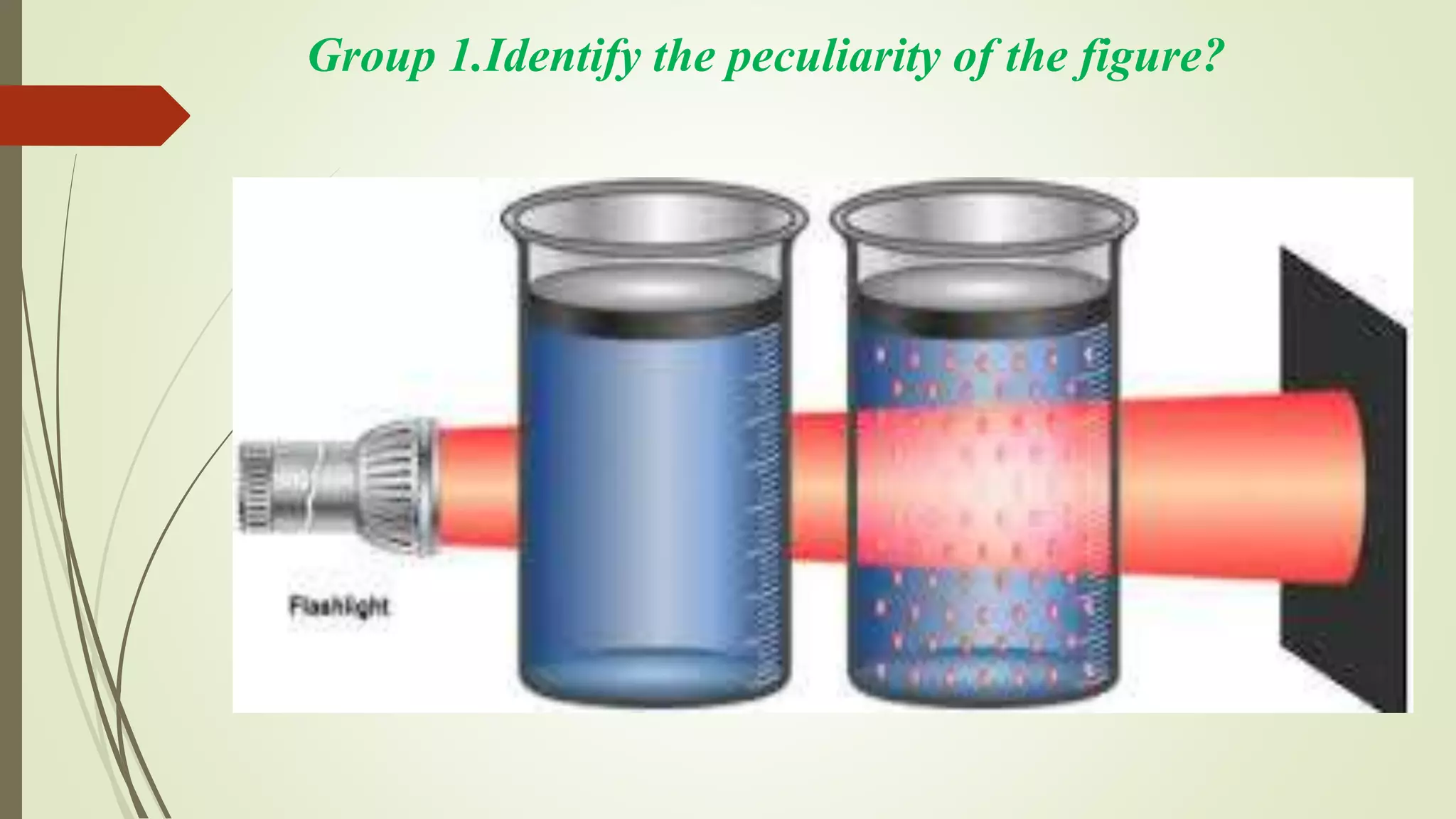
When a beamof light passes through a colloidal solution,
the path of light becomes visible due to the scattering of
light by the colloid particles. This is known as Tyndall
effect.
The earth’s atmosphere contains air molecules, water
droplets, dust, smoke etc. When sunlight passes through the
atmosphere the path of the light becomes visible due to the
scattering of light by these particles.
The colour of the scattered light depends upon the size of the
scattering particles. Very fine particles scatter blue light.
Larger particles scatter different colours of light.
9.
Why is thecolour of the clear sky is blue?
The fine particles in the atmosphere have size smaller than the
wave length of visible light. They can scatter blue light which has
a shorter wave length than red light which has a longer wave
length. When sunlight passes through the atmosphere, the fine
particles in the atmosphere scatter the blue colour more strongly
than the red and so the sky appears blue.
If the earth had no atmosphere there would not be any scattering
of light and the sky would appear dark. The sky appears dark at
very high altitudes.