Reflection of Light
By: Salahdeen H.I
Teacher and E-learning Consultant
Reflection of Light
1. Ray of Light : A line drawn in the direction of propagation of light is called a
ray of light.
2. Beam of Light : A group of rays of light emitted by a source of light is called
a beam of light. A light beam is of three types.
ThreeTypes of Light Beam
(i) Parallel beam : A group of light rays parallel to each other is known as
parallel beam of light.
(ii) Divergent beam : A group of light rays spreading out from a source of light
is called divergent beam of light.
(iii) Convergent beam : A group of light rays meeting at a point is called
convergent beam
Reflection of Light
There are some surfaces which have ability to send the light back in the same
medium when light strikes it.The phenomena of sending the light back in the
same medium by a surface is called reflection of light.
Laws of Reflection
(i)The incident ray, the reflected ray and the normal at the point of incidence,
all lie in a same plane.
(ii)The angle of incidence is always equal to the angle of reflection, ∠i = ∠r.
Demonstration on Laws of Reflection
Images
Image : When light rays meet or appear to meet after reflection from a
mirror,then it is called an image.
1. Real Image : It is a kind of image which is formed by actual intersection of
light rays after reflection.
2.Virtual Image : It is a kind of image which is formed by producing the
reflected rays backward after reflection.
Plane Mirror
Plane mirror is a piece of glass whose one side is polished by using silver
paint, which is covered by a coating of red paint to protect the silver layer.
CHARACTERISTICS OF IMAGE FORMED BY
PLANE MIRROR
1. It is the same size as the object
2. It is virtual
3. It is laterally inverted
4. It is upright
5. It is far behind the mirror as the object is in front of the mirror
USES OF PLANE MIRROR
• It is used in periscope
• It is used in kaleidoscope
• It is used in sextant
Spherical Mirrors
It is part of hollow glass sphere whose one surface is polished.
There are two types of spherical mirror.
(i) Concave Mirror : It is a spherical mirror whose outer surface is polished and
inner or concave side is reflecting surface.
(ii) Convex Mirror : It is a spherical mirror whose inner is polished and outer
side or convex side is the reflecting surface.
Demonstration on Concave Mirror
Demonstration on Convex Mirror
Uses of Concave Mirror
(i) It is used as a shaving mirror because when it is placed close to the face, it
forms a large image.
(ii) It is used in solar heating devices like solar cooker, because it converges
Sun’s rays over a small area to produce high temperature.
(iii) It is used for security checking purposes.
Uses of Convex Mirror
(i) It is used as rear view mirror in automobiles because it gives erect image as
well as diminished.
(ii) It is also used in street lights.
Mirror Formula
The focal length, f, object distance, u, and the image distance, v, can be related using
the formula below
1
𝑓
=
1
𝑢
+
1
𝑣
Magnification : It is defined as the ratio of height of image to the height of the
object. It is denoted by letter m.
𝑚 =
𝑣
𝑢
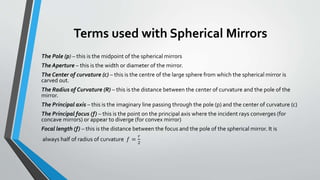
Terms used with Spherical Mirrors
The Pole (p) – this is the midpoint of the spherical mirrors
The Aperture – this is the width or diameter of the mirror.
The Center of curvature (c) – this is the centre of the large sphere from which the spherical mirror is
carved out.
The Radius of Curvature (R) – this is the distance between the center of curvature and the pole of the
mirror.
The Principal axis – this is the imaginary line passing through the pole (p) and the center of curvature (c)
The Principal focus (f) – this is the point on the principal axis where the incident rays converges (for
concave mirrors) or appear to diverge (for convex mirror)
Focal length (f) – this is the distance between the focus and the pole of the spherical mirror. It is
always half of radius of curvature 𝑓 =
𝑟
2
THANKS
• PRESENTED By: Salahdeen H.I
• Teacher and E-learning Consultant
• +2348023455893
• salahdeenhi@edunaija.com.ng

Reflection and refraction

  • 1.
    Reflection of Light By:Salahdeen H.I Teacher and E-learning Consultant
  • 2.
    Reflection of Light 1.Ray of Light : A line drawn in the direction of propagation of light is called a ray of light. 2. Beam of Light : A group of rays of light emitted by a source of light is called a beam of light. A light beam is of three types.
  • 3.
    ThreeTypes of LightBeam (i) Parallel beam : A group of light rays parallel to each other is known as parallel beam of light. (ii) Divergent beam : A group of light rays spreading out from a source of light is called divergent beam of light. (iii) Convergent beam : A group of light rays meeting at a point is called convergent beam
  • 4.
    Reflection of Light Thereare some surfaces which have ability to send the light back in the same medium when light strikes it.The phenomena of sending the light back in the same medium by a surface is called reflection of light.
  • 5.
    Laws of Reflection (i)Theincident ray, the reflected ray and the normal at the point of incidence, all lie in a same plane. (ii)The angle of incidence is always equal to the angle of reflection, ∠i = ∠r.
  • 6.
    Demonstration on Lawsof Reflection
  • 7.
    Images Image : Whenlight rays meet or appear to meet after reflection from a mirror,then it is called an image. 1. Real Image : It is a kind of image which is formed by actual intersection of light rays after reflection. 2.Virtual Image : It is a kind of image which is formed by producing the reflected rays backward after reflection.
  • 8.
    Plane Mirror Plane mirroris a piece of glass whose one side is polished by using silver paint, which is covered by a coating of red paint to protect the silver layer.
  • 9.
    CHARACTERISTICS OF IMAGEFORMED BY PLANE MIRROR 1. It is the same size as the object 2. It is virtual 3. It is laterally inverted 4. It is upright 5. It is far behind the mirror as the object is in front of the mirror
  • 10.
    USES OF PLANEMIRROR • It is used in periscope • It is used in kaleidoscope • It is used in sextant
  • 11.
    Spherical Mirrors It ispart of hollow glass sphere whose one surface is polished. There are two types of spherical mirror. (i) Concave Mirror : It is a spherical mirror whose outer surface is polished and inner or concave side is reflecting surface. (ii) Convex Mirror : It is a spherical mirror whose inner is polished and outer side or convex side is the reflecting surface.
  • 12.
  • 13.
  • 14.
    Uses of ConcaveMirror (i) It is used as a shaving mirror because when it is placed close to the face, it forms a large image. (ii) It is used in solar heating devices like solar cooker, because it converges Sun’s rays over a small area to produce high temperature. (iii) It is used for security checking purposes.
  • 15.
    Uses of ConvexMirror (i) It is used as rear view mirror in automobiles because it gives erect image as well as diminished. (ii) It is also used in street lights.
  • 16.
    Mirror Formula The focallength, f, object distance, u, and the image distance, v, can be related using the formula below 1 𝑓 = 1 𝑢 + 1 𝑣 Magnification : It is defined as the ratio of height of image to the height of the object. It is denoted by letter m. 𝑚 = 𝑣 𝑢
  • 17.
    Terms used withSpherical Mirrors The Pole (p) – this is the midpoint of the spherical mirrors The Aperture – this is the width or diameter of the mirror. The Center of curvature (c) – this is the centre of the large sphere from which the spherical mirror is carved out. The Radius of Curvature (R) – this is the distance between the center of curvature and the pole of the mirror. The Principal axis – this is the imaginary line passing through the pole (p) and the center of curvature (c) The Principal focus (f) – this is the point on the principal axis where the incident rays converges (for concave mirrors) or appear to diverge (for convex mirror) Focal length (f) – this is the distance between the focus and the pole of the spherical mirror. It is always half of radius of curvature 𝑓 = 𝑟 2
  • 18.
    THANKS • PRESENTED By:Salahdeen H.I • Teacher and E-learning Consultant • +2348023455893 • salahdeenhi@edunaija.com.ng