CHAPTER 6CHAPTER 6
Infancy: Social and EmotionalInfancy: Social and Emotional
DevelopmentDevelopment
Attachment: Bonds That EndureAttachment: Bonds That Endure
Attachment: Bonds that Endure
• Attachment
– Enduring emotional bond between one animal or person and
another (Ainsworth, 1989)
– Essential to the survival of the infant (Bowlby, 1988)
– Infants try to maintain contact with caregivers to whom they are
attached.
• Make eye contact
• Pull and tug at them
• Asked to be picked up
• Separation anxiety
– Behaviors such as thrashing about, fussing, crying, screeching,
or whining when contact with the caregiver is lost
Patterns of Attachment
• “Strange situation” method
– Infant exposed to a series of separations and reunions with a
caregiver (usually the mother) and a stranger who is a
confederate of the researchers
– Developed by Ainsworth et al.
• Secure attachment (most infants in the US)
– Mildly protest mother’s departure
– Seek interaction when reunited
– Are readily comforted by mother
– Are happier, more sociable, and more cooperative with
caregivers
– Get along better with peers and are better adjusted at school at
5 and 6 years old
Mary Ainsworth
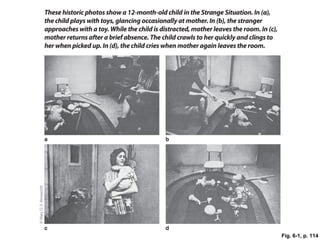
Fig. 6-1, p. 114
Patterns of Attachment (cont’d)
• Avoidant attachment
– Infants least distressed by mother’s departure
– Play without fuss when alone and ignore mothers when they
return
• Ambivalent/resistant attachment
– Infants are most emotional
– Show severe signs of distress when mothers leave and are
ambivalent upon their return
– Alternate clinging to mother with pushing her away
• Disorganized/disoriented attachment
– Babies seem dazed, confused, disoriented; behaviors are
contradictory
Establishing Attachment
• Attachment related to quality of care
– Secure infants have parents who are more affectionate,
cooperative, and predictable than parents of insecure infants.
– Parents respond more favorably to infant’s smiles and cries.
• Security is related to the infant’s temperament
– Mothers of “difficult” children are less responsive to them.
– Mothers report feeling more distant from infant
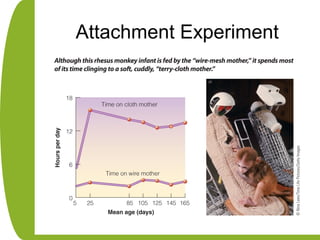
Attachment Experiment
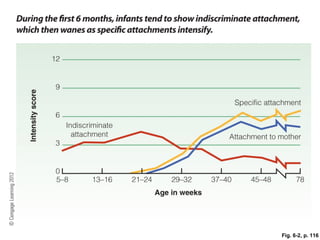
Fig. 6-2, p. 116
Involvement of Fathers
• The number of diapers a father changes per week
indicates his involvement in childrearing.
• Fathers more likely to play with children than to feed or
clean them
• Fathers engage in rough-and-tumble play.
• The more affectionate the interaction between father
and infant is, the stronger the attachment.
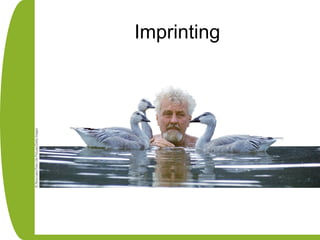
Imprinting
Stability of Attachment
• Attachment can change due to family dynamics.
• Adopted children of various ages show secure
attachment to adoptive family.
• Early attachment patterns endure into middle childhood,
adolescence, and even adulthood.
Stages of Attachment
• Ainsworth study on Ugandan infants identified three
phases of attachment
1) Initial-preattachment phase
• Birth to 3 months of age
• Characterized by indiscriminate attachment
2) Attachment-in-the-making phase
• 3 to 4 months of age
• Characterized by preference for familiar figures
3) Clear-cut attachment phase
• 6 to 7 months of age
• Characterized by intensified dependence on the primary
caregiver, usually the mother
Theories of Attachment
• Cognitive view
– Infant must develop the concept of object permanence before
specific attachment becomes possible.
• Behavioral view
– Attachment behaviors are conditioned due to infant’s needs
being met by caregiver; caregiver associated with gratification
• Psychoanalytic view
– Caregiver or “mother” becomes a love object who forms basis
for all later attachments (Freud)
– Sense of trust has to be established in first year of life (Erikson)
Theories of Attachment (cont’d)
• Caregiver as source of contact comfort
– Study by Harlow and Harlow on rhesus monkey infants
– Indicated that humans may have a need for contact comfort that
is as basic as need for food
• Ethological view
– Attachment is an inborn or instinctive response to a specific
stimulus
– Social smiles help infant to survive by eliciting affection from the
family social structure
– Attachment in nonhumans occurs during critical period of life
– First object seen is imprinted on the young animal (Lorenz,
1962, 1981)
• Bowlby and Ainsworth maintain that if critical period
exists in humans, it can extend for months or years
When Attachment FailsWhen Attachment Fails
When Attachment Fails
• Children deprived of social stimulation have difficulty
attaching.
• Harlow and Harlow study
– Found that rhesus infants reared in isolation cowered in the
presence of other monkeys; they did not defend themselves
– Instead, they sat in a corner, clutching themselves and rocking
back and forth
• Older deprived infant monkeys became more social
when placed with younger monkeys.
– Same was found to be true with socially withdrawn 4- and 5-
year-old children
Studies with Children
• Spitz (1965) study of institutionalized children
– Found children to show withdrawal and depression
– Some infants showed the same rocking back and forth as the rhesus
monkeys
• The age of the child contributes to how well the child can overcome
social deprivation.
• Study on Guatemalan children by Kagan and Klein (1973) indicates
children may be able to recover from 13 or 14 months of
deprivation.
• Study by Skeels (1966) found 19-month-old retarded children when
placed in care of older institutionalized girls made dramatic gains in
IQ scores, whereas the other children remaining in the orphanage
declined in IQ.
Child Abuse and Neglect
• 90% of parents have engaged in some sort of psychological or
emotional abuse ranging from pushing to using a knife or a gun on
a child (by age 2).
• 3 million American children
– Neglected or abused each year by parents or caregivers
• 150,000 of 3 million children
– Sexually abused
– Girls make up the majority of sexually abused
– Boys make up one-third to one-fourth of the sexually abused
• 50-60% of cases of child abuse and neglect go unreported
(estimated).
Effects of Child Abuse
• Abused children show high incidence of personal and
social problems as well as psychological disorders.
• Less securely attached to parents
• Less intimate with peers and more aggressive, angry, and
noncompliant than other children
• Reduced self-esteem and school performance
• Greater risk of delinquency, risky sexual behavior, and substance
abuse
• Adults abused as children more likely to act aggressively toward
their partners
Causes of Child Abuse
• Stress
• History of child abuse in at least one parent’s family of
origin
• Lack of adequate coping and childrearing skills
• Unrealistic expectations of children
• Substance abuse
• Infants in pain and more difficult to soothe more likely to
be abused
• Cries of the infant found to be aversive to abusive
parents
• Disobedient, inappropriate, or unresponsive children
more likely to be abused
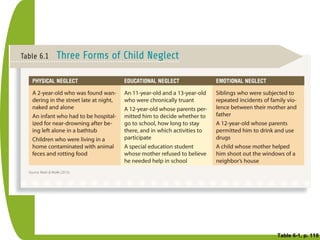
Table 6-1, p. 119
What to Do
• Report abuse to the authorities.
• Provide parenting training to the general population.
• Target high-risk groups such as poor, single teen
mothers and provide parenting programs or home
visitors for them.
• Present information about abuse and provide support for
families.
• Have child abuse hotlines for private citizens who
suspect child abuse to get advice.
– Parents who are having difficulty with aggressive impulses are
also encouraged to call
Child Abuse is a Crime
Autism Spectrum Disorders
• Autism spectrum disorders
– Impairment in communication skills and social interactions, and
by repetitive, stereotyped behavior; evident by age 3; 1 in 152
American children have disorder
• Asperger’s disorder
– Social deficits and stereotyped behavior; no significant cognitive
or language delays associated with autism
• Rett’s disorder
– Physical, behavioral, motor, and cognitive abnormalities that
begin after a few months of apparent normal development
• Childhood disintegrative disorder
– Abnormal functioning and loss of previously acquired skills that
begins after about 2 years of apparent normal development
Asperger’s Syndrome
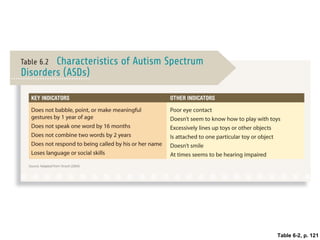
Table 6-2, p. 121
Autism
• Autism is 4 to 5 times more prevalent in boys.
• Attachment to others is often weak or nonexistent
• Show ritualistic behavior and intolerance to change
• Development of speech lags
• Show mutism, echolalia, and pronoun reversal
– (Referring to self as “you” or “he”)
• Some may mutilate themselves
Causes of Autism
• Concordance rates for autism are about 60% among
pairs of MZ twins.
• No correlations between the development of autism and
deficiencies in child rearing.
• Biological factors play a key role.
– LBW
– Advanced maternal age
– Neurological abnormalities
• Brain-wave patterns
• Neurotransmitter sensitivity
• Unusual activity in motor region of cerebral cortex
Treatment of Autism
• Treatment of autism is based on principles of learning,
including behavior modification programs.
• Intensive individual instruction has been found to be
most effective.
• Research on medications and their treatment of autism
are under study.
Day CareDay Care
Daycare’s Positive Effects
• Most infants (whether cared for at home or in daycare)
are generally securely attached.
• More prosocial than children who are not in daycare
• Better academic performance in elementary school
• Get scores on tests of cognitive skills that rival or
exceed those of children reared in the home by their
mothers
Limitations of the NICHD study
• Differences were small between groups
• Study implied causation, yet there was no control group
• Did not take into account the stress level of the parents
who put their children in daycare
• No research on whether the disruptive children become
less productive and successful adults
– Possibly these children grew up to become “assertive and
entrepreneurial”
Emotional DevelopmentEmotional Development
Emotional Development
• Emotion
– A state of feeling with physiological, situational, and cognitive
components
• Unclear how many emotions a baby has
– Facial expressions appear to be universal.
• Emotions
– Infants show only a few emotions during the first few months.
– Emotions are more apparent at end of first year of life.
• Infants have a positive attraction to pleasant stimulation
and withdrawal from aversive stimulation.
• Emotional development is linked to cognitive
development and social experience.
Emotional Development and
Patterns of Attachment
• One study (Kochanska, 2001) assessed patterns of
attachment using the “strange situation”.
– Found that differences in emotional development were first
related to attachment at the age of 14 months
– Securely attached infants were less likely to show fear and
anger even when exposed to situations designed to elicit these
emotions (at 33 months).
– Insecurely attached infants showed increase in negative
emotions
– Avoidant children grew more fearful
– Resistant children became less joyful
Fear of Strangers
• Stranger anxiety
– Is the development of the fear of strangers
– Is normal and most infants develop it
– Appears at 6 to 9 months of age
– Older infants will display crying, whimpering, gazing fearfully,
and crawling away
– Peaks at 9 and 12 months of age
– Declines in second year
Social Referencing
• Social referencing
– Seeking out another person’s perception of a situation to help
us form our own view of it
– Infants display it as early as 6 months
– Infants use caregiver’s facial expressions or tone of voice as
clues on how to respond.
• Social referencing requires
1) looking at another, usually older, individual in a novel,
ambiguous situation
2) associating that individual’s emotional response with the
unfamiliar situation
3) regulating our own emotional response in accord with the
response of the older individual
Emotional Regulation
• Emotional regulation
– Ways in which young children control their own emotions
• Caregivers help infants learn to regulate their emotions
• Children of secure mothers are
– more likely to be secure themselves
– more likely to regulate their own emotions in a positive manner
• Adolescents who were secure as infants were most
capable of regulating their emotions to interact
cooperatively with their friends.
Personality DevelopmentPersonality Development
Personality Development
• Self-concept has been measured using mirror
technique, nose-touching technique
– At 18 months, infants begin to touch their own noses upon
looking into the mirror.
• Self-awareness affects the infant’s social and emotional
development.
– Knowledge of self permits the infant and child to develop
notions of sharing and cooperation with other children.
• Self-awareness contributes to the development of the
“self-conscious” emotions.
– Embarrassment, envy, pride, guilt, and shame
Temperament
• Temperament
– Stable way of reacting and adapting to the world that is present
early in life
– Believed to have a strong genetic component
– Includes activity level, smiling and laughter, regularity in eating
and sleep habits, approach and withdrawal, adaptability to new
situations, intensity of responsiveness, general cheerfulness or
unpleasantness, distractibility or persistence, soothability
Types of Temperament
• Thomas and Chess (1989) identified three types of
temperament
– Easy child (40%)
• regular sleep and feeding schedules, approaches new situations
with enthusiasm, and is generally cheerful
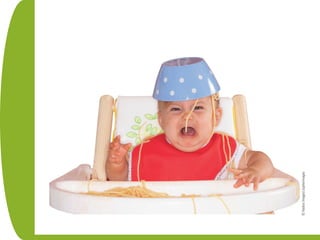
– Difficult child (10%)
• irregular sleep and feeding schedules, is slow to accept new
people, takes a long time adapting to new routines, and is prone to
emotional outbursts
– Slow-to-warm-up child (15%)
• falls between the two categories
• Temperament is related to emotional adjustment and
psychological disorders later in life.
Goodness of Fit
• Temperament may be strengthened or weakened by the
parents’ reaction to the child.
• Difficult child may become more difficult due to rigidity of
the parents
– This would be an example of a poor fit between parent and child
• Parents can positively modify difficult temperament child
to achieve a goodness of fit.
Gender Differences
• Girls tend to advance more rapidly in motor
development in infancy than boys.
• Girls and boys are similar in social behaviors.
• Differentiation between “boy” and “girl” toys is made as
early as 12 months old.
• At 24 months old, boys and girls are aware of gender-
appropriate and -inappropriate behavior.
Adults’ Behavior toward Infants
• Parents try to shape their children’s behavior during infancy and lay
the foundation for development in early childhood.
– Adults are more likely to offer girl babies a doll and offer a boy baby a
hammer or football even when sex of baby is disguised.
– Fathers are more likely to encourage rough-and-tumble-play with their
sons.
– Parents talk more to daughters than to sons.
– Parents smile more at daughters and are more emotionally expressive
with them.
– Parents tend to use gender specific colors.
• Girls in pink, boys in blue
– Fathers show negative reactions when son plays with girls’ toys.

Chapter6 PP HDEV MJC

  • 1.
    CHAPTER 6CHAPTER 6 Infancy:Social and EmotionalInfancy: Social and Emotional DevelopmentDevelopment
  • 2.
    Attachment: Bonds ThatEndureAttachment: Bonds That Endure
  • 4.
    Attachment: Bonds thatEndure • Attachment – Enduring emotional bond between one animal or person and another (Ainsworth, 1989) – Essential to the survival of the infant (Bowlby, 1988) – Infants try to maintain contact with caregivers to whom they are attached. • Make eye contact • Pull and tug at them • Asked to be picked up • Separation anxiety – Behaviors such as thrashing about, fussing, crying, screeching, or whining when contact with the caregiver is lost
  • 5.
    Patterns of Attachment •“Strange situation” method – Infant exposed to a series of separations and reunions with a caregiver (usually the mother) and a stranger who is a confederate of the researchers – Developed by Ainsworth et al. • Secure attachment (most infants in the US) – Mildly protest mother’s departure – Seek interaction when reunited – Are readily comforted by mother – Are happier, more sociable, and more cooperative with caregivers – Get along better with peers and are better adjusted at school at 5 and 6 years old
  • 6.
  • 7.
  • 9.
    Patterns of Attachment(cont’d) • Avoidant attachment – Infants least distressed by mother’s departure – Play without fuss when alone and ignore mothers when they return • Ambivalent/resistant attachment – Infants are most emotional – Show severe signs of distress when mothers leave and are ambivalent upon their return – Alternate clinging to mother with pushing her away • Disorganized/disoriented attachment – Babies seem dazed, confused, disoriented; behaviors are contradictory
  • 10.
    Establishing Attachment • Attachmentrelated to quality of care – Secure infants have parents who are more affectionate, cooperative, and predictable than parents of insecure infants. – Parents respond more favorably to infant’s smiles and cries. • Security is related to the infant’s temperament – Mothers of “difficult” children are less responsive to them. – Mothers report feeling more distant from infant
  • 11.
  • 12.
  • 13.
    Involvement of Fathers •The number of diapers a father changes per week indicates his involvement in childrearing. • Fathers more likely to play with children than to feed or clean them • Fathers engage in rough-and-tumble play. • The more affectionate the interaction between father and infant is, the stronger the attachment.
  • 14.
  • 15.
    Stability of Attachment •Attachment can change due to family dynamics. • Adopted children of various ages show secure attachment to adoptive family. • Early attachment patterns endure into middle childhood, adolescence, and even adulthood.
  • 16.
    Stages of Attachment •Ainsworth study on Ugandan infants identified three phases of attachment 1) Initial-preattachment phase • Birth to 3 months of age • Characterized by indiscriminate attachment 2) Attachment-in-the-making phase • 3 to 4 months of age • Characterized by preference for familiar figures 3) Clear-cut attachment phase • 6 to 7 months of age • Characterized by intensified dependence on the primary caregiver, usually the mother
  • 18.
    Theories of Attachment •Cognitive view – Infant must develop the concept of object permanence before specific attachment becomes possible. • Behavioral view – Attachment behaviors are conditioned due to infant’s needs being met by caregiver; caregiver associated with gratification • Psychoanalytic view – Caregiver or “mother” becomes a love object who forms basis for all later attachments (Freud) – Sense of trust has to be established in first year of life (Erikson)
  • 19.
    Theories of Attachment(cont’d) • Caregiver as source of contact comfort – Study by Harlow and Harlow on rhesus monkey infants – Indicated that humans may have a need for contact comfort that is as basic as need for food • Ethological view – Attachment is an inborn or instinctive response to a specific stimulus – Social smiles help infant to survive by eliciting affection from the family social structure – Attachment in nonhumans occurs during critical period of life – First object seen is imprinted on the young animal (Lorenz, 1962, 1981) • Bowlby and Ainsworth maintain that if critical period exists in humans, it can extend for months or years
  • 20.
    When Attachment FailsWhenAttachment Fails
  • 21.
    When Attachment Fails •Children deprived of social stimulation have difficulty attaching. • Harlow and Harlow study – Found that rhesus infants reared in isolation cowered in the presence of other monkeys; they did not defend themselves – Instead, they sat in a corner, clutching themselves and rocking back and forth • Older deprived infant monkeys became more social when placed with younger monkeys. – Same was found to be true with socially withdrawn 4- and 5- year-old children
  • 22.
    Studies with Children •Spitz (1965) study of institutionalized children – Found children to show withdrawal and depression – Some infants showed the same rocking back and forth as the rhesus monkeys • The age of the child contributes to how well the child can overcome social deprivation. • Study on Guatemalan children by Kagan and Klein (1973) indicates children may be able to recover from 13 or 14 months of deprivation. • Study by Skeels (1966) found 19-month-old retarded children when placed in care of older institutionalized girls made dramatic gains in IQ scores, whereas the other children remaining in the orphanage declined in IQ.
  • 23.
    Child Abuse andNeglect • 90% of parents have engaged in some sort of psychological or emotional abuse ranging from pushing to using a knife or a gun on a child (by age 2). • 3 million American children – Neglected or abused each year by parents or caregivers • 150,000 of 3 million children – Sexually abused – Girls make up the majority of sexually abused – Boys make up one-third to one-fourth of the sexually abused • 50-60% of cases of child abuse and neglect go unreported (estimated).
  • 24.
    Effects of ChildAbuse • Abused children show high incidence of personal and social problems as well as psychological disorders. • Less securely attached to parents • Less intimate with peers and more aggressive, angry, and noncompliant than other children • Reduced self-esteem and school performance • Greater risk of delinquency, risky sexual behavior, and substance abuse • Adults abused as children more likely to act aggressively toward their partners
  • 25.
    Causes of ChildAbuse • Stress • History of child abuse in at least one parent’s family of origin • Lack of adequate coping and childrearing skills • Unrealistic expectations of children • Substance abuse • Infants in pain and more difficult to soothe more likely to be abused • Cries of the infant found to be aversive to abusive parents • Disobedient, inappropriate, or unresponsive children more likely to be abused
  • 26.
  • 27.
    What to Do •Report abuse to the authorities. • Provide parenting training to the general population. • Target high-risk groups such as poor, single teen mothers and provide parenting programs or home visitors for them. • Present information about abuse and provide support for families. • Have child abuse hotlines for private citizens who suspect child abuse to get advice. – Parents who are having difficulty with aggressive impulses are also encouraged to call
  • 28.
  • 29.
    Autism Spectrum Disorders •Autism spectrum disorders – Impairment in communication skills and social interactions, and by repetitive, stereotyped behavior; evident by age 3; 1 in 152 American children have disorder • Asperger’s disorder – Social deficits and stereotyped behavior; no significant cognitive or language delays associated with autism • Rett’s disorder – Physical, behavioral, motor, and cognitive abnormalities that begin after a few months of apparent normal development • Childhood disintegrative disorder – Abnormal functioning and loss of previously acquired skills that begins after about 2 years of apparent normal development
  • 30.
  • 31.
  • 32.
    Autism • Autism is4 to 5 times more prevalent in boys. • Attachment to others is often weak or nonexistent • Show ritualistic behavior and intolerance to change • Development of speech lags • Show mutism, echolalia, and pronoun reversal – (Referring to self as “you” or “he”) • Some may mutilate themselves
  • 33.
    Causes of Autism •Concordance rates for autism are about 60% among pairs of MZ twins. • No correlations between the development of autism and deficiencies in child rearing. • Biological factors play a key role. – LBW – Advanced maternal age – Neurological abnormalities • Brain-wave patterns • Neurotransmitter sensitivity • Unusual activity in motor region of cerebral cortex
  • 34.
    Treatment of Autism •Treatment of autism is based on principles of learning, including behavior modification programs. • Intensive individual instruction has been found to be most effective. • Research on medications and their treatment of autism are under study.
  • 35.
  • 36.
    Daycare’s Positive Effects •Most infants (whether cared for at home or in daycare) are generally securely attached. • More prosocial than children who are not in daycare • Better academic performance in elementary school • Get scores on tests of cognitive skills that rival or exceed those of children reared in the home by their mothers
  • 37.
    Limitations of theNICHD study • Differences were small between groups • Study implied causation, yet there was no control group • Did not take into account the stress level of the parents who put their children in daycare • No research on whether the disruptive children become less productive and successful adults – Possibly these children grew up to become “assertive and entrepreneurial”
  • 38.
  • 39.
    Emotional Development • Emotion –A state of feeling with physiological, situational, and cognitive components • Unclear how many emotions a baby has – Facial expressions appear to be universal. • Emotions – Infants show only a few emotions during the first few months. – Emotions are more apparent at end of first year of life. • Infants have a positive attraction to pleasant stimulation and withdrawal from aversive stimulation. • Emotional development is linked to cognitive development and social experience.
  • 40.
    Emotional Development and Patternsof Attachment • One study (Kochanska, 2001) assessed patterns of attachment using the “strange situation”. – Found that differences in emotional development were first related to attachment at the age of 14 months – Securely attached infants were less likely to show fear and anger even when exposed to situations designed to elicit these emotions (at 33 months). – Insecurely attached infants showed increase in negative emotions – Avoidant children grew more fearful – Resistant children became less joyful
  • 41.
    Fear of Strangers •Stranger anxiety – Is the development of the fear of strangers – Is normal and most infants develop it – Appears at 6 to 9 months of age – Older infants will display crying, whimpering, gazing fearfully, and crawling away – Peaks at 9 and 12 months of age – Declines in second year
  • 42.
    Social Referencing • Socialreferencing – Seeking out another person’s perception of a situation to help us form our own view of it – Infants display it as early as 6 months – Infants use caregiver’s facial expressions or tone of voice as clues on how to respond. • Social referencing requires 1) looking at another, usually older, individual in a novel, ambiguous situation 2) associating that individual’s emotional response with the unfamiliar situation 3) regulating our own emotional response in accord with the response of the older individual
  • 43.
    Emotional Regulation • Emotionalregulation – Ways in which young children control their own emotions • Caregivers help infants learn to regulate their emotions • Children of secure mothers are – more likely to be secure themselves – more likely to regulate their own emotions in a positive manner • Adolescents who were secure as infants were most capable of regulating their emotions to interact cooperatively with their friends.
  • 44.
  • 45.
    Personality Development • Self-concepthas been measured using mirror technique, nose-touching technique – At 18 months, infants begin to touch their own noses upon looking into the mirror. • Self-awareness affects the infant’s social and emotional development. – Knowledge of self permits the infant and child to develop notions of sharing and cooperation with other children. • Self-awareness contributes to the development of the “self-conscious” emotions. – Embarrassment, envy, pride, guilt, and shame
  • 46.
    Temperament • Temperament – Stableway of reacting and adapting to the world that is present early in life – Believed to have a strong genetic component – Includes activity level, smiling and laughter, regularity in eating and sleep habits, approach and withdrawal, adaptability to new situations, intensity of responsiveness, general cheerfulness or unpleasantness, distractibility or persistence, soothability
  • 47.
    Types of Temperament •Thomas and Chess (1989) identified three types of temperament – Easy child (40%) • regular sleep and feeding schedules, approaches new situations with enthusiasm, and is generally cheerful – Difficult child (10%) • irregular sleep and feeding schedules, is slow to accept new people, takes a long time adapting to new routines, and is prone to emotional outbursts – Slow-to-warm-up child (15%) • falls between the two categories • Temperament is related to emotional adjustment and psychological disorders later in life.
  • 49.
    Goodness of Fit •Temperament may be strengthened or weakened by the parents’ reaction to the child. • Difficult child may become more difficult due to rigidity of the parents – This would be an example of a poor fit between parent and child • Parents can positively modify difficult temperament child to achieve a goodness of fit.
  • 51.
    Gender Differences • Girlstend to advance more rapidly in motor development in infancy than boys. • Girls and boys are similar in social behaviors. • Differentiation between “boy” and “girl” toys is made as early as 12 months old. • At 24 months old, boys and girls are aware of gender- appropriate and -inappropriate behavior.
  • 52.
    Adults’ Behavior towardInfants • Parents try to shape their children’s behavior during infancy and lay the foundation for development in early childhood. – Adults are more likely to offer girl babies a doll and offer a boy baby a hammer or football even when sex of baby is disguised. – Fathers are more likely to encourage rough-and-tumble-play with their sons. – Parents talk more to daughters than to sons. – Parents smile more at daughters and are more emotionally expressive with them. – Parents tend to use gender specific colors. • Girls in pink, boys in blue – Fathers show negative reactions when son plays with girls’ toys.


Editor's Notes

  • #8 Figure 6.1: The Strange Situation. These historic photos show a 12-month-old child in the Strange Situation. In (a), the child plays with toys, glancing occasionally at mother. In (b), the stranger approaches with a toy. While the child is distracted, mother leaves the room. In (c), mother returns after a brief absence. The child crawls to her quickly and clings to her when picked up. In (d), the child cries when mother again leaves the room.
  • #13 Figure 6.2: Development of Attachment. During the first 6 months, infants tend to show indiscriminate attachment, which then wanes as specific attachments intensify.
  • #17 Most infants form multiple attachments to father, day-care providers, grandparents, etc.
  • #19 Freud believed that the infant becomes emotionally attached to the mother during this time because she is the primary satisfier of the infant’s needs for food and sucking. Erikson believed the mother’s general sensitivity to the child’s needs, not just the need for food, fosters the development of trust and attachment.
  • #35 SSRI’s can apparently help prevent self-injury, aggressive outbursts, depression, anxiety, and repetitive behavior. “Major tranquilizers” used for schizophrenia are helpful with stereotyped behavior, hyperactivity, and self-injury, but not with cognitive and language problems.
  • #37 Research on negative effects of day care are inconclusive.
  • #42 Children who have developed fear of strangers show less distress in response to strangers when their mothers are present show less fear when in familiar settings
  • #46 Mirror technique-involves the use of a mirror and a dot of rouge.