Family Relationships
The Family
Families form a system of interacting
elements
Parents and children influence one another
‐ Parents influence their children both directly and
indirectly
‐ Children influence their parents
‐ Children’s behaviors, attitudes, and interests affect how
their parents behave toward them
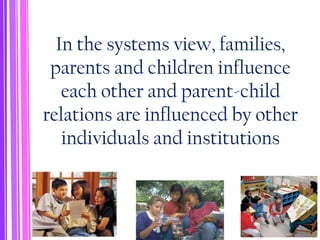
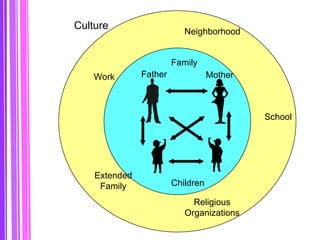
In the systems view, families,
parents and children influence
each other and parent-child
relations are influenced by other
individuals and institutions
Culture
School
Work
Extended
Family
Neighborhood
Religious
Organizations
Family
Mother
Father
Children
Function of Families
Survival of offspring
‐ Families help to ensure that children survive to maturity by
attending to their physical needs, health needs, and safety
Economic function
‐ Families provide the means for children to acquire the skills and
other resources they need to be economically productive in
adulthood
Cultural training
‐ Families teach children the basic values in their culture
Parental Socialization
Parents as direct instructors
‐ Parents may directly teach their children skills, rules, and strategies and
explicitly inform or advise them on various issues
Parents as indirect socializers
‐ Parents provide indirect socialization in the course of their day-to-day
interactions with their children
Parents as providers and controllers of opportunities
‐ Parents manage children’s experiences and social lives, including their
exposure to positive or negative experiences, their opportunities to play
with certain toys and children, and their exposure to various kinds of
information
Parenting Dimensions
There are two general dimensions of parental
behavior
‐ The degree of warmth and responsiveness that
parents show their children
‐ The amount of control parents exert over their
children
Warmth and Responsiveness
At one of the spectrum are parents who are
openly warm and affectionate with their
children
At the other end of the spectrum are parents
who are relatively uninvolved with their
children and sometimes even hostile toward
them
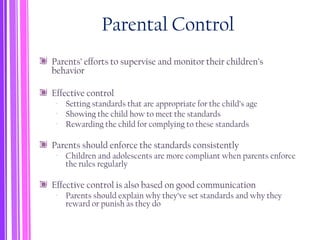
Parental Control
Parents’ efforts to supervise and monitor their children’s
behavior
Effective control
‐ Setting standards that are appropriate for the child’s age
‐ Showing the child how to meet the standards
‐ Rewarding the child for complying to these standards
Parents should enforce the standards consistently
‐ Children and adolescents are more compliant when parents enforce
the rules regularly
Effective control is also based on good communication
‐ Parents should explain why they’ve set standards and why they
reward or punish as they do
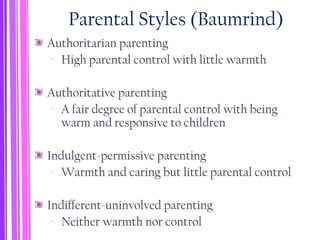
Parental Styles (Baumrind)
Authoritarian parenting
‐ High parental control with little warmth
Authoritative parenting
‐ A fair degree of parental control with being
warm and responsive to children
Indulgent-permissive parenting
‐ Warmth and caring but little parental control
Indifferent-uninvolved parenting
‐ Neither warmth nor control
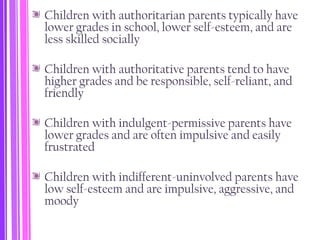
Children with authoritarian parents typically have
lower grades in school, lower self-esteem, and are
less skilled socially
Children with authoritative parents tend to have
higher grades and be responsible, self-reliant, and
friendly
Children with indulgent-permissive parents have
lower grades and are often impulsive and easily
frustrated
Children with indifferent-uninvolved parents have
low self-esteem and are impulsive, aggressive, and
moody
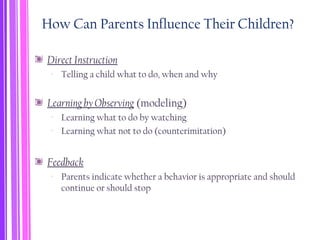
How Can Parents Influence Their Children?
Direct Instruction
‐ Telling a child what to do, when and why
Learning by Observing (modeling)
‐ Learning what to do by watching
‐ Learning what not to do (counterimitation)
Feedback
‐ Parents indicate whether a behavior is appropriate and should
continue or should stop
Feedback
Reinforcement
‐ Any action that increases the likelihood of the
response that it follows
Punishment
‐ Any action that discourages the reoccurrence of
the response that it follows
Negative Reinforcement Trap
Parents often unwittingly reinforce the very behaviors
they want to discourage
‐ First step: The mother tells her son to do something he
doesn’t want to do
‐ Second step: The son responds with some behavior that
most parents find intolerable
‐ Third step: The mother gives in – tells the son he doesn’t
need to do as he was initially told as long as he stops doing
the behavior that is so intolerable
Punishment Works Best When:
Administered directly after the undesired behavior
occurs, rather than hours later
An undesired behavior always leads to punishment,
rather than usually or occasionally
Accompanied by an explanation of why the child was
punished and how punishment can be avoided in the
future
The child has a warm, affectionate relationship with
the person administering the punishment
Drawbacks to punishment
Punishment is primarily suppressive: if a new
behavior isn’t learned to replace it, the old
response will come back.
Punishment can have undesirable side effects:
‐ Children become upset as they are being punished
which makes it unlikely that they will understand
the feedback that punishment is meant to convey.
‐ When children are punished physically – they often
imitate this behavior with peers and younger
siblings.
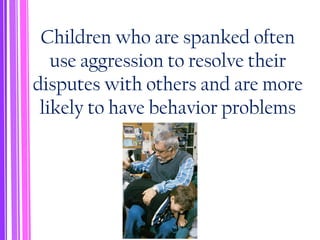
Children who are spanked often
use aggression to resolve their
disputes with others and are more
likely to have behavior problems
Parenting behavior and styles evolve as a
consequence of the child’s behavior.
Children’s behavior helps determine how
parents treat them and the resulting
parental behavior influences children’s
behavior, which can in turn cause parents
to again change their behavior.
This reciprocal influence lead many families
to adopt routine ways of interacting with
each other.
Some families end up running smoothly
(parents and children cooperate, anticipate
each other’s needs, and are generally happy).
Some families end up in trouble
(disagreements are common, parents spend
much time trying to unsuccessfully control
their defiant children, and everyone is often
angry and upset).
Children’s Influence
Parental warmth gradually changes as
children develop
‐ Hugs and kisses work with toddlers not with
adolescents
Parental control gradually changes as
children develop
‐ Parents gradually relinquish control and expect
children to be responsible for themselves
Attractiveness
Mothers of very attractive infants are more
affectionate and playful with their infants than are
mother of infants with unappealing faces
Why?
‐ An evolutionary explanation would propose that
parents are motivated to invest more time and
energy into offspring who are healthy and
genetically fit and therefore likely to survive
‐ Attractiveness could be seen as an indicator of
these characteristics
Marriage and Divorce
Divorce
Alot all first marriages are experiencing
divorce
Divorce is distressing for children because it
involves conflict between parents and
usually separation from one of them
Family Life After Divorce
Children usually live with their mothers
‐ About 15% of children live with their fathers after divorce
How does life change (based on the Virginia Longitudinal
Study)?
‐ First few months after divorce, many mothers are less
affectionate toward their children
‐ Two years after the divorce, mother-child relationships
improve, particularly for daughters
‐ Six years after divorce or when children are adolescents
‐ Family life continued to improve for mothers and
daughters
‐ Family life was problematic for mothers and sons
Impact of Divorce on Children
Children whose parents had divorced fare poorly
compared to children from intact families in:
‐ School achievement
‐ Conduct
‐ Adjustment
‐ Self-concept
‐ Parent-child relations
Children adjust to divorce more readily if their
divorced parents cooperate with each other,
especially on disciplinary matters
‐ Children benefit from joint custody if parents get
along
Divorce’s Influence on Development
The absence of one parent means that children lose
a role model, a source of parental help and
emotional support, and a supervisor
Single-parent families experience economic
hardship
‐ Creates stress and often means activities once
taken for granted are no longer available
Conflict between parents is extremely distressing
to children and adolescents
‐ Particularly for children who are emotionally
insecure
Which Children are Affected?
The overall impact of divorce is about the same for boys and
girls
‐ However, divorce is more harmful when it occurs during
childhood and adolescence than during preschool or
college years
With regard to parents’ remarriage, young adolescents
appear to be more negatively affected than younger children
‐ Young adolescents’ struggles with issues of identity are
heightened by the presence of a new parent who has
authority to control them and is a sexual partner of their
biological parent
Peer Relations
Children’s skills at interacting with peers
improves rapidly
‐ Children are becoming increasingly self-aware,
more effective at communicating, and better at
understanding the thoughts and feelings of
others
What are some benefits of play?
Play and social development go hand and
hand.
Play offers many opportunities to be with
other children and to share, take turns,
disagree, and compromise (Mitchell and
Davis, 1992).
While at play, children are increasing their
self awareness and are becoming more
involved in cooperative play.
Benefits of play
Emotionally, children develop greater self
awareness and they are more able to predict
the emotions of others.
According to Huffnung (1997) children will
develop empathy or the ability to appreciate
the feeling of others and understand their
point of view.
‐ If one child begins an activity, it is likely that his
friends will want to follow along.
Parten's Five Types of Play
Mildred Parten (1932) was one of the early
researchers studying children at play. She
focused on the social interactions between
children during play activities.
Recent research suggests that children do
not necessarily spend more time in social
types of play as they get older, but rather
their play within each category becomes
more cognitively mature (Berk, 2004)
Parten's Five Types of Play
Onlooker behavior
‐ Playing passively by watching or conversing
(or asking questions) with other children
engaged in play activities.
These children seem to move closer to a
group rather than watching whatever
momentarily catches their attention.
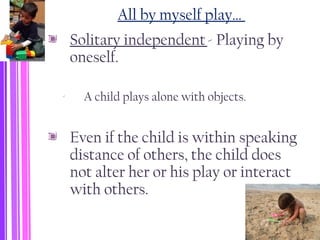
All by myself play…
Solitary independent- Playing by
oneself.
‐ A child plays alone with objects.
Even if the child is within speaking
distance of others, the child does
not alter her or his play or interact
with others.
Solitary Play – Good or Bad?
Some forms of solitary play are signs that children are
uneasy interacting with others
‐ Wandering aimlessly
‐ A child that goes from one preschool activity to the next, as if
trying to decide what to do
‐ They just keep wandering, never settling into play with others or
into constructive solitary play
‐ Hovering
‐ A child stand nearby peers who are playing, watching them play
but not participating
Parallel Play
Playing, even in the middle of a group,
while remaining engrossed in one's own
activity.
‐ Children playing parallel to each other
sometimes use each other's toys, but always
maintain their independence.
‐ “He plays beside rather than with the other
children" (Parten, 1932).
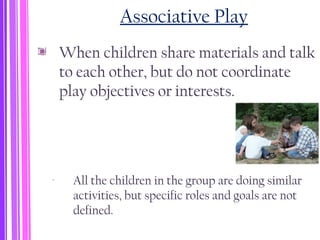
Associative Play
When children share materials and talk
to each other, but do not coordinate
play objectives or interests.
‐ All the children in the group are doing similar
activities, but specific roles and goals are not
defined.
A Group Effort
Example: When several children make sand
castles at the beach, they may share the job of
making walls and perhaps consult with one
another about digging a channel to these.
BUT…as members of the group lose interest
and wander off, others may joining the activity.
Cooperativeplay
This type of play occurs when children
organize themselves into roles with specific
goals in mind
‐ They help each other accomplish a joint venture,
such as selling lemonade or building a fort for
their “club”
Think back…What are some examples of
YOUR cooperative play?
The progression from solitary to
parallel to associative to cooperative
play reflects the child's growing
ability to sustain his interests and
relate to other children.
Click on the picture for a video on play
Sociodramatic Play
As children develop the ability to represent
experiences symbolically, pretend play becomes
a prominent activity.
‐ Pretend play is when children act out various roles
and themes in stories that they create themselves.
By the age of four or five, children's ideas
about the social world initiate most pretend
play.
Sociodramatic Play
Actions in play often reflect real world behavior, they
also incorporate children's interpretations and wishes.
Through dramatic play, children learn to assert
themselves in a way to build their competence in later
adult roles (Elkind, 1981).
‐ Children explore and rehearse social roles they have
observed in society
‐ A child learns basic life skills such as cooperation,
negotiation and compromise through play.
Click for a video on this
type of play!
Is there any value to sociodramatic play?
When children play dress-up they are taking
on the role of someone else. By doing this,
children must try to think and behave in a
manner appropriate to their pretend persona.
Such Sociodramatic play also helps them to
understand others and develop feelings of
empathy.

Family Relationships.pp t

  • 1.
  • 2.
    The Family Families forma system of interacting elements Parents and children influence one another ‐ Parents influence their children both directly and indirectly ‐ Children influence their parents ‐ Children’s behaviors, attitudes, and interests affect how their parents behave toward them
  • 3.
    In the systemsview, families, parents and children influence each other and parent-child relations are influenced by other individuals and institutions
  • 4.
  • 5.
    Function of Families Survivalof offspring ‐ Families help to ensure that children survive to maturity by attending to their physical needs, health needs, and safety Economic function ‐ Families provide the means for children to acquire the skills and other resources they need to be economically productive in adulthood Cultural training ‐ Families teach children the basic values in their culture
  • 6.
    Parental Socialization Parents asdirect instructors ‐ Parents may directly teach their children skills, rules, and strategies and explicitly inform or advise them on various issues Parents as indirect socializers ‐ Parents provide indirect socialization in the course of their day-to-day interactions with their children Parents as providers and controllers of opportunities ‐ Parents manage children’s experiences and social lives, including their exposure to positive or negative experiences, their opportunities to play with certain toys and children, and their exposure to various kinds of information
  • 7.
    Parenting Dimensions There aretwo general dimensions of parental behavior ‐ The degree of warmth and responsiveness that parents show their children ‐ The amount of control parents exert over their children
  • 8.
    Warmth and Responsiveness Atone of the spectrum are parents who are openly warm and affectionate with their children At the other end of the spectrum are parents who are relatively uninvolved with their children and sometimes even hostile toward them
  • 9.
    Parental Control Parents’ effortsto supervise and monitor their children’s behavior Effective control ‐ Setting standards that are appropriate for the child’s age ‐ Showing the child how to meet the standards ‐ Rewarding the child for complying to these standards Parents should enforce the standards consistently ‐ Children and adolescents are more compliant when parents enforce the rules regularly Effective control is also based on good communication ‐ Parents should explain why they’ve set standards and why they reward or punish as they do
  • 10.
    Parental Styles (Baumrind) Authoritarianparenting ‐ High parental control with little warmth Authoritative parenting ‐ A fair degree of parental control with being warm and responsive to children Indulgent-permissive parenting ‐ Warmth and caring but little parental control Indifferent-uninvolved parenting ‐ Neither warmth nor control
  • 11.
    Children with authoritarianparents typically have lower grades in school, lower self-esteem, and are less skilled socially Children with authoritative parents tend to have higher grades and be responsible, self-reliant, and friendly Children with indulgent-permissive parents have lower grades and are often impulsive and easily frustrated Children with indifferent-uninvolved parents have low self-esteem and are impulsive, aggressive, and moody
  • 12.
    How Can ParentsInfluence Their Children? Direct Instruction ‐ Telling a child what to do, when and why Learning by Observing (modeling) ‐ Learning what to do by watching ‐ Learning what not to do (counterimitation) Feedback ‐ Parents indicate whether a behavior is appropriate and should continue or should stop
  • 13.
    Feedback Reinforcement ‐ Any actionthat increases the likelihood of the response that it follows Punishment ‐ Any action that discourages the reoccurrence of the response that it follows
  • 14.
    Negative Reinforcement Trap Parentsoften unwittingly reinforce the very behaviors they want to discourage ‐ First step: The mother tells her son to do something he doesn’t want to do ‐ Second step: The son responds with some behavior that most parents find intolerable ‐ Third step: The mother gives in – tells the son he doesn’t need to do as he was initially told as long as he stops doing the behavior that is so intolerable
  • 15.
    Punishment Works BestWhen: Administered directly after the undesired behavior occurs, rather than hours later An undesired behavior always leads to punishment, rather than usually or occasionally Accompanied by an explanation of why the child was punished and how punishment can be avoided in the future The child has a warm, affectionate relationship with the person administering the punishment
  • 16.
    Drawbacks to punishment Punishmentis primarily suppressive: if a new behavior isn’t learned to replace it, the old response will come back. Punishment can have undesirable side effects: ‐ Children become upset as they are being punished which makes it unlikely that they will understand the feedback that punishment is meant to convey. ‐ When children are punished physically – they often imitate this behavior with peers and younger siblings.
  • 17.
    Children who arespanked often use aggression to resolve their disputes with others and are more likely to have behavior problems
  • 18.
    Parenting behavior andstyles evolve as a consequence of the child’s behavior. Children’s behavior helps determine how parents treat them and the resulting parental behavior influences children’s behavior, which can in turn cause parents to again change their behavior.
  • 19.
    This reciprocal influencelead many families to adopt routine ways of interacting with each other. Some families end up running smoothly (parents and children cooperate, anticipate each other’s needs, and are generally happy). Some families end up in trouble (disagreements are common, parents spend much time trying to unsuccessfully control their defiant children, and everyone is often angry and upset).
  • 20.
    Children’s Influence Parental warmthgradually changes as children develop ‐ Hugs and kisses work with toddlers not with adolescents Parental control gradually changes as children develop ‐ Parents gradually relinquish control and expect children to be responsible for themselves
  • 21.
    Attractiveness Mothers of veryattractive infants are more affectionate and playful with their infants than are mother of infants with unappealing faces Why? ‐ An evolutionary explanation would propose that parents are motivated to invest more time and energy into offspring who are healthy and genetically fit and therefore likely to survive ‐ Attractiveness could be seen as an indicator of these characteristics
  • 22.
  • 23.
    Divorce Alot all firstmarriages are experiencing divorce Divorce is distressing for children because it involves conflict between parents and usually separation from one of them
  • 24.
    Family Life AfterDivorce Children usually live with their mothers ‐ About 15% of children live with their fathers after divorce How does life change (based on the Virginia Longitudinal Study)? ‐ First few months after divorce, many mothers are less affectionate toward their children ‐ Two years after the divorce, mother-child relationships improve, particularly for daughters ‐ Six years after divorce or when children are adolescents ‐ Family life continued to improve for mothers and daughters ‐ Family life was problematic for mothers and sons
  • 25.
    Impact of Divorceon Children Children whose parents had divorced fare poorly compared to children from intact families in: ‐ School achievement ‐ Conduct ‐ Adjustment ‐ Self-concept ‐ Parent-child relations Children adjust to divorce more readily if their divorced parents cooperate with each other, especially on disciplinary matters ‐ Children benefit from joint custody if parents get along
  • 26.
    Divorce’s Influence onDevelopment The absence of one parent means that children lose a role model, a source of parental help and emotional support, and a supervisor Single-parent families experience economic hardship ‐ Creates stress and often means activities once taken for granted are no longer available Conflict between parents is extremely distressing to children and adolescents ‐ Particularly for children who are emotionally insecure
  • 27.
    Which Children areAffected? The overall impact of divorce is about the same for boys and girls ‐ However, divorce is more harmful when it occurs during childhood and adolescence than during preschool or college years With regard to parents’ remarriage, young adolescents appear to be more negatively affected than younger children ‐ Young adolescents’ struggles with issues of identity are heightened by the presence of a new parent who has authority to control them and is a sexual partner of their biological parent
  • 28.
    Peer Relations Children’s skillsat interacting with peers improves rapidly ‐ Children are becoming increasingly self-aware, more effective at communicating, and better at understanding the thoughts and feelings of others
  • 29.
    What are somebenefits of play? Play and social development go hand and hand. Play offers many opportunities to be with other children and to share, take turns, disagree, and compromise (Mitchell and Davis, 1992). While at play, children are increasing their self awareness and are becoming more involved in cooperative play.
  • 30.
    Benefits of play Emotionally,children develop greater self awareness and they are more able to predict the emotions of others. According to Huffnung (1997) children will develop empathy or the ability to appreciate the feeling of others and understand their point of view. ‐ If one child begins an activity, it is likely that his friends will want to follow along.
  • 31.
    Parten's Five Typesof Play Mildred Parten (1932) was one of the early researchers studying children at play. She focused on the social interactions between children during play activities. Recent research suggests that children do not necessarily spend more time in social types of play as they get older, but rather their play within each category becomes more cognitively mature (Berk, 2004)
  • 32.
    Parten's Five Typesof Play Onlooker behavior ‐ Playing passively by watching or conversing (or asking questions) with other children engaged in play activities. These children seem to move closer to a group rather than watching whatever momentarily catches their attention.
  • 33.
    All by myselfplay… Solitary independent- Playing by oneself. ‐ A child plays alone with objects. Even if the child is within speaking distance of others, the child does not alter her or his play or interact with others.
  • 34.
    Solitary Play –Good or Bad? Some forms of solitary play are signs that children are uneasy interacting with others ‐ Wandering aimlessly ‐ A child that goes from one preschool activity to the next, as if trying to decide what to do ‐ They just keep wandering, never settling into play with others or into constructive solitary play ‐ Hovering ‐ A child stand nearby peers who are playing, watching them play but not participating
  • 35.
    Parallel Play Playing, evenin the middle of a group, while remaining engrossed in one's own activity. ‐ Children playing parallel to each other sometimes use each other's toys, but always maintain their independence. ‐ “He plays beside rather than with the other children" (Parten, 1932).
  • 36.
    Associative Play When childrenshare materials and talk to each other, but do not coordinate play objectives or interests. ‐ All the children in the group are doing similar activities, but specific roles and goals are not defined.
  • 37.
    A Group Effort Example:When several children make sand castles at the beach, they may share the job of making walls and perhaps consult with one another about digging a channel to these. BUT…as members of the group lose interest and wander off, others may joining the activity.
  • 38.
    Cooperativeplay This type ofplay occurs when children organize themselves into roles with specific goals in mind ‐ They help each other accomplish a joint venture, such as selling lemonade or building a fort for their “club” Think back…What are some examples of YOUR cooperative play?
  • 39.
    The progression fromsolitary to parallel to associative to cooperative play reflects the child's growing ability to sustain his interests and relate to other children. Click on the picture for a video on play
  • 40.
    Sociodramatic Play As childrendevelop the ability to represent experiences symbolically, pretend play becomes a prominent activity. ‐ Pretend play is when children act out various roles and themes in stories that they create themselves. By the age of four or five, children's ideas about the social world initiate most pretend play.
  • 41.
    Sociodramatic Play Actions inplay often reflect real world behavior, they also incorporate children's interpretations and wishes. Through dramatic play, children learn to assert themselves in a way to build their competence in later adult roles (Elkind, 1981). ‐ Children explore and rehearse social roles they have observed in society ‐ A child learns basic life skills such as cooperation, negotiation and compromise through play. Click for a video on this type of play!
  • 42.
    Is there anyvalue to sociodramatic play? When children play dress-up they are taking on the role of someone else. By doing this, children must try to think and behave in a manner appropriate to their pretend persona. Such Sociodramatic play also helps them to understand others and develop feelings of empathy.

Editor's Notes

  • #2 Direct influence of parents example: encouraging them to study hard Indirect influence of parents example: being generous and kind ot others Children example: when children resist discipline, parents may become less willing to reason and more inclined to use force
  • #5 The first function is the most fundamental: the goals of economic function and cultural training are of little importance if children do not survive
  • #6 Indirect socializers: Parents behaviors unintentionally demonstrate skills and communicate information and rules They model attitudes and behaviors toward others, such as helpfulness or aggression Providers and controllers: The managerial role is especially prominent and influential when children are young If parents decide to place their child in day care, for example, the child’s daily experience with peers and adult caregivers will likely differ dramatically from that of young children whose daily care is provided at home by a parent
  • #7 Parenting styles: parenting behaviors and attitudes that set the emotional climate in regard to parent-child interactions, such as parental responsiveness and demandingness Some parents are strict rule setters who expect complete and immediate compliance from their children. Others are more likely to allow their children some leeway in following the standards they have set for them. Still others seem oblivious to what their children do. Parents differ in the overall emotional tone they bring to their parenting, especially with regard to the warmth and support they convey to their children.
  • #8 Warm parents: See when their children are upset and try to comfort them Enjoy hearing their children describe the day’s activities Children typically feel happy and secure and are better behaved Uninvolved: Aren’t interested in their children’s activities, considering it a waste of their time Pay little attention to their children’s emotional-states and invest little effort comforting them when they’re upset Children are often anxious and less controlled, children often have low self-esteem
  • #9 Behaviorally-controlling parents Set reasonable standard for their children They know where their children are, what they’re doing, and with whom When parents enforce the rules erratically: children come to see the rules as optional instead of obligatory and try to avoid complying with them Inconsistent discipline is associated with the onset of psychological problems in children
  • #10 Parenting style is fairly stable over time. Parents who are authoritative with their school-age children tend to be authoritative with their adolescents.
  • #11 Children seem to benefit most from authoritative parenting Children growing up in poverty seem to benefit from authoritarian parenting: When youngsters grow up in neighborhoods with a lot of violence and crime, strict obedience to parents can protect children
  • #14 Most often occurs between mother and her son. The feedback that the son learns: whining, complaining, etc works. The mother rewards the behavior by withdrawing the request that the son did not like. Behavior is strengthened when it is followed by removing something that is disliked.
  • #15 Drawbacks to punishment: Punishment is primarily suppressive: if a new behavior isn’t learned to replace it, the old response will come back Punishment can have undesirable side effects: children become upset as they are being punished which makes it unlikely that they will understand the feedback that punishment is meant to convey. When children are punished physically – they often imitate this behavior with peers and younger siblings. Children who are spanked often use aggression to resolve their disputes with others and are more likely to have behavior problems
  • #20 Parenting behavior and styles evolve as a consequence of child’s behavior. Children’s behavior helps determine how parents treat them and the resulting parental behavior influences children’s behavior, which can in turn cause parents to again change their behavior. This reciprocal influence lead many families to adopt routine ways of interacting with each other. Some families end up running smoothly (parents and children cooperate, anticipate each other’s needs, and are generally happy). Some families end up in trouble (disagreements are common, parents spend much time trying to unsuccessfully control their defiant children, and everyone is often angry and upset).
  • #21 Mothers of unappealing infants are more likely than other mothers to attend to other people who are in the vicinity rather than to their infants and to report that their infants interfere with their lives This pattern continues – attractive children tend to elicit more positive responses from adults
  • #23 Some experts estimate that 20% to 25% of children from divorced families exhibit significant problems compared to 10% of children in intact families
  • #24 Little information is known about family life with dad’s as head of household. Virginia Longitudinal Study of Divorce and Remarriage conducted by Mavis Hetherington (1988, 1999, 2002) Traced the lives of families for several years after divorce along with comparison of sample of families who were not divorced First few months: Mothers and children suffer the distress of a major change in life circumstances -- They also accepted less mature behavior from their children and they have a harder time controlling their children Children regresses to less mature forms of behavior and mothers were less able to parent effectively Fathers also were less able to control their children (extremely indulgent) Two years: Mothers were more affectionate They were more likely to expect age-appropriate behavior from their children and discipline their children effectively Fathers also demanded more mature behavior of their children, but many had become relatively uninvolved with their children Six years: Mothers and daughters grew extremely close Mothers often complained about their sons who resisted discipline – mothers and sons were frequently in conflict and neither was very happy with the other or with family life in general Conflict between parents and adolescents is common for married parents but this conflict is more intense for single moms with adolescent sons
  • #25 When children of divorced parents become adults, the effects of divorce persist. As adults children of divorce are more likely to become teenage parents and to become divorced parents themselves As adults they report less satisfaction with life and are more likely to become depressed Custody: if parents don’t get along, joint custody is out of the question. Mothers still more likely to get custody. But, fathers are gaining custody of their sons. Boys are less likely to become involved in negative reinforcement traps
  • #27 Younger children may have more trouble understanding the causes and consequences of divorce, may be more anxious about abandonment by their parents, and may be more likely to blame themselves for the divorce Older children may understand it more, but they are at risk for adjustment problems, such as poor academic achievement, and negative relationships with their peers College students are the least reactive because of their maturity and relative independence from the family