Christina A. / 1213013008 Ivena M. A. / 1213013010 Paulin K. G. / 1213013018
• Families
• Peer Relations, Play, and Television
• The Self, Gender, and Moral
Development
What influences it?
Families
• Parenting styles
• Adapting parenting to developmental changes in the
child
• Cultural, ethnic, and social class variations in family
• Siblings relationship and birth order
• The changing family in a changing society
• Depressed parents
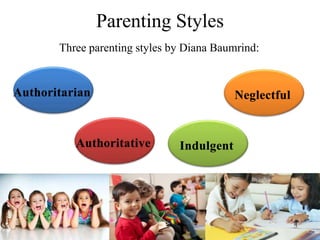
Parenting Styles
Three parenting styles by Diana Baumrind:
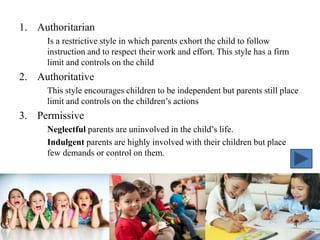
1. Authoritarian
Is a restrictive style in which parents exhort the child to follow
instruction and to respect their work and effort. This style has a firm
limit and controls on the child
2. Authoritative
This style encourages children to be independent but parents still place
limit and controls on the children’s actions
3. Permissive
Neglectful parents are uninvolved in the child’s life.
Indulgent parents are highly involved with their children but place
few demands or control on them.
Adapting Parenting to Developmental
Changes in the Child
Parents need to adapt their behavior to their
children based on their children’s developmental
maturity.
As the child grow older, parents increasingly to
reasoning, moral exhortation and giving or withholding
special privileges, give less physical affection.
Cultural, Ethnic, and Social Class
Variations in Family
Different culture, different ethnic, different
social class
Different values, different parenting behaviors
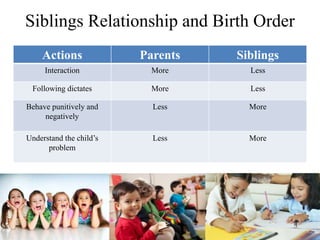
Siblings Relationship and Birth Order
Actions Parents Siblings
Interaction More Less
Following dictates More Less
Behave punitively and
negatively
Less More
Understand the child’s
problem
Less More
Birth order effects suggest that birth order might
be a strong predictor of behavior. However, we
must remember that there are so many other
complex influences on a child’s behavior.
The Changing Family in a Changing
Society
• Working Mothers
Maternal employment is a part of modern life.
Many working mothers are feeling guilty about being
away from their children. Working parents’ guilt can be
reduced if they begin paying closer attention to how
their children are doing.
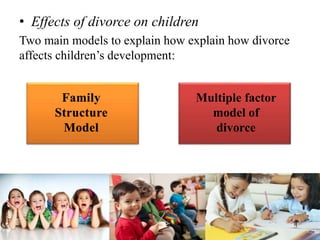
• Effects of divorce on children
Two main models to explain how explain how divorce
affects children’s development:
Multiple factor
model of
divorce
• Family structure model
Any differences in children from different family structures
are due to the family structure variations, such as the father’s
being absent in one set of the families.
• Multiple factor model of divorce
Takes into account the complexity of the divorce context and
examines a number of influences on the child’s development.
Such as: age and developmental changes; conflict; sex of the
child and custody arrangements; income and economic
stress.
Most children initially experience considerable
stress when their parents divorce, and they are
at risk for developing problem behaviors.
Depressed Parents
Research shows that depression in parents is
associated with problem of adjustment and
disorders, especially depression, in their
children.
Peer Relations, Play,
and Television
Peer Relations
• Peer group function
to provide a source of
information and comparison
about the world outside the
family
• Two kinds relations
Poor peer relations and
Harmonious peer relations
• The Distinct but
Coordinated Worlds of
Parent-Child and Peer
Relations
The Distinct but
Coordinated Worlds of
Parent-Child and Peer
Relations
1. bullies ⇒ their parent
rejected, were
authoritian
permissiviness toward
aggresion discord
2. whipping boys ⇒ their
parent were anxious
and over protective.
Peer Relations
Play
Play’s Functions
• Freud and Erikson
Play help child master
anxieties and conflicts.
• Piaget
Play advance children's
cognitive development.
• Vigotsky
Belives that play advance
children's cognitive
development.
• Daniel Berlyne
Describes play as being
exciting and pleasurable.
Play
• Unoccupied play
• Solitary play
• Onlooker play
• Parallel play
• Associative play
• Cooperative play
Parten's Classic
Study of Play
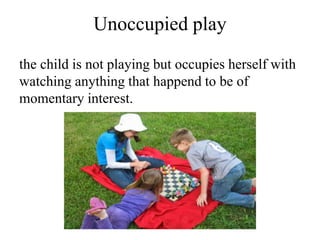
Unoccupied play
the child is not playing but occupies herself with
watching anything that happend to be of
momentary interest.
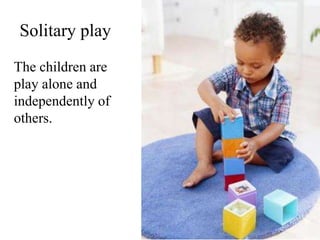
Solitary play
The children are
play alone and
independently of
others.
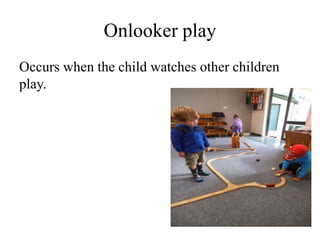
Onlooker play
Occurs when the child watches other children
play.
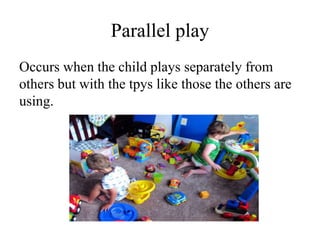
Parallel play
Occurs when the child plays separately from
others but with the tpys like those the others are
using.
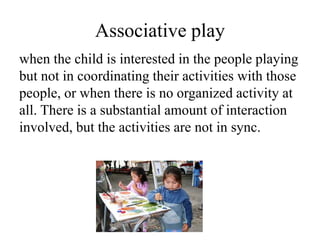
Associative play
when the child is interested in the people playing
but not in coordinating their activities with those
people, or when there is no organized activity at
all. There is a substantial amount of interaction
involved, but the activities are not in sync.
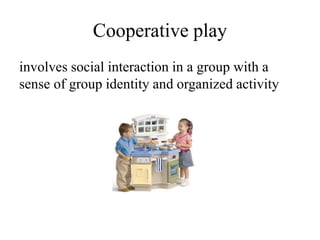
Cooperative play
involves social interaction in a group with a
sense of group identity and organized activity
Play
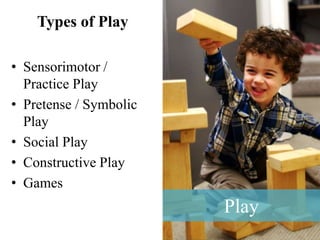
Types of Play
• Sensorimotor /
Practice Play
• Pretense / Symbolic
Play
• Social Play
• Constructive Play
• Games
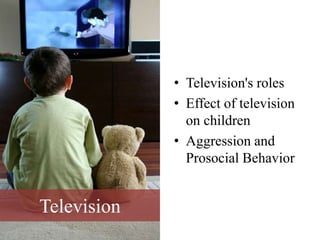
Television
• Television's roles
• Effect of television
on children
• Aggression and
Prosocial Behavior
Strategies for Enriching the
Quality of Children's Play
1. Time = give 30- to 50- minute at
least several times a week.
2. Space = at least 25 to 30 square
feet
3. Experience = field trip
4. Play Materials
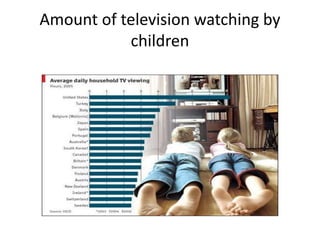
Amount of television watching by
children
The Self, Gender, and
Moral Development
The Self
Initiative vs. Guilt
As preschool, children
encounter a widening social
world, they are challenge more
& need to develop more
purposeful behavior to cope
with these challenges. Children
are asked to assume more
responsibility. Uncomfortable
guilt feelings may arise, though,
if the children irresponsible &
are made to feel too anxious.
The Self
Self-Understanding
is the child’s cognitive
representation of self,
the substance & content
of the child’s self-
conception.
Gender
Gender refers to the social
dimension of being male or
female.
Gender identity is the sense of
being male or female, which most
of children acquire by the time
they are 3 years old.
Gender role is a set of
expectation that prescribe how
males and females should think,
act, and feel.
Gender
Biological Influences
Sigmund Freud
Human behavior and history are
directly influenced by sexual drives.
Erik Erikson
Because of genital structure, males
are more intrusive and aggressive,
females more inclusive and passive.
Gender
Social Influences
Identification theory
The preschool child develops a sexual
attraction to the opposite-sex parent.
By approximately 5 or 6 years of age
the child renounces this attraction
because of anxious feelings. Then, the
child identifies with the same-sex
parent, unconsciously adopting the
same-sex parent’s characteristics.
Social learning theory of
gender
Children’s gender development
occurs through observation and
imitation of gender behavior, and
through the rewards &punishments
children experience for gender
appropriate and inappropriate
behavior.
Gender
Gender
• Parental Influences
Mother are more consistently
given responsibility for nurture
& physical care.
Father are more likely to
engage in playful interaction &
be given responsibility for
ensuring that boys & girls
conform to existing cultural
form.
Gender
• Peer Influences
Boys teach one another need
masculine behavior and do that
strictly.
Girls mainly congregate with
one another.
Gender
• School & Teacher
Influences
• Girls’ learning problems are
not identified as often as boys’
are.
• Boys are given the lion’s share
of attention in school.
• Girls start school testing higher
in every academic subject than
boys, yet graduate from high
school scoring lower on the SAT
exam.
Gender
• Boys are most often at the top
of their classes, but they are also
are most often at the bottom.
•Pressure to achieve is more
likely to be heaped on boys than
on girls.
Gender
• Television was portraying
females as less competent than
males.
•In the print media
Females are shown more often
in beauty products, cleaning
products, and home appliances
advertisements.
Males are shown more often in
car, liquor, and travel
advertisements.
• Media Influences
Gender
Cognitive Influences
• Cognitive Developmental
Theory
Children’s gender typing
occurs after they have
developed a concept of
gender. Once they
consistently conceive of
themselves as male or
female, children often
organize their world on the
basis of gender.
Gender
• Gender Schema Theory
states that an individual‘s
attention & behavior are
guided by an internal
motivation to conform to
gender-based sociocultural
standards and stereotypes.
Gender
• The Role of Language in
Gender Development
The language that children
hear most of the time is
sexist.
Moral Development
Concerns rules and
conventions about
what people should
do in their
interactions with
other people.
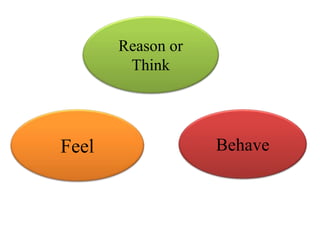
Behave
Reason or
Think
Feel
Moral Development
• Piaget’s View of How
children’s moral
Reasoning Develops
Heteronomous morality
The first stage of moral
development in Piaget’s
theory, occurring
approximately 4 to 7 years
of age. Justice and rules
are conceived of as
unchangeable properties
of the world, removed
from the control of people.
Moral Development
Autonomous morality
The second stage of moral
development in Piaget’s
theory, displayed by older
children (about 1o years of
age and older]. The child
becomes aware that rules
and laws are created by
people and that, in
judging an action, one
should consider the actor’s
intentions as well
consequences.
Moral Development
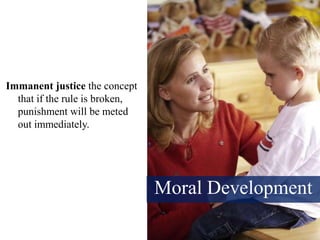
Immanent justice the concept
that if the rule is broken,
punishment will be meted
out immediately.
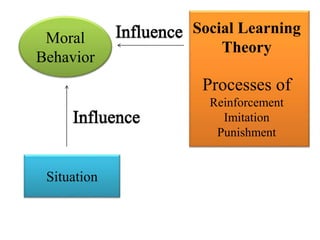
Moral
Behavior
Social Learning
Theory
Processes of
Reinforcement
Imitation
Punishment
Situation
Moral Development
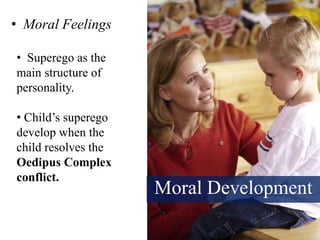
• Moral Feelings
• Superego as the
main structure of
personality.
• Child’s superego
develop when the
child resolves the
Oedipus Complex
conflict.
Moral Development
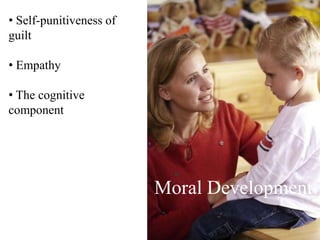
• Self-punitiveness of
guilt
• Empathy
• The cognitive
component
Developmental Psychology Presentation (socioemotional development)

Developmental Psychology Presentation (socioemotional development)

  • 1.
    Christina A. /1213013008 Ivena M. A. / 1213013010 Paulin K. G. / 1213013018
  • 2.
    • Families • PeerRelations, Play, and Television • The Self, Gender, and Moral Development What influences it?
  • 3.
    Families • Parenting styles •Adapting parenting to developmental changes in the child • Cultural, ethnic, and social class variations in family • Siblings relationship and birth order • The changing family in a changing society • Depressed parents
  • 4.
    Parenting Styles Three parentingstyles by Diana Baumrind:
  • 5.
    1. Authoritarian Is arestrictive style in which parents exhort the child to follow instruction and to respect their work and effort. This style has a firm limit and controls on the child 2. Authoritative This style encourages children to be independent but parents still place limit and controls on the children’s actions 3. Permissive Neglectful parents are uninvolved in the child’s life. Indulgent parents are highly involved with their children but place few demands or control on them.
  • 6.
    Adapting Parenting toDevelopmental Changes in the Child Parents need to adapt their behavior to their children based on their children’s developmental maturity. As the child grow older, parents increasingly to reasoning, moral exhortation and giving or withholding special privileges, give less physical affection.
  • 7.
    Cultural, Ethnic, andSocial Class Variations in Family Different culture, different ethnic, different social class Different values, different parenting behaviors
  • 8.
    Siblings Relationship andBirth Order Actions Parents Siblings Interaction More Less Following dictates More Less Behave punitively and negatively Less More Understand the child’s problem Less More
  • 9.
    Birth order effectssuggest that birth order might be a strong predictor of behavior. However, we must remember that there are so many other complex influences on a child’s behavior.
  • 10.
    The Changing Familyin a Changing Society • Working Mothers Maternal employment is a part of modern life. Many working mothers are feeling guilty about being away from their children. Working parents’ guilt can be reduced if they begin paying closer attention to how their children are doing.
  • 11.
    • Effects ofdivorce on children Two main models to explain how explain how divorce affects children’s development: Multiple factor model of divorce
  • 12.
    • Family structuremodel Any differences in children from different family structures are due to the family structure variations, such as the father’s being absent in one set of the families. • Multiple factor model of divorce Takes into account the complexity of the divorce context and examines a number of influences on the child’s development. Such as: age and developmental changes; conflict; sex of the child and custody arrangements; income and economic stress.
  • 13.
    Most children initiallyexperience considerable stress when their parents divorce, and they are at risk for developing problem behaviors.
  • 14.
    Depressed Parents Research showsthat depression in parents is associated with problem of adjustment and disorders, especially depression, in their children.
  • 15.
  • 16.
    Peer Relations • Peergroup function to provide a source of information and comparison about the world outside the family • Two kinds relations Poor peer relations and Harmonious peer relations • The Distinct but Coordinated Worlds of Parent-Child and Peer Relations
  • 17.
    The Distinct but CoordinatedWorlds of Parent-Child and Peer Relations 1. bullies ⇒ their parent rejected, were authoritian permissiviness toward aggresion discord 2. whipping boys ⇒ their parent were anxious and over protective. Peer Relations
  • 18.
    Play Play’s Functions • Freudand Erikson Play help child master anxieties and conflicts. • Piaget Play advance children's cognitive development. • Vigotsky Belives that play advance children's cognitive development. • Daniel Berlyne Describes play as being exciting and pleasurable.
  • 19.
    Play • Unoccupied play •Solitary play • Onlooker play • Parallel play • Associative play • Cooperative play Parten's Classic Study of Play
  • 20.
    Unoccupied play the childis not playing but occupies herself with watching anything that happend to be of momentary interest.
  • 21.
    Solitary play The childrenare play alone and independently of others.
  • 22.
    Onlooker play Occurs whenthe child watches other children play.
  • 23.
    Parallel play Occurs whenthe child plays separately from others but with the tpys like those the others are using.
  • 24.
    Associative play when thechild is interested in the people playing but not in coordinating their activities with those people, or when there is no organized activity at all. There is a substantial amount of interaction involved, but the activities are not in sync.
  • 25.
    Cooperative play involves socialinteraction in a group with a sense of group identity and organized activity
  • 26.
    Play Types of Play •Sensorimotor / Practice Play • Pretense / Symbolic Play • Social Play • Constructive Play • Games
  • 27.
    Television • Television's roles •Effect of television on children • Aggression and Prosocial Behavior
  • 28.
    Strategies for Enrichingthe Quality of Children's Play 1. Time = give 30- to 50- minute at least several times a week. 2. Space = at least 25 to 30 square feet 3. Experience = field trip 4. Play Materials
  • 29.
    Amount of televisionwatching by children
  • 30.
    The Self, Gender,and Moral Development
  • 31.
    The Self Initiative vs.Guilt As preschool, children encounter a widening social world, they are challenge more & need to develop more purposeful behavior to cope with these challenges. Children are asked to assume more responsibility. Uncomfortable guilt feelings may arise, though, if the children irresponsible & are made to feel too anxious.
  • 32.
    The Self Self-Understanding is thechild’s cognitive representation of self, the substance & content of the child’s self- conception.
  • 33.
    Gender Gender refers tothe social dimension of being male or female. Gender identity is the sense of being male or female, which most of children acquire by the time they are 3 years old. Gender role is a set of expectation that prescribe how males and females should think, act, and feel.
  • 34.
    Gender Biological Influences Sigmund Freud Humanbehavior and history are directly influenced by sexual drives. Erik Erikson Because of genital structure, males are more intrusive and aggressive, females more inclusive and passive.
  • 35.
    Gender Social Influences Identification theory Thepreschool child develops a sexual attraction to the opposite-sex parent. By approximately 5 or 6 years of age the child renounces this attraction because of anxious feelings. Then, the child identifies with the same-sex parent, unconsciously adopting the same-sex parent’s characteristics.
  • 36.
    Social learning theoryof gender Children’s gender development occurs through observation and imitation of gender behavior, and through the rewards &punishments children experience for gender appropriate and inappropriate behavior. Gender
  • 37.
    Gender • Parental Influences Motherare more consistently given responsibility for nurture & physical care. Father are more likely to engage in playful interaction & be given responsibility for ensuring that boys & girls conform to existing cultural form.
  • 38.
    Gender • Peer Influences Boysteach one another need masculine behavior and do that strictly. Girls mainly congregate with one another.
  • 39.
    Gender • School &Teacher Influences • Girls’ learning problems are not identified as often as boys’ are. • Boys are given the lion’s share of attention in school. • Girls start school testing higher in every academic subject than boys, yet graduate from high school scoring lower on the SAT exam.
  • 40.
    Gender • Boys aremost often at the top of their classes, but they are also are most often at the bottom. •Pressure to achieve is more likely to be heaped on boys than on girls.
  • 41.
    Gender • Television wasportraying females as less competent than males. •In the print media Females are shown more often in beauty products, cleaning products, and home appliances advertisements. Males are shown more often in car, liquor, and travel advertisements. • Media Influences
  • 42.
    Gender Cognitive Influences • CognitiveDevelopmental Theory Children’s gender typing occurs after they have developed a concept of gender. Once they consistently conceive of themselves as male or female, children often organize their world on the basis of gender.
  • 43.
    Gender • Gender SchemaTheory states that an individual‘s attention & behavior are guided by an internal motivation to conform to gender-based sociocultural standards and stereotypes.
  • 44.
    Gender • The Roleof Language in Gender Development The language that children hear most of the time is sexist.
  • 45.
    Moral Development Concerns rulesand conventions about what people should do in their interactions with other people.
  • 46.
  • 47.
    Moral Development • Piaget’sView of How children’s moral Reasoning Develops Heteronomous morality The first stage of moral development in Piaget’s theory, occurring approximately 4 to 7 years of age. Justice and rules are conceived of as unchangeable properties of the world, removed from the control of people.
  • 48.
    Moral Development Autonomous morality Thesecond stage of moral development in Piaget’s theory, displayed by older children (about 1o years of age and older]. The child becomes aware that rules and laws are created by people and that, in judging an action, one should consider the actor’s intentions as well consequences.
  • 49.
    Moral Development Immanent justicethe concept that if the rule is broken, punishment will be meted out immediately.
  • 50.
  • 51.
    Moral Development • MoralFeelings • Superego as the main structure of personality. • Child’s superego develop when the child resolves the Oedipus Complex conflict.
  • 52.
    Moral Development • Self-punitivenessof guilt • Empathy • The cognitive component

Editor's Notes

  • #32 Erikson states the psychosocial stage in early childhood is initiative versus guilt. Baca desccription In this stage, children will be more active in learning and search for new experiences. They also have a surplus of energy which is let them to forget the failure quickly then continue to search other things that they want to do, even though that seem dangerous. In this part, children begin to use their conscience or their inner voice which is consist of self-observation, self-guidance, and self-punishment. The children in this stage with happily move out into a wider social world. Whether children leave this stage with more sense of initiative than sense of guilt depends on how their parents respond to their self-initiated activities. Children who are given freedom and opportunity have their sense of initiative supported. Initiative is supported when parents answer their children’s questions and don’t inhibit their fantasy or play activity. In contrast, if children are made to feel their motor activity is bad, that their questions are nuisance, and their play is stupid, they more develop a sense of guilt.
  • #33 Before I explain this. Let us watch the video. The basic beginning of self-understanding begins with self-recognition, which takes place around 18 months of age. Since children can verbally communicate, self-understanding is not limited to visual self-recognition. It also include mind and body, self in relation to others, and pride and shame in self. In early childhood, children like to describe themselves in term of physical, position, and behavior characteristics. Young children distinguish themselves from others through many different physical and material attributes. In early childhood, active dimension is a central self component. For example, preschool children often describe themselves in activities term like play. The conclusion is in early childhood, children often think themselves in term of a physical self or an active self.
  • #34 There are two aspects of gender that produce special mention. Gender Identity and Gender Role. For clear, let us watch the video.
  • #35 In GENDER, there are 3 influences. Those are BIOLOGICAL influences, SOCIAL influences, and COGNITIVE influences. Even though prenatal hormones may or may not influence gender behavior, Freud and Erikson have agued that individual’s genitals do play a very important role. Freud said that…. He argued that gender & sexual Behavior are unlearned and instinctual.–example if it’s possible Erikson argued that… That state contend that he has not given enough credit to experience–example if it’s possible Freud argued that women & men are more free to choose their behavior than Erikson said. Then, Erikson clarified his view, that he never said biology is the only one determinant of differences between the sexes. But, biology interacts with cultural & psychological factors to produce behavior. The conclusion is, Biology is not destiny when gender attitudes and behavior are at issue. But children socialization experiences matter a great deal.
  • #36 Have we realized in or culture that adult discriminate the sexes starting after the infant’s birth? Blue color for boys and Pink color for girls. Then continue with differences in hairstyles, boy with short hair and girl with long hair. Adult and peers reward these differences throughout development. Children learn gender roles through imitation or observational learning by watching what other people do and say. Parents are the only one of many resources which the individual learns gender roles because parents are important influences on gender development. There are 2 prominent theories address the way children get masculine and feminine attitudes & behaviors. Those are Identification theory & Social learning theory of gender. Identification theory is… According to this theory, many child developmentalists don’t believe that gender development result of the identification. Children become gender-typed much earlier than 5 or 6 years of age. And they become masculine or feminine even when the same-sex parent is not present in the family.
  • #37 Social learning theory of gender emphasizes that… This theory argues that sexual attraction to parents is not involved in gender development. Parent often use rewards and punishments to teach their daughters to be feminine and their sons to be masculine. And by observing adults and peers at home, at school, their environment, or even on the television, children have so many models who display masculine and feminine behavior. Example pg 248
  • #38 Mother are more consistently given responsibility for nurture & physical care. example Father are more likely to engage in playful interaction & be given responsibility for ensuring that boys & girls conform to existing cultural form. Example Boys and Girls are encouraged by their parents to play in different type of play & activities. Girls: are given dolls to play with during childhood, so they’re more likely to be assigned baby-sitting duties and encourage to be more nurturant & emotional than boys. Boys: are engaged in aggressive play, so… and when boys become adolescents, their parents give them freedom than girls.
  • #39 Peer join the societal process of responding to & modeling masculine and feminine behavior. Individual ‘tomboy’ girls can join boys’ activities without losing their status in the girls’ groups. But, it cannot be same with boys. Reflecting our society’s greater sex-typing pressure for boys.
  • #40 Hambatan belajar perempuan
  • #41 Point 1: For example: fail a class, miss promotion, a drop out of school
  • #51 Reinforcement: When children are rewarded for behavior that is consistent with laws and conventions, they’ll repeat that behavior. example Punishment: When children are punished for immoral behavior, those behavior are more likely to be reduced or eliminated. example Imitation: When models who behave morally provided, children are likely to adopt their actions. example
  • #52 Before, we’ve learned about Freud’s psychoanalytic theory which describes superego as the main structure of personality. In that theory, child’s superego develop when the child resolves the Oedipus Complex conflict. Oedipus Complex is the Freudian concept that the young children develops an intense desire to replace the same-sex parent and enjoy the affection of the opposite-sex parent, So, how this conflict resolved? At about 5 to 6, children recognize that they will losing their parents’ love and their same-sex parent might punish them for their incestuous wishes. Incestuous is a love relationship that is owned by a couple who have blood ties. It’s like you have a feeling with one of your family members. So, to reduce their anxiety, the punishment for their unacceptable sexual wishes toward the opposite-sex parent, and also maintain parental affection, children form a superego by identifying with the same-sex parent. From that identification, children understand the parent’ standards of right & wrong in societal prohibitions. … Self-punitiveness of guilt is responsible for keeping the child from doing violation. Positive feelings such as empathy also contribute to the child’s moral development. Empathy is the ability to sense the others emotional state, feeling sympathetic and try to resolve the problem, and taking others perspective. Even though empathy is experienced as an emotional state, it often has a cognitive component. The cognitive component is the ability see another’s inner psychological states which is called perspective taking.