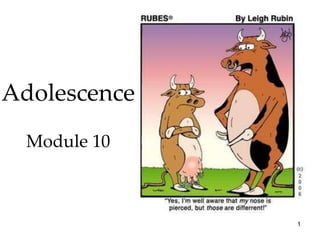
Adolescence
  Module 10


              1
Developing Through the Life Span

  Adolescence
   Physical Development
   Cognitive Development
   Social Development
   Emerging Adulthood


                                   2
Adolescence
Many psychologists once
believed that childhood
  sets our traits. Today
 psychologists believe
 that development is a
    lifelong process.
 Adolescence is defined
     as life between


                              AP Photo/ Jeff Chiu
     childhood and
       adulthood.
                               3
Physical Development
Adolescence begins with
      puberty (sexual
   maturation). Puberty
 occurs earlier in females
   (11 years) than males
(13 years). Thus height in
 females increases before
          males.


                                 4
Primary Sexual Characteristics

During puberty primary sexual characteristics —
the reproductive organs and external genitalia —
                develop rapidly.


                                   Ellen Senisi/ The Image Works
                                                                   5
Secondary Sexual Characteristics

     Also secondary sexual characteristics—the
 nonreproductive traits such as breast and hips in
girls and facial hair and deepening of voice in boys
develop. Pubic hair and hair in armpit grow in both
                        sexes.


                                                   6
Brain Development
Until puberty neurons increase their connections,
however, at adolescence selective pruning of the
neurons begin. Unused neuronal connections are
  lost to make other pathways more efficient.


                                                    7
Frontal Cortex
 During adolescence neurons in the frontal cortex
 grow myelin which speeds up nerve conduction.
    Frontal cortex lags behind limbic system
development. Hormonal surges and limbic system
   may explain teens’ occasional impulsiveness.


                                                8
Cognitive Development
Adolescents’ ability to reason gives them a new
level of social awareness. In particular they can
                  think about:

1. Their own thinking.
2. What others are thinking.
3. And think about what others are thinking
   about them.
4. How ideals can be reached. Criticize
   society, parents and even themselves.
                                                    9
Developing Reasoning Power
  According to Piaget, adolescents can handle
 abstract problems, i.e., they can perform formal
operations. Adolescents can judge good from evil,
truth and justice, and think about God in deeper
                      terms.

                        William Thomas Cain/ Getty Images


                                                            AP/Wide World Photos
                                                                                   10
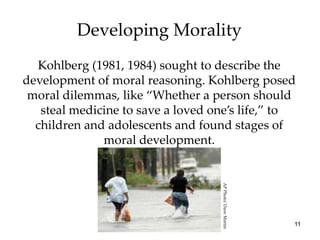
Developing Morality
  Kohlberg (1981, 1984) sought to describe the
development of moral reasoning. Kohlberg posed
 moral dilemmas, like “Whether a person should
   steal medicine to save a loved one’s life,” to
  children and adolescents and found stages of
              moral development.


                                   AP Photo/ Dave Martin
                                                           11
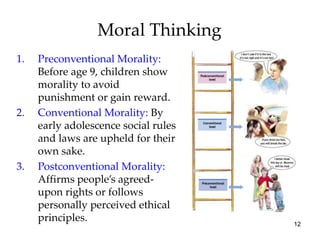
Moral Thinking
1.   Preconventional Morality:
     Before age 9, children show
     morality to avoid
     punishment or gain reward.
2.   Conventional Morality: By
     early adolescence social rules
     and laws are upheld for their
     own sake.
3.   Postconventional Morality:
     Affirms people’s agreed-
     upon rights or follows
     personally perceived ethical
     principles.                      12
Moral Feeling
Moral feeling is more than than moral thinking.
When posed with simulated moral dilemmas the
brain’s emotional areas only lighted up when the
  nature of the dilemmas were emotion driven.


                                                   13
Moral Action
 Moral action involves doing the right thing.
 People who engage in doing the right thing,
develop empathy for others, self-discipline for
  themselves to restrain their own impulses.


                                                  14
Social Development


                     15
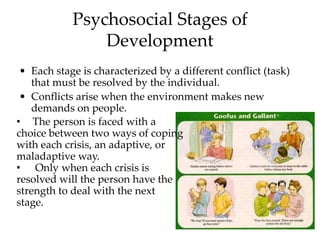
Psychosocial Stages of
                Development
 • Each stage is characterized by a different conflict (task)
   that must be resolved by the individual.
 • Conflicts arise when the environment makes new
   demands on people.
• The person is faced with a
choice between two ways of coping
with each crisis, an adaptive, or
maladaptive way.
• Only when each crisis is
resolved will the person have the
strength to deal with the next
stage.
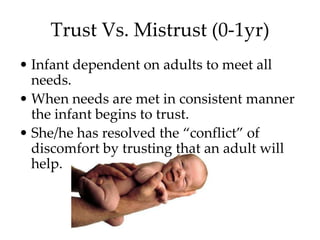
Trust Vs. Mistrust (0-1yr)
• Infant dependent on adults to meet all
  needs.
• When needs are met in consistent manner
  the infant begins to trust.
• She/he has resolved the “conflict” of
  discomfort by trusting that an adult will
  help.
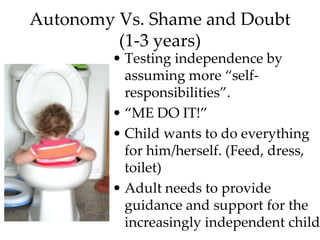
Autonomy Vs. Shame and Doubt
         (1-3 years)
        • Testing independence by
          assuming more “self-
          responsibilities”.
        • “ME DO IT!”
        • Child wants to do everything
          for him/herself. (Feed, dress,
          toilet)
        • Adult needs to provide
          guidance and support for the
          increasingly independent child
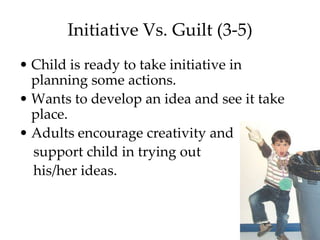
Initiative Vs. Guilt (3-5)
• Child is ready to take initiative in
  planning some actions.
• Wants to develop an idea and see it take
  place.
• Adults encourage creativity and
  support child in trying out
  his/her ideas.
Industry Vs. Inferiority (6-12)
• Child must deal with demands to learn
  new skills or risk a sense of inferiority,
  failure, and incompetence.
• Important to help children set realistic
  goals and maintain
  motivation to reach
  goals.
Identity Vs. Role Confusion
       (teens-early 20s)
• Identity achievement reached through
  “selective repudiation and mutual
  assimilation of childhood
  identifications.” (Erikson, 1968)
• Adolescent must achieve an identity in
  occupation, sex roles, politics, religion.
Forming an Identity
  In Western cultures many adolescents try out
 different selves before settling into a consistent
and comfortable identity. Having such an identity
       leads to forming close relationships.


                                                      Matthias Clamer/ Getty Images
                        Leland Bobble/ Getty Images


                                                                                      22
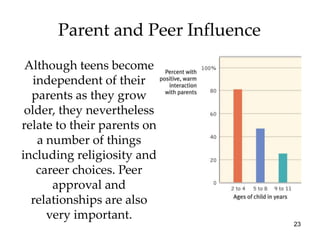
Parent and Peer Influence
 Although teens become
   independent of their
  parents as they grow
 older, they nevertheless
relate to their parents on
    a number of things
including religiosity and
    career choices. Peer
       approval and
  relationships are also
      very important.
                                   23
Emerging Adulthood
 Emerging adulthood spans from 18-25 years.
 During this time young adults live with their
parents and attend college or work. They marry
       on average in their mid-twenties.


                                                 Ariel Skelley/ Corbis
                                                 24
Adult Stages
• Intimacy vs. Isolation: Young adulthood, must
  develop close relationships.
• Generativity vs. Stagnation: Middle adulthood,
  must find some way to satisfy and support the
  next generation
• Ego Identity vs. Despair: Late adulthood, sense
  of acceptance of oneself as one is and of being
  fulfilled.

Adolescence

  • 1.
  • 2.
    Developing Through theLife Span Adolescence  Physical Development  Cognitive Development  Social Development  Emerging Adulthood 2
  • 3.
    Adolescence Many psychologists once believedthat childhood sets our traits. Today psychologists believe that development is a lifelong process. Adolescence is defined as life between AP Photo/ Jeff Chiu childhood and adulthood. 3
  • 4.
    Physical Development Adolescence beginswith puberty (sexual maturation). Puberty occurs earlier in females (11 years) than males (13 years). Thus height in females increases before males. 4
  • 5.
    Primary Sexual Characteristics Duringpuberty primary sexual characteristics — the reproductive organs and external genitalia — develop rapidly. Ellen Senisi/ The Image Works 5
  • 6.
    Secondary Sexual Characteristics Also secondary sexual characteristics—the nonreproductive traits such as breast and hips in girls and facial hair and deepening of voice in boys develop. Pubic hair and hair in armpit grow in both sexes. 6
  • 7.
    Brain Development Until pubertyneurons increase their connections, however, at adolescence selective pruning of the neurons begin. Unused neuronal connections are lost to make other pathways more efficient. 7
  • 8.
    Frontal Cortex Duringadolescence neurons in the frontal cortex grow myelin which speeds up nerve conduction. Frontal cortex lags behind limbic system development. Hormonal surges and limbic system may explain teens’ occasional impulsiveness. 8
  • 9.
    Cognitive Development Adolescents’ abilityto reason gives them a new level of social awareness. In particular they can think about: 1. Their own thinking. 2. What others are thinking. 3. And think about what others are thinking about them. 4. How ideals can be reached. Criticize society, parents and even themselves. 9
  • 10.
    Developing Reasoning Power According to Piaget, adolescents can handle abstract problems, i.e., they can perform formal operations. Adolescents can judge good from evil, truth and justice, and think about God in deeper terms. William Thomas Cain/ Getty Images AP/Wide World Photos 10
  • 11.
    Developing Morality Kohlberg (1981, 1984) sought to describe the development of moral reasoning. Kohlberg posed moral dilemmas, like “Whether a person should steal medicine to save a loved one’s life,” to children and adolescents and found stages of moral development. AP Photo/ Dave Martin 11
  • 12.
    Moral Thinking 1. Preconventional Morality: Before age 9, children show morality to avoid punishment or gain reward. 2. Conventional Morality: By early adolescence social rules and laws are upheld for their own sake. 3. Postconventional Morality: Affirms people’s agreed- upon rights or follows personally perceived ethical principles. 12
  • 13.
    Moral Feeling Moral feelingis more than than moral thinking. When posed with simulated moral dilemmas the brain’s emotional areas only lighted up when the nature of the dilemmas were emotion driven. 13
  • 14.
    Moral Action Moralaction involves doing the right thing. People who engage in doing the right thing, develop empathy for others, self-discipline for themselves to restrain their own impulses. 14
  • 15.
  • 16.
    Psychosocial Stages of Development • Each stage is characterized by a different conflict (task) that must be resolved by the individual. • Conflicts arise when the environment makes new demands on people. • The person is faced with a choice between two ways of coping with each crisis, an adaptive, or maladaptive way. • Only when each crisis is resolved will the person have the strength to deal with the next stage.
  • 17.
    Trust Vs. Mistrust(0-1yr) • Infant dependent on adults to meet all needs. • When needs are met in consistent manner the infant begins to trust. • She/he has resolved the “conflict” of discomfort by trusting that an adult will help.
  • 18.
    Autonomy Vs. Shameand Doubt (1-3 years) • Testing independence by assuming more “self- responsibilities”. • “ME DO IT!” • Child wants to do everything for him/herself. (Feed, dress, toilet) • Adult needs to provide guidance and support for the increasingly independent child
  • 19.
    Initiative Vs. Guilt(3-5) • Child is ready to take initiative in planning some actions. • Wants to develop an idea and see it take place. • Adults encourage creativity and support child in trying out his/her ideas.
  • 20.
    Industry Vs. Inferiority(6-12) • Child must deal with demands to learn new skills or risk a sense of inferiority, failure, and incompetence. • Important to help children set realistic goals and maintain motivation to reach goals.
  • 21.
    Identity Vs. RoleConfusion (teens-early 20s) • Identity achievement reached through “selective repudiation and mutual assimilation of childhood identifications.” (Erikson, 1968) • Adolescent must achieve an identity in occupation, sex roles, politics, religion.
  • 22.
    Forming an Identity In Western cultures many adolescents try out different selves before settling into a consistent and comfortable identity. Having such an identity leads to forming close relationships. Matthias Clamer/ Getty Images Leland Bobble/ Getty Images 22
  • 23.
    Parent and PeerInfluence Although teens become independent of their parents as they grow older, they nevertheless relate to their parents on a number of things including religiosity and career choices. Peer approval and relationships are also very important. 23
  • 24.
    Emerging Adulthood Emergingadulthood spans from 18-25 years. During this time young adults live with their parents and attend college or work. They marry on average in their mid-twenties. Ariel Skelley/ Corbis 24
  • 25.
    Adult Stages • Intimacyvs. Isolation: Young adulthood, must develop close relationships. • Generativity vs. Stagnation: Middle adulthood, must find some way to satisfy and support the next generation • Ego Identity vs. Despair: Late adulthood, sense of acceptance of oneself as one is and of being fulfilled.